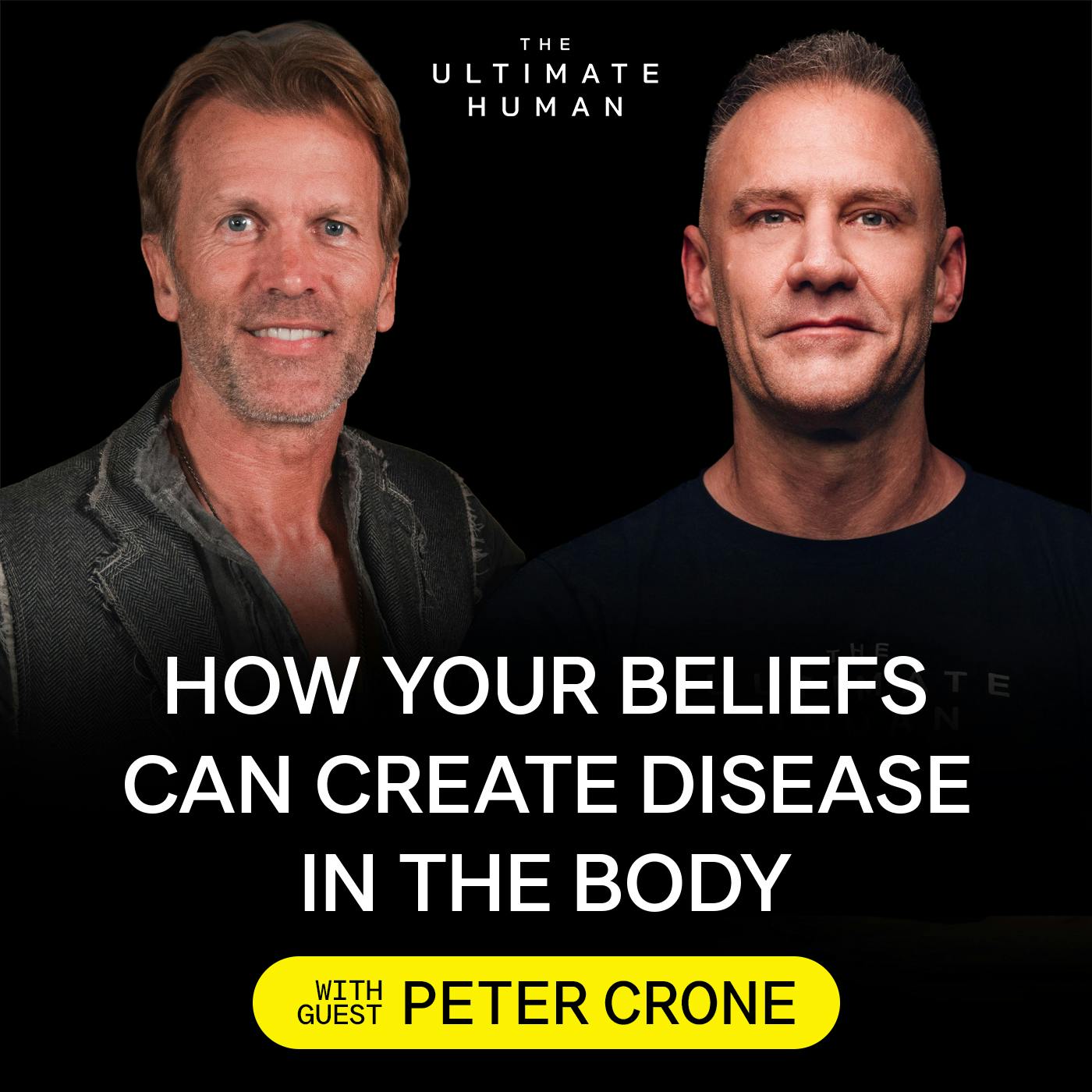
219. Peter Crone: The Science of Mindset and How Your Subconscious Patterns Control Your Health & Longevity
CLICK HERE TO BECOME GARYS VIP!: https://bit.ly/4ai0Xwg
Connect with Peter Crone
Website: https://bit.ly/4r5p1dK
YouTube: https://bit.ly/3XzWKyu
Instagram: https://bit.ly/3JYuO4j
TikTok: https://bit.ly/4o6RLQN
Facebook: https://bit.ly/3LQdH57
X.com: https://bit.ly/3LQdKOl
LinkedIn: https://bit.ly/3K7FNZ9
Thank you to our partners
H2TABS: “ULTIMATE10” FOR 10% OFF: https://bit.ly/4hMNdgg
BODYHEALTH: “ULTIMATE20” FOR 20% OFF: http://bit.ly/4e5IjsV
BAJA GOLD: "ULTIMATE10" FOR 10% OFF: https://bit.ly/3WSBqUa
COLD LIFE: THE ULTIMATE HUMAN PLUNGE: https://bit.ly/4eULUKp
WHOOP: JOIN AND GET 1 FREE MONTH!: https://bit.ly/3VQ0nzW
AION: “ULTIMATE10” FOR 10% OFF: https://bit.ly/4h6KHAD
A-GAME: “ULTIMATE15” FOR 15% OFF: http://bit.ly/4kek1ij
PEPTUAL: “TUH10” FOR 10% OFF: https://bit.ly/4mKxgcn
CARAWAY: “ULTIMATE” FOR 10% OFF: https://bit.ly/3Q1VmkC
HEALF: 10% OFF YOUR ORDER: https://bit.ly/41HJg6S
RHO NUTRITION: “ULTIMATE15” FOR 15% OFF: https://bit.ly/44fFza0
GOPUFF: GET YOUR FAVORITE SNACK!: https://bit.ly/4obIFDC
GENETIC TEST: https://bit.ly/3Yg1Uk9
Watch the “Ultimate Human Podcast” every Tuesday & Thursday at 9AM EST:
YouTube: https://bit.ly/3RPQYX8
Podcasts: https://bit.ly/3RQftU0
Connect with Gary Brecka
Instagram: https://bit.ly/3RPpnFs
TikTok: https://bit.ly/4coJ8fo
X: https://bit.ly/3Opc8tf
Facebook: https://bit.ly/464VA1H
LinkedIn: https://bit.ly/4hH7Ri2
Website: https://bit.ly/4eLDbdU
Merch: https://bit.ly/4aBpOM1
Newsletter: https://bit.ly/47ejrws
Ask Gary: https://bit.ly/3PEAJuG
Timestamps
00:00 Intro of Show
03:02 The Mind is the Ultimate Environment
08:08 Taking on a Journey of Introspection
09:09 Perspective of the Identity and Ego
22:10 How Do We Get Started in this Journey?
34:42 Gary’s Personal Journey of Introspection
36:14 The Possibility to Go through This Journey On Your Own
44:22 Universal Law of Attraction
46:09 Loneliness and Isolation as a Reflection of Being Misidentified
54:00 How to Increase Self-Awareness?
57:19 Impact of Ancient Practices and Wisdom
1:03:43 No Greater Virus than a Thought
1:05:04 Connect with Peter
1:06:40 What does it mean to you to be an Ultimate Human?
The Ultimate Human with Gary Brecka Podcast is for general informational purposes only and does not constitute the practice of medicine, nursing or other professional health care services, including the giving of medical advice, and no doctor/patient relationship is formed. The use of information on this podcast or materials linked from this podcast is at the user’s own risk. The Content of this podcast is not intended to be a substitute for professional medical advice, diagnosis, or treatment. Users should not disregard or delay in obtaining medical advice for any medical condition they may have and should seek the assistance of their health care professionals for any such conditions.
Learn more about your ad choices. Visit megaphone.fm/adchoices
Press play and read along
Transcript
Speaker 1
How many people say they have dreams and aspirations? Get in shape, create a business, start a homestead. Whatever people are passionate about, but you're not doing it.
Why?
Speaker 1
People become resigned and cynical. They're no longer like actually enthusiastic for their life.
It becomes normalized.
Speaker 2 Well, because normal is safe.
Speaker 1 It occurs as safe. It's actually the most dangerous way to live.
Speaker 2 Rarely do we really understand the correlation between our mindset and the tricks that it plays on us.
Speaker 1 That's why understanding that the space you live with inside of this mind, if it has a consistent, persistent conversation that is in any way self-deprecating you're living in a hostile environment.
Speaker 2 When a fish gets sick, we don't treat the fish, we treat the tank. The brain is kind of like the fish and the mind is like the tank.
Speaker 2 And if we don't clean these things out, they're constantly poisoning an otherwise healthy body.
Speaker 1 When you recognize that we have this predisposition to want to be right, but what we're being right about is our shortcomings.
Speaker 2 We want to be right for our ego.
Speaker 1 I was right.
Speaker 2 But very often, being right is the antithesis of the the outcome within a lot of times.
Speaker 1 There's no greater virus than a thought. And to me, you know, there's nothing that hurts us more than our own thinking.
Speaker 2 How do we begin this journey of even getting in touch with our ego?
Speaker 1 How do we get there? We have to, first of all, one of the best ways is
Speaker 2 hey guys, welcome back to the Ultimate Human Podcast. I'm your host, human biologist Gary Brecca, where we go down the road of everything, anti-aging, biohacking, longevity, and everything in between.
Speaker 2 And today's guest coming to you live again from Saudi Arabia, which is why I have a suit on, and I normally don't have a suit on.
Speaker 2 Coming to you live from Saudi Arabia.
Speaker 2 Our next guest is going to absolutely blow your mind. He's going to answer questions that you've always had that didn't, you didn't know how to ask.
Speaker 2 I have enjoyed every minute that I've spent with him since I've been in Saudi Arabia. We've had some deep introspective conversations.
Speaker 2 I actually watched him in real time heal a woman's trauma in a car ride.
Speaker 2 And so I cannot wait to run this podcast. Welcome to the podcast, Peter Crohn.
Speaker 1 Yeah, it's a pleasure. I feel like this was well overdue in ways that we didn't understand, but I'm so happy to connect and contribute to your audience in whatever way I can.
Speaker 2 Yeah, you know, it's odd for me to sit down across from another human biologist, too.
Speaker 2 I was actually reading, you know, your background, and you have a degree in human biology, a degree in exercise physiology.
Speaker 2 Yeah, and then you jump to the other side of your brain and you have a master's in information technology. Yeah, when these two don't belong in the same frames of the brain, right?
Speaker 1 But in the same skull, in the same skull, yeah, they fit in the same skull, but they're very left brain, right-brain.
Speaker 2 And, you know, it's been a fascinating few days. I mean, I'm aware of your work
Speaker 2 and my team's aware of your work. But actually
Speaker 2 experiencing it with you and listening to you walk somebody through unpacking their trauma in real time was fascinating.
Speaker 2 You know, I consider myself pretty astute in the biohacking world and my mind is really just blown.
Speaker 2 But it was blown because, you know, it really returned my awareness back to,
Speaker 2
you you know, the Bible says, so a man thinketh, he shall become. Yeah.
Right. And
Speaker 2
our thoughts become medicine. They become real action in our body.
Yeah. Everybody knows stress.
You know, you got to lower stress if you want to live a long time. And stress can make you unhealthy.
Speaker 2 But rarely do we really understand the correlation between our mindset and the tricks that it plays on us. And even before we start, you did an interesting exercise,
Speaker 2 which I found profound. You hooked 100% of the audience and you said,
Speaker 2 take a finger and point at your mind.
Speaker 1 Yeah.
Speaker 2 And 100% of the room pointed
Speaker 2 at their skull. And then you said, you're pointing at your brain.
Speaker 1 Yeah.
Speaker 2 And you said, the mind exists outside of that.
Speaker 1 Yeah.
Speaker 2 Can we unpack that a little bit?
Speaker 1 For sure.
Speaker 2 Because I think that's a great place for us to start.
Speaker 1
Yeah, it's quite a reframe. And I think it's very profound, especially with all the work you do, which I'm such a fan of.
And again, it's just lovely to get to know you personally.
Speaker 1 And I'm excited for the
Speaker 2 intersection is the perfect.
Speaker 1 I believe there is just such a beautiful synergy. You know, our partners both saying the same thing.
Speaker 1 You know, it's like you have mastered that whole arena of three-dimensional reality, physiology, structure, anatomy, chemistry, biology.
Speaker 1 And I would assert, you know, as humbly as I can, I've sort of mastered the inner terrain of like psychology and emotional intelligence and the degree to which those are commensurate.
Speaker 1
Like they're inextricably connected, as you know. There's not a mind-body connection.
They're just different levels of density.
Speaker 1 And so for me, making that reframe for people is typically astonishing, right? Because we understand that at some degree, we are at the effect of our environment, right?
Speaker 1 You speak to this eloquently all the time about all of the toxicities in our soils, in our waters, in our airs, and the things that we accumulate. We're fundamentally walking trash cans at this point.
Speaker 1 And so people understand that and we mitigate as much as we can.
Speaker 1 You know, the more extreme do the Faraday cages to mitigate EMFs, but at least most people are hopefully doing some sort of detoxing and cleansing, and they recognize from chemtrails that apparently don't exist.
Speaker 1 Or, you know,
Speaker 1 well, when they're starting to pass legislation and states that you can't do it anymore, it's sort of you know, they've revealed the wizard behind the curtain that it's been happening for a while.
Speaker 1 So we understand that. And I sort of use the analogy at the talk we did at YPO.
Speaker 1 You know, if you live within a 600-square-foot studio apartment and there's mold in the drywall, then there's no way that you can mitigate or overcome the effect of that.
Speaker 1 You can do the best you can to minimize it, and maybe you're proactive and you cleanse, but you know that if you live in an environment that at some level is deleterious to your health, that over time the accumulation of that means that it's going to manifest in something.
Speaker 1 So, by reframing the fact that the mind, which to me is really a space, it contains the narratives that typically get formed in our childhood, is the space that we live in.
Speaker 1 It's the ultimate environment. To me, there's no more valuable piece of real estate than what is within the state of our mind.
Speaker 1 And for that reason, I know it's a bold statement, but I don't think there's anything more toxic than dialogues that are in any way self-derogatory.
Speaker 1 You speak to all of these diseases probably way more proficiently than me, but like a lot of people ask me about things like cancer. And we understand the genesis of a cancerous cell.
Speaker 1 And I look at it energetically and emotionally. And to me, it's a cell that's really in a hostile environment, right? It's really the primordial imperative of every being and human is to survive.
Speaker 1 And so, the cell, which is just sort of the mini version, is got the same MO, it's just trying to survive. So, if it's in a hostile environment, and in this case, it could be a
Speaker 1 series of different things that sort of give the impression of hostility or defined hostility.
Speaker 1 But for me, the mind, if it's got a narrative of I'm not good enough, there's something wrong with me, I'm trash, nobody loves me, I'm not safe, you're living inside of that 24-7.
Speaker 1 So, that to me is the ultimate.
Speaker 1 Of course, I'm biased, but the precursor to disease is dis-ease, which is the absence of ease, which means just from a purely physiological background, which I can speak to with my under my undergrad, is putting you in sympathetic mode.
Speaker 1 Yes. And then, if you're in sympathetic mode, five, flight, or freeze, then there's no rejuvenation, there's no healing, there's no rest.
Speaker 1 You know, sleep is suddenly compromised, relationships become more acrimonious, and you know, you've got this sort of dysfunction.
Speaker 1 You're in a state of stress, And so that's why understanding that the space you live with inside of this mind, if it has a consistent, persistent conversation that is in any way self-deprecating, you're living in a hostile environment.
Speaker 2 You know, it's, it's, there's an analogy that
Speaker 2 someone told me one time, which is very,
Speaker 2 it describes what you're saying. And it says, you know, when a fish gets sick,
Speaker 2 you know, we don't, we don't treat the fish, we treat the tank. Exactly.
Speaker 2
You know, the brain is kind of like the fish, and the mind is like the tank. Yeah.
Right. And, and if we don't clean these things out, they're constantly poisoning an otherwise healthy body.
Yeah.
Speaker 2 And without identifying anyone, you know,
Speaker 1 the
Speaker 2 person you were talking to in the car,
Speaker 2 I mean, outwardly, she's a beautiful woman, young.
Speaker 2 well-spoken,
Speaker 2 got along with my wife, just very, very engaging.
Speaker 2 But that was the fish, but in the mind, you were able to unpack
Speaker 2 all of these consequences of how the mind was affecting her.
Speaker 2 And so for somebody that's never been on a journey of introspection,
Speaker 2 but
Speaker 2 doesn't know even how to go inward and find out where are these roadblocks? How do I unlock childhood trauma? How do I unpack the narrative that is working against me?
Speaker 2 Because a lot of times, you know, since these are inner monologues,
Speaker 2 we might not even acknowledge that they exist.
Speaker 1 No, they're complete blind spots.
Speaker 2
And so it's fascinating to me. I believe that all of us have some of these voices going on.
Some of this inner narrative.
Speaker 2 And, you know, a lot of it has to do with
Speaker 2 The only thing that our minds, our brains can actually conceive is what's already happened. It's hard to us to conceive something in the future.
Speaker 2
Yeah, so very often we take what's happened in the past and we just superimpose it on the future. Correct.
And
Speaker 2
you're sort of fulfilling your own destiny. Yeah.
And then you're not surprised when a negative outcome happens because you were expecting a negative outcome and you go, there, see, I'm safe.
Speaker 2
I knew everything was going to go to shit. Yeah.
And it did. Yeah.
But I expected that.
Speaker 1 It's, I, you know, you're somewhat familiar with my work, and I know you're learning more, but I write a lot in quotes.
Speaker 1 And so the one that comes to mind as you say that is: I say that being right is the poor man's version of self-worth.
Speaker 1 And so, the ego, because it's fictitious in its actual nature, it's a
Speaker 1 identity, it's a personality. You know, nobody on the planet is their name, their nationality, their religion, but that's something that gets adopted.
Speaker 1 Typically, you're born into a family, and therefore, like I'm British and you're American, and you know, then it gets even more complicated with dogmas and religions, and then we get bloodshed over things that were made up at some point.
Speaker 1 You start to see the absolute insanity from my perspective. You know, we're all beings underneath it.
Speaker 1 So when you recognize, okay, that we have this predisposition to want to be right, but what we're being right about is our shortcomings.
Speaker 1
That's one of the things that I was most fascinated is that someone say, I knew that was too good to be true. I'll prove to you that this won't last.
And it's like, wow, that's so inspiring.
Speaker 1 You get to be right about your inadequacies.
Speaker 2 It's such a reframe of how we think about things.
Speaker 1
Isn't it fascinating? Yeah. I really saw this in display so often with athletes because, like, you work with a lot of athletes as well.
And it's like you get those tangible results instantaneously.
Speaker 1
And when I worked with my one of my first predominant players, I worked with triathletes to begin with, and I had a PGA tour player. We tripled his winnings in two seasons.
Not that insignificant.
Speaker 1
Yeah. Back in the day, this was before Live and the Saudis here brought a lot of money.
And then sort of the PGA tour had to step up their game.
Speaker 1
But he was making about a million bucks, 900,000 a year, which at the time was pretty decent, you know. And we went to 2.2 million in his first season and then 3.6 in his second season together.
Wow.
Speaker 1
Same clubs, same clothing, same instructor, different mindset. However, he hadn't had as much success as he even wanted.
Like he was blown away. Like he was on the verge of divorce.
Speaker 1 You know, his wife sent me one of the most moving texts I've ever received, you know, said, just before you arrived, I thought after 10 years that we were, this was going to be the end of my marriage and now since you've come into our lives it's the beginning of a new love affair you know wow so just through this change in perspective but anyway my whole point is he said look I want to go to the next level you've changed my life in every arena but there's something obviously happening on the course and you're not there with me I'm not a caddy he said so caddy
Speaker 2 so I said okay you said I can do it it's gonna be expensive
Speaker 1 exactly
Speaker 1
so I never forget we were you know at one of the Texas events Byron Nelson, and he was playing very well. We went into the weekend.
We were probably about four shots off the lead.
Speaker 1
So, you know, made the cut, it's four days of a golf tournament. The first two days is where everyone competes.
If you make the cut, there's about 140 guys typically in a tournament.
Speaker 1 70 go through, and then that's when you make the money, right? So, the first, you know, half that lose, they go home, suck it up, and see you next week. But he was in a good position.
Speaker 1
We're in the top 10. So, primed for a good weekend.
We get to the sixth green, and he had par everything and had a good look at Birdie a couple of times. And so he was a little bit frustrated.
Speaker 1 But so, anyway, this particular green he hit, he had a long part.
Speaker 1 I hand him the putter as the, you know, now newly positioned caddy. It's like his mind caddy.
Speaker 2 That's like immersing yourself in your work, man.
Speaker 1 Yeah.
Speaker 1
I don't know. I've been in some funny situations.
I've sat in dugouts with some of the greatest baseball players.
Speaker 1 I remember when I first went in the MLB, I was in flip-flops, and guys are like, who's this clown?
Speaker 1 Some dude in flip-flops in a dugout where they're all with
Speaker 1 studs and spitting tobacco. But anyway, so I hand him the putter and he said to me, watch me three-putt this.
Speaker 1 Now, perhaps golfers and your thing or listeners, if you have a par four, you want to get on the green ideally in two. And then one part, which is called a birdie, which is one better than the core.
Speaker 1
So that's an accolade. That's a good thing.
Two-part is you make a four, which is the score, and that's called a par. That's okay, not great.
Speaker 1 Three-part means he would have made a five, which is one worse than what is expected.
Speaker 1
So he was already predetermined. Watch me three-part this, meaning he's going to make a five.
And it was such a fascinating
Speaker 1 insight into way the insidious nature of the ego that he was more unconsciously determined to be right because what was actually happening is he was scared.
Speaker 1 Much of his world of prison that he lived in is like that he could mess up. It was more, he was Australian, so it was more like, I'm going to fuck fuck up.
Speaker 1 A slightly different lexicon. But anyway, so that was his way of mitigating the perceived stress of a disappointing outcome, because even though it's not what you want, at least I'm right.
Speaker 1 Isn't that fascinating? And that's the differential between most people who become winners and those who are looking at winners.
Speaker 2 So it was a par two and he was going to three part.
Speaker 1
Well, it's a par four. He got there in two.
Two part would have been okay. That's fine.
No damage. Right.
Speaker 1 You ideally want to make a one part.
Speaker 1 You know, when some guy hits it near the pin and everyone's applauding, it's because he's going to tap it in and he makes a three on a four or four on a five, and that's great.
Speaker 1 You know, the lower the score in golf, the better. Right.
Speaker 1 Didn't mean this to be a golf education. But anyway,
Speaker 1 the fact that he declared a future that was now the antithesis of what he as a professional athlete is trying to accomplish showed the absolutely insidious nature of the ego and how it's yeah.
Speaker 2 And that's the ego wanted to be right, everybody's even though it was against his outcome.
Speaker 1
Everybody's. And that's what we're up against.
It is the greatest adversary. You know, that is the, you know, even
Speaker 1 Ben Hogan, when one of the greatest golfers, he said the most difficult place, course you'll ever play is the four inches between your ears.
Speaker 1 Yeah, and so that's what we're up against.
Speaker 2
You know, I'm all about optimizing performance. And lately, I've been using the ion weighted vest during my workouts, and it's been a game changer.
It isn't your average weighted vest.
Speaker 2 It's designed to fit like a second skin, activating your core, improving blood flow, and even helping you with recovery while you train. What I love most is that the weight is perfectly distributed.
Speaker 2 It doesn't pull on your shoulders or throw off your alignment.
Speaker 2 Whether I'm doing strength training or cardio or just taking a walk, I'm burning more calories, building muscle, and pushing my endurance even further.
Speaker 2 If you're serious about leveling up your training and unlocking your full potential, check out the Ion Weighted Vest at iongear.com. That's a-i-o-n-gear.com.
Speaker 2 And you can use code Ultimate for 10% off and start training smarter today.
Speaker 2 Now, let's get back to the Ultimate Human podcast.
Speaker 1 So, even with your work, which I am just so inspired by and happy to learn more, and can't wait for my education to be advanced by you.
Speaker 1 That to me is secondary, not in a way that like I'm in any way putting myself above you, but relative to the mind being outside of the body, that's the ultimate influence, right? Because
Speaker 1 if you live in an environment, sort of the cascade of the hierarchy of the things that influence who we are, you know, for me, I i get it a little more esoteric there's karma we came here to incarnate to process things so that's the bigger picture beneath that we have our genetic code you know you're not going to change the color of your eyes just by taking you know some supplements right correct that's pretty hardwired programming then the subconscious patterns which give rise to the conscious thoughts that eventually cascade through the physiology and manifest based on our predisposition, you know, will then, you know, lead to whatever the great things that you do to help replicate or to repair some of the things that people are creating.
Speaker 1 But for me, getting into that subconscious code, you know, even I know for myself, as we discussed off air, that like I have a high homocysteine, but I've never been on medication.
Speaker 1 It's not something that I, you know, apply to.
Speaker 2
Because there are more than one way. I mean, this is exactly what we were discussing.
It's, you know, in human physiology, I don't know that there's ever absolutely only one way.
Speaker 1 No, not at all.
Speaker 2 And I think a risk of science in general is that, you know, we think very often that science is done, it's finite, it can't be questioned, it can't be challenged, this is it.
Speaker 2 It's as absolute as gravity.
Speaker 2 And it's not.
Speaker 1 That's why I love Ayurveda, which we started to talk about because I studied that for 25 years.
Speaker 2 The oldest form of medicine in the world.
Speaker 1 Yeah, and it makes today's modern medicine, which we both know is not healthcare, sick care, and disease management, right?
Speaker 1 You know, pharmaceutical companies aren't celebrating in their HQ when they discover that drug sales have dropped. You know, it's like, no, they're pushing more like reps out there.
Speaker 1 And so from a point of view of Ayurveda, one of the things that I love so much, one of the tenants, they said the greatest vaja, vaja being a doctor, is the one who has no patients.
Speaker 1 And I don't mean like ability to be with people, but he has no people he's helping because he has empowered and educated his community how to take care of themselves.
Speaker 1 And yeah, you know, I spent a lot of time in LA when I first got here. And it's like, you know,
Speaker 1 who's the best doctor? Who does everyone go and see? I'm like, how freaking good could he be if everyone's going to see him? Yeah.
Speaker 1 That's actually a really
Speaker 1 if everybody keeps going to see it.
Speaker 2 That's called job security, which you don't want in a doctor. I mean,
Speaker 2 I'm very familiar, not as familiar as you are, but I'm very familiar with Ayurvedic medicine, one of the oldest forms of medicine, based largely on observation, which I think is excellent because we really,
Speaker 2 people stand in front of us and we don't see them. No,
Speaker 2 as you know, especially in medicine.
Speaker 2 We might see the lab values, but we don't see the person.
Speaker 2
And we don't see their stress. We don't see the color of their eyes.
We don't look at their tongue. We don't.
Speaker 1 What's going on at home? How's the relationship?
Speaker 1 You sit down with the doctor for three minutes and it's like, da-da-da, this particular ill for this particular pill next.
Speaker 2 So back to, you know,
Speaker 2 the fascination that I have with trying to unpack this on
Speaker 1 our own. You know,
Speaker 2
we all know that we have some limiting beliefs. We have some limiting thoughts.
We all have an inner monologue that we don't share with the outside world.
Speaker 2 We only share with our inside world. And the way that you frame the egos is so incredible because
Speaker 2
we want to be right for our ego. Yes.
I was right. But very often, being right is the antithesis of the outcome that we want.
Correct. And we don't realize that these conversations are happening.
Speaker 2 Where do they come from? Like, what is the genesis of these conversations conversations in our mind?
Speaker 1 Great question.
Speaker 1 And I feel that's where, if I were to sort of, you know, differentiate myself from a lot of great teachers, coaches, therapists out there in the world, is for whatever reasons, just like you have the brilliant insights that you're able to get to.
Speaker 1 You know, I heard your talk today, which is great about like being diagnosed as ADHD or whatever when you were a kid.
Speaker 1 And that actually was sort of turned out to be your superpower, you know, this sort of
Speaker 1 ability to recall and to memorize. And I think for me, if I have sort of some inherent gift, it's that I delineated what I consider to be the 10 primal prisons or constraints of the subconscious.
Speaker 1 So just as we have certain genetic codes that we all have, you know, like whatever it is, 99.whatever percent that we're all the same.
Speaker 1 So for me, from the perspective of the identity and the ego, we all have the same 10 primal prisons. And so this is what I'm writing about in my first book.
Speaker 1 And so that's where it comes from: is really it's the opportunity that it is to be human. To me, this is cosmic hide and seek, right?
Speaker 1 We're souls, boundless, timeless, limitless beings, incarnate into this confined identity to have a human experience, to feel the experience of separation and what it is to have to survive, such that we can bring to the surface and ultimately to transcend the constraints with which we arrived.
Speaker 1 And the ultimate destination then is liberation. To me, that's the sole purpose of being human.
Speaker 2 And so it sounds like a definition of the soul. Yeah.
Speaker 1 You know, this continuum. Yeah.
Speaker 2 And so, because we all have these inner monologues and
Speaker 2 we all have this narrative going on in our mind,
Speaker 2 I want to give people some
Speaker 2 tools that they can use to bring awareness to it.
Speaker 2 Because I think that it's so ingrained in the physiology of how we live, how we think,
Speaker 2 that it's not something that we recognize.
Speaker 2 Listening to you talk to this woman the other night,
Speaker 2 what was fascinating was how she was unaware
Speaker 2 of how her own limiting beliefs were limiting the exact outcome that she was after.
Speaker 2 And I found it very fascinating. And
Speaker 2 while you were, I don't know what you want to call it, psychoanalyzing her, I was doing the same thing in the front seat by myself.
Speaker 1 Sort of
Speaker 1 going through my own checklist.
Speaker 1 And then my ego popped in and said, well, she's way worse off than I am. I'm good.
Speaker 2 And then it protected me, right?
Speaker 2 And then I actually caught myself and I was like, well, that's exactly what he's talking about.
Speaker 2 Here's your ego wanting to be right. You're okay because somebody else is worse.
Speaker 1 Finding validity through comparison is like one of the ways that we try to survive.
Speaker 2 It's so incredible.
Speaker 2 I
Speaker 2 intentionally focus on not being that person.
Speaker 2 don't feel like I'm good because somebody else is bad.
Speaker 2 There's a lot of that persive mentality in my industry that I'm good because everybody else is bad.
Speaker 2 Or
Speaker 2
Gary made one mistake saying something. So everything that he says is absolute garbage and he's a charlatan and what have you.
And that's for them to deal with. That's them protecting their own ego.
Speaker 2 But so how do we begin this exercise of even just drawing awareness to some of these voices, some of this inner monologue?
Speaker 1
Great question. And I love your dedication to your community.
It's beautiful. So
Speaker 1 my crass response is, you know, whatever pisses you off.
Speaker 1 That's life.
Speaker 1 You know, my more profound poetic, because again, I write in quotes, and one of my more popular ones is that life will present you with people and circumstances to reveal where you're not free.
Speaker 1
So if you really get that, like that to me is this dimension. That is the opportunity.
It is a being who's incarnated.
Speaker 1 You know, the gods, again, without getting too out there, didn't say, oh, go to planet Earth, it's Nirvana.
Speaker 1 No, go to planet Earth because your in-laws are going to piss the fuck out of you and you're going to get divorced. And, you know, that's where you're going to have to process stuff, right?
Speaker 1 So this dimension that we're we're all here in is because we arrive with our constraints the opportunity in common vernacular it's like what are you triggered by you know this triggered me so much the trigger is the the misnomer is that you're at the effect of life i'm upset because fill in the blank my wife my kids my boss my neighbor you know somebody else who did something to elicit an expression a reaction that's how it occurs It's like when people say, I'm so worried what other people think about me.
Speaker 1
No, you're not. You're not.
You're worried what you think other people think about you,
Speaker 1 which is a relationship with self, right? So everybody else is equally worried about what you think about them. They're not worried about you, right?
Speaker 1 So when you start to unpack these things, you start to see how, again, how slippery it all is.
Speaker 1 And as you said, with the girl that I was helping, these are blind spots and they're actually deeper than beliefs. Beliefs belong to the identity.
Speaker 1 It's the you that you are for yourself, which is perhaps a weird sentence, but if people really get that, it is.
Speaker 1 It's not that I have a belief, it's the I that you think you are is the constraint that then generates the belief. All of our conscious yeah, yeah, isn't that right?
Speaker 1 So that's why so you think that's why it gets so so subtle.
Speaker 1 And again, why you know, I would say if I have a super parrot, it's listening because I can hear where people are lying to themselves and yet they're oblivious of that.
Speaker 1 So, what I hear, like, just as you will see the presentation of symptoms, you probably see
Speaker 1 even the presentation of a body, let alone their data, right?
Speaker 1 But you can then reverse engineer that into, okay, well, because of X, the homocysteine, for example, or the Dana's, you know, you can take that back to, okay, well, this is, you know, follow the cookie trail and then let's go to the causative factors.
Speaker 1 I do the same, but psychologically.
Speaker 1 So if someone is dealing with a health issue, a relationship issue, a financial issue, then I immediately, within a couple of minutes of them telling me a story, already know the predominant prison that they're defined by.
Speaker 2 Yeah, I've heard you describe it. And if you wouldn't mind, walk us through a real-life scenario.
Speaker 2 You've described a number of these.
Speaker 2
At the YPO meeting, you used an excellent one with the basketball player. You just sort of described one.
And there was
Speaker 2 a woman who you also
Speaker 2 walked out of a similar prison,
Speaker 2 mine prison.
Speaker 2 If you wouldn't mind, just identify one of these people and walk us through the process.
Speaker 1 Sure.
Speaker 1 There's so many. And for those who really want to witness it, better than me recalling conceptually to watch it in real time on my Instagram.
Speaker 1 I still get goosebumps, you know, and I've done this thousands of times, you know.
Speaker 1 So, but there's a couple that come to mind just because I was recently doing a live event and one woman, beautiful, articulate. You know, this is in front of a hundred people that I don't know.
Speaker 1 I mean, bearing a couple of friends or people who are repeat customers because they're like, I can't get enough of this.
Speaker 1 You know, this is a woman I've never met, 60, you know, smart, successful, articulate.
Speaker 1 And her quote-unquote issue is she's like, you know, I'm just so hurt and scared because I would love to have another relationship. I've been divorced twice and both of my exes cheated on me.
Speaker 1 Something that unfortunately happens in everyday life. There's many people right now who are either, you know, the
Speaker 1 recipient of such infidelity or themselves acting from it. And
Speaker 1 so I said, okay. And so I wanted to get a little bit of a better understanding where she's from.
Speaker 1 And so typically I go straight to childhood to tell me a little bit, you know, what's your relationship like with your folks? And da da da.
Speaker 1 And so she talks about, you know, perhaps the lack of affection. That's one contributing factor to the language that she learned to use.
Speaker 1
So I, again, one of my expressions is say there's language we use and there's language that uses us. So the language we're using, English.
The language that uses us is
Speaker 1 the code that we're oblivious to, the programming that God instilled at a very formative phase of our life that now we're being... driven by.
Speaker 1 So I always want to find the language that's using somebody.
Speaker 1 So she started to tell her story and the one that really stood out is that her sister would, older sister, would just just like any sibling, pick on her, bully her, fatso, dah, dah, dah, you know, you're not cool.
Speaker 1 You can't come and play with me and my friends, just everyday stuff. But what people don't recognize is the degree to which that can actually have a lasting imprint.
Speaker 1 And here's a 60-year-old woman, couple of marriages, kids. And so she said, I've done so much work, which a lot of people say, I've been to therapy.
Speaker 1
And we've identified, you know, that, yeah, that I was made fun of. And so what I've realized is I believe there's something wrong with me.
That's great.
Speaker 1 You've done a fair amount of work, but it clearly hasn't mitigated whatever you're struggling with or you're suffering.
Speaker 1 So I said, okay, that's not inaccurate, but it's insufficient for the full story.
Speaker 1 So I said, okay, so when you're cool fat, so obviously that hurts as a kid. You know, I say there's two primordial emotions that are at the basis of every human being's emotional scope.
Speaker 1 You're either hurt or you're scared, typically both.
Speaker 1 So it's like you feel the energy of a kid, right?
Speaker 1 When something happens that you're made fun of, you're mocked, you know, you tripped up in the classroom and people laughed or you did a presentation, you know, it hurts.
Speaker 1 What that then does is I say past hurt informs future fear, just as you were saying, right?
Speaker 1 We have the superimposition of past trials, tribulations, and so now the brain designed to predict and protect is rightly so going to say, well, how do I make sure that doesn't happen again?
Speaker 1 Because that sucked. Right.
Speaker 2 So I start trying to protect myself.
Speaker 1 Which is the scare.
Speaker 2 That's where the dialogue starts.
Speaker 1 Yeah. So we have people that we know.
Speaker 2 Even though I haven't started this relationship.
Speaker 1
Yeah. So that's the, you know, sabotage.
Absolutely. self-fulfilling prophecy, which is physics.
Speaker 1 So, even though I'm, you know, spiritual teacher, the mind architect, whatever, really, I'm just dealing with physics like you, right?
Speaker 1 Like the conversation you just shared about, you know, a woman that had some questions about your process or the offense she took, you know, it's like you're explaining physics. It's okay.
Speaker 1 And so the same for me. It's like it's that categoric.
Speaker 1 You know, if I sat down with a tech pro and I said, I want to build this particular website and he had the ability to write code and I want the background to be blue, there's a particular code that will give that effect.
Speaker 1
Same with language of the code of the mind. So for her, thinking there was something wrong with her, definitely impactful that she could see it.
That's helpful.
Speaker 1 But what that would give rise to as a behavioral adaptation is now trying to make sure there's nothing wrong with her.
Speaker 1 You know,
Speaker 1 she's broken somehow. Well, then the logical approach is to try and fix herself.
Speaker 1 Which also manifests, especially as a woman, you know, being more subservient, secondary to the male, which itself is unattractive because really it's a
Speaker 1 degradation of your own sense of of self-worth, which energetically, whether it's aware or not, is unattractive.
Speaker 1 So the man is then going to find or the woman is going to go and find somebody who's more confident, right? So again, self-fulfilling.
Speaker 1
But anyway, I said to her, okay, well, that's definitely part of it. But if there's something wrong with you, that's the symptom of something much deeper.
What does that mean?
Speaker 1 And I said, remind me when you said your sister said you can't play with them. What does that feel like as a kid? You know, that really speaks to that primal sense of not belonging.
Speaker 1 And so we got to, or she got to, I try and get people to understand it sometimes because it's so blind, they don't know until I say it, which this case I said, you know, what if it's just that you're not wanted?
Speaker 1 And that, like, you know, going back to the mind being the space she lived in, when she suddenly saw the lights came on of the home that she's been in, which is she's not wanted, the floodgates just open and the body starts to go into this sort of tremors and this response, very similar to a gazelle being chased by a a lion you know where all of this pent-up survival instincts yeah which was beautiful uncomfortable sometimes for the person but she she was such a trooper you know even at the age of 60 the older we get typically the more ingrained these condition programs are and she's like she just got it she's like oh my god of course i would attract humans that would replicate or at least reflect me not being wanted which meant they had to cheat
Speaker 1 and so when you understand the mechanics and what was for me the most powerful part at the end is I said, okay, you know, so now do you see, like, I always investigate the validity of these statements?
Speaker 1 So is it true that you're not wanted? Is that an absolute truth? And she's like, no.
Speaker 1 That's when you step out of prison.
Speaker 1
You know, we use the evidence of our childhoods typically, and then that becomes, you know, reinforced over time. See, they're like, my, my husband cheated.
Of course I'm not wanting.
Speaker 1 And the next guy. And, you know, it's like, we just want to be right again about our own shortcomings.
Speaker 1 So, but what I do is I use this just basic questioning. Is it an absolute truth that you're not enough? Is it absolute truth you're not wanted?
Speaker 1 Is it an absolute truth that you're not going to be okay? No, you, you, no.
Speaker 1 Could you be in the absence of that constraint?
Speaker 1 Wow, you know, I could be free.
Speaker 2 I mean, I could have a relationship with meaning. I could have a relationship that lasted.
Speaker 1 An entirely different existence.
Speaker 2 She deserves to be loved
Speaker 1 rather than someone by herself to start with, because really all of her attempts were to overcome and compensate for who she was, the you that you are for yourself.
Speaker 1 She didn't know that who she is is not wanted. She just got to experience the ramifications of that perspective.
Speaker 2 Over the last 20 years in human biology, one compound I've trusted again and again is NAD Plus. It's critical for energy, focus, and cellular repair, but your levels drop around age 30.
Speaker 2 I used to administer NAD via IVs in my clinics, but now I take Roe Nutrition's liposomal NAD, the first oral formula that actually works.
Speaker 2
Their advanced delivery tech gets NAD straight into your bloodstream. I take one teaspoon daily and the results are real.
Clean energy, sharper focus, and better recovery.
Speaker 2
You can try it risk-free with the Ultimate 15 code at checkout for 15% off. Just put in Ultimate15 at checkout.
You'll receive 15% off and your cells will thank you.
Speaker 2 Now let's get back to the Ultimate Human podcast.
Speaker 1 And so now, and I just wanted to do a quick test because she was very smart.
Speaker 1 I said, okay, so what if now you see the pure possibility, love, connection, intimacy, infinity, all the things we want with the primal urge to belong, and especially as a woman, wanting to be held and safe.
Speaker 1
I said, you can see that's now valuable. So I'm so excited.
She said, but also I don't need it now,
Speaker 1 which is so profound, right?
Speaker 1
She'd found it for herself. And I said, I'm just going to do a little litmus test.
If you date a guy and he cheats on you, does that mean you're not wanted? And she said, no.
Speaker 1 So she was even okay with the same result, but not eliciting the internal trauma that had been there for decades.
Speaker 2 Yeah, what was amazing about
Speaker 2 just because having been in proximity to you doing this and watching this sort of liberation happen in real time, what was interesting about you investigating
Speaker 2 this woman's
Speaker 2 picture of who she was
Speaker 2 was you,
Speaker 2 she had just exited a tough relationship. And,
Speaker 2 you know, it made her obviously feel very unwanted yeah and you said well what if i was to tell you that next week you're going to meet prince charming yeah you know this is the one you've always waited for yeah right and finally uh
Speaker 2 you're gonna have the relationship that you wanted she said i wouldn't believe you yeah um
Speaker 2 and it's it's very it was just very profound to me because
Speaker 2 I had a period like that in in my life, you know, as a as a scientist, you know, human biologist, um, biology background, very matter of fact, you know, this causes this, this leads to this.
Speaker 2 There's an explanation for everything. And I think men in general, there was a book written years ago called Men Are From Mars, Women Are From Yes, remember that one?
Speaker 2
And they always talked about the man's toolbox. Like, the woman is like espousing all this emotional stuff.
And as she's talking, she's not even getting to the end of her sentence. Yeah.
Speaker 2 The guy's trying to fix it.
Speaker 1 He's like, well, if it hurts when you do that, don't do that. You know, what do you mean you don't like your best friend?
Speaker 2 Stop talking to her.
Speaker 1
And she's like, But she's my best friend, but you don't like her. So just cut her off.
But I can't do that.
Speaker 2
You know, like men are trying to fix, fix, fix. And then eventually, you know, as the book was saying, they just want to be heard.
Yeah.
Speaker 1 I've learned that being in a marriage.
Speaker 2 But,
Speaker 2 you know, it was a very difficult time for me to realize that the repeated consequences of my environment
Speaker 2 were all
Speaker 2 of my own self-sabotage.
Speaker 1 You know, and I
Speaker 2 had become a very narcissistic person, developed this very egocentric personality
Speaker 2 that I was protecting. And when I left my previous industry and said, I'm going to not just leave that industry, but that person behind.
Speaker 2 And you have to leave a lot of people in your past too that still think that you're that person because they will drag the old you forward too. Yeah, of course.
Speaker 2 But it was the most liberating thing for me. And mine was just a massive career shift.
Speaker 2 Not going to predict mortality anymore. I'm going to help people live healthier, happier, longer lives.
Speaker 2 The difference in
Speaker 2 the people that I have attracted
Speaker 2 from my wife to the relationship with my children,
Speaker 2 which has dramatically deepened since then,
Speaker 2 to the relationships of the people that I've been blessed enough to be around in this industry.
Speaker 2 So much more fulfilling than what I had back then.
Speaker 2 I wish I had had you
Speaker 2 years before that.
Speaker 2 Because I think there's so many people that are, you know, in places in their life where they are frustrated, they're not happy, they're not happy with themselves, they're not happy with their environment, their relationship, what have you.
Speaker 2
And they're, like you said, looking to the outside world. Yeah.
Look what my neighbor did to piss me off. You know, what my spouse did to make me feel this way.
Yeah.
Speaker 2 And I think going on this journey of introspection, is it possible for someone to do this themselves?
Speaker 1 It is. It just takes takes
Speaker 1
a profound level of discipline and self-reflection. And honesty.
And honesty. I think the nature of life is relativity, right?
Speaker 1 You know, you're lying in bed, you're hot, you move your leg to another part of the sheet, it's cooler.
Speaker 1 Only do you have an experience because of relativity.
Speaker 1 And so, in the
Speaker 1 experiment, mental range and the experiential range of life, it's all based on relationship, you know, which is why relationships themselves, typically romantic, are normally the number one topic of conversation in any coffee shop around the world.
Speaker 1 Right.
Speaker 1 Because that's where really we're getting the reflection. So it is possible.
Speaker 1 I've certainly done a lot of introspection, but I also know I'm not naive to say that the profound shifts that I went through, similar to what you're just describing, which I'll speak to in a minute, I feel like are the byproduct of relationship.
Speaker 1 For me, particularly romantic, you know, where
Speaker 1 my parents died when I was very young.
Speaker 1 And so my first profound relationship, where I thought had meaning and love as best as I knew it at 27 years of old, of age, you know, really when that when she left me, you know, I thought my desperation and my fear and my upset and the
Speaker 1 sleepless nights was because of her leaving me.
Speaker 1 No, that was the catalyst to pull to the surface all of the unprostrauma of my parents dying and me being stuck in the narrative of I lost my parents, which is, you know, it's a common experience or a narrative that people, oh, sorry, for your loss.
Speaker 1 You know, I kept hearing that, like, oh my gosh, orphaned by the age of 17, it's awful, you know, and so you continually are getting reinforced the story of woe.
Speaker 1 And so, for me, relationships are the conduit, you know, especially,
Speaker 1 especially romantic because it's almost like a surgeon, right? Like, I guess at one level, I'm sort of doing this emotional spiritual surgery.
Speaker 1 And oftentimes, I'd walk into a sports team, and the training staff, the coaches are like, you know, when you're not here, how can we help the guys?
Speaker 1
I'm like, you can't unless they're willing to open the door. Right.
Because the ego and the mind is
Speaker 1 designed to defend itself.
Speaker 1 And so, you know, I use the very simple analogy: if I were the greatest interior designer in the world, got all the greatest furniture, my tastes are impeccable, everybody's seeking my counsel.
Speaker 1 If I went to somebody's house, barged through the front door, you know, with all of my guys and my furniture, you know, depending on which state I'm in in America, I could get shot.
Speaker 1
Florida, for sure. No, no.
And Texas. And Texas and Montana.
And Los Angeles, you'll be fine.
Speaker 1 It's their fault.
Speaker 1 Yeah, so even I might be well sought after, I wouldn't be well received.
Speaker 1 So, you know, so a long-winded answer of saying, yes, you need interaction, you need communion, you need community, you need conversation. So for anybody at home, like, you know,
Speaker 1 in my panel yesterday, I was talking about
Speaker 1 how people can start this process is just find at least that one person
Speaker 1 with whom you feel the least amount of judgment from. from.
Speaker 1
Now, I hope people at least have that. You know, it might not be your spouse, even.
It might not be a parent. Typically, it's not, but it could be a best friend.
It could be, you know,
Speaker 1 somebody at work who, for whatever reasons, you feel kinship and you feel like they've got your ear.
Speaker 1 And I'm going to be speaking about that today. I think they're the three things that every human being craves more than anything is to be seen, heard, and held.
Speaker 1 And so that's the space to start to unpack because typically people don't know how to listen. People are too busy reacting.
Speaker 1 It's like, you know, the old radio expression of, you know, W-I-F-whatever it is.
Speaker 1 What's in it for me?
Speaker 2 Yeah. W-I-I-F-M.
Speaker 1 Yeah, yeah, exactly.
Speaker 1 And so that's typically the lens that people listen through. And so there's no holding somebody's reality.
Speaker 1 I was sharing on another show, like I was at a retreat in Hawaii working with a group.
Speaker 1 And this mother was talking about how she's so concerned for her younger son, who always feels inadequate relative to his older brother.
Speaker 1 And she can see the dynamic in the older brother because he's older, is faster, quicker, smarter, whatever.
Speaker 1 But for the younger sibling, this was like, you know, distressing to the point that he kept saying, you know, he was feeling the malaise and the apathy of like, well, what's the point?
Speaker 1 You know, da, da, da, he's always better. And the mother, being very nurturing, would come in, no, no, no, you're this, and sort of giving accolades and acknowledgement.
Speaker 1 And I said to her, but you're not listening to him.
Speaker 1 And she was like, what do you mean? Like, you're not listening to his reality. You're reinforcing and superimposing your reality on top of his.
Speaker 1
And she's like, oh, my God, like he's always telling me I don't listen. I said, well, there's your first clue.
I said, I don't want him to stay there.
Speaker 1 But in order to be able to take him to a new frequency, you have to at least acknowledge where he's at.
Speaker 1 Then you can inquire, well, oh,
Speaker 1 what's that like to feel like that next to your brother? Get into his world.
Speaker 1 And immediately what you're showing him is that you care, which is a value proposition.
Speaker 1 You know, the appreciation of a stock in a corporation that I work with is directly correlated, as far as I'm concerned, to the degree in which you appreciate your personnel,
Speaker 1
right? So, true, versus like making people wrong for mistakes. You know, now people are living in fear and pressure.
So, she's like, my God, I never thought about that.
Speaker 1 And I said, Yeah, like he just wants to be heard. Then, when he's heard, he's going to feel seen and valued.
Speaker 1 And then his value, which is his main concern relative to his brother, starts to all boats rise with the tide, and he's going to feel better about himself.
Speaker 2 Just by being heard, to say, what's it like to.
Speaker 1 Yeah, where did that start? And then you'll find a memory. Oh, you know, well, I don't know.
Speaker 1 I was playing with him like, you know, it could be years ago, and he just didn't want me to play with him and his friends.
Speaker 1 Oh, my God. I can really see how that would hurt.
Speaker 1 Come here, you know, like, it's a totally different way of engaging.
Speaker 1 The thing that I always love, I always like to leave these sort of, you know, closing invitations that I say to the woman, go home and meet your son.
Speaker 1
And she just lost it. Wow.
Yeah.
Speaker 1 So, but
Speaker 1 point being.
Speaker 2 I think there's a lot of that, though. I mean,
Speaker 2 I grew up as an only child,
Speaker 2 but I raised three children. Yeah.
Speaker 2 And now I have a fourth
Speaker 2
with Sage, who entered my life at a very young age. She was five and a half.
She's 17 now. Amazing.
And it's like a daughter to me because of the timeframe that she entered our life.
Speaker 2 We have this great modern family. But it is very interesting to see the dynamic between siblings, right? As they, as they get older, certain are very independent, some are dependent.
Speaker 1 Not one's not better than the other.
Speaker 2 No, it's just interesting how the hierarchy coming into the house
Speaker 2 and establishing their domains
Speaker 2 leads to these vastly different personalities.
Speaker 1 And I would assert, you know, again, there's no evidence, you know, it's just intuition and people can take it or leave it.
Speaker 1 But that is a conscious choice from the soul to experience because it's often seen as, okay, you're the runt of the litter. You're the youngest, the weakest.
Speaker 1 You know, that's sort of the worst case scenario.
Speaker 1 But the number of people I've worked with who were the eldest sibling who had no childhood because their role became, I'm responsible for the life with pressure of my younger sister or brother.
Speaker 1
And then they become the care provider. The people pleaser.
They don't know how to speak up because their needs didn't matter relative to the younger sibling who was weaker. Right.
Speaker 1 And so, you know, wherever you come in, you're here to experience what it is that you're wanting to transcend.
Speaker 1 So, and these are the stages, like I want to, as a man of my word, come back to what you shared about this shift in your life, and you started to attract all these other people.
Speaker 1 To me, that's no different than shifting the frequency on a radio.
Speaker 1 You came from one particular vibration, which attracted a particular, you know, in this case, music, which was the lifestyle, the people, the career, the dysfunction, and the trials and tribulations.
Speaker 1 You shift currency, which frequency, which to me is like a vertical ascension.
Speaker 1 You attune yourself to a different vibration and then just no different to a radio.
Speaker 1 Everything is out there, all the data. You're just going to attract different scenarios.
Speaker 2 It's so incredible. I mean, just the, you know, the universal law of attraction, you know, I am such a deep believer now.
Speaker 2
And, you know, there's a lot of evidence, science, and physics that are starting to explain this. You know, we're getting more and more sensitive equipment.
You know, we're...
Speaker 2 We're really starting to reveal this quantum entanglement, you know, where we really are truly all interconnected. You know, there are things, interestingly,
Speaker 2 sometimes that don't fit the scientific narrative, so we just sort of push them aside. We talked about this the other day, and one of them is the quantum.
Speaker 2 A lot of people don't believe in this entanglement, yeah, this universal entanglement, but it's very true.
Speaker 2 Yeah, and um, you know, we call it intuition, all kinds of other things, but it really is this interconnectedness.
Speaker 2 And I talk about this all the time: about how in blue zones and longevity research, um, isolation, yeah, was the single biggest impact other than
Speaker 2 terminal illness or trauma.
Speaker 2 And obviously a bus could take somebody out, but
Speaker 2 isolation for human beings as a comorbidity, which is how we put things into the model,
Speaker 2 had one of the greatest impacts on lifespan. So if you wanted to cut somebody's life expectancy in half
Speaker 2 at any age,
Speaker 2 you would put them in isolation.
Speaker 2 Broken heart syndrome,
Speaker 2 these,
Speaker 2 we have these terms, but they're very real issues. And what you're saying is that, if I'm paraphrasing a lot of what you're teaching, is that we can be isolated in plain sight.
Speaker 1
Yeah. Some of the lonest.
Because we've isolated ourselves. Some of the loneliest people I know are married with kids.
Speaker 1
You know, I like you, only child orphan. You know, I could assert that I've probably spent more time alone than any human being.
Again, as a big claim, but you know, in that realm, right?
Speaker 1 And yet, I'm not lonely. I've never been lonely, you know, and again, without sounding too poetic or like philosophical, I'm connected to source because I am source right now.
Speaker 1 Of course, I love companionship, the number of people like yourself and Sage that I've met on this trip that I'm so excited for the friendships and the creations that we're going to explore together.
Speaker 1 But loneliness is really a reflection of being misidentified with the identity as opposed to the essence of who you are.
Speaker 2 I don't know, say that again. Loneliness.
Speaker 1
Yes, is where we've become misidentified with our identity, our human existence, as opposed to the essence of who we are. We're human beings.
The human points to the equipment. Right.
Brain and body.
Speaker 1
The being is the essence. Like, if I died right in front of you, as inconvenient as that would be for the show.
Yeah, I mean, I'd have to cancel the podcast. Yeah, no.
No, no, you'd play it.
Speaker 1
It'd be probably the most viewed. I mean, like, someone died on your show, and you couldn't even fucking save.
Died on your show, dude. You couldn't even fucking save him.
Speaker 2 Actually, good point. If you wouldn't mind,
Speaker 1 I, as far as you see me, as most people, as a human, you know, my outfit, my clothes, my, every tissue and all of my organelles and my cells, they're all here. Where the hell did I go?
Speaker 1
Didn't see me get up and leave. So that to me starts to just in pure logic explain that the essence of who we are is ineffable.
Like we can only point to it.
Speaker 1 You know, it's all of these beautiful expressions like the seeker is the sought is one of my quotes like the essence of where we're looking from is what we're looking for it's like a lighthouse you know is it very essence of where we're looking from is what we're looking for that is so profound because yeah it's
Speaker 2 we orient ourselves based on our perceptions our mind um
Speaker 2 You know, it's funny. Years ago,
Speaker 2 I knew a very, very famous stock trader, and
Speaker 2 was being interviewed on CNBC, and we were talking about his history of picking great stocks. And
Speaker 2 they asked him what his secret was. And you were expecting this big explanation about PE ratios and all of this things, performance, and finding
Speaker 2 the needle in the haystack that nobody knew about. And he said,
Speaker 2
The secret to my success is that I have come to materially understand that perception is more important than reality. Yeah, absolutely.
And
Speaker 2 it is so true. Yeah.
Speaker 2 You know, the fear of missing out makes people impulsively buy. Very often it drives, it drove the whole dot-com revolution.
Speaker 2 Most of these companies weren't worth the dust that floated around the paper they were printed on, much less the paper they were printed on.
Speaker 2 And then we get to billion-dollar valuations because this fear of missing out.
Speaker 2 And I think we create these perceptions. Of course.
Speaker 2 And that becomes our reality.
Speaker 1 Reality is really
Speaker 1 deception is reality. We live on one globe, but there's eight billion worlds.
Speaker 2 Yeah.
Speaker 1 Because we all live in our own reality. And it's so beautiful if you understand the mechanics of this dimension, that every human being will attract whatever is necessary for their own evolution.
Speaker 1 Isn't that cool? So you're not seeing, it's not the world you see, it's the way you see.
Speaker 1 And when people really get that, like it's not that you're upset by or because of, it's just the way that you're interpreting that as usually a perceived threat.
Speaker 2 You know what drives me crazy, Having all these health questions burning inside you, but nowhere to get real science-backed answers. That's exactly why I created my VIP community.
Speaker 2 Every month, I jump on live video calls where you can ask me anything.
Speaker 2
I'm talking about your specific health challenges, your biohacking questions, your optimization goals, whatever is keeping you up at night. And here's the thing.
These aren't generic responses.
Speaker 2 These are personalized answers based on decades of human optimization experience. But it gets better.
Speaker 2 You're not just getting access to me, you're getting my personal protocols, my exact water fasting approach, my morning routine that sets me up for peak performance, my gut health strategies that transformed all my energy levels, my breathwork series, you name it.
Speaker 2 This is the stuff my private clients pay thousands of dollars for and what insurance will not give you.
Speaker 2 Plus, you'll get exclusive access to quarterly challenges where we dive deep with special guests and top experts. Think of it as your personal optimization laboratory.
Speaker 2 Right now, if you join annually, you'll save nearly $200 and get two months free.
Speaker 2 That's less than the cost of a single consultation with most functional medicine doctors, but you're getting a year of direct access to cutting-edge health optimization.
Speaker 2
Head to theultimatehuman.com forward slash VIP and become the ultimate human version of yourself. Your future self will thank you.
Now, let's get back to the Ultimate Human podcast.
Speaker 1 You know, one of my early on quotes or expressions for myself is, you know, when I was growing and starting to be more at peace with circumstances, can I be with this?
Speaker 1 Whatever it is, can I be with this? Like unaffected,
Speaker 1
not a victim of anything. And that to me was the equivalent to true peace and vitality.
Disease, the absence of ease, I'm not at peace with circumstances.
Speaker 1
Oh, road rage. You know, that person just cut me off.
Do you know that person? No, but you're giving them all that power over your internal terrain of emotional well-being.
Speaker 2 Yeah.
Speaker 1 You know,
Speaker 1 that's a wake-up call to do you want to be responsible for your health or do you want to give it all over to that complete stranger in a piece of metal and plastic, you know, that interrupted your day for five seconds?
Speaker 1
You know, it's quite fascinating, you know. So, that's where people really again, for me, it's an on-off switch.
You're either a victim of circumstance or you're fully responsible for your life.
Speaker 1
End of story. Wow.
Yeah. And
Speaker 1 that's a place that most people don't want to go. They want the experience of it, but it's much easier to point fingers.
Speaker 1 But, you know, as they've often said, you point a finger at someone, you've got three coming back at yourself.
Speaker 2 Yeah, but that's the ego being men. That's a protective mechanism.
Speaker 1
I mean, which is isolation. I I mean, what is one of the worst consequences for a human being? You get thrown in prison, and then how do you amplify that? Solitary confinement.
Oh, yeah.
Speaker 1
Second law of thermodynamics. You separate a piece is going to entropy and eventually die.
That's right. You know, and so what I'm speaking to is, you know,
Speaker 1 I can remember a line. I'm going to see if I can actually...
Speaker 1
recall it exactly. I said, you know, at the end, this guy was so scared that he didn't belong.
He was
Speaker 1 he was
Speaker 1
adopted into a family. So much of his story was, well, I wasn't actually part of the family, which was really a deeper, you know, underlying sense of like he just doesn't belong.
Right.
Speaker 1 Similar to not wanted, not loved, you know, they're all bedfellow.
Speaker 1 And at the end, I said, Welcome to the gang that you were never not a part of.
Speaker 1
Yeah. Humanity, life.
Right. And that itself, like, because he was worried, it started with Instagram posts.
He's like, you know, I'm always worried about the one person who doesn't like my posts.
Speaker 1 Oh, my God. If I worried about the one person who didn't like my posts, I made my
Speaker 1 hole somewhere.
Speaker 1
But it's something we can all relate to, you know? Like we get nine compliments and one criticism. That's the one that keeps us up at night.
It's so true.
Speaker 1 Because what it does, it triggers that part of us that we're here to reconcile.
Speaker 2 Especially if it hits close to that sensitive part that we've protected with our ego, especially if it does that.
Speaker 2 How do we become
Speaker 2 more
Speaker 2 aware? It's through talking to people like yourself
Speaker 2 that makes me more aware of the stages that I went through. But I won't say that I consciously said, okay,
Speaker 2 I've recognized my ego. I've dismantled my ego.
Speaker 2 I'm now this person, not that person.
Speaker 2 It happened to me by, you know, circumstance, being frustrated with, you know, where I was, really wanting a material change in my life.
Speaker 2 And along with that came this profound, deep sense of joy, connection, satisfaction.
Speaker 2 And now I'm
Speaker 2 conscious of
Speaker 2 what really feeds my soul, for lack of better words, you know, where I really draw true enjoyment, which is almost entirely from the close, the inner circle of my family.
Speaker 2 Like I live for these in-betweens with my kids and my wife and the time that I, you know, get to spend with them just being real.
Speaker 2 And I would exchange any monetary cycle in my life, you know, for those moments.
Speaker 2 And it usually is very basic things hiking in the woods,
Speaker 2 driving racers around on the property, getting a workout in with my sons, you know. Yeah.
Speaker 2 But how do we begin this journey of even getting in touch with our ego?
Speaker 2 Because sort of by its very nature, it's asking us to invite the question of whether or not we're not really in control or haven't been in control,
Speaker 2 which has its own set of issues, right?
Speaker 1 Huge.
Speaker 2 So I think drawing awareness to the fact that I mean
Speaker 2 the ego is
Speaker 2 really, really detrimental.
Speaker 1 It's the
Speaker 1 greatest adversary of our life, and yet for that reason, the ultimate form of accomplishment.
Speaker 1 And a lot of people, you know, the ego gets a bad rap, and ego to me is interchangeable with persona, personality, yeah,
Speaker 1
identity. It's just really like the you that you are for yourself, Peter, Gary, you know, it's like whatever.
And then it's got all of these undercurrents of like narratives that are like deleterious.
Speaker 1 So start with is awareness, right? Like I say, these two main buckets that I deal with is awareness.
Speaker 1 So Carl Jung said, you know, until the unconscious is made conscious, it will rule your life and you'll call it fate.
Speaker 1 Right.
Speaker 1 So, you know, the traditional definition of guru in Sanskrit is one who brings light. So awareness is really bringing light to that which you can't see, a blind spot.
Speaker 1 You know, the number of times I've worked with someone, oh my God, I've
Speaker 1 that's been there for 40 years. Yeah.
Speaker 1 And it's that, like, it's that sneaky, you know, and yet it's the greatest game afoot to me. Like, this is the game.
Speaker 1 And, you know, when I start my three-month mastermind, helping people understand and teach all of this, you know, I always say,
Speaker 1 you're not going to survive this mastermind.
Speaker 1 Because the you that arrived is not going to be the you that leaves.
Speaker 1
Right. So, and that's a good thing, right? Yeah, yeah.
And so it's helping them understand that really who you are for yourself, the opportunity is to break out of that.
Speaker 1 Like, it's this sort of invisible,
Speaker 1 like, straightjacket for the soul, you know. And so, how do we get there?
Speaker 1 Well, you have to, first of all, one of the best ways is really to become sufficiently aware, not necessarily even of your constraints, but
Speaker 1
become aware of the effects of circumstance, right? You know, The thing is, in this day and age, we've got so many means of escape, right? To meaning placate suffering and pain. Yeah.
Right.
Speaker 1
Fill in the blank. You know, food being probably one of the first, earliest ones, right? The early adopters of a, you know, comfort.
And then, of course, we've got alcohol, nicotine.
Speaker 1 They were early on. And now we go.
Speaker 2 Yeah, just things to keep our mind busy because, you know, being present, being silent.
Speaker 2
I mean, years ago was a very difficult thing for me. I never liked to sit in silence.
So I constantly filled my time.
Speaker 2
And I think a lot of us do that. Yeah.
You know, the moment,
Speaker 2
you know, we arrive to a meeting where five minutes early, we can't actually just sit in the lobby and wait to be calling. We've got to get on the phone.
We've got to get that stimulus.
Speaker 2 We've got to, because maybe it's, you know, it's a threat to be with our own thoughts. Yeah.
Speaker 1
That's the awkward silence on a first date. It's not awkward silence.
It's just silence. And then you're left with your internal dialogue, which is awkward.
Right, right.
Speaker 1
You're left with your internal dialogue, which is awkward. Yeah.
I hope they don't find out what I think about me.
Speaker 1
Which, of course, then you go into a marriage and hope to protect for the next 20 years until you can't do it anymore. And then they're like, screw you, I'm out of here.
You know,
Speaker 1 take your trials and tribulations and internal conversations to the next one.
Speaker 2 Yeah, my wife is always telling me, You're lucky you don't hear the internal conversations going.
Speaker 1 Well, we're going to get rid of that. So I'm going to work on that.
Speaker 2
No, that's great. I'm excited for you to work with Sage.
You know, as an Ayurvedic practitioner,
Speaker 2 too, which I find fascinating that you've sort of melded all of these things, this left brain, right-brain,
Speaker 2 ancient wisdom, ancient practice of medicine, the oldest form of medicine.
Speaker 2 They have these different,
Speaker 2 I don't want to misdescribe them, but body morphic images and
Speaker 2 body morse, for lack of better words, PETA, Vada, Kapha.
Speaker 2 I think I'm a PETA kapha.
Speaker 2 And when it was described to me, it was incredibly, you know, spot on. I have all the manifestations of it or run hot, you know,
Speaker 1 all those things.
Speaker 2 Where does that play into all of this? Because as an Ayurvedic practitioner, you don't just put that aside.
Speaker 1 No, no, it's a beautiful complement to the work. You know, for me, again, since I started like you, human biology, exercise, physiology, I was a trainer to the stars for a few years, sculpting bodies.
Speaker 1 That was great, but it's dense, right? This stuff takes a while to.
Speaker 2 Most of the people that go on the track that you and I are on don't wind up where you are.
Speaker 1
No. Right? Yeah.
No, I feel very fortunate that I slipped into this. Through my own sort of trials and tribulations, fucking around finding out and
Speaker 1
going through a ton of my own suffering. I kind of break through the other side.
What was more helpful?
Speaker 2 The fuck around or the find out part?
Speaker 1 I think they were sort of inextricably connected. You can't have one without the other.
Speaker 1 So I think, yeah, it's sort of a calling.
Speaker 1 Even on Chat GPT, you look up Peter Crowe and they're like, oh, his is more, it's not a work, it's so much as a movement and a calling.
Speaker 1 You know, it's like, so really, I have the audacity now to think that I can truly shift the course of humanity by ending human suffering because really we're old, we're running a redundant operating system, which is based on survival.
Speaker 1 So, you know, when we get out of that, then it's literally an entirely different frequency to live from. It's an entirely new domain and world.
Speaker 1 So, yeah, for me to like why I got there is, again, I just felt like I saw the matrix, you know, like not just the movie, but the world that we live in, you know, that albeit a film from it's hard to believe they made that 25-something years ago, maybe more.
Speaker 1 And it was so spot on, but it was a documentary about human life, you know. And so for me,
Speaker 1 for whatever, call it cosmic, my karma my astrologers will always say I got Mercury and Jupiter in the first house you're a guru you're a great communicator you articulate these intricate patterns you make the profound palatable you know and so it's just dharma you know it's like why are you brilliant at what you do like this is my realm of genius and so I feel blessed fortunate that I can truly dissolve suffering you know I say I don't solve problems anymore I dissolve them so for me to get to that place where I can remember I ski instructed for a while too one summer during college and I had two people at the top of a slope and I'd watch them come down
Speaker 1 on paper identical, you know, different name and family and you know astrology and whatever, but they had same body, same experience, same equipment, but one was super timid and one was just like, go for it.
Speaker 1 You know, that to me, then I started to see it's not hardware, it's software.
Speaker 2 Yeah.
Speaker 1 And so then I was like, okay, this is like, okay, if I can change the software, then I completely and directly impact hardware.
Speaker 1 And that's why the mind for me sits out the body. Because if you have code that is, I'm not good enough, I'm this, I'm that, then your body is living in that sort of hostile, derogatory environment.
Speaker 1 So at some time, depending on your constitution, you know, if you're kuffer, great, then I can understand that you can withstand. Oh, yeah, you're true.
Speaker 1 You know, you're thick as, you know, you're tough as nails. Your skin is thick, you know, literally, but also figuratively.
Speaker 1 You know, if you're pitta, then yes, you're going to have inflammatory disorders.
Speaker 1 So where it helps me in my work is it's supportive in as much as I know of utter person, more like a sage, and it's like you know, they're going to struggle more with future propositions that are like worst-case scenarios, which then what's that going to create?
Speaker 1 Fear, anxiety, worry. How does that manifest in the physiology?
Speaker 1 Might eventually become Hashimoto's adrenal fatigue because you're too busy, like the hamster on the wheel, trying to figure what's going to happen because, really, you're being driven from the concern that you're not going to be okay.
Speaker 1
Yeah, pull the rat rug from beneath, it's like, oh, then all of a sudden, the physiological impacts dissipate. Yeah, pitter person, I know they're going to run hot.
What does that mean emotionally?
Speaker 1
They're the perfectionists. Light, fire brings the ability to see.
So you and I have the capacity to see things other people can't see.
Speaker 1 But when it's out of balance, that becomes perfectionism, maybe even tyranny.
Speaker 1 Right? The CEOs that we work with, they're visionaries, they see. But if they're out of whack and it's built on a foundation of not enough, then that has to be, they have to be in that position.
Speaker 1 They have to be right.
Speaker 1
But fire, when it's balanced, is inspiration. It's teachers.
It's people who see. They can help you see without making it a judgment or making you wrong.
Speaker 1
And then our beautiful, you know, cuffers, like I said, they're accumulative disorders. So I understand that they're going to hold on to things.
They're going to be stuck in their history.
Speaker 1
They're going to tend towards things like depression, guilt, shame. They're holding on.
There's a heaviness. It's hard for them to get out of a relationship and a job.
There's a density.
Speaker 1
So they need, you know, I can speak to a kuffa way tougher than I can speak to a vata who needs a little bit more mully cuddling. Yeah.
It's okay. Don't worry about it.
They want to feel safe.
Speaker 1
They don't feel secure in themselves because they're all up in the ethers. Again, brilliant, tapped in.
Like, you know, they're so enthusiastic about life. They're passionate.
They're spontaneous.
Speaker 1
They're the great PR and marketing people. You know, they're enthused, but then they collapse.
You know, they get things really quickly. They forget them just as quickly.
Speaker 1 You know, they're going to long-term end up in the Parkinson's and Alzheimer's because they're degenerative disorders. Right.
Speaker 1 So I can pull from all of these different energies and then immediately when someone's telling my story, you know, almost unconsciously, I can see, okay, well, they're a pitzer predominant person.
Speaker 1 They're going to be super self-critical.
Speaker 1 You know, so where did they hear from a teacher, a high school coach, a mum, a dad that, you know, you're, you know, I have one of my MLB guys, he could go four for five at a baseball game, which is batting 800.
Speaker 1 And he'd still kind of walk around like on his chin on his chest. I'm like, what's up? You know, and he's like, well, I could have, you know, I could have done better.
Speaker 1 I'm like, where did you learn that? And he's like, well, I don't know. We'd go home from games and my dad would always say, what happened at the fifth at bat?
Speaker 2 Yeah.
Speaker 1 You know, so he's still in that code of like, it wasn't quite enough.
Speaker 2 You know,
Speaker 2 I heard you say there are plenty of male professional athletes that are male professional athletes because they wanted to prove their father wrong. Yeah.
Speaker 2 And it just shows how profound these voices are.
Speaker 1 Yeah. There's nothing more,
Speaker 1 there's no greater virus than a thought.
Speaker 1 And to me, you know, there's nothing that hurts us more than our own thinking.
Speaker 1 And when you really get that, so to go back to your question, how people can start, look at the impact of the way that you talk to yourself over time.
Speaker 1 Sometimes it's not so obvious because it comes normalized, or as we discussed, you learn to escape the pain. You know, even medication, which is a medication, right? It's drugs.
Speaker 1 Like, no one's taking medication in pharma. Medication is preventative or curative, right?
Speaker 1 If you have to get a refill, you don't have a medicine, you have a drug.
Speaker 1 Very simple distinction, right? And so that's the first thing to see.
Speaker 1 Anyone out there on any form of medication, whether it's social media, actual drugs, street or recreational or prescribed, food, sex, Netflix, you know, look at the effect.
Speaker 1 You know, how many people say they have dreams and aspirations? Get in shape, you know, create a business, start a homestead, whatever people are passionate about, but you're not doing it. Why?
Speaker 1
There's an effect, but you've just become okay with it. People become resigned and cynical.
They're no longer like actually enthusiastic for their life. It becomes normalized.
Speaker 1 So that's one of the places to look.
Speaker 2 Because normal is safe.
Speaker 1 It occurs as safe.
Speaker 1 It's actually the most dangerous way to live.
Speaker 2 Yeah, I totally agree with you.
Speaker 2 Wow.
Speaker 2 That was amazing.
Speaker 2 Peter, I mean, first of all, where can my audience find out more about you?
Speaker 1 My name is everywhere, like in terms of all the platforms, meaning it's not everywhere, everywhere, but it's petacrone.com for a website. It's at PeterCrone for Instagram, my LinkedIn, my Facebook.
Speaker 1
Yeah, so I think my Instagram is probably the most informative. Like, I don't post pictures of me, you know, with cars and salads.
It's all like, hopefully,
Speaker 1
it's all hopefully inspirational. Short clips.
Salads. I don't know.
What people do. So inspiring.
Yeah, yeah, yeah, exactly. See your Lamborghini and your quinoa salad.
Exactly.
Speaker 1
Here's my lunch today. No, I like to take clips from beautiful conversations like this.
So hopefully it's super informative. If people want to see live in action when I'm working with people,
Speaker 1
because everyone can relate. You know, that's the beauty.
I can work with six people in front of hundreds. And yeah, everybody got something because, oh my God, that's how I feel.
Speaker 1 You know, so the vicarious effect.
Speaker 2 That's why I always take questions from the audience, too. Because somebody brave enough to raise their hand and ask the question, there's somebody five seats away that's the exact same question.
Speaker 1
100%. And somebody who didn't even know they needed the question.
Exactly. Yeah.
Speaker 2 Well, fantastic. I don't think I've ever been more excited to ask a guest this question because
Speaker 2 I end all my podcasts by.
Speaker 2
asking the same question. And then after this, we're going to go into my VIP group and they have some special questions.
Okay, cool.
Speaker 1 I have this group of
Speaker 2 called the ultimate human VIPs, and this is the community that I'm really trying to build to influence the world. And I let them know ahead of time who's coming on the podcast.
Speaker 1 So
Speaker 1 they have some questions for you.
Speaker 2 Okay, great.
Speaker 2 But I end all my podcasts by asking every guest the same question.
Speaker 2 And there's no right or wrong answer. But what does it mean to you to be an ultimate human?
Speaker 1 What does it mean to be an ultimate human? I think I already have a predisposition because of my work
Speaker 1 to be a being
Speaker 1 who not only embraces their humanity but recognizes the misidentification with it such that they can really live from the essence of who we are and therefore experience true freedom, love and possibility.
Speaker 2 From the essence of who we are. That's a big
Speaker 2 distinction.
Speaker 1 Yeah, because
Speaker 1 most people are trying to get away from something they don't want, right? Even with the people, they have their issue, the
Speaker 1 hypertension and whatever's going on in their physiology. So, most people, again, I say you'll never create the life you want by trying to fix a life you don't want.
Speaker 1
And that's the way that most people are currently wired. I have my problems, health, wealth, relationships.
How do I fix it?
Speaker 1 Which only perpetuates it.
Speaker 1
That's trying to get away from something. If you're more proactive, you're at least working towards something.
But they're both based in time.
Speaker 1 And for me, I want to live from something, the essence of who we are. So, that is to be the ultimate human being, is to live from the essence of the timeless, limitless beings that we are.
Speaker 2 If it's not the best answer I've had so far, it's up there.
Speaker 1 I've had hundreds of episodes.
Speaker 2 Peter, this was absolutely amazing, brother.
Speaker 1 Thank you so much.
Speaker 2 I'm looking forward to continuing to get to know you and
Speaker 2
following your work. You definitely piqued my interest, and I think my audience is going to absolutely love this.
So, thank you, guys.
Speaker 1 Until next time, that's just science.