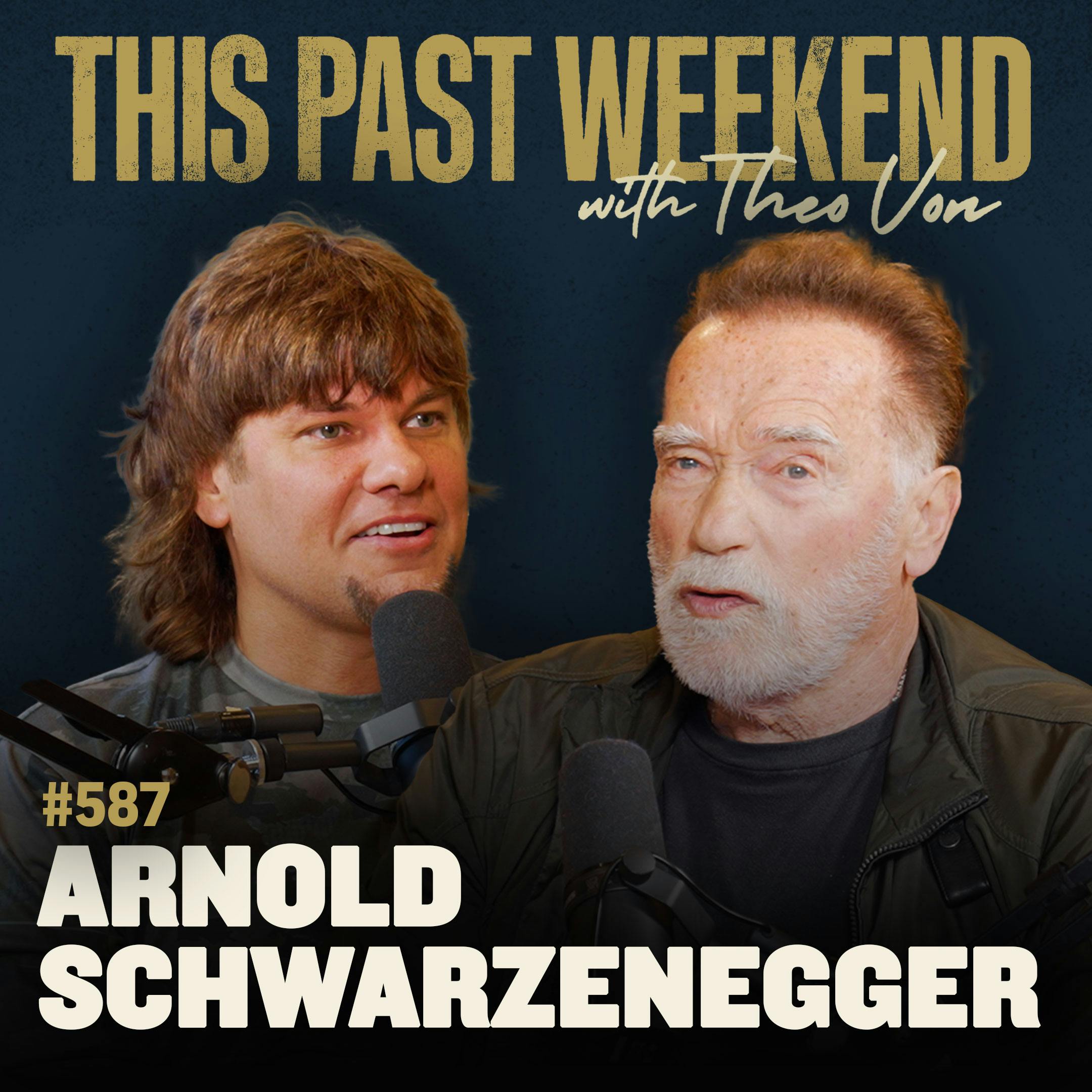
#587 - Arnold Schwarzenegger
Arnold invites Theo to his office to talk about leaving Austria to turn his American dream into a reality, what he learned about politics when he was Governor of California, and why a mindset is all you need to succeed at your goals.
Arnold Schwarzenegger: https://www.instagram.com/schwarzenegger/
------------------------------------------------
Tour Dates! https://theovon.com/tour
New Merch: https://www.theovonstore.com
-------------------------------------------------
Sponsored By:
Celsius: Go to the Celsius Amazon store to check out all of their flavors. #CELSIUSBrandPartner #CELSIUSLiveFit https://amzn.to/3HbAtPJ
DraftKings: Pick 6 from DraftKings is the most fun way to play fantasy sports. Download the DraftKings Pick Six app NOW and use code THEO. That’s code THEO for new customers to play $5, get $50 in bonus picks. Better payouts. Bigger wins. Only with Pick6 from DraftKings. The Crown is yours. https://draftkings.com ".
Moonpay: Head over to https://www.moonpay.com/theo to sign up
Oracle: Go to http://oracle.com/THEO to try OCI for free.
-------------------------------------------------
Gambling Problem? Call one eight hundred gambler. Help is available for problem gambling. Call eight eight eight seven eight nine seven seven seven seven, or visit c c p g dot org in Connecticut. Must be eighteen plus, age and eligibility restrictions vary by jurisdiction. Pick6 not available everywhere, including New York and Ontario. Void where prohibited. One per new customer. Bonus awarded as non-withdrawable Pick Six Bonus Picks that expire in fourteen days. Limited time offer. Terms at pick six dot draftkings dot com slash promos.
-------------------------------------------------
Music: “Shine” by Bishop Gunn Bishop Gunn - Shine
------------------------------------------------
Submit your funny videos, TikToks, questions and topics you'd like to hear on the podcast to: tpwproducer@gmail.com
Hit the Hotline: 985-664-9503
Video Hotline for Theo Upload here: https://www.theovon.com/fan-upload
Send mail to:
This Past Weekend
1906 Glen Echo Rd
PO Box #159359
Nashville, TN 37215
------------------------------------------------
Find Theo:
Website: https://theovon.com
Instagram: https://instagram.com/theovon
Facebook: https://facebook.com/theovon
Facebook Group: https://www.facebook.com/groups/thispastweekend
Twitter: https://twitter.com/theovon
YouTube: https://youtube.com/theovon
Clips Channel: https://www.youtube.com/c/TheoVonClips
Shorts Channel: https://bit.ly/3ClUj8z
------------------------------------------------
Producer: Zach https://www.instagram.com/zachdpowers
Producer: Trevyn https://www.instagram.com/trevyn.s/
Producer: Nick https://www.instagram.com/realnickdavis/
Producer: Colin https://www.instagram.com/colin_reiner/
Learn more about your ad choices. Visit megaphone.fm/adchoices
Press play and read along
Transcript
Speaker 1 Sebastian Maniscalco's new stand-up special, It Ain't Right, is now streaming on Hulu. Filmed live at the sold-out United Center Arena in Chicago.
Speaker 1 Sebastian's newest special features his larger-than-life presence and hilarious everyday observations to keep you laughing.
Speaker 1 Sebastian goes all in on family chaos, non-existent manners, and life's most relatable and funny moments.
Speaker 1 Watch Sebastian Maniscalco, It Ain't Right now streaming on Hulu and Hulu on Disney Plus for bundle subscribers.
Speaker 2 Terms apply.
Speaker 1 Today's guest is a legendary actor,
Speaker 1 bodybuilder, tastemaker, really in the world of bodybuilding.
Speaker 1 He was the governor of California. When you think of the American dream, he is pretty much it.
Speaker 1
The second season of his Netflix show, Fubar, is dropping soon. We're going to talk about that.
And a lot more. I'm honored to sit down with the one and only Mr.
Arnold Schwarzenegger.
Speaker 2 So where do you work out of?
Speaker 2 Where do you work out of North?
Speaker 1 I live in Nashville, Tennessee now.
Speaker 2 Tennessee. Yeah.
Speaker 1 I lived here for about 12 years.
Speaker 2 It's a growing city now, isn't it? Yeah.
Speaker 1 It's growing fast because it's safe. They have,
Speaker 1 you can have a weapon if you need to. So you can, you know, I think there's that semblance of you can take care of yourself type of energy.
Speaker 2 Right.
Speaker 1 And so,
Speaker 1 and it's a friendly community and it's very safe. You know, it's like a lot of cities, some of them get kind of dangerous.
Speaker 2 It's known for its country music, right? Yeah.
Speaker 1 Did you ever listen to country music growing up?
Speaker 2 Yeah, I mean, that's when it's growing up.
Speaker 2 Growing up was
Speaker 2 kind of rock and roar. You know, the 50s,
Speaker 2 rock and roar.
Speaker 1 Did they have any? Because you grew up in Austria, right? Or to what age?
Speaker 2 Austria, yeah. I was an Austrian until I was 19.
Speaker 2 And so we were, there was a program
Speaker 2 that was called
Speaker 2 Hit Parade
Speaker 2 and the Hit Parade.
Speaker 1 A television show?
Speaker 2 No, no.
Speaker 2 We didn't have television.
Speaker 2 So we just had the radio at home. But I had then bought,
Speaker 2 I was like 15 and I just bought my first transistor radio
Speaker 2 in a little plastic box, right?
Speaker 2 And
Speaker 2 I paid off
Speaker 2 like
Speaker 2 fifty shillings a month until it was paid off a year later. But then that I always took down to the lake where I grew up.
Speaker 2 And we were sitting around with the the boys from a village and we were listening to this hit parade. It was from seven to eight at night on Wednesdays.
Speaker 2 And there was like Little Richard and Chuck Chuck Berry and all of those guys that were big in the 50s and 60s. Exactly.
Speaker 2 And so I grew up with that. And that's why I have that station in my radio 50s at all times.
Speaker 1 Oh, so you still listen to it?
Speaker 2 I just love it, right? Then when I came over here,
Speaker 2 I became aware of a little bit of the country Western kind of music.
Speaker 1 Did you go to a concert in Austria? Was there a concert you ever went to before you came here?
Speaker 2
I could never afford a concert. Are you kidding me? I had no money.
But I mean,
Speaker 2 when I I came over here,
Speaker 2 I then became aware of the Country Western songs, especially Johnny Cash. He had done a television show, a weekly television show.
Speaker 2
And it was great, great music. And so I fell in love with that.
And then friends of mine here in America then took me to concerts. You know, it was like a...
Speaker 2 jazz concert or a country western concert and all of this stuff and so then that's when I started really getting into it. But I mean, I loved the music.
Speaker 2 But when you grow up in Austria, most of the stuff that you hear is really Austrian music.
Speaker 2
You know, the umpedla, umpede de la and all this kind of thing. It's a beautiful music.
Beautiful music. But I mean, that's what you hear on public radio and public television, also.
Speaker 2
That's what you see. And you see operas and you hear concerts.
You know, my father himself was a musician. He played six instruments.
Six instruments? Yeah, six instruments.
Speaker 2 All kind of like a fliglie hoan,
Speaker 2 trumpet, saxophone, clarinet, all of the stuff like that.
Speaker 1 A lot of traditional music he would play.
Speaker 2 Yeah, very traditional, because he was the conductor of the chandelie music, which is the police, the country police, like the chandemar.
Speaker 1 Chante-Marie, it's called?
Speaker 2 Yeah, Chandemarie is a French word, a chandarme.
Speaker 2 And so
Speaker 2 he was a chendarme, he was a police officer. And so he played in that Shandamari music.
Speaker 1 Would he play at home or where would he play at home?
Speaker 2 He practiced at home. You know, while I was training, I remember I was doing my workouts and he would be standing, the window would be open up at our house and he would be kind of
Speaker 2 playing out to the window, out the window. And there was a kid that was my age
Speaker 2
that lived 150 yards away from us. It was one of my best friends.
And he also learned how to play the trumpet at the age of like 13 or 14.
Speaker 2
So he would play over there and then my dad would play over here and they were going back and forth like that. So it was really fun.
Like a couple of birds almost.
Speaker 2
Yeah, but I never, for some reason or the other, my dad always wanted me to get into music. Not as professional, but I mean...
Did you try it at all? Yeah, I tried it. It just didn't work.
Speaker 2
What instrument? Well, he tried with the trumpet, obviously. Then he thought that he kind of seduce me kind of into the music because I liked Elvis.
So he said,
Speaker 2
well, why don't you learn how to play the guitar? Yeah. I don't play the guitar.
He says, but there's a farmer that is 100 yards up the road. He plays the guitar and he can teach.
He's also a teacher.
Speaker 2
And so I would go to him. But it just, you know, I just...
could see right away that that was not meant for me.
Speaker 1 Was there a lot of, like when you were a child in Austria, was there a lot of like individualism or was it, were things very like regimented?
Speaker 1 Like in America, you could like, you can be an individual, right? But some countries, it's a little bit harder to kind of like,
Speaker 1 you know, be an individual and have a voice. I'm just wondering, what was it like there when you were young? Did it feel like things were regimented or it was okay to be rebellious?
Speaker 1 What was it like there?
Speaker 2 Well, I was rebellious in a way because,
Speaker 2 I mean, think about it: soccer and track and field, they were kind of like the in-sports.
Speaker 2 But when I was exposed to weightlifting and to powerlifting and to bodybuilding, I fell in love with that.
Speaker 2 And also because my heroes like Reg Park and Steve Rifte were doing Hercules movies and I just started looking at those movies, right?
Speaker 2 And so I said to myself, I want to be like that. I don't want to be a top soccer player.
Speaker 2
I want to be like that. I want to have the muscles like that.
And I want to get into movies like that. So that always became my dream.
Speaker 1 So you really want it to be like this?
Speaker 2 Yeah. So I was fixiated.
Speaker 2 I was like kind of like concentrating that I kind of put visually my
Speaker 2
head on Reg Park's body. And I said to myself, there was a picture, a famous picture, where he won the Mr.
Universe contest in London in 1951.
Speaker 2
And when I saw that picture, it was like him holding the trophy and flexing his bicep. Yeah.
And then I said to myself,
Speaker 2
can you imagine if this is me? I'm going to make this me. And so that's what I was training for.
So my parents thought that it was kind of like, what is that all about? Where did that come from?
Speaker 2 And the whole neighborhood was kind of like
Speaker 2 wondering, what is this guy doing training every day, two hours, three hours a day?
Speaker 2
I came home and instead of having lunch, I would put my sit-up board up on the kitchen table and I would be doing sit-ups. 500 sit-ups during lunch.
So you were addicted totally addicted.
Speaker 2 Because I was driven by my vision.
Speaker 2 It was always there.
Speaker 2 Even when I was in school, I would sometimes just wander off when the teacher was teaching out there and writing up something on the blackboard.
Speaker 2 And I would be looking at that and then all of a sudden he could see that I was just kind of like
Speaker 2
staring off. Yeah.
And then
Speaker 2 all of a sudden he threw a chalk at my head and bang. And I looked back again.
Speaker 2
He says, Arnold, I'm up here. I mean, I know you're looking at the beautiful trees out there.
They're more beautiful maybe than me, but you got to listen to what I'm saying here.
Speaker 2 So I noticed I was always kind of drifting off and
Speaker 2
visualizing my dreams, always visualizing my dreams, being on that stage in a Mr. Universe contest, doing maybe Hercules movies.
going to America and all of that. So it was very dreamy.
Speaker 2 So that was not the norm. So I did step out of the norm and then because everyone else was talking about, oh, I'm going to go and get a job with the government because I want to make sure that
Speaker 2
I collect my pension when I was 65 and all this. I had no interest in any of that pension.
I mean, what are we talking about now? The age of 18, we start talking about pensions.
Speaker 2 I mean, it's crazy, right? But that's the European way. Everyone looks for stability,
Speaker 2 especially in those times where government was really ruling. And so then that's also, I think, an explanation of why when I came over here to America
Speaker 2
in 1968 and I saw Hubert Humphrey and Nixon came together. Hubert Humphrey, who is Nixon? He was the vice president under Johnson.
Okay.
Speaker 2
And so he was came after Kennedy to become, well, Johnson was after Kennedy, then Hubert Humphrey was his vice president. So he was running.
for president. Oh, yeah.
And then so was.
Speaker 1 Because he eats gumdrops, that guy.
Speaker 2 And so it was really interesting when I listened to the debates, and I didn't understand
Speaker 2 maybe three-quarter of it, but I had a friend that spoke German, and he translated for me.
Speaker 2
And when I heard of what Nixon said, it was so opposite of what I grew up with, which I didn't like, where government was in kind of in charge of everything. In Austria.
In Austria, yeah, exactly.
Speaker 2
And so it was in Germany and all those countries over there in Europe. Socialism was the system that I grew up in.
So when Nixon spoke, I felt like, wow, get government off your back.
Speaker 2
Get the government off your back. Great.
Wow. And
Speaker 2
lowering the taxes, strong military, strong police force, strong, strong gladiator, strong economy. Let the people be free.
Let them shop all around the world. And blah, blah, blah.
Speaker 2 And I said to myself, this is like unbelievable.
Speaker 2 and then when Humphreys spoke it was like I was back in Austria you know so then I said to myself what what are the parties here because I didn't understand really the parties yet why what was it about Humphreys that made it feel like you were back in Austria well I said government is the solution oh I see so he was more like the cage we all know that the government is not the solution I mean it's like the free enterprise the the the economy and all this you got to let people be free and not be controlled by government government is good but you have to find kind of the middle ground of all this stuff.
Speaker 1 Yeah, if you rely solely on the government for your life, then you'll just be a you'll be a part of the government, basically.
Speaker 2
Well, and you become a vegetable. Yeah.
Because they create the safety net, then you don't have the will to really kind of make it on your own.
Speaker 2 So the big advantage of coming to America was that there was no safety net.
Speaker 2
So I was on my own. So I had to get really creative.
Okay, how can I go and go to school and educate myself? How can I go and get more English classes?
Speaker 2 How can can I go to Santa Monica City College and at the same time work
Speaker 2 and at the same time train five hours a day and do all of those kind of things? So this is, but it was up to me now to be successful, not up to the government. Oh, I like that.
Speaker 2
So the government was providing the opportunities in order to see the structure. But that is what I enjoyed.
And so this is why I became kind of like a Nixon Republican.
Speaker 2 And people always were kind of like, you know, especially in California, which is much more liberal. How can they be a Republican? So
Speaker 2 I really enjoyed it. Nixon, of course, came from California.
Speaker 1 Question, Arnold. Was it scary to tell your parents that to leave Austria? Did people do that at the time?
Speaker 1 I'm just a little bit curious on what it was like to say, I'm leaving here and I'm going to go to America. Was it even a popular path for people to go?
Speaker 2 Well, remember, I started saying this when I was 10.
Speaker 1 Ah, I see.
Speaker 2 So it had been, your parents knew it was in your head. Yeah, exactly.
Speaker 2 So I saw a documentary, a black and white documentary, in a school that showed always those films with this eight millimeters, whatever, films films on the little screen.
Speaker 2 And like I said, television was not the common thing at that time in Austria, so we didn't grow up with that.
Speaker 2 But they showed the film and I saw a documentary about America.
Speaker 2 Now I see the Empire State Building.
Speaker 2 I say, wait a minute, this building is like, you know, 100 times. taller than any of the buildings in Graz, where I grew up, right? In Austria.
Speaker 2
And then I saw the Golden Gate Bridge, Bridge, then I saw the Pacific Coast Highway. I saw all of this kind of, you know, great, great things.
I saw the six-lane highways.
Speaker 2 I saw the big Cadillacs, you know, with the big fins sticking out, you know.
Speaker 2 And I said to myself, and then we had all this little kind of cars and Muscle Beach and all of this stuff that the Hollywood.
Speaker 2 And so I was like, I got to go to America. I've got to go to America.
Speaker 2 Austria is not the place. It was almost kind of like that my gene was over here.
Speaker 2
You know, so this is so it kind of I gravitated towards America. Not that I hated Austria, but I just wanted to leave and go do something different.
So my parents always saw me as being different.
Speaker 2 So it was not a surprise to them that I wanted to go as soon as I was through with high school and trade school that I want to go into the military.
Speaker 2 So I went into the military because after you go and serve in the military, then you can get your passport and you can travel.
Speaker 1 So you had to go to the military to get your passport in Austria? That's right. Is it still that way?
Speaker 2 No, I don't think it's different now. Everything is different because
Speaker 2 everything has changed.
Speaker 1 Yeah. And you had a brother as well, right? Did he go to the military?
Speaker 2 He was in the military. And
Speaker 2
he was a year older. Oh, cool.
What's your name? So he was a year Meinhardt.
Speaker 1 Meinhart. Meinhard, yeah, exactly.
Speaker 2 So he was a year earlier, but he passed away, as you know. I didn't know.
Speaker 2
very young at the age of 24. Oh, I didn't know that.
He passed away at the, yeah, it was like a drummer. That's him right there? Yeah.
No, this is Disch. This is Franz Dischinger.
Speaker 2
He He was my training partner in Munich. So when I went, I went first.
So after the army, the Austrian army, I immediately left to go to Munich. Because I got an offer.
Speaker 2
Because now at that meantime, I became the European champion in bodybuilding in the junior division. Okay, so you went to the military.
So yeah, so I became this.
Speaker 2 While I was in the military, I won this title,
Speaker 2 Best Built Men of Europe, Junior.
Speaker 2 And I was 18 years old.
Speaker 2 So now I get this offer in Munich, the biggest gym, to go and become a trainer.
Speaker 2 So I said to myself, okay, I'm going to serve out my term here, get out of here a year later, and then I go to Munich and I become a trainer there. Now then,
Speaker 2 I can train anytime, 24 hours a day, because I actually lived in the gym. So I could get up literally, if I wake up at three in the morning, and you know, I can, let's say, I can fall back to sleep.
Speaker 2 I go out to the gym. How did you live in there?
Speaker 1 Like, where? They just had a bed in the soda.
Speaker 2
Exactly. It was a little room.
There was from here to there where you used to sit and a bed and just a little kind of thing with cabinet with drawers. I put my stuff in.
That was it. That was it.
Speaker 2
And then I walked out of it. It used to be an office there for the gym.
And I just moved in there because I had no money.
Speaker 1 And you were like, this is what I do all the time anyway. This is like.
Speaker 2
Yeah, so I was in heaven. Yeah.
Are you kidding me? I mean, I went out there, turned on the lights, and I was posing with all the overhead lights.
Speaker 2 I was posing in the mirror all the time. At night I would wake up and I would go out there posing and stuff.
Speaker 2 So I was
Speaker 2 very intense
Speaker 2 and very
Speaker 2 passionate about bodybuilding and perfecting my body and going to London to that very same contest that Reg Park won the Mr. Universe.
Speaker 2
And that very same year when I went now to Munich in 1966, I became now Mr. Europe literally two months later.
and then best buildment of Europe. And then I went to the Mr.
Speaker 2 Universe contest with the age of 19.
Speaker 2 I was the youngest competitor and I came second.
Speaker 1 And where was that held at?
Speaker 2 It was in London. Same stage as Reg Parker.
Speaker 1 So you still hadn't made it to the U.S. yet?
Speaker 2
No, no, not yet. No, no, no.
And was your brother also lifting weights?
Speaker 1 Was he a weightlifter? No.
Speaker 2
He was not interested in that. He was much more, I think, academic, I would say, because he read a lot.
And he started out. He was really good in school.
I was not that good in school.
Speaker 1 Can you guys get along pretty well? Is that him or no?
Speaker 2 That's him. Yeah, that's Meinhart.
Speaker 2 hut oh that's a cool yeah what is mine mine hut yeah mine hut yeah i just wonder what it would be like because i have a brother too so i'm just thinking sometimes like it would be um yeah i just think about my brother a lot so i guess i was just curious what it was like um what your brother was like well he was different than me uh but we did hang out together he did come to the gym every so often and he worked out with me but he was not into it he wasn't into it but he has naturally he had a better body than i had actually oh really yeah he had a really v-shaped body had wide shoulders a very very small waist.
Speaker 1 God, they always give it to the person that doesn't want it. I know.
Speaker 2 Yeah.
Speaker 2
But that's, I think, what is interesting about it is that you struggle much more in the beginning and to catch up. And then all of a sudden, you know, you see your own potential.
Yeah.
Speaker 2 You know, which is you don't see it in the beginning. But then, I mean, I think it was like going to the gym was my first time where I got compliments.
Speaker 2 Because my parents were not into that.
Speaker 2 It was the Austrian kind of upbringing, kind of everything, they correct everything.
Speaker 2 The grades are no good. And the soccer,
Speaker 2
why didn't you kick the ball? You were like 10 yards away from the goal. You didn't kick it in.
You tripped over the ball. I mean, what the,
Speaker 2 come on out.
Speaker 2 It was always some kind of a complaint.
Speaker 1 Always trying to correct you.
Speaker 2
Exactly. That's right.
Yeah. It was always a complaint.
And then if you made a mistake, you get smacked and stuff like that. So it was that kind of upbringing.
Speaker 2 But it was very helpful to me because it actually gave me the motivation to leave Austria. And it gave you control.
Speaker 1 I mean, if you're weight, if you're bodybuilding, it's just you against you. There's no, you don't have to depend on anybody else.
Speaker 1 I mean, I guess you have to depend on the judges when you go to actually compete. But day to day, it is you against your own emotions and mentality and ability.
Speaker 2 Yes, but also at the same time, even though it is a sport that you are on your own, but in the end you still rely on your training partners.
Speaker 2 I was very fortunate always that I had the mentality mentality of
Speaker 2 being able to attract the best training partners. So I had guys that were as hungry as I was, because that's the important thing.
Speaker 2 If you have someone that is not as hungry, then it doesn't really mean anything.
Speaker 2 If you have someone that competes with you, that counts out the reps, then he wants to do an extra two reps more than you do, and you get up the weight and all this stuff.
Speaker 2 So I always had good training partners. So I'm a big believer in that we really can't
Speaker 2 do anything by ourselves.
Speaker 2 That's why we say, don't call me a self-made man, because I'm a product with a lot, a lot of help, if it is in bodybuilding or just, I mean, think about Joe Weida. After winning two Mr.
Speaker 2
Universe titles in London, the amateur Mr. Universe, the following year, 1968, the professional Mr.
Universe. So I was like the youngest Mr.
Universe ever.
Speaker 1 And that was the year after you got second?
Speaker 2
That's right. Okay.
1966. You were 20 years old.
I was second. 1967, I was 20 years old.
Wow. And I want to become the youngest Mr.
Universe.
Speaker 2 And now I'm then that stage exactly where Reg Park was and win the Mr. Universe and not only that but the Reg Park immediately sent me a fax
Speaker 2 and
Speaker 2 to London and they said I want to invite you to South Africa to give posing exhibitions and do strongmen act down there so I was invited by Reg Park to eventually then within by end of the year I went down to South Africa and you still hadn't gone to the US yet I haven't gone to the US what brought me to the US was
Speaker 2
which was kind of my dream, someone would notice me in bodybuilding, that they would take me to a because bodybuilding was an American sport. Oh, it was.
Not a European sport.
Speaker 2 It was an American sport, really. And so I obviously hadn't got this invitation from Joe Weider, who was the publisher of the muscle magazines.
Speaker 2 He published like four big muscle magazines, Flex and Strength and Health, and
Speaker 1 some of them, I think, when I was a kid.
Speaker 2 And
Speaker 2 he
Speaker 2 off this.
Speaker 2 And he had also an equipment company, the food supplement company because it's weights right i've seen the weights before it's it's weights it's the food supplements it's uh and his brother was the head of the organization the bodybuilding federation and this is when you came to the us yeah so he brought me over in 1968 okay before we get there arnold that's what and not to interrupt or anything but you did a show you went to like one of the first interracial shows that was in south africa that was late on oh that was later on okay there was 1975 got it okay so absolutely correct so you get to the us U.S.
Speaker 2 Very good research.
Speaker 1 Do you remember your first...
Speaker 2 Thank you.
Speaker 1 Do you remember your first day in America?
Speaker 2 Oh, yes.
Speaker 2 It was in Miami.
Speaker 2 Oh, yeah. I went to Miami and I was competing there in a competition.
Speaker 2 And then after that, I came out to California and I was picked up in California at the airport by a bodybuilding photographer.
Speaker 2 by the name of Adi Zeller and Dick Tyler, who wrote for the Muscle Magazines. They picked me up and took me to an apartment that Joe Wheeler rented for me and it was fantastic.
Speaker 2 I mean from then on I got all the help in the world now because that's when I really realized the generosity of the American people. Wow.
Speaker 2 I mean they gave me, I mean the bodybuilders, there was Thanksgiving came up after that.
Speaker 2 Because I came over here in October, November was Thanksgiving. So
Speaker 2 there was like this whole thing about, you know, giving me pillows and giving me blankets and giving me dishes and silverware where were you homeless or something but saying what why were they giving you all that
Speaker 2 when you move into an apartment oh yeah what do you get i mean it was a furnished apartment and you were living in l A at that point yeah it was in it was in the valley over there in the valley and then all these bodybuilders came to me and they brought me all this stuff it was like unbelievable so I could not even believe how generous they were.
Speaker 2 And
Speaker 2 this were a lot of times people that didn't know me at all. But just because bodybuilding and joining a club, you know, you become kind of part of that family.
Speaker 2
And so they were very, very sweet and kind. And I would never forget that.
That's actually what made me then think about, well, when I ever make it, I will give that back.
Speaker 2 I will help other people myself, you know.
Speaker 1 What's it like finding a gym that really fits you? Like, what's that like at that level of bodybuilding? Were there a couple of gyms you tried out and you're like, this isn't it?
Speaker 1 Or did you already know where you wanted to be?
Speaker 2 I came over here. There was a gym called Vince's Gym that had all the champions training.
Speaker 2
Where was that located? It was over in the valley in Vendura Boulevard and North Hollywood. And a very, very famous gym.
This is where, you know, Larry Scott, Mr.
Speaker 2
Olympia, trained, and Don Howard, who was Mr. America, and Don Peterson, all those guys were training there.
And then I ventured over here every so often for powerlifting.
Speaker 2 There was a gym called Gold's Gym.
Speaker 2
Not many bodybuilders trained there, some, but I mean, not many. Most of them were like shot putters and powerlifters and weightlifters and so on.
And it was a much more rough gym.
Speaker 2 But somehow, because of the Austrian gym, where I kind of started the first three years in this weightlifting club, it reminded me of that. So I started getting more and more attracted to that gym.
Speaker 2 And then I moved from the valley over here to Venice. To Venice.
Speaker 2
And it was still part of Santa Monica, actually. It was, you know, Ashland, one of the streets not far away from here.
And then I went daily training there.
Speaker 2 And then Gorge Gym, then other bodybuilders came from all over the country to train there too.
Speaker 1 Because you were there?
Speaker 2
Well, I was there. And Joe Weida now started writing in his magazines about Arnold is training in Gorge Gym.
And, you know, if you want to go and train in a great place, this is the place to go.
Speaker 1 Was it hard for you to train? I mean, were people at that point just standing around watching you train?
Speaker 2 No, because there was a lot of, you know, I mean
Speaker 2
this place was filled with great bodybuilders. Oh, I see.
Oh yeah.
Speaker 2 So then others came out here from Florida and from Kentucky and from New York and they all started joining Goach Gym and started training there.
Speaker 2
So this was kind of like the place that had the best bodybuilders in the world. training in Goach.
That's how Goach Gym became famous.
Speaker 2
You know, because it was a little gym. It was not big.
It was 3,000 square feet, I think it was.
Speaker 1
Well, I remember when I first moved to Los Angeles, we went to a firehouse. I don't know if it's still there or not.
Yeah, firehouse. Was that the place? It was a big protein place.
Speaker 2 It was like a, was that, I mean, I think it was. Well, Firehouse now
Speaker 2 is a restaurant down there.
Speaker 1 It used to be like a place where you could get literally like a bowl of chicken.
Speaker 2 Yeah, yeah, you still can get there. You can get great scrambled chicken.
Speaker 1
You can get like 30 eggs or whatever. Yeah, exactly.
It's crazy. It was like, yeah, I remember I ate, I ordered like a month worth of food right there just for what, just at lunch.
Speaker 2 Yeah, yeah.
Speaker 1 Yeah, it took me like five hours to get out of there just because I didn't want to like.
Speaker 2
Yeah, I was never a big eater. So to me, that meant nothing.
If I had a little steak and some two scrambled eggs, I was perfectly fine. I was full.
For the day?
Speaker 2 Not for the day, no, but let's say in the morning, steak and eggs
Speaker 2
or scrambled eggs or something like this. I always had to take protein drinks in between meals because I could never eat enough.
to get my 250 grams of protein because I weighed 250 pounds.
Speaker 2 And the idea then was that for every kind of pound of body weight you have, you should have one gram of protein. Yeah.
Speaker 1 When, uh, because I used to buy some, I don't know if I used to bodybuild, I used to use steroids when I was like growing up and just lift weights a lot. I loved it for years, you know?
Speaker 1 And I think whenever I get like,
Speaker 1 you know, whenever I quit working as much, I'll probably try to get back more weightlifting. Was steroids pretty popular then or what was it like?
Speaker 1 Was that part of the, because I'm sure it was part of the culture.
Speaker 2 Well, no, it was not yet, but it was something that was in the beginning very experimental.
Speaker 1 So would you hear it, like, would would it be like on the black market or it was just like public? It was just like people would talk about it like as a supplement.
Speaker 2 It might be in some places it was on the black market. I don't know.
Speaker 2 But all I know is that we always went to a doctor because they want to make sure that they measure your blood pressure and they check your health and all of that stuff because it has side effects.
Speaker 2 Oh, yeah. And especially if you take it beyond of what they recommend.
Speaker 2 So if they recommend, let's say, one shot a week and you start taking one shot a day or something, which is of course the case a lot of the day that people are overdosing, and that's why you see some bodybuilders actually die because of the overdose of drugs and all this stuff.
Speaker 1 Did you see friends go down that road, or people, as other bodybuilders go down that road where they would get addicted to it?
Speaker 2 No, not in my days, it was a new, but now it's, I think, really somewhat, I would say, out of control. Yeah,
Speaker 1 is a sequel better than the original? We're gonna find out at UFC 316.
Speaker 1 It's a rematch nine months in the making. And you can get in on all the action at DraftKings Sportsbook, the official sports betting partner of UFC.
Speaker 1 It's a huge night of fights, headlined by a rematch between Dvolashvili and O'Malley, as O'Malley looks to avenge the unanimous decision that saw Dvolashvili take the Bannamweight title back in September.
Speaker 1
First time betting on UFC at DraftKings? It's easier than you think. Just pick something simple like a fighter to win and make your pick.
That's all there is to it.
Speaker 1
And if you're new to DraftKings, here's your shot at cashing in right now. New customers bet $5 to get $300 in bonus bets if your bet wins.
UFC 316 and DraftKings.
Speaker 1 One night only for a shot to win some cash.
Speaker 1 Download the DraftKings Sportsbook app now and use code theo that's code th e o for new customers to get 300 in bonus bets if your bet wins when you bet just five dollars
Speaker 1 only on draft kings the crown is yours
Speaker 3 gambling problem call 1-800 gambler in new york call 877-8 hope and why or text hope and why at 467-369.
Speaker 3 in connecticut help is available for problem gambling call 888-789-7777 or visit ccpg.org Please play responsibly on behalf of Booth Hill Casino and Resort in Kansas. 21 and over.
Speaker 3
Age and eligibility varies by jurisdiction. Void in Ontario.
Bet must win to receive reward. Bonus bets expire 168 hours after issuance.
Speaker 3 For additional terms and responsible gaming resources, see dkng.co slash audio.
Speaker 1
You know, I've been in and out of crypto over the years. I've had one foot in, one foot out.
I've been hokey-pokey in there with it. But what's got me back now is Moon Pay.
Speaker 2 That's right.
Speaker 1 Moon Pay powers the entire world of crypto. Some people say they are the PayPal of crypto.
Speaker 1 Because just like you could use PayPal to buy anything on the internet, now you can use MoonPay to buy anything in crypto. Now here's where it gets really interesting.
Speaker 1 Moon Pay powers payments on OpenSea.
Speaker 1 OpenSea is the biggest NFT marketplace in the game where collectors and creators come to mint, buy, and sell everything from digital art to meme worthy masterpieces.
Speaker 1 Whether you're in a pixelated punks or futuristic fashion, there's something for everyone. With millions of assets and a smooth user experience, it's basically the go-to place for all your NFT needs.
Speaker 1
Go check it out. You can buy some with MoonPay.
Remember, while MoonPay makes buying crypto straightforward, it's essential to do your own research and understand the risks involved.
Speaker 1
Crypto trading can be volatile and you could lose your investment. MoonPay is is a tool to facilitate your transactions, not a source of financial advice.
Trade responsibly.
Speaker 1 Whenever you start,
Speaker 1 like you've had such an interesting life and career, you've gotten to do so many things.
Speaker 1 What do you think? Was there a time period in your life that you wish you had maybe done like a little bit different, you know?
Speaker 2 No.
Speaker 2
There's no. move that I ever made career-wise.
I thought that I had a real good nose when to make my moves forward and when I should retire from bodybuilding.
Speaker 2 When I felt like, okay, I don't have the joy anymore.
Speaker 2
After five Mr. Universe competitions that I won, Mr.
World and Mr. Olympia six times, I retired in 1975.
Speaker 2
After that competition in South Africa that you mentioned just earlier. So that was kind of the last competition.
I did come back in 1980 again for the Mr. Olympia, but that was really
Speaker 2 just an afterthought. But I mean, really, I retired in 1975.
Speaker 2 After the South African show? After the South African show.
Speaker 1
Tell me a little bit about that because I bet it was really interesting. South Africa is probably my favorite country.
I mean, it is beautiful.
Speaker 2 It is a gorgeous country. And of course,
Speaker 2
at that time, blacks and whites and everyone was separated. I mean, by separated, meaning they had different rights.
You know, the whites were the ones that ruled the country.
Speaker 2 The blacks were kind of kept down.
Speaker 1 Was Desmond Tutu down there there at the time? Do you know if he was speaking?
Speaker 2 Yes, of course he was. But I mean,
Speaker 2 the whites really were kind of in control.
Speaker 1 They were the kind of the leaders of the country.
Speaker 2
Exactly, the Dutch and the British. It was always a fight between those two in the parliament and all that.
And so then I got to meet and to know
Speaker 2
the minister of immigration, and he was also minister of sports. and minister of labor and blah blah blah.
So he was a very, very powerful guy in administration. and he
Speaker 2 uh when i met him he said to me arnold when you come over here to south africa and you do posing exhibitions and strongmen acts you should also go to the townships to the townships yeah yeah so so i said the townships like the sowet for the sowetos yeah so i said was it of course i did not know so he then explained it to me And then he would organize with the Reg Park together for me to go in because it was not what we call the safest place in town.
Speaker 2 Not that they wanted to do harm to you, but I mean
Speaker 2 for someone like me to come in there and to do a demonstration there,
Speaker 2
I mean everyone, everyone got lit. I mean, they were drunk, they were celebrating that someone would come in and give them their respect and do something special for them.
So very appreciative, right?
Speaker 2 So I would go in there and I was in the cage.
Speaker 1 Into the Sowetos? Is that what it's called? Can you ring it up for me, Nick?
Speaker 2 Yeah, the townships, they're all over the place.
Speaker 2
In every town in South Africa, there is townships like that. There's places where the blacks would live, right? They're very, very kind of flow.
They're called the Sowetos.
Speaker 2 That's one of them.
Speaker 1 Yeah, Sowetos. Yeah, I think so.
Speaker 2 So
Speaker 2 in any case, so I would go in there and do a demonstration and do my posing and lift weights and all of this kind of stuff.
Speaker 1 In these small towns.
Speaker 2 And there was like, you know...
Speaker 2 thousands of them surrounding and then just screaming loud and having the greatest time and then we would go out oh they would would put you on the grill.
Speaker 1
I'm surprised. I bet they were so hungry sometimes.
They would be like, look at this well for you.
Speaker 2 It was fantastic, the reception and everything. So, but the reason I'm mentioning that is because it led to the conversation with
Speaker 2 that minister of sports.
Speaker 2 And
Speaker 2
he said to me, he says, we should have an international competition here in South Africa. He says, we should work together on that.
And I said, okay, we will.
Speaker 2 And
Speaker 2 his name was Dr. Kornhoff.
Speaker 2
Dr. Kornhoff.
And he was an extraordinary man, very, very smart. But it just shows you that there was people like him that already wanted to do more for the blacks and to
Speaker 2 elevate them. Yeah, creatively.
Speaker 2 So he then, I set him up with Ben Weeder, with Joe Weida's brother, who was the head of the National Federation of Partybuilding. They got together and they hit it off really well.
Speaker 2
And so Joe Weider and Ben Weeder worked with him to bring the Mr. Olympia contest to South Africa, to Pretoria, to the capital of South Africa.
But the conditions were that
Speaker 2 they were able to have a mixed audience.
Speaker 1 Okay, so black and white audience. Have they done that ever? Never.
Speaker 2 Wow. So there was the first time there was black with blacks, but there was not just black and white in South Africa.
Speaker 2 There was a group that was called blacks, there was a group that was called colored, there was a group that was called Indians, there was a group that was white.
Speaker 2
I mean, there was like five different Asians. So everyone was different.
So everyone... A lot of variety.
It was kind of like, it was not considered we are all equal there, right?
Speaker 2 And so... what Ben negotiated was that we have a mixed audience that anyone, no matter what their nationality and what their kind of color is or religious beliefs,
Speaker 2 anyone should be able to come to this competition. And also, not only that, but to be a judge, we will have also half black and half white judges, blah, blah, blah.
Speaker 1 So, was that scary to go before a black judge? Did you think that they would judge you fairly? I would be no,
Speaker 2
not at all, because they were not. I mean, I was competing in America at that time.
You were used to it. And I was used to it.
Speaker 2 We have Leary Colbert, who was the first guy with a 21 22-inch arms, big, big bodybuilder from the 50s and 60s and he was a judge in New York several times and he was a totally honest judge there was other black judges that so there was that that's the great thing about bodybuilding in bodybuilding there was no prejudice you know there were some people in bodybuilding that were prejudiced right but in general like especially under the weeders the weeders i think because they were jewish bring them up
Speaker 2 i think it had something to do with the fact that they were that kind of open-minded about it. Oh, yeah.
Speaker 1 A lot of times they're the leaders.
Speaker 1 They're like the leaders in promoting diversity.
Speaker 2
That's right. Yeah, so there was no prejudice.
There has been.
Speaker 2
There was no prejudice there at all. And as a matter of fact, there was a guy by the name of Bob Hoffman.
He always made sure that when they had the AAU had their Mr.
Speaker 2
America competition, only whites could win. No black could win there.
Oh, really? Yeah, so there was really embarrassing.
Speaker 1 So there were some barriers within the...
Speaker 2 There were guys like Sergio Liver that would be competing in 1966 or 1965 in a Mr. America and he would get beaten by white guys and it was totally unfair.
Speaker 2
Or Harold Poole got beaten in 1963 by Bern Weaver which I thought was unfair. So it was there was this.
So what they did then was because there was now two federations.
Speaker 2
There was the IFBB, there was the AAU and NAPA. AAU? The AAU, exactly.
The American Athletic Union. Yeah.
Speaker 2
And so they then went from that federation over to the IFPB and there Sergio Lever won immediately. Got it.
He became Mr. America, he became Mr.
World and Mr. Universe, then Mr.
Speaker 2
Olympia, and he actually in the first Mr. Olympia competition, Sergio Lever beat me in 1969 fairly.
I mean, there was no complaints there at all because he was extraordinary, right?
Speaker 2
And so then in 1970, I came back and I beat him in a Mr. World competition in Columbus, Ohio.
And then two weeks later, in a Mr. Olympia in New York.
So
Speaker 2
we were big rivals. And I was, of course, a big admirer of his and a big idol.
And he treated me really well. We went to Chicago and trained together at the Duncan YMCA and all that stuff.
Speaker 2 I wanted to learn from him.
Speaker 1 I love the YMCA, don't you?
Speaker 2 Oh, absolutely. It's great.
Speaker 1 I've always been a fan of the YMCA.
Speaker 1 It's just kind of like they're always a little bit met, like, it's never perfect there, but everything's kind of like a little bit old enough where I like the equipment.
Speaker 1 You know, it's never too fancy.
Speaker 2
Yeah, but you can get the job done. Right.
But to me, it's not about the luxury. It's just much more about the will to succeed.
And when I see pictures online
Speaker 2 of bodybuilders that are training in the sand in Africa right now, blacks that are having cement weights on a bar
Speaker 2 and a cheap bench.
Speaker 2 And when they do their bench press,
Speaker 2
and the other day I... I saw one of those kind of videos and they get up from the bench.
I'm looking at at it, I say, This guy could win Mr. America or win Mr.
California or something like that.
Speaker 2 He looks extraordinary. So
Speaker 2 it's really not the technology so much.
Speaker 2 It helps you, but I mean, on the end, it is really what you have to work on. It's the will.
Speaker 2 The will was the best.
Speaker 1
There's nothing better than just having like a little weight bench outside in your backyard or something. And you can go out there or in your garage.
And it's just.
Speaker 2 I did my deadlifts right in front of the house in Graz, in Tarl,
Speaker 2 which now is a museum at the house where I grew up in.
Speaker 1 Your Your home is a museum where you grew up?
Speaker 2 The home, exactly, yeah. Yeah, I'm gonna go over there in two weeks.
Speaker 2 So we have our pump club is meeting there with the European bodybuilders, members from the pump club, and then there's some Americans that are also coming over there.
Speaker 1 That audience in South Africa, what was,
Speaker 1 did it have the feeling during the show of like, this is like a novel thing? This is like a...
Speaker 1 like, was there that energy in the...
Speaker 2 There was so much energy in that auditorium. and it was not a big auditorium it maybe held i would say
Speaker 2 1500 people i would guess
Speaker 2 um
Speaker 2 and it was the energy was fantastic the joy of being together was fantastic and i really think that had a tremendous impact also on the future of south africa and it was just wonderful that there were leaders there that believed in that and wanted to organize.
Speaker 2 And everyone, the police and everyone was really cooperative, everyone worked together, so it was a fantastic show and a fantastic competition. And of course, I won.
Speaker 2
So it's always a fantastic competition, you know, when he wins as your sixth Mr. Olympia.
But
Speaker 2 what was interesting about it was I got $1,000 cash prize.
Speaker 2 And
Speaker 2 I was really upset about that because I felt like, wait a minute.
Speaker 2 In 1965, 10 years ago, Sergio, Larry Scott, when he won Mr. Olympia, got $1,000.
Speaker 2 And now 10 years later, we still get $1,000.
Speaker 2 So that's what made me actually motivated to go then in front of the IFPB, the International Party Building Congress, and to ask them for permission to organize the next year's Mr.
Speaker 2
Olympia in Columbus, Ohio. And that's exactly what we did.
I got the permission and then we upped the cash press to $5,000, then to $10,000, to $20,000, and we doubled it every year.
Speaker 2 And now we're giving over a million dollars away for cash prizes for the Arnold Classic.
Speaker 1 What's like one of the things right before you go on? Because I'm guessing you're backstage, right? You wait to go on and they call your name out and then you go out and do your poses.
Speaker 1 Is that how it goes?
Speaker 2 Well, it's
Speaker 2
in those days, the way it worked was the whole lineup of all the competitors. Now, if them understand, Mr.
Olympia means that you have to have won a world championship title before.
Speaker 2
So Mr. World, Mr.
International, or Mr. Universe.
So those guys are the top guys. So you have like six or seven guys that are on the stage.
And so the judges, they ask you the order come out.
Speaker 2 You have a certain time at one o'clock, be ready for pre-judging. And then you come out and then you stand there.
Speaker 2 And then the judges will shuffle you around. And it says, okay, can number seven go over where number one is and number one goes over where number seven was.
Speaker 2 You know, they just see them next to each other, different people next to each other. Then you say, turn around, turn sideways.
Speaker 1 What's the scariest way to be turned? Like, was there ever a part where you're like, this is, I got to kind of cheat this angle a little bit?
Speaker 2 No, I mean, for me, it was basically always a tremendous joy to be up on stage because it's one of those things where
Speaker 2 you feel like when you're really ready. I always felt kind of like in most cases, that I was so ready that no matter what angle it was, I was ready to go.
Speaker 2 And I had always a smile on my face, and I flexed everything. And you know, the key thing is that you have practiced your posing enough that you can stand there in a flex position that looks relaxed.
Speaker 2 You stand there like this, but you still flex, and you keep the stomach in, and you keep the abs flex, and the calves flexed, and the bicycles and the dries are flexed.
Speaker 2 So, that was the idea, and I was always having great joy with that.
Speaker 1 So, it's a lot of acting, too.
Speaker 2
It's kind of some acting up there. It is one of the great forms of acting.
Why? Because you cannot go and say to the judge, look at me.
Speaker 2
I am the most perfect up here. Look at my abs.
No, you have to do all that without talking. You have to communicate with them and also with the audience.
Speaker 2
Because remember that the sound of the audience is very important because you want to get big applause. So the judge says, oh, this guy got the most applause.
I mean, he definitely
Speaker 2 has the best body.
Speaker 2 But then you wait for the individual posing.
Speaker 2 So then you come out one after the next, you do your three-minute posing routine.
Speaker 1 And what's the trick there? Is there any trick of the trade, a last-minute thing you used? You would like
Speaker 1 pinch your tits or just rub some just like molasses into your limb? Like, was there what was like a last-minute thing people would do? Put ice under your arms or something?
Speaker 2 No, I think the key thing is just that when you go there, that you're so ready
Speaker 2 that you don't shake.
Speaker 2 How many bodybuilders, I'm sure you've seen it. They hit a shot and then they,
Speaker 2 after
Speaker 2 a few seconds, they start shaking.
Speaker 1 Oh, so that's bad.
Speaker 2
Well, for that level, I mean, it's natural when you have a Mr. Venice Beach competition, Mr.
Muscle Beach, Mr.
Speaker 1 Montgomery, Alabama.
Speaker 2
Yeah, you know, beginners, of course, they make mistakes and they're not as well trained. But when you get to the Mr.
Olympia level, it's unacceptable.
Speaker 2 Oh, so you want to make it look so that you want to look at it? And you hit the shot
Speaker 2 and you smile. You look at the judges
Speaker 2
and you smile. And then you smoothly move into the next shot.
Buff, bang. You know, and then the hands, just the movement.
It has to be all very gracefully and no shaking.
Speaker 2 So that again, that you say to the judges, look, I am so ready for this.
Speaker 2 Unlike maybe the others. So
Speaker 2 that's what it is. So it's all about the seven Ps.
Speaker 2 You know, the seven P's. Proper, prior planning prevents pissed, poor performance
Speaker 2 right and the marines they have that proper prior planning prevents
Speaker 2 pissed poor performance exactly so that's what it's about it's the same there you come prepared you make sure that you worked everyone has weak points so you have to make sure that you worked as much on your weak points so that the judges see that you're not blind that you notice that last year you maybe had not so defined legs
Speaker 2 yes maybe you won, but the legs were so-so.
Speaker 2
And then the next time when you come back, you have to have ripped legs. Right.
So then the judge says, That guy got the message. So this is what it's all about.
Because in the end,
Speaker 2 you really are
Speaker 2 an artist.
Speaker 2
You're a sculptor. You're not just the athlete that's competing, but you're the sculptor.
But you're
Speaker 2 putting on your own body. Instead of a chisel and a hammer that you kind of sculpt,
Speaker 2 a physique, You do it now with machines and with the reps and with the different exercises where you say, I need a little bit more of the rear deltoids.
Speaker 2
I need a little bit more separation in the front between the deltoid and the pectoral muscle. I need a little bit more cut on the lower abs.
I need the calves have to be balanced.
Speaker 2
They're not big enough for the arms because it should be the same size as your arms are. And all of those kind of things.
So you become kind of like an artist in your own body.
Speaker 2 That's what the idea is.
Speaker 1 Do you ever like have to work out the top of your feet or your hand? Were there things you could do for your face even and stuff like that?
Speaker 2 No, no.
Speaker 2 I mean, there are people that pay attention to that. I didn't.
Speaker 2 To me, it's always about the bottom line. So, but what is it that we're doing here?
Speaker 2 What we're doing here is we are showing the most perfect physique and who is the best in actually displaying that physique. Because it's all about, you know, presentation, presentation, presentation.
Speaker 2 It's like a piece of art. You know, know, you can have a painting that is maybe amongst many other paintings, and you wouldn't even notice there's a Picasso.
Speaker 2 But then, when you put it up there on a white wall
Speaker 2 and in a beautiful gold frame with the special lighting, and then you have someone talk about it, now you can auction something off for a lot of money. So, it's all about presentation.
Speaker 2 And so, this is why I think the same is also in bodybuilding and the way you present your body and the way you present your muscles.
Speaker 1 And did at that point, I mean, I can see now how even like lobbying for certain things to be changing in
Speaker 1 like in the prize money, right? I can almost see where your direction comes to even end up in politics, right? You can start to see it like, well, this should be more.
Speaker 1 There should be some adjustments. You weren't just like a competitor.
Speaker 1 You were also somebody who was examining how things were run and how they could be better, especially when you were partnering with guys like Ben Wider and stuff like that and probably inspired by those guys to probably get this.
Speaker 1 larger vision of things that were going on.
Speaker 1 Did you, when you got into film, so at that point, you know how to act, you know how to impress the front row, you know how to use probably every element of your body to impress people.
Speaker 1 So that kind of just leans
Speaker 1 kind of perfectly into acting.
Speaker 2 Yeah, but remember that what is key on all of this stuff is also personality.
Speaker 2
And I don't know if you can train a personality or not. I mean, I don't know what you think about that.
But I mean, I think some people just don't have the greatest personality.
Speaker 2 Oh, yeah, some people don't have a lot of people. Some people have a great personality.
Speaker 2 And so I think that I developed over the years, not that someone taught me that, but I developed a personality because my joy for whatever I did came through.
Speaker 2 So when people talked to me about bodybuilding in those days, I was not shy of the press. Other bodybuilders for decades didn't talk to the press.
Speaker 2 So when I came over here, people thought that when they saw my body, they thought it was a football player or it was a wrestler or something like that.
Speaker 2
But the last thing they guessed was a bodybuilder. So they didn't know about bodybuilding.
So I, in 1974, I hired, I was the first bodybuilder to hire a publicist.
Speaker 2 And so we went and did talk shows, the Johnny Carson show, Murph Griffin show, Mike Douglas show, and all of those shows.
Speaker 1 And were there football teams that tried to get you to come and play for them? Did you ever get an offer?
Speaker 2 No, because, I mean, I think I made it very clear in my interviews. that my vision is to be the greatest bodybuilder of all times and to go then into acting.
Speaker 2 So even when people came to me, because I was always very good in business, I studied business, I got my degree in business while I was over here doing the training for bodybuilding.
Speaker 1 At SMC? Second. Did you go to SMC?
Speaker 2 I went to Santa Monica City College, the UCLA, and to, you know,
Speaker 2
got my degree in business, and it was like in business administration. And I was just naturally always gifted.
for making deals and being creative. Got it.
Speaker 2 You know, and I always understood how it works.
Speaker 2 And so in bodybuilding, for instance, it's one thing to say, okay, I'm going to up the cash price to $20,000. Let's say from like
Speaker 2 within a three-year period,
Speaker 2
we give away $20,000 in the beginning. But then you have to say, okay, where do we get this money from? Ah, sponsors.
So now I have to go out and hustle the sponsors.
Speaker 2 And so now, of course, we have the biggest bodybuilding and fitness convention in Columbus, Ohio in the world. We have 200,000 people coming through there in three days.
Speaker 2 We have every company displaying their products there, their machines, their food supplements, clothing.
Speaker 2
The Arnold Classic. Arnold Classic.
So it's always the first week in March. And it's three days, the whole thing.
Speaker 2 So now, like I said, now we're raising enough money where we can give away over a million dollars. As a matter of fact, this coming year, we're going to go in up to a million and a half dollars.
Speaker 2
So it's like, so it's all kinds of great things happening. But I was able to build it to that because I have have a business mind.
Right.
Speaker 2 And I know exactly how that works and how do we attract everyone and bring everyone together.
Speaker 1 Were there women all weightlifting at that time or no?
Speaker 2 The first Mr. Olympia competition, Miss Olympia competition was a guy by the name of Schneider from,
Speaker 2
he was back east, from the Philadelphia area. And we did that together.
Oh, you guys started it? Yeah, well, yes, because the women were all kind of complaining, why can't we compete?
Speaker 2 So we did a little, Shelby called it Miss Olympia.
Speaker 2 And because the International Federation of Bodybuilding at that point had no interest in women bodybuilding.
Speaker 2 Why was that, do you think?
Speaker 1 Was it just their view of women at the time? No,
Speaker 2 at the time,
Speaker 2
he was stuck in, we created this Federation for the Guys. Oh, yeah.
So
Speaker 2 why are we getting, it's like Jim owners, like Joe Gord.
Speaker 2 He would not let women train.
Speaker 2
Why? Not because it was against women. No, we love women coming in there.
But he figured, I don't have the room for another bathroom here. I have 3,000 square feet.
Speaker 2
I have only for the man, the shower, and the bathroom. Some of those girls are pissed standing up.
I'll tell you. Yeah, exactly.
Speaker 2 Yeah, but I mean, we had women coming in and the watches work out, but they couldn't train there until they got in a bigger space and then women were included in the whole thing.
Speaker 2 And so the Federation was a little bit reluctant to do that.
Speaker 2 And when we did the Miss Olympia, and all of the girls really enjoyed that, that they were able to go on stage and to also compete with the muscles and all that stuff.
Speaker 2 The Federation then woke up and they said, Okay, we're going to get involved in that, and we're going to go get, and since then, it has been booming, you know, and they've been doing not only bodybuilding competitions, but you know, fitness competitions and beauty competitions.
Speaker 1 Does Arnold Classic have a women's revision? Oh, yeah, absolutely.
Speaker 2
Oh, that's great. I didn't know that.
Sorry.
Speaker 1 Oh, wow. Look at these chocolate babies right here, huh?
Speaker 1 Yeah, everybody kind of gets chocolatier, huh?
Speaker 2 Tanned.
Speaker 2 Now you have this tanning stuff.
Speaker 1 Was it real tanning back then, or was it?
Speaker 2 No.
Speaker 1 What was the key to the best tan? The best tan?
Speaker 2
We got the best tan that we could get. So I would work out a lot of times outside in the weight lifting platform in Venice.
Oh, yeah, I love that.
Speaker 2 So you get kind of tanned all over the place. They're doing chin-ups and doing bench presses and inkling and dips and all this stuff.
Speaker 2 Then we would jump in the ocean again, come back and work out some more and all this.
Speaker 2 But on the end,
Speaker 2 we then added to that tan, tan in a minute by Helena Rubenstein.
Speaker 2 So I don't even know if this exists anymore.
Speaker 1 Bring it up tan in a minute, huh?
Speaker 1 60-second
Speaker 2
sousé, they call it. That was in those days, it was the big trick.
So you put it on with a sponge. You know, you just poured it out on a little plate.
Speaker 2 You put it on with a sponge, and you had a buddy of yours that did your back and stuff again the back of the thighs and all of that stuff. So this is what they did.
Speaker 2 That's why a lot of guys, the day they spray it on, they have actual experts come to the bodybuilding show and backstage.
Speaker 2 There's a people that manufacture the staining stuff and they would then help bodybuilders and spray it on and all of that. So it is much more professional today.
Speaker 1 But at the time, so you would, they would put that tan in a can, basically.
Speaker 2 Yeah, they would put it in a bottle. It was in a bottle.
Speaker 2 And when you'd have a friend do your back, would anybody ever sabotage somebody and not do their back really good no but i mean there were some people that were really stupid and then did not know how to put it on they it would show kind of like streaks of the of the because they didn't have to be a little mulatto around the wrist so we put on just a light kind of layer it was all about just a little subtle thing because it's not going to make you win it just makes you the photos look a little bit better when you have a little bit of color and what was it called if somebody went too dark would you just call them a little chocolate bunny or something like what did you do if somebody it was up to the individual.
Speaker 2 As a matter of fact, they tell you that you can see in our Arnold Classic, a lot of times when the guys turn around,
Speaker 2 you sometimes don't even know who is black and who is not. Oh, yeah, I know.
Speaker 2 Because they're so dark now, the tanning has gone so sophisticated and so frowning.
Speaker 2 Yeah, so he's a perfect example. When he turns around, you will think it's a black guy standing for sure.
Speaker 1 And a nutmeg fella, yeah. That is just a little molasses, baby.
Speaker 1 That's so remarkable.
Speaker 1 In business, they say you can have better, cheaper, or faster, but you only get to pick two.
Speaker 1 What if you could have all three at the same time?
Speaker 1 That's exactly what some of the world's most innovative brands and AI tech companies have since they upgraded to the next generation of the cloud, Oracle Cloud infrastructure.
Speaker 1 OCI is the blazing fast platform for your infrastructure, database, application development, and AI needs, where you can run any workload in a high availability, consistently high performance environment and spend less than you would with other clouds.
Speaker 1 How is it faster? OCI's block storage gives you more operations per second. Cheaper? OCI costs up to 50% less for compute, 70% less for storage, and 80% less for networking.
Speaker 2 Better?
Speaker 1 In test after test, OCI customers report lower latency and higher bandwidth versus other clouds. This is the cloud built for AI and all your biggest workloads.
Speaker 1 Right now, with zero commitment, try OCI for free. Head to oracle.com/slash T-H-E-O.
Speaker 2 That's oracle.com/slash Theo.
Speaker 2 Okay, Dad, showtime. Now!
Speaker 2 I'm very protective of my team.
Speaker 2 Sweetness protection was our only choice, but all of us living under one roof seemed awkward.
Speaker 1 Nope.
Speaker 2 No!
Speaker 2 Oh my god! Bad Donnie! Bad Donnie!
Speaker 2 Hello, Luke.
Speaker 2
Underneath the foreign stars in a foreign place where... Bretta Noso, East German spy, disappeared in 1989.
Your eyes are wide and the fan
Speaker 2 Everybody wants you.
Speaker 2 Cool, Dad.
Speaker 4 Your terrorist friend is amazing.
Speaker 2 Who the hell is that? Theodore Chips, former MI6 agent.
Speaker 1 He works for me. Together, we'll destroy the world.
Speaker 2 You're gorgeous.
Speaker 2 Love changes hands as
Speaker 2 a brains crash and the dream don't die, but I do
Speaker 2 You'll spying on us.
Speaker 2 Us spying on you.
Speaker 1 Well, Emma's pregnant.
Speaker 2 I hope not. I may need it in the future.
Speaker 2
Sex. She means sex.
Mean.
Speaker 2 World War III is about to jump off. Dance with me.
Speaker 2 Get out of there! Ready? No! No!
Speaker 2 One, two, dance! Hold on, old man!
Speaker 2 I told you.
Speaker 1
I want to talk about your new show. You do have some stuff just so we make sure we talk about it, man.
Fubar, I watched your first episode. So I guess it's not out yet, right?
Speaker 2 No.
Speaker 1 And it's season two. It's kind of great because it brings me through all this like nostalgia of watching you over the years, right?
Speaker 1 Like, I feel like it's a little bit of all the, like, to me, this is perception. It could be judgment, but a little bit of like all your roles into one.
Speaker 1 Did it feel like that a little bit when you're shooting it? Or?
Speaker 2 Well, the idea of the show is, of course, when you act out then you find those moments where you can play all of the different roles but the idea of the show is just to do like what what we did with uh true lies what jim cameron did with true lies right so it was like how do we go and do a show where you pack it with action and also with comedy with the with humor and also with uh kind of soap opera where it's relationships the interesting relationships and so on and so i think that the writers did a really good job because it just like in true Lives, I'm the number one spy in this show.
Speaker 2 But when I come home, so I kick ass out there, I take care of the job all the time, wipe out the enemy, all the terrorists know this.
Speaker 2 But when I come home, I have to deal with the everyday crap, right?
Speaker 2 Like we all do, right? You have to worry about the kids.
Speaker 2 The wife is mad at you because you were gone for a week again and you couldn't really explain. You always, I always, because my wife does not know that I'm a spy.
Speaker 2
So you always had to lie and have to have this equipment company. And there's a health convention there.
They have to go to this convention.
Speaker 2
Then I come home and have to make up stories. I said, the sales guys are really interesting.
I said, I tried to sell my equipment there. And over there, talked about his life cycles all of a sudden.
Speaker 2 I said, I was so upset about this whole thing. And so, you know, you just make up all these stories, which I said, but.
Speaker 2 I'm getting, you know, there's a divorce there, then, you know, then my daughter of a sudden is in the CIA, and then she's also a spy, and all of this stuff.
Speaker 2 So, there's all these conflicts that are going on, and it makes it a really interesting show then to watch because it's relationships, it's action, it's funny, and all that.
Speaker 2
And so, last show did very well. The last series, and now they did the second season.
And so, now we see how that is doing.
Speaker 1 Yeah, I think there's like a level of also nostalgia just getting to see you still operate in these roles, you know, like you've just, you've continued to keep your, I mean, you're, you know, you've just continued to want to work.
Speaker 1 It does, because you don't have to work anymore.
Speaker 2 Well, let me tell you something.
Speaker 2 I
Speaker 2 love to work.
Speaker 2 Why? Because it makes you active.
Speaker 2
And I just think the most important thing is as we get older, you don't have to worry about any of that right now. But I mean, eventually you will.
When you get older, you just...
Speaker 2
you have a tendency of sitting around. You have a tendency of not moving as much.
And so it forces you. So when you do a movie, you have to get up at six in the morning.
You have to get to the set.
Speaker 2
You have to go and prep. You have to go and practice the action and all that stuff and the fight scenes.
You have to do the rehearsals of the scenes. And you work until night.
Speaker 2
Then you go home and you fall a bit tired. And then you get up again in the morning.
So, and
Speaker 2 remember, the most important thing for your brain is to go and practice and to kind of do challenging things with your brain so you don't get Alzheimer's and the other kind of diseases like that.
Speaker 2 So it makes you memorize lines, long scenes, and especially on TV, you do like six to eight or ten pages a day.
Speaker 1 Oh, it's keeping your brain.
Speaker 2
And then I play chess on the side while I'm waiting for the scenes and all this. Just keep always going.
So to me, the important thing is because I feel like if you rest, you rust.
Speaker 2
And so it's all about movement. It's all about keep moving and keep moving and keep challenging yourself.
Because as soon as we retire, you know, things go south. Yeah.
Speaker 2
I mean, it's just something that happens. Especially Alzheimer's.
I mean, especially
Speaker 2 it's Alzheimer's.
Speaker 1
Schwarzenegger Alzheimer's. They almost seem like they would be neighbors.
You know what I'm saying?
Speaker 1 Like, no judgment or anything, but it almost seems like that would be the one that could look for you because of just your
Speaker 1 same letters, some of the same letters, even.
Speaker 2
I have enough with my heart problems. So, I mean, I don't have to worry about that.
Oh, you had a heart problem. Another problem
Speaker 2 forever.
Speaker 2 You know, for the last 25 years, had heart open heart surgery, you know, three times and all that kind of stuff and valve replacements and and all that stuff it's a congenital thing for my for my mother she had it from her mother and all that stuff and uh so i have to deal with that all the time but everything is good because i train every day and i i exercise and i watch what i eat which is i watch the food and then i eat it did you ever have a stroke and you just kind of you're like i've kind of had that before i can get through the rest of the day no None of that.
Speaker 2 You know what I'm talking about, though? Yeah.
Speaker 1
Like, did you ever have like, because sometimes you'll get a pain or something. You're like, I think I'm okay.
Did you ever have, like, I'm assuming if you had
Speaker 1 a lifetime of like having heart issues that you would start to be like, ah, that's not the same thing.
Speaker 2 No, it was never, it was, I always was kind of in front of the situation. So that means that I remember when I took my mother to the hospital here when she was here visiting, she always
Speaker 2 had an episode and I took her to the UCLA. That's when we found out that she had a valve problem.
Speaker 2 And the doctor then said to me, he says, make sure that you also check yourself. He says, because this is something that is a genetic thing.
Speaker 1 So it's almost like a gift that she got to be here and you got to go through that. Yeah, exactly.
Speaker 2 So I, from that point on, always went to the doctor. And the doctor said to me, he says, well, you have, you know, at one point, he said, you have a problem with your valve, with the aortic valve.
Speaker 2 And you don't have to do anything now.
Speaker 2 He says, but as soon as we see it going down, we want to catch it before it goes down because otherwise it affects the aorta itself and blah, blah, blah, and all of that.
Speaker 2 So the bottom line is I stayed on top of it. And always, so when I got my surgery, open heart surgery, I went in there because I made an appointment.
Speaker 2
So, there was no episode, there was no stroke, there was no heart attack or anything. Never had any of those kind of things.
So, I always was ahead of the game.
Speaker 1 Was it scary when they put you under? Like, were you kind of scared? Did you make sure it was the best guy doing it, Arnold?
Speaker 2 Because you got to have a lot of people who weren't going to do it.
Speaker 2 Of course, it's important.
Speaker 1 Did you look him in the eyes and take him off the side and say, Hey, let's make sure we do it good?
Speaker 2
No, I didn't have to do that. No, I think I would do that for sure.
I knew this guy's history at Dr. Stan's was his name.
Speaker 2 They did the first surgery, first two surgeries, and he was like the top of the top. So there was no two words about it.
Speaker 1 You've had a very blessed and interesting life, right? It's been, you know, and you've had it, so you know.
Speaker 1 At what point, you're probably, I would say, I think it's fair to say you're probably in the second half of your life.
Speaker 1 At what point do you, like, does kind of like goal, like, goals turn into like legacy, if, if in your mind at all if it does and I don't mean that to be an uncomfortable question I'm just like does your brain start to adjust where like these are my goals and then like okay this is a legacy that I want to leave does that make any sense or no
Speaker 2 well I think it is always important to
Speaker 2 think about
Speaker 2 you know the idea of that we should leave the world a better place than we inherited it and so I my whole life was always about okay how can I make this better world of the knowledge that I have?
Speaker 2
So for instance, in fitness, in bodybuilding, I went around the world to promote the idea of weightlifting and weight training and resistance training. Oh, yeah.
And made it then popular, right?
Speaker 2 Because we had to figure out a way of penetrating through the general public that thought that bodybuilding is just, you know, flexing
Speaker 2 your muscles on stage. But they didn't realize that bodybuilding is something that you just get a healthy and stronger body for whatever you do.
Speaker 2 You maybe need it for tennis, you maybe need it for your bicycling, you maybe need it for your
Speaker 2 whatever sport, you know, like UFC fighters I work in.
Speaker 1 Oh, the first time I heard of fitness was through you.
Speaker 2
It was through you. But I mean, that was the idea.
I wanted to not just lift myself up, but I wanted to lift the rest of the bodybuilding movement up. And so it was always something.
Speaker 2 So now, of course, 50 years later, there's a gymnasium in every hotel in the world. There is a gymnasium or weight room in every kind of a military installation or base.
Speaker 1 There's those guys we saw there doing those curls with the cement. There's everything exactly.
Speaker 2 So people are lifting weights everywhere. Every high school, every college, every sports team, everyone has weight rooms.
Speaker 2 So this is where we are now. So this is why I felt really proud of that, that we were able, with the help of Jane Farna and other kind of characters that were
Speaker 2 helping women with the fitness movement. And so we really elevated the fitness sport to something really also a huge economic
Speaker 2
contribution that it made. So to me, that's important.
When I became governor, I wanted to make sure that we have healthcare for everybody.
Speaker 2 I want to make sure that we have a clean environment, that we fight pollution, and to pass laws to reduce the pollution in California by 25% and all that.
Speaker 2 So I continued on creating an environmental organization and to have our World Summit.
Speaker 2 in Vienna every year where all the environmentalists come together and talk about how do we go and fight pollution and all that stuff. So we have one coming up in 14 days now again.
Speaker 2 And so it's always after school programs, for instance, when I realized that our kids,
Speaker 2 that
Speaker 2 70% of the kids come from a home where both of the parents are working. So there's no way they're picking them up after 3 o'clock from the school.
Speaker 2 So there's kids standing around after school and not doing anything. So then I found out, well, this is the danger zone for kids between 3 and 6 o'clock because there's no supervision.
Speaker 2
So they get involved with drugs, with gangs, with violence, with alcohol, teenage pregnancy. I said this costs the community a lot of money.
Let's do something about it.
Speaker 2 Everyone was complaining about it, but they were not doing anything about it. So I stepped out and I started the after-school programs.
Speaker 2
And it has been a huge hit we have raised over the last 30 years. Are they still open before we get started? After $10 billion we raised.
Oh, really? How many do you think?
Speaker 2
We went all over the country. We have been to millions and millions of kids.
We have helped with after-school programs, with great success rates and all of that stuff.
Speaker 2 So to me, it's all about how can I make this a better world.
Speaker 1 I see what you're saying. So you feel like a lot of your legacy has kind of been lived along the way.
Speaker 2
Exactly. It's not like I want this should be my legacy.
I don't think that way, but I think about I want to improve the world, especially.
Speaker 1 Now.
Speaker 2 But I mean, think about it. I'm an immigrant.
Speaker 2 I'm an immigrant that came over here and got every opportunity in the world because of America.
Speaker 2 America gave me everything. They gave me the money that I've made, the career in bodybuilding, the career in acting,
Speaker 2
the wonderful family. All of that stuff is because of America.
So to me, it's a natural thing that they give something back to America.
Speaker 1 But you're one of the most jacked immigrants, too, that we've ever had, probably, I think, for sure.
Speaker 2 I hope so. Yeah, you do.
Speaker 1
And you're competitive about it. I love that, you know, I can feel how competitive you are.
And that's great.
Speaker 1 You have to be competitive because also America is a platform for if you are competitive and if you choose to apply yourself, that you can reach
Speaker 1 some of your dreams and goals and aspirations. Do you think that it's still possible?
Speaker 1 Like you've had this, you've gotten to live in America for a while now and have a good breadth of understanding here. You've gotten to work in politics.
Speaker 1 Do you think it's the American dream is still possible? Or do you think there's things happening these days that are
Speaker 1 where we're not helping that along?
Speaker 2 Well, I can tell you,
Speaker 2 I didn't study this issue, right? So I couldn't really give you facts and figures. But what I can tell you is, no matter where I go in the world today,
Speaker 2 people come up to me and say, Arnold, can you please help me get to America?
Speaker 2
So that never has changed. It doesn't matter to immigrants.
People that want to come here, they don't know what the political situation is.
Speaker 2 They don't care if the Democrat is in power or a Republican is in power, what the Senate says, what the Congress says, what the governor says, nothing. They just want to come over here.
Speaker 2 They want to get a shot.
Speaker 2
So this is what it is. And they have to do it the legal way.
So that is the key thing to me. You should do it the legal way.
So anyway, the bottom line is, I think the opportunities are there.
Speaker 2 When I go down to Gorge Gym,
Speaker 2 I see this guy from Africa that was competing in my bodybuilding shows in the Arnold Classic and came, was in one of the top three
Speaker 2
and all that. Then he became a personal trainer.
He's charging $200 an hour. He's driving up one day with his blue
Speaker 2
Bentley. The next day he's driving up with his red Ferrari.
And I mean,
Speaker 2 this is a guy from Africa that came over here with nothing.
Speaker 2
So this is a young kid. He's like maybe 35 or 40 years old.
And look at what he does. So there's trainers down there that are from different countries.
Speaker 2
There's people, if you're willing to work, that's why I always say the people, I say, work your ass off. Don't ever come.
This is my big advice to immigrants.
Speaker 2 I say, don't ever come over here to just use this country.
Speaker 2
I say, give something back. Think about that you want to work your ass off here.
You want to educate yourself here. You want to contribute to America here.
That's what you want to do.
Speaker 2 Because the very fact that you're allowed to come over here, you should go and have that mentality of wanting to
Speaker 2 give something back. That's the bottom line.
Speaker 1
Amen, man. And I think that goes to it.
Even as you're saying that, Arnold, it's making me think about like even a relationships that I'm in or or business situations.
Speaker 1 I should think of most things as that way. Like, let me give something to this, right?
Speaker 1 Whatever this is, if this is a relationship with a spouse or a girlfriend or a boyfriend or a, um, if it's a team that I'm on or just a commitment I've had, I'm going to spend an hour with my son or your, or my mom to do something.
Speaker 1 Let me give something to this, right?
Speaker 1 Let me not just take even this moment for granted, whatever it is. Let me be here and be present and apply myself
Speaker 1 so that we create something that,
Speaker 1 just so i'm honoring the fact that i even have this moment in time yes yeah and let me tell you something that
Speaker 2 as soon as people realize that they're not self-made that there were a lot of people involved
Speaker 2 in where you are today
Speaker 2 a lot of people you couldn't operate without the engineer you couldn't operate without the deal that you got to do this and blah blah blah and all this kind of stuff
Speaker 2 you have to recognize that because when you recognize that you're not self-made that people have helped you, that is what makes you then click and say, I got to now help other people.
Speaker 2 I have the responsibility to help other people. And then you realize how much joy it brings you when you see that you have an impact and you can help other people.
Speaker 2 That's why we have the pump club and that's why we do the Arnold Classic and the promotion of bodybuilding and the environmental stuff and the after-school programs.
Speaker 2 I mean, to go to one of these after-school program conventions and to hear the kids' stories, it just makes you feel so good that you did that that you raised the money we have poker tournaments at my house where we raise like seven eight million dollars sometimes and then we put this right into the after-school programs so this is where the action is and you can do all of that because as I always say the day is 24 hours and I talk about at great length in my book and it'll be useful I talk about all of those kind of principles of giving back and having a vision and don't listen to the naysayers and all those kind of things.
Speaker 1 Who do you go to for your like your inspiration? Do you have like a coach or a mentor over the years? Have you had like do you go to Tony Robbins?
Speaker 1 Do you hire some of these guys who are really good at this type of stuff to help you in certain speed bumps in your life?
Speaker 2 Well, I would say that I have always had mentors like I had, you know, the weeders
Speaker 2
that helped me and I looked up to them. Reg Park is something then bodybuilding that I looked up to.
Then later on was Ronald Reagan when he was governor of California, then became president.
Speaker 2 And Nixon,
Speaker 2 people that I looked up to old George Schultz, who was Secretary of State under Reagan, that then became my mentor when I became governor and taught me about how to work together with Democrats and Republicans and not just it's my way or the highway.
Speaker 1 Did you get to meet Reagan?
Speaker 2 Yeah, for many times. Oh, really?
Speaker 2
Wow. What was he like? I was at the White House.
I was invited to state dinners there and everything like that. They have good food over there? Sigan? Good food over there, huh? Oh, yeah,
Speaker 2
yeah, they know how to cook. Hell yeah.
Yeah, exactly. Yeah.
Speaker 2
and then also Nixon. I mean, I was down at the Nixon Library, I remember in the early 90s.
And
Speaker 2 that's when Nixon, just without telling me, called me up on stage and
Speaker 2
wanted me to give a speech. You know, so I told him how I became a Nixon fan.
And, you know, when I came over here to this country and all that stuff, he loved it.
Speaker 2 He said to me, he says, Art, you should become governor of California. You know,
Speaker 2
so it was like, it was really great. So he was one of the guys that always pushed the That's also Bob Hope right there.
Yeah, exactly.
Speaker 1
I just got back. I just did a show in Qatar.
Qatar? Qatar? Oh, you did? It was pretty cool, yeah. I happened to just be over there.
Speaker 1 Trump was over there speaking to it the same day, but we just did a show for the troops.
Speaker 2
Oh, yeah, yeah, exactly. But this is a great thing that you do.
It was awesome.
Speaker 2 I tell you, there's nothing that they appreciate more than to go there and do schmooze with them, take photographs with them, or tell them some jokes. Yeah, so I remember I did it with Jay Leno.
Speaker 1 It was hit or miss. There we are right there.
Speaker 2 Oh, man. Look at that.
Speaker 1 That's what I look at that team a couple ku kluck sandsmen that's the joke i made yeah pretty good joke i think it's good yeah um
Speaker 2 do when you look do you do that do you do that often do you do shows for i did it for a long time and then i've taken a break recently
Speaker 1 yeah yeah i've i did it for a long time and then i've taken a break recently but um this really reignited me on it i was actually texting uh a couple friends of mine and saying, let's go do some just even close bases that are close to us in America, just whatever we can.
Speaker 1
Let's start to do do it a little bit more. And I think we're going to start to do it more.
So I'm really excited about that. I feel really lucky.
I mean, my whole job is freedom of speech, right?
Speaker 1 So it's like, if people aren't protecting that, you can't even be a comedian in some countries.
Speaker 2
No, of course not. No, I think it's a great idea.
And of course, I remember that when I was in my height in my bodybuilding days, I was invited to go on the aircraft carrier.
Speaker 2 Norfolk, Virginia, and to go and train with the sailors
Speaker 2 and to show them how to exercise and all that stuff. It was fantastic.
Speaker 2 Great event. I was up there under
Speaker 2 ever since then. I really found it really enjoyable to go.
Speaker 2 If it's down here, there near San Diego, the Pendleton, or any of those military bases, or if I go to Seoul, South Korea, or to Japan, or anywhere I go, Middle East, I was in Kuwait and visiting the
Speaker 2 working out with them at like three, four in the morning.
Speaker 1 Dude, when I work out with them, they don't give a shit. I'll tell you that.
Speaker 2 Well, I tell you that there's some really serious liftists here.
Speaker 1
Yeah, but they do not, yeah, they do not want to see me do anything. I usually stand on the side and just drink.
I'll have a little bit of a protein shake. But
Speaker 1 when you, what about, like, was it hard with your whole life? Was it tough to be like, was it ever tough to be a good husband or be a good dad?
Speaker 1 Like, if, if so much of your job takes like your work side of you, because I noticed for me, like, I'm not married yet. I would like to find a wife, but it's hard for me to even find time, you know?
Speaker 1 Like, is it like, were there moments where
Speaker 1 because your life gets so big, right? And you've had a big life. I mean, there's like you, Arnold, and then the other guy, hey, Arnold, he's a fucking drawing, I think, right?
Speaker 1 So you're the only, you're like, the name is yours, really.
Speaker 1 Like, does it ever get hard to be a parent or something
Speaker 1 because of how big you're...
Speaker 2
Let me tell you something. Everything that you want to do that is really good and you want to go all out, it's difficult.
It's challenging.
Speaker 2 But I was very fortunate because I married a woman that understood that I have to work. And she didn't complain about it.
Speaker 2 You know, so we got together and I understood that right away because of the family she came from, the Kennedy family, right? So Maria Schreiber was like, she understood that all of her...
Speaker 2
Bobby Kennedy's related Bobby Kennedy. Yeah.
So
Speaker 2 if it is, you know, John F. Kennedy, if it was Bobby Kennedy Sr., you know, when he ran for president, I mean, her father ran for president and for vice president and all of this.
Speaker 2 So she was used to that everyone has to go out and work. The They left the house in the morning and they came back late at night.
Speaker 2 Or like, for instance, then later on, you know, was traveling around the world for special Olympics.
Speaker 2 And her mother was also a workaholic. And so she understood that.
Speaker 2 And so when I was going on location, when we had kids, she would go and she would stop her job in New York, the NBC job that she was hosting, the morning news. And she would stay home.
Speaker 2
She would stay home and she would stay with the kids. And so this is why we have four terrific kids that we created together.
And Patrick, of course, we're very proud of him.
Speaker 1 Oh, yeah. I love his new show.
Speaker 2
The show. So he did a great job.
He did a fantastic job. And Catherine is fantastic and writes books and all this stuff.
And who are your other two children, just so we are? Christina and Christopher.
Speaker 2
And Christopher. And Christopher is also in show business.
He's
Speaker 2
working for a production company. He reads more scripts than I ever read in my whole life.
But I mean, so it's really great to see all the kids.
Speaker 2
And then Then I have one son outside the marriage, which is Joseph. And Joseph is also doing terrific in real estate.
So
Speaker 2 it's a key thing is to really concentrate on being a participative father when you have kids. Because you got to go, they want to see you ski when you go up and say, let's go skiing.
Speaker 2 They don't want you to just send them up in the mountains in the cold weather where they freeze their butt off. They want to see you sitting on a chairlift, go up with the skis and ski with them.
Speaker 2 So that's what I did.
Speaker 2
So they, of course, they hated it when they were kids. They said, oh, daddy, let's go in.
I want to get a hot chocolate. They said, there is no hot chocolate.
They're skiing.
Speaker 2 I said, this is a ski mountain, not a hot chocolate mountain. I said, what's the matter with you kids? You know, and then they were crying on the chair.
Speaker 2
And then people were going up there on the chairlift. And we were skiing down and skiing down for three, four hours.
And then we had the hot chocolate and we had the lunch and all that stuff. And now,
Speaker 2
when they go up to Sandali and go skiing, they stop me and they say, Dad, I just want you to know how much I appreciate that you made us ski. Because now I ski fantastic.
I can go down on any run.
Speaker 1 And they think you when they do it.
Speaker 2 So, because that's what I always tell my friends: I said, don't just go and take pictures of them skiing. No, you put the skis on, you put the ski boots on, and you go and do it.
Speaker 2
And it's the same with playing soccer. I was playing soccer with my son, and I was you got to go and participate in all of this stuff.
And so, this is what I believed in.
Speaker 2 I went to all the games with my wife. Oh, damn.
Speaker 2 And so this is my brother.
Speaker 2 Well, any Liverwitz can make anyone look good. I guess, yeah.
Speaker 1 My gosh.
Speaker 1 No, but you know what? I just gather from some of your things is just the application of self, right? And that you have to go get it. You have to go do this, right?
Speaker 1 Yeah, do you know Bobby pretty good? Bobby Kennedy is a friend of mine. Yeah.
Speaker 2 Yeah. Bobby, I mean,
Speaker 2 let me tell you something about Bobby.
Speaker 2 He's a great guy. Oh, he's one of my favorite.
Speaker 1 He's one of my favorite guys.
Speaker 2 Thank you.
Speaker 1 I know him from recovery. We go to recovery meetings together.
Speaker 2 But think about this for a second.
Speaker 2 I'm running for governor
Speaker 2 in 2003. And then all of a sudden I get a phone call from Barbie, who I knew very well.
Speaker 2 And Barbie and Joe Kennedy, his brother, his older brother, and they were always really kind of nice to me and kind and inclusive and stuff like that. Well, fuck it.
Speaker 1 Did you give the damn Terminator? Did they got me at least?
Speaker 2 No, no, but I mean, you know, some people are kind of like, oh, who's this new guy coming into the family type of thing?
Speaker 1 Especially their family because it's a prestigious thing.
Speaker 2
That's right, yeah. So, but they were really nice.
So, Bobby calls me and he says, Arnold, you're Republican. Republicans are not known for the environmental record.
He says, I'm an environmentalist.
Speaker 2 He says, yes, you know, I'm the head of the River Kippers and all that stuff.
Speaker 2 And
Speaker 2 I have a guy that you should have a new team. They can educate you really about the environment.
Speaker 2
I said, well, thank you, Bobby. That's really nice.
He said, who is it? Terry Taminon. He says, let me send him over to your office.
Speaker 2 he sent over terry tamanon we hit it off right away really well and the next thing i know is this is that we're working together he's part of the team and then when i became governor and i think that contributed to me becoming governor because i saw this whole idea that i want to be environmentally friendly i want to reduce greenhouse gases i want to get the info that the renewable energy up in california and all of this stuff so The next thing I said, I become governor.
Speaker 2 He becomes now Terry Taminan becomes the head of the EPA and all of this. But this all happened in my knowledge about the environment and all this happened because of Bobby Kennedy.
Speaker 2
So that's the kind of a guy he is. I mean, he's like, didn't say, oh, you're a Republican.
I'm going to campaign against you. No.
He was 100% on board.
Speaker 2 He wanted to wish me good luck, and he did wish me good luck, and he wanted me to win.
Speaker 2 Not because I'm a Republican.
Speaker 2 He just felt like... oh, I like Arnold.
Speaker 2
I want the good guy to win. No matter what side he's on.
Exactly. So that's the kind of a guy Bobby is, you know.
So I think the world of him.
Speaker 1 Yeah, he's cool.
Speaker 1 We had him on the podcast when everybody was thinking he was kind of crazy during the pandemic and stuff, and he was concerned about just people's health and well-being with vaccines and stuff.
Speaker 1 We had him on.
Speaker 1 But yeah, I've always known him to be just a neat guy. He's my friend.
Speaker 1
I'm excited for him. I'm curious to see what it's like once you get into office.
How can you still keep your beliefs or not? Or do things get heavily compromised? Do you feel like?
Speaker 2
It is compromised. You have to.
You have to compromise. Because not that the whole world doesn't think exactly like you
Speaker 2 remember what eisenhower said eisenhower said that politics is like the road the left the right is the gutter and the center is drivable and that's exactly the way it is in politics you have to understand that there's a sweet spot you know like the teacher in golf hit the sweet spot or in tennis they hit the sweet spot notice there's a sweet spot to find exactly so he can get a deal made and that he can move things forward it's not exactly exactly your way.
Speaker 2 I mean, I remember with the infrastructure, I wanted to build $100 billion worth of infrastructure, but they only agreed on hand to around $60 billion.
Speaker 2 So I didn't get my way with the financial situation. I wanted to wipe out
Speaker 2
the deficit. And I was not able to do that with all these Democrats around it.
They love to spend money. So
Speaker 2 I was stuck with it.
Speaker 2 But the fact of them is we could improve the situation and I was able to work together with the Democrats on environmental issues, and infrastructure issues, and so many other healthcare issues, so many other issues, education, and all of this stuff.
Speaker 2 And we did really fine, and that a great time up there being governor of the state of California.
Speaker 1 But it's about compromise. I mean, you've said before that you can't do everything, you can't do it all by yourself.
Speaker 2 No, it's not a dictatorship. You know, so you have two parties, you have within your own party, they think differently.
Speaker 2 So, that's you have to face reality.
Speaker 2 The trick is just to be to not hate the other side because they think differently uh it's just kind of like figuring out how can we work together and how can we do something that's really good for the people that that's the bottom line they just had do you think we'll ever have a republican governor again in california well
Speaker 2 you know if someone has a good program and if uh someone is organic
Speaker 2
um i mean with me it was possible Because I had a great mentor, number one, which was Pete Wilson, who was a governor of California two terms. And he helped me.
Pete Wilson? Yeah, Pete Wilson, yeah.
Speaker 2 And he helped me, you know, with the race a lot.
Speaker 2 And then I also was organic because, you know, people saw that I did not come out of nowhere where I always had and went from acting to politics.
Speaker 2 I mean, I had was working with Special Olympics for decades, going around the world to help Special Olympics and to get recognition for them and to be able to get jobs and to have, you know, be able to live
Speaker 2 anywhere they want and to get into sports, special Olympics, sports programs, and all this powerlifting and all this.
Speaker 2
So I want always fighting for equality, including in South Africa with Nelson Mantella. We were there together fighting for Special Olympics.
So the people in California saw all of that. Right.
Speaker 2 And also me starting the after-school programs and having an initiative that I went to the people a year before in 2002. And the people voted 57% in favor of that initiative for after-school programs.
Speaker 2 So I was already in there, and I was working with President Bush, being the chairman of the President's Council on Physical Fitness and Sports.
Speaker 2 So I was already giving back and giving back and giving back. So when I said, now
Speaker 2 I'm not interested anymore in just doing another movie, I'm more interested in getting the state of California back on its feet because we had blackouts with huge deficits.
Speaker 2 You know, the illegalists were getting driver's license. There was all kinds of crazy stuff that was going on here.
Speaker 2 and i said myself you know that the indian gaming that didn't pay taxes and they didn't all the gaming and made it billions of dollars and their workers compensation costs were high and people were moving out with their businesses in california i said i will bring california back
Speaker 2
No matter how many people were campaigning for Greg Davis, who was governor then. You know, Clinton came out and campaigned for him.
Gore came out.
Speaker 2
John Kerry came out. Al Sharpen, all of those guys came out to campaign for him.
I said to Bush, I said, no, no, don't come out. I don't need that.
It's between me and the voters. Yeah.
Speaker 2 And so I convinced the California people, and that's how I became governor. That's why I got a huge majority of votes.
Speaker 2
But it was organic. So many of the guys come from real estate and they say, well, I want to be governor.
I have the money now.
Speaker 2 People don't buy in on that stuff. Right.
Speaker 1 You can't just buy it. You don't
Speaker 2 just buy it.
Speaker 1 You had Bloomberg tried to do it a few years ago. It didn't work.
Speaker 2 Yeah, you have to be real.
Speaker 2 And you have to be able to have a vision.
Speaker 2 Remember, again, it goes back to the book you know uh it'd be useful you have rule number one is you have to have a clear vision you can't just say i want to be governor what is your vision if someone sits down and says what is your vision of your california right you know remember that teddy kennedy the problem he had when they asked him roger mudd asked him when he announced to run for president and rajah mudd asked him he says why do you want to be president
Speaker 2 Teddy couldn't answer it.
Speaker 2 You know what I'm saying? So it was like, well, my mother rose, she
Speaker 2 always taught us to give something back.
Speaker 2
So it didn't work. People didn't buy.
And even though he was a great public servant, he did a great job of a senator, but he couldn't sell it.
Speaker 2
So you have to come out of the gate and really be very forceful and know and let the people know, I know what I want to do. And I'm going to fight for you.
Not fight for me.
Speaker 2
I don't want to be a political hack. I don't want to be just another Republican that wins the thing.
No, I want to fight for you. So that was the whole theme of the campaign.
Speaker 1 They have like, they just had where they found like 20 something billion dollars that was like, it was supposed to be earmarked for homeless help in California that went missing, right?
Speaker 1 How does money go missing once you're in these places, do you think?
Speaker 1 Is it just like people, what does this say, Newsome confronted at a press conference about $24 billion spent on tackling homelessness.
Speaker 1 Like how does, how does stuff like that, and not it didn't have to be this specifically, but once you're in office and you see these huge amounts of money,
Speaker 1 how does stuff like that just go by the wayside where it gets
Speaker 1 lost or missing, hypothetically, do you think?
Speaker 2 Well, first of all, let me just say,
Speaker 2 none of those politicians,
Speaker 2 I would want to run my company. Yeah.
Speaker 2 None of those companies, none of those politicians, I would like to hand over my checkbook and my bank account and say, you manage it now. Yeah.
Speaker 2 Right? So that's where it starts. So
Speaker 2 they're not
Speaker 2 that smart when it comes to solving problems.
Speaker 2
And so I can totally understand how $24 billion is missing because it's wasted. They cannot even show it.
They cannot even have any accountability. But this has been going on for 20 years now.
I know.
Speaker 2 We're not talking about just for the last few years. This has been going on and on.
Speaker 2 Everyone has been complaining about the homeless, but they don't create, they don't really tell you that this was created by the politicians, the homelessness.
Speaker 2 did reagan create it though no no it was it was created by having people go and say we don't want no growth in california
Speaker 2 so when you have 19 when i came over here it was 19 20 million people in california well they built six lane highways so now when you go to 40 million people you would know mathematically now you need 12 lane highways, meaning six lanes, and then on top of it, you build another freeway, right?
Speaker 2
So that you don't have traffic congestion. But that's not what they did.
Right. Then, when you have the, you know, when you go from 20 to 40 million people, then you need twice as many houses.
Yeah.
Speaker 2
You need twice as many apartment buildings. You need twice as much of everything, schools and everything.
And they didn't.
Speaker 2
They didn't take care of them because the environmentalists thought that if we say no growth, then no one would come. But in the meantime, no one gives a shit about that.
They come anyway.
Speaker 2 And then they somehow then live three people in one apartment or five people in one apartment. Or sometimes,
Speaker 2 you know,
Speaker 2 workers that sometimes live 10 people in one apartment. Oh, yeah, they'll really be.
Speaker 2 But then, what happens now is when you have a limited amount of housing, now the prices rise.
Speaker 2 So, now when the prices go up, the value of the apartment building goes up, so the unit that used to cost $600 now costs $3,000 a month. But the salaries, the wages didn't go up accordingly.
Speaker 2 So, now you have people that are economically homeless.
Speaker 2
They cannot afford paying for their rent anymore. So this is created by the politicians.
And now remember
Speaker 2 what Einstein said. The people that created the problem cannot solve it.
Speaker 2 So they are doing the same thing over, which is another thing Einstein said. If you try to do the same thing over and over again and expect different results, that's the definition of insanity.
Speaker 1 And it feels like that's what we're living in.
Speaker 2
So this is what we're dealing with here. So we have, you know, the city here is not able to manage this whole thing.
On the state level, we are not able to manage this whole thing.
Speaker 2 So it's like I had to go, I mean, we had the homeless veterans
Speaker 2 camping out in front of the Veterans Administration up there in Westwood.
Speaker 1 Oh, yeah, right over there, 405 and 7.
Speaker 2 Right in front of the four
Speaker 2 years.
Speaker 2 They're camping out there and no one is helping them.
Speaker 2 So I went and I started making a deal and I said, can we not put inside some houses,
Speaker 2 little houses?
Speaker 2 And they said, yes.
Speaker 2 And we started, I donated the money and we started building houses.
Speaker 2 And since then, there's now hundreds of houses inside the veterans administration and the homeless are gone because they wanted to help.
Speaker 2 the veterans administration, but it took a while and the city kept saying, oh, it is too difficult to do and this is really challenging to do. I said, watch that.
Speaker 2
Within two months, we had those houses there, and we created homes for 25 people so they could move in, just to show to the city it can be done. Amen.
Don't give me this, it can't be done.
Speaker 2 Anything can be done if there's a will to it with the whole thing. Amen.
Speaker 1
Um, I have two quick questions for you just about people. Thank you so much for your time today, Arnold.
Thanks for the inspiration. I feel like this has been an inspirational conversation for me.
Speaker 1 You never know what certain conversations are going to be like. Thanks for your contributions to entertainment and to
Speaker 1 just, it's evident that you, you know you are the american dream and it made me feel like it is still possible which i don't know if i even felt like that when i started this conversation um did you ever get to meet michael landon before no you didn't i love him he was one of my favorites and did you ever get to meet michael jackson before yeah what was he like do you have any good like a cool story about him really nice man
Speaker 2 i mean he was very nice he came to my trailer several times when there was filming over there in the Universal lot, the studio. And then we had also dinner several times.
Speaker 2
I remember one time with Katzenberg, and maybe it was even Katzenberg that organized it. I cannot remember anymore.
But I mean, yeah, I mean, he was a wonderful, wonderful guy.
Speaker 1 Would he tell stories and stuff like regular people? Because they always make him seem so quiet.
Speaker 2
No, no, he's quiet. And it could be because he wanted to protect his voice.
You know, he was odd. Yeah.
No two worries about that.
Speaker 2 But he was very, very nice and very interesting and fascinated about different things. And
Speaker 2 he was
Speaker 2 many times he also felt like you're talking to a child.
Speaker 1 Oh, I can see that for sure.
Speaker 2 You know, he would shift into this thing with things that
Speaker 2 children are really into, you know, kind of like riots and Disney or something like that, that he would talk about that really interested him. And so
Speaker 2
it was kind of an interesting thing. But you can see the way he grew up.
And with the amount of fame that he had, how difficult it must have been for him to handle all that.
Speaker 1 Oh, I can't even.
Speaker 2
To be this genius of a musician. I mean, it's like unbelievable.
And it's sad that he got addicted to this kind of, you know, sleeping thing.
Speaker 1 Ropa Fall, I think, or something.
Speaker 2
Yeah. And then took too much of it and passed away.
It was a huge loss for the world because he was just such a fantastic entertainer. Yeah.
Speaker 1 Yeah, I'll see his children every now and then. I cross paths with his daughter every once in a while.
Speaker 1 Anything else that you want to show, Roman? I think it's been a good conversation. Do you guys feel like that?
Speaker 2 I think that the key thing is
Speaker 2 that we pump up
Speaker 2
that while you're airing this interview, that you show every 10 minutes a trailer of FUBAR? A FUBAR. Okay.
And then while I'm talking, you show a little bit of clips again.
Speaker 2 And then a little bit of that.
Speaker 2 Let me help you with the editing, okay?
Speaker 1
Hey, I promise you this. I will certainly support it.
And I'll watch some more of it. I'm going to get some of my friends to watch it.
Speaker 1 We grew up watching just so many other movies, the lady with the three breasts. Remember that one?
Speaker 2
She was like, God. Oh, yeah, from Total Recall.
Oh, yeah, exactly.
Speaker 1 I recall those a lot, brother.
Speaker 2 You know,
Speaker 1
and I totaled them up three every time, you know. But thank you for that.
That was the first breasts I was ever allowed to see, a little bit.
Speaker 1 But thank you so much, man.
Speaker 1 Absolutely.
Speaker 2
It was great. And remember, I hope this is not the last time.
Oh, yeah. We do it again sometimes.
Oh, no. I would love to do this again.
Yeah, that was fun. I really enjoyed that.
Thank you so much.
Speaker 2 One more.
Speaker 1 Just say something nice about each one of your children. So one day they'll be able to see this really fast.
Speaker 2
Well, I'm proud of all my children. I'm very proud of Catherine, who has three kids now herself, and who's writing books.
And she's the greatest mother.
Speaker 2
She's just like her mother, Maria, that was a really fantastic mother. And I'm very proud of her.
I'm proud of Christina. who is also in the producing and doing TV shows, documentaries, and all that.
Speaker 1 Here in Los Angeles? Yeah.
Speaker 2 And
Speaker 2 then,
Speaker 2 of course, Patrick Schwarzenegger, you know, just saw his new show.
Speaker 1 He's so good.
Speaker 2
He's doing really well. I'm so happy that his acting career is taking off.
You know, this is something that he really was very passionate about always. Christopher is doing a great job.
Speaker 2
I mean, he just lost 150 pounds. No way.
Yeah, so he used to weigh 350. He's now down like to 210 or something like that.
Oh, he must be feeling so much healthier, huh?
Speaker 2 He feels really great. Works out in Goach Gym every day, and I know that's I'm really proud of him.
Speaker 1 You get to see him there sometimes?
Speaker 2
Yeah, I see him all the time. Oh, that's awesome.
And then, you know, Joseph is a fantastic human being. He's into real estate.
He's into acting. And
Speaker 2
he's going into training. He works out all the time.
So I'm really proud of all of them. Yeah.
Well, and none of them is into drugs. None of them is the alcohol and any of those things.
Speaker 2
So it's really fantastic to see them. And even, and I have also a nephew here.
I mean, that is a really fantastic, Patrick Knapp.
Speaker 1 Patrick Knapp is.
Speaker 2 That's Catherine's.
Speaker 2
He's my entertainment lawyer. I mean, so I brought him over from Austria because my brother passed away.
So he's, this is Patrick.
Speaker 1 This is your brother's son? Yes, my brother's son.
Speaker 2 No way. So he was three years old when my brother passed away.
Speaker 2
And then so he went to school over there and everything. Then I brought him over to also go to Santa Monica College, go to UCLA, go to Hastings Law School.
That's your patient.
Speaker 1
Santa Monica, UCLA. That's right, yeah.
yeah. Did he does he remind you of your brother?
Speaker 2 Oh, yeah, yeah, he reminds me a lot of my brother.
Speaker 1
Yeah, that's awesome. I bet your brother's super proud of you, man.
And thank you so much, Arnold, for just all your contributions and for your time today. My pleasure.
Yep, you guys, go watch Foobar.
Speaker 2 Now, I'm just floating on the breeze, and I feel I'm falling like these leaves. I must be
Speaker 2 cornerstone.
Speaker 2 Oh, but when I reach that ground, I'll share this peace of mind. I found I can feel it
Speaker 2 in my bones.
Speaker 2 But it's gonna take
Speaker 4
this is an Etsy holiday ad, but you won't hear any sleigh bells or classic carols. Instead, you'll hear something original.
The sound of an Etsy holiday, which sounds like this.
Speaker 4 Now that's special.
Speaker 1 Want to hear it again?
Speaker 4
Get original and affordable gifts from small shops on Etsy. For gifts that say, I get you, shop Etsy.
Tap the banner to shop now.