Trump v. Mangione
This episode was produced by Hady Mawajdeh, edited by Jolie Myers, fact checked by Laura Bullard, engineered by Patrick Boyd and Andrea Kristinsdottir, and hosted by Sean Rameswaram.
Listen to Today, Explained ad-free by becoming a Vox Member: vox.com/members. Transcript at vox.com/today-explained-podcast.
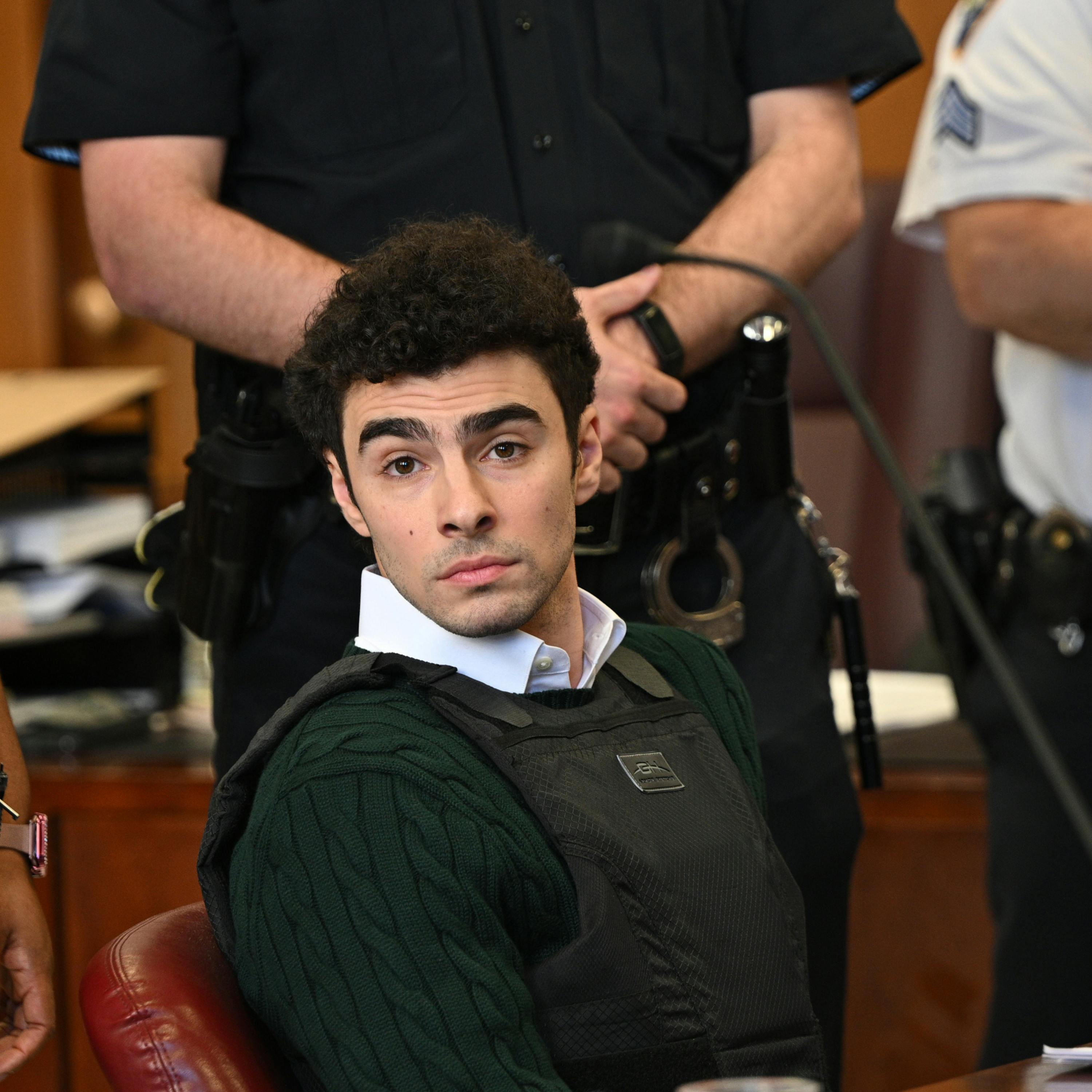
Luigi Mangione appearing at a February hearing for the murder of UHC CEO Brian Thompson. Photo by Curtis Means - Pool/Getty Images.
Learn more about your ad choices. Visit podcastchoices.com/adchoices
Press play and read along
Transcript
Speaker 1 Luigi Mangioni is supposed to be back in court on Friday, and court looks different when Luigi shows up.
Speaker 2 Luigi!
Speaker 3 The last time that I was in court with him,
Speaker 3 there were so many members of the public that wanted to be inside the courtroom, and so many of them were young women.
Speaker 1 Mangioni has a fan club.
Speaker 3 People outside with signs, people inside lining up. I mean, sometimes for a really long time to just want to get into the courtroom to see him.
Speaker 3 It's just a different experience than the people that you are typically seeing.
Speaker 1 What will be different this week is that it'd be the first time Mangioni appeared since the federal government, the Justice Department, Pam Bondi, Donald Trump have said they would like to seek the death penalty in this case.
Speaker 1 We're going to ask how that's going to go over in New York on Today Explained.
Speaker 4
Support for today's show comes from ATT, the network that helps Americans make connections according to ATT. When you compare, there's no comparison.
ATT
Speaker 5 with a Spark Cash Plus card from Capital One, you earn unlimited 2% cash back on every purchase. And you get big purchasing power so your business can spend more and earn more.
Speaker 5 Capital One, what's in your wallet? Find out more at capital1.com/slash Spark Cash Plus.
Speaker 8 Terms apply.
Speaker 1 Today, Explain Sean Robinson here with Samantha Max from Gothamis. Samantha, you've been covering Luigi Mangioni since we found out about Luigi Mangioni.
Speaker 1 He's scheduled to be in federal court tomorrow. What can you tell us about what we can expect from this hearing?
Speaker 3 Well, Mangioni is facing a few different cases. Two here in New York, also one in Pennsylvania, where he was arrested.
Speaker 9 The 26-year-old faces five charges in Pennsylvania, including forgery and possession of a gun without a license.
Speaker 3 In New York, he has already been indicted in state court.
Speaker 11 Mangioni was indicted on charges that included murder as an act of terrorism. The 26-year-old pleaded
Speaker 3 in federal court. What's going to be happening is he has been charged, but he hasn't actually been indicted.
Speaker 3 So the case would theoretically advance to another level where he could be indicted after a grand jury had considered the allegations against him.
Speaker 3 And then he actually has not entered a plea in his federal case. So he would be probably entering a plea if he were indicted.
Speaker 1 Why has he not yet been indicted federally? Do we know?
Speaker 3 That's a really good question that is not totally clear at this point, honestly.
Speaker 3 Every month for the last few months now, the government has asked for an extra 30 days to decide whether or not they're going to bring an indictment.
Speaker 1 And we know Pam Bondi came out and said that Mangioni will be facing the death penalty in this federal case. Is that right?
Speaker 3 So she has directed prosecutors in New York City to seek the death penalty.
Speaker 10 Bondi calling the killing a premeditated cold-blooded assassination and an act of political violence.
Speaker 12 If there was ever a death case, this is one. This guy is charged with hunting down a CEO, a father of two, a married man, hunting him down and executing him.
Speaker 3 I mean, this whole case is a bit unprecedented.
Speaker 3 And as we have seen with several other federal cases since the Trump administration has taken office, that they're not exactly always following the typical protocols.
Speaker 3 Mangioni's attorneys have filed papers challenging this request to seek the death penalty, calling out Pam Bandi for putting out this press release where they said that you know she didn't make it clear enough that these are only allegations that he is presumed innocent
Speaker 3 and actually in the government's response they were saying well it's way too early for the defense to be, you know, making a stink about the fact that there's this directive to seek the death penalty because we haven't even sought it yet.
Speaker 3 We haven't even indicted him yet.
Speaker 3 But of course, none of that would have been happening if it weren't for the Attorney General putting out this press release, also making an Instagram post saying that she wants the death penalty for Mangione.
Speaker 1 What was the Instagram post like? I'm afraid I missed it.
Speaker 3 It's like a pull quote
Speaker 3 from, yeah, from the press release.
Speaker 12 But then she actually went on Fox News and she was saying, I was receiving death threats for seeking the death penalty on someone who is charged with an execution of a CEO.
Speaker 12
We're going to continue to do the right thing. We're not going to be deterred.
The president's directive was very clear. We are to seek the death penalty when possible.
Speaker 1 Is the state of New York taking issue with the call for the death penalty? Because I believe in New York State, they do not execute prisoners anymore. Yeah.
Speaker 3 Well, the state actually, I mean, they have no say really on what punishment the federal government does or doesn't seek.
Speaker 3 You know, the federal government, they're going by federal law and they can do what they want. And even the crimes that Mangioni is accused of are pretty different from one to the other.
Speaker 3 In the state case, he's facing murder charges and actually terrorism charges.
Speaker 3 In the federal case, he's facing stalking charges, charges that he stalked this healthcare executive across state lines and killed him.
Speaker 3
So it's two different theories here. New York State does not seek the death penalty anymore in its state cases.
The highest court in New York has found that it is against the state's constitution.
Speaker 3
But in federal law, the death penalty is still allowed. It is still sought.
I actually covered a federal death penalty case here in New York City brought by the same prosecutor's office.
Speaker 3 That was for a man named Seifulo Saipov a few years ago.
Speaker 10 At least eight people are dead and 11 more injured after that pickup truck plowed through a busy bicycle path along the West Side Highway.
Speaker 13 Prosecutors say Seifalo Saipov smiled while talking to investigators and even asked to fly an ISIS flag in his hospital room after allegedly using his truck as a weapon to mow down people on a bike path in 2017, allegedly telling investigators his goal was to kill as many people as possible in order to become a member of ISIS.
Speaker 3 In that case, he was convicted, but there was this separate part of the trial where a jury then had to decide whether to give him the death penalty. And it has to be a unanimous decision.
Speaker 3
It's this whole long process. And in the end, they could not come to a unanimous decision to give him the death penalty.
So he was instead sentenced to life in a federal prison.
Speaker 1 And this was a mass murderer with fealty to ISIS that a jury could not decide to put to death.
Speaker 1 Does that mean it's not very likely that Luigi Mangioni, an alleged murderer who killed allegedly one person
Speaker 1 who's received unprecedented amounts of letters and has a fan club showing up to court whenever he might be there, who's on the face of votive candles?
Speaker 1 Does that make it much less less likely that a New York jury is going to put him to death? Or does that remain to be seen?
Speaker 3 I mean, I think that's a really good question. In Saipov's case, that was an incredibly emotional trial.
Speaker 3 You had the loved ones of people who had been killed testifying, talking about just the tragic loss of their family members and friends.
Speaker 3 You actually had surviving victims that were testifying about these horrible injuries and traumas that were lingering.
Speaker 3 And even after all of that, that jury decided we are not going to put this person to death.
Speaker 3 So for someone like Mangioni,
Speaker 3 you know, I could only imagine what it would be like for a jury to be making that type of decision. As you've said, he has garnered so much public support.
Speaker 14 The Ivy League Grant has received an outpouring of support and hundreds of thousands in donations to his legal fund.
Speaker 8 The Manhattan DA called anybody who supports Luigi extreme activists and a lawless mob. Very strong words coming out of the Manhattan DA just because we're tired of being bullied by CEOs.
Speaker 15
Are we supposed to hate this guy? Just ask for a jury trial, Luigi. Ask for a jury trial.
It's like everyone's behind you, bro. Except for the overlords, except for the CEOs, obviously.
Speaker 3
Though, of course, a few things. I mean, one, this is one of these cases where it's always the question of how much is what's on the internet real life.
And just because our perception of
Speaker 3 public opinion might be one thing because of how things are playing out on the internet, we don't know what it would be like for a jury, which, first of all, juries aren't always totally representative of society.
Speaker 3 It's, you know, it's a very particular group of people that is available to come to jury service and able to sit on what would likely be a very lengthy trial.
Speaker 3 But also,
Speaker 3 if this case does eventually go to trial, if there is eventually a death penalty phase, that will be a long time from now. These cases are very complex.
Speaker 3 They take a long time to get through all of the investigating, building the case, putting everything together. So we don't know how public sentiment will change between then and now.
Speaker 1 You can follow follow Samantha Max's coverage of Luigi Mangioni at Gothamist.com. Last year, Mangioni went on Goodreads to leave a review.
Speaker 1 He wrote, It's easy to quickly write this off as the manifesto of a lunatic in order to avoid facing some of the uncomfortable problems it identifies, but it's simply impossible to ignore how prescient many of his predictions about modern society turned out.
Speaker 1 He was writing about the Unibombers Manifesto, and we are going to talk about the enduring influence of that text when we return on Today Explained.
Speaker 9 Every story you love,
Speaker 2 every invention that moves you,
Speaker 16 every idea you wished was yours
Speaker 2 all began as nothing.
Speaker 16 Just a blank page with a blinking cursor.
Speaker 16 Asking a simple question.
Speaker 2 What do you see?
Speaker 16 Great ideas start on Mac.
Speaker 2 Find out more on apple.com slash Mac.
Speaker 4 Support for Today Explain comes from Wondery and their new podcast, Lawless Planet. It unfolds almost like a true crime podcast, I've been asked to tell you, but it is about the global climate crisis.
Speaker 4 complex stories wide-ranging happening in every corner of the planet. On Lawless Planet, the new podcast from Wondering, you will hear stories from the depths of the Amazon to small-town America.
Speaker 4 Host Zach Goldbaum takes you around the world as he investigates stories of conflict, corruption, resistance, and highlights activists risking their lives for their beliefs, corporations shaping the planet's future, and the everyday people affected along the way.
Speaker 4 Each episode takes you inside the global struggle for our planet's future, mysterious crimes, those high-stakes operations, those billion-dollar controversies that you do know so well.
Speaker 4 To reveal what's truly at stake, you can follow Lawless Planet on the Wondery app or wherever you get your podcasts. You can listen to new episodes early and ad-free.
Speaker 4 Right now, by joining Wondery Plus, in the Wondery app, Apple Podcasts, or Spotify.
Speaker 4 Support for today's play comes from Udacity. Udacity says they can help you prepare yourself to be able to use IT.
Speaker 4 Udacity is an online learning platform. It has courses in AI and tech, generative AI, agentic AI, Python, data science, so much more.
Speaker 4 When you learn with Udacity, according to Udacity, you're not just passively watching videos or reading articles, maybe even books, you're doing practical exercises and projects that prepare you for the job you want.
Speaker 4 That's why they claim 90% of Udacity graduates surveyed say they achieved their enrollment goal. Udacity just launched a master's degree in AI.
Speaker 4
When you have a certification from Udacity, they say recruiters and employers take notice. You can check out Udacity today.
The tech field is always evolving. You should be too.
Speaker 4
You can try Udacity risk-free for seven days. You can head to udacity.com/slash explained.
Use code explained for 40% off your order. Once again, udacity.com/slash explained for 40% off.
Speaker 4 Make sure you use the promo code explained.
Speaker 8 You're listening to Today Explained.
Speaker 17 So I stumbled across it on this reading list and I put it aside to read on the weekend.
Speaker 17 And I expected to be kind of perversely amused by the insane conspiratorial ravings of a madman, like an anti-tech Charles Manson, I suppose.
Speaker 17 And then I read it, and what struck me is how unconspiratorial it was.
Speaker 17
Kaczynski doesn't think there's an evil cabal of technocrats plotting to oppress us all. His entire worldview is evolutionary.
And so I thought, this is interesting as political theory.
Speaker 17 It's extremely radical and there's a lot I disagree with, but
Speaker 17 as a historian of political ideas, I thought it would make an interesting side project. And then it took on a life of its own.
Speaker 1
Sean Fleming is a research fellow at the University of Nottingham. Lately, he's been doing research on industrial society and its future by one Theodore Kaczynski.
He's better known as the Unibomber.
Speaker 1 The text is better known as the Unibomber's Manifesto. We reached out to him to ask how it may have influenced Luigi Mangioni.
Speaker 17 Well, I guess I want to be careful what I say about the relationship between Mangioni and Kaczynski, and also what I say about Mangioni in general. He hasn't been convicted of anything yet.
Speaker 17 And I haven't seen any hard evidence that Mangioni was inspired by Kaczynski. But there are some interesting parallels.
Speaker 17 So, assassinating corporate executives to create a media spectacle is straight out of the Unibomber's playbook.
Speaker 17 The assassin of Brian Thompson also left some engravings on the shell casings, which reminds me of the engravings that Kaczynski left on the components of his bombs.
Speaker 17 And more generally, Kaczynski and Mangioni are both disaffected overachievers. with backgrounds in STEM fields.
Speaker 17 So whether or not Mangioni was actually inspired by Kaczynski, he's precisely the sort of person who's likely to find the Unibomber's ideology compelling.
Speaker 1 For those who don't remember, who was he? What did he do? And how did people come to know him?
Speaker 17 Ted Kaczynski was born in Chicago in 1942, and he started out as a child prodigy in mathematics.
Speaker 17 He went to Harvard at the age of 16, and then he went on to do a PhD in mathematics at the University of Michigan. He was then hired as an assistant professor in math at Berkeley.
Speaker 17 And at that time, he was the youngest in the institution's history. But after two years at Berkeley, he abruptly resigned.
Speaker 17 And after a little while, he bought himself a piece of land outside Lincoln, Montana, where he built himself a one-room cabin. 10 feet by 12 feet with no electricity or running water.
Speaker 17 And from there, he launched his one-man war against modern technology.
Speaker 10 Another bombing is making the news tonight.
Speaker 9 The one-time mathematics prodigy played a deadly cat-and-mouse game with the FBI in a nationwide bombing campaign that stretched nearly two decades.
Speaker 17 So, the reason we're still talking about Kaczynski is that he managed to blackmail the media into publishing his writings.
Speaker 17 So, in April 1995, he sent a letter to the New York Times promising that he would stop bombing if his 35,000-word essay titled Industrial Society and Its Future were published in the Times or some other major newspaper.
Speaker 17 So the manifesto was published in the Washington Post on September 19th, 1995.
Speaker 1 Which I think is hard to imagine today, but hundreds of thousands of Americans were mailed a terrorist's manifesto.
Speaker 17
Yes, that's right. Without exaggeration, it might be one of the most read manifestos since the Communist Manifesto.
It was soon after published in paperback.
Speaker 17 It was also uploaded to Time Warner's Pathfinder platform. So it became what might be the first ever internet manifesto.
Speaker 17 And it's set the template for the manifestos that have become all too common in the aftermath of violent attacks.
Speaker 1 And it's very readable.
Speaker 1 It's got this sort of numbered format where the whole thing is broken down into categories with these sort of points made in every category.
Speaker 1
It's not the hardest read in the world. It isn't the scrawlings of a madman.
It's the ordered philosophy of
Speaker 1
a terrorist. He writes that we aren't the first to mention that the world today seems to be going crazy.
This sort of thing is not normal for human societies.
Speaker 1 There is good reason to believe that primitive man suffered from less stress and frustration and was better satisfied with his way of life than modern man is.
Speaker 1 I think a lot of people could find some truth in that statement. What was he trying to get across with this manifesto?
Speaker 17 In the passage you've just quoted, what he's arguing is basically that human beings are biologically maladapted to the modern world. This is a big claim from evolutionary psychology.
Speaker 17 The argument is that, biologically speaking, we're still Stone Age hunter-gatherers.
Speaker 17 We evolved hunting large animals on the savanna, and in the span of just 10,000 years, a blink in evolutionary time, we've constructed this world of concrete, steel, and screens.
Speaker 17 So Kaczynski argues that
Speaker 17 because of this, we suffer from depression, anxiety, eating disorders, substance abuse, and so many other psychological pathologies that so-called primitive human beings do not.
Speaker 1 And what's his solution?
Speaker 17 His solution is to destroy all modern technology and return ourselves to a more primitive condition, to crash out of the modern world.
Speaker 17 So basically what he envisions is a group of anti-tech revolutionaries sabotaging the electric grid, blowing up the gas pipelines.
Speaker 17 attacking the nervous system, so to speak, of modern society and plunging us back into, if not the Stone Age, then something like small-scale agriculture and a shepherd society.
Speaker 1 How was this manifesto received in the 90s when it was published by the Washington Post and delivered to, you know, front porches around the country?
Speaker 17 Well, there was a lot of debate about it, but overall, the reception of the manifesto was shockingly sympathetic.
Speaker 17 Many journalists treated Kaczynski as a serious intellectual, and many members of the public, in letters to the editor and on talk radio shows hailed him as a folk hero. Wow.
Speaker 17 He was often described as a modern-day Thoreau.
Speaker 17 So from 1995 through about 1997, he was hailed as this philosopher of the counterculture. But then in 1998, during his legal proceedings, a psychiatrist labeled him a paranoid schizophrenic.
Speaker 17 and portrayed his ideology as a sort of bundle of delusions.
Speaker 17 And the media took her word for it, and so did the public to a large extent. So Kaczynski fell out of fashion from the late 90s until the early 2010s.
Speaker 17 But then he was rediscovered as concerns about climate change, artificial intelligence, and the consequences of digital immersion became so much more salient.
Speaker 17 And his warnings about the negative consequences of modern technology began to seem prophetic to many people. So there's been a Unibomber revival.
Speaker 1 So who are the types of people who are
Speaker 1 glomming on to this manifesto?
Speaker 17 This too has changed significantly over time. So during the Unabomber mania of the mid-1990s, Kaczynski gained a following on the radical left, especially among green anarchists.
Speaker 17 But he's returned to cultural prominence with the opposite political valence. So today he's seen more as a figure of the right.
Speaker 17 As you may have noticed, he spends the first 3,000 words of his manifesto railing against leftism.
Speaker 17 And in the context of the culture war in the 2010s, conservatives rediscovered him. and rehabilitated him and co-opted him onto their side in the culture war.
Speaker 17 So Kaczynski has now been appropriated by neo-Nazis, eco-fascists, far-right accelerationists, a ragbag of people on the right who are drawn to his critique of leftism.
Speaker 1 Which is so interesting because Luigi Mangioni has
Speaker 1 been hailed as something of a hero on the left, right? How is it that Kaczynski appeals to a figure like Mangioni, but also neo-Nazis?
Speaker 17 What makes Kaczynski appealing to so many different sorts of radicals is that he defies easy categorization. And this makes his ideology sort of like an a la carte menu of ideas.
Speaker 17 So different radicals and reactionaries latch on to different aspects of his ideology.
Speaker 17 So for instance, green anarchists were enthralled with his critique of technology, while neo-Nazis, generally speaking, ignore the critique of technology and focus solely on the critique of leftism.
Speaker 1 This man ultimately is advocating for murder, if not mass murder, to achieve his aims. Does he ever show any remorse for that?
Speaker 17
No, he doesn't. He doesn't show any remorse for the people he killed in his bombings.
He says they're not innocent.
Speaker 17 At one point, he says the people who are responsible for the advancement of technology are worse than Stalin, worse than Hitler. What they're doing to humanity is even more grotesque, he says.
Speaker 17 But he does acknowledge that his anti-tech revolution would kill millions, if not billions, of people. This is an extremely apocalyptic vision.
Speaker 1 And even though his vision is apocalyptic,
Speaker 1 it was hugely influential and continues to be significantly influential.
Speaker 17 Many people read the manifesto and think,
Speaker 17 well, that's a good point.
Speaker 17 That's an interesting insight. But when he starts talking about about revolution,
Speaker 17 it's so omnicidal that it's impossible for most of us to take seriously.
Speaker 17 Many people accept the argument up until the point where he suggests that we should blow up the electric grid and knock ourselves back to the Stone Age.
Speaker 17 In other words, many people accept parts of his diagnosis of the problems with the modern world,
Speaker 17 but they're completely unwilling to take his prescription seriously.
Speaker 17
In the 90s, he looked like a one-off. He could easily be dismissed as an isolated crank with a sort of idiosyncratic ideology.
But in the 2020s, it looks like the world's caught up with him.
Speaker 17 And I think as concerns about the negative consequences of modern technology become especially acute, I think it will become increasingly likely that others will follow in Kaczynski's footsteps.
Speaker 1
Sean Fleming, University of Nottingham, famous for its sheriff. Hadi Mawagdi made our show today.
Jolie Myers edited Laura Bullard fact-checked Patrick Boyd and Andrea Kristen's daughter mixed.
Speaker 1 This today
Speaker 1 explained.
Speaker 6
Time. It's always vanishing.
The commute, the errands, the work functions, the meetings, selling your car?
Speaker 7 Unless you sell your car with Carvana. Get a real offer in minutes.
Speaker 6
Get it picked up from your door. Get paid on the spot.
So fast you'll wonder what the catches.
Speaker 7 There isn't one.
Speaker 6 We just respect you and your time.
Speaker 7
Oh, you're still here. Move along now.
Enjoy your day.
Speaker 6 Sell your car today.
Speaker 7 Car, Vana.
Speaker 6 Pickup fees may apply.
Speaker 8 This episode is brought to you by OnInvesting, an original podcast from Charles Schwab. I'm Kathy Jones, Schwab's chief fixed income strategist.
Speaker 8 And I'm Lizanne Saunders, Schwab's chief investment strategist.
Speaker 8 Between us, we have decades of experience studying the indicators that drive the economy and how they can have a direct impact on your investments.
Speaker 8 We know that investors have a lot of questions about the markets and the economy, and we're here to help.
Speaker 8 So download the latest episode and subscribe at schwab.com/slash on investing or wherever you get your podcasts.


