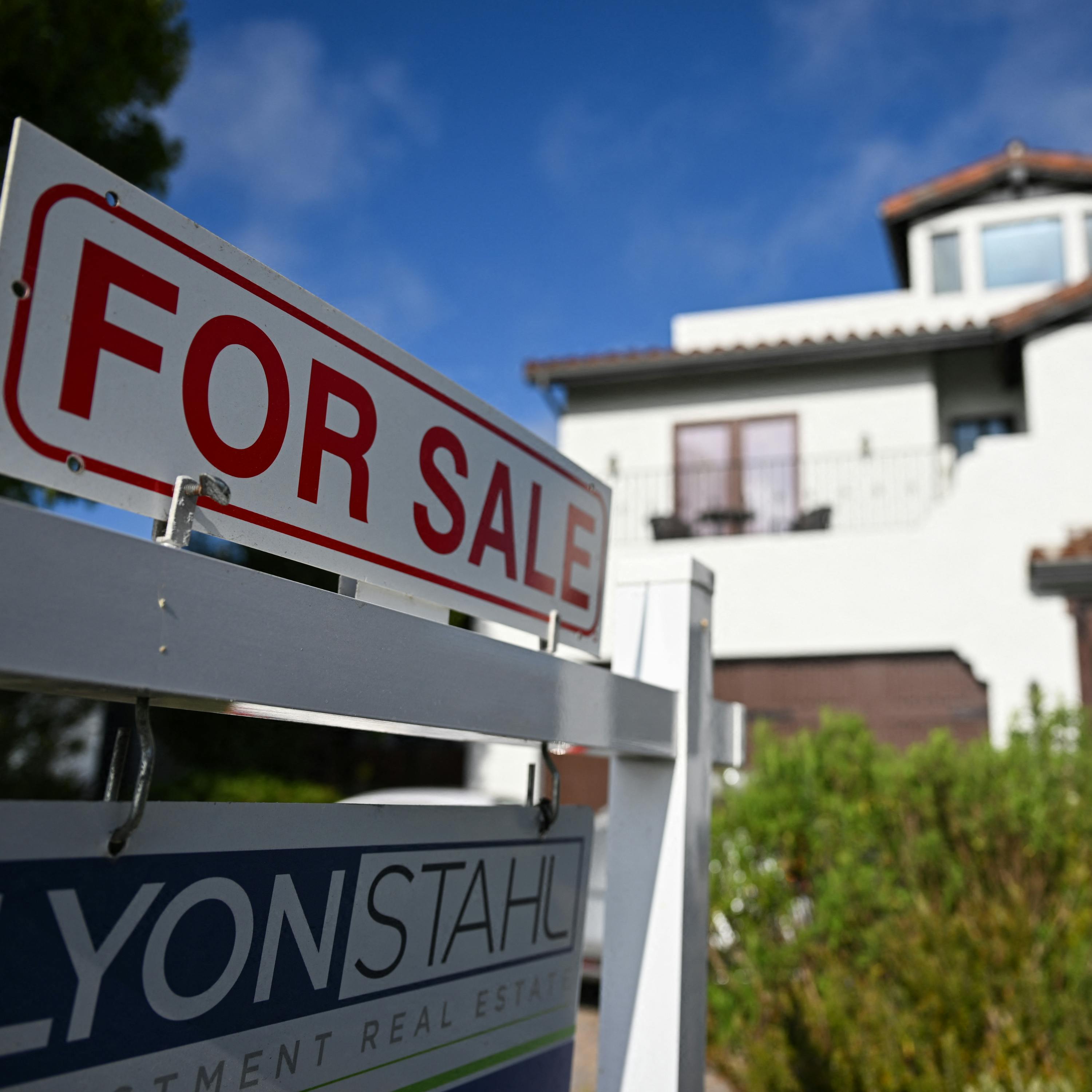
Is a house still a good investment?
If you have a question about a story that matters to your life, give us a call at 1-800-618-8545.
This episode was produced by Hady Mawajdeh and Carla Javier. It was edited by Miranda Kennedy, fact checked by Melissa Hirsch, engineered by Andrea Kristinsdottir and hosted by Jonquilyn Hill. Photo by PATRICK T. FALLON/AFP via Getty Images.
Learn more about your ad choices. Visit podcastchoices.com/adchoices
Press play and read along
Transcript
Speaker 1 Support for today's show comes from ATT, the network that helps Americans make connections according to ATT. When you compare, there's no comparison, ATT.
Speaker 2 With a Spark Cash Plus card from Capital One, you earn unlimited 2% cash back on every purchase. And you get big purchasing power so your business can spend more and earn more.
Speaker 2 Capital One, what's in your wallet? Find out more at capital1.com/slash Spark Cash Plus. Terms apply.
Speaker 3 Mortgage rates. I know they're not cute.
Speaker 3 Very ugly right now.
Speaker 4 Hey, I'm John Glenn Hill, and this is Explain It To Me, the show where you call 1-800-618-8545, and we find the answers to the questions that matter most to you.
Speaker 4 Miranda hails from the Twin Cities and called in with a question that's on more than a few people's minds.
Speaker 5 Is it worth it to buy a house? I think that's always been the go-to investment for like past generations of like you buy a house and that's kind of your retirement plan.
Speaker 5 And that just doesn't seem realistic or even attainable to buy a house. So it's like, should I even try to do it? Is that something I should do?
Speaker 4
This is a question I've wondered about too. Okay, I'm going to be honest.
I love to scroll through real estate websites, but should we we be buying homes?
Speaker 4 Given the economy and the interest rates, it can often feel like a fantasy. The market is just so much more different than it was when our parents were looking for starter homes.
Speaker 4 Is this really where our money should be going? To get an answer, I called up James Rodriguez, senior real estate reporter at Business Insider.
Speaker 4 Do you ever just like scroll through Zillow dreaming of what it would be like to own your own home? Or am I telling on on myself?
Speaker 6 Not at all. I do that all the time.
Speaker 4 So the conventional wisdom is that buying a home is the way to build wealth in here in America. Is that true? Has that ever been true?
Speaker 6 Definitely with past generations, and I think it especially has this hold on people today when they've seen, especially baby boomers who may have bought homes decades ago and have reaped all of the rewards from this really crazy moment in the housing market where prices jumped so substantially during the pandemic.
Speaker 6 If you compare the end of 2019 to the beginning of this year, home prices are up about 50%.
Speaker 6 So historically, we have seen people
Speaker 6 invest a lot in their homes. And
Speaker 6 for some people, it is absolutely true that they have reaped substantial rewards. I think it's important to look closer at that though and see that for some people it has been really perilous.
Speaker 6 There have been periods of home price declines. We saw this during the great financial crisis in 2008 when some people
Speaker 6 lost all the money that they had put into their homes because of the
Speaker 6
foreclosure crisis. And so I think it's important to recognize that while that has been true for some people, it hasn't been true for everyone.
And it may not be something that's true in the future.
Speaker 4 Yeah, I want to talk a little bit about why that conventional wisdom around home buying and building wealth isn't hitting quite like it used to. What's different for today's home buyers?
Speaker 6 I think we just see the affordability aspect. People are stretched so thin budget-wise.
Speaker 4 The majority of middle-class Americans say that they are struggling financially.
Speaker 7 Their financial stress has increased since before the COVID-19 pandemic began.
Speaker 8 So, when you look at inflation, economic instability, a lack of savings, all of these have increased the share of Americans feeling financially stressed.
Speaker 6 Mortgage rates, they went super low during the pandemic.
Speaker 6 They were at record lows, and that allowed people to get in because even if prices were rising, the rate on their loan was so low that you could kind of stomach the monthly payments and make it work.
Speaker 6 Whereas now we've seen mortgage rates rise to more than double those levels. And home prices haven't really stopped climbing, especially in areas where there's still not a lot of homes on the market.
Speaker 6 So there's uncertainty around just the future of the economy, interest rates are up. So that all of that together really makes it hard to see a future in which
Speaker 6 people who are already stretched thin renting, how do you save up money for a down payment? How do you justify these higher mortgage rates? And how do you bring it all together to become a homeowner?
Speaker 6 It's a real challenge right now.
Speaker 4 Is this the case in particular for Zoomers and millennials who are looking to buy homes in their 20s and 30s? Like, it just feels so, like, I don't know.
Speaker 4 I just think of, oh, baby boomers, they got to get their house for like $5 and now the rest of us have been priced out and they're aging in place. Like, there's just so much.
Speaker 4
And I don't want to just blame baby boomers. It's very easy to do that.
That's a little unfair. But yeah,
Speaker 4 what's keeping these younger generations out?
Speaker 6 It is easy to blame baby boomers, especially when they've been so fortunate in the housing market at large. But I think one of the things you have to think about too is the demographic side of things.
Speaker 6 And we had this huge wave of millennials, currently the largest living generation in the U.S.
Speaker 6 We knew that they were going to be hitting their prime home buying years around the turn of the decade, 2010s, going into 2020.
Speaker 6 And there was just not enough building happening after the Great Recession to keep up with all of that demand that was on the horizon.
Speaker 6 So you had people who were also starting to work remotely, and so they wanted more space.
Speaker 6 And it can be tough to have an optimistic outlook for home buying chances when all of these forces seem to be conspiring against younger generations in ways that older generations just didn't have to deal with.
Speaker 6 I think we're still feeling the effects of the Great Recession in that respect.
Speaker 9 A report released today by the National Association of Realtors paints a picture with housing data.
Speaker 10
The Great Recession hit, hits, employment there fell 1.5 million. We have not recovered that over all these years.
We are still short of around 500,000 workers in construction.
Speaker 6 Another reason why you saw home prices rise so dramatically is not only were millennials competing against their generation, but they were also competing against baby boomers in the market who had cash, who had substantial savings, and were able to, in a lot of cases, bid up home prices.
Speaker 6 And we're seeing, as you mentioned, baby baby boomers staying in their homes longer than ever. But eventually they will be aging out of the market, which is kind of a euphemistic way of saying dying.
Speaker 6 And
Speaker 6 when you look ahead to that and substantially less people competing for homes in the U.S., you see household growth slowing down as well, more deaths from boomers combined with lower birth rates over the next couple of decades.
Speaker 6 And all that equates to weaker demand for homes going from 2030 through 2040.
Speaker 4 Yeah, can you sort of run through kind of what the home buying experience and, you know,
Speaker 4 growth has been like from the boomer side and then sort of compare it to how it goes now?
Speaker 6 Yeah, so you think of a baby boomer who maybe they bought a home in 1994 and they hold on to it for the life of their mortgage for 30 years, and then they sold last year for if you look at typical home price increases, a 305% gain.
Speaker 6 So that's, you know, say they they bought a $300,000 home, it's worth more than a million dollars by the time they sell it.
Speaker 4 Woo, okay, you can retire with that.
Speaker 6 It's a crazy return. It's really mind-boggling to think about.
Speaker 6 And, you know, the same millennial who maybe bought a $300,000 home in 2010, they might not see as substantial increases over the next 30 years, but they still got to reap all the benefits of those crazy pandemic years when home prices were rising around 50%.
Speaker 6 And so you bring that forward and you consider all the gains since 2010. And then you look at people who are buying homes today and it starts to raise questions about
Speaker 6 will younger buyers today get the same financial benefits of home ownership as their predecessors.
Speaker 4 What would it mean for the economy if housing wasn't this go-to way? to build wealth? Like if that was not the answer for how do I get a net worth?
Speaker 6 I think that's a really interesting question, and one that honestly we don't know because for so long it has been looked at as the primary method of wealth building. You think about millennials,
Speaker 6 the typical elder millennial who's born in the 80s, they saw their wealth, the value of their assets increase by more than 57% just between 2019 and 2022.
Speaker 6 And 41% of that, 41 percentage points, was attributable to real estate.
Speaker 4 Wow.
Speaker 6 So it's a huge portion of people's assets. I think it's just
Speaker 6
tough because for every person who owns that real estate, it's all concentrated in this one asset that's not diversified. It's not like it's in the stock market.
And if
Speaker 6 one of the companies in your portfolio tanks, it's okay because you've spread out the risk amongst multiple companies.
Speaker 6 It's really all concentrated in this one thing that can be threatened by a wildfire or a flood.
Speaker 6 And that can be concerning for anyone looking at the housing market and seeing so much of that wealth concentrated in homes.
Speaker 4 That threat of wildfires and floods James mentioned, it's real.
Speaker 4 How much has climate change raised insurance prices and how much should we really worry about that when we are thinking of buying a home? That's coming up after the break.
Speaker 11 Every story you love,
Speaker 11 every invention that moves you,
Speaker 11 every idea you wished was yours,
Speaker 11 all began. as nothing.
Speaker 11 Just a blank page with a blinking cursor.
Speaker 11 Asking a simple question.
Speaker 11 What do you see?
Speaker 11 Great ideas start on Mac.
Speaker 11 Find out more on apple.com slash Mac.
Speaker 1 Support for JExplain comes from AT ⁇ T. There's nothing worse than needing to make a call and realizing you can't connect says AT ⁇ T.
Speaker 1 And of course, every wireless provider will claim that they're the best, but AT ⁇ T says AT ⁇ T has the goods to back it up.
Speaker 1 According to Root Metrics, AT ⁇ T earned the best overall network performance.
Speaker 1 While the other guys are busy making claims they can't keep, AT ⁇ T says they're making connections on America's fastest and most reliable wireless network.
Speaker 1
No matter if you're at a concert, a huge sporting event, or just out enjoying nature, you can post when you want to post. Don't post when you're enjoying nature, guys.
Keep it in control.
Speaker 1
Call when you want to call and rest easy knowing that no matter where you go, AT ⁇ T has got you covered. When you compare, there's no comparison.
AT ⁇ T.
Speaker 1 Based on Root Metrics United States Route Score Report 1H2025 tested with best commercially available smartphones, smartphones on three national mobile networks across all available network types, your experiences may vary.
Speaker 1 Root Metrics rankings are not an endorsement of AT ⁇ T.
Speaker 4
We're back. It's Explain It to Me.
And we're talking about whether it's a good idea to buy a house these days. It's 2025 and climate change is definitely a factor.
So I called up Dr. Jeremy Porter.
Speaker 4 He heads up research into housing and climate for First Street. They analyze the climate risk of homes and share that analysis with websites like Zillow and Redfin.
Speaker 15 It really is the point at which
Speaker 15 your standard American feels climate change.
Speaker 16 I mean, we're seeing that there's more hurricanes, breaking news, Hurricane Barrow, slamming Texas, making landfall just a few hours ago near.
Speaker 17 Transcrian is now a hurricane in the Gulf of Mexico, heading for Louisiana.
Speaker 18 Whipping winds, torrential downpours, and communities submerged. Hurricane Debbie wreaking havoc across the coast.
Speaker 19 This is the city of Asheville in the western mountains of North Carolina, 2,000 feet above sea level and hundreds of miles away from the nearest coastline.
Speaker 19 But such was the force of Hurricane Helene.
Speaker 15 We're seeing that there's more extreme precipitation events. What we saw in LA is that there's more wildfires, more severe wildfires than we've seen in the past.
Speaker 15 But the way that it's affecting individuals is that we're seeing more property damage, more people be impacted by these events directly to their properties or to their communities.
Speaker 20 Fear and concern is growing tonight as flames light up the Los Angeles hillsides. Firefighters are scrambling to contain several major fires tonight.
Speaker 20 Just into our newsroom, we are learning of another fire erupting this time in Sylmar in the San Fernando Valley.
Speaker 21 Overnight catastrophic damage reported as severe storms slam the central U.S. A tornado emergency in northeastern Arkansas, powerful twisters destroying homes.
Speaker 21 In Missouri, an EF1 tornado, winds nearing 100 miles an hour, causing widespread destruction in the town of Nevada. Homes and businesses reduced to rubble.
Speaker 15 Lots of times people live in places like Miami or they live in Houston and they'll say, oh, you know,
Speaker 15 the weather's always been like this in the area that that I'm at. And they'll say, well, what about insurance? And they'll say, well, insurance is killing me.
Speaker 15 And lots of times people won't make the connection that the reason insurance is spiking is because there's more damages and there's more payouts from the insurance companies.
Speaker 4 That's really interesting.
Speaker 4
Our caller is in her late 20s, Miranda. She lives in the Twin Cities and she's considering whether buying a house is the right decision for her.
What would you say to someone like her?
Speaker 15 I think we're at a point at which we finally have data to help make decisions like this.
Speaker 15 And I think one of the biggest problems that we've seen so far in the way that climate and real estate are being covered is that climate's driving down the value of home prices.
Speaker 15 It's sort of reversing the trend that we've had in the U.S. for a century where the American dream was owning a property and people have aspired to do that.
Speaker 15 I think what we're seeing though is that there's a lot more nuance to the decision-making process than simply avoiding homeownership because of climate risk.
Speaker 15 I don't think people should avoid home ownership. I think it's still a good investment.
Speaker 15 I think that there are ways to optimize that process now, though, that do include taking climate into account the same way we've taken other factors into account in the past.
Speaker 15 How do I, you know, optimize the home buying process so that I'm reducing the risk and maybe I'm buying a home that has, you know, a flood score of a five instead of a flood score of a 10.
Speaker 4 What's an example of that?
Speaker 15 The quintessential example in Miami has been sort of this movement from parts of the Miami Beach, sort of coastal region, into an area called Little Haiti that's further inland in Miami-Dade County.
Speaker 15 It's right along the railroad tracks. It's the high point of Miami-Dade County.
Speaker 15 And people on the real estate market at that time were asking their realtors for, you know, three bedrooms, two bathrooms, 2,000 square feet, and a certain level of elevation.
Speaker 15 They wanted to be a certain level above sea level because of tidal flooding and because of increasing sea level,
Speaker 15 tidal flooding events along the coast and sort of the limestone bedrock in Miami meant there really wasn't anywhere safe.
Speaker 15 The water got underground and it rose up through the ground, but high points, places like Little Haiti became much more valuable than they had been prior to this because people were aware of the flooding risk within that market.
Speaker 4 I wonder how all of this plays a role in like inequity and gentrification and things like that. Like who's getting pushed where? Who's having the impacts of climate change? Yeah.
Speaker 15 And that Miami example that I gave earlier, it was part of an analysis back in 2017. And the title of the paper that it came out in was called Climate Gentrification.
Speaker 15
It was people leaving the Miami Beach area. moving into the Little Haiti area, which had been a less desirable area.
It was primarily
Speaker 15
a more vulnerable socioeconomic community, a minority community. And people were moving in.
They were driving up the cost of real estate in the area. So having the information and integrating it into
Speaker 15 the process of the home buying
Speaker 15 process, I guess, it does have consequences in terms of potentially giving those that have the means to avoid climate risk, the ability to do so.
Speaker 15 And those that don't have the means are ultimately unable to.
Speaker 4 You know, we've been talking about these climate scores as a way to help people
Speaker 4 find a home to buy, but so much of our wealth in America is tied up in home ownership. I wonder if there's a flip side to this where it's negatively impacting home values.
Speaker 15 There absolutely is a negative impact to having a high climate risk score.
Speaker 15 I think we've already seen, even through the integration of the data on like on one of the sites on redfin.com, they did an analysis where they exposed half the people that came to the site to the data.
Speaker 15 They didn't expose the other half of the people to the data. And the people that were exposed to the data systematically searched for lower-risk homes.
Speaker 15 That means the higher-risk homes are staying on the market longer. They have lower list-to-sale prices or sale-to-list prices, sorry,
Speaker 15 on the market, and they are losing property value because of that. Ultimately, that makes its way into the transaction record and depresses the value of property value
Speaker 15 in specific neighborhoods.
Speaker 4 Overall, how much of a science versus an art is it to factor in climate change predictions? Like,
Speaker 4 you know, there's geopolitics, there's a human factor on top of weather and all these external events. Like, how do you do that?
Speaker 15 Yeah, and it's an important part of our analysis because a lot of research that exists today basically says, hey, sea level rise is happening on the coast.
Speaker 15 Millions of people are going to move away from the coast.
Speaker 15 But if you just, if you go back and model the data historically and you layer in, to your point, all of this geopolitical information, all of this economic investment information, really the
Speaker 15 social, political, and economic drivers of place, why people choose to live where people end up living, those things outweigh climate risk in a lot of cases.
Speaker 4 Okay, so the story is bigger than just climate. And in fact, the story of home buying is bigger than any one single factor.
Speaker 4 What that means for those of us still considering opting into the home ownership society, and also what to do if you aren't. That's coming up after this break.
Speaker 1 Support for Today Explained comes from Bambas. Putting on a new pair of socks can instantly feel refreshing, according to Bambas, especially according to Bombas, if they're Bombas socks.
Speaker 1
Bombas makes socks for just about any activity. Your warm merino wools, your comfortable compressions, your cushioned running socks, and so much more.
High-quality slippers, t-shirts, mudans.
Speaker 1 Nisha Chital, try Bombas. Here's what she thinks.
Speaker 22 Bombas has great kid socks. I have a three-year-old.
Speaker 22 She runs around a lot indoors in her socks, and she's often slipping on the hardwood floors.
Speaker 22 But Bombas kids' socks have grips on the bottom, and they're really great to prevent that slipping around on hardwood or tile floors.
Speaker 22 So, we love those for her. They're definitely our preferred socks for our daughter.
Speaker 1 Bombas says that for every pair of bombas you buy, they donate one to someone facing homelessness. Anytime you get something cozy, someone else can too.
Speaker 1 According to Bombas, you can go to bombas.com/slash explain and use code explain for 20% off. Your first purchase, that's bombb-as.com/slash explain, code explain to checkout.
Speaker 2
With the Spark Cash Plus card from Capital One, you can earn a limited 2% cash back on every purchase. And you get big purchasing power.
So your business can spend more and earn more.
Speaker 2 Stephen, Brandon, and Bruno, the business owners of SandCloud, reinvested their 2% cash back to help build their retail presence. Now, that's serious business.
Speaker 2 What could the Spark Cash Plus card from Capital One do for your business? Capital One, what's in your wallet? Find out more at capital1.com slash spark cash plus. Terms apply.
Speaker 4 We're back. This is Explain It to Me, and I was super excited to get to call up our next guest.
Speaker 3 Hey, I'm Mandy Woodruff Santos, and my podcast is called Brown Ambition.
Speaker 4 Okay, so I have to admit, I am a brown ambition listener. You know, I'm trying to get my big girl finances in order.
Speaker 4 So I'm very happy to be talking with you today about homeownership, which feels like one of the big girl finance things.
Speaker 3 Yeah, it sure is, isn't it? I mean, at least that's what society wants us to think. Got to get a Birken, got to get a home.
Speaker 4 Big Birkin, big hole, five, six, figgish.
Speaker 3
Are you a homeowner? I am. Yeah, I am.
I bought my house in 2018, which feels like a thousand years ago. This is pre-motherhood, pre-pandemic.
Speaker 3 And at the time, our total mortgage, which included property tax and the actual loan monthly principal that we were paying, was about $2,700. That's increased a thousand bucks since then.
Speaker 3
So now I'm spending $3,600. So nearly $4,000.
Oh my gosh. And I'm like, oh, I'm reminded.
Oh, yeah, that's why. I always feel broke.
Speaker 4
Yeah, it's interesting. This question we got jumped out to me because it's one that I have too.
So I'm a renter and I have a lot of friends who have bought or are just starting to buy.
Speaker 4 And I admit that I have not completely given up a little bit of a dream of owning a sexy condo in the city. Like that is how I see it.
Speaker 4
I don't know if I like I'm not trying to have a yard or anything, but you know, I could, I could live in a condo. Yards are overrated.
So I support that. Yeah.
Speaker 4 And we've been told for years that buying a home is this important milestone for adulthood. And, you know, it's this first step to building equity and wealth and generational wealth.
Speaker 4 I wonder what you make of the question from our listener. Like, should she buy a house? Is this something she should be working towards?
Speaker 3 There's all sorts of like different trains of thought about is it a good investment to buy a house? And I think you have to understand why you're buying a house.
Speaker 3 Are you buying a house for your family to live in for the next 10 plus years? That's a very different equation to me than are you buying a home that you're hoping to fix up.
Speaker 3 flip on the market in a year or two.
Speaker 3 Now, if you really want to buy a house and it is your dream and you love everything that you understand what goes into it, you understand, listen, I didn't understand how much property taxes could be.
Speaker 3 I thought my mortgage was just going to be my mortgage, but you add in property taxes. It just about doubled it, which was crazy to me.
Speaker 3 If you understand maintenance, if you understand
Speaker 3 how property values can, yes, typically they do go up, but how they can be impacted by things like development and by weather patterns, like global warming is real.
Speaker 3 If you understand all these things and you still really want to buy a house then yeah go get your house especially if i mean like the ultimate thing is can you afford it of course mortgage rates i know they're not cute right at all very ugly right now to me but they're not as ugly as they could be like in the 80s you know people were just walking out the door with like double digit interest rates like it was nothing that was like the norm right so they're not great but they're not the worst they've ever been what's more difficult these days is inventory what i wouldn't do today is because because there's such like a dearth of good properties on the market, I wouldn't just buy whatever's there just because you want to buy something.
Speaker 3
Like, I got to get it. You know, I would, if you can, wait, wait until you find a home that you really like that fits all your needs.
It's worth it.
Speaker 4
Yeah. So if you sit down and you go through these numbers, you do the checklist, you find out where you are emotionally, lifestyle, and you're like, okay, buying a house.
That is for me.
Speaker 4 That is what I want to do.
Speaker 4 What are the first steps? What do you suggest that a person do?
Speaker 3 Look at your credit score because your credit score is going to determine how expensive that mortgage is going to be.
Speaker 3 And, like, we're assuming, right, that people are going to be taking out a mortgage. If you got cash to buy a house, that's a whole other conversation.
Speaker 4 Like, you're a different person than we talk about right now.
Speaker 3 You want to avoid making any big taking out additional loans six months before you're going to apply for a mortgage because mortgage lenders don't like to see new debt right before they're going to potentially approve you for a loan.
Speaker 3 Ideally, you're not going to have a fluctuation in income, like household income.
Speaker 3 So you want to save up for that down payment, of course, but also think about also saving up for a few months of your household income just to have it on the side.
Speaker 3 Another thing to consider is how much do you want to put down for your down payment?
Speaker 3 There are, if you're a first-time homebuyer, I would absolutely spend time researching first-time homebuyer programs. There are some through the federal government.
Speaker 4 When people are looking at their finances, is there a limit on how much they should budget for home ownership-related costs?
Speaker 3 Look at your monthly income. Look at it, guys, post-tax.
Speaker 3 And look at maybe 25 to 35% of it. If you live in a more high-cost area, it just may be more realistic to look at that, like, you know, 30% to 40% range and even up to 50%.
Speaker 3 And that's what I would cap your monthly housing expenses at.
Speaker 3 I mean, the worst thing you can do is buy a property and then end up getting into it and all your bills start hitting and you're like, wait, what?
Speaker 3 Right. Like, how am I supposed to afford all of this? And then you're, you're stopping investing, you're stopping, you know, contributing to your savings account and debt starts getting not paid back.
Speaker 3 And then you're just in a real difficult position.
Speaker 4 That's if you want to buy a home, but say you can't buy a house or, you know, there are some of us who just don't want to.
Speaker 4
How do you build that equity? Because home ownership is kind of raised as this. This is how you do it.
This is how you get a net worth. This is how you do X, Y, Z.
Speaker 4 What if you don't want to buy into that?
Speaker 3 What can you do? Oh, you get some Bitcoin, obviously. No, just kidding.
Speaker 4 Duh.
Speaker 3 No,
Speaker 3
listen, homeownership. Yes, a home can be a vessel for, you know, increasing equity and building wealth.
And that's true, but it is not the only game in town.
Speaker 3 Like, ever heard of index funds, mutual funds? You should be investing through your 401k. And in fact, like, we, no one can predict the market, right? No one can predict.
Speaker 3 I could not have predicted that I would have bought one of the last homes in this. It feels like that because there's such low inventory where I am.
Speaker 3
And so, yes, my, my home value has gone up something nuts. I don't even, I think my house was valued at 400.
We bought it for 445. Now it's worth like 700,000 or something.
Speaker 4 Wow.
Speaker 3
It's not though. Like, I don't know.
People be buying houses out here for for way too much money.
Speaker 3 I just can't, you will not catch me dropping 700K on, you should see what a million dollar home is these days. It is depressing.
Speaker 4 Yeah. Yeah.
Speaker 3 So you can absolutely invest in the stock market, invest through your 401k, max out your Roth IRA, invest in yourself.
Speaker 3 Can we make that normal again? And I don't mean go get a brand new degree. I mean, what do you value in life? Do those things.
Speaker 3 One of the myths that I kind of fell into when I became a homeowner was was that you would have these tax benefits of being a homeowner.
Speaker 3 That really changed with the 2017 jobs, tax and jobs cut act, whatever Trump put in effect back then.
Speaker 3 And like the amount that you can actually get, you know, how much you can reduce your taxable income as a homeowner has gotten a lot less attractive.
Speaker 3
I haven't, the most tax breaks I've gotten is when I open my LLC. And I'm not trying to sugarcoat the entrepreneur lifestyle.
It ain't for everybody.
Speaker 3 But when I say invest in yourself, maybe it's investing in a business idea that you have.
Speaker 3 Who's to say that your business, you know, if it's a, if it does well, that it couldn't do better on the return on investment than a home?
Speaker 6 Who knows?
Speaker 4 That's Mandy Woodruff Santos. You can find her on her podcast, Brown Ambition.
Speaker 4 We're working on a show about what to do after you graduate.
Speaker 4 If you're in middle school or high school and have thoughts about what you want to do after you get your diploma, give us a call, 1-800-618-8545.
Speaker 4 This episode was produced by Hadi Mawagdi and Carla Javier, who also runs our show.
Speaker 4 It was edited by a different Miranda than our caller, Miranda Kennedy, with fact-checking by Melissa Hirsch and Engineering by Andrea Christensdaughter. Special thanks to Bird Pinkerton.
Speaker 4
I'm your host, John Glenn Hill. Talk to you soon.
Bye!
Speaker 12 Oh, the car from Carvana's here.
Speaker 12
Well, will you look at that? It's exactly what I ordered. Like, precisely.
It would be crazy if there were any catches. But there aren't, right? Right.
Speaker 14 Because that's how car buying should be. With Carvana, you get the car you want.
Speaker 12
Choose delivery or pickup and a week to love it or return it. Buy your car today with Carvana.
Delivery your pickup fees may apply. Limitations and exclusions may apply.
Speaker 12 See our seven-day return policy at Carvana.com.
Speaker 13 Support for this show comes from Capital One. With the Spark Cash Plus card from Capital One, you earn an unlimited 2% cash back on every purchase.
Speaker 13 Plus, no preset spending limit helps your purchasing power adapt to meet your business needs. Capital One, what's in your wallet? Find out more at capital1.com/slash spark cash plus.
Speaker 13 Terms and conditions apply.


