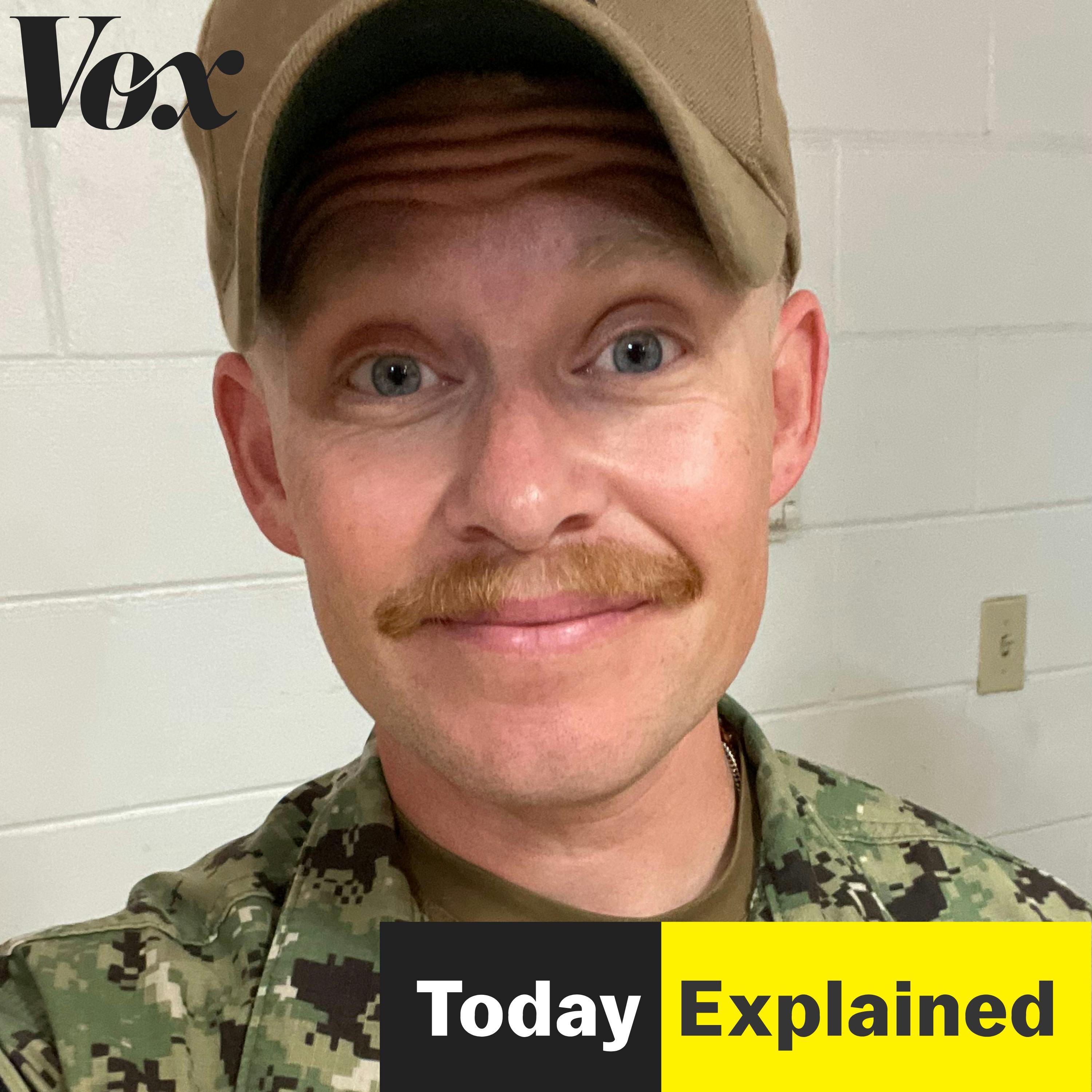
Serving your country while trans
This episode was produced by Victoria Chamberlin, edited by Amina Al-Sadi, fact-checked by Laura Bullard, engineered by Patrick Boyd and Andrea Kristinsdottir, and hosted by Noel King.
Transcript at vox.com/today-explained-podcast
Support Today, Explained by becoming a Vox Member today: http://www.vox.com/members
Photo courtesy of Navy Petty Officer Sam Rodriguez.
Learn more about your ad choices. Visit podcastchoices.com/adchoices
Press play and read along
Transcript
Speaker 1 President Trump addressed the Congress last night. You heard that.
Speaker 2 Uganda.
Speaker 1 But let's check in on Secretary of Defense Pete Hegseth. He tweeted from the car on his way to the address.
Speaker 2 It is an honor to be going.
Speaker 1 He tweeted again a thank you after Trump mentioned him.
Speaker 3
Our service members won't be activists and ideologues. They will be fighters and warriors.
They will fight for our country. And Pete, congratulations.
Speaker 1 Then he went on Fox News this a.m. to discuss enlistment numbers.
Speaker 4 From the Marine Corps to the Army to the Air Force to the Navy, we've seen record numbers across the country of Americans saying, I want to serve under the Commander-in-Chief, President Trump.
Speaker 1 So neither Hegsteth nor the president mentioned their plan to force transgender service members out of the military.
Speaker 5 Today, Unexplained, we're going to do that.
Speaker 6 There are so many things that I would not have today if it wasn't for joining the military. I would regret not fighting to stay.
Speaker 5 Support for Today Explained comes from BetterHelp. BetterHelp says it's winter and winter is often depressing.
Speaker 5 Instead of getting depressed, BetterHelp wants to encourage you to reach out to someone, perhaps get coffee with an old friend, perhaps write a letter to a family member, perhaps connect with a licensed therapist using BetterHelp.
Speaker 5 This month, don't wait to reach out, says BetterHelp.
Speaker 5 Whether you're checking in on a friend or reaching out to a therapist yourself, BetterHelp makes it easier to take that first step, says BetterHelp.
Speaker 5 You can get 10% off your first month at betterhelp.com/slash explained. That's betterhelp.com/slash explained.
Speaker 5 With a Spark Cash Plus card from Capital One, you earn unlimited 2% cash back on every purchase. And you get big purchasing power so your business can spend more and earn more.
Speaker 5 Capital One, what's in your wallet? Find out more at capital1.com/slash spark cash plus. Terms apply.
Speaker 1 this is today explained noelle king here with haley britzki haley is cnn's pentagon reporter and producer and she's been following the dod's plan to separate transgender service members from the military haley what does this new pentagon policy say exactly Individuals who have a diagnosis or history of gender dysphoria are no longer eligible to serve.
Speaker 7 serve.
Speaker 3 As of today,
Speaker 3 it will henceforth be the official policy of the United States government that there are only two genders, male and female.
Speaker 7 All service members will identify as only either male or female, which the policy says is unchangeable during a person's life. And it says their pronouns must reflect that.
Speaker 7 And it also disqualifies the use of DOD funds for medical procedures and things like hormone therapy and other procedures related to gender transition and things like that.
Speaker 7 It lays out exceptions for individuals currently serving in the military who will be separated under this policy.
Speaker 7 You know, it'll be a case-by-case basis of if a service member is kept in the military despite having a history or a diagnosis of gender dysphoria, if there is a, quote, government interest in keeping them in uniform because they directly support what they say is warfighting capabilities.
Speaker 7 It also says that they, you know, there are other exceptions exceptions.
Speaker 7 And if they have 36 months of what they say, stability in their sex and can demonstrate they've never attempted to transition and that they can adhere to the standards laid out in the military.
Speaker 7 So they lay out a few exceptions for people. It's kind of unclear how many people will fall into that category.
Speaker 7 And especially when we talk about warfighting capabilities, well, what does that actually mean? How will commanders view that or define that within this process?
Speaker 7 All of that is still kind of in a gray area at this point, as we haven't really started separating people quite yet.
Speaker 1 Do we know how many people this will affect?
Speaker 7 We heard last week, a senior defense official told reporters that there were a little over 4,000 troops who'd been diagnosed with gender dysphoria across all three components.
Speaker 7 So that's active duty, military, national guard, and the reserve.
Speaker 7 You know, important to note that not all transgender people have a medical diagnosis of gender dysphoria. So it's kind of unclear how many people at the end of the day this is really going to impact.
Speaker 7 Between 2014 and 2025, roughly 1,000 individuals in the military received gender-affirming surgery.
Speaker 7 So
Speaker 7 that's sort of what we're waiting to see is, okay, in practice, how many people will be impacted by this? And ultimately, how many would be eligible for waivers or even want to seek a waiver?
Speaker 1 President Trump and Pete Hegseth, the Secretary of Defense, have they come out and said why they think people who are trans are unfit to serve their country?
Speaker 7 So a lot of times what we hear is that this is tied to their deployability.
Speaker 8 Being transgendered in the military causes complications and differences.
Speaker 7 Meaning that, you know, if an individual is undergoing a medical procedure, they may be considered non-deployable for so much time.
Speaker 7 That also is the case for pregnancy or for specific injuries or bone breaks, things like that. A non-deployable status is not specifically tied to gender dysphoria or transgender individuals.
Speaker 7 So that's oftentimes one of the reasonings that they use.
Speaker 7 But what we see in the executive order and then in the Pentagon policy that resulted from it is they kind of go a step further than just focusing on the medical readiness of these individuals.
Speaker 7 They kind of hone in on their value system and morals by saying that individuals who have gender dysphoria or have been diagnosed with gender dysphoria, that they are inconsistent with the honesty, humility, and integrity that's required in the military.
Speaker 8 In search of a non-traditional constituency, they offended their core constituency. So there aren't enough lesbians in San Francisco to man the 82nd Airborne.
Speaker 8 And in
Speaker 8 trying to cater to that, they lost the boys from Tennessee and Kentucky and Oklahoma.
Speaker 8 The traditional dudes who did it because they wanted, they loved their country or they wanted the adventure or they wanted to try tough things or.
Speaker 7 It goes a step further than just saying medically you may not be able to serve, physically you may not be able to serve.
Speaker 7 It's saying that you do not align with our values of humility and integrity and honesty.
Speaker 7 That is sort of has
Speaker 7 been made policy by existing in the executive order and within this new policy memo from the Pentagon. But we haven't seen a lot of explanation of that that point just yet.
Speaker 1 So the military is using the word separation, which is the word that it generally uses in cases like this. But it means people are losing their jobs.
Speaker 1 For people who are losing their jobs and didn't expect to lose their jobs,
Speaker 1 what are they receiving?
Speaker 7 What the memo says is that if you elect to voluntarily separate within 30 days of that memo, you will get two times the separation pay as if you wait to be involuntarily separated.
Speaker 7 And separation pay is, you know, it's kind of a complicated calculus, but it's essentially boils down to it's calculated on how long you've served in the military and what you were getting paid at the time of your separation.
Speaker 7 And so the Pentagon is saying, hey, if you are a transgender individual or an individual who's been diagnosed with gender dysphoria, if you know that you are going to be involuntarily separated under this policy, you can go ahead and start the process yourself.
Speaker 7 And by voluntarily separating, you'll get paid twice as much.
Speaker 7 And so we don't have a lot of answers as to, you know, when, how that will be calculated or what that will really look like in practice, other than it's clearly an incentive hoping to get individuals to start the process sooner rather than later of separating themselves from service.
Speaker 1 We're assuming there will be legal challenges, and we're in an environment where it's hard to tell what a legal challenge might lead to.
Speaker 1 But during President Trump's first term, as I recall, there were legal challenges to some of what he tried in the Pentagon.
Speaker 9 The ACLU of Maryland filed a lawsuit challenging the president's ban on transgender individuals in the military.
Speaker 7 They're asking for a preliminary injunction on the ban that was signed by President Trump over the summer after first announcing his intentions on Twitter.
Speaker 1 Can you take us back and tell us, as we start to see lawsuits and look for lawsuits, what we might be looking at here?
Speaker 7 Yeah, so there was legal challenging in 2017
Speaker 7 to the ban that he issued then. I think it was at least four different lawsuits who were saying that this was a form of sex discrimination.
Speaker 7 The Supreme Court let that ban take effect just a couple years later in 2019.
Speaker 9 The justices did not rule on the merits of a lawsuit challenging the ban, but will allow it to move forward while lower courts work through it.
Speaker 7 So it did move forward in that sense. And then President Biden, when he took office, reversed it.
Speaker 10 And what I'm doing is enabling all qualified Americans to serve their country in uniform and essentially
Speaker 10 restoring the situations existed before where transgender personnel, if qualified in every other way, can serve government in the United States military.
Speaker 11 It's not so about to sound.
Speaker 7 So this is essentially a reversal of a reversal of the original policy saying that this is going to move forward. So yeah, it's unclear where the legal status or where legally this
Speaker 7 memo or this policy can move forward, given the new lawsuits against it.
Speaker 7 It's, you know, we may see it end up back in higher court. It's kind of unclear at this point where it's going to go, but it's certainly something that is playing out in the courts.
Speaker 7 And, you know, just as recently as this weekend, we saw more filings in which the Defense Department was given a Saturday deadline to answer some questions from the courts, which included things like
Speaker 7 how much money has the department spent on some of these procedures? And how many people are included under this definition?
Speaker 7 Many of the questions they could not answer in the filings, saying that essentially they didn't have enough time to figure this out, that it would have taken a few more weeks than they were allowed.
Speaker 7 But it's still very actively being debated in court and certainly something that we're going to be continuing to follow.
Speaker 1 When do these separations have to be done by? What's the the deadline here?
Speaker 7 For those who are voluntarily separating, as I said, that's they have, if they have 30 days to elect to voluntarily separate.
Speaker 7 Outside of that, the policy says that the service secretary, so Secretary of the Army, of the Navy, Air Force, et cetera, that they need to begin establishing procedures to identify those troops within 30 days for separation and then begin separating them 30 days after that.
Speaker 7 So it sounds like roughly 60 days before separations will officially begin within the military services.
Speaker 1
That was Haley Britsky. She covers the Pentagon for CNN.
Coming up, so you've been serving honorably, and now you're out. We're going to hear what that's like.
Speaker 6 I feel a lot of anger.
Speaker 6 I feel,
Speaker 6 and not just anger because
Speaker 6
of a ban. I feel a lot of anger and disappointment at large.
Just,
Speaker 6 you know, trans and non-binary people have become public enemy number one.
Speaker 6 And once you start taking away the rights of trans and non-binary people, then the rest of the chips begin to fall.
Speaker 5 Support for Today Explain comes from Indeed. Indeed says if you're looking to hire, you can give your job posting the best chance to be seen with Indeed sponsored jobs.
Speaker 5 With sponsored jobs, Indeed, boosts your post so that it is more visible. Their data shows it's effective.
Speaker 5 According to Indeed, sponsored jobs posted directly on Indeed are 90% more likely to report a hire than those non-sponsored jobs because you reach a bigger pool of people.
Speaker 5 1.6 million companies sponsor jobs with Indeed. You can spend more time interviewing candidates, less stress, less time, more results now with Indeed sponsored jobs.
Speaker 5 Listeners of this show get a $75 sponsored job credit. To help your job get the premium status it deserves at Indeed.com/slash TodayExplained, Indeed.com/slash TodayExplained.
Speaker 5
Support our show by saying you've heard about Indeed on this podcast, TodayExplained, Indeed.com/slash TodayExplained. Terms and conditions do apply, guys.
Hiring. Do it the right way with Indeed.
Speaker 5 support for Today Explained comes from Bambas. Putting on a new pair of socks can instantly feel refreshing, according to Bombas, especially according to Bambas, if they're Bombas socks.
Speaker 5
Bombas makes socks for just about any activity. Your warm merino wools, your comfortable compressions, your cushioned running socks, and so much more.
High-quality slippers, t-shirts, mudons.
Speaker 5
Nisha Chital, try Bombas. Here's what she thinks.
Bombas has great kids' socks. I have a three-year-old.
Speaker 5 She runs around a lot indoors in her socks, and she's often slipping on the hardwood floors.
Speaker 5 But Bombas kids socks have grips on the bottom, and they're really great to prevent that slipping around on hardwood or tile floors.
Speaker 5
So we love those for her. They're definitely our preferred socks for our daughter.
Bombas says that for every pair of Bambas you buy, they donate one to someone facing homelessness.
Speaker 5 Anytime you get something cozy, someone else can too. According to Bambas, you can go to bombas.com/slash explain and use code explain for 20% off.
Speaker 5 Your first purchase, that's bombbas.com slash explain, code explain to checkout.
Speaker 5
Support for today's show comes from Upwork. You're the CEO of your business and the CFO and customer service.
That's a small business. Maybe you need some support.
Speaker 5 Upwork says that with Upwork Business Plus, they can bring you support in the form of top quality freelancers and fast.
Speaker 5 Instant access to the top 1% of talent on Upwork in fields such as marketing, design, AI, so much more.
Speaker 5 Upwork says that when you use Upwork Business Plus, you can source and vet candidates for skill and reliability.
Speaker 5 They can also send you a curated shortlist of proven expert talent so that you can delegate with confidence. Don't spin your wheels.
Speaker 5
Right now, when you spend $1,000 on Upwork Business Plus, you'll get $500 in credit. Go to upwork.com slash save now.
You can claim this offer before December 31, 2025. And again, that's
Speaker 5 slash S-A-V-E.
Speaker 5 Scale smarter with top talent and $500 in credit. Terms and conditions to apply.
Speaker 1
Today Explained is back. So this is kind of a universal experience.
Your job changes a policy that affects you, and it is terrible because change is very hard.
Speaker 1
For most of us, this doesn't happen all that often. But Navy Petty Officer Sam Rodriguez's military service has been upended again and again and again by policy changes.
Sam joined the Navy in 2015.
Speaker 1
In 2016, a ban on transgender service members was lifted. Then Donald Trump was elected.
And in 2017, Trump banned transgender service members. In 2020, Joe Biden was elected.
Biden reversed the ban.
Speaker 1 And then in 2024, President Trump was elected. And his DOD is now firing trans service members.
Speaker 6 Yes.
Speaker 6 Constant changing of the policies, it definitely creates distractions and also
Speaker 6 an instability.
Speaker 6 You know, not just for me, but for our leadership too, and for the rest of the military, right? Because the yo-yoing of policy...
Speaker 6 can make it challenging for people to know what is the most up to date.
Speaker 6 And so when we need to be concentrating on training and deployment, we're often left just like navigating this unnecessary uncertainty.
Speaker 6 And that's what's really, you know, that's what's weakening our forced cohesion and readiness. It's not the fact that I'm in uniform.
Speaker 6 Because if I wasn't meeting the standards, I would have already lost my job. People get separated from the military for all sorts of reasons all the time.
Speaker 6 I had actually wanted to join since high school, but I also didn't want to join during Don't Ask, Don't Tell.
Speaker 6 I was in a family that wasn't very supportive of me as a young queer person.
Speaker 6 And so then thinking of joining an institution that wasn't going to be supportive didn't seem ideal, even though being a part of something bigger than me did.
Speaker 6 When I ultimately decided to enlist in 2015, it was because I still very much felt this
Speaker 6 desire to join the military and I wanted to be a mental health provider. I wanted to serve the people within the military.
Speaker 6 You know, people that join the military, they take an oath to uphold the Constitution and to protect the American people.
Speaker 6 And we also have to take care of them if we're expecting them to then fight for our rights.
Speaker 6 And so for me, it was serving my country through the service that I give back to the other service members as a mental health provider.
Speaker 6 Being in the military, it's a multi-layered system with multi-layers of stress, especially if you're in an operational command and you have a family.
Speaker 6
So your obligation and work tempo is going to be high. And then you also have to go home and take care of your family.
And you need to be able to find time to take care of yourself. And so
Speaker 6 I would argue that we still don't have enough mental health care providers in the military
Speaker 6 and that
Speaker 6 we need to do a better job at taking care of the whole service member.
Speaker 6 Again, if we're going to continue to ask them to do these very hard things and give up time with their family and essentially, you know, put their life on the line, then we also have to make sure that we're taking care of them.
Speaker 6 My place in supporting the mission is supporting the people.
Speaker 6
So I identify as transmasculine, non-binary. So my gender is non-binary.
I don't align with being a woman or with a man. I identify as just being a person.
Speaker 6 And the transmasculine simply just correlates to
Speaker 6 I'm masculine presenting and I have, or I take testosterone.
Speaker 6 Most outsiders, if they don't know me, they're just going to assume I'm some cis white dude, especially if you see me with my wife and kids.
Speaker 6 When I first started receiving gender-affirming care, I was working
Speaker 6 at a command that was very supportive of me, and I had colleagues that were very supportive of me.
Speaker 6 I,
Speaker 6 at around almost 18 months on hormones, I did
Speaker 6 switch commands. So, I returned back to sea, which in the Navy that means that you return back to a deployable command or a command that will deploy.
Speaker 6 And it was a very small command. And I was the first person, the first trans person that any of
Speaker 6 any of the people that worked there had ever interacted with or worked with so there was definitely a lot of growing pains during that three and a half years and honestly there were times where i felt like um many of my colleagues never
Speaker 6 respected my identity um they likely still just saw me as like a butch lesbian um
Speaker 6 but
Speaker 6 After I left that command and I got to the command that I'm at now,
Speaker 6
Up until recently, no one knew any differently. You know, I showed up there and have been assumed male.
And unless I feel comfortable or safe to
Speaker 6 tell someone, they don't know any different. They don't know that I'm trans.
Speaker 1 How is this new policy going to affect you? What does it mean for your career?
Speaker 6 I was selected for a clinical fellowship that I'm supposed to start this year.
Speaker 6 So that was to be a two-year intensive clinical fellowship to be a clinical social worker within the Navy.
Speaker 6 So if I were to be separated based on my identity alone, then I am left trying to figure out where I'm going to work next,
Speaker 6
where my family is going to live, where we're going to get insurance. I have a wife.
I have two kids. I have bills to pay.
Speaker 6 So it definitely, it's going, it's already creating a lot of disorientation
Speaker 6 of
Speaker 6 what am I going to do next? Where am I going to go? Where are we going to live? We can't afford to live in our housing without my salary and housing stipend.
Speaker 6 So essentially we will be homeless unless we're able to find something
Speaker 6 that will support us on the one income.
Speaker 6 You know, I still have to find employment.
Speaker 6 And so having looking for employment and where that's going to be, we know that we won't stay here in San Diego.
Speaker 6 And so, then identifying a place to relocate where hopefully we have a support network there.
Speaker 1
The Department of Defense is offering some terms for people who voluntarily leave the military in 30 days. We learned that in the first half of the show.
Would you ever volunteer to go?
Speaker 6 No, I would not.
Speaker 1 Why not?
Speaker 6 Because I want to stay, because I want to continue to do my job. I want to finish my 20 years.
Speaker 6 I don't want to voluntarily say, oh, yep, I'll take this ticket out of here
Speaker 6 because you're essentially saying that my nine years of honorable service means nothing, and I'm not going to let you have that.
Speaker 1 I'm hearing you say you wanted to and you planned to stay in the military until retirement.
Speaker 6 Yes.
Speaker 6 That was the goal.
Speaker 1 The Department of Defense has said that being trans is contrary to the, and here i'm going to quote sam high standards for service member readiness lethality cohesion honesty humility uniformity and integrity you've been in the service since 2015 you know what this is driving at here
Speaker 1 let me ask you how you respond to that statement
Speaker 6 that statement makes me feel
Speaker 6 really
Speaker 6 mad sad everything right because
Speaker 6 our nation is built on the values of freedom and service and sacrifice.
Speaker 6 My core values in the Navy are honor, courage, and commitment. And I have given nine years of honorable service with honor, courage, and commitment and integrity.
Speaker 6 I've never once received a counseling. I've never been to a disciplinary board.
Speaker 6 I have various personal awards and awards that I received at units to include the ranks and the positions that I've held.
Speaker 6 And so,
Speaker 6 for you to just
Speaker 6 say that I am not adhering to all of those standards is an actual betrayal of every principle that I've sworn to defend.
Speaker 6 Because
Speaker 6 I do show up and I do continue to fight for the American people and also for the right to remain in service.
Speaker 6 And so
Speaker 6 it just,
Speaker 6 I don't believe that my service is not worthy or honorable, but for it to be, for that to be the narrative that they're spinning
Speaker 6 when all of us have served honorably, because if we weren't, if we weren't doing all of those things already, if we weren't meeting the standards, we would have already lost our job.
Speaker 6 Again, most people are, people leave service all the time for all sorts of reasons.
Speaker 6 And if we weren't meeting the standards, they would have already given us our walking papers, not because we're transgender or non-binary, but because we weren't meeting the standards to uphold the missions within the military.
Speaker 1
Listener, did you know that every branch of the U.S. military has a creed? It must be memorized and sometimes quickly recalled.
Petty Officer Second Class Sam Rodriguez can recite it without a hitch.
Speaker 6 I am a United States sailor. I will support and defend the Constitution of the United States of America, and I will obey the orders of those appointed over me.
Speaker 6 I represent the fighting spirit of the Navy and those who have gone before me to defend freedom and democracy around the world.
Speaker 6 I proudly serve my country's Navy combat team with honor, courage, and commitment. I am committed to excellence and the fair treatment of all.
Speaker 1
Victoria Chamberlain produced today's show, Amina El Sadi edited. Patrick Boyd and Andre Kristen's daughter engineered.
And Laura Bullard checked the facts. I'm Noelle King.
It's Today Explained.
Speaker 11 Support for this show comes from one password. If you're you're an IT or security pro, managing devices, identities, and applications can feel overwhelming and risky.
Speaker 11 Trellica by OnePassword helps conquer SaaS sprawl and shadow IT by discovering every app your team uses, managed or not. Take the first step to better security for your team.
Speaker 11
Learn more at onepassword.com/slash podcast offer. That's onepassword.com/slash podcast offer.
All lowercase.
Speaker 11 Support for this show comes from OnePassword. If you're an IT or security pro, managing devices, identities, and applications can feel overwhelming and risky.
Speaker 11 Trellica by OnePassword helps conquer SaaS sprawl and shadow IT by discovering every app your team uses, managed or not. Take the first step to better security for your team.
Speaker 11
Learn more at onepassword.com podcast offer. That's one password.com/slash podcast offer.
All lowercase.


