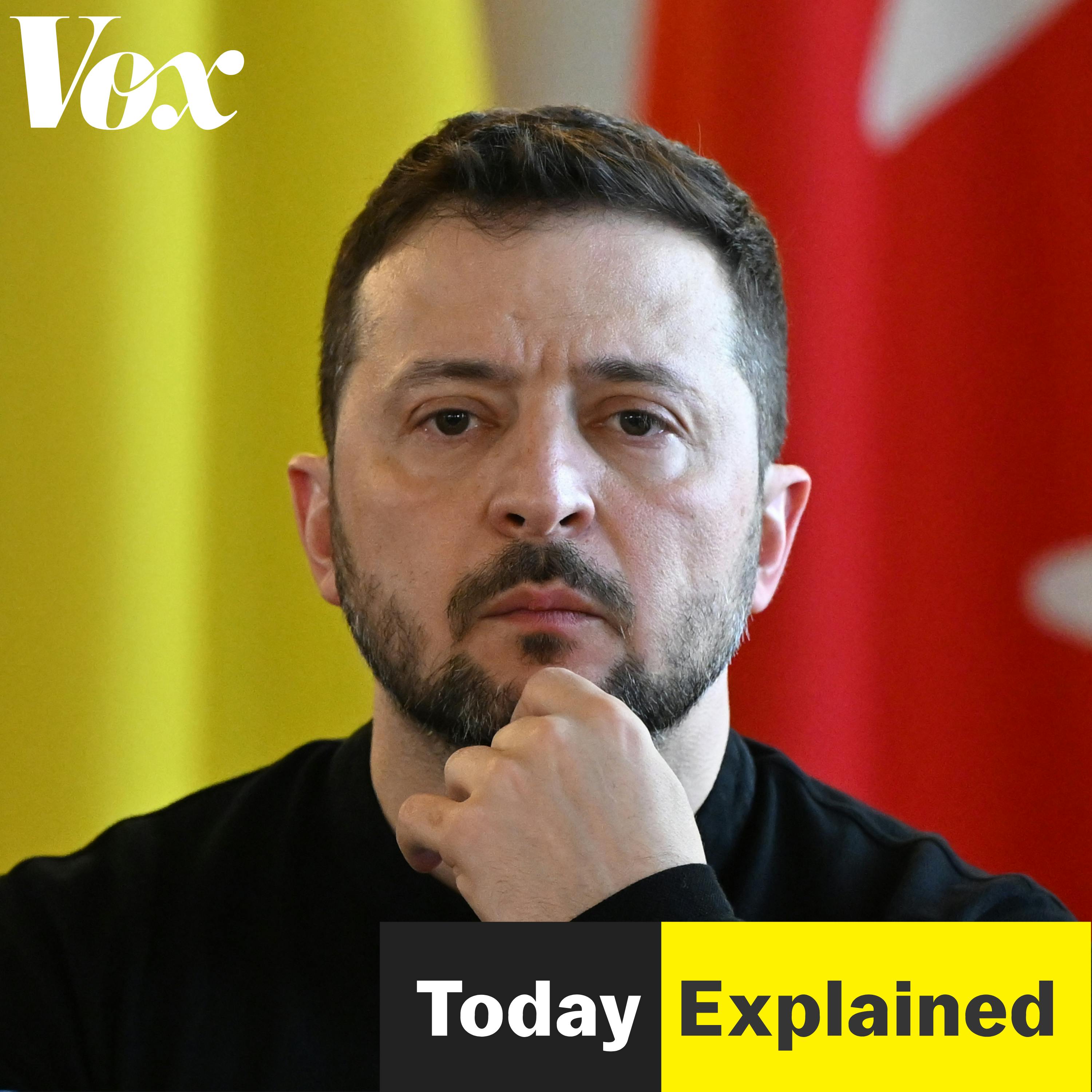
Breaking up with Ukraine
This episode was produced by Avishay Artsy and Devan Schwartz, edited by Jolie Myers, fact-checked by Laura Bullard and Kim Eggleston, engineered by Patrick Boyd and Andrea Kristinsdottir, and hosted by Sean Rameswaram.
Transcript at vox.com/today-explained-podcast
Support Today, Explained by becoming a Vox Member today: http://www.vox.com/members
Ukrainian President Volodymyr Zelenskyy preparing for the European leaders' summit on Ukraine in London. Photo by Justin Tallis - WPA Pool/Getty Images.
Learn more about your ad choices. Visit podcastchoices.com/adchoices
Press play and read along
Transcript
Speaker 1 It's official. The United States is breaking up with Ukraine.
Speaker 1
Last night, the president suspended military aid to the country. That's about one billion in arms.
Ukraine isn't getting until it commits to negotiating peace with Russia.
Speaker 1 That move, of course, comes after a perfect meeting with Ukrainian President Volodymyr Zelensky at the Oval Office on Friday. They talked about playing cards.
Speaker 2
You don't have the cards right now. With us, you start having playing cards.
Right now, you don't have to play cards.
Speaker 4 friends you're i'm wearing
Speaker 2 you're gambling with the lives of millions of people
Speaker 2 you're gambling with world war three they talked about being thankful have you said thank you once that entire meeting they took questions from the crowd what are you saying
Speaker 2 she's asking what if russia breaks the ceasefire well what if they what if anything what if a bomb drops on your head right now
Speaker 1 today explains looking into why humiliating zelensky appeals to the maga base and what europe plans to do about it
Speaker 8 Every story you love,
Speaker 9 every invention that moves you,
Speaker 9 every idea you wished was yours,
Speaker 9 all began as nothing.
Speaker 9 Just a blank page with a blinking cursor,
Speaker 9 asking a simple question:
Speaker 9 What
Speaker 11 do you see?
Speaker 9 Great ideas start on Mac.
Speaker 9 Find out more on apple.com/slash Mac.
Speaker 10 Support for this show comes from OnePassword. If you're an IT or security pro, managing devices, identities, and applications can feel overwhelming and risky.
Speaker 10 Trellica by OnePassword helps conquer SaaS sprawl and shadow IT by discovering every app your team uses, managed or not. Take the first step to better security for your team.
Speaker 10
Learn more at onepassword.com/slash podcast offer. That's password.com slash podcast offer.
All lowercase.
Speaker 11 Ukraine.
Speaker 11 Ukraine explained. It's Ukraine explained.
Speaker 1 Today explained, Sean Ramiser. I'm here with Eric Levitz, a senior correspondent at Vox.
Speaker 1 Eric, I think people are pretty sure how the left and moderates and globalists responded to that Oval Office meeting between Trump and JD and Zelensky.
Speaker 1 But how did the right in the United States respond?
Speaker 13 Yeah, well, the American right responded as it responds to most things that Donald Trump does, very positively.
Speaker 13 In fact, I think it wasn't just the fact that Trump personally did this, but that substantively on the MAGA right, on the nationalist American right, there's a real appetite to see the United States stand up to Ukraine and Zelensky and project the kind of line that Trump did.
Speaker 13 So you saw the American Conservative magazine hailed Trump's performance as a great clarifying moment in which a U.S. president finally stood up to the war-mongering Washington foreign policy blob.
Speaker 13 Former Trump advisor Steve Bannon lauded the administration as giving a masterclass in how to deal with an entitled punk.
Speaker 13 And you sort of saw similar sentiments from other conservative influencers and social media users and Republican politicians.
Speaker 1 Now, you know, with the Bannon comment, it sounds like he has some disdain for Volodymyr Zelensky, the Ukrainian president.
Speaker 1 There was a sense from what was going on in the room and from, you know, what's his name, Brian Marjorie Taylor Greene bullying Zelensky over not wearing a suit.
Speaker 3 Do you own a suit?
Speaker 1 That people on the right maybe just don't like this president. Is that the case?
Speaker 13 So I think they don't, or a significant segment doesn't. And I think that there's really two really distinct reasons for that, depending on what part of the right you sit on.
Speaker 13 Among hardline American social conservatives, there is just outright fondness for Putin's Russia that's been this presence within the movement since about 2013,
Speaker 13 when Putin enacted what he called an anti-propaganda law.
Speaker 14 Russia's Duma gave near unanimous approval to a vaguely worded bill that would ban homosexual propaganda accessible to minors.
Speaker 15 Hundreds of people took to the streets of the capital on Saturday to demonstrate for and against the measure, which effectively bans gay rights rallies and could be used to prosecute anyone voicing support for homosexuals.
Speaker 8 Critics say this is just one more step in what the Russian government sees as a fight against Western values.
Speaker 13 It was also simultaneous with a broader crackdown on LGBT rights within Russia.
Speaker 13 American social conservatives, who at the time were dealing with an Obama-era advance in gay rights and social liberalism, really took inspiration from this. And Putin, in the years after,
Speaker 13 really started casting himself as a defender of traditional Christian morality against an increasingly decadent West.
Speaker 13 And so there's a part of the American right that simply likes and supports Vladimir Putin, sees him as kind of representing God's side in this new cultural Cold War in which Ukraine is kind of the front for this decadent European, pro-gay, cultural movement, and that Putin is essentially pushing back against this.
Speaker 13 And so that informs their views of the Ukraine-Russia conflict and thus their views of Zelensky.
Speaker 1 How big is this faction in the United States of pro-Putin Americans? Because, you know, historically speaking, Eric, Russia, Putin, bad.
Speaker 13 Yeah, so I think that this is a very marginal force on the level of the American population. as a whole.
Speaker 13 I think about 8% of Americans have expressed a positive view of how Vladimir Putin handles world affairs.
Speaker 13 I think that it's overrepresented, though, an oversubscribed view among Republican elites, and, you know, particularly, I think, those in the general orbit of J.D. Vance.
Speaker 13 And so to this, you know, segment, Zelensky is a sinister figure who
Speaker 13 maybe some of them will allow that he's doing the right thing for Ukraine because Ukraine needs America to intervene, although not all of them would say that, but they pretty much uniformly see him as fundamentally irresponsible and potentially inviting a nuclear war.
Speaker 1 Okay, so Putin, not necessarily MAGA's best friend.
Speaker 1 Zelensky, maybe not so much MAGA's arch nemesis, but this way of thinking that the United States needs to have Europe's back all the time, not exactly the MA platform.
Speaker 13 Yeah, like I said, I think it's a little bit that.
Speaker 13 And then there are, you know, for the purposes of telling a compelling narrative, I think, but also maybe it's felt, you know, figures like Joe Rogan have actually really
Speaker 13 had a strong emotional and negative reaction to Zelensky. So Rogan has implied that he's addicted to cocaine and said that,
Speaker 13 you know, Zelensky is basically trying to orchestrate World War III.
Speaker 16 Zelensky, can I get a drug test? This is like cocaine, like, baby.
Speaker 9 Putin's fucking scared, man. Yeah.
Speaker 8 Putin's terrified.
Speaker 16
We got him, man. We got him.
Like, what are you talking about? He has nuclear missiles, you fucking monkeys. Jesus Christ.
Speaker 13 I think that there's a broader group of conservatives who don't have any particular ill will to Zelensky, but just fundamentally oppose the goal of fighting for Ukrainian democracy.
Speaker 13 And then there are others who actually specifically have animus towards him. Notably, the Russian government has also at times implied that Zelensky is addicted to cocaine.
Speaker 13 So I think that there's some specific narrative here that I'm not fully versed in. But yeah, this seems to be a meme.
Speaker 1 How do most Americans feel about all this, Eric? It sounds like Trump's base, Joe Rogan, not into supporting Zelensky and Ukraine. But most Americans, I mean, we've been at this for years now.
Speaker 1 You would hope most Americans are on board.
Speaker 13 Yeah, I think that there is definitely mixed feelings and there is declining American support for involvement in the Ukraine war, particularly as Republicans move more against it.
Speaker 6 There's also, as CNN's Harry Enton pointed out, he's doing considerably better than Joe Biden was doing on the handling of the Russia-Ukraine conflict.
Speaker 17 And so, on this simple question, I think Americans are saying, okay, Donald Trump's doing all right on this.
Speaker 1 Well, Donald Trump at this point says he wants nothing more than peace between Russia and Ukraine, perhaps with a little bit of Ukraine resources on the side. Does this U.S.
Speaker 1 break with Zelensky that we're seeing now get us any closer to peace?
Speaker 13 I don't think it does.
Speaker 13 I think that there is a reasonable argument that as part of a comprehensive strategy for forcing an end to the conflict, the United States should encourage Ukraine to prepare itself for making some territorial concessions in the interests of peace.
Speaker 13 Because Russia has some advantages in a long-term war of attrition, it has a lot more people,
Speaker 13 it has a lot more resources.
Speaker 13 And so there's an argument that Ukraine should be interested in the kind of deal that Trump sometimes expresses fondness for.
Speaker 18 We want, like you, a sovereign and prosperous Ukraine.
Speaker 18 But we must start by recognizing that returning to Ukraine's pre-2014 borders is an unrealistic objective.
Speaker 13 But an effective version of of that strategy, in my view, would require the United States to credibly threaten to fund Ukraine's war effort indefinitely so that Russia actually has an incentive to come to the table.
Speaker 13 You know, if Ukraine is going to be starting to draw down the military supplies it received from America, then six months from now, Russia might be in a position to conquer a lot more territory than they are today.
Speaker 13 Giving them that impression is not a recipe for a near-term peace.
Speaker 5 So what is?
Speaker 13 If I had a really good answer to that, I think that I would be potentially making more money at a different employer.
Speaker 13 I think it is a very difficult situation.
Speaker 13 I mean, on the Ukrainian side, in order to get Ukraine comfortable with signing a peace agreement, I think you really need to have some kind of assurance that its security is going to be protected if it does make concessions.
Speaker 13 I think that Zelensky is in a position where he really does not have a good choice beyond trying to win back the Trump administration's favor because the path for Ukraine to really get a decent settlement of this conflict is much narrower if the United States is not in its corner.
Speaker 1 Eric Levitz, read his work at Vox.com. Ahead on today explained, you're up to the plate.
Speaker 8 Every story you love,
Speaker 9 every invention that moves you,
Speaker 9 every idea you wished was yours, all began as nothing.
Speaker 9 Just a blank page with a blinking cursor
Speaker 9 asking a simple question.
Speaker 9 What do you see?
Speaker 9 Great ideas. Start on Mac.
Speaker 9 Find out more on apple.com slash Mac.
Speaker 17
Support for today's show comes from Upwork. You're the CEO of your business and the CFO and customer service.
That's a small business. Maybe you need some support.
Speaker 17 Upwork says that with Upwork Business Plus, they can bring you support in the form of top quality freelancers and fast.
Speaker 17 Instant access to the top 1% of talent on Upwork in fields such as marketing, design, AI, so much more.
Speaker 17 Upwork says that when you use Upwork Business Plus, you can source and vet candidates for skill and reliability.
Speaker 17 They can also send you a curated shortlist of proven expert talent so that you can delegate with confidence. Don't spin your wheels.
Speaker 17
Right now, when you spend $1,000 on Upwork Business Plus, you'll get $500 in credit. Go to upwork.com slash save now.
You can claim this offer before December 31, 2025.
Speaker 17 And again, that's upwork.com/slash S-A-V-E.
Speaker 17 Scale Smarter with Top Talent and $500 in credit. Terms and conditions do apply.
Speaker 17
Support for Today Explained comes from Chime. What's Chime? Chime is different.
Chime is a financial technology company that wants you to embrace each and every dollar.
Speaker 17 When you set up direct deposit with QIIME, you can get access to fee-free features like overdraft protection, or they say you can get paid up to two days early and even more.
Speaker 17 Speaking of no fees, QIIME says that when you open a checking account with them, there are no monthly fees and no maintenance fees.
Speaker 17 And with qualifying direct deposits, you can be eligible for free overdraft up to $200 on debit card purchases and cash withdrawals. Not to mention, although I will, 47,000 fee-free ATMs.
Speaker 17
You can work on your financial goals through QIIME today. You can open an account in two minutes at chime.com slash explain.
That's chime.com slash explain. Chime feels like progress.
Speaker 19 Chime is a financial technology company, not a bank. Banking services and debit card provided by the Bankor Bank NA or Stripe Bank NA.
Speaker 19 Members, FDIC, spot me eligibility requirements and overdraft limits apply. Timing depends on submission of payment file.
Speaker 19
Fees apply at out-of-network ATMs, bank ranking, and number of ATMs, according to U.S. and World Report 2023.
Chime checking account required.
Speaker 1 Today, Explain is back with Shoshank Joshi, defense editor at leading magazine The Economist in London, England.
Speaker 1 Shashank, the United States doesn't seem to want to help anymore with this war, at least for the moment. Who's going to help Ukraine?
Speaker 5 Well, the good news is that there's already a lot of aid flowing to Ukraine from non-American sources.
Speaker 5 And then you can add into that Canada, Australia, and indeed even some other Asian countries, Japan and
Speaker 5
others. The bad news is that that 40% of American aid includes some stuff that is pretty significant.
So that's things like air defense systems that can take out big Russian ballistic missiles.
Speaker 5 It includes intelligence support to help Ukraine understand what's going on, where the Russians are, how to target their missiles.
Speaker 5 And it includes some commercial services provided by American companies. The most famous one, of course, being Starlink, the communication systems provided by Elon Musk SpaceX.
Speaker 5 There's no indication that has stopped right now, those things, intelligence for Starlink, but there is a concern, obviously, that that could be severed at some stage.
Speaker 1 So what does that mean for Ukraine? Does that mean they can't win this war with the U.S. pulling out in its
Speaker 1 intelligence,
Speaker 1 you know, air support capacity?
Speaker 5 It means Ukraine's in trouble. It doesn't mean it's in immediate trouble.
Speaker 5 You know, there's enough stuff in the pipeline, enough stuff in their stockpiles in order to keep going, certainly through spring, probably through the summer.
Speaker 5 There's a lot, you know, the Biden administration gave them a ton of stuff just before they finished their time in office.
Speaker 5 And if you look at what Ukraine's defense industry is making, we must remember here, Ukraine had this huge defense industry in Soviet times, right? It was like
Speaker 5 the specialist maker of, I think, guidance systems for Soviet ballistic missiles in the Soviet Union. So it has this incredible engineering skill.
Speaker 5 It's building out huge numbers of strike drones that are now providing the lion's share of casualties in the war. The Ukrainian government says they can make about 40% of their battlefield needs.
Speaker 5 But anyway, all in all, that's great.
Speaker 5 But if the Americans cut everything and run, then we would be in a battlefield crisis probably by the end of this year, maybe early next year, where ammunition would be running dry, the Russian Air Force would be able to go over Ukraine more easily.
Speaker 5
And to answer your question directly, no, Ukraine would not be able to win. It would have to stay on the defensive.
It would be eking out its position, probably falling back.
Speaker 5 And I think it would be in a very, very difficult place at that point.
Speaker 1 I mean, if we game that out, does that mean that ultimately in about a year, once
Speaker 1 their resources run dry and they're forced to capitulate potentially, that they may end up in the same place they're in right now with President Trump trying to force them to come to a negotiating table and to settle this thing?
Speaker 5
Well, at that stage, I suspect President Trump would have less interest in the war. He would have had to wash his hands of it at that point.
But I also caution, you know, war is unpredictable.
Speaker 5 In early 2022, I was among the many people who thought that Ukraine was bound for defeat against these overwhelming odds.
Speaker 5
And I completely, you know, hold my hands up and acknowledge I was wrong because wars are unpredictable. Things happen.
We saw a rebellion in Moscow with
Speaker 5 one of Vladimir Putin's most important mercenaries, Evgeny Progozhin, rising up and marching on the capital. So who knows what happens in a year? The Russian economy could blow up.
Speaker 5 We could see other developments inside Russia.
Speaker 5 You know, in some ways, the strategy on the Ukrainian side has been: look, keep it going, keep the Russians engaged, keep killing or wounding 1,200, 1,300 Russians a day, and something will turn up.
Speaker 5 At some point, they will just run out, they'll get exhausted.
Speaker 5 And so, I'm always wary of saying Ukraine will lose because we don't know all the other things that can happen in a conflict like this. And technologies change as well.
Speaker 5 You know, the drone revolution that Ukraine is exploiting right now to inflict these massive casualty rates, those ton of drones, they did not exist as usable battlefield weapons back in February 2022.
Speaker 1 Europe seems to be making noise about stepping up in this moment. There was this huge assembly of European leaders and Justin Trudeau this past weekend.
Speaker 5 The UK is prepared to back this with boots on the ground and planes in the air. Together with others, Europe must do the heavy listing.
Speaker 1 Is there going to be a difference between the European support of, say, you know, four four or six months ago and what we see in the coming months?
Speaker 5 I think there is, yes.
Speaker 5
I think we realize we're in a crisis here. And I know we've said that before.
You may have heard that before in Trump 1. You may have heard it before at other times.
But this feels to me the most
Speaker 5 febrile, fluid moment in European security in my lifetime and possibly since,
Speaker 5 you know, I think certainly since the end of the Cold War, possibly the most dramatic rupture in transatlantic relations, maybe since the 1950s.
Speaker 5 And I can see people finding new ways to spend more on defense. You can have a big 150 billion euro loan facility for European defense programs.
Speaker 5 You could allow the EU's own budget to go on defense, get a European investment bank to put money into it.
Speaker 5 So I'm seeing all these new solutions to say, at the end of the day, whether it's for Ukraine, whether it's for us, if you walk away, if America walks away from NATO, we need more money.
Speaker 5 And I am seeing radical new ways to consider that that I haven't seen in the past.
Speaker 1 Why was it that the U.S. was so invested in in Ukraine up until, say, I don't know, last Friday?
Speaker 5 I think fundamentally the same reason it's been invested in Europe since 1945. It realized that a continent in which
Speaker 5 this
Speaker 5 authoritarian power is able to steamroller over a smaller power, change borders by force, that this begins to threaten NATO.
Speaker 5 And if you threaten NATO, you begin to threaten the basis of European security, the cohesion and peace and economic prosperity of Europe that America has benefited from by trading with Europe for so many years.
Speaker 5 But I think the larger picture is also that if you're in a world where a dictator can basically rewrite the borders by force and say, actually, this country doesn't exist.
Speaker 5
I'm going to take it, that this doesn't bode well for everyone else. This doesn't bode well for Taiwan.
It doesn't bode well if you're kind of a Japan or South Korea.
Speaker 5 It doesn't bode well if you're any American ally.
Speaker 5 And in turning that upside down, I'm seeing concern, profound concern, not just among Europeans.
Speaker 5 You know, you can accuse us of being whiny Europeans, and sometimes we are, but actually I'm seeing a lot of concern among Taiwanese, among Japanese, among Australians who are looking at this and thinking, hey, this administration that is saying, I will no longer defend you.
Speaker 5 And in fact, I want you to give me $500 billion worth of minerals to pay me back. They're saying, what would this administration do if my country came under attack? And would they do anything?
Speaker 5 Or would they turn on me and demand I hand over my resources in a kind of protection racket?
Speaker 5 I think that's provoking some serious questions about the reliability and integrity and the good faith of the United States government as we have known it for 80 years.
Speaker 1 But hearing you say that, Shashank, it occurs to me that, you know, we're talking about our own president who, you know, isn't quite at that dictator status, but is making threats, you know, north of the border in Canada, over there in Greenland, south of the border in Panama.
Speaker 1 I mean, this is a guy who's who's into territorial conquest.
Speaker 1 What do you think the U.S. might lose in a moment like this, where
Speaker 1 it seems to be transitioning to this sort of more America-first mindset?
Speaker 5 I think that's a brilliant question. And my goodness, where do we begin, right?
Speaker 5
Look at Germany. The U.S.
has a lot of troops in Germany. Do we think they're all there just to sit there defending Germany against Putin?
Speaker 5
No, Germany is this huge hub for American military power projection. It has has this huge military hospital.
It's an airbridge to get your forces to the Middle East.
Speaker 5 And then what about this coalition to compete with China in technology?
Speaker 5 You know, do you think you're going to do this whilst the Europeans are hoovering up Chinese electric vehicles and building Huawei into their telephone systems?
Speaker 5 It's an alliance, a tech alliance in which alliances are critical. You need to work with partners.
Speaker 5 That's been the assumption of this last administration, the Biden administration, but even Trump won to some degree. If that's going away and allies are just viewed as these
Speaker 5 inferior powers who have to come to the Oval Office in a suit and pay tribute and grovel,
Speaker 5 then I think America's going to find itself in a world where stuff it has taken for granted, that allies just show up in Iraq and Afghanistan to fight alongside you, for instance, that that world is going to crumble and America will be on its own.
Speaker 5 And one of the big strengths it has, that China doesn't and that Russia doesn't, which is real allies, that will ebb away.
Speaker 1 So, America first saves us some money. Maybe, you know,
Speaker 1 I don't even, I can't even think I'm trying to play the devil's advocate. All I can think is that it saves us some money.
Speaker 5 No, look, I mean, let me have a go, right? Because I think it is important to understand where an administration like this is coming from.
Speaker 5 I think there is this faction in the administration that says Europe is a side story. We're going to get out of Europe and send stuff to Asia, husband our resources.
Speaker 5 We're not going to spend 50 billion a year on Ukraine.
Speaker 5 We're going to spend it on Asia, confront china put more stuff into japan put more stuff into south korea um i think that that that kind of makes sense you know i may not agree with that but i could i see the internal logic of that yeah however
Speaker 5 however it is a big but this assumes this is a normal administration that does strategy where people you and i sit in a room and discuss strategy and produce documents
Speaker 5 what happens when the president puts out a video saying you know that strategy you said about pivoting to asia i just want to put this ai video out showing you a giant golden statue of myself in Gaza because I want to own Gaza.
Speaker 5
And then at that point, there is no sense of strategy. It's a sense of whimsy.
It's a kind of, you know, the Emperor Caligula making his horse the consul.
Speaker 5 It's a sense of
Speaker 5 governance by presidential impulse.
Speaker 5 And there, I think, I'm afraid I can't offer a coherent view of strategy other than a raw assertion of American power, regardless of the costs or consequences or benefits.
Speaker 1
Shashank Joshi, economist.com, Avishai Artsy produced. That's a hat-trick.
Devin Schwartz was producing too. Patrick Boyd and Andrea Kristen's daughter mixed.
Jolie Myers Edited.
Speaker 1
And Laura Bullard and Kim Eggleston fact-checked. Thank you, Kim.
I'm Sean Ramesfurm. I'm going to be at South by Southwest in Austin, Texas this Saturday.
Come say hi if you're there too.
Speaker 1 I know I told you I'd be talking to Rami Youssef, but Tim Walls said he wanted to chat, so we're doing that instead. Swing by the Vox Media Podcast stage, presented by Smartsheet and Intuit.
Speaker 1 If you're into it, learn more at voxmedia.com/slash SXSW,
Speaker 1 voxmedia.com/slash South by Southwest. All right, all right, all right.
Speaker 10 Support for this show comes from one password. If you're an IT or security pro, managing devices, identities, and applications can feel overwhelming and risky.
Speaker 10 Trellica by OnePassword helps conquer SaaS sprawl and shadow IT by discovering every app your team uses, managed or not. Take the first step to better security for your team.
Speaker 10
Learn more at onepassword.com slash podcastoffer. That's onepassword.com slash podcast offer.
All lowercase.
Speaker 7 All right, remember, the machine knows if you're lying. First statement: Carvana will give you a real offer on your car all online.
Speaker 7
False. True, actually.
You can sell your car in minutes.
Speaker 17 False? That's gotta be.
Speaker 7 True again. Carvana will pick up your car from your door, or you can drop it off at one of their car vending machines.
Speaker 17 Sounds too good to be true, so true.
Speaker 7
Finally caught on. Nice job.
Honesty isn't just their policy, it's their entire model. Sell your car today, too.
Speaker 12 Carvana. Pickup fees may apply.


