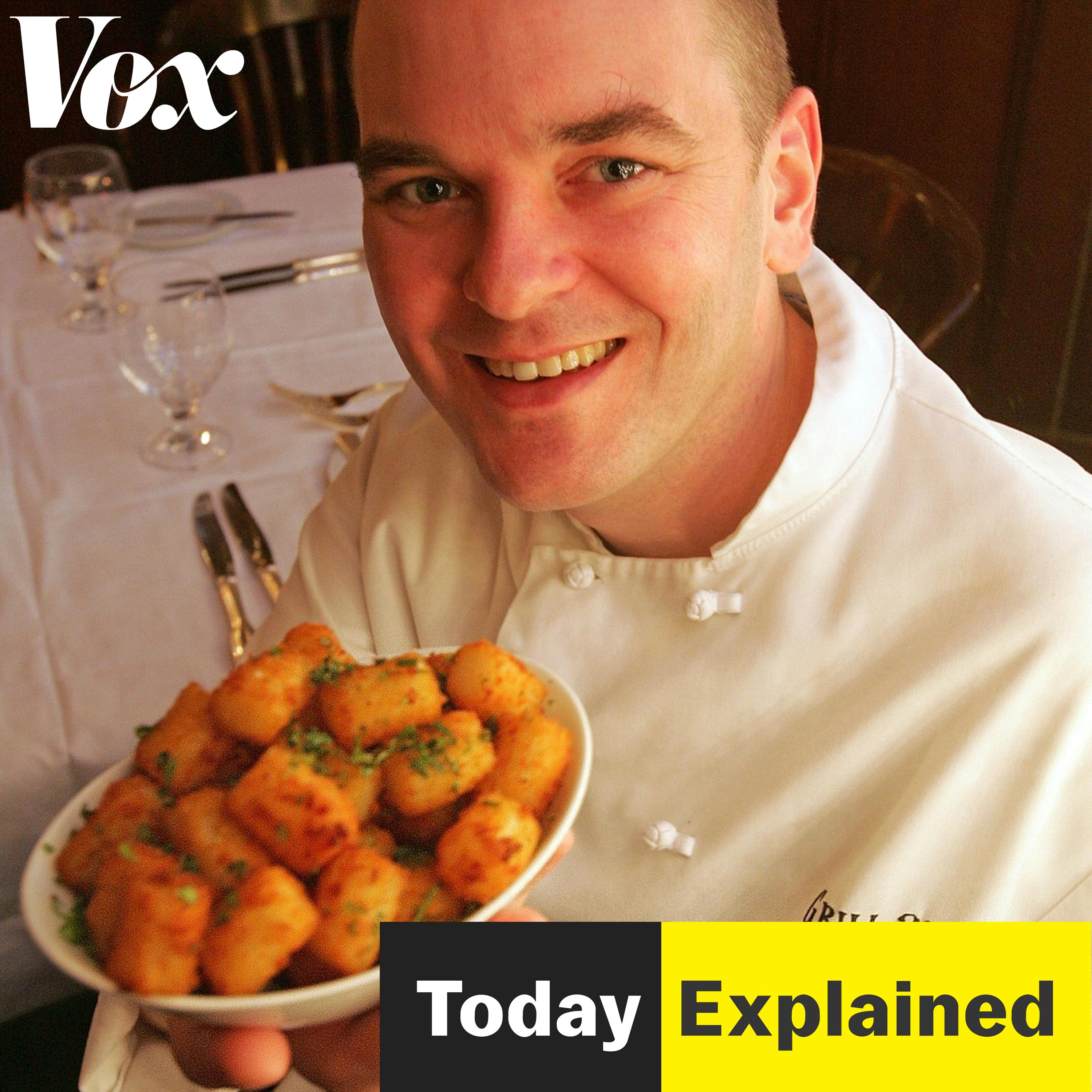
Tater bot
This episode was produced by Peter Balanon-Rosen with help from Devan Schwartz, edited by Jolie Myers, fact-checked by Laura Bullard, engineered by Patrick Bpyd and Andrea Kristinsdottir, and hosted by Sean Rameswaram.
Transcript at vox.com/today-explained-podcast
Support Today, Explained by becoming a Vox Member today: http://www.vox.com/members
Chef Jay Murray at Grill 23 in Boston shows off a dish of tater tots. Photo by MediaNews Group/Boston Herald via Getty Images.
Learn more about your ad choices. Visit podcastchoices.com/adchoices
Press play and read along
Transcript
Speaker 1 On the show today, we're going to talk about potatoes.
Speaker 1 Frozen potatoes in particular.
Speaker 1 We're going to talk about frozen potatoes because they actually have a lot to say about where the country's at right now.
Speaker 5 Brixton's baked potatoes mascot, you see it there, it's the Tater Trump.
Speaker 1 Frozen potatoes can tell us a lot about why things cost what they cost, about why it sometimes feels like the odds are stacked against consumers, about why it sometimes feels impossible to find an apartment to rent in the United States, about how our government has failed to do much to regulate big tech, and why it's high time we hash it all out.
Speaker 5 Good luck, live in peace. Go ahead, please.
Speaker 1 Taterbots coming up on Today Explained.
Speaker 5 Support for Today Explained comes from BetterHelp. BetterHelp says it's winter and winter is often depressing.
Speaker 5 Instead of getting depressed, BetterHelp wants to encourage you to reach out to someone, perhaps get coffee with an old friend, perhaps write a letter to a family member, perhaps connect with a licensed therapist using BetterHelp.
Speaker 5 This month, don't wait to reach out, says BetterHelp.
Speaker 5 Whether you're checking in on a friend or reaching out to a therapist yourself, BetterHelp makes it easier to take that first step, says BetterHelp.
Speaker 5 You can get 10% off your first month at betterhelp.com slash explained. That's betterhelp.com slash explained.
Speaker 10 Support for this show comes from OnePassword.
Speaker 4 If you're an IT or security pro, managing devices, identities, and applications can feel overwhelming and risky.
Speaker 10 Trellica by OnePassword helps conquer SaaS sprawl and shadow IT by discovering every app your team uses, managed or not.
Speaker 8 Take the first step to better security for your team.
Speaker 10 Learn more at onepassword.com/slash podcast offer. That's onepassword.com slash podcast offer.
Speaker 11 All lowercase.
Speaker 12
You're listening to Today Explains. This is, is it Today Explain or TreExplain? Explain death.
Explain duck.
Speaker 1 Sean Ramis from here with Katya Schwenk, reporter at The Lever, who has been investigating what
Speaker 13 There are only four companies that control 97% of this market. And what people say that has led to is price fixing and colluding to keep the prices of your French fries very high.
Speaker 1 Katya says this big story starts with a kind of small fry, a guy named Josh.
Speaker 13 Josh Saltzman is the owner of a small sort of divey sports bar in Washington, D.C. called Ivy and Coney.
Speaker 13 Josh, you know, like many bar owners,
Speaker 13 he's getting his french fries from food distributors, which are buying them from these frozen potato companies.
Speaker 13 And a couple years ago, Josh gets a notice from this food distributor he works with saying, you know, these, you know, three or four big companies that are selling you your french fries, they're all raising the price of their product and they're all raising them by the same amount by 12 cents a pound,
Speaker 13 all effective like the same week or the same day.
Speaker 13 And, you know, Josh was like, you know, that's really weird.
Speaker 13 He goes online, he writes a few tweets saying, you know, this looks a lot like price fixing, looks a lot like pollution, you know.
Speaker 12 Amazing how all of the major suppliers for french fries and the like are all raising their prices at the same time and by the same amount. Totally not collusion or anything, right?
Speaker 13 Big potato,
Speaker 13 is this what's going on?
Speaker 1 Big potato, not to be confused with baked potato. Yes.
Speaker 13 Okay.
Speaker 1
So Josh takes to the internet. He sees all of the prices of potatoes going up, but also by the exact same amount.
And he says, something's going on here.
Speaker 13
In this moment of frustration, he's like, it's happening in this way that looks really a lot like price fixing. I'm going to go online and write some tweets about it.
The tweets go viral.
Speaker 13 And then no one really talks about it for, you know, a couple years.
Speaker 13 Two years later, Josh's tweets show up cited in this like series of private lawsuits calling out price fixing in this frozen potato industry.
Speaker 13 So, you know, but you know, he was not the only one to have been harmed by this because all of these lawsuits are being brought with the help of, you know, these antitrust lawyers by grocery store teams, restaurants,
Speaker 13 food suppliers all around the country who are saying like, these prices are going up, they're going up in lockstep and it's hurting our bottom lines.
Speaker 1 When we talk about the potato companies,
Speaker 1 who are we talking about? Would people know the names of these companies? Are they, you know, like everyday companies that you see at the grocery store?
Speaker 13 These are companies
Speaker 13
that are a little bit behind the scenes. Their names are Lamb Weston Holdings, Cavendish Farms.
Probably you're unfamiliar with them if you are a layperson.
Speaker 1 I've heard of Cavendish.
Speaker 13 Okay, yeah, you know, like they are often part of bigger agricultural conglomerates
Speaker 13 in the case of Cavendish Farms. But, you know, these are not big brand name companies because they're not usually selling their products to consumers at the grocery store.
Speaker 13 You're not going to be going to buy your frozen french fries. They have sort of this niche of the market where they are buying potatoes from growers
Speaker 13 and then they are preparing those, pre-preparing those potatoes and selling them mostly to
Speaker 13
big restaurant chains. Presumably, this is, you know, free market.
They're competing with each other.
Speaker 13 In reality, what the lawsuits allege is that because this market is so, so consolidated, it sort of allowed these companies to sort of collude tacitly to fix prices by feeding their information into this data sharing platform that allows them to share confidential information about prices.
Speaker 13 Yes, it's actually called Potato Track, if you can read that.
Speaker 13 You know, so that has done a lot to reduce competition in this market.
Speaker 1 Unlike Nike and Adidas, maybe, for example, the big potato firms are essentially using the same software to fix the price of potato. And that software is perfectly titled Potato Track.
Speaker 1 How does it work?
Speaker 13 That is right. Yeah, this is actually something of a trend
Speaker 13 in a lot of the big anti-monopoly cases that we're seeing, whether it's like from meat processors to like sugar, are looking at these, the rise of these third-party data platforms that allow companies in the industry to sort of feed information.
Speaker 13 So things like their labor costs, their operational costs, their prices for different products.
Speaker 13 And
Speaker 13 once that it is in this platform, the platform shares that information among the rivals.
Speaker 13 So it's a way for executives to share the kind of confidential pricing information that you need to do to fix prices without having to like gather together secretly and conspire to fix them, which is like against the law.
Speaker 1 Yeah, it's hard to imagine something called potato track being illegal, but
Speaker 1 can you give us an idea of how expensive potato track might be making potatoes?
Speaker 13 Yeah, so prices have gone up really significantly. They actually increased by almost 50%
Speaker 13 from July 2022 to July 2024.
Speaker 13 Companies Drive initially justified by pointing to higher operational costs,
Speaker 13 supply chain pandemic stuff. But those costs have since gone down and the prices have stayed high.
Speaker 1 So this whole time, people might have thought my frozen potatoes cost more because of Joe Biden and really it was because of potentially potato track.
Speaker 13 Right. In fact, you had the wrong villain potentially.
Speaker 1 People got really mad at Joe Biden. Have people gotten really mad at like Cavendish and Potato Track and all the rest?
Speaker 13 So
Speaker 13 over the last like three months, starting in November of last year,
Speaker 13 we have seen a bunch of cases against these four companies.
Speaker 5 Class action lawsuits were filed in Illinois against four food producers. You're being called the Potato Cartel.
Speaker 3 Prosecutors say the companies formed a cartel by having equal access to each other's data on pricing and other sensitive information.
Speaker 5
Cane Foods, Cavendish Farms, Lamb Weston, and J.R. Simplin.
These are the companies that tried to create a monopoly on our favorite fried food.
Speaker 13 Grocery stores, restaurants, like bars, like Josh's have banded together and they have sued for damages saying, you know, these companies' price fixing has hurt our bottom lines.
Speaker 1 Has Big Potato spoken about this publicly? Have they said anything to try and ease the public's concerns about the the price of frozen potatoes?
Speaker 13 Yeah, they've actually been quite, they've said very little.
Speaker 13
I had one of the companies get back to me saying, you know, we completely deny all of these claims. The rest haven't said anything.
Big potato remains silent on this issue.
Speaker 13 For now, they're not saying much.
Speaker 1 And what does that mean for Josh in the bar in DC? And all of us, are we going to be able to get cheaper french fries and hash browns and all the rest anytime soon?
Speaker 13 Right. I mean, I think that's where this speaks to this bigger problem, right? Of like, if we are living in a world with really lax anti-monopoly enforcement,
Speaker 13 we are living in a world where companies are sort of allowed to like price fix and, you know, buy up all of these markets and agriculture agriculture supply chains remain as they are.
Speaker 13
These are the bigger systemic issues. It's hard to know, hard to say if we'll be able to get cheaper french fries until they are solved.
But for now, you know, Josh's bar is doing fine.
Speaker 13 They're still making it work with the french fries they have.
Speaker 13 So, you know, and I think at least the fact that people are talking about this issue has brought a little bit of hope.
Speaker 1
Katya Schwinklenews.com. The government, at least parts of it, would like to do something about algorithms.
We're going to tell you about it when we return on Today Explained.
Speaker 5 Support for Today Explained comes from Indeed. Indeed says if you're looking to hire, you can give your job posting the best chance to be seen with Indeed-sponsored jobs.
Speaker 5 With sponsored jobs, Indeed, boosts your posts so that it is more visible. Their data shows it's effective.
Speaker 5 According to Indeed, sponsored jobs posted directly on Indeed are 90% more likely to report higher than those non-sponsored jobs because you reach a bigger pool of people.
Speaker 5 1.6 million companies sponsor jobs with Indeed. You can spend more time interviewing candidates, less stress, less time, more results now with Indeed sponsored jobs.
Speaker 5 Listeners of this show get a $75 sponsored job credit. To help your job get the premium status it deserves at Indeed.com slash today explained, indeed.com slash today explained.
Speaker 5
Support our show by saying you've heard about Indeed on this podcast, Today Explained, Indeed.com slash Today Explained. Terms and conditions do apply, guys.
Hiring. Do it the right way with Indeed.
Speaker 5
Support for Today Explained comes from Select Quote. Perhaps you've been putting off life insurance.
Select quote says you can only put something off for so long before it really matters.
Speaker 5 Select quote says they take the guesswork guesswork out of finding the right term life insurance policy.
Speaker 5 For over 40 years, SelectQuote has been one of the most trusted brokers in the insurance business.
Speaker 5 According to Select Quote, they say they've helped more than 2 million Americans secure over $700 billion in coverage. You don't have to sort through dozens of confusing options.
Speaker 5 One of their licensed agents will sort through dozens of confusing options to find the right policy at the right price for you. They compare plans from trusted top-rated insurance companies.
Speaker 5 Select quote works with providers who offer same-day coverage up to $2 million worth. Select quote says life insurance is never cheaper than it is.
Speaker 5 Today, get the right life insurance for you for less and save more than 50% at selectquote.com slash explain.
Speaker 5 Save more than 50% on term life insurance at selectquote.com slash explain today to get started. What's that? That's selectquote.com slash explained.
Speaker 5
Support for Today Explained comes from QIIME. What's Chime? Chime is different.
Chime is a financial technology company that wants you to embrace each and every dollar.
Speaker 5 When you set up direct deposit with QIIME, you can get access to fee-free features like overdraft protection, or they say you can get paid up to two days early and even more.
Speaker 5 Speaking of no fees, QIIME says that when you open a check-in account with them, there are no monthly fees and no maintenance fees.
Speaker 5 And with qualifying direct deposits, you can be eligible for free overdraft up to $200 on debit card purchases and cash withdrawals. Not to mention, although I will, 47,000 fee-free ATMs.
Speaker 5
You can work on your financial goals through QIIME Today. You can open an account in two minutes at chime.com/slash explain.
That's chime.com/slash explain. Chime feels like progress.
Speaker 9 Chime is a financial technology company, not a bank. Banking services and debit card provided by the Bank or Bank NA or Stride Bank NA members, FDIC.
Speaker 9
Spot me eligibility requirements and overdraft limits apply. Timing depends on submission of payment file.
Fees apply at out-of-network ATMs, bank ranking, and number of ATMs, according to U.S.
Speaker 9 News and World Report 2023. Chime checking account required.
Speaker 1 You like potato, and I like today explain.
Speaker 1 Bill Baer is a fellow specifically at the Brookings Institution, but he also served in the Justice Department as head of antitrust enforcement.
Speaker 1 And he also served as the head of antitrust enforcement at the Federal Trade Commission, known by its friends as the FTC. Bill says it's not just frozen potatoes.
Speaker 1 He says price-setting algorithms are shaping prices across our lives.
Speaker 6 The government enforcement agencies, the antitrust enforcers, are very worried that this use of pricing algorithms is growing.
Speaker 6 There are cases that have been brought by the government relating to the use of a third party called Agri-Stats, which is alleged to be using a pricing algorithm to raise prices for poultry, for chicken, all essential things and are consuming America.
Speaker 14 All the major packers are paying Agri-Stats to provide them with information.
Speaker 12 It's alleged that AgriStats organizes and then launders that information across the industry.
Speaker 14 Total collusion. It makes me have goosebumps.
Speaker 6 There are also allegations that a third party called RealPage is limiting competition by suggesting prices and output that have the effect of raising prices and also restricting availability of apartments because shortage allows companies to raise prices.
Speaker 16 When the Sherman Act was passed, an anti-competitive scheme might have looked like robber barons shaking hands at a secret meeting.
Speaker 16 Today, it looks like landlords using mathematical algorithms to align their rents.
Speaker 6 Third area this appears to be going on involves hotels in major cities across the country.
Speaker 17 The lawsuit claims those companies used a revenue platform called Rainmaker to monitor real-time prices for their competitors so an algorithm could adjust their rates on the fly to maximize profits.
Speaker 6
If those companies sat together and did this, they would go to jail. That's classic price fixing.
But they think by being clever and using a third party, they avoid antitrust violations. They don't.
Speaker 1 Have we seen something like this before, like competitors becoming collaborators to serve their bottom line? Are there examples of this from before the age of algorithms?
Speaker 6 The answer is yes.
Speaker 6 Back when I was in the government in the 90s,
Speaker 6 we found that Toys R Us, which was the dominant retailer of toys.
Speaker 15 Once a Toys R Us kit?
Speaker 15 All the way to Toys R Us kit.
Speaker 6 Was upset that Discounters like Costco and Sam's Clubs were selling popular toys toys at prices cheaper than Toys R Us.
Speaker 6 So Toys R Us went to the toy manufacturers and said, if you all stop selling to Costco and Sam's Club, you'll make more money and we'll make more money. We sued at the Federal Trade Commission.
Speaker 6 The courts agreed that was designed to facilitate price fixing and limit competition.
Speaker 1 Wow, that giraffe is evil.
Speaker 6 It is evil. Same thing happened in the airline industry.
Speaker 6 In the 1990s, the government found that airlines were using a third party to announce forthcoming fare reductions on particular routes.
Speaker 6 The airlines that were making the most money on those routes then would retaliate by proposing a dramatic fare cut on the competing airlines' favorite routes. They coded those flights as FU flights.
Speaker 13 Are you serious?
Speaker 2 FU.
Speaker 6
The implication could not be clear. Absolutely.
If you cut rates on my bread and butter, guess what's going to happen to your bread and butter?
Speaker 6 And the result was the airlines moved back to the higher fare rates. So the airlines made money,
Speaker 6 consumers got screwed.
Speaker 1 What happened in each case with the airlines, with the giraffe? Did the government say FU back and did they have to pay hefty fines or what?
Speaker 6 The government was able to stop the behavior, and private plaintiffs acting on behalf of injured consumers were able to secure monetary relief.
Speaker 1 And yet, we're back where we were back then.
Speaker 1 Surely, there are arguments for
Speaker 1 letting these companies determine their prices through algorithms. What are those arguments?
Speaker 6 Well, the companies will say it's more efficient if I can respond to developments in the marketplace,
Speaker 6 if my pricing algorithm allows me to meet a competitor's discount, meet a competitor's sale price. But
Speaker 6 the worry is, and there is some evidence to suggest, the actual real effect of this is to discourage discounting in the first place.
Speaker 15 Joe Biden once famously said, capitalism without competition is not capitalism. It's exploitation.
Speaker 6 And that sums up the worry about what's going on here. Come on, man.
Speaker 1 Joe Biden was,
Speaker 1
you know, relatively tough on tech. Lena Khan, the FTC, they were bringing a lot of antitrust suits.
We covered some of them on the show. What appears to be coming with Trump
Speaker 1 is a much friendlier
Speaker 1 relationship with big American technology. Is Congress cooking up any legislation that would address this?
Speaker 6 There are a number of bills pending. The lead bill by Senator Amy Klobuchar from Minnesota.
Speaker 7 Because that is sophisticated price fixing. Price fixing illegal.
Speaker 7 I'm Amy Klobuchar, U.S. Senator from the state of Minnesota.
Speaker 1
Senator Klobuchar, we've been talking about potatoes and algorithms on the show today. Trump has been president for a few weeks now.
We've got planes planes blowing up.
Speaker 1
We've got trade wars ramping up. We've got the federal government being remade before our eyes.
We've got policies about diversity being rewritten.
Speaker 1 And yet, we asked you here to talk to us about algorithms. Why is now a good time to talk about algorithms?
Speaker 7 Well, first of all, it's always a good time to talk about algorithms. But the second reason is that
Speaker 7 when President Trump ran, he talked about bringing prices down on everything from groceries.
Speaker 7 And from what I see right now you see chaos up corruption up and egg prices up but from groceries to health care costs to child care and of course to housing what some of these major landlords are doing right now is they're giving all their data to the company that the competitors go to then that company goes through their data with algorithms and says, hey, why don't you both charge this rate?
Speaker 7
You would not ever under the law allow the two apartment owners to go and shake hands and say, let's both set our rents high. You would never let them do that.
That's against the law.
Speaker 7
It's against the antitrust laws. But what do we have now? We have high price, sophisticated price fixing.
They let this algorithms go unchecked.
Speaker 7 With all those brolegarks that were at the inauguration and all their buddies. If that continues, this is not going to be good for you.
Speaker 1
In the same room as you. I saw you guys all in there together.
Oh, yeah. So you don't have to convince me that we should talk about algorithms because here we are.
Speaker 1 But I do hope that was useful for our audience.
Speaker 1 What would your bill do for them?
Speaker 7 So what this says is this is illegal, basically, and it's being sued out in court anyway.
Speaker 7 I think it is illegal, but we want to make it very clearly illegal that landlords cannot collude by putting all their data when they compete against each other in one company.
Speaker 7
And what the bill says is, yeah, you can use algorithms. We're not Luddites here.
However, you can't give your data to the same place that has your competitors' data in the same market.
Speaker 7
It undermines all competition in the rental market. And that is the worst thing for consumers.
It's great for landlords. It's horrible for renters.
Speaker 1
Help people understand why we need new legislation on that front, because presumably we already have antitrust law. We already have the FTC.
Why do we need something further?
Speaker 7 I'm laughing because I'm just, I want you to picture back to the days of, you know, when the Senate, everyone drove a horse and buggy there and or like they came in their trains once a month or something.
Speaker 7
Okay. So that's when they did the antitrust laws in the late 18.
They didn't have algorithms. And one of the frustrations on all of the tech rules in place,
Speaker 7 despite these incredible companies and what they've done for us, is that a lot of our laws are just not as sophisticated as those marketplaces. So you should make adjustments, right? Ticket prices.
Speaker 7 Let's get this Ticketmaster bill done. That was bipartisan.
Speaker 7 And also, Senator Lee and I had a major hearing on ticketmaster um and that led i believe that evidence that we extracted from that hearing led in part to a major justice department case started during the biden administration can easily be finished in the trump administration and that's you know they've hired a pretty good person that they're putting in charge of antitrust.
Speaker 7 That's not true of a lot of the people they've hired, but on this front,
Speaker 7 this is a good person who understands these laws.
Speaker 1 I'm glad you brought up your prior work on this issue. You're You're basically senator antitrust out there.
Speaker 7 I wrote a book on it. I was on the New York Times bestseller list for 10 days.
Speaker 1
There you go. Congratulations.
Yeah. You've introduced a number of pieces of legislation to this, and a lot of them haven't been signed into law.
Speaker 1 Do you think there's an opportunity here with these price-fixing algorithms where maybe there wasn't on Ticketmaster or some anti-tech stuff?
Speaker 7 It's not just passing bills, Sean. We can do that, but it's also
Speaker 7 is the law being enforced? Are they actually bringing actions? Are they getting results that matter?
Speaker 7 In the cases of this, the case going on with Real Page or Ticketmaster or the tech company, so much of it is in the details of what they agree to.
Speaker 7 They could actually get them to agree, the tech companies, to a bunch of things they already agreed to in other countries to protect consumers.
Speaker 1 were in the same room as the president and the vice president a couple of times a few weeks ago, a lot of Americans saw that.
Speaker 7 And in the same car as both presidents. I'm the only person that I know of in history that rode with both President Biden and President Trump from the White House to the Capitol.
Speaker 1 Did you happen to bring up algorithms? I have to ask.
Speaker 7 Well, at some point during the day, I mean, it was a little hard to avoid not mentioning tech with all those. geyser.
Speaker 7 And, you know, I believe, and I'm not going to talk about what I talked about, but I believe that they've got to make sure they hold these companies accountable.
Speaker 7
It doesn't mean you're going to get rid of these companies. Of course not.
But what it means is you're going to have true competition.
Speaker 1
Senator Amy Klobuchar, you can call her Senator Amy Klobuchar. Before that, you heard from Bill Baer from Brookings.
Peter Balinon Rosen made our show today. We miss him already.
Speaker 1
Devin Schwartz helped. Jolie Myers helped.
Laura Bullard helped. Patrick Boyd played the potato.
Here's a fun one. Today, Explained is doing a show about the great wealth transfer.
Speaker 1 If you don't know what that is, I feel you. Some lucky youngish Americans are getting trillions, literally trillions of dollars from their parents.
Speaker 1 Not like individually, but when you add it all up, like, you know, parents pay the credit card bill every month. They pay the rent for that two-bedroom in Brooklyn.
Speaker 1 They throw you $200K for a down payment on your first house, tuition for the kids' private schools. Are you getting money from your parents? Call us and tell us about it, if you will.
Speaker 1
You can be anonymous if you want. 844-453-4448.
Especially if it's a lot of money, we want to hear from you. No judgment, but we might call you back: 844-453-4448.
Thanks for sharing.
Speaker 10 Support for this show comes from OnePassword.
Speaker 4 If you're an IT or security pro, managing devices, identities, and applications can feel overwhelming and risky.
Speaker 10 Trellica by OnePassword helps conquer SaaS sprawl and shadow IT by discovering every app your team uses, managed or not.
Speaker 8 Take the first step to better security for your team.
Speaker 10 Learn more at onepassword.com slash podcast offer. That's onepassword.com slash podcast offer.
Speaker 11 All lowercase.
Speaker 18 Support for this show comes from Capital One. With the VentureX business card from Capital One, you earn unlimited double miles on every purchase.
Speaker 18 Plus, the VentureX Business Card has no preset spending limit, so your purchasing power can adapt to meet your business needs.
Speaker 2 Capital One.
Speaker 18 What's in your wallet?


