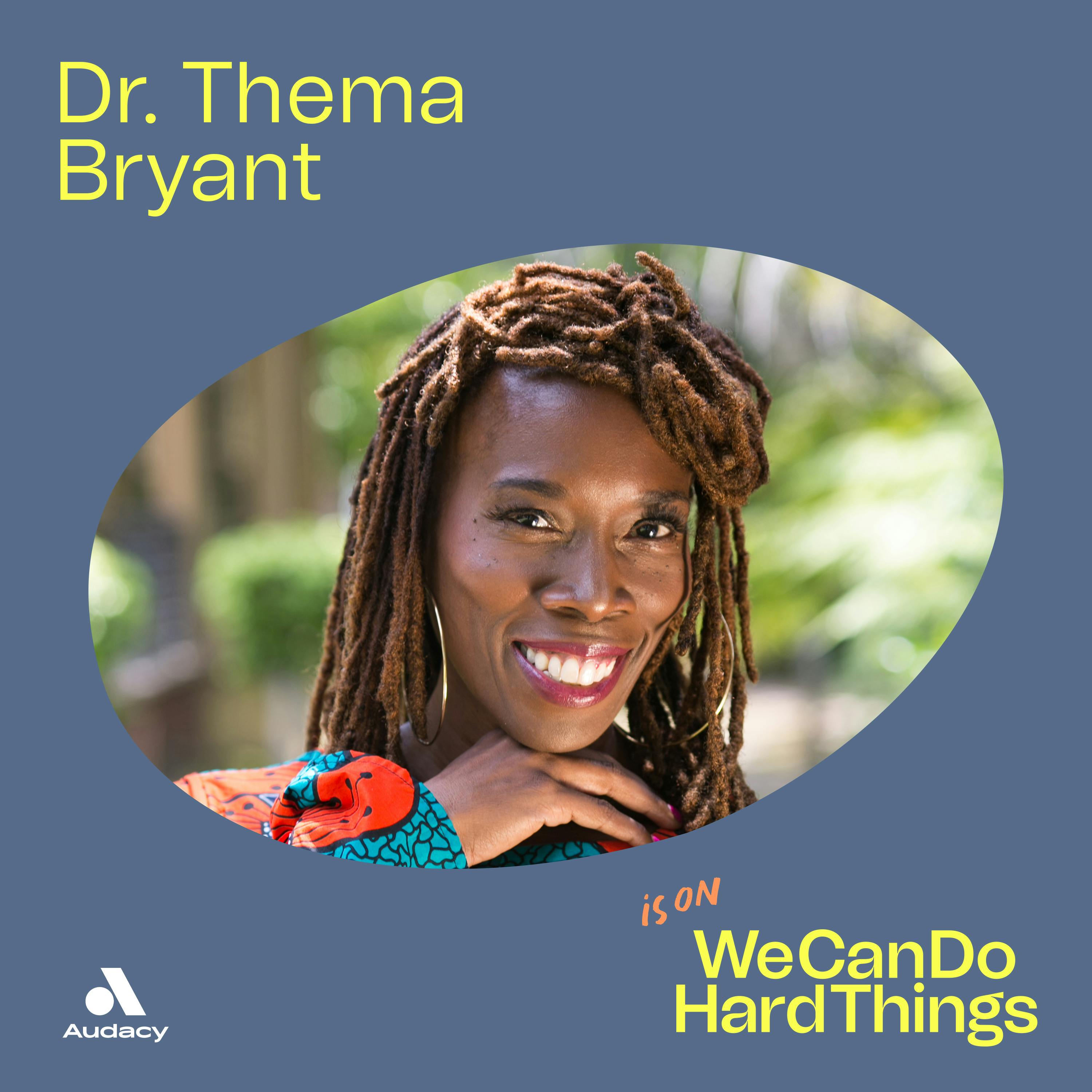
7 Questions To Reclaim Yourself with Dr. Thema Bryant
Psychologist, author, professor, and minister, Dr. Thema Bryant, joins us to explore how to rebuild a relationship with yourself and why healing that relationship is the foundation for real connection with others.
-The essential shift to stop believing your wounded self is your whole self
-Why you are worthy of grieving—and why recognizing that changes everything
-How to end the hunger for safety—and what to trust instead
-How to stop constantly running and finally learn to stand still
-The question Abby asked that made Amanda nauseous.
Dr. Thema Bryant is a psychologist, professor, sacred artist, minister and author of the new book Matters of the Heart, who teaches how to create healthy relationships, heal trauma, and overcome stress and oppression. She is a professor of psychology at Pepperdine University, where she directs the Culture and Trauma Research Laboratory. Dr. Tayma is an ordained elder in the African Methodist Episcopal Church and leads the mental health ministry at First A.M.E. Church in Los Angeles. She was the 2023 president of the American Psychological Association (APA) and is the host of The Homecoming Podcast.
To learn more about listener data and our privacy practices visit: https://www.audacyinc.com/privacy-policy
Learn more about your ad choices. Visit https://podcastchoices.com/adchoices
Press play and read along
Transcript
Speaker 1 What if you could bleach and color without wrecking your hair? With K-18 Molecular Repair Hair Mask, you can. It's not another quick fix with false promises, it's hair science.
Speaker 1
The patented K18 Peptide repairs hair at the molecular level. That's really, really deep.
So you can keep coloring and still have hair that feels soft, strong, and bouncy.
Speaker 1 Because yes, we can do hard things, but your hair doesn't have to be one of them. Shop K18's mask at Sephora Sephora or get 10% off your first purchase with code hardthings at k18hair.com.
Speaker 1 That's code hardthings at k18hair.com
Speaker 2
Welcome to We Can Do Hard Things. I am telling you right now, Pod Squad, you are not going to want to miss this conversation.
In the next hour,
Speaker 2 you're going to learn what we learned, which is
Speaker 2 the only way to have a good relationship with others in the world is to start
Speaker 2
by building a good relationship with yourself. A million people have told us this.
No one has ever told us what the hell it means to have a good relationship with yourself.
Speaker 2
And today, I freaking learned it. Okay, you will learn it too.
It's It's absolutely revolutionary. The person who we're speaking to today is absolutely revolutionary.
Speaker 2 In this hour, she teaches us about self-sovereignty. She teaches us how to come home to ourselves, how to analyze whether or not we have a solid relationship with ourselves.
Speaker 2
And she teaches us how to go out into this wild world and maintain our gentleness while being powerful. in a way we couldn't without gentleness.
Dr.
Speaker 2 Tama Bryant is a psychologist, professor, sacred artist, minister, and author of the new book, Matters of the Heart.
Speaker 2 She teaches how to create healthy relationships, heal trauma, and overcome stress and oppression.
Speaker 2 She is a professor of psychology at Pepperdine University, where she directs the Culture and Trauma Research Laboratory. Dr.
Speaker 2 Bryant is an ordained elder in the African Methodist Episcopal Church and leads the mental health ministry at First AME Church in Los Angeles.
Speaker 2
She was the 2023 president of the American Psychological Association, the APA, and she is the host of the Homecoming podcast. Dr.
Tama Bryant, welcome.
Speaker 3 Oh, my goodness.
Speaker 2 Dr. Bryant.
Speaker 2 Oh, this is so exciting for us.
Speaker 4
I'm so excited. So thank you all for your yes.
I have been really looking forward to today. Yeah.
Speaker 2 Huge fans over here. Our only request of you is you do have 48 hours for this talk.
Speaker 2 I know, exactly.
Speaker 3 So sorry.
Speaker 4 Let me grab some green tea and some almonds so I can make the marathon.
Speaker 2 I mean, we have been sitting with your work for a while and
Speaker 2 inspired by your work and moved by your work and helped by your work.
Speaker 2 And when we were thinking about how do we somehow in 50 minutes design this
Speaker 2 talk
Speaker 2 with you in a way that is most helpful to our pod squatters. We thought, okay,
Speaker 2 well, your new book is so beautiful and so important and all about,
Speaker 2
oh, thank you, all about relationships with others. And it makes sense that your first book was all about relationship with self.
And it feels,
Speaker 2 of course, very intentional that in order to have a good relationship with others, you must first establish a good relationship with yourself.
Speaker 2 And so we were hoping that we might be able to start with you by asking,
Speaker 2 I would also like to have a good relationship with myself. But the thing is, when I ask myself, myself feels great about it, but I don't know if I can trust her.
Speaker 2 So could you help the pod squad with your incredible wisdom and your six questions, teach us how to even know if we are in solid relationship with ourselves?
Speaker 4 Yeah, it's a beautiful question and such a great way to start because it is counter to the culture, you know, counter to our societal messages teach us to pay attention to everything else and everybody else and to neglect and abandon ourselves.
Speaker 4
We get rewarded for that. People like it.
when you have no needs and no self and when you'll just shift according to the winds and what people demand of of you or want from you.
Speaker 4 And so to check in with myself
Speaker 4 is to first actually slow down and begin to tell myself the truth.
Speaker 4 Because we often do public relations, not just with other people, but sometimes we don't even know the condition of our hearts because we're so used to the automatic. How are you? I'm fine.
Speaker 4
How are you? I'm blessed. How are you? I'm good.
It's like without any reflection.
Speaker 4 And so to slow down, to take what I like to call sacred pause, and to say,
Speaker 4 how am I living? Because how I'm living is actually the fruit of how I'm feeling, right? Not productivity, how am I living, but how am I living in terms of my care for myself? How is my sleep?
Speaker 4 How am I eating? Am I eating because I want to live? Or am I eating in order to medicate my pain? Has my drinking increased because my anxiety has increased? How am I living?
Speaker 4 And then that will start to tell me the condition of my heart.
Speaker 2 I can't believe you just said, Am I eating because I want to live? I have a major history of eating disorders.
Speaker 2 And I was just trying to explain to my therapist that I think I figured out that my anorexia is a hunger strike.
Speaker 2 It's like
Speaker 2 all of this, no, thank you.
Speaker 2 It's like a voting no.
Speaker 4 You know, it is a no, and it is an attempt at control and an uncontrolled circumstance. So it's like, in this way, I have voice, in this way, I have agency, and this way I'm in resistance, right?
Speaker 4 That I'm in rebellion.
Speaker 4 And
Speaker 4 so then to shift my rebellion and my voice to what is the new thing I want to say in the midst of all of this.
Speaker 3 Your work is so beautiful and so important to me. And I feel like with Homecoming, the first book and now Matters of the Heart, it's like this incredible synergy to really like full circle it.
Speaker 3 And I feel like there's so many of us who have lived
Speaker 3 in, you know, what you call warrior mode or, you know, survival mode.
Speaker 3 This is the thing that is on top of our insecurities or our traumas or our fears that we've lived so long like that, we think that is who we are.
Speaker 3 Like we don't, especially if things happen in our childhood, which to many of us, it started so early that there is not really,
Speaker 3 it's hard to even know there's a thing under the thing
Speaker 3
to get to. And then we show up in our relationships as the same warriors.
And then of course, that goes predictably awful.
Speaker 3 And then we think like, well, I'm with the wrong person because this isn't working. So in homecoming, if it's okay with you, can I read those six questions you asked? Because when I
Speaker 3 heard them, I was like, all right.
Speaker 3 Okay. I understand what she's talking about now.
Speaker 5 And sister, before you read that, I want the pod squad, unless you're driving or doing something active while listening to this, I want you to close your eyes because I did this exercise.
Speaker 5 while listening to a different podcast that Tamo was on and it really did hit me. I just close your eyes and be really present with Amanda reading these questions.
Speaker 3 Unless you'd like to, Dr.
Speaker 2
Tama. No, I wouldn't read them.
That would be beautiful.
Speaker 4 Yeah.
Speaker 4 Okay.
Speaker 3 Does the state of your life internally or externally fall short of what you imagined?
Speaker 3 Did you attain what you thought you wanted only to discover that you still feel empty and unfulfilled?
Speaker 3 Do you have a sense of powerlessness or hopelessness?
Speaker 3 Do you lack the energy or motivation to pursue the things that used to matter to you?
Speaker 3 Do you feel there are no words to capture the ache in your heart?
Speaker 3 Do you find yourself crying often or does it seem impossible to cry?
Speaker 3 And I will add a seventh one, which is also in a different part of your book,
Speaker 3 which is,
Speaker 3 do you miss you?
Speaker 4 Yes, yes, yes, and yes.
Speaker 4 This is the way we come home to ourselves is to finally tell ourselves the truth and to recognize that we actually
Speaker 4 are grief worthy.
Speaker 4 The things that we lost, including parts of ourself, are deserving of our grief
Speaker 4 as we
Speaker 4 then alchemize that to the motivation to get ourselves back.
Speaker 4 I am deserving of the girl I never got to be.
Speaker 2 Oh, yes. Oh, yes.
Speaker 2 Yeah.
Speaker 4 Right?
Speaker 4 For all of the times, you know,
Speaker 4 for all of the times curled up in a bed, for all of the times sleepless, for all of the times tearful, and then that being named as problematic, oh, you're too sensitive.
Speaker 4 And that's your gift. That's your art that you didn't
Speaker 4 totally harden.
Speaker 4 That the heart is still there, beating and pumping and speaking and feeling
Speaker 4 and so we get ourselves back we get ourselves back and the point you made in the framing is so important that sometimes the violations and the dishonoring happen so early that we really believe the wounded self is our true self right so sometimes we are reclaiming a self we never got to be
Speaker 4
right maybe we never got to be free. We don't know what that looks like, but we get to make it up.
We get to create it.
Speaker 4 No matter how early the scarring and wounding, there is a self, which is the soul, which predates the earliest wound.
Speaker 2
I believe that. I believe that.
Do the answers to these questions,
Speaker 2 for example, does the state of your life internally or externally fall short of what you imagined?
Speaker 2 Are the answers to these questions in a
Speaker 2 well inside of us
Speaker 2 that we
Speaker 2 use a million things to avoid? To take the edge off, quote.
Speaker 4 That's right.
Speaker 2 And is it all, I always think, is inside of that well just all potential energy? It's like we avoid it.
Speaker 2 But if we surrender to it, to that grief you're talking about, is that where
Speaker 2 the alchemizing comes from
Speaker 2 to sit in it? And then it's the potential energy that becomes the kinetic energy to change.
Speaker 4 Yes, yes, that is so beautifully described because we spend so much time running and so much time distracting ourselves.
Speaker 4 And even our minds can be the distraction where we justify our current circumstance and convince ourselves that this basement life is the penthouse, that this must be the best it can be.
Speaker 4 So let me just accept it and dress it up and be grateful for it when it is actually a fraction of the life that I can have and that I'm worthy of.
Speaker 4 And so we stop running.
Speaker 4 And many times for us, because the traumas and hurts build on themselves, the idea of feeling it can seem to people that it would be too much, right?
Speaker 4 Which is why we keep trying to outrun it and say, I don't think about it, I'm good, I don't think about it, I'm fine. Because if I actually was still enough to feel it,
Speaker 4 then that would be overwhelming. But what we don't realize is
Speaker 4 In my busyness, I'm still bleeding.
Speaker 4
In my busyness and distraction, I hurt hurt myself. I hurt other people.
I don't live to the fullness of my capacity. And so the outrunning it actually is not working.
Speaker 4 So then
Speaker 4 we get to
Speaker 4 honor the gift
Speaker 4 of finally living in truth. That I'm going to finally tell myself the truth.
Speaker 4 And that's liberating. You know, people see it as painful, but it's liberating to live in truth.
Speaker 3 Yeah, you don't have to run. Is it acceptance? When you say, when I accept me, I have nothing to prove.
Speaker 3 Is it just accepting that all of these things happen, accepting that this is who you are?
Speaker 3 Is all of this warrior stuff, is all of this armoring up just an effort to try to prove something else? Because like, what are we doing when we're doing that?
Speaker 3 When we're putting all the things on top and we're saying I'm not gonna show that I'm gonna
Speaker 3 inside of me feels scared but outside of me looks strong what are we doing when we're doing that yeah
Speaker 4 we are
Speaker 4 following one of the biggest
Speaker 4 desires which is to be safe is self-protection.
Speaker 4
I am running to keep myself safe because in my own skin doesn't feel safe. In the presence of others doesn't feel safe.
Nowhere feels safe.
Speaker 4 And so if I am excellent enough, if I am busy enough, if I am pretty enough, if I'm productive enough, then that might keep me safe. If I'm religious enough, then that might keep me safe.
Speaker 4 And so it's all in the pursuit of safety, right?
Speaker 4 What do I have to do
Speaker 4 for people, one, to not bother me?
Speaker 4 And then then what do I have to do
Speaker 4 for people to accept me? Even if that means abandoning myself, I will do it for the illusion of their acceptance.
Speaker 4 Now, when we talk about healing and when I talk about healing and coming home to yourself, it's not just accepting the truth of what other people did to me.
Speaker 4 but it is also accepting with grace what I have done to myself.
Speaker 2 Yes.
Speaker 4 Right?
Speaker 4
Because we have voice and agency. And if we are honest, there are times in our lives when we didn't believe we were worthy.
And so we dishonored ourselves. And
Speaker 4 I also get to accept the gift of this moment, the gift of my power, the gift of my voice. to make a different choice.
Speaker 4 So that's where it gets liberating is like, I was living in alignment with the lies about me.
Speaker 4 I was living as if it were true that I was nothing because I was treated that way or discarded or looked over or underestimated.
Speaker 4 And when I come out of alignment with that, when I actually say as an act of resistance, glory in my own truth,
Speaker 2 ah, now I can breathe.
Speaker 4
Now I can be still. Now I don't have to fight people all the time.
Now I'm not defensive. Now I can actually get some sleep.
Now things shift because I'm at home with myself.
Speaker 4 And the beautiful part is when you're in the presence of someone who's at home with themselves, it's contagious. Yes.
Speaker 2 Yes, it is. Right?
Speaker 4 You start to feel more settled too, because like they're just there.
Speaker 4 So you get to see a glimpse of that because many of us have not seen it because so many people are, you know, walking on that balance beam of pretending and performing.
Speaker 3 I see so many products out there for hair care. It's hard to know where to start or what I even need.
Speaker 3 My hair texture has changed a lot over the years, depending on what phase of life I've been in or what what my hormones are currently doing.
Speaker 3 And if you're someone who is also coloring your hair, it might mean you want a product that really supports the health of your hair.
Speaker 3 I have tried hair masks before with none that have really stood out to me or which might leave my hair soft for like a day, then back to dry and brittle the next day.
Speaker 3 But that is why I want to tell you about the K18 Molecular Repair Hair Mask.
Speaker 3 This isn't just another temporary fix, it's patented K18 peptide goes deep all the way to the molecular level to actually repair damage from coloring, bleaching, and heat. The result?
Speaker 3
Hair that's soft, strong, bouncy, and completely renewed without feeling weighed down. Using it is simple.
Just a few minutes once a week after coloring and your hair starts to come back to life.
Speaker 3 It's like giving your hair a reset button, leaving it healthier, smoother, and more resilient than ever before. So yes, we can do hard things, but your hair doesn't have to be one of them.
Speaker 3 With K18, you can keep coloring, styling, and creating while your hair stays strong and beautiful every step of the way.
Speaker 3 Shop K-18's mask at Sephora or get 10% off your first purchase with code hardthings at k18hair.com. That's codehardthings at k18hair.com.
Speaker 3 This show is sponsored by MIDI Health. For way too long, we've been told that we just have to power through the symptoms of menopause.
Speaker 3 That hot flashes, mood swings, sleepless nights, exhaustion are just part of the natural order of things.
Speaker 3 It's no wonder why 75% of women who do seek help for perimenopause and menopause end up getting no treatment at all. 75%,
Speaker 3 zero treatment. A friend of mine was talking about this just a few weeks ago.
Speaker 3 She'd been dealing with constant perimenopause symptoms and said just trying to find a doctor who actually understands menopause felt impossible.
Speaker 3 Researching specialists, figuring out insurance, waiting forever for an appointment, it's all too much. So I told her, skip all of that nonsense, go straight to MIDI.
Speaker 3 She went online and got an appointment the next day. With MIDI, you can meet one-on-one with a perimenopause trained clinician online from wherever you are.
Speaker 3 They'll actually listen to your whole story and build a plan around you. That could mean hormone therapy, lifestyle changes, preventive care, or all of the above.
Speaker 3 They even send prescriptions right to your local pharmacy. Ready to feel your best and write your second act script?
Speaker 3
Visit joinmitti.com today to book your personalized insurance-covered virtual visit. That's joinmittie.com.
MIDI, the care women deserve. This show is brought to you by Alma.
Speaker 3
I want to start with a truth I've learned the hard way. Taking care of your mental health isn't a one-time decision.
It's a daily practice.
Speaker 3 And even when you know you want support, the hardest part is often just figuring out where to start. For me, finding the right therapist changed everything.
Speaker 3
But getting there was kind of overwhelming. Endless searches, phone calls, dead ends.
It's wild that the thing that's supposed to help you can feel so hard to reach. And that's why I love Alma.
Speaker 3 Alma, A-L-M-A, takes all that chaos out of the process. It's a simple, easy-to-use platform where you can search for licensed, in-network therapists who actually feel like the right fit.
Speaker 3 You don't even need an account to browse, and you can filter by what matters most to you, their background, specialty, therapy style, and more. And here's the part that really matters.
Speaker 3
This isn't just about checking a box, it's about real connection. 97% of people who found a therapist through Alma say they felt seen and heard.
And that's the heart of good therapy.
Speaker 3
Someone who gets you, not just your symptoms. Better with people, better with Alma.
Visit helloalma.com/slash we can to schedule a free consultation today.
Speaker 3 That's hello A-L-M-A dot com slash W-E-C-A-N.
Speaker 2 I want to ask you about
Speaker 2 a concept and a chapter in Matters of the Heart that my sister and I have been talking about a lot. It's from the chapter called Gentleness, Healing Harshness, and Releasing Warrior Mode.
Speaker 2 Pad Squad, I'm just going to read you this right now, and I want you to think about it in terms of the moment we're in in this country and
Speaker 2 how I do not know how we're going to be gentle, but I think
Speaker 2 that what Tema is telling us is that it's never been more important
Speaker 2 and that
Speaker 2 in order to be effective, we have to find this gentleness, okay? Gentleness is reflective of being at peace with yourself, even when you don't agree with others.
Speaker 2 You can be at home within yourself, so you are not easily agitated or offended simply because someone has a different opinion.
Speaker 2 I know Abby's laughing because if you could just reverse this, Tama, if you could just put not in front of all of it, then you would know me. Okay.
Speaker 2 Gentleness is not based on fear, but in clarity of who you are. Are you clear enough about you that you don't have to convince others? You are not easily moved, provoked, or irritated.
Speaker 2 You are not a puppet.
Speaker 2
In your gentleness, you are a person with intentions, voice. You are rooted, not reactive.
You can breathe, speak, and act out of the gentle essence of who you are.
Speaker 2 Okay, that tracks. My question is,
Speaker 2 how
Speaker 2 do we do that
Speaker 2 in the world right now?
Speaker 2 How
Speaker 2 do we, we were at an event and the only things people were asking was this beautiful woman stood up and said, I have been a kind, funny,
Speaker 2 soft person.
Speaker 2
I know that's who I am. And now I'm angry and hard and scared all the time.
And I feel like the world is stealing myself from me. How do I hold on to who I am?
Speaker 2 What would you have said to her? Yeah,
Speaker 4 that's a beautiful moment of self-awareness and self-recognition.
Speaker 4 And the first thing I would say from the standpoint of liberation psychology is that there is nothing wrong with being outraged about outrageous things.
Speaker 5 That's right.
Speaker 4
It's madness. This is foolishness.
This is chaos. So it's a false teaching to say, notice I said not easily moved instead of not moved.
Speaker 2 Yeah.
Speaker 4 I'm not easily disrupted and
Speaker 4 I am moved, passionate, compassionate, fired up about the state of things, but it's not in a reactionary way.
Speaker 4 It is in a grounded way because what what we see happening is not spontaneous. It is strategic and it has been planned for years.
Speaker 4 So us
Speaker 4 then kind of just spontaneously trying to do something will be like chasing fires.
Speaker 4 So we want to first slow down to nourish ourselves. and be gentle with ourselves because the intention of it is to keep us off balance and panicked.
Speaker 4 Because panicked people don't organize, panicked people don't make good decisions, panicked people don't move strategically.
Speaker 4 And so we get to practice sovereignty
Speaker 4 that we will not be puppets, right?
Speaker 4 So that gentleness with myself and compassion with myself is also understanding my response and seeing that
Speaker 4 as something that's actually praiseworthy. I'm glad that people are outraged about outrageous things because the opposite is to either be okay with it or to be numb,
Speaker 2 right?
Speaker 4 So
Speaker 4 then we think about how do I
Speaker 4 care for myself and give myself gentleness, especially during times like this, right? That I'm going to take an extra long bubble bath, that I'm going to surround myself with
Speaker 4 gentle people people who are good for my nervous system and i'm gonna be that for those that i love can we become sanctuaries for each other right and for it to be a sanctuary yes you know we want the vocal leaders of movement who will kind of give directives but we also all really want soft places to land And so, who will I be that for?
Speaker 4 And who is that for me?
Speaker 4 That's the gentleness.
Speaker 5 That's beautiful. I mean, something that you just said that really landed for me,
Speaker 5 because so much of what we're experiencing right now, whether it's looking at our phone or watching the news or even talking to people,
Speaker 5 we have kind of a rule in our family that we're not talking about politics. around each other or the children.
Speaker 5 And
Speaker 5 because so much of that is nervous system activating.
Speaker 2 And you mean the daily things, whatever he's done today, whatever is happening today.
Speaker 5 Like the onslaught of stuff that is everybody's experiencing right now.
Speaker 5
Because the way that that happens and that I experience it, it comes straight up into my head. And then my head starts to get all jumbled.
And then I'm just, and so.
Speaker 5 trying to bring that energy down to the ground and the grounding that you're talking about is something that I've been reading your work and listening to you on podcasts.
Speaker 5 And I'm just like grounding myself into
Speaker 5
my sovereignty. And I think that it's such a lesson because it's dramatic.
Everything is so dramatic, and the drama lives up high in me.
Speaker 5 And so, if you're listening, try to remember that and bring it down into your core and down to the ground and go for a walk.
Speaker 2 Can you tell us more about sovereignty?
Speaker 2 What do you mean by sovereignty?
Speaker 4 Yeah,
Speaker 4 it is empowerment, voice, agency.
Speaker 4 It is to rehumanize in resistance to every force that tries to steal your humanity, to deny your humanity. To be sovereign is to take sacred pause and to choose.
Speaker 4 I have the capacity. People will make, and systems, I should say that, right? It's not just individuals.
Speaker 4 Systems will place all kind of pressures, expectations shoulds on you then you get to pause and decide
Speaker 4 just because they said it is so does that make it so for me
Speaker 4 just because i am being pressed to run in a million directions and the messaging is that that is the only way to survive Do I want to believe that? Do I believe it?
Speaker 4 And how do I want to create space in my life
Speaker 4 for an authentic truth instead of a rehearsed, problematic, dysfunctional
Speaker 4 life
Speaker 4 that is scripted, that has been written by people who do not honor me?
Speaker 4 So I get to say no.
Speaker 4 that I like to call it the holiness of no.
Speaker 4 What do I want to say no to So I can say yes to truth, yes to liberation, yes to wellness, yes to wholeness, yes to breath, yes to rest.
Speaker 4 To say yes to those things, I have to say no to some other things.
Speaker 4 And so being empowered to do that and, you know, sovereignty, some people talk about body sovereignty is especially important for assault survivors. And I'm a sexual assault survivor.
Speaker 4 And so to come home to your body, right? I'm not just reclaiming my heart and my mind, but also my body and how I treat my body and where I go with my body and to honor that, right?
Speaker 4 Because in a moment of violation, the message from offenders is what you want doesn't matter. The only thing that matters is what they want.
Speaker 4 So now, if I live my whole life now
Speaker 4 doing with my body what other people demand of it and never
Speaker 4 honoring the truth of what I want, what I need, what I desire, then I'm out of sovereignty. Then I have continued to live based on that moment or those moments.
Speaker 4 But instead, I get to choose, I get to choose and care for this body.
Speaker 2 It's so interesting because even though I love it and I'm in it, but it's what bothers me about the resistance word.
Speaker 2 Because it's like, if I'm resisting all the time, then the other thing is always the boss of me. Like the thing I'm resisting is the agent of my life, right?
Speaker 2 Yeah.
Speaker 4 Let me short. Let me tell you, it's a both and.
Speaker 4 So
Speaker 4 there is
Speaker 4 liberation or decolonial work, which is around what you're disrupting, right?
Speaker 4 And then
Speaker 4 the
Speaker 4
other aspect of the work is what I am building, what I am creating, what I am imagining. And both pieces are necessary.
So you are correct.
Speaker 4 We don't want to live our whole lives trying to be the opposite of what other people want.
Speaker 4 But it's that I want to live in my truth. So to live in my truth, that is going to mean pushing past the voices that are trying to put their truth on me.
Speaker 4 Like that is a part of the process, but that's not the end of the process. Now I'm about dreaming, creating, manifesting, living, soaring, shining.
Speaker 4
But I will say, you know, resistance is a part of it. And it's just a matter of.
If that becomes the only thing, right?
Speaker 3 If that becomes the central thing, then we never to live yes yeah it's so interesting because what you're saying like the work that you do on the micro personal level feels exactly the same to me as what you're describing on the macro level that like we are living either in reaction to triggers in which case we are given the false choices you can do this or this these are your only two choices or we can take the sacred pause and say, absolutely not.
Speaker 3 Those are not my two choices. I am going to start from inside and work my way out.
Speaker 3 So like when you're talking about the chaos, that is very, very intentional, the flood of our nervous systems that is very, very intentional.
Speaker 3 The difference between resistance and reaction is like they are very intentionally triggering in a very strategic way so that we think our false choices are, I need to bury myself under this and put my head in the sand because this is too much, or I need to react to every single thing you do and flap in the wind and expend all of my energy in a non-productive way.
Speaker 4 Yeah, both of your points together remind me of the continuum of acts of resistance, right?
Speaker 4 So, you know, going to a protest march, signing a petition, advocating for something, contacting your political official, official. All of those can be acts of resistance.
Speaker 4 Resistance is also being loving.
Speaker 4 Resistance is also our rest, what Tricia Hersey writes about.
Speaker 4 Resistance is in spite of all of this, we're going to have this joyful moment and the family is going to turn on whatever this movie is and eat this popcorn and we're going to laugh and uh because we will not be consumed and does that mean we're permanently checking out no we're filling our tanks because we and our families are worthy of joy, are worthy of rest, are worthy of tenderness.
Speaker 4 So, you know, you don't often think about tenderness as an act of resistance, but it is, right? To be gentle with ourselves is to refuse to treat myself like a machine.
Speaker 4 So these social messages have taught us that our busyness and our labor is our worth.
Speaker 4 And so if I'm just going to sit on this couch and look out the window, that is an act of resistance against the machine and against turning myself into a machine.
Speaker 4 So all of these things are ways that we honor our wholeness, our wellness, our humanity, and prevent ourselves from being caught up and prevent ourselves from being devoured.
Speaker 2 Devoured, consumed. It reminds me of one of my favorite writers, Cole Arthur Riley, always says: if you are not in your body, then someone else is.
Speaker 4 I love that.
Speaker 4 I love that. It's true.
Speaker 2 Yeah.
Speaker 2 If we don't say what you're calling self-sovereign, then who's in our bodies? The news, Trump,
Speaker 2 wellness culture, whatever it is, something's in there directing your steps if it's not you.
Speaker 4 Yeah.
Speaker 4 So to take it back, to take it back.
Speaker 4 And
Speaker 4 that also requires the courage to do some evictions.
Speaker 4 Who and what do I need to put out so I can actually inhabit myself so that I can reside with me?
Speaker 2 Yeah. I love that.
Speaker 2
I know that you're in the church. And so when you start using that language, I get very excited because I can't get it out of me.
I was in the evangelical.
Speaker 2 Jesus is my first language, but it feels like exorcisms to me.
Speaker 2
All of it, wellness, beauty, white supremacy, one at a time. It's just all exorcism, exorcism, exorcism.
And it feels that dramatic to me.
Speaker 4 And it is important that we nourish our spirits, right? You know, we think about what do I do for my mind? What do I do for my body?
Speaker 4 And then on that soul level, what speaks to me and what helps me to get free. I like to say, get free and stay free, which is an ongoing process.
Speaker 2 Beautiful.
Speaker 6 I don't know about you, but mornings in our house can feel like a marathon before 9 a.m.
Speaker 6 And I am just used to powering right on through, which always left me dragging by mid-morning. Cachava has completely changed that for me.
Speaker 6 It's a plant-based superfood meal shake that actually feels like real nourishment, not some chalky health drink.
Speaker 6 With over 85 superfoods, nutrients, and plant-based ingredients, cachava is a whole-body meal that supports your strength, energy, digestion, metabolism, cognition, and immunity.
Speaker 6 And best of all, it's the taste. They really understand that we need to be motivated by actual flavor here.
Speaker 6 I have more steady energy, fewer crashes, and I am not rummaging through the pantry at 10 a.m. for snacks.
Speaker 6 It's become this little anchor in my day, something easy and good I can do for myself, even on the most chaotic mornings.
Speaker 6 If you've seen me recently, I'm probably sipping on their new strawberry flavor. They use real freeze-dried strawberries and you can really actually taste the difference.
Speaker 6
You've never tasted strawberry like this. Go to kachava.com and use code WeCandoHardThings for 15% off your next order.
That's cachava, k-a-c-h-a-v-a.com, code we can do hard things for 15%
Speaker 6 off.
Speaker 3
As the air turns crisp and the holidays draw near, comfort becomes the best gift of all. That's why I love Quints.
They deliver layers that last.
Speaker 3 Think sweaters, outerwear, and everyday essentials that feel luxurious, look timeless, and make holiday dressing and gifting effortless.
Speaker 3
Right now, I'm obsessed with their camel double-faced merino wool trench coat. It looks straight out of a designer showroom, but costs a fraction of the price.
The quality is honestly incredible.
Speaker 3 Warm, structured, and so elegant, it instantly feels like you are wearing something very much on purpose.
Speaker 3 I have so many items from Quince layered underneath, like button-ups and sweaters, but the coat is my current fave. And Quince really does have it all.
Speaker 3 100% organic cotton cardigans for under 50 bucks, oversized blazers, classic denim, silk tops, and fleece fleece hoodies, down outerwear, everything to make you look chic, and most importantly, be cozy this fall and winter.
Speaker 3 Step into the holiday season with layers made to feel good, look polished, and last from Quince. Perfect for gifting or keeping for yourself.
Speaker 3 Go to quince.com slash hard things for free shipping on your order and 365-day returns. Now available in Canada too.
Speaker 3 That's q-u-i-n-ce-e.com/slash slash hard things to get free shipping and 365 day returns. Quince.com slash hard things.
Speaker 3 Every year, I tell myself I'm going to live in the moment during the holidays. And then I blink and it's over.
Speaker 3 The wrapping paper's gone, the tree is shedding, and if I want to relive any parts of it, I have to go through the photo app of my phone. That's why I love Aura Frames.
Speaker 3 They make those moments live on without adding another project to your life.
Speaker 3 I just upload photos of unwrapping gifts, cookie decorating, all of the best parts of the holiday, and now they pop up on the frame all year long. Setting it up was ridiculously easy.
Speaker 3
You just download the aura app, connect to Wi-Fi, and add unlimited photos and videos. You can even preload pictures before it ships.
And so when someone opens it, it's already full of love.
Speaker 3
And it comes in this beautiful gift box. No wrapping, no stress.
They nailed it over there. You know what I'm talking about, right?
Speaker 3 It's like a frame that looks like it's just like got a picture in it, except all of your pictures rotate through it all year long without you even like making a fancy album.
Speaker 3 For a limited time, visit auraframes.com and get $45 off Aura's best-selling Carver Matte Frames, named number one by Wirecutter by using promo code hardthings at checkout.
Speaker 3 That's A-U-R-A-Frames.com, promo code hard things.
Speaker 3
This exclusive Black Friday Cyber Monday deal is their best of the year. So order now before it ends.
Support the show by mentioning us at checkout. Terms and conditions apply.
Speaker 2 For people who are trying,
Speaker 3 If they resonated with those six questions, if they find themselves doing the same thing over and over in their lives or their relationships.
Speaker 3 Like if you're doing the same thing over and over and you hate that outcome, but you keep doing it, most likely you are responding automatically to a trigger in the same way over and over.
Speaker 3 So if someone really wants to live in the space where they are getting to the truer thing under their reaction to a trigger,
Speaker 3 how do you like practically guide people
Speaker 3 to the first steps of how to do that? Because if a lot of us have never, ever known there's another way other than doing the trigger and then feeling ashamed of it and then cycle forever.
Speaker 2 Sissy, give an example from you so that we can actually not talk about it theoretically. Okay.
Speaker 3 Well, I mean,
Speaker 3 the gentleness chapter, I have to say, I was very mad at you for like that was very,
Speaker 3 that was like a real, a real kick in the butt for me because I've really struggled with that a lot i have like an aversion to it even when people that
Speaker 3 i don't really know how to describe it but there is something in me that when
Speaker 3 even people have gentleness towards me
Speaker 3 or i am supposed to i know i'm supposed to be expressing it except with my kids it's almost intolerable. And so when you were describing how like holding on to gentleness is holding on to me,
Speaker 3 I realized that there was something there that I was like
Speaker 3 not connected to.
Speaker 3 So, I am much quicker to when I am scared.
Speaker 3 An example is when I'm scared about something, when I feel alone in something, like, for example, parenting, or I'm carrying something I'm scared of, my reaction is anger, judgment.
Speaker 3 You're doing this wrong. So, I immediately go to anger when it's, there's actually something under it because I think those things feel too gentle and soft for me to touch.
Speaker 4 I mean, I don't know if that's the kind of example, but that's a beautiful example.
Speaker 4
And I want to honor the warrior in you. She showed up for a reason and she has stayed for multiple reasons.
And so I honor your fight.
Speaker 4 And I also
Speaker 4 honor the ways you have tried to protect yourself and protect those that you care about.
Speaker 4 And I understand
Speaker 4 why you have come to believe
Speaker 4 that gentleness is weakness and the idea that gentleness is not safe
Speaker 4 and the idea
Speaker 4 that
Speaker 4 somebody has to be willing to fight and speak. So for some reason,
Speaker 4 that been your job.
Speaker 2 Yeah.
Speaker 4 So now in this season of your life,
Speaker 4 you get to
Speaker 4 retire.
Speaker 4 The warrior in you
Speaker 4 is actually
Speaker 4 allowed now to rest
Speaker 4 because they have been on call for a long time.
Speaker 4 And that has meant the other parts of you
Speaker 4 never fully got to develop.
Speaker 4 And, you know, the warrior's not gone. Like, if you need her, she can show up.
Speaker 4 She can show up and get things done.
Speaker 4 But she actually
Speaker 4 doesn't need to be in charge 24-7.
Speaker 4 And while
Speaker 4 your inner warrior has done some great things,
Speaker 4 it also has cost you some things,
Speaker 4 the discomfort
Speaker 4 of
Speaker 4 accessing your heart
Speaker 4 and so
Speaker 4 it can be lonely
Speaker 4 and exhausting to fight all the time
Speaker 4 and it also can cause us to mistake some people for enemies who really didn't mean you any harm
Speaker 4 So then it's about
Speaker 4 tolerating the discomfort of being different.
Speaker 4 And let me also say for you and for many of us, whenever we're trying to shift something, it's going to feel fake.
Speaker 3 That's a good call out because then when you're like, well, I'm doing this horse shit thing,
Speaker 3 it's okay. You're supposed to feel like that.
Speaker 4 Right. It's supposed to be fake.
Speaker 2 Okay. Okay.
Speaker 3 That's good.
Speaker 2 Right.
Speaker 4
You're faking it till you make it. Okay.
Until it becomes more true.
Speaker 4 Right. I was doing work with a parent of an adult child, and the adult child really wanted the parent to say they love them.
Speaker 4
And that's just not in the wheelhouse of this person. It's not how they were brought up.
So you kept saying, it feels fake. I'm like, it's only fake if you actually don't love your child, right?
Speaker 4
You love her. It's just uncomfortable to say it.
So you feel like this must be like some little fake TV program where I'm like, I love you. Right.
Speaker 4 So I lean into
Speaker 4 it because I'm changing. And what feels familiar to me
Speaker 4 is who I had to become. It's actually not the truth of me.
Speaker 3 You feels fake because you don't recognize it in your authentic self, but you don't recognize it in your authentic self because you never had the chance to show up that way.
Speaker 4 You never got to be that. And you probably have resentment for people who are like all soft because then you're like, well, somebody else must be doing their work.
Speaker 3 Listen, disdain disdain
Speaker 2 take it
Speaker 3 i'm like gross yuck ick back
Speaker 4 because you're like how dare you right how dare you get to walk through or think that you can walk through the world like that
Speaker 4 and uh it's your turn
Speaker 5 and you yeah it's going to be like you're like bambi like that's like the awkward icky, weird feeling because it's a part of yourself that you haven't connected with in a long time.
Speaker 5 So of course it's going to feel weird and maybe even fake.
Speaker 2 And reckless. It's going to feel reckless.
Speaker 2 Okay. So for Amanda and for any pod squatters who are Amanda-like, there are many.
Speaker 3
There are many. So sorry, everybody.
For the warriors out there.
Speaker 2 Can you give them just an actual practical thing to do?
Speaker 2 Because I'm picturing my sister, I don't know, like in a conversation or in a meeting when she's about to try to act fake gentle, because eventually the gentle will become real.
Speaker 2 But what is a thing that we can do when we feel a trigger and we would like to try the other fake thing?
Speaker 2 How do we get our bodies, like our traumatized self to quiet down so our self-sovereign self can make a choice?
Speaker 4 Yeah. So one of the skills, well, of course, one thing is breath, because when we're panicked and triggered, we're not breathing, right? And we're like danger, danger, danger.
Speaker 4 All the alarms are going off. And so now I'm going to bring the fire, right?
Speaker 4 So one of the things that's important to start to do is allow yourself
Speaker 4 to put the situation on a scale, right? On a scale one to 10.
Speaker 4 How dangerous is this? Or how disrespectful is this? Because many times for warriors, they don't comprehend a two, a three, or a four. Everything is a 10.
Speaker 4 And so now you're drained and you're fighting people with the venom of years of violation. And what they did was actually like a two.
Speaker 4 And now you're exhausted.
Speaker 2 Yeah.
Speaker 3 For warriors, it's a zero or a 10. There is no
Speaker 3 either you didn't do it or you did it.
Speaker 2
But now it's a 10. But now it's a 10 after you come to them with the venom of a thousand witches.
Right. Now it has turned into a 10.
Speaker 4 So to give myself and that, sometimes we think, oh, I'm doing that for them or I'm letting them off easy is do I really want to use all of my resources on things that are not drama worthy?
Speaker 4 Like there are enough legitimate things to be fighting, right? And somebody saying something off the wall. It's probably a one or a two,
Speaker 4 right? I mean, depending on what they said and who they are in relationship to you and what they have the power to do with that opinion. But to begin to scale it so then I can scale my response.
Speaker 4 So I start to make a decision that I am not going to bring the fullness of my rage to minor situations.
Speaker 4 I'm not. Not because I'm protecting them only.
Speaker 4 For me, I'm conserving myself, right? So what is sustainable?
Speaker 4 And then it will help for for me to have curiosity because often I'm responding with an intensity because I think I know the whole story.
Speaker 4 I am making meaning
Speaker 4 that may not be the fullness of what's happening. So let me become curious about like, I think I know why they did that.
Speaker 4 And what else could be a reason why they did that? And what else? And what else?
Speaker 4 And so when I'm curious, I'm not so stuck in my script that is often based on these past triggers.
Speaker 3 I hear that because I have a stories, like I have stories in my relationship that is like,
Speaker 3
well, those are the three stories. So any data falls into one of those three baskets and there is no other story.
And those are them. So I get that a lot.
Speaker 4 Yes.
Speaker 4 And let me say, you know, when you talked about like being in a meeting, you know, as opposed to like fake gentle.
Speaker 2 Yeah.
Speaker 4 You know, for me to think about it as
Speaker 4 grounded.
Speaker 4 Let me think about it as clear.
Speaker 4 Let me think about it as sitting in my sovereignty.
Speaker 4 Right.
Speaker 4 So that is more maybe.
Speaker 4 empowering language than like, let me think about how to be fake gentle. gentle, right?
Speaker 2 That is,
Speaker 4 right? How can I be grounded in myself in this moment? And this may be designed to get a reaction out of me. Do I want to give them that?
Speaker 4 Maybe, maybe not.
Speaker 2
It's more powerful. It's not less powerful.
It's more powerful.
Speaker 4 Yes, because that's the thing. If we equate it with weakness, it's like, do I want to be weak in this moment?
Speaker 4 No, it's do I want to give them my power in this moment do i want to give them all my energy in this moment and how do i want to move effectively and strategically to shift the tide especially if i'm in a meeting then i'm trying to get a different result so then it may require what a lot of business people do is a meeting before the meeting
Speaker 4
right so now when i come out of here I'm going to talk to you. I'm going to talk to you.
I'm going to talk to you. And we're going to shift the tide.
Speaker 4
So the next time we come to the big meeting, oh, it's going to be a different story. But they don't need to know that right now.
Right now, I'm just going to nod and listen.
Speaker 3 Yeah, because it's really about aligning yourself with your intention as opposed to
Speaker 3 what feels like a compulsive response
Speaker 3 is what often feels like it's like it used to be, and I'm starting to work with this now, but it used to be like I would feel, this is why I love your work about like body work,
Speaker 3 feel it in my body rising up. And I'm like, here it is.
Speaker 2 It's out.
Speaker 3 But now that sacred pause we were talking about, I've just started to be able to feel it in my body rising up. And I'm like, okay,
Speaker 3 that's not
Speaker 3 like a green light for its coming out.
Speaker 3 It is a sign of like, I need to triple check.
Speaker 3 that what is going to come out is actually aligned with my intentions for myself.
Speaker 3 Like, I don't really care about who's on the other end of it, but like, is what I want that's coming out to be as opposed to something that I'm going to be like, damn it.
Speaker 2 Right.
Speaker 4 Now, you know, they took me out of myself.
Speaker 4
Yes. You know, and now I got to either repair that or now I'm embarrassed or.
now like I'm digging in even more and I don't care that everybody's upset.
Speaker 3 That ship is sailed now.
Speaker 2 Now we're going.
Speaker 4 I'm going to stick with it. I do want to say it was beautiful that you mentioned the exception of your children.
Speaker 2 Yeah.
Speaker 4
Right. Yeah.
So then when you're being gentle with them, it's authentic, right?
Speaker 3
Yes. It's the only place in my life.
And I'm, I thank God for it all the time, that it is like I have an endless capacity to receive. their softness and give softness and joy.
Speaker 3 And it is a sliver of my life that I'm so grateful for because I don't know if I'd be able to.
Speaker 3 I feel really sad for people.
Speaker 3 I can look at other areas of my life and be like,
Speaker 3 that's hard for me to deal with what has happened in my life in that area, but I feel really thankful that there's this one. So I know it's like a laboratory for something.
Speaker 4 Yes, that it's possible for you, that it exists for you, and it's with your children you feel safe. So now it's how do I spread that, cultivate that in other spaces to feel safe with other people?
Speaker 2 I'm really grateful that you brought up safe again because
Speaker 2 what I'd like to do is if we could circle back to the beginning and so much of your work is in the new book, it really is like a bunch of different
Speaker 2 ideas about how people keep themselves safe. And then those ways that we keep ourselves safe actually keep ourselves completely isolated from the person we're trying to reach, right?
Speaker 2 Because it has struck me over the past couple of years that life is absolutely not safe, and that love is not safe, and friendship is not safe, and work is not safe.
Speaker 2 And whatever I was going for in terms of control and safety, I need a different word. I think we all need a different
Speaker 2 you.
Speaker 2 I mean, you're the way that you speak the languages of science and spirituality and all. It's just
Speaker 2 what is the goal? Like, what is a better
Speaker 2 thing we're aiming for other than safe? Because safe is not life.
Speaker 4 Yeah.
Speaker 4 It is
Speaker 4 to be fully alive
Speaker 4 and to
Speaker 4 be,
Speaker 4 give, and receive love
Speaker 4 that we can do.
Speaker 4 Am I living the fullness of myself?
Speaker 4 Am I being the truth of me?
Speaker 4 Am I living in alignment with my values and my purpose?
Speaker 4 And then,
Speaker 4 you know, when I show up in spaces
Speaker 4 and in my heart, I already know I am loved. Doesn't matter, may not be with these people, right?
Speaker 4 It may not be in this meeting or with strangers, but when I have that as my foundation, then I go out in the world in a different way,
Speaker 4
right? That I am not starving for it. I'm not searching for it.
I'm not contorting myself.
Speaker 4 I already know that I am known, accepted, and loved, including by myself.
Speaker 4 Right?
Speaker 4 So once I have that,
Speaker 4 that changes things. Now, I still want to like spread that and create that in the world, but sometimes
Speaker 4 when we are not living in truth and don't have that foundation of love, like our outrage alone will not sustain us.
Speaker 4 People who have led major movements were often people of various faith traditions because you have to have the capacity to believe for what does not yet exist,
Speaker 4 whatever the root of that, your hope, your faith, your possibility,
Speaker 4 that
Speaker 4 then can come from a great sense of love,
Speaker 4 even for humanity, right? Because I
Speaker 4 love humanity, then I'm going to keep working to make things better so that everybody can have the right to live the fullness of themselves and to experience being known, accepted, loved.
Speaker 5 Sister, can I say something to you? And I just want to ask you a question.
Speaker 5 I want to honor this maybe idea that you want to like engage in your gentleness and work. And I know that you work with us on a daily basis.
Speaker 5 What can I do and what can Glennon do to make you feel safe, more safe, so that you can bambi your gentleness around even in the workplace if you wished?
Speaker 2 And also, does even that question make you want to jump and strangle her? Or
Speaker 3 no, I'm dealing with my nausea over the question
Speaker 3
because it's beautiful. So beautiful.
And
Speaker 3 I think just
Speaker 3 patience, like I think they'll probably have some moments where I'm just like not responding and need a minute to let the electricity settle so I can figure out what I actually want to communicate and say.
Speaker 3 So maybe just a little bit of grace and patience in,
Speaker 3 I'm going to try to be responding less.
Speaker 2 quickly.
Speaker 3 And I think that it's so interesting and beautiful what you just said, Tema, because it's like
Speaker 3 when you love yourself and have clarity over yourself,
Speaker 3 then
Speaker 3 you don't have to fight all these small battles, right?
Speaker 3 I feel like so much of what we do, whether it's in our relationship, or I'm worthy of love, I'm worthy of being paid attention to, I'm worthy of all these things that I'm not getting or whatever it is.
Speaker 3 It's like,
Speaker 3 So much of that is our effort to try to prove these things or get these things for ourselves.
Speaker 3 But I think what your work is saying is: if we give those things to ourselves,
Speaker 3 we don't have to spend our whole lives begging people and shaming people for not giving them to us.
Speaker 3 And doesn't that open up a whole vat of energy and possibilities for the bigger fights we could be having for the world?
Speaker 3 It's beautiful.
Speaker 4 I want to appreciate the question
Speaker 4 and
Speaker 4 appreciate you sitting with the answer. So the answer you gave, if you don't mind me saying, was what you're going to do, which is to take pause.
Speaker 4 And the question was, is there anything you would like them to do?
Speaker 3 I think maybe
Speaker 3 accepting some awkwardness and slowness,
Speaker 3 which is a difference in my responses. Or, like, if you're asking me things,
Speaker 3 I might
Speaker 3 need a little more time to access
Speaker 3 what the answer is under the thing.
Speaker 3 Or if things happen and I feel charged, I might just say, like,
Speaker 3 give me a minute on that one because I don't want to answer out of charge. I want to answer out of more clarity.
Speaker 2 Yeah, that's what I think. That's good.
Speaker 3 That's what I think.
Speaker 5 Granted.
Speaker 2 Thank you.
Speaker 2 Okay, Pod Squad, I know that you're going to, I would, if I had just listened to this, I would want to go buy all of Dr. Bryant's books.
Speaker 2 So please, please do yourself a big favor and get homecoming and get matters of the heart. Your work is revolutionary and everyone knows that.
Speaker 2 So I'm not telling you anything new, but I am deeply, deeply grateful for you and your work. Thank you.
Speaker 4 Thank you so much for having me. It has been so beautiful spending time with the three of you and also
Speaker 4 following your work and your compassion and your authenticity.
Speaker 4 I think it frees people. That's a part of the big draw to be able to see three folks
Speaker 4 who are themselves, the truth of themselves in conversation. So bless you for your work and thank you for the opportunity to share.
Speaker 2
Thank you. We can do hard things, Pod Squad, gently.
We can do hard things gently.
Speaker 4 Yes.
Speaker 3 And maybe only gently can we do hard things.
Speaker 2 That might be it.
Speaker 2
Damn it. Okay.
Bye, Pod Squad. See you next time.
Speaker 2 If this podcast means something to you, it would mean so much to us.
Speaker 2 If you'd be willing to take 30 seconds to do these three things, first, can you please follow or subscribe to We Can Do Hard Things?
Speaker 2 Following the pod helps you because you'll never miss an episode and it helps us because you'll never miss an episode.
Speaker 2 To do this, just go to the We Can Do Hard Things show page on Apple Podcasts, Spotify, Odyssey, or wherever you listen to podcasts, and then just tap the plus sign in the upper right hand corner or click on follow.
Speaker 2 This is the most important thing for the pod. While you're there, if you'd be willing to give us a five-star rating and review and share an episode you loved with a friend, we would be so grateful.
Speaker 2 We appreciate you very much.
Speaker 2 We Can Do Hard Things is created and hosted by Glennon Doyle, Abby Wombach, and Amanda Doyle in partnership with Odyssey.
Speaker 2 Our executive producer is Jenna Wise-Berman, and this show is produced by Lauren Lograsso, Allison Schott, and Bill Schultz.