How the economy went "K-shaped"
The U.S. economy is increasingly “K-shaped.” That means the gap between the wealthiest companies and consumers, and ... everyone else, is growing. Big Tech companies rake it in while smaller firms struggle. Similarly, the economy is increasingly dependent on the wealthiest consumers as everyone else pinches pennies. Economists warn these imbalances make the economy more fragile. Also in this episode: Farmers experiment with agrivoltaics, a Chicago tour guide showcases the city’s architectural history, and we recap the week's economic headlines.
Every story has an economic angle. Want some in your inbox? Subscribe to our daily or weekly newsletter.
Marketplace is more than a radio show. Check out our original reporting and financial literacy content at marketplace.org — and consider making an investment in our future.
Press play and read along
Transcript
Speaker 1 This podcast is supported by Odoo. Some say Odoo business management software is like fertilizer for businesses because the simple, efficient software promotes growth.
Speaker 1 Others say Odoo is like a magic beanstalk because it scales with you and is magically affordable.
Speaker 1 And some describe Odoo's programs for manufacturing, accounting, and more as building blocks for creating a custom software suite. So Odoo is fertilizer, magic beanstock building blocks for business.
Speaker 1
Odoo, exactly what businesses need. Sign up at odoo.com.
That's odoo.com.
Speaker 3 Introducing your new Dell PC with the Intel Core Ultra Processor. It helps you handle a lot, even when your holiday to-do list gets to be a lot.
Speaker 3 Like organizing your holiday shopping and searching for great holiday deals and customer questions and customers requesting custom things, plus planning the perfect holiday dinner for vegans, vegetarians, pescatarians, and Uncle Mike's carnivore diet.
Speaker 3 Luckily, you can get a PC with all-day battery life to help you get it all done. That's the power of a Dell PC with Intel inside, backed by Dell's Price Match Guarantee.
Speaker 3
Get yours today at dell.com/slash holiday. Terms and conditions apply.
See Dell.com for details.
Speaker 2 Hey, what do you think Jay Powell is going to dress up as for Halloween?
Speaker 2 From American Public Media, this is Marketplace.
Speaker 2
I'm Kyle Risdahl. It is Friday, October the 31st.
Good as always to have you along, everybody. There is a Halloween joke to make here about the state of this economy.
Speaker 2 Spooky, scary, something something like that.
Speaker 2 I, though, will control myself and instead ask Courtney Brown, she's at Axios, and Catherine Rampell of MSNBC and the Bulwark what they think about what's going on. Hey, you two.
Speaker 2
Hey, Kai. Hey, Kai.
Catherine Rampell, you get the first bite at the apple today.
Speaker 2 And I want to start with Jay Powell. What is your sense of what the Fed chair had to say at his press conference on what was it, Wednesday?
Speaker 5 I think the Fed was in a terrible situation to begin with, right? They've had these tariffs fall in their lap and
Speaker 5
they complicate both sides of the Fed's dual mandate, which is stable prices and maximum employment. Tariffs both raise prices and potentially drag on employment.
And now
Speaker 5 we have
Speaker 5 no data, or at least much less available data, to try to figure out which side of that dual mandate is the one that they should be more worried about.
Speaker 5 And I think you heard that in his tone, you know, that
Speaker 5 he's basically flying blind, but doesn't want to panic anyone by acknowledging that they're flying blind and they're like everybody else, squinting at the available private data and trying to make sense of this economy.
Speaker 2 Courtney, you were in the room, and I want to ask you about the tone and the general vibe, because as with Catherine, and my guess would be most other, you know, interested observers who were watching that thing, he did seem a little frustrated, not cranky, but a little, a little irritated.
Speaker 6 Oh, he was definitely trying to
Speaker 2 so so i got it right it came that came through the tv loud and clear
Speaker 6 oh boy did it he he was definitely trying to correct the markets uh assumption uh that the fed was on this preset course to cut rates in december when he said that um the fact that the fed uh would be cutting rates in december is not a foregone conclusion far from it, he said.
Speaker 6 I think there was this acknowledgement in the room that no one said it, but you could feel it. The vibe was like, oh, oh, okay.
Speaker 6 I mean, there was clearly some drama, as much as there can be drama in a Fed policy moving behind the scenes.
Speaker 6 There is a part of the FOMC Federal and Marketing Committee that did not want to cut rates.
Speaker 6 And we heard some of that talk today, Kansas City Fed president Jeff Schmidt, who dissented against the decision. He said that he doesn't believe that interest rates are as,
Speaker 6 or policy rather, is not as tight as maybe we all think. And one of the things he pointed to was: look at financial conditions, look at the stock market.
Speaker 6 How do you look at that and say financial policy is tight? And so, this is something that I think Jay Powell was trying to reconcile in his comments.
Speaker 6 There's a part of the committee that was happy with the cut, and a part of the committee that's very concerned about
Speaker 6 the potential for cutting rates in December.
Speaker 2 Catherine, for the lay people, help us understand why those dissents
Speaker 2 matter in this moment.
Speaker 5
Well, they matter for a few reasons. One is that, again, the Fed is trying to balance risks to both sides of its dual mandate.
And so
Speaker 5 understandably, you are seeing disagreement among Fed officials about which side of the dual mandate to be more worried about, right? Do you worry about
Speaker 5 slowing slowing growth, slowing the labor market? Do you worry more about
Speaker 5 financial assets like equities growing and potentially suggesting some hotness in the economy, some heat in the economy?
Speaker 5 And
Speaker 5 again, to the extent that we have inflation data, and we did get at least one sneak peek at inflation data,
Speaker 5 that's concerning as well.
Speaker 5 And then on top of all of that, there's sort of the political intrigue, if you will, because Trump has made clear what he wants the Fed to do, which is to continue cutting rates.
Speaker 5 And if there is any hesitation among members of the board that could get in the way of his
Speaker 5 president's deepest desires here,
Speaker 5 one could imagine that there will be more pressure placed on the Federal Reserve to do as Trump wants, which will manifest in potentially, you know, like cyberbullying along the lines that we've seen so far.
Speaker 2 Totally.
Speaker 5 Fed choice, you know, or personnel choices.
Speaker 2
Right, right. So look, we can go there maybe at the end if we want to, because, because that certainly will start coming up.
But, but,
Speaker 2 Courtney, let me ask you this. Powell and the gang, all of them, all the Fed officials who give speeches and do interviews and all of those things, they try,
Speaker 2 I mean, you can see them straining at it, trying to protect confidence and a sense of we know what we're doing, we're working this data, we're getting it, and we're working for the American people.
Speaker 2 And now they have no data. The economy is perilous, and they kind of have to go,
Speaker 2 and I guess I wonder what you make of this moment that the Fed is in with its communication strategy.
Speaker 6 So we've talked about these divisions among the Fed. In normal times, one of the things that could help reconcile
Speaker 6
these divisions are economic data. And so we don't have that right now.
You heard Fed chair Jerome Powell make the analogy about, you know, driving through the fog.
Speaker 6 And trust me, we will all be sick of this analogy come December.
Speaker 2
Already sick. Already sick of it.
Already.
Speaker 6 Maybe already sick of it.
Speaker 6 You know,
Speaker 6 Fed Governor Waller was on television today. And one of the things that he talked about is that when you're driving in the fog, you don't
Speaker 6
slow down. You don't pull over to the side.
And just,
Speaker 6
I think he was trying to suggest you don't stop cutting rates. He supports another rate cut in December.
But I think what they're pointing to and what they're looking at are anecdotes.
Speaker 6 And there is one of my esteemed colleagues on the Fed beat raised this question. Are you afraid of essentially cutting by anecdote?
Speaker 6
And when there is hard economic data, it shows the opposite of maybe what you were hearing. And I think this is something the Fed is going to be cognizant of.
But it's hard. There's no data.
Speaker 6 It's really hard.
Speaker 2 Are you, Catherine, worried at all about the macroeconomic effects of this shutdown, which is going to go for who truly knows how much longer?
Speaker 5 Potentially, the CBO, the Congressional Budget Office, estimated that the shutdown could cost, what was it, $14 billion?
Speaker 2 I think it was like $18, right?
Speaker 2 Anyway, it was tens of billions of dollars.
Speaker 5 It was a lot of money, and there is no potential upside to any of that, right?
Speaker 5
Government dysfunction generally doesn't have... much of an upside.
So that is not helpful. And there are a lot of other policy thing, policy
Speaker 5 changes,
Speaker 5 actions or inactions, as we've been discussing, that have also been really dragging on this economy. So if it were just the shutdown in isolation, I guess I would say,
Speaker 5 you know, maybe we'll bounce back afterward, but it's the shutdown, it's trade wars, it's uncertainty about the labor force and immigration. It's a whole bunch of unnecessary
Speaker 5 burdens, I would say, on the private sector right now when you really just want companies to be plowing ahead and focusing on growing their business and hiring workers and all of that, and instead they're having to pay attention to all of this nonsense coming out of Washington.
Speaker 2 Yeah. Courtney, real quick, you got like less than a minute on this question, and sadly for you, it's a toughie.
Speaker 2 Well, Catherine talked about personnel a minute ago, right? The president wants to fire Lisa Cook. That one's going to court.
Speaker 2 Stephen Myron, who is on leave, air quotes from the Council of Economic Advisors, is now voting on interest rate policy.
Speaker 2 How worried are you about the personnel dynamics as the Fed tries to run this economy?
Speaker 6 This is what I asked Powell at the press conference.
Speaker 2 That's why I'm asking you, man.
Speaker 6 This is a big question that
Speaker 6
when I talk to my sources about this risk to Fed independence, this is what they bring up. All of the Fed presidents are up for reappointment.
It happens every five years and next year just
Speaker 2 we should say regional Fed presidents, right?
Speaker 6 Regional Fed presidents, yes, the regional Fed presidents. And I asked Powell, should we expect some changes?
Speaker 6 And is something, is that something the Fed board is thinking about? And he gave me a process answer. He said it's a process.
Speaker 6 He said they're going to announce the outcome of said process with plenty of time. But
Speaker 6 it is definitely
Speaker 6 an interesting time for this to happen at the same time where the White House clearly wants to see some changes, a lot of changes at the Fed.
Speaker 2 I will tell you, we were watching the meeting here in the office, and all of us, when he gave you that process answer, we all three of us were like, he didn't answer the question.
Speaker 2
He didn't answer the question. He did not.
Because he did not.
Speaker 2 Courtney Brown at Axios, Kathy Rampell at MSNBC and the Bulwark. Thanks, you two.
Speaker 5 Thanks, guys. Have a good weekend.
Speaker 2
Wall Street on this Friday. Traders are still feeling pretty good, actually, late in the year.
We'll have the details when when we do the numbers.
Speaker 2 So there was that Jay Powell press conference Wednesday, and somewhere in there, in between talk of the Fed's balance sheet and what the central bank may or may not do with interest rates, at its December meeting, Powell said this.
Speaker 9 If you listen to the earnings calls or the reports of
Speaker 9 big public consumer-facing companies, many, many of them are saying that there's a bifurcated economy there.
Speaker 2
Upper-income consumers are going out in spending. Lower-income consumers are spending less.
A K-shaped economy is the vernacular.
Speaker 2 And it turns out that that divergence is showing up in corporate America, too.
Speaker 2 Profits are surging at the biggest, that is, upper-income companies, to torture the analogy, while profits at smaller companies are more sluggish. Marketplace's Justin Ho has that one.
Speaker 8 When we're talking about the biggest companies pulling in the most profits, we're really talking about big tech companies.
Speaker 10 They're benefiting from some themes and megatrends such as AI and cloud computing, and they have very wide moats of power.
Speaker 8 That's Nathan Tuft with Manulife Investment Management. He says those wide moats of power are filled with money, which they can use to fend off the competition.
Speaker 10 To innovate innovate and introduce new technologies at a very fast pace relative to some of the rest of the market.
Speaker 8 Tuft says smaller companies have been more reluctant to make those kinds of investments, especially since economic policy has been so hard to predict this year.
Speaker 10
And that policy uncertainty certainly impacted smaller companies more than large companies. And it just impacted how they made business decisions.
It had them defer decisions.
Speaker 8 And that's making it hard for smaller corporations to pull in profit.
Speaker 8 Evan Raleigh, a professor at the University of Connecticut, says says that can make it even harder for smaller companies to catch up.
Speaker 11 Capital flows towards the firms that make money.
Speaker 11 And so unless they can find a way to fight back and create useful products that people and businesses want, they're going to shrink and they're going to become less and less important.
Speaker 8 Raleigh says that's not necessarily a bad thing for the economy overall.
Speaker 11 In terms of economic growth, it's good. I mean, we're having growth and some people are winners and some people are losers, but overall, the cake is growing.
Speaker 8 But the concern, he says, is that these tech giants are too dominant.
Speaker 11
You know, in cloud computing, there's basically three players. Operating systems, there's basically two players.
In search, there's basically two or three players.
Speaker 11 So you have these oligopolies, and that gives them a lot of pricing power.
Speaker 8 Which raises costs for consumers and businesses. Another concern is that an increasingly powerful tech sector could make the economy more vulnerable to a tech slowdown.
Speaker 8 John Bayh is a finance professor at Northeastern University.
Speaker 12 Eventually, it's going to reach an equilibrium, kind of like a balance point where they're going to find their new growth pattern.
Speaker 8 Which means the industry will have to adjust.
Speaker 12 When that happens, just the number of people, you can call it over-hired people at this point in time, will inevitably be let go.
Speaker 8 The hope, Bai says, is that those tech sector workers would eventually get scooped up by other industries. I'm Justin Ho for Marketplace.
Speaker 2 Those K-shaped corporate profits flow from a K-shaped consumer economy.
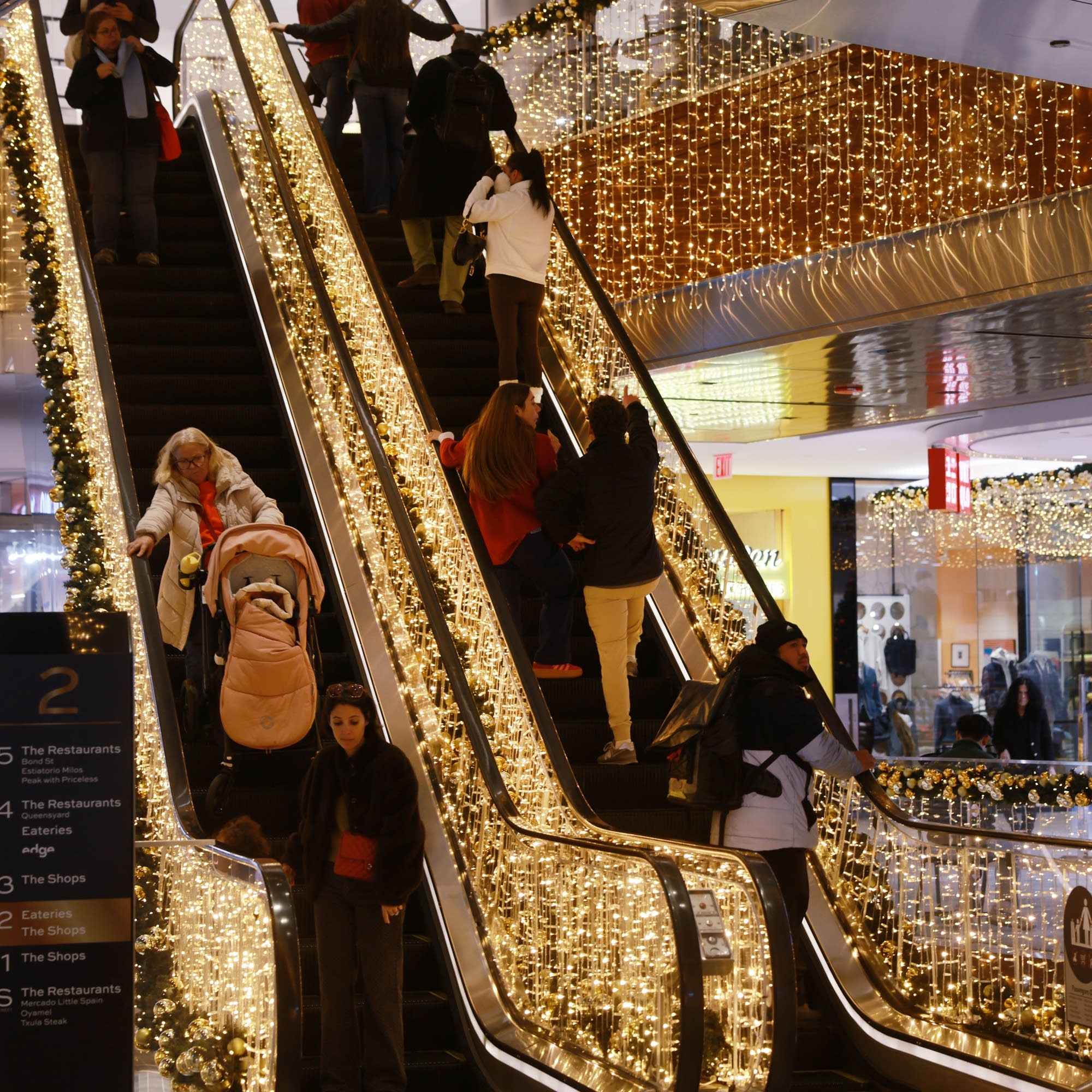
Speaker 2 A very thin slice of consumers in the top 20 or so percent of incomes is due in the majority of spending, evidence of which can be found in Apple's latest earnings.
Speaker 2 After a couple of years of sluggish for them sales, the iPhone 17 pretty much blew the doors off last quarter. Retail price of said phone, $799.
Speaker 2 Marketplace's Henry Epp looks at how we got here and what it's going to mean for where we're going.
Speaker 13 This concentration of spending at the top has been building for decades, driven by widening wealth inequality, says Christina Sargent, an economist at Middlebury College.
Speaker 6 Higher earners have seen strong wage growth and massive gains in wealth from stock and housing.
Speaker 6 Meanwhile, middle and lower income households are squeezed by rising costs like rent and child care, groceries, the basics.
Speaker 13 This inequality has really shown up in spending the last few years as consumers have grappled with inflation, and it's changed the kinds of things people in different economic classes buy, says Leo Feller at the consumer insight company Numerator.
Speaker 14 Everyone has kept buying food. Everyone has kept buying health and personal care items such as deodorant and soap and toothpaste.
Speaker 13 But then there's pretty much everything else, vacations, restaurants, discretionary goods.
Speaker 14 This is going to include things like toys, electronics, sporting goods, apparel.
Speaker 14 This is where we really see a big pullback amongst lower income consumers and higher income consumers have continued to spend.
Speaker 13 The potential trouble with an economy propped up by the wealthiest is that a lot of them are feeling wealthy thanks to the stock market, says Christina Sargent at Middlebury.
Speaker 6 So if the stock market dips, that can ripple out really quickly and the wealthier households make fewer big ticket purchases. We see slower demand and then knock-on effects for jobs.
Speaker 13 It's like the economy is a table balancing on just three legs, Sargent says.
Speaker 6 You're fine in good times, but it gets shakier as things turn to be a little bit less stable.
Speaker 13 But Betsy Stevenson at the University of Michigan says that concern that the wealthy might pull back in a downturn could be a bit overblown.
Speaker 15 The higher-income people tend to have savings as well as access to borrowing, and so they don't change their consumption very much as their wealth moves around.
Speaker 13 The real risk to a K-shaped economy, Stevenson says, is social and political instability. I'm I'm Henry App for Marketplace.
Speaker 2 Coming up.
Speaker 16 You know, I joke that if I could get a middle schooler to be honest about their feelings, I can make a person excited about a brick.
Speaker 2 From teacher to tour guide, straight ahead. But first, let's do the numbers.
Speaker 2
Now Industrial is up 40 points today. That's about a tenth of 1%, 47,562.
The NASDAQ climbed 143 points. That is 6 tenths percent, 23,724.
The SP 500 gained 17 points, a quarter percent, 68, and 40.
Speaker 2 For the week, the Dow found three quarters of 1%. The NASDAQ added 4.10%.
Speaker 2
SP 500 strengthened 7 tenths percent. For the month, the Dow increased 1.7%.
The NASDAQ pocketed 1.3%.
Speaker 2 The S ⁇ P 500 up 1.8 tenths of 1%.
Speaker 2
Checking in on some of those companies on the top half of that K-shaped corporate economy. Three big big cloud computing firms had a mixed day.
Actually, Amazon accumulated 9.6% today.
Speaker 2 Alphabet dipped a 10th percentile. Microsoft down 1.5%.
Speaker 2
We were talking about Apple as well, slipped four-tenths of 1% there. Bonds up, yield on the tenure.
T-Note down 4.08%. You're listening to Marketplace.
Speaker 17 This podcast is brought to you by Wise, the app for international people using money around the globe.
Speaker 17 With Wise, you can send, spend, and receive up to 40 currencies with only a few simple taps and save up to 55% compared to major banks.
Speaker 17 Whether you're buying souvenirs with pesos in Puerto Vallarta or sending Euros to a loved one in Paris, you know you're getting a fair exchange rate with no extra markups.
Speaker 17 That's what makes Wise the fast, affordable way to use your money around the globe.
Speaker 17 WISE offers 24-7 live support and runs over 7 million daily checks to catch and prevent fraud, so you know your money is where it's supposed to be. Be smart.
Speaker 17
Join the 15 million customers who choose WISE. Download the WISE app app today or visit wise.com.
Learn more by visiting wise.com/slash US slash compare. T's and C's apply.
Speaker 1 This podcast is supported by Odoo. Some say Odo business management software is like fertilizer for businesses because the simple, efficient software promotes growth.
Speaker 1 Others say Odoo is like a magic beanstalk because it scales with you and is magically affordable.
Speaker 1 And some describe Odo's programs for manufacturing, accounting, and more as building blocks for creating a custom software suite.
Speaker 1
So Odoo is fertilizer, fertilizer, magic beanstock building blocks for business. Odoo, exactly what businesses need.
Sign up at odoo.com. That's odoo.com.
Speaker 4 This marketplace podcast is supported by Wealth Enhancement, who ask, Do you have a blueprint for your money?
Speaker 4 Wealth Enhancement can help you build the right blueprint for investing, retirement, tax, and more.
Speaker 4 With offices nationwide, there's an advisor who's ready to listen and craft a blueprint for your future. Find out more at wealthenhancement.com/slash build.
Speaker 18 With built-in advanced AI features, it's the PC that helps you do more faster.
Speaker 18 From smarter multitasking to extended battery life, these PCs get the busy work done so you can focus on what matters most to you.
Speaker 18 Plus, earn Dell rewards and enjoy many other benefits like free shipping, expert support, price match guarantee, and flexible financing options.
Speaker 18 They also have the biggest deals on accessories that pair perfectly with your Dell PC, improving the way you work, play, and connect.
Speaker 18 Whether you just started holiday shopping or you're finishing up, these PCs and accessories make perfect gifts for everyone on your list. Shop now at dell.com/slash deals and don't miss out.
Speaker 18 That's dell.com/slash deals.
Speaker 2
This is Marketplace. I'm Kai Rosdal.
This is pretty much self-evident, but we need food, which is another way to say we need American farmers.
Speaker 2 We also need electricity, much more of it now than we used to thanks to our digital economy.
Speaker 2
Those two things collide headlong in a changing climate, and all of that is making things harder for farmers. So Enter Now, a way to produce food and energy at the same time.
Jediro Schleice reports.
Speaker 7 Linda Hetzel gets up early to clip herbs, vegetables, and produce from the plants on her farm north of Kansas City. Italian parsley, cutting celery,
Speaker 7
peppers. I'm trying peppers, which you normally think would be only in full sun.
Hetzel's peppers are shaded by 18 solar panels hoisted more than eight feet off the ground.
Speaker 7 There's no blossom on in yet, but the plants look healthy. Hetzel's been farming for three decades, and this is her first season planting under her new solar array, a strategy called Agrivoltaics.
Speaker 7 The panels power her home and also provide shade, which is crucial for many crops in Missouri thanks to climate change.
Speaker 7 I have observed over the 30 years here, the heating of this landscape is making it more difficult for some plants to thrive and even survive.
Speaker 7 Hetzel has a small farm and a small-scale solar array, but agrovoltaic installations are more and more common. From 2020 to 2024, the number of agrovoltaic sites in the U.S.
Speaker 7 more than doubled to cover some 62,000 acres because there's lots of land out there underneath larger solar projects.
Speaker 6 Every time I see land space, I'm like, food.
Speaker 7 Kajawa Berry is with Minnesota-based nonprofit The Food Group, which offers training for new organic farmers.
Speaker 7 She says one huge challenge for farmers is finding affordable, consistent access to land to grow produce.
Speaker 6 You know, whenever they rent land, they are just subjected to the annual lease. And they can't plant perennials.
Speaker 6 I mean, they could, but it will cost them a lot of money and then they can't take it with them.
Speaker 7 So Barry is constantly hustling to find any little plot of available land for the farmers she works with.
Speaker 6 My kids make fun of me because they're like, mommy's probably just thinking about how many tomatoes or how many watermelons can we go? I'm like, yes, you know me so well.
Speaker 7
Now the food group is partnering with a Minnesota-based energy developer called U.S. Solar.
They're piloting long-term farming leases for land underneath and around solar panels.
Speaker 7 The company gets free land maintenance and the project's farmers get an essentially free space to grow their crops. Peter Schmidt with U.S.
Speaker 7 Solar says it's a good deal for his company because something has to happen to that land.
Speaker 19 So whether it's pollinators, whether it's grazing, whether it's crop production, we're not going to leave it fallow.
Speaker 7 Schmidt is U.S.
Speaker 7 Solar's Director of Project Development and says the company has also experimented with other types of agrovoltaics, like planting pollinator habitat or providing pasture for flocks of sheep.
Speaker 7 He says this could be one answer for ag communities that wonder whether solar arrays are a good fit in general.
Speaker 19 When we can come into a community and, you know, they might have folks that are saying, we don't want to see farmland taken out of production. Well, our response could be, neither do we.
Speaker 7 For some small-scale farmers in the Midwest, at least, it's working.
Speaker 7 Kajawa Berry says the farmers she works with are now able to grow lettuce or herbs in the middle of the summer, thanks to the shade. In Kearney, Missouri, I'm Jana Roschleis for Marketplace.
Speaker 2 You know the story of the three little pigs, right? The first one had the house built of straw, the second of sticks, the third of bricks.
Speaker 2 Spoiler alert of sorts, I guess, that third one of brick was the only one that stayed standing when the wolf huffed and puffed.
Speaker 2 Now, yes, it's a fairy tale, and no, this isn't necessarily the moral of the story, but bricks are just darn good building material, which is why a lot of the oldest buildings still standing in these United States are made of brick or stone.
Speaker 2 Here's today's installment of our series, My Economy.
Speaker 16 My name is Will Kwam, and I run Brick of Chicago, which is a walking tour organization where I give brick-based walking tours of 11 neighborhoods all across Chicago.
Speaker 16 So I kind of came into this accidentally. I moved to Chicago originally to teach theater, and my work brought me all over the city and all over the suburbs.
Speaker 16 And what you start to notice the more time you spend in Chicago is how the building forms repeat.
Speaker 16 You know, we build the same bungalow over and over again or the same two-flat, but that the brick is what makes each one unique. And I started to see that, hey, these aren't just red rectangles.
Speaker 16 There's texture, there's color, there's pattern.
Speaker 16 Slowly I started building tours after a suggestion of a friend of mine who runs a tour organization. And then the pandemic hit, and all my teaching stopped.
Speaker 16 And I was at home, and my wife had the idea: hey, what if you give virtual tours? And I did, and it was really successful. And I was able to do that all of 2020 and 2021.
Speaker 16 And starting in 2021, I went back out in person. And now I give anywhere from five to eight tours a week.
Speaker 16
There's a huge amount of overlap between my theater background and the work I do today. You know, I'm still, I'm performing.
I'm performing out there, trying to get people to be interested.
Speaker 16 You know, I joke that if I could get a middle schooler to be honest about their feelings, I can make a person excited about a brick.
Speaker 16 So I'm also an architecture photographer, so I take pictures for architects and developers and brick manufacturers and floor makers and all sorts of different people.
Speaker 16
And that's a big part of my income, too. It comes out to about 60, 40 tours, photos.
It varies year to year.
Speaker 16 It's not a great side hustle, so to speak, in that all the timing of it overlaps with my tour work. People want photos when the weather is nice, when the sun is out.
Speaker 16
And that's also when people want to take tours. And that means then my winter is very quiet.
I don't have as
Speaker 16 going on.
Speaker 16 And that requires a lot of foresight and a lot of planning ahead when it comes to my finances, which I'm still learning how to be good at.
Speaker 16 Part of what's changed for me over the last few years too is not just thinking season to season, but having to think a little more long term, especially now that I have a kid.
Speaker 16 You know, right now I do four tours every weekend and I'm away from 10.30 to 5 every weekend.
Speaker 16 Looking ahead, I'm planning to hire a guide who can take over some routes, or I can have routes that run concurrently, or I can just be home more. So that's something I have to plan ahead for.
Speaker 2
Welcome, planning and running brick of Chicago, Chicago, Illinois. No matter where you are, no matter what you do, we cannot do this series without your stories.
So send them to us.
Speaker 2 Would you marketplace.org/slash mycon.
Speaker 2 Okay, so what happened was Catherine and Courtney and I went nine minutes instead of seven and a half. So we got to go.
Speaker 2 Our theme music was composed by BJ Lederman, Marketplace's executive producer is Nancy Fargali. Joanne Griffith is the chief content officer Neil Scarborough's vice president and general manager.
Speaker 2
And I'm Kyle Rizzol. Have yourselves a great weekend, everybody.
We will see you on Monday.
Speaker 16 This is 8 p.m.
Speaker 2 Sometimes kids ask questions that reveal just how much adults still need to learn, like, can you explain what causes an economic bubble? And why are things so expensive at the airport?
Speaker 2 Or how much national debt might be too much?
Speaker 2 Fear not, Million Bazillion is back with a new season to help you and your kids become pros at understanding how money shapes the answers to all those questions and more.
Speaker 2 Listen to the latest season of Million Bazillion on your favorite podcast app.