The great decoupling
When revenue grows, hiring grows — usually. But in November, retail sector job cuts were up nearly 140% year over year, according to outplacement firm Challenger, Gray & Christmas, in spite of strong consumer spending. What gives? Mostly, more automation. Also in this episode: Medium-term bonds send hints about Fed interest rate decisions, an AI bubble burst will come with new jargon, and small business owner optimism is up.
Every story has an economic angle. Want some in your inbox? Subscribe to our daily or weekly newsletter.
Marketplace is more than a radio show. Check out our original reporting and financial literacy content at marketplace.org — and consider making an investment in our future.
Press play and read along
Transcript
Ready to elevate your career in the sports industry?
The Masters in Sports Business from the Levy School of Business prepares you for leadership roles, connecting you with partners including the San Francisco Giants and the 49ers.
Discover mentorship and real-world experience that raises your game in the heart of Silicon Valley. Search Levy Sports Business Masters to find out more about the program today.
This podcast is supported by Odoo. Some say Odoo business management software is like fertilizer for businesses because the simple, efficient software promotes growth.
Others say Odoo is like a magic beanstalk because it scales with you and is magically affordable.
And some describe Odoo's programs for manufacturing, accounting, and more as building blocks for creating a custom software suite. So Odo is fertilizer, magic beanstock building blocks for business.
Odoo, exactly what businesses need. Sign up at odoo.com.
That's odoo.com.
on the program today the bond market ai small businesses and botox in that order from american public media this is marketplace
in los angeles i'm kai risdahl it is tuesday today this one is the 9th of december good as always to have you along everybody We all want to know which way the economy is going, right?
I think that's a pretty uncontroversial thing to say.
And to find out, you could, for instance, ask an economist friend what they think, maybe a Wall Street banker if you know one, or better yet, a small business person.
You could also clue into the Federal Reserve tomorrow when the central bank is going to release its summary of economic projections, where they think rates and a bunch of other parameters are headed.
You could also, though, if you are of a mind, look at the bond market.
Demand for short-term treasury bills and longer-term bonds at either end of what is known as the yield curve can tell us a lot about what investors are expecting.
But there is a part of that yield curve that we don't often talk about. Medium-term treasury, sometimes known as the belly of the curve.
And as Marketplace Adjustin Ho reports now to get us going, that belly has been sending some signals of its own.
The government issues treasuries that mature in anywhere from less than a year to 10 and even 30 years. So the belly of the curve is basically everything in the middle.
We tend to focus on two-year and five-year notes. That's Chris Lowe, chief economist at FHN Financial.
He says yields on treasuries in that belly of the curve are influenced by what investors expect the Federal Reserve to do in that two to five year timeframe. They anticipate.
So when we talk about the Fed might cut rates at an upcoming meeting or they might not, well, we're anticipating not just the next one, but the next several years worth.
Investors know that the Federal Reserve is still trying to bring rates down to a neutral level to support full employment and stable inflation.
And if investors think interest rates are going to keep falling, they're more likely to buy those bonds today.
But Lowe says over the last couple of weeks, demand for treasuries within that belly of the curve has eased off a bit.
When we look at the pricing of interest rates in the belly of the curve, it partly reflects a debate within the trading community, within the Federal Reserve itself, about just exactly where is neutral.
Over the last couple months, expectations for economic growth have picked up.
John Canavan, lead market analyst at Oxford Economics, says the tax incentives and the budget law passed this year are expected to stimulate consumer spending.
That same act has also resulted in significant investment benefits for corporations, which is likely to improve capital expenditures next year, which should help economic growth.
And if economic growth continues to pick up and inflation sticks around? That actually means the Fed is likely to cut rates less. That's Kathy Bosjancic, chief economist at Nationwide.
She says bond markets are only expecting two cuts next year. And beyond that? We think that then we settle into a neutral level and it could be there for a while.
In other words, the belly of the curve is suggesting that rate cuts could be coming to an end. I'm Justin Ho for Marketplace.
Hmm,
Wall Street today. Once again, I know I'm a broken record here.
Traders were waiting on the Fed. We will have the details when we do the numbers.
All right, tell the truth here. Before the financial crisis and the Great Recession, did you know what a mortgage-backed security was? Had you ever heard of a credit default swap?
If I'd have asked you whether Lehman Brothers was an investment bank or a chain of auto body shops, which would you have guessed?
Well, investment bank, probably most of you, but the point is, every bubble has its own jargon and its own terms of art that when things are bubbling up, they become common parlance on Wall Street.
After things pop, though, all that jargon makes its way into our Main Street vocabulary. And you can perhaps guess where I'm going here.
There's plenty of debate about whether we're even in an AI bubble, let alone its poppability.
But just in case things do go south, Marketplace Met Levin has three early candidates for the bubble buzzwords we hope you are not going to be learning in the near future.
Just to reassure you a bit, very few experts I interviewed think we're on the precipice of some global economic meltdown like the Great Recession.
But on a scale of one to 10, with 10 being, I'm getting major 2008 heebie-jeebies here. Just how worried are those experts? I'd say I think it's between five to seven.
I'll say probably seven or eight at least. I'm probably in the middle of that range at a four or a five.
Okay, so maybe not that reassuring. Gil Luria at the investment firm D.A.
Davidson, the four or a five guy, says if things do go haywire, you'll probably probably hear these words a lot.
Special purpose vehicle. Special purpose vehicle, or SPV as the cool kids call it.
Even very rich tech companies sometimes need to borrow money to build an AI data center.
So when Meta announced it was building a nearly $30 billion data center in Louisiana earlier this year, it wasn't surprising there was lots of debt involved. Now, this isn't Meta borrowing the money.
Technically, it's a special purpose vehicle borrowing the money, a separate legal entity Meta co-created with a private investment firm. Meta is agreeing to rent the data center.
So that would be like you buying a house, but not taking the mortgage yourself, but having somebody else take the mortgage. Which, from your perspective, is great.
But from a broader economic perspective, maybe not so great. The fraudulent energy company Enron was a big fan of special purpose vehicles.
Now, there's nothing inherently illegal about SPVs, but if demand to use that Louisiana data center falls short of expectations, it's meta borrowing money without borrowing money, and at the end of the day, somebody's going to be left holding the bank.
Which brings us to AI bubble buzzword number two. Private credit.
Advait Arin is at the Center for Public Enterprise. He was the five to seven guy on the doomsday scale.
Private credit is basically investment firms like hedge funds and private equity lending money to businesses, like a bank would, except they're not regulated like banks.
I don't even think Americans are necessarily unfamiliar with this concept. We might have even heard of it previously as a shadow bank.
That data center in Louisiana Meta is building with that special purpose vehicle, a private credit firm is throwing in billions, which is the case for a lot of AI financing.
These chips that companies like NVIDIA make, they help those tech companies buy those chips, and they help the data center developers take out long-term debt or construction debt to build the data centers themselves.
If the AI bubble goes pop, private credit will be hit pretty hard.
That's bad news for the pension funds whose money private credit firms invest, but it could also be bad news for actual non-shadow banks.
So banks are actually funding private credit and are getting some amount of returns from private credit.
And private credit uses banks' funding to go and raise other debt or other capital and goes and makes their risky bets.
Private credit, special purpose vehicle, admittedly, these buzzwords sound so boring. Isn't there a new, sexy, sci-fi-sounding word that better befits a a bubble tied to super intelligent robots?
Neo-cloud is a term that people might come to know. Ooh, neocloud.
Paul Kodrowski is a fellow at the MIT Institute for the Digital Economy. He was the expert most worried about the AI bubble.
Neo-Clouds are tech companies that basically rent out AI chips to tech firms and often take out loans against the chips they're renting out.
These neo-cloud providers have very high debt loads, much of it at high yields, much of it that has to be turned over on a four-year, five-year basis. And so they're a very risky bunch.
Core weave is probably the most famous of the neo-clouds. It started as a cryptocurrency company.
The analogy I sometimes make is they're like some of the more aggressive mortgage providers during the financial crisis who showed up to do only ninja loans, no income, no job, no asset loans.
There's already some signs neo-cloud companies are struggling. The price of insurance against Core Weave defaulting on its debt went up by by nearly 60% in two months.
By the way, that insurance, well, it has a familiar name, credit default swaps. Remember those?
Yeah, I tried to forget them too. I'm Matt Levin for Marketplace.
What could possibly go wrong? We are going to be doing some coverage the next couple of months, the general gist of which will be, tell me if this sounds familiar,
AI.
Too big to fail?
Let us know what you want to know at marketplace.org.
As we've said a couple of times the past couple of days on this program, we are never going to get the jobs report for October.
That data has vanished into the black hole of the government shutdown, never to be seen again.
We did, though, this morning, get a slice of labor market data for the 10th month of the year in the form of the October Jolts, the job openings and labor turnover survey.
Help wanted ads climbed to a five-month high. That's good.
Layoffs were up too, though, and people were less likely to change jobs.
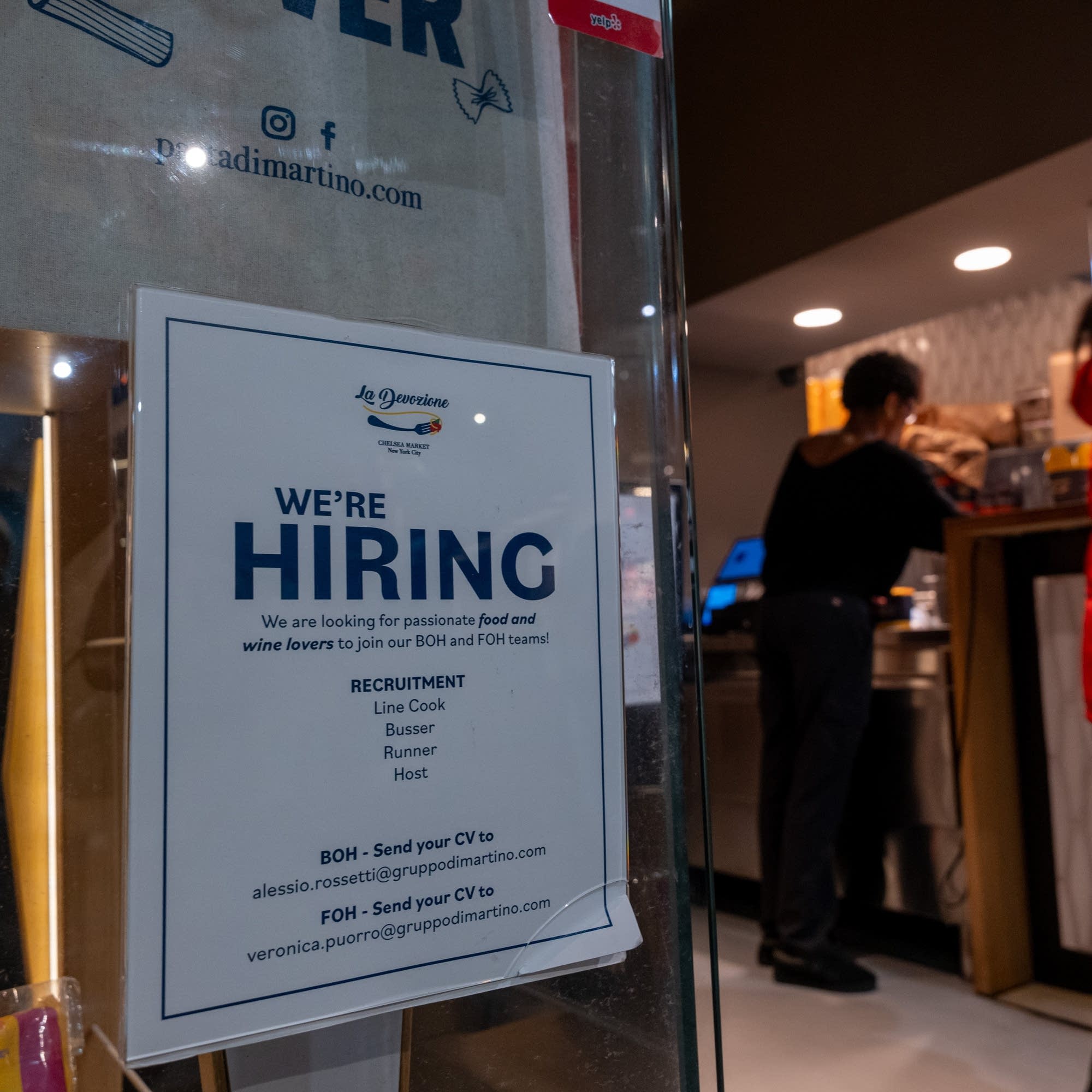
And more top of mind, given the calendar, the outplacement firm Challenger Gurian Christmas says announced job cuts in retail are up nearly 140% from the same period last year.
Marketplace's Kristen Schwab has the holiday retail cautionary tale. Last year, David Swartz, an analyst at Morningstar, toured a new warehouse that Ulta, the cosmetics chain, had recently opened.
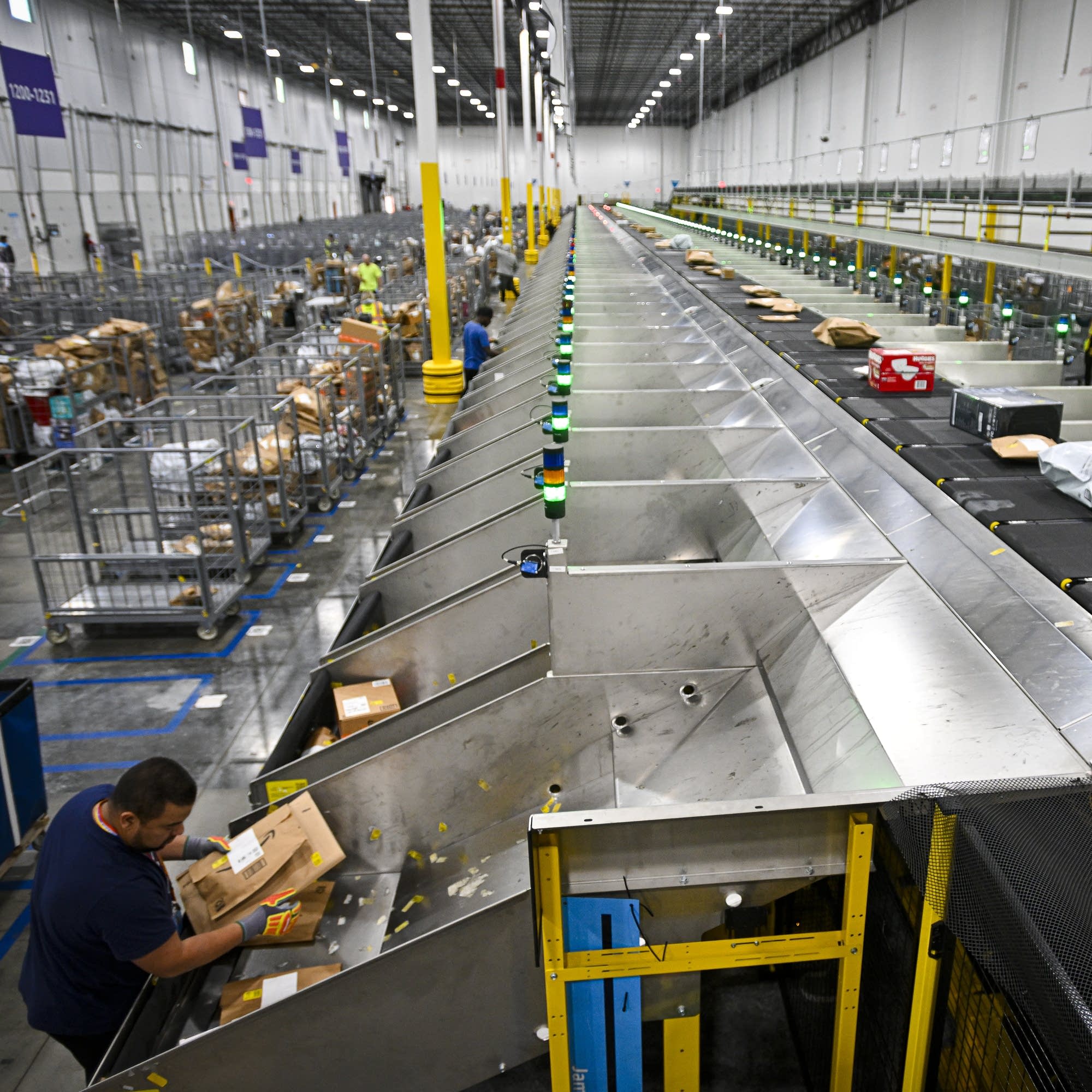
And there's very few people working in there. The people are sort of there to monitor the machines.
The robots are efficient. They can unload, organize, and pack.
From self-checkout at stores to AI at corporate headquarters, technology saves money, considering wages typically make up something like half of retailers' operating costs.
And relying on machines means there's less seasonal hiring fuss. Even the robot workers can be laid off to some degree when they're not needed.
This is the future of retail, says Steve Hawkman at Nagaro. We call it, in fancy terms, the great decoupling.
Usually in business, when revenue grows, hiring grows.
There's more money to invest and expand. But this holiday season, what we're seeing is a separation of those two trends.
Meaning now, even when a retailer's revenue increases, hiring typically falls.
Companies are investing in other areas, like those robots, instead of in their headcount.
Especially this year, brands have leaned hard into automation because of uncertainty in the economy, even though the holidays are kind of the worst time for job cuts.
John Talbot teaches marketing at Indiana University. For years, larger retailers have mostly avoided any form of layoffs during the holiday season.
For, you know, 15 years now, it's just bad press.
Because reporters like me are watching extra closely. Still, Target and Amazon have announced layoffs in the last several months.
Talbot says between low consumer sentiment and tariffs, every dollar counts. This is an odd year.
I definitely think it's an odd year.
He says, even if consumers spend like crazy, it'll at most slow the trend a tad. Inevitably, the great retail labor reshuffling is here.
I'm Kristen Schwab for Marketplace.
I mentioned layoffs were up in October overall. In the information industry specifically, October a year ago, there were 34,000 layoffs.
October this year, 48,000.
This past September, we heard from Archett, who'd been laid off from his tech job back at the start of the year around the same time that his parents were laid off too.
So we got him back on the phone to hear how he and the family are faring.
I've been fortunate enough to have the opportunity to interview at a bunch of places and get a couple of offers and be able to choose between them.
But that process has kind of taught me a lot about the job market as it currently is.
I started interviewing in October after again putting in over 100 applications, but almost all of my interviews were to referrals.
My first offer was actually at a startup, but it ended up the pay was so low that out of respect for I guess myself I just couldn't take that job because you're not even paying me a livable wage.
Then it was a large Fortune 500 company.
The thing with them is they're economically doing pretty poorly and as I joined, I'm hearing news that they might do layoffs next year and it's unclear what the future of the company is.
So then that adds like a whole other layer.
And even when I'm getting these offers, the economy weirdly doesn't feel stable enough that even if I start working and I am working at one of these companies that the opportunity is guaranteed for that long.
Pretty much every parent I know between me and my friends who's in technology is laid off right now. My dad, he hasn't been able to
find
anything.
And my mom, I think he just burnt out and she just isn't interested in looking anymore. So
I see hope in the horizon in the sense that I think I will
probably be able to get another job if I get laid off. But I don't really know anything about what's going to happen to my parents at the moment.
And I don't really know the wider industry.
Like for people who are less fortunate than me, I wouldn't blame them for not having hope, I guess, is what I'm trying to say.
Archett, newly re-employed in the tech sector out in Phoenix, Arizona.
Coming up. And so when people are saying that they're going to get Botox, it might not be Botox.
Little did you know. First, though, let's do the numbers.
Dow Industrial is down 179 today. 4 tenths of 1% closed at 47,560.
The NASDAQ notched up 30 points. One-tenth of 1%, 23,576.
The S ⁇ P 500 declined six points, about a 10th percentile, 68, and 40.
Cosmetics retailer Ulta Booty Beauty,
which Kristen mentioned, had a glow up to the tune of 2.3 tenths percent. Target crept up six-tenths percent.
Macy's rose two percent. Walmart climbed one and a third percent.
Costco wholesale added one-tenth of one percent today.
Campbell's reports today sales are down due to President Trump's tariffs, especially on the steel and aluminum that they need to make those iconic cans.
The company also doesn't want to raise prices too much in this, and this is a quote. Critical soup season, Campbell's sank five and two-tenths percent today.
You're listening to Marketplace.
When we ask home service bros about their challenges, we can sound a bit repetitive. Can't get quotes out fast enough? Jobber can help.
Trouble finding new customers? Jobber can help.
Spending too much time chasing checks? Jobber can help. Working every night?
You get the idea. Jobber helps you organize, automate, and grow your home service business.
Start your free trial today at jobber.com.
10 years from today, Lisa Schneider will train in her office job to become the leader of a pack of dogs. As the owner of her own dog rescue, that is.
A second act made possible by the reskilling courses Lisa's taking now with AARP to help make sure her income lives as long as she does and she can finally run with the big dogs and the small dogs who just think they're big dogs.
That's why the younger you are, the more you need AARP. Learn more at aarp.org slash skills.
If you're a maintenance supervisor for a commercial property, you've had to deal with everything from leaky faucets to flickering light bulbs.
But nothing's worse than that ancient boiler that's lived in the building since the day it was built, 50 years ago. It's enough to make anyone lose their cool.
That's where Granger comes in.
With industrial-grade products and dependable fast delivery, Granger can help with any challenge, from worn-out components to everyday necessities.
Call, clickgranger.com, or just stop by, Granger, for the ones who get it done.
This is Marketplace. I'm Kai Rizdahl.
Some news now from the world of small business, which I will set up by pointing out that that according to the Small Business Administration, that's businesses with 500 employees or less account for give or take two-thirds of all new jobs in this economy.
With that in mind, then this. According to the most recent survey by the National Federation of Independent Business, first of all, and you probably expected this one, uncertainty is creeping up.
It's up three points since October. That said, though, and uncertain though they are, small business owners remain optimistic, more optimistic than the historical average, in fact.
Marketplace's Carla Javier squares that circle. At Latchkey, a record store in South Philly, sales are up 60% this year, says owner Mark Foletti.
That's no joke. We feel really good about that.
That lines up with the latest survey of entrepreneurs like him. Small businesses are generally doing really well in current economic conditions.
That's NFIB's Holly Wade.
At the same time, she says, uncertainty is high. Hiring remains a concern, and inflation is affecting them too.
Especially in this last survey, where we saw far more small businesses saying that they raised prices in the last quarter. Still, somehow, small business owners like Mark Folletti are optimistic.
I'm probably 58% optimistic. Not quite, maybe 60%,
but more optimistic than pessimistic. One potential explanation comes from John Ahrensmeier of Small Business Majority.
If you're crazy enough to start and run a small business, you are by definition a very optimistic person.
His company did its own survey of small businesses too and found, What is different from the past is that the optimism and pessimism numbers are very close.
He says small businesses have been challenged by tariffs, increasing health care costs, and immigration operations.
Erica Tapp Duran works with owners through the Temple University Small Business Development Center. She says they're doing okay, but are nervous.
They don't necessarily have deep capital reserves or access to large lines of credit. So the flow of commerce needs to be moving at a pretty good clip in order to keep operations sustainable.
Back at Latchkey, Mark Foletti says for now, he's leaning into used records and taking a hit on margins.
If I thought we were in this situation forever where we were going to have tariffs and tumultuousness and total unpredictability, that might be a different ballgame.
Instead, he quit his other full-time job in hopes that next year at the store is as strong as last one was. I'm Carla Javier from Marketplace.
Love it or hate it, since its debut as a cosmetic treatment in 2002, Botox has become a household name, synonymous with the anti-aging hopes of millions.
Sales match those hopes to $2.7 billion last year in the cosmetics space. That said, Botox and his parent company are not enjoying the same prosperity they once did from that injectable.
Madison Mueller covers health and healthcare for Bloomberg, where she wrote about brand Botox. Welcome to the program.
Thanks for having me.
I would like you to tell me, please, how you came to this story.
So I am one of our healthcare reporters reporters here at Bloomberg, and that means I have the privilege of covering AbVee, which is a pharmaceutical company, and AbVee is the maker of Botox.
And one of the things that I've noticed over the last couple of quarters is that Botox was repeatedly missing analysts' estimates in terms of sales.
And that to me was surprising because here in New York, it seems like everyone has Botox. I'm in LA, Madison.
I'm in LA here.
Yeah, so you get it too. You get it, right? So I was like, this doesn't make sense.
Something doesn't add up and dug a little bit more into it. And that's sort of how I got into this story.
So what's going on? I mean, we talked a little bit about, not you and I, but somebody else, about med spas, you know, sort of these days, you know, and people going to get touch-ups or what have you.
It's not like Botox isn't being used more or is it? What's the deal? That is sort of the mystery that was part of this story.
So the thing is, there are different types of neurotoxins now on the market. So Botox is the one that everyone's most familiar with, but Botox isn't the actual class of medications.
And so there are other products on the market. There's one called Disport.
There's one called Ziamin, but it's like Kleenex. You know, everyone uses the word Botox to just describe the treatment.
And so when people are saying that they're going to get Botox, it might not be Botox. And Abby or Allergan has really started to lose out on market share to some of these competitors.
Allergan and now Abbey, they are not the first company to lose market share with their flagship product. What are they doing to bring it back? So they are launching a pretty big marketing campaign.
And one of those events I actually got to go to here in New York.
It was an event called Naturally You. And this was more focused on filler, actually, which is a separate problem.
But it shows the sort of consumer activation that Abbey is doing right now to get consumers and customers back on their side, making sure that people know, you know, they've been around for so long.
There's lots of studies, super safe, and it has a ton of different approved uses for, you know, different types of lines and signs of aging all over your face.
For all the approved uses and the safeness of it, naturally you is somewhat ironic in that conference title, yeah. Yeah, exactly, exactly.
But I think that that's, that's a big part of this is one of the reasons that people are shying away from cosmetic treatments at this moment is because there's a more natural look that's in.
I mean, if you think about celebrities like Pam Anderson and, you know, you're in LA, you're there with all the celebrities. They're embracing aging.
And so people are scared of looking unnatural.
And that's one of the things that Avi is contending with.
And so they have a new product that's called Trenabot E, and it's a faster acting neurotoxin. So it wears off within a couple of weeks.
And so they're hoping that, you know, if people like them, they'll come back and just start getting Botox. You got to innovate, man.
You got to innovate.
I I will close here, and I'm not outing you because you actually put this in Bloomberg. You know whereof you speak.
Well, so I mean, part of this also came from my personal experience of I am on TV sometimes here at Bloomberg and was like, wow, this job is aging me. I'm really getting some forehead wrinkles here.
You should try radio. That's all I'm saying.
Yeah, exactly, exactly. And so I went to a med spa here in New York and really liked the results.
I was going for probably two years and one day looked over at the needle and the vial that they're injecting into my face and saw that it was not Botox as I thought that it was for the past two years.
It was Disport, which is a different product. And I think that that sort of illustrates what is happening.
And a lot of people maybe don't realize that there was anything really going wrong at AbV at all, just because Botox is so ubiquitous and everyone knows what it is. Yeah.
Madison Mueller at Bloomberg.
Madison, thanks a bunch. Appreciate your time.
Thank you.
This final note on the way out today, which, you know, grain of salt. Bloomberg has the story that SpaceX is moving ahead with plans for an initial public offering.
Mid to late 2026 is the timeframe.
The valuation is the interesting part: $1.5 trillion,
says Bloomberg. The grain of salt attaches not to the story, but to the guy running the company.
Elon Musk's penchant for over-promising and delivering very, very late are very well documented.
Jordan Manji, Zonio Maharaj, Janet Wynn, Olga Oxman, and Virginia K. Smith work on the digital team around here.
I'm Kai Risdahl. We will see you tomorrow, everybody.
This is APM.
10 years from today, Lisa Schneider will train in her office job to become the leader of a pack of dogs. As the owner of her own dog rescue, that is.
A second act made possible by the reskilling courses Lisa's taking now with AARP to help make sure her income lives as long as she does and she can finally run with the big dogs and the small dogs who just think they're big dogs.
That's why the younger you are, the more you need AARP. Learn more at aarp.org/slash skills.