This isn’t the 2018 trade war
The Federal Reserve may be steering the economy through another trade war. But this time, the inflation of the last few years complicates its task. Also in this episode: Unemployed Americans struggle to snag new positions, banks’ unrealized losses jump, and an aerospace tech startup sets up shop in Cumberland County, Tennessee.
Press play and read along
Transcript
Speaker 1 This marketplace podcast is supported by Wealth Enhancement, who ask, Do you have a blueprint for your money?
Speaker 1 Wealth Enhancement can help you build the right blueprint for investing, retirement, tax, and more.
Speaker 1 With offices nationwide, there's an advisor who's ready to listen and craft a blueprint for your future. Find out more at wealthenhancement.com/slash build.
Speaker 3 This podcast is supported by Odoo. Some say Odoo business management software is like fertilizer for businesses because the simple, efficient software promotes growth.
Speaker 3 Others say Odoo is like a magic beanstalk because it scales with you and is magically affordable.
Speaker 3 And some describe Odoo's programs for manufacturing, accounting, and more as building blocks for creating a custom software suite. So Odoo is fertilizer, magic beanstock building blocks for business.
Speaker 3
Odoo, exactly what businesses need. Sign up at odoo.com.
That's odoo.com.
Speaker 2
All right, that's it. I give up.
You all figure it out. I mean, I'm kind of kidding, but I'm kind of not.
Speaker 2 From American Public Media, this is Marketplace.
Speaker 2
In Los Angeles, I'm Kai Risdolph. Thursday, today, the 6th of March.
Good as always to have you along, everybody.
Speaker 2
Tariffs are on. Tariffs are off.
Tariffs are modified. Tariffs are coming in a month.
Stop me when you have heard enough. Traders obviously have given up on trying to figure it out.
Speaker 2 All three major indices tumbled amid the chaos and confusion, even though the tariff news today is that the president's taxes on most imports from Canada and Mexico, effective as of just two short days ago, are off for a month.
Speaker 2 Whiplash is the economic order of the day for everybody for sure, but most particularly for the people whose actual job it is to keep this economy going.
Speaker 2 When it comes to navigating through a trade war, this is not Jay Powell's first rodeo.
Speaker 2 Powell was new to the job in March of 2018 when first-term President Trump announced those 25% tariffs on steel and 10% on aluminum, and then the China tariffs a couple of months later.
Speaker 2 But the American economy the Fed was managing back then was very, very different than the one it's managing now.
Speaker 2 And as Marketplace's Matt Levin reports, so are the Fed's options for keeping it on track.
Speaker 4 The obvious difference between the economies of 2018 and 2025?
Speaker 5 I think there's three words. It's inflation, inflation, inflation.
Speaker 4 Ann Owen is an economist at Hamilton College. Back in 2018, entire generations of Americans had never really had experience with high inflation.
Speaker 4 It was one of those mythical things from decades past, like print newspapers or civil political discourse.
Speaker 4 So when Trump floated his first term tariffs, consumers and businesses didn't really expect inflation to rise above the 2% or so they were used to.
Speaker 4 Now, though, after four years of paying through the nose for eggs.
Speaker 5 So if you are paying attention to any discussion about the impact of tariffs, certainly inflation is a word that you're going to be sensitive to.
Speaker 5 And that's going to influence your expectations about inflation.
Speaker 4 Higher inflation expectations can cause higher inflation, a self-fulfilling nightmare for the Fed. Richard Clarida was Fed vice chair in 2018.
Speaker 4 He says consistently low inflation allowed the central bank to basically ignore Trump's tariffs as one-off shocks, although those 2018 tariffs were smaller in scope.
Speaker 6 Right now, there's a discussion about
Speaker 6 Mexico and Canada and potentially on the Eurozone and reciprocal tariffs. And so the menu of possible tariff options is vastly longer.
Speaker 4 On the other side of the Fed's dual mandate, full employment, the 2018 and 2025 economies look similarly strong with unemployment around 4%.
Speaker 4 But over the past few months, payroll and GDP numbers show signs of a slowdown.
Speaker 4 Stephanie Aliaga at JP Morgan Asset Management says this time around, tariffs are hitting an economy that's losing momentum.
Speaker 8 The economy the 2025 Fed is trying to steer is a far more fragile economy than the one that they encountered in 2019. And given the risks,
Speaker 8 with inflation and growth, it puts the Fed in a really tricky spot.
Speaker 4 Either keep rates high to fight the inflationary impact of tariffs and risk recession, or lower rates and risk more inflation. I'm Matt Levin for Marketplace.
Speaker 2
Wall Street today seriously, gang. Traders have had it.
We'll have the details when we do the numbers.
Speaker 2 We're going to do a little labor market now. We get the first full monthly unemployment report of the second Trump administration tomorrow morning.
Speaker 2
Today, it was first-time claims for unemployment benefits. They dropped last week after a big bump a week earlier.
You might remember that.
Speaker 2 But the number of people making continuing claims has reached a three-year high, which means it is taking people longer to find new jobs.
Speaker 2 There was evidence of that competitive job market in the Fed's Beige book, too. It was out earlier this week.
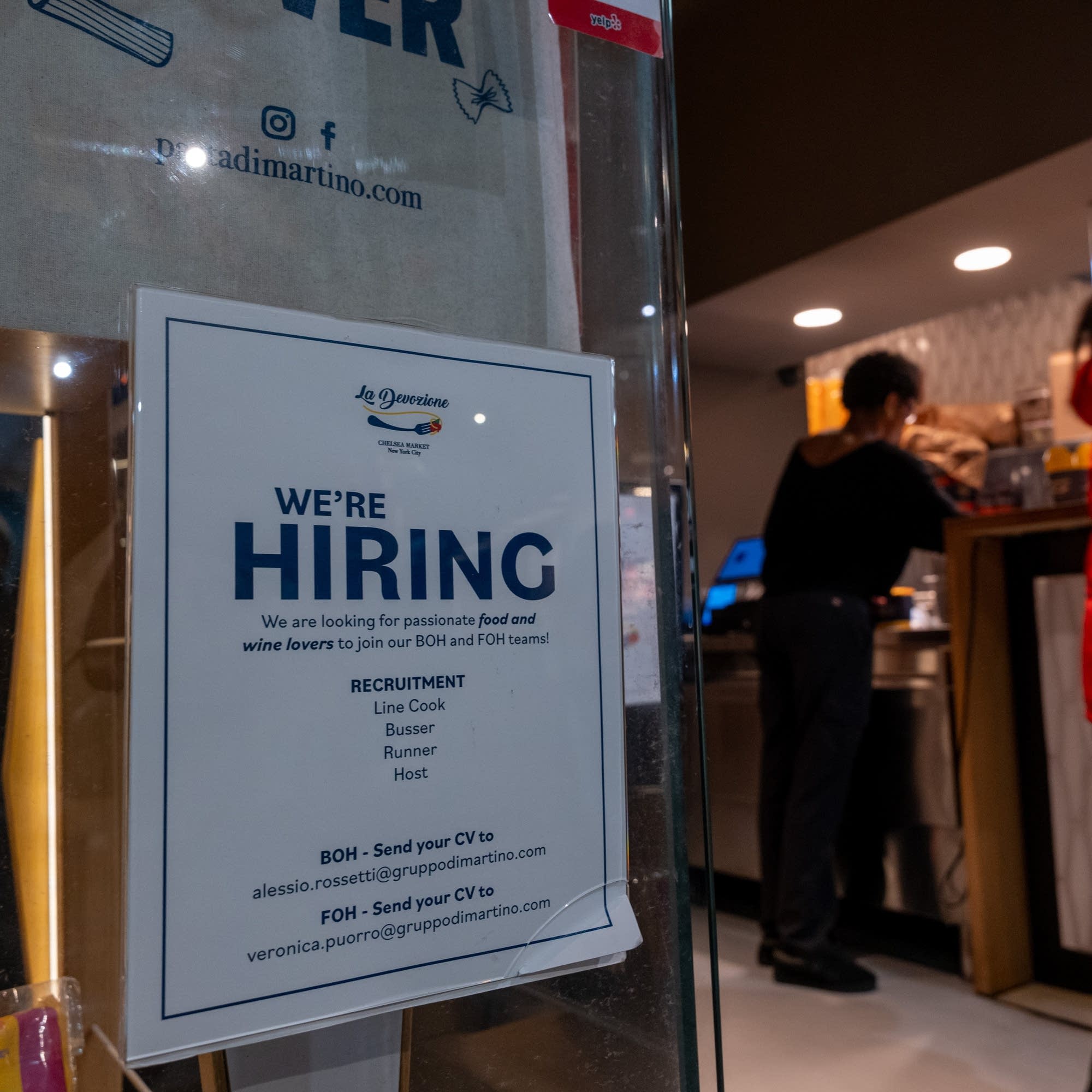
Speaker 2 A lot of businesses outside the chronically short-staffed sectors like healthcare and construction said they're having an easy time finding people. One said they had resumes stacked to the ceiling.
Speaker 2
That's a quote. Another said jobs that used to get dozens of applications now get hundreds.
Marketplace Megan McCarty-Carino has more on the state of American labor.
Speaker 9 On paper, the job market looks pretty strong this year. Layoffs and unemployment have been relatively low.
Speaker 9 But when you ask career coach Amanda Augustine at the outplacement firm Career Minds, for those who are looking for a job, you know, get ready to be in it for the long haul.
Speaker 9 Augustine serves mostly white-collar workers who've been let go. She says it's taking an average of five and a half months for them to find new jobs.
Speaker 10 It does seem to be a longer, more drawn-out process than before.
Speaker 9 She says competition is fierce, and many employers are asking applicants to jump through more hoops. Skill assessments, personality tests, or multiple rounds of interviews.
Speaker 10 Nobody wants to make a costly mistake and hire the wrong person, so they're taking all this extra time.
Speaker 9 The job market in some sectors almost feels frozen, not just because hiring has slowed, says Alison Srivastav, an economist with Indeed Hiring Lab.
Speaker 12 People are pretty hesitant to leave their jobs. Quit rates rates are pretty low right now.
Speaker 12 It seems as though people don't have the confidence that they did a few years ago to just go out and find a new job.
Speaker 9 Sri Vastov says in some fields, like accounting, job postings are well above their pre-pandemic baseline, but they're down in banking and software development.
Speaker 9 Unemployment has hit hardest for workers with some college but without advanced degrees, says Julia Pollack, chief economist at jobsite ZipRecruiter.
Speaker 7 There are some fields where workers are still doing fine, but for people with communications majors, PR,
Speaker 7 IT, HR, all of those kinds of fields, this is a very, very unforgiving market right now.
Speaker 9 She says ZipRecruiter surveys of job seeker confidence show a decline this year.
Speaker 7 And workers are expressing a fair degree of layoff anxiety.
Speaker 9 Especially government workers who are job searching at increased rates. Pollock says federal employees are concentrated in fields like program management and administration.
Speaker 9 So those areas are being flooded with applications. I'm Megan McCarty-Carino for Marketplace.
Speaker 2
Megan mentioned government workers and layoff anxiety there at the end. We now have a number on how many of those federal workers have been fired so far.
I guess I should say.
Speaker 2 It comes from the outplacement firm Challenger Grain Christmas, which said this morning that overall in this economy, 172,000 people were laid off in February. 62,242 of those were federal employees.
Speaker 2 A reminder here that what is being billed as government savings
Speaker 2 often and usually isn't.
Speaker 2 You might have picked up on this if you listen through to the end of the numbers every day when I do the tenure treasury, that when bond prices go up, bond yields go down.
Speaker 2 Or in simpler terms, when interest rates go up, the value of existing bonds goes down. Doesn't matter why right now, that's a whole separate separate thing.
Speaker 2 But the fact that that's what happens was a big factor in the collapse of Silicon Valley Bank two years ago, this coming Monday, which does seem very, very long ago.
Speaker 2
Interest rates were going up back then. Powell and the Fed were worried about inflation.
And so the value of the bonds that the bank was holding tumbled.
Speaker 2 I mention all that because a new report from the Federal Deposit Insurance Corporation shows that banks are still holding plenty of exactly that kind of loss.
Speaker 2 So Marketplace Justin Ho looked into how that's affecting banks and what those banks are doing about it.
Speaker 15 When trillions of dollars of government relief aid went out early in the pandemic, a lot of it ended up being deposited in banks across the country, and they had to figure out what to do with that money.
Speaker 16 We sat on our deposits for quite a while and then ultimately decided that, well, the money's sticking around. It's a little bit stickier than we thought it was going to be.
Speaker 16 Let's put it to work.
Speaker 15 That's Chris Duncan. chief lending officer at LaSalle State Bank in Illinois.
Speaker 15 He says there wasn't much demand for loans at the time, so the bank decided to invest some of those deposits in five to ten-year government bonds, which at the time were paying next to nothing in interest.
Speaker 15 But then the Federal Reserve started raising interest rates, and all of a sudden, those low-interest bonds the bank owned were worth less.
Speaker 16 You can imagine that there is no one out in the market that is looking to purchase that very low-interest rate-bearing security when they could now go out in the market and buy a security that's earning them much higher interest rate.
Speaker 15 Duncan says he had hoped that interest rates might come down a bit more than they have, but they haven't.
Speaker 16 And so we have not seen our unrealized loss position in our securities portfolio reduce as much as maybe we would have anticipated a year ago.
Speaker 15 If a bank needs to sell off any of those securities, say to scrounge up some cash, it'd have to do so at a loss and take a chunk out of its profits.
Speaker 15 Julie Hill is dean at the University of Wyoming College of Law.
Speaker 13
Your shareholders are upset. Maybe it costs you more to borrow.
Maybe it's harder for you to provide loans to your customers.
Speaker 15 But Hill emphasizes that's only an issue if banks need to sell off their bonds. And right now, most of them are holding on to what they own, which might not be such a bad idea.
Speaker 13 Because at some point, some of those securities are going to hit maturity and go away and they won't have been sold.
Speaker 15 So the bank gets back the full amount that it invested. Banks can afford to do that when they have plenty of excess capital they can use as a cushion.
Speaker 15 Quinton Lady is chief financial officer of First National Bank Colorado.
Speaker 15 He says his bank has plenty of extra capital sitting around, in large part because he says his borrowers are paying back their loans just fine.
Speaker 11 And that really is a driver for an environment where you're building capital over time because you're not needing to put more aside for potential loan losses.
Speaker 15 Lady says it also helps that most of the bank's assets are invested in loans rather than bonds because they tend to have shorter terms and often allow banks to increase the interest rate.
Speaker 11 And so we get to experience the rising rate environment quicker with those.
Speaker 15 At LaSalle State Bank in Illinois, Chris Duncan, the chief lending officer, says one strategy is to make more loans to take advantage of today's elevated interest rates.
Speaker 15 Another is selling off some of its old low-interest bonds, taking the hit and reinvesting in new bonds with better yields.
Speaker 16 We feel in five to ten years, when rates have come down, those securities, those investments, will still be earning much higher rates and therefore those securities will have value.
Speaker 15 Hope is, Duncan says, that in five to ten years, we'll be talking less about unrealized losses and more about unrealized gains. I'm Justin Ho for Marketplace.
Speaker 17 Coming up, we were sequestered
Speaker 17 out in the boonies.
Speaker 2 Living with your co-workers. But first,
Speaker 2 sure, why not? Let's do the numbers.
Speaker 2 Yeah, the Wawas again. I think that's like three days out of four, right? Dow Industrial is off 427 points, about 1%, 42,579.
Speaker 2 NASDAQ plunged 483 points, 2.6%, 18,069. The S ⁇ P 500 down 104, 1.8%, 57, and 38%.
Speaker 2 Remains to be seen what the back and forth and back and forth and back and forth and back and forth on trade will mean for retail prices, but we're guessing it's not going to be great.
Speaker 2
Walmart down 1.4% today. Dollar General went up 3.4%.
Target off by 2 and 2 tenths percent today. Costco, which reported earnings after the bell, was down 2% during the session.
Another 1.25%
Speaker 2
after hours. Missed analyst expectations, which is never good.
Bonds down, yield on the 10-year T-note rose 4.28%.
Speaker 2 You're listening to Marketplace.
Speaker 2 Now's the time to start your next adventure behind the wheel of an exciting new Toyota hybrid.
Speaker 2 With the largest lineup of hybrid, plug-in, hybrid, and electrified vehicles to choose from, Toyota has the one for you.
Speaker 2 Every new Toyota hybrid comes with Toyota Care, two-year complementary scheduled maintenance, an exclusive hybrid battery warranty, and Toyota's legendary quality and reliability.
Speaker 2 Visit your local Toyota dealer today, Toyota, let's go places. See your local Toyota dealer for hybrid battery warranty details.
Speaker 14 With built-in advanced AI features, it's the PC that helps you do more faster.
Speaker 14 From smarter multitasking to extended battery life, these PCs get the busy work done so you can focus on what matters most to you.
Speaker 14 Plus, earn Dell rewards and enjoy many other benefits like free shipping, expert support, price match guarantee, and flexible financing options.
Speaker 14 They also have the biggest deals on accessories that pair perfectly with your Dell PC, improving the way you work, play, and connect.
Speaker 14 Whether you just started holiday shopping or you're finishing up, these PCs and accessories make perfect gifts for everyone on your list. Shop now at dell.com slash deals and don't miss out.
Speaker 14 That's dell.com slash deals.
Speaker 18 When your company works with PNC's corporate banking, you'll gain a smart and steady foundation to help you carry out all your bold ideas.
Speaker 18 But while your business might not be shaky, you might still experience shakiness in other ways. You might be outbid on the perfect summer house.
Speaker 18 Your kid might not attend your alma mater, or your yacht might be jostled by stormy waters. No amount of responsible banking can prevent these things.
Speaker 18
Except maybe the yacht, because we tell you boats are generally a bad investment. PNC Bank, brilliantly boring since 1865.
The PNC Financial Services Group Inc., All Rights Reserved.
Speaker 19 At Capella University, learning the right skills could make a difference. That's why our business programs teach you relevant skills you can take from the course room to the workplace.
Speaker 19 A different future is closer than you think with Capella University. Learn more at capella.edu.
Speaker 2
This is Marketplace. I'm Kai Rizdahl.
We started a new series this year called The Age of Work.
Speaker 2 about how the biggest wave of retirements that this country has ever seen are going to change the economy here and abroad.
Speaker 2 Prime age workers, people between 25 and 54 years old, have been a smaller and and smaller share of the American labor force since the 1990s.
Speaker 2 And as a result, compared to the rest of the world, the United States has fewer and fewer workers supporting the economy.
Speaker 2 Our first stop in this series was Cumberland County, Tennessee, where one out of every three people is 65 or older.
Speaker 2 But among the golf courses and the quilt shops and the other businesses aimed at that county's many retirees, we did find an outlier.
Speaker 17 Several of us came out of Uber Elevate knowing what we needed to achieve as goals and developed a whole new method of distributed electric propulsion that is focused on ultra-quiet and ultra-high efficiency.
Speaker 2 Mark Moore is the founder and CEO of Whisper Arrow. They're trying to make thrusters for electric airplanes and drones quieter.
Speaker 2 Mark worked at NASA for 34 years, then ran engineering at Uber's Electric Aviation Division. In July 2020, he started his own company, Whisper Arrow.
Speaker 2 As it happens, he was on vacation the days that we were in town, his first vacation, by the way, since starting the company. So we got him on Zoom.
Speaker 2 I'm sorry we're going to miss you in person.
Speaker 17 I'm bummed too, because
Speaker 17 I'm so excited that you're doing a story about Crossville. It's a very cool place, and a lot of things are happening.
Speaker 2
Crossville is the county seat, population 13,000 or so. So it was an easy first question for this former NASA engineer running a tech startup.
Cumberland County, Tennessee, how did that come to be?
Speaker 17 Well, in the last year that I was at Uber Elevate, I was doing a lot of traveling and COVID was just starting to rear up. And
Speaker 17 happened to be in Tennessee and I saw this
Speaker 17
resort on a gorgeous lake right by the airport. that was in foreclosure.
And I'm like, man, that would be a really cool place to start the company.
Speaker 17 And so I bought it, turned those Uber shares into a resort. And all the engineers just moved in and we started with Sperero.
Speaker 2 Sorry, like a resort resort?
Speaker 17
A resort resort. Yep.
So 40,000 square feet on 16 acres with about 2,000 feet of lakefront on the most gorgeous clearwater lake.
Speaker 17 And on the other side is the local Crossville Airport where we have our flight test operations.
Speaker 2 So the pitches come live in a resort in Cumberland and do, you know,
Speaker 2 new technology in aviation?
Speaker 17 Yes. And I can tell you, for the first engineers, they were like, you think I'm going to move to rural Tennessee? Forget that.
Speaker 17
And we say, just come visit. And they'd come to the resort and they'd go, oh, my gosh, this is paradise.
And they'd bring their kids and wives and dogs.
Speaker 17 And for the first two years of the company, you know, there was a big risk where we could have ended up hating each other by living, working, and playing in such close proximity.
Speaker 17 But it was amazing, especially during COVID.
Speaker 2 While a lot of other companies moved to Zoom, this one had its own quarantine bubble, which Mark bought for $1.1 million, comparable, you should know, to the median single home price in San Francisco.
Speaker 17 We were sequestered
Speaker 17 out in the boonies. And I say that lovingly for Crossville.
Speaker 2 Well, we'll get to Crossville in a second, but much as COVID, COVID, as it started to wane, you know, the stresses got to all of us.
Speaker 2 And, you know, I love my family, but I didn't want to be with them forever.
Speaker 2 I can't imagine that there weren't some stresses that led you guys then to say, look, we've got to figure out a new way to do this.
Speaker 17 Actually, it was hiring in many more people. So, you know, from that original...
Speaker 17 eight, which quickly grew to 12, now we're at 56 plus 20 contractors.
Speaker 17 And
Speaker 17 we outgrew the facility to do the advanced manufacturing that we do.
Speaker 2 Mark says an average engineer at Whisper Arrow makes more than four times Cumberland County's median wage, not including equity and bonuses.
Speaker 2 So once we got to Crossville, I went to see the company's new headquarters in a brick building downtown since they've outgrown that lakeside resort.
Speaker 2 This is about as nondescript as they come.
Speaker 2 I mean, I wasn't even sure we'd found the right door.
Speaker 4 I don't, oh, it was. Okay.
Speaker 2
Yeah, you go first. I'm not going first.
We walk down a long, kind of dark hallway into a not-yet fully built-out office space. So, wait, did we interrupt lunch?
Speaker 2 I'm really sorry. We can come back in like 10.
Speaker 2 Where they keep their technology under lock and key.
Speaker 20 The iPad requires your phone number.
Speaker 20 Then you'll sign our standard NDA, which is just stating you will not share anything that you see here.
Speaker 2 All right. Except like, you know, on the radio, but other than that.
Speaker 20 Right, yeah, of course. Things that have already been shared, right? Everything else we'll just assume is a secret.
Speaker 2 That's probably not a great assumption to make. Who's my host?
Speaker 20 We'll say John.
Speaker 2
Yeah, so John Huff. John Huff.
John Huff's been at Whisper Arrow about a year. He's the head of testing.
Also, today, our tour guide.
Speaker 21 Yeah, so Louis has his assembly stations here.
Speaker 2 There were engineers working at computers, some poking at fan blades in a pristine manufacturing space.
Speaker 21 Next to it, we have where we're prototyping some parts.
Speaker 2 Also, test test machines.
Speaker 21 It looks like some kind of weird concept art.
Speaker 2 It kind of does.
Speaker 21 You know, just sort of a new age flower or something like that.
Speaker 2 It had a spot for the engines that Whisper makes on one side, and then a structure almost like a sea coral on the other with egg-sized round things all over it.
Speaker 21
It's a beam-forming array, or some people call it an acoustic camera. And so, each one of these balls has a microphone under it.
This is just a windscreen.
Speaker 2 The engine turns on. 116 microphones capture the sound coming out of it.
Speaker 21 And so what you end up with is a sound map, like a color image or like a thermal image, if you will, of the acoustics.
Speaker 2 Remember, this is a tech company focused on making stuff quieter. John showed me an electric leaf blower they made as a sort of proof of concept of their whisper technology.
Speaker 2
All right, so it's audible. You know what it is? It's a little higher pitched, right? There's a little sound.
Right.
Speaker 21 And that's a big part of the fan design.
Speaker 2
Idea being, that same technology could be used for a drone or electric airplane, too. Please don't take offense at this.
I thought it would be quieter.
Speaker 21 You know, what's the expectation, right? I mean,
Speaker 2 I know. I know.
Speaker 2 I'm sorry. It's a medium whisper.
Speaker 2
Right. Okay, that's fair.
Not a secret whisper. That's fair.
Speaker 2 Along the way, as John was showing us around, we met people who'd moved to Crossville from big cities to work there.
Speaker 22
Seattle. So I used to work for Amazon.
And so I came from Seattle maybe about three years ago.
Speaker 2 And we met local Crossvillians taking advantage of this new hometown opportunity. Where'd you come from?
Speaker 14 Crossville. I'm from here.
Speaker 2
That's Ace Hawkins, manufacturing technician. Graduated from technical college about a year ago, worked at a car dealership before coming here.
How old are you?
Speaker 14 20.
Speaker 2 20.
Speaker 14 Yes, sir.
Speaker 2 None of my business, but you're making a good living for a 20-year-old here in Crossville? Yes, I am.
Speaker 14 In Crossville, yes, I am.
Speaker 2 You got spare change? You got enough disposable income? Yes, sir.
Speaker 2 How long do you think, without
Speaker 2 your bus being standing right here, how long you think you're going to be here?
Speaker 14 I'd say we got about five years.
Speaker 2
All right. And then where do you go from here, right? Because you'll have really, I mean, you'll have good high-tech manufacturing background.
Then what?
Speaker 14 We'll see. I haven't thought about it that much yet, but we'll see.
Speaker 2
Fair enough. Thanks, Ace.
Thank you. Appreciate your time.
Yep.
Speaker 2 Younger, skilled workers like Ace are critical for growing companies like Whisper Arrow if they can keep them around.
Speaker 2 What else haven't I asked you, John? What's the most important thing?
Speaker 21 Do you know any test engineers interested in moving to Crossville?
Speaker 2 I do not.
Speaker 2 For this high-tech company in a small Tennessee town, labor force is top of mind. So I put that question to Mark Moore, Whisper Arrow's CEO.
Speaker 2 Talk to me now about the recruiting challenge that you're having. As you grow and as you scale, you're going to have to recruit many more people to come to Crossville, yeah?
Speaker 17 Aaron Powell, well, and I want to be completely honest about this because, look, small-town living is not for everyone. I love it.
Speaker 17 But, you know, we have a lot of single engineers who are, you know, PhDs from Stanford and MIT.
Speaker 17 And frankly, the dating life in Crossville was not too exciting for them.
Speaker 17 And so for the single guys and gals, we actually had to open up a Nashville, Tennessee office, a satellite office, where those engineers could have a more exciting dating life, night life.
Speaker 17 It's about an hour and a half away between the two offices, but it really works well to give employees the maximum choice and be able to fit to diverse needs.
Speaker 2 Mark Moore and his company are invested in Crossville. They've worked out a partnership with Tennessee Tech University to build an incubator here in town.
Speaker 2 And Mark has actually actually done some work with the city to help him raise money for a new sports complex.
Speaker 2 The whole time we were in Cumberland County, we talked about how changing demographics created both opportunities and challenges for that community.
Speaker 2 Whisper Arrow is an example of one opportunity for the county to expand its economy and give young people more reason to stay.
Speaker 2 At the same time, though, people moving into a place with high-tech wages can and does change things for the people already there.
Speaker 2 You can find all of our stories from Cumberland County in our Age of Work series. It is of course at marketplace.org.
Speaker 2 This final note on the way out today, which I offer for, you know, no reason, just some vocabulary that might be useful in the near future.
Speaker 2 A particular Wall Street index or commodity or a stock is said to be in a correction when it falls more than 10% from its most recent high.
Speaker 2
As in the NASDAQ is now in correction, off 10.4% from its high this past December. That's true, by the way.
That sentence. Should you be curious, a bear market is a decline of 20%.
Speaker 2
John Buckley, John Gordon, Noah Carr, Diantha Parker, Amanda Peacher, and Stephanie Seek are the marketplace editing staff. Amir Bibawi is the managing editor.
I'm Kai Rizno.
Speaker 2 We will see you tomorrow, everybody.
Speaker 2 This is APM.
Speaker 2 Now's the time to start your next adventure behind the wheel of an exciting new Toyota hybrid.
Speaker 2 With the largest lineup of hybrid, plug-in hybrid, and electrified vehicles to choose from, Toyota has the one for you.
Speaker 2 Every new Toyota hybrid comes with Toyota Care, two-year complementary scheduled maintenance, an exclusive hybrid battery warranty, and Toyota's legendary quality and reliability.
Speaker 2
Visit your local Toyota dealer today. Toyota, let's go places.
See your local Toyota dealer for hybrid battery warranty details.