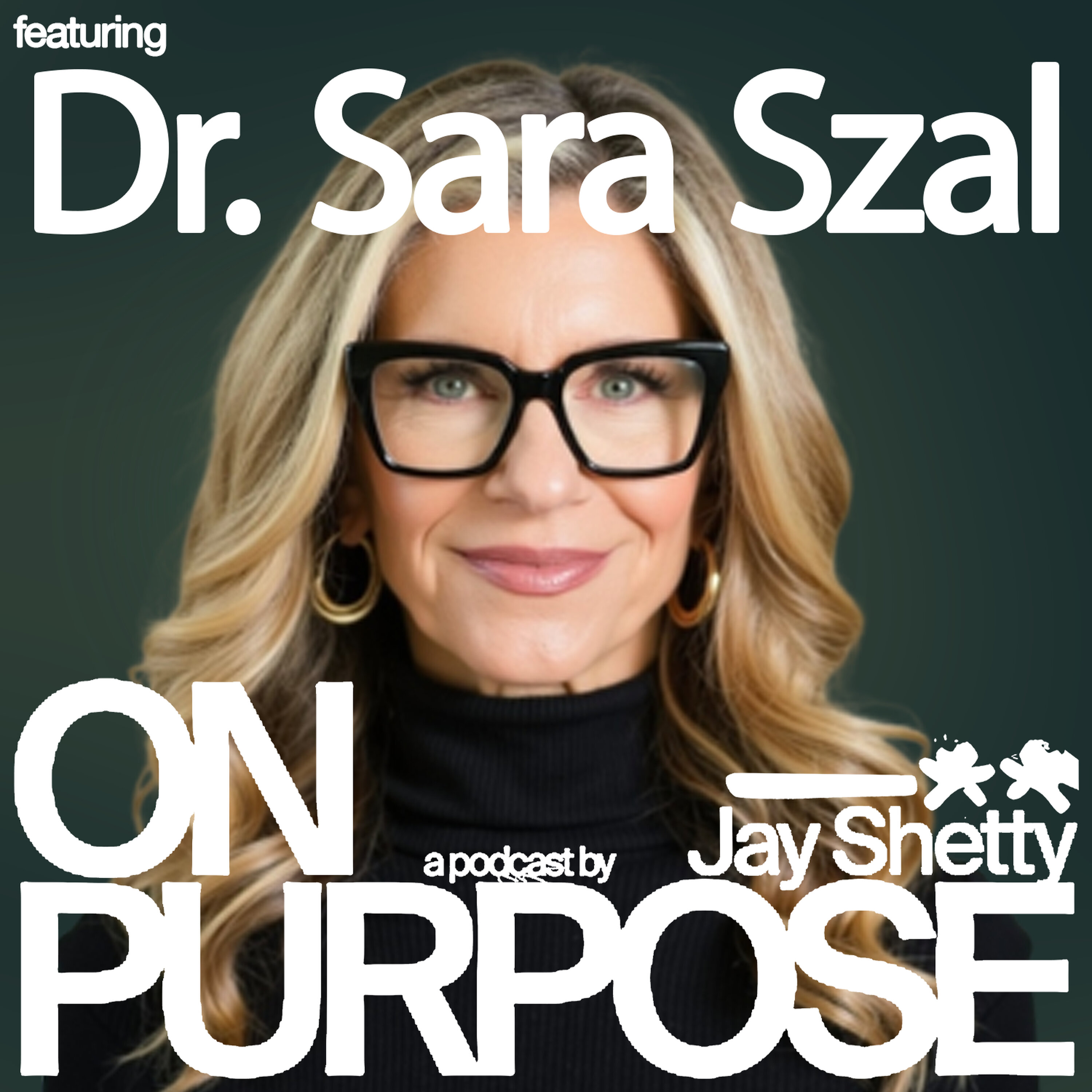
Dr. Sara Szal: Stop Ignoring What Your Body’s Trying to Tell You! (THESE Are the Hormone Signals You Can’t Afford to Miss!
Have you ever felt totally off but couldn’t explain why?
Did you ever figure out what was causing it?
Today, Jay sits down with Dr. Sara Szal, a Harvard- and MIT-trained physician, researcher, and bestselling author, to dive into a topic that affects everyone but rarely gets the attention it deserves: hormones. Together, they break down what hormones really are, how stress and daily habits can throw them off balance, and why understanding these powerful chemical messengers can completely transform the way we think about health. Dr. Sara shares how simple changes, from better sleep and mindful eating to managing stress, can help reset your body’s natural rhythm in just a few days. This is a conversation that beautifully bridges science and self-awareness, revealing just how deeply our biology and emotions are connected.
Jay and Dr. Sara also explore one of today’s most misunderstood topics: women’s health and birth control. Dr. Sara explains how the pill, though widely used, can disrupt hormone balance, increase inflammation, and even affect fertility, insights many women never hear about. She breaks down what’s really happening inside the body and offers practical ways to restore balance through nutrition, testing, and natural alternatives. Together, they also discuss how emotional stress and relationships deeply influence hormonal health, and why learning to understand and manage your body’s signals is one of the most empowering steps you can take for your well-being.
In this interview, you'll learn:
How to Balance Your Hormones Naturally
How to Manage Stress and Lower Cortisol
How to Reset Your Body in Just 3 Days
How to Heal Fatigue by Listening to Your Body
How to Transition Off Birth Control Safely
How to Support Fertility and Hormone Health
How to Regulate Before You React
When you slow down, nourish yourself, and make small, consistent changes, you create space for balance to return. Health isn’t about perfection or control; it’s about awareness, alignment, and kindness toward yourself.
With Love and Gratitude,
Jay Shetty
Join over 750,000 people to receive my most transformative wisdom directly in your inbox every single week with my free newsletter. Subscribe here.
Check out our Apple subscription to unlock bonus content of On Purpose! https://lnk.to/JayShettyPodcast
What We Discuss:
00:00 Intro
01:28 What Exactly Are Hormones?
02:30 What Causes Hormonal Imbalance?
04:02 How to Measure Stress Hormones
05:11 When You’re Running on Cortisol
06:01 The Truth About Insulin Resistance
07:45 How Hormones Differ in Men and Women
10:21 Why Measuring the Right Hormones Matters
11:30 Simple Ways to Rebalance Your Hormones
14:19 Why Estrogen and Progesterone Decline
20:19 Why You Should Start with Cortisol
22:19 Four Powerful Ways to Reduce Stress
24:17 How to Turn Stress into Strength
25:58 Breaking Free from Chronic Stress
27:52 Everyday Habits to Lower Cortisol
30:08 Feeling Low on Energy But Can’t Explain Why?
35:09 How to Decompress and Recenter Yourself
39:00 Do Men or Women Heal Faster After a Divorce?
41:37 Creating Healthy Emotional Distance
43:06 The Power of Boundaries in Healing
46:35 People-Pleasing: A Hidden Stress Response
49:06 The Biggest Hormonal Shifts in Life
53:09 What You Need to Know About Andropause
54:09 The Evolution of Birth Control
56:24 Painful Periods Are Not Normal!
57:23 Lifestyle Fixes for Acne and Hormone Health
59:09 The Hidden Long-Term Effects of the Pill
01:01:56 How to Reverse the Pill’s Impact
01:03:47 Does Birth Control Affect Fertility?
01:05:33 The Complexity and Simplicity of Hormones
01:08:31 How to Take Ownership of Your Health
01:09:36 Is Natural Birth Control Effective?
01:11:27 How to Make IUD Insertion Less Painful
01:14:05 Getting Pregnant After Birth Control
01:16:31 What Science Says About Cycle Syncing
01:18:06 How to Safely Transition Off the Pill
01:20:41 Where Science Meets Spirituality
01:25:49 Sara on Final Five
Episode Resources:
Dr Sara Szal | Website
Dr Sara Szal | Instagram
Dr Sara Szal | YouTube
Dr Sara Szal | LinkedIn
See omnystudio.com/listener for privacy information.
Press play and read along
Transcript
Speaker 1 This is an iHeart podcast.
Speaker 2 This episode of On Purpose is brought to you by Chase Sapphire Reserve.
Speaker 2 I believe that travel is one of the greatest gifts that we've ever been given, and Chase Sapphire Reserve has been my gateway to the world's most captivating destinations.
Speaker 2 When I use my Chase Sapphire Reserve card, I get eight times the points on all the purchases I make through Chase Travel and even access to one-of-a-kind experiences, experiences like music festivals and sporting events.
Speaker 2 And that's not even mentioning how the card gets me into the Sapphire Lounge by the club at select airports nationwide. Travel is more rewarding with Chase Sapphire Reserve.
Speaker 2 Trust me, discover more at chase.com forward slash Sapphire Reserve. Cards issued by JP Morgan Chase Bank NA.
Speaker 2 Member FDIC, subject to credit approval, terms apply.
Speaker 2 What are you doing this Thanksgiving? Besides overindulging and watching football?
Speaker 2 Well, maybe take the opportunity to reconnect with some friends through Facebook, comment on an old friend's post, or post to a Facebook group telling the gang you want to get together.
Speaker 2
I'll even write it for you. Hey, everybody, let's meet at mine for pizza and football.
Facebook offers a great way to connect, and a little connection goes a long way.
Speaker 2 Let's reconnect this holiday season with Facebook.
Speaker 2 Radi, we're always talking about being intentional with our time and energy, right? What about gifting with intention?
Speaker 3
Apple Gift Card is perfect. They can use it for meditation apps on the App Store or audio books from Apple Books.
Whatever nourishes their mind best.
Speaker 2 Exactly. It's a gift of possibilities aligned with their personal growth journey.
Speaker 3 Visit applegiftcard.apple.com to learn more and gift with purpose today.
Speaker 1 Some people have a greater risk of developing something like polyocystic ovary syndrome, where you've got too much androgen or testosterone. So it can lead to infertility, acne, and other problems.
Speaker 2 Hey, everyone, welcome back to On Purpose, the place you come to become happier, healthier, and more healed. Today's guest is here because of so much popular demand about this theme.
Speaker 2 You've had so many questions about hormones, about birth control, about emotional regulation and fitness, and how it all connects to this big theme.
Speaker 2 Today's expert knows everything we need to know about this, so I cannot wait to dive in. Today's guest is Dr.
Speaker 2 Sarah Sahl, a Harvard and MIT trained physician, researcher, educator, and author of four New York Times best-selling books on trauma, hormones, and health.
Speaker 2
The one that stands out most is called The Hormone Cure. So if you like this conversation, go and grab a copy.
Dr.
Speaker 2 Sahl serves as clinical assistant professor at Thomason Jefferson University and director of precision medicine at the Marcus Institute of Integrative Health, where her work focuses on how personalized data and root cause medicine reveal the links between mental and physical health.
Speaker 2
Please welcome to On Purpose Dr. Sarah Sahl.
Sarah, it's great to have you here.
Speaker 1 Jay, so happy to be here.
Speaker 2 Yeah, I'm so excited about this conversation. As I was saying to you, our audience has been dying to learn more about hormones.
Speaker 2 They are inquisitive, they're curious, and I think we're almost starting from a baseline of we don't know enough.
Speaker 2 And I wanted to ask you the first question, which sounds really basic, but I think it's the right place to start is what are hormones? And what is a hormonal imbalance?
Speaker 1
Hormones are these chemical messages in the body. And I think of them like text messages.
They tell different parts of the body to do something.
Speaker 1
There's five ways that the body communicates with itself. Hormones, first and foremost.
Peptides, proteins, nutrients, and the genome.
Speaker 1 We want to be working with these different systems and not against them. So what is hormone imbalance? It's when this exquisite state of homeostasis in the body gets out of balance.
Speaker 1 And so that can happen in women with endometriosis or polycystic ovary syndrome. It can happen in men with low testosterone.
Speaker 1 It can happen with your cortisol if you're someone who's chronically stressed and you're not attending to it.
Speaker 1 So there's ways that hormones get out of balance, but there's also ways to easily get back into a state of homeostasis.
Speaker 2 What are some of the most common ways that we end up with a hormonal imbalance that you see in the modern day?
Speaker 1
Well, I would say stress is number one. So we've got this stress response system, and I think a lot of people consider stress sort of this feeling.
But the truth is, you can measure stress.
Speaker 1 You can measure your cortisol. You can do it in the blood in the morning.
Speaker 1 You can also measure it at four points during the day and look at your stress response to see if there's a way that it's getting pulled out of balance.
Speaker 1
There's lots of ways to deal with that, but I would say measurement is really critical. So that's one piece.
Another is genomics.
Speaker 1 So some people have a greater risk of developing something like polycystic ovary syndrome, where you've got too much androgen or testosterone.
Speaker 1 There's also hormone imbalances that are related to other sex hormones, like your testosterone, your estrogen, your progesterone. It can lead to infertility, can lead to acne and other problems.
Speaker 2 Do we have the tools to measure stress at home or do we have to go take a test?
Speaker 1 No, you can do it at home. So I usually start by doing it a lot because I think working with a clinician who's knowledgeable about hormones is the best way to begin.
Speaker 1 Otherwise, you're getting all this information. You may not know what to do with it.
Speaker 1 But increasingly, we're disintermediating the medical system because I would say the medical system has really failed a lot of people with hormone imbalances.
Speaker 1 And so testing can be a valuable way to do, to look at it at home in addition to what you can get at the lab.
Speaker 2 And what are you learning at the lab? Like, what are they testing? What chemicals are they seeing? What are you hoping to see? Like, is it a percentage scale? Is it a rating of one out of 10?
Speaker 2 Like, where are we trying our stress to land throughout the day?
Speaker 1
It depends on what hormone you're measuring. So when it comes to stress, cortisol is the main stress hormone.
But there's others others too, like DHEA.
Speaker 1 So what we're looking for, if you measure a blood cortisol in the morning, you want it to be about 10 to 15. That's the optimal range, which is different than the normal range.
Speaker 1
So normal is what we tend to use in mainstream medicine. It's what I was taught to use.
But I don't necessarily want to be like the average American. I want to be in a more optimal state.
Speaker 1 So that's the optimal state. If you measure it in the afternoon, it's more like you want your level to be about five to ten.
Speaker 1
So that's what we want with cortisol. DHEA and other hormones often vary depending on age.
So generally with DHEA, I like to see more than 100 in women, more than 150 in men.
Speaker 2 Got it. And if you're seeing yourself outside of that five to 10 in the morning, I'm assuming above.
Speaker 1 We want to see it about 10 to 15 in the morning.
Speaker 2 And so above that is negative or below that is bad?
Speaker 1
Both. Both.
So, with all hormones, I can't think of a single exception. You want it to be in this Goldilocks zone of not too high and not too low.
Speaker 1
And when I first started measuring my cortisol, this was in my 30s, I found that it was about three times what it should be. Wow.
So, I was someone who was a bit of a stress junkie.
Speaker 1 I would, you know, I was just sort of used to running on adrenaline and running on cortisol. And so, if it's too high, that can be causing too much wear and tear in the body.
Speaker 1 And if it's it's too low, that can be a stress response system that has become exhausted.
Speaker 2
Understood, understood. And so stress was one of the first ones when we were talking about hormonal imbalance.
What was the second?
Speaker 1
Well, your sex hormones can get out of balance. Another system that's critical is your metabolic system.
So this includes hormones like insulin, glucagon.
Speaker 1 But insulin is really the star of the show here.
Speaker 2
And talk to me about the importance of insulin and the impact that it has. I think we've all heard about it.
We may understand a little about it, but not enough.
Speaker 1 Yeah, insulin is like the bouncer at a club that determines whether to let glucose into the club or not. So the club here is your cell.
Speaker 1 If you're someone who has insulin that's working well, it's in that Goldilocks position, fasting of about five to seven,
Speaker 1
then you're letting glucose into the cell. You're able to use it as fuel.
You feel good. You're not storing excessive fat.
Speaker 1
But if you are someone who has insulin resistance, where your cells become numbed to insulin, your insulin can climb. And that leads to more fat storage.
It leads to glucose not getting in the club.
Speaker 1
And so the streets are full with glucose. Your bloodstream is full of glucose.
And that's where fasting glucose starts to rise. And you can pick that up in a blood test.
Speaker 1 You can also pick it up on a continuous glucose monitor.
Speaker 2 And what's the negative effects of having glucose? on the streets?
Speaker 1 Well, there's a lot. So having high glucose causes damage to your blood vessels.
Speaker 1 That's especially important in women because lower levels in the prediabetes range of, you know, somewhere between 100 to 125 can set you up for high blood pressure and cardiovascular disease later on.
Speaker 1
And that's different than what we see in men. So they tend to have vascular damage at a higher fasting glucose.
So I think women especially need to pay attention to this.
Speaker 2 What's the difference between hormones for men and women? What are the key differences that you see? Because I think that's, again, something we're not that well versed in at the moment.
Speaker 1
There's a lot of differences. I mean, it's important, first of all, to realize that we all have all of these hormones.
Women and men just have different amounts.
Speaker 1 So if you think of what's classically thought of as a male hormone, testosterone, women have about one-tenth what men have. But still,
Speaker 1
We're exquisitely sensitive to it. And so we want that Goldilocksone when it comes to women.
With other hormones like estrogen, men make it too.
Speaker 1 If your estrogen is too low, that can lead to problems with bone loss for men. And then for women, it has about 400 jobs.
Speaker 1 So it's related to brain health, it's related to memory, it's related to whether you are growing things inside your uterus like fibroids,
Speaker 1
endometriosis elsewhere in the body. So you want these hormones to be in a balance.
And generally, they vary depending on your sex.
Speaker 2 What are the hormone deficiencies you're seeing in women the most at the moment and in men?
Speaker 1 Well, for both men and women, for people who've got a stress response issue, this can start to rob you of some of the sex hormones that you really need to function well.
Speaker 1 So what I see, especially for people in their 20s, starting around 27 to 28, if you are a high stress person, like I used to be, that can lead to problems with falling testosterone.
Speaker 1
And so increasingly we're seeing low testosterone in men. We can see that in women as well.
So it can start as early as your 20s.
Speaker 1 Other hormone deficiencies or insufficiencies include with your thyroid. So thyroid is one of those hormones that is kind of like the gas pedal.
Speaker 1 Almost every cell in your body has a receptor for thyroid hormone.
Speaker 1 And if you're low, then that can lead to fatigue, weight gain, constipation, feeling like you just don't have the energy that you once did.
Speaker 1
You might lose the outer third of your eyebrows, have hair loss on your head. So that's a common issue that we see in terms of hormone imbalances.
Women much more commonly than men.
Speaker 1
It's about seven to nine times more common in women. And the root cause of low thyroid function, most of the time, is autoimmune.
Hashimoto's thyroiditis is the typical cause.
Speaker 2 I mean, these are things that I feel like so many people people are struggling and suffering with today. And I don't know how quickly we're able to pinpoint that it's a hormonal imbalance.
Speaker 2 It seems like we're trying to solve it in different ways, whether that be weight gain or hair loss or whatever it may be.
Speaker 2 We often think that we're almost not always working to the root cause of the issue. But I feel like what you're saying is the hormones are the root cause.
Speaker 1
Yeah, and I would say start there. You know, what happens for a lot of folks is that they feel tired.
They feel like they they just don't have the energy when they wake up in the morning.
Speaker 1
They don't feel fully restored after they sleep. And they assume that it's some sort of moral failing or that they need to change their mindset.
And I would say, let's start with your biology.
Speaker 1 Before we go to the place of moral failing, Let's start with measuring your hormones and measuring the right hormones, looking at your stress response.
Speaker 1 So you can look at cortisol, but you can also look at heart rate variability, that time between each of your heartbeats.
Speaker 1 That tells you a lot about your stress response system and about your ability to regulate your nervous system.
Speaker 2
Yeah, it's so interesting. I was saying this to you before we started.
I feel like
Speaker 2
I've always been someone who's tried to solve things at the mind. And that's been very good for me.
I feel like it strengthened my mind in incredible ways. But it was only when I started to unlock.
Speaker 2 the potential and capacity of the body that I was actually able to have this two-pronged approach to making a shift in my life.
Speaker 2 And I remember in the past, if I, I remember even when I was a monk and I sometimes struggled to wake up in the morning to meditate, I always felt it was a moral failing.
Speaker 2 And I think so many people today could relate to the fact that you wake up and you don't want to go to work and you think, oh, it's because I hate my job.
Speaker 2 Or you wake up in the morning and you're feeling rushed and frazzled and you're thinking, oh, gosh, I just have so much to do and I'm failing at it.
Speaker 2 And the reality is that there could be a hormonal imbalance that's actually making you feel that way that is then making it harder to love your job find meaning or support your family and it's a much stronger place to start
Speaker 1 because you'll actually feel the benefits quicker how how quickly can we create a shift in a hormonal imbalance to being back into the homeostasis well i so appreciate this framing because i think the answer is both the answer is both and so look at the mindset look at the way your mind is functioning look at your cognition but also look at your look at your biology put put them together.
Speaker 1
So how quickly can you turn this around? It depends on the hormone. When it comes to a hormone like insulin, you can change it with your food and exercise in three days.
Three days. Three days.
Speaker 1 So food is such an important driver of what your body is doing. So going back to you know, these five ways that the body communicates with itself, hormones are number one.
Speaker 1 There's peptides, proteins, your genome, and nutrients. So nutrients here drive so much of your hormonal balance.
Speaker 1 Now, other hormones like estrogen, progesterone, those two are kind of like a tango, a set of tango partners.
Speaker 1 Those take longer to adjust. They take more like four to six weeks.
Speaker 2 Okay, but that's still not that long.
Speaker 1 That's not that long.
Speaker 2 That's not terrible at all. I think sometimes when you hear about these things, you go, oh, God, it's going to take me like three years.
Speaker 1 It's refreshing to hear that three three days in four to six weeks i mean that's doable that's realistic it's doable and there was a study also looking at folks with high testosterone women with high testosterone and they found that by reducing the carbohydrates in your diet
Speaker 1 within seven days, you can actually change your testosterone levels. So some of this can happen sooner with the right messages, with the right orchestra that's happening in the body.
Speaker 2 What are the main reasons in our 20s and 30s, do we see a decline in estrogen, testosterone, and progesterone?
Speaker 1
They're each a little different. So if we take estrogen first, the most common reason I see for decline is women who are not eating enough.
They're not getting the nutrients that they need.
Speaker 1 They're not getting the calories that they need to have the control hormones, luteinizing hormone in particular, help them ovulate each month. So their estrogen might be lower.
Speaker 1 We also think that exposure to toxins and endocrine disruptors can affect your estrogen levels and also thyroid levels. It can also affect testosterone.
Speaker 1 The other reason I see is women who have premature ovarian insufficiency. So this is mostly focused on women in their 20s and 30s.
Speaker 1 So premature ovarian insufficiency is not an immune process where the ovaries are attacked. by your immune system.
Speaker 1 And you can start to have symptoms of early perimenopause and menopause, including low estrogen.
Speaker 1 So these are women in their 20s and 30s who have hot flashes, night sweats, mood swings, and you have to check labs to see if that's the cause.
Speaker 1 When it comes to testosterone, the number one thing that I see that leads to low testosterone in women is having a heightened stress response.
Speaker 1 So high stress, being kind of run by cortisol like I was in my 30s, that can then rob you of the production of testosterone. Another factor that affects testosterone is insulin.
Speaker 1 So if you're someone with high insulin levels, that can affect the ovaries and lead to dysregulation of testosterone.
Speaker 1 Usually high testosterone is something we see with one of the types of polycystic ovary syndrome. Progesterone is an interesting one for people who are not ovulating every single month.
Speaker 1
Their control system is a little wonky. We see something called late luteal phase disorder.
And that's where you're just not making making as much progesterone.
Speaker 1 And it can be related to the health of the eggs that are in your ovaries.
Speaker 1 It may be helpful to look at your egg quality to do a day three FSH, follicle stimulating hormone, and estradiol level, and then a day 21 or 22 progesterone.
Speaker 1 So normally on day 21 or 22, if you ovulate it around day 14, you want your progesterone to be about 10 to 15 or higher.
Speaker 1 So if it's lower, that can be because your egg quality is potentially declining or there's some kind of nutrient that needs to be addressed increasingly jay this is super interesting that i i've been reading a lot about
Speaker 1 the the cells in your body that have the most mitochondria those powerhouses of the cell that produce fuel produce energy the cells that have the highest concentration is your eggs.
Speaker 1 In men, it's the sperm. So when your mitochondria are not working well because you're sedentary, you've got too much stress, you're not getting the right nutrients, it can show up in your eggs first.
Speaker 1 And you might see it with like a low progesterone level.
Speaker 1 So tracking your mitochondria, getting things like morning light when you first wake up in the morning, managing your stress response so that it's not running the show, getting all the nutrients that support your mitochondria, maybe even some supplements like CoQ10, that can be a way to support your mitochondria to prevent some of these problems.
Speaker 2 For someone who's struggling with weight loss, what hormonal imbalance could they be experiencing?
Speaker 1
First, I think about insulin because insulin is really the king of metabolism. So I would say look at your insulin, look at your glucose.
Insulin changes first.
Speaker 1 It can change seven to 14 years before your glucose changes.
Speaker 1 And probably the best way to look at insulin is to do what's called a two-hour glucose challenge test, where you look at your insulin and glucose fasting an hour later and two hours later.
Speaker 1
You give a 75-gram carb load to see how your body responds. So fasting and insulin can change, but it changes typically after post-prandial insulin.
So measuring is really critical.
Speaker 1 When it comes to weight, another factor is in women having excess testosterone. In women, high testosterone is similar to low testosterone in men.
Speaker 1 So it can lead to metabolic dysfunction, it can lead to cardiovascular risk, it can lead to fatigue and mood changes. So I like to look at androgens, testosterone, DHEA.
Speaker 1 And then another factor, especially in women, is having estrogen and progesterone out of balance.
Speaker 1 So if you've got too much estrogen, typical story, compared to progesterone, that leads to something called dysestrogenism. If you have excess estrogen in the body, it can lead to more mood swings.
Speaker 1
It can lead to more eating habits that you may not want to be supporting. It can lead to more structural changes in your body.
So it's important to have these in balance.
Speaker 1 Thyroid is another critical one.
Speaker 1 And then I would say cortisol is really important when it comes to weight gain because a lot of people don't realize that the stress that they have in their system, in their body, could be driving their deposition of belly fat.
Speaker 1 It could be driving food cravings.
Speaker 1 It could be changing, you know, we know people with depression, about half of them have high cortisol levels.
Speaker 1 And that can then affect the way that you eat, the way that you move, the way that you think, and the risk of weight gain.
Speaker 2 As a
Speaker 2 normal human being who is struggling to deal with work responsibilities, commitments to our partners, challenges with intimacy, someone who's trying to take care of their kids, it already feels like you have so many factors of your exterior world that you're struggling with.
Speaker 2 You're juggling all of these things.
Speaker 2 And then at the same time, now you've opened up to us this interior world of all of these other things that we're like, oh yeah, I probably need to figure out my cortisol.
Speaker 2 And I'm sure there's some insulin stuff I need to work on. And it sounds like I've got too much or too little testosterone, whatever it may be.
Speaker 2 Like there's this, there's almost like this waking up to the fact that all of this exterior difficulty is matched with some sort of interior imbalance.
Speaker 2 Where would you recommend someone to start if they're starting from zero and thinking, this feels like a lot, it feels overwhelming?
Speaker 1 Start with cortisol.
Speaker 1
There's a few reasons for that. Cortisol is the great unifier because it's involved in all of these other systems.
So if you're a high cortisol person, it might be affecting your insulin.
Speaker 1
It might be dropping your progesterone levels. It could be affecting your testosterone levels as early as your 20s.
So I would say start with cortisol. Like the measurement there is critical.
Speaker 1 And you made an important link here, Jay, between
Speaker 1 your external world and your inner world. And hormones drive so much of your inner world.
Speaker 1 The more that you have a sense of the landscape, of your inner terrain, the more that you're going to be able to work with it, befriend it, allow these hormones, these messages, these signals to become your friend and not be, you know, some villain that you're blaming for the way that you're feeling.
Speaker 2 What are the top three things someone could do today to decrease stress? What should they be focused on?
Speaker 1
Well, I would say number one, measure, like know what you're dealing with. What you measure improves.
So know where you're starting. I think a benchmark is critical.
Number two,
Speaker 1 you know, I started learning yoga from my great-grandmother when I was five years old. I started practicing meditation when I was 17 in college.
Speaker 1 I think there's nothing more effective than meditation and breath work as a way of working with your cortisol. And then number three, I would say
Speaker 1 there's supplements that can really make a difference. I don't think you can out-supplement a bad diet.
Speaker 1 I don't think you can out-supplement a stressful life, but you can really work with supplements like phosphatidyl serine, very effective at reducing cortisol at a dose of 400 milligrams.
Speaker 1 Omega-3s, so taking fish oil or a more plant-based source of omega-3s,
Speaker 1
those are really critical. And then fourth, I would say, look at your relationships.
relationships.
Speaker 1 They're often a common source of stress in the body. And a lot of people don't put those things together.
Speaker 1 So when you've got a relationship with someone that is co-regulating, that allows your nervous system to calm down and reduce your cortisol to that Goldilocks position. That is so effective.
Speaker 1 There's just a study that got pre-printed, so it's not published yet in a peer-reviewed journal, but it's really interesting, Jay. It's about the hassler.
Speaker 1 So people who provide some support, but also cause a lot of hassle in your life, and I have a few of those, those tend to be associated with shortening your life and raising your cortisol.
Speaker 1 So, you want to get a sense of: okay, who are the people that help me stay in hormonal balance? Because the people you surround yourself with can affect your hormones.
Speaker 2 When I first started my podcast, I remember thinking, where do I even begin? There were so many things to figure out. Writing, recording, editing, logos, scheduling.
Speaker 2 And it often felt like I was building something completely on my own. When you're starting your own business, it's exciting, but it can also feel lonely and overwhelming.
Speaker 2 You're suddenly wearing every hat, creator, designer, marketer, customer support, and it's easy to lose sight of why you started in the first place. That's why having the right partner matters.
Speaker 2 Shopify makes that journey easier.
Speaker 2 It's the commerce platform powering millions of businesses around the world behind 10% of all US e-commerce, from household names like Mattel and Gymshark to small brands just getting started.
Speaker 2 With Shopify, you can design a beautiful store with ready-made templates, use built-in AI tools to write your product descriptions and headlines, and even manage your marketing like you've got a full team behind you.
Speaker 2 If you're ready to sell, you're ready for Shopify. Turn your big business idea into
Speaker 2 with Shopify on your side. Sign up for your $1 per month trial and start selling today at shopify.com forward slash j.
Speaker 2 Go to shopify.com forward slash j. Shopify.com forward slash j.
Speaker 2 Support for this podcast is brought to you by Walden University.
Speaker 2 If you're listening right now and feeling that pull to grow in your career or make a bigger impact, Walden is designed exactly for that.
Speaker 2 For over 50 years, they've helped working adults get the W with the knowledge, confidence, and real skills to create meaningful change. What makes Walden stand out is how flexible it is.
Speaker 2
With Walden's tempo learning, you're in control. No set weekly deadlines, no rigid schedules, just a pace that actually fits your life.
And everything you learn is practical.
Speaker 2 You're working through real-world scenarios that prepare you to make a positive difference in your community and beyond.
Speaker 2 You're also guided by faculty who've lived the work themselves, scholars and practitioners with real experience.
Speaker 2
This is the kind of opportunity that reminds you: it's never too late to go after what you want. If you've been waiting for the right moment, this is it.
Head to waldenu.edu and take that first step.
Speaker 2 Walden University, set a course for change. Certified to operate by Chev.
Speaker 2 In your family at Thanksgiving, do you go around and say what you're thankful for? A lot of families do that and it's such a great tradition.
Speaker 2
Sometimes we just need to remind ourselves what's important. Family and friends.
Real human connection. There's no better time to find that connection than Thanksgiving.
Speaker 2
Old friends are coming into town, reach out to them. It couldn't be easier.
A quick Facebook post asking who's around. Somebody's got to get the ball rolling, right? Tag your friends.
Speaker 2
Maybe your high school class has a Facebook alumni group. Even just going onto Facebook and commenting on friends' posts can lead to a connection.
Congratulations on a new baby. A happy birthday.
Speaker 2
Point is a little connection goes a long way. But you've got to make the connection first.
And Thanksgiving really is the perfect opportunity. Happy Thanksgiving and say hello to your friends for me.
Speaker 2 Let's reconnect this holiday season with Facebook.
Speaker 2 Does stress you enjoy affect you differently from the stress you don't?
Speaker 1 Absolutely.
Speaker 2 Okay,
Speaker 2 tell me about that.
Speaker 1 So we all need stress.
Speaker 1
And I don't think of stress as a negative word. In medicine and science, we call it you stress.
So you stress, EU stress is a healthy form of stress. It's known as hormesis.
It's like a positive
Speaker 1 intervention on the system of your body. So your body is designed to deal with stress.
Speaker 1 Like you developed, our genome developed on the savanna a long time ago in response to stressors that would occur, you know, once a month, once once a quarter, something like that.
Speaker 1 But we're not designed to deal with the stressors that we get, you know, from checking our email inbox every morning. So we're designed to have a healthy amount of stress.
Speaker 1 And you can even imagine there's a U-shaped curve where you want to find just the right amount of stress that allows you to be the most productive, allows your system to work really well, allows you to deal with a stressor and then bounce back.
Speaker 1 You don't want so little stress that you're, you know, not being of service and not contributing and not discovering your gift and sharing it with the world.
Speaker 1 But you also don't want so much stress that cortisol is running the show and leading to disrupted relationships, not being able to
Speaker 1 really deliver on your talents and
Speaker 1 getting this wear and tear process in the body.
Speaker 2 Can you change the way stress impacts you by how you see it? So could I change distress to you stress
Speaker 2 by viewing it differently? So for example, my wife was taking care of her grandma who sadly passed away last week for the last four months.
Speaker 2 As soon as we heard that she was unwell, she flew back to London to take care of her and be by her bedside every day. It was stressful in the sense that she didn't sleep a lot.
Speaker 2 She didn't have, it wasn't like she was supported in the support. She was, you know, doing a lot of things with her and her family.
Speaker 2 They were all taking turns, but it was stressful for her physically, mentally, emotionally.
Speaker 2 It's her favorite person on the planet, but she was doing it as a form of showing love to a person she was trying to repay for all the gifts that she'd given her her whole life.
Speaker 2 Does that change how that stress impacts her or does it not?
Speaker 1 Oh, it does, definitely.
Speaker 1 First, I'm really moved by this story, and I'm so sorry for her loss.
Speaker 1 You know, there's a way that when we're serving in a place of love, even if it is leading to sleep disruption, even if it's leading to more wear and tear,
Speaker 1 the connection,
Speaker 1 the loving connection can offset the potential downstream consequences of having higher cortisol levels.
Speaker 1 So it's not so much, you know, a week or two or a month of taking care of someone who's dying that causes a problem in the body it's more people who become adapted to a chronic stress state that goes on for months to years that's where we have problems
Speaker 1 so yes you can definitely turn it around and you can buffer it you can blunt the effects of stress What would you recommend to someone who comes home from a stressful day of work?
Speaker 2
They had a stressful morning. We've talked about morning routines for so long, but I feel people just struggle.
They wake up.
Speaker 2 They've got to start making lunch, they've got to get their kids ready for school, they've got to drop them, they've got to go to work.
Speaker 2 What can they do after that long day that will actually help, that will actually make a difference?
Speaker 1 Well, I love to have rituals when the day is closing, like especially to separate work from family time and personal time at your home.
Speaker 1 So just like I love a morning ritual, I think we need to bookend the day. So there's a lot of different ways to do that.
Speaker 1 And I like to think of an a la carte menu of what works the best for you. So I can tell you what doesn't work.
Speaker 1 Like what I used to do is I would come home from a busy day of seeing 30 patients and I would have a glass of wine.
Speaker 1
And that does not work. So that lowers your testosterone.
It raises the
Speaker 1
not so good estrogens in the female body. And it is toxic to the brain.
It shrinks the brain over time. So I don't think that's effective.
Speaker 1 But the very thing that we are trying to get from a glass of alcohol is what we want to create in a ritual. So
Speaker 1 there are advanced beings, maybe you're one of them, Jay, who can come home from a busy day of work and meditate. They can do, you know, just like touch.
Speaker 1 have that touch point of five to 10 minutes just to regulate themselves before they go into you know kind of the second half of the day so i would say by whatever means necessary.
Speaker 1 So for me, breath work and meditation is really effective. I love to go on the deck of my house and kind of look at the view and trace the horizon, which relaxes my eye muscles.
Speaker 1 I like to read something really beautiful and
Speaker 1
meaningful. I love to connect with someone that I adore, someone who co-regulates me.
So I would say develop a menu of a few things that really work.
Speaker 1 But I would say the glass of wine that raises your cortisol even further, the very thing that you are trying to avoid, that's not a solution. What do you think? Like, what, what helps you?
Speaker 2 No, I love everything you recommended. I think that the natural response people have, and me admittedly, I'm in this group sometimes as well, where I'm like, I have no energy to do anything.
Speaker 2
And I mean, one of my favorite things is playing pickleball. I play a lot of sport in the evening and it's something I look forward to.
And I'm like so excited to get to.
Speaker 2 And I found that does a lot of things. Me and my friends have
Speaker 2 a formula that we try and stick to of fitness, friendship, and fun. And it's like, how do we do something active together? How do we hang out?
Speaker 2 And how do we do something that's playful and makes us feel like kids again? And so I have a group of great.
Speaker 2
male friends where we just, you know, three, four times a week, we're just playing sport, hanging out in the evenings and having a great time. That to me is my ideal evening.
Now, I can't do that.
Speaker 2 Every night
Speaker 2 when
Speaker 2 my wife and I are at home together, definitely connecting with her is a high priority to me, having dinner together. I agree with you on that connection is so important.
Speaker 2 But there are those days where I just want to sit and turn on a show.
Speaker 2 And it's usually after I finish it where I go, I don't know if that was worth it. Like I will sometimes do it.
Speaker 2 And then I'll feel like, well, I don't feel more connected to my partner unless the show is really good and we're really talking about it and we're really engaging over it.
Speaker 2 It can almost feel like, oh, well, that was a waste of time.
Speaker 2 And I think at least what I've noticed noticed is that I think the menu idea that you gave is really good.
Speaker 2 Because there are some days I just want to switch off and watch a show because I don't want to think and I don't want to use my body or my brain because I'm exhausted.
Speaker 2
And then there are certain days where playing sports does it. And then there are certain days where connecting does it.
And I think the thing I worry is.
Speaker 2 And I think what you're saying is when we get into chronic behaviors where it's like, I come home every night and have a glass of wine. I come home every night and I just watch TV.
Speaker 2 And it's like when you don't have a menu and you don't have this variety to select from and it just becomes one of these patterns that doesn't refuel you and doesn't renew you.
Speaker 2 That's when it starts to get really unhealthy. Whereas the once a week that you, twice a week that you felt like watching a show or whatever isn't the end of the world and it's fine.
Speaker 2 But it's, hey, do you have other options? I couldn't agree with you more about looking out into the distance.
Speaker 2 I find that to be one of the most powerful things for my eyes, especially as we're living in such a short-sighted world now where everything's up in our face, whether it's a Zoom screen, our phones.
Speaker 2 And so to actually be able to look into the distance and
Speaker 2 this is not about sounding poetic or spiritual.
Speaker 2 I literally think it's a physical thing that our eyes need, if like looking far at a cloud or looking at a bird in the sky, and you don't have to find it mystical or beautiful or special.
Speaker 2 Just the act of looking into the distance is an important thing for our mind and brains and our ability to slow down. I think
Speaker 2 when people talk about being with nature, a lot of people are like, oh, oh, well, what does that even mean? And it sounds a bit woo-woo. And it's like, well, no, there's science to prove it.
Speaker 2
But I think being with nature is moving at the pace of nature. That's right.
And, you know, watching a tree flow is good for your breath because you can breathe in and out of it.
Speaker 2 You would never breathe in and out of watching traffic, right? And you should, you should breathe healthily when you're watching traffic.
Speaker 2
But what I mean is you would never breathe at the pace of traffic. Right.
It's, it would be jarring.
Speaker 2 Whereas if you breathed at the pace of watching a bird in the sky or watching the ocean or watching a tree sway in the wind, that would feel a lot more natural and a lot more therapeutic and probably feels like a better thing to try, at least from my perspective.
Speaker 1 Totally agree with you. And maybe we could riff to come up with a menu for folks just to have some ideas because
Speaker 1 you mentioned another piece that I think is critical, Jay, which is to notice when you try these things, how do you feel in your body? Like, where do you notice a shift?
Speaker 1 So, if I watch a show and I'm watching Homeland right now with my partner, and it's very triggering, you know, there's just so many scary things that happen in every episode.
Speaker 1 I don't feel that great by the end of it. Like, I don't like to watch it before I go to bed.
Speaker 1 If that desire, because I feel low in energy and I want to transition, like watching a show, if I instead roll out my yoga mat
Speaker 1 and do,
Speaker 1
you know, five minutes pigeon pose, or even just shavasana for five minutes. That's a low energy way to integrate and to regulate.
So I feel so much more regulated after that.
Speaker 1 But that may not be true for you or for the next person.
Speaker 1 I also love cooking. And I really consider making food to be a sadhana, to be this sacred practice.
Speaker 1 You know, it's not just chopping arugula and throwing it together with some nuts and some goat cheese, but, you know, just very intentional and slowing it down and breathing and regulating as I do it.
Speaker 1
So tell me about some of your other rituals. I love this fun, fitness, and friends.
I think that's a beautiful one.
Speaker 2 That's definitely one of my go-tos. I mean, my wife and I love going on long walks in the evening or even a short walk in the evening.
Speaker 2
Sometimes we'll just be like, let's have dinner together and then just have a 15 to 20 minute walk together. And that feels like a really low impact.
It's not intense. It's not crazy.
Speaker 2 And, you know, of course, you've got to have good enough weather wherever you live to be able to do that. And I appreciate that.
Speaker 1 And it helps your insulin and your glucose, even a 10-minute walk.
Speaker 2
Exactly. Exactly.
So we're like, this, this solves a lot. It solves our connection.
We get to talk about our day. We get to catch up.
Speaker 2 But at the same time, it's helping our body digest and everything else as well. So that for us is a really, really special practice.
Speaker 2 I've definitely found that sitting with, for me, sitting with scripture or sitting with some spiritual texts is really powerful and i found that in the evening it's not a time when i can do academic study or a lot of writing or a lot of memory work but it is a time where i can sit with something and just meditate on it for 10 minutes or let it sink in and let it be there and i almost feel like what we're missing is and i think this has happened by working at home for a lot of people i feel like your commute played a really powerful role in preparation in the morning and decompressing in the evening.
Speaker 2 So most people had an hour commute on the way to work and maybe you still have one and some people had an hour commute on the way back.
Speaker 2 And what that allowed you to do subconsciously was decompress from the day.
Speaker 2 You thought about the day, you reflected, maybe you had a little nap if you were on the train or if you were driving, maybe you listened to a podcast and maybe you're listening right now and you're reflecting about things.
Speaker 2 Whereas the challenge right now is if you literally walk out of your bedroom or your home office and walk straight into the dining room, you've had zero minutes to decompress.
Speaker 2 And I find that creating a little five to 10 minute decompression ritual of sitting by yourself, that's what you did on the train or in the car. You sat by yourself for an hour.
Speaker 2 And so you may think you don't know how to meditate or you may think you don't know how to spend time on your own, but chances are you've been doing it for a long time and now creating some intention around it and saying, hey, I'm going to spend 10 minutes and just see how my body feels, see how my mind feels, and maybe I'll make a better decision of what to do tonight.
Speaker 2 I think that's what it is sometimes. If I don't do that decompression ritual, I go into my default.
Speaker 2 But if I almost spend a moment doing that, I'm like, oh, I actually want to go on a walk or I do want to go out and play sport tonight or actually, you know, I will go out and go out for dinner with my friends tonight because even though I think I'm out of energy, sometimes I only need five to 10 minutes to regroup.
Speaker 1 That decompression is so critical. And I would add regulation.
Speaker 1 Like the
Speaker 1
decompression often needs to come first and then the regulation. So I'm going to add a couple of things if I may.
Please. So one is a vibe check.
Speaker 1 So I've been doing this quite a bit with my partner recently where you just spend five minutes just like, hey, how's our vibe? Like, what could I be doing more to support you?
Speaker 1 Is there anything going on this week that I could help you with? You know, how can I, how can I be the best possible partner?
Speaker 1 It creates an atmosphere of giving and service that I think can help with the decompression and also with the regulation.
Speaker 1 You mentioned going for a walk. I live in a forest in Marin County in California, and we know that just five minutes, five to 10 minutes in the forest can regulate your cortisol.
Speaker 1 So we talked about how a walk after having a meal can make a difference in terms of insulin and helping you with your glucose after you eat.
Speaker 1 These hormones can come into balance even with these really short rituals.
Speaker 2 I love that. I love that.
Speaker 2 It always always strikes me how simple the solutions are to what seems like very complex problems.
Speaker 2 I think that's one of the hardest things for people because I feel like so often the people we love or the people we grew up with, our family, can often be the greatest cause of stress in our life.
Speaker 2 And I don't mean when they need help or support.
Speaker 2 I mean They can say all the wrong things, they can rub us the wrong way, they can make us feel disappointed, they can make us, they can make us feel almost the hardest emotions because they know us the best.
Speaker 2 Are there hormonal impacts that come with divorce? And are they different from men and women?
Speaker 1
Such a good question. So I completed my divorce a couple of years ago.
And so I've been looking at the data on men and women. Men tend to have
Speaker 1 health effects, adverse health effects sooner than women. Women often have health effects that show up later.
Speaker 1 But 69 to 70% of divorces are initiated by women. The most common age is women who are 40 plus.
Speaker 1 Most of the women that I work with say that
Speaker 1 the level of autonomy and kind of healthier psychobiology
Speaker 1 is worth the short-term dysregulation. that's caused by divorce.
Speaker 2 And who deals better hormonally with divorce, men or women?
Speaker 1
I don't know from a research perspective. Anecdotally, from what I've observed in myself and patients, is that women do better.
Wow.
Speaker 2 What does it do anecdotally to men's hormones?
Speaker 1 There was this meme that went around like a decade ago.
Speaker 1 It was a Stanford psychiatrist who wrote an email that got spread around the world, which was, if you're a man and you want to improve your health, be with a woman, be married.
Speaker 1 If you're a woman and you want to improve your health, be with your girlfriends. Like, it doesn't help women to be married.
Speaker 1 And so, I think what we see is that men often don't have a community of people that they're close to, and they often rely on their wives for that.
Speaker 1 Whereas women are much more likely to be leveraging oxytocin, the hormone of connection and love, and they've got more of a support system.
Speaker 1 Now, there's economic consequences that tend to hit women harder. And I think that maps to health, but I would separate that.
Speaker 2 How do we create hormonal emotional distance, even if physical distance is not an option?
Speaker 1
Yeah, I love this question. So I'm going to roof with you on it because I think you've got some answers as well.
So I think understanding where your vulnerabilities are is a good place to start.
Speaker 1 You know, I think a lot about
Speaker 1
my daughters. So I've got one daughter who's 20, another that's 25.
And
Speaker 1
I want them to be aware of their sensitivities and vulnerabilities. They're both highly sensitive.
I'm highly sensitive. About 20% of the population is highly sensitive.
80% is not.
Speaker 1 So we live in a world that is not designed for people who are highly sensitive. When you're highly sensitive and you're around some of those people that tend to trigger you or
Speaker 1 tend to pull you out of a state of balance, then that's where you have to have some extra tools to allow you to not become overstimulated.
Speaker 1 Or if you get triggered by a family member or someone else, to have the self-awareness and these boundaries to be able to work with it.
Speaker 1 You know, one of the things that I think is so helpful is to never waste a good trigger.
Speaker 1 So when you're with someone and you're getting triggered, then that's showing you a place where you still need to heal.
Speaker 1 right it's showing you a shadow side some part of you that's disowned that you need to work with some old childhood wound that you still need to address and heal. What do you think?
Speaker 1 How do you deal with this?
Speaker 2 Yeah, no, I think that's a really, really beautiful point and a way of looking at it. And I think that
Speaker 2 that feels like an evolution from the first step, which is just, I'm exhausted and I need space. I think a lot of us,
Speaker 2 before we can look at what we can change, we almost just need to change our environment.
Speaker 2 And for me, whether it's crafting alone time space with people who do lift us up, I've always said to everyone that for every one person you have in your life that causes you stress, have three people that don't.
Speaker 2 And you can't change that person or that situation, but you can change the proportion of energy that you're exposed to.
Speaker 2 And so if you're exposed to three people who lift you up and are good energy and make you feel calm and are good for your nervous system, even if you have to spend 25% of your time with the other individual that does the the opposite, it's now in perspective.
Speaker 2 It's a bigger group of people that are lifting you up.
Speaker 2 I think another thing for me, I mean, I've been a big, big, big proponent of boundaries for people because I think a lot of the time it's our guilt that keeps us connected to people who block our growth.
Speaker 2 If someone's holding you back,
Speaker 2 chances are you're holding on to them, trying to people please them, trying to
Speaker 2 make them know you're a good person, person, trying to make sure that they respect and value you. And sometimes you have to let go of those things.
Speaker 2 I think I've had to be okay with letting people down. I've had to be okay with letting people think whatever they want to think of me.
Speaker 2 I've had to let go of that perception because it frees me from my own people pleasing tendencies and allows me to start crafting the life that I need.
Speaker 2 And then that gives me the space to then re-approach them with more respect, with more perspective, with the ability ability to say, oh, maybe there's healing that I need to do and evolution that I need to have.
Speaker 2 But that setting of boundaries has been unlimitedly useful for me because I found that I'm always the one getting in my own way.
Speaker 2 And sometimes I need to move far away from the person that I'm blaming to realize that because while I'm close to them, I keep... pointing the finger at them.
Speaker 2
But actually when I step away, I realize it was me compromising my own values. It was me sacrificing my own boundaries.
It It was me
Speaker 2 going against myself.
Speaker 2 And then the final thing I'd add is, I think it comes down to really taking a look at
Speaker 1 what
Speaker 2 really matters and what feels like a waste of time. And I often find that so much of what we get wrapped up in in our human feelings is so based on ego and envy that don't really get us anywhere.
Speaker 2 And I think for me, I try and get to that point as quickly as I can where I'm like, does this matter? Do I really care? Is this going to change my life?
Speaker 2 And I realize that even if I solved this situation, it would not change my life. And so why would I waste any more energy on it when I could be building something beautiful over here?
Speaker 2 And that's usually my personal go-to, where I realize that whether it's someone disrespecting me or whether it's some sort of fallout, even if I solved it.
Speaker 2 First of all, I don't think I could solve it even if I tried. Even if I did solve it, it wouldn't change the quality of my life that much.
Speaker 2 So, why give it so much waiting and why give it so much value?
Speaker 1 It's so profound what you're describing, Jay.
Speaker 1 And it's reminded me a bit of your Princeton commencement speech because I think you had that opportunity with these graduates in 2025 to share with them some of the things you've learned.
Speaker 1 And that piece of people-pleasing, I want to highlight for a moment because
Speaker 1
a lot of folks learned people-pleasing as a way to adapt to a chaotic home environment. Yes.
Especially if you were quite young, when you were exposed to some sort of traumatic experience.
Speaker 1
And, you know, 60% of men have that, 70% of women have that as children. The stress response comes out in different ways.
We think of it as fight or flight, but it's actually much broader.
Speaker 1 It's fight, flight, freeze, and fawn. People pleasing is a form of stress response where you are abandoning yourself to be in relationship with someone else.
Speaker 1 So it's an old pattern that we often have to unlearn. And it's through this process that you're describing of coming up against that
Speaker 1 frustration being triggered, like with a family member or a friend, that you start to see that pattern.
Speaker 1 And then I love how you described what I think of as radical self-responsibility to look at your side of the street and to look at what you can clean up.
Speaker 1 Now, I've gone through
Speaker 1 a 12-step process with food. I used to have a very dysregulated relationship with food until I turned 40.
Speaker 1 And part of 12-step
Speaker 1 is really looking at your side of the street and cleaning it up. And another thing that we learned that was so
Speaker 1 surprising to me was that
Speaker 1 if you have to choose in a situation with someone else between guilt or resentment,
Speaker 1 you should choose guilt. Now, as a mother, that was really hard for me to do because that's not what I chose
Speaker 1 for most of my life.
Speaker 1 And yet,
Speaker 1 it's a way of witnessing the way that you tend to make decisions,
Speaker 1 especially decisions that lead to resentment, that then are a signal you might need to set a boundary.
Speaker 2 You're juggling a lot, full-time job, side hustle, maybe a family, and now you're thinking about grad school? That's not crazy, that's ambitious.
Speaker 2 At American Public University, they respect the hustle and they're built for it. Their flexible online master's programs are made for real life because big dreams deserve a real path.
Speaker 2 Learn more about APU's 40 plus career relevant master's degrees and certificates at apu.apus.edu APU Built for the Hustle
Speaker 2 In your family at Thanksgiving, do you go around and say what you're thankful for? A lot of families do that and it's such a great tradition.
Speaker 2
Sometimes we just need to remind ourselves what's important. Family and friends.
Real human connection. There's no better time to find that connection than Thanksgiving.
Speaker 2
Old friends are coming into town, reach out to them. It couldn't be easier.
A quick Facebook post asking who's around. Somebody's got to get the ball rolling, right? Tag your friends.
Speaker 2
Maybe your high school class has a Facebook alumni group. Even just going onto Facebook and commenting on friends posts can lead to a connection.
Congratulations on a new baby. A happy birthday.
Speaker 2
Point is, a little connection goes a long way. But you've got to make the connection first.
And Thanksgiving really is the perfect opportunity. Happy Thanksgiving.
Speaker 2 And say hello to your friends for me. Let's reconnect this holiday season with Facebook.
Speaker 2 Radi, you know how much we value mindful living and personal growth? But finding the perfect gift that reflects that can be tough.
Speaker 3 That's why I really love Apple Gift Card. It's not just a present, it's an investment in their well-being.
Speaker 3 They can use it to subscribe to their favorite wellness apps from the App Store by inspiring e-books from Apple Books or even upgrade their AirPods.
Speaker 2
It's the gift of choice, allowing them to curate their own path to happiness and fulfillment. Plus, it's super convenient.
Send it instantly by email or pick one up while you're out.
Speaker 3 Give the gift of mindful living. Visit applegiftcard.apple.com to learn more and gift with purpose today.
Speaker 2 As a mother of two yourself, I wanted to ask you about the hormonal shifts that we all go through from being teenagers to 20 year olds to 30 year olds to 40 year olds. What are the
Speaker 2 decades that have the biggest hormonal shifts in our lives that we're not paying enough attention to?
Speaker 1
Yeah, well, the first decade is 10 to 20. And that's when most of us are going through puberty.
If you're healthy, you're not exposed to excessive endocrine disruptors. And
Speaker 1 that's a time of a lot of volatility.
Speaker 1
So boys become men. They go through the puberty process.
They start making more testosterone. Their voice deepens.
Women, girls, go through puberty and they start to menstruate.
Speaker 1 The systems that control this, which are mostly in the brain, the hypothalamus, pituitary, and how they talk to the adrenals and also the gonads, so ovaries and women, testes and men, that system is immature, 10 to 20.
Speaker 1 Now, we often intervene in that time period, which I don't agree with. So I like to give a lot of room for this control system to get set up.
Speaker 1 I'm not a big fan of giving birth control pills as an example to girls who have acne or irregular periods or painful periods.
Speaker 1 There's so many other ways that we can work with lifestyle first to address that. So right now, millions of girls between 10 and 20 get started on birth control pills.
Speaker 1 Hopefully we'll talk more about this and why I think that is the number one hormone disruptor that we have in this country.
Speaker 1
And then if you look 20 to 30, That's the period where your control system for hormones becomes more stabilized. So women often have more regular Men sees.
Men reach their peak testosterone.
Speaker 1
And so they often have a lot of vigor. It's why athletes, you know, I take care of MBA players and 20 to 30 is really when they're at their peak.
So performance,
Speaker 1 it's a time where you recover better from exercise.
Speaker 1 It's a great place to establish critical habits, like with food, with sleep, because if you don't sleep well, you're going to fall down a hormonal flight of stairs at some point.
Speaker 1 So, that's when I think people really need to dial in some of the boring basics that really set you up for the kind of hormonal homeostasis that we're talking about. Now,
Speaker 1
in your late 20s, some hormones can start to decline. In some of us, fertility can start to decline, egg quality, sperm quality.
So, 30 to 40 is when I like for people to really focus on
Speaker 1 noticing any early signals of change. So that might be in a woman looking at your day three of the cycle, estradiol and follicle stimulating hormone.
Speaker 1
FSH is one of those control hormones from the brain. Looking at your estrogen to make sure it's not too high, not too low.
Looking at testosterone.
Speaker 1
So for men, they may want to check their sperm quality at that time. They may want to look at a baseline testosterone level, free and total.
So that's when things start to get out of whack.
Speaker 1
And then after 40, that's when women especially start to have symptoms of perimenopause. And there's more than 100 plus symptoms associated with that.
Mood swings, irritability, sleeplessness,
Speaker 1
noticing that your memory might be changing. You know, you lose your phone, you lose your keys.
So perimenopause is another critical piece to think about.
Speaker 1 But there's this myth that your hormones don't change until you go through perimenopause and menopause or andropause for men. The truth is, it changes decades before that.
Speaker 1 So we want to be paying attention throughout.
Speaker 2 What was the male hormone word change? I've never heard that ever. Andropause.
Speaker 1
I've never heard that ever. Well, I'm glad you haven't heard of it because that probably means your testosterone is good.
So a lot of people call andropause male menopause.
Speaker 1 And it's when testosterone starts to decline. We're seeing this in younger and younger men.
Speaker 2 Why?
Speaker 1 We think it's related to stress, like the amount of stress that we're managing.
Speaker 1 We think it's also related to toxins, endocrine disruptors, things like bisphenol A is an example of something that can lower your testosterone, being exposed to forever chemicals.
Speaker 1 I know you talked to Darshan Shah about these.
Speaker 1 So
Speaker 1 when it comes to men, the hormonal change of andropause is gradual. and it can sometimes fly below the radar.
Speaker 1 Whereas for women, the change in progesterone that kicks off the start of perimenopause and then the decline in estrogen is much more sudden. So that's why it tends to trigger so many more symptoms.
Speaker 2 I wanted to dive into something you mentioned earlier, which was around birth control, because I think this is a big topic for our community and our audience. And you mentioned there that so many
Speaker 2 teenage women get given birth control, especially for acne.
Speaker 2 Why was birth control ever given for acne or anything else that wasn't connected to birth control?
Speaker 1
Yeah, the number of reasons that clinicians prescribe birth control pills has broadened over time. So, when it was first developed, it was for contraception.
And it's very effective for contraception.
Speaker 1 It's about 90%
Speaker 1 effective.
Speaker 1 You have to be a perfect user, like take it at the right time each day.
Speaker 1 But what happened was that the pharmaceutical companies that make birth control pills started to look, especially as their pills became off-patent, look for other reasons to prescribe it.
Speaker 1
And I'm an OBGYN, so I was taught all these other indications besides contraception to prescribe it. So that includes acne.
Why does it help with acne?
Speaker 1 Because the birth control pill raises this intermediate hormone, sex hormone binding globulin, and that drops the body's testosterone level. And that reduces acne that's related to high testosterone.
Speaker 1
Now, a lot of teenagers, women in their 20s and 30s have breakouts. They have acne.
Some of it is driven by testosterone, not all of it. And so going on the birth control bill can help.
Speaker 1 But there's also lifestyle medicine that you could do to address that. It's given for painful periods.
Speaker 1 It's another reason that makes me crazy because we know that the reason why women have painful periods is something called prostaglandins are produced in the uterus, the muscle of the womb.
Speaker 1 And you can reduce the prostaglandins by having more omega-3s in your diet. So eating smashed fish, for instance, salmon, anchovies,
Speaker 1 mackerel,
Speaker 1 sardines, herring, all of those things help to reduce prostaglandins. And if you reduce inflammation, it can help you with painful periods.
Speaker 2 Wait, so you're saying that women don't always have to have painful periods?
Speaker 1 No. And this idea that pain is a normal part of being female and cycling is a myth that we totally have to bust because it's not normal for your periods to hurt.
Speaker 2
Wow. I mean, that feels like pretty shocking information.
Like, I mean, I feel like that's a myth that, or that's at least a belief that has been around for a long time.
Speaker 1 It's been around for a long time. And I feel like if...
Speaker 1 If boys and men suffered the way that women do with painful periods, we would have solved it a long long time ago.
Speaker 1 So the way that you eat, the supplements that you take can really make a difference in terms of painful periods. So even taking omega-3s at a dose of 1,000 to 2,000 milligrams can help.
Speaker 1 Having a diet that reduces inflammation, not just when you have your period, but really for the week or two before, really makes a difference in terms of painful periods.
Speaker 2 What are the lifestyle choices that people could change for acne and irregular periods instead of going on the pill?
Speaker 1 When it comes to acne, I mean, first of all, know the root cause. So run a hormone panel and see, is it PCOS? Is it something else that's driving it?
Speaker 1 But when it comes to acne, you know, a common cause of acne is having too much inflammation in the body. I think of it, Jay, kind of like a frat party.
Speaker 1 you know, sort of this party that's happening in the body that's going on too long. The party was fun initially, and then it causes a problem when it goes on for more than three days.
Speaker 1 So having an anti-inflammatory diet, cutting out gluten, cutting out dairy, reducing sugar can make a big difference when it comes to acne.
Speaker 1 With painful periods,
Speaker 1 we think about the prostaglandins as a driver of painful periods, but there's also 10% of women who have endometriosis as a cause of painful periods or adenomyosis, which is where you have
Speaker 1 endometrial cells growing in the muscle of the uterus and it causes pain. In those situations, you want to get a diagnosis and you want to get it treated.
Speaker 1
And there's lots of ways that you can deal with it using lifestyle medicine. You may end up on the birth control bill.
That might be the best solution. But there's also surgical options, even
Speaker 1
laparoscopic methods that can treat the underlying cause. So there's lots of ways of dealing with it.
You don't have to jump to the birth control bill.
Speaker 1 And I think the part that bugs me the most, that troubles me the most deeply, is that
Speaker 1 we prescribe birth control pills to girls and women without giving them full informed consent about the consequences.
Speaker 2 What should women know about the long-term consequences of birth control pills?
Speaker 1 They need to know first that it reduces sex hormone binding globulin. So that SHBG, something you can measure in your blood, is kind of like a sponge in the blood.
Speaker 1 So it soaks up your free testosterone.
Speaker 1 When you go on the birth control bill, some women don't notice any problem with their testosterone dropping as a result of sex hormone binding globulin going up, but other women do.
Speaker 1 So about 25% have decreased libido or vaginal dryness because their testosterone is lower.
Speaker 1 Now, in women with acne that's caused by testosterone, that's potentially a good thing to drop their testosterone. But here's the part that most women don't know.
Speaker 1 When you raise sex hormone binding globulin by going on the birth control pill, and then you come off of the pill a year later the sex hormone binding globulin is still elevated not quite as high as it was on the birth control pill but it's still high so we're changing the hormone balance in women in a way that may not be completely reversible so that's one piece another piece is that the birth control pill can raise inflammation so if you use a marker of inflammation like high sensitivity ciractive protein.
Speaker 1 I know you run function tests, so I know you measure your HS, C, or P.
Speaker 1
So, we know the birth control bill can double to triple the level of inflammation in the body. And a lot of women don't realize that.
A third factor is micronutrient depletion.
Speaker 1 So, that means the birth control bill, just by blocking some of these normal hormonal pathways in the body, can deplete you in certain nutrients that are really important: magnesium, CoQ10, vitamin Bs, like B2, B6, B9, B12.
Speaker 1
It can cause problems with mitochondrial function. And so this is never part of the informed consent.
And I think it should be.
Speaker 1
Like we should have eyes wide open going in and seeing what this, what can result. Now, the microbiome can also be affected by the birth control bill.
In fact,
Speaker 1 one autoimmune disease, Crohn's disease, the risk of it is increased by going on the birth control bill.
Speaker 1 But women who get diagnosed with Crohn's disease often don't get asked, hey, did you get started on the birth control bill when you were 16? So I think women deserve to have choice.
Speaker 1
I'm not removing the choice of birth control bills. There's time and a place for it.
But I think women need to know what the risks are.
Speaker 2 I mean, hearing that feels scary. I mean, the amount of,
Speaker 2
you know, there's not just one or two or three side effects. I mean, there's so many consequences that you've just reeled off.
If a woman has been on the birth control pill since she was a teenager
Speaker 2 and she wants to reverse some of this that's happened to her, what should she be doing?
Speaker 1
Well, there's a lot of things you can do. So first with the micronutrient depletions, that's probably the easiest place.
Start a multivitamin.
Speaker 1 Now, you could measure and see if you're depleted in any of these micronutrients and then adjust supplements to address that or your food. But I would say the simplest hack is to take a multivitamin.
Speaker 1 The other thing that women can do is they can measure inflammation in their body. And if their inflammation is increased, they can address it.
Speaker 1 You can address it with an anti-inflammatory diet, as an example. If you're someone who is having low testosterone symptoms, you can measure your free and total testosterone.
Speaker 1 You can measure your sex hormone binding globulin. See if you're one of those women who's affected.
Speaker 1 Now, there are some women who can stay on the birth control pill and they can address some of these side effects, but then there are other women who say, I'm done with this.
Speaker 1 Like the one that really gets women is that the birth control pill can shrink the clitoris by 20%.
Speaker 1 20%.
Speaker 1 Now, most women do not want that. So if I have a woman who's on the fence, she's not sure if she wants to continue the pill, that often seals the deal.
Speaker 1 So what I usually advise women who are interested in coming off of the birth control pill, but they still need contraception, is to choose something that's non-hormonal, like the copper IUD.
Speaker 2 It seems like our hormones are something that shouldn't be artificially messed with because there's so much going on anyway, and there's so many shifts that are going on decade by decade by decade that when you start playing around with it, there are so many long-term effects.
Speaker 2 And I wanted to ask you, does the birth control pill affect fertility?
Speaker 1 So the effect on fertility is mixed. There are some women, you know, I've been taking care of women for 30 years.
Speaker 1 There are some women who come off the birth control pill and it takes them a year or longer to get back into a normal ovulatory pattern where they're producing an egg each month.
Speaker 1 There are other women who come off the pill and they get pregnant right away. I mean, there are women who get pregnant on the pill.
Speaker 1 So there are some women in whom fertility is affected and some women for whom it is not.
Speaker 2 And what do you think that is?
Speaker 2 What do we know that that is? What's making a difference there? Is it health in different areas? Is it?
Speaker 1 I don't know that we understand it completely, Jay. I mean, this is part of the work I do in precision medicine: trying to understand,
Speaker 1 you know, when you start a pill for somebody, whether it's the birth control pill or a statin, who are the people who are going to benefit the most with the fewest side effects?
Speaker 1 Now, I was taught in mainstream medicine that you make a diagnosis, you know, someone who wants contraception or has
Speaker 1 endometriosis, and then you prescribe a pill.
Speaker 1
But that is really a way of practicing imprecision medicine. In precision medicine, we personalize.
We understand the measurements for the individual.
Speaker 1 We understand your values and understand what might work the best for you before we have that knee-jerk response to write a prescription for a pill.
Speaker 2 I think, I mean, you mentioned function there.
Speaker 2 That was one of the reasons why I invested in function health was because I wanted people to have more precision in how they took their health into their own hands.
Speaker 2 And I just found it was so hard for people to get those kind of tests done and find access to it.
Speaker 2 give people the ability to have their results and be able to talk to their doctor and say, hey, here's what I'm seeing. Here are my 200 lab results.
Speaker 2 What looks odd and what doesn't. And it's hard.
Speaker 2 It's hard for people to have to own that process because if you're not educated and trained as a doctor or as a professional, it's even as for me, I find it so complex to look at all of these data points and make sense of it.
Speaker 2 And I feel fortunate enough to have good doctors and good professionals around me, but I felt at least as a starting point, function health allowed people to have that and have the right conversation.
Speaker 1 It's a critical starting point.
Speaker 1 And it's, you know, I think that putting the power of testing in the hands of the individual is critical because there are so many people who are failed by mainstream medicine.
Speaker 1
And I'm not throwing mainstream medicine under the bus. I trained in it.
Some of my best friends are still working in the mainstream system.
Speaker 1 But there are a lot of people who are failed, who don't get an early diagnosis of autoimmune disease, who don't know that their thyroid is not working, who don't know that their cortisol is two to three times what it should be.
Speaker 1
So to put that testing in the hands of the individual, I think is so important. And you mentioned something else that I think is critical here.
And that is,
Speaker 1 yes, there's complexity to the hormone system,
Speaker 1 but there's also an exquisite simplicity.
Speaker 1 And a lot of the things that you know, come back to the foundational aspects of a life well lived, of lifestyle that's managed for the individual, help you with your hormones.
Speaker 1 So yes, there's complexity, but there's also a simplicity here.
Speaker 1 You know, getting the right amount of sleep, seven to 8.5 hours every night, tracking your deep sleep, tracking your REM sleep, knowing how long it takes you to fall asleep.
Speaker 1 Normal is 10 to 20 minutes. If you're falling asleep before 10 minutes, you probably have sleep dead.
Speaker 1 Knowing what's going on with your heart rate variability.
Speaker 1 Knowing about relationships and how critical they are to your hormonal balance. Knowing about your metabolic health, because more than 93% of Americans are metabolically unhealthy.
Speaker 1 So not outsourcing that to your doctor, because you're really
Speaker 1 your best doctor, right? I mean, you spend less than 1% of your time in a doctor's office.
Speaker 1 So living your life and kind of tracking how these measurements can reflect the way that you're living your life and then allowing you to course correct and code switch. That's very empowering.
Speaker 2 You're so right that what you just said really hit me, the idea that you only only spend 1% of your time in your doctor's office and to expect that 1% to positively impact the 99% of life.
Speaker 1
Well, that, and I mean, the cool thing here is that I feel like younger people are changing this. 100%, which I totally love.
You know, like I'm, I'm Gen X
Speaker 1 and my
Speaker 1 generation was okay
Speaker 1 with being dismissed by physicians. I mean, not totally, but baby boomers especially.
Speaker 1 But it's the younger generation that is really wanting to own their health and participate in a way that we've never seen before. Millennials, Gen Z,
Speaker 1 they're saying, you know, this idea that I go to see a doctor once a year and that's when I get a few hormone tests, hormone tests, or they get told by their doctor, oh, no, we don't check hormones, they vary too much.
Speaker 1 No,
Speaker 1 they're like, that's not how I want to live my life. I want a different path.
Speaker 2 Absolutely.
Speaker 2
You're juggling a lot, full-time job, side hustle, maybe a family. And now you're thinking about grad school? That's not crazy.
That's ambitious.
Speaker 2 At American Public University, they respect the hustle and they're built for it. Their flexible online master's programs are made for real life because big dreams deserve a real path.
Speaker 2 Learn more about APU's 40 plus career relevant master's degrees and certificates at apu.apus.edu APU Built for the Hustle
Speaker 2 In your family at Thanksgiving, do you go around and say what you're thankful for? A lot of families do that and it's such a great tradition.
Speaker 2
Sometimes we just need to remind ourselves what's important. Family and friends, Real human connection.
There's no better time to find that connection than Thanksgiving.
Speaker 2
Old friends are coming into town. Reach out to them.
It couldn't be easier. A quick Facebook post asking who's around.
Somebody's got to get the ball rolling, right? Tag your friends.
Speaker 2
Maybe your high school class has a Facebook alumni group. Even just going onto Facebook and commenting on friends' posts can lead to a connection.
Congratulations on a new baby. A happy birthday.
Speaker 2
Point is a little connection goes a long way. But you've got to make the connection first.
And Thanksgiving really is the perfect opportunity. Happy Thanksgiving.
And say hello to your friends for me.
Speaker 2 Let's reconnect this holiday season with Facebook.
Speaker 2
Comfort isn't just about how something feels. It's about what it's made of and what it stands for.
The avocado green mattress is built on that belief.
Speaker 2 Each mattress features thousands of individually cased steel coils that move with your body, giving you world-class back support that helps you rest, recover and rise feeling renewed.
Speaker 2 You'll feel just as good getting into it as you do getting out of it. But real comfort also lasts.
Speaker 2 That's why avocado mattresses are handcrafted from certified organic materials for durability and long-term support. designed to stay strong and comfortable for years, not just a season.
Speaker 2 And there's peace of mind in knowing your mattress is made to some of the highest standards for safety, sustainability, and social impact. Better for you and better for the planet.
Speaker 2 If you want to experience that comfort for yourself, visit an avocado retail store or one of their premier partners and try it in person.
Speaker 2 Head to avocadogreenmattress.com today and check out their mattress embedding sale. Avocado, dream of better.
Speaker 2 There's a growing movement for natural birth control, especially amongst younger people or ditching the pill. So what are the most effective forms of natural birth control and are they as effective?
Speaker 1 The key way of doing natural contraception and natural family planning is what it's called, is to be able to track your cycle. So this is assuming that women have a healthy, regular menstrual cycle.
Speaker 1 And if that's the case, then you can track your temperature. You can use wearables to understand when your fertility window is.
Speaker 1
And then you can have outer chorus during that time of your fertility window. This is a family show, so I'm going to be careful about my language.
So that's one way.
Speaker 1 But I would also say, you know, something like a copper IUD, and we're seeing younger and younger women use a copper IUD, that is a form of natural contraception.
Speaker 1
And here's the part that I think is so important. I want to shout this from the rooftops.
Women who have an IED are more satisfied with it than any other type of birth control bill.
Speaker 2 In what way? In why?
Speaker 1
They're just, they don't have to think about it. They don't have to take a pill every day.
It's not messing with their hormones. It's not,
Speaker 1 you know, they don't have to worry about unprotected sex.
Speaker 1
There's a level of security. There's a level of being symptom-free.
So it is the highest level of satisfaction. And yet it has the lowest usage.
So there's a total disconnect that we have to change.
Speaker 1 Wow.
Speaker 2 I mean, and is it growing fast or is it not?
Speaker 1
I mean, not as fast as I would like. I feel like an IUD crusader.
So yeah, let's get more people to get their IUDs.
Speaker 2
Yeah. Well, you're telling everyone here.
So
Speaker 2 I think you're going to see a lot of searches on ChatGPT and Google with it. There are so many women that are scared of getting an IUD because of how painful the process can be.
Speaker 2 What are your suggestions for that?
Speaker 1
You've got to find a doctor who's willing to give you some nummy medicine. So I've put in probably 5,000 IEDs over the course of my career.
I always do a cervical block. Why?
Speaker 1 Because the uterus, the cervix in a woman is our deepest, most sacred part. So to go stick an IUD through the cervix up inside the uterus with no pain medicine, that's criminal.
Speaker 1
Like I don't agree with that at all. So find a doctor who will give you some numbing medicine.
And then
Speaker 1 another strategy, I'm a big fan of using other ways besides medications to help you relax and be able to adjust to having an IED inside your uterus.
Speaker 1 So meditation, hypnosis, breath work, having a clinician who's talking through what they're doing so something doesn't happen all of a sudden and set off a fear response, fight, flight, freeze.
Speaker 1 Use some of these other strategies.
Speaker 1 Use breath work.
Speaker 1 Use hypnosis. It's been studied to help with pain and to reduce the pain response.
Speaker 1 You can also use some of the lifestyle strategies that reduce inflammation so that you don't get as much inflammation to having the IUD inserted.
Speaker 2 And the other thing I wanted to ask you is about, is there a difference between the hormonal IUD and the hormonal birth control pill? Would you still recommend the IUD in that consideration?
Speaker 1 I would. I mean, my preference first and foremost, probably my first three choices would be copper IUD, copper IUD, copper IUD.
Speaker 1 But there are some women who have really heavy periods or they've got some other reason that a hormonal IUD is a better choice.
Speaker 1 So it doesn't mess with your hormones quite as much as an oral contraceptive does. It still has,
Speaker 1 in about 5 to 10% of women, up to 20%, it can have systemic effects. What the makers of the hormonal IED say is that
Speaker 1
the hormones are local. So they're just released inside the uterus and they don't affect the hormones in the rest of the body.
That's true for some women, but not all.
Speaker 1 So I still think that the hormonal IED is a second choice to the copper IED and definitely better than the oral contraceptive.
Speaker 2 If there are women that are struggling to
Speaker 2 transition from the birth control pill to being able to conceive, what lifestyle changes would you encourage to help with fertility? Like what can people do if they're struggling right now?
Speaker 1 Well, this is where what I like to think of as the boring basics are so important. So really dialing in your sleep, tracking your sleep, understanding your stress response, because
Speaker 1 when you want to have a baby, when you're heading toward that phase of fertility, you want to make sure that cortisol is not impacting the way that your hormones are produced.
Speaker 1
And these hormones are not a democracy. It's not like cortisol has equal power as progesterone and estrogen.
Cortisol is really at the top of the hierarchy.
Speaker 1 And so you will make cortisol no matter what. Your body doesn't actually need to make estrogen and progesterone to survive, but you have to make cortisol.
Speaker 1 So when you're getting ready to conceive and you're you're transitioning to it, nutrition is so important.
Speaker 1 So, one of the things I like to do, especially to avoid micronutrient deficiencies, which become more of a problem if you've been on the birth control bill, is to make sure you get five to seven colors of the rainbow with your vegetables and fruits each day.
Speaker 1 That's one of the ways that you can avoid micronutrient deficiencies. Nutrition is so important.
Speaker 1 It can sometimes be helpful to look at some of your genes, your genomics, because some of us, myself included, need more certain B vitamins. You may want to start
Speaker 1 a prenatal vitamin for three to six months before you start trying to conceive. And that helps to replace those micronutrient deficiencies that could potentially cause a problem in a pregnancy.
Speaker 1 So you want to avoid that. Another piece that I think is really important is to measure your hormones as soon as possible.
Speaker 1 Like don't wait until you've been trying in earnest for six to 12 months before you get your hormones tested.
Speaker 1 And this is one of those situations where women who are trying to conceive have been trying for a year or they've been trying for six months and they're over the age of 35. We check every hormone.
Speaker 1
Now, women who are not trying to conceive, that's a situation where they often are told, oh, no, they vary too much. We don't check them.
That's a double standard.
Speaker 1 So I think all women deserve a hormone panel, regardless of whether they're trying to conceive or not.
Speaker 2 The other question I wanted to ask you is, I'm seeing a lot about balancing hormones and cycle syncing for women on social media. Are these trends scientifically grounded?
Speaker 2 Like, is there value in that?
Speaker 1 So the data is pretty limited. You know, I'm a researcher.
Speaker 1 I really think about the hierarchy of evidence, Jay.
Speaker 1 You know, the highest quality evidence that I was taught at Harvard Medical School is the randomized trial. The problem is randomized trials are really designed for looking at drugs like statins.
Speaker 1 What I was also taught at Harvard is that even better than the randomized trial is the end of one experiment, where you serve as your own control and you have an intervention like cycle sinking.
Speaker 1
So there's not a lot of data on cycle sinking. I think it's something that you could try for four to eight weeks and see if it makes a difference.
Got it.
Speaker 1 Now, when we think about some of the hormones and sort of the natural cycle of your estrogen production and your progesterone production, if you're female, your testosterone production, which tends to peak around day 9, 10, 11.
Speaker 1 What we know is that it makes sense to change your fitness goals, as an example, depending on where you are in the cycle.
Speaker 1 It may also make sense to change how many carbohydrates you're consuming, depending on where you are in the cycle. So I think there's better evidence for that.
Speaker 1 But in terms of, you know, seed cycling or some of the other strategies that are used, I would say not as much evidence, but lack of proof is not proof against. So do the end end of one experiment.
Speaker 2 I'm hearing that more and more now.
Speaker 2 And it's so refreshing to hear you say it as well, with all your incredible expertise, research, the amount of work you do with individuals of just how focused this has to be on you and the individual and what your experience is and trying things out.
Speaker 2 And I think we all get mad at diets or fads or trends or whatever it may be. And the truth is that might have worked really, really well for one person.
Speaker 2 And they're sharing it and saying that it helped them. And hey, there may be thousands of people that it helps, but that doesn't mean it's going to help you.
Speaker 2
And that doesn't mean that trend or diet or whatever didn't work. It's just that it didn't work for you.
And when we take our health into our own hands, I think we get into that feeling.
Speaker 2
I mean, I had that experience with protein recently. I was taking as much protein as everyone's being recommended to take, and it was just too much for me.
I didn't enjoy it physically.
Speaker 2
I didn't enjoy it from a gut perspective. I felt bloated and heavy all day.
And I'm so much more happier happier having 100 grams of protein a day than I was having like 120 or 130 or whatever it was.
Speaker 2
And it was just too much. And it was only something that I had to do by testing.
I couldn't have known that. And I don't think the number that's out there is wrong or bad.
Speaker 2 It's just that it didn't work for me. I wanted to ask you, if there are women right now who want to transition away from the birth control pill, how do they do that safely?
Speaker 1 I would say first run some measurements.
Speaker 1 So look at micronutrient deficiencies, what's going on with your testosterone, look at the sex hormone binding globulin level, take a look at your thyroid function because the birth control pill can affect that as well.
Speaker 1 And then I would come up with a bridge. Like what's the transition plan? If you're going to come off the birth control pill, you might want to get an IED inserted before you come off the pill.
Speaker 1 Like make sure the IED is a good fit for you before you come off of it.
Speaker 1 So I think coming up with a bridge, talking to a collaborative clinician who's not just going to do power over and saying, oh, no, you have to stay on the pill, but someone who says, yeah, I get it.
Speaker 1
I understand. You don't want the inflammation.
Yes, the micronutrient deficiencies are real. Let's.
track your hormones and see what might be a better fit for you. So I would say build that bridge.
Speaker 1 And it can take some adjustment. It's kind of like shoe shopping, Jay, where, you know, sometimes you buy the shoe and it's the perfect fit and you buy three more pairs because they're fantastic.
Speaker 1 But sometimes you have to futz a little bit and find the right fit for you.
Speaker 2 I feel like, Sarah, talking to you, you have such a medical research-based background, but you also have such a spiritual awakened self.
Speaker 2 And I wanted to ask you, how have those both together worked in your favor and how have they supported and complemented each other?
Speaker 1
Well, I feel like spirit is such a critical part of how I take care of patients. It always has been.
There was a way that it would be more suppressed when I was in a conventional medical system.
Speaker 1 You know, a big part of the way that I take care of people is from the heart. You know, so many of the patients who come to me are in a state of fear or a state of dysregulation.
Speaker 1 And they don't want the top 10 cognitive strategies for how to get their insulin back into balance. There's a way that they need to be met and seen and heard first.
Speaker 1 So
Speaker 1 it's not everything because people come to me because they want some answers or they at least want to talk through the problem and kind of solve it for them.
Speaker 1 But it's a through line of everything I do.
Speaker 1 And then secondly, another piece, and I would love to hear your comments about this.
Speaker 1 I'm someone probably because of childhood patterns. I had a lot of early childhood trauma before age three, which tends to lead to more dysregulation than other people who are exposed to trauma.
Speaker 1
I'm someone who would burn out constantly. So this was mostly in my 30s, like especially once I started having kids.
I had my first kid at 32.
Speaker 1 And I would work hard, hard, hard. come home exhausted, have that glass of wine, didn't work, and I would be facing burnout.
Speaker 1 And in my 30s, I would plan these increasingly more elaborate vacations as a way of trying to bypass the burnout.
Speaker 1 But what I needed to bring in was spirit and meaning and purpose and this heart connection and really seeing the person in front of me, not, you know, doctor patient, but
Speaker 1 Here's this beautiful person and my job is to serve them and to understand what their gifts are and to understand their values and not to impose my values, but to
Speaker 1 really bring a sense of wholeness and to help to activate their own healing capacity.
Speaker 1 So that's different than the model that I was taught in medical school and at UCSF in residency. But it's what works for me and it helps me avoid the burnout that I had in my 30s.
Speaker 2
It's incredible. It's so wonderful to hear.
And so much of what's needed, I feel, of two worlds that are seemingly opposite to each other and are often pit against each other.
Speaker 2 And there's a debate about which has more value to offer.
Speaker 2 But I really do believe it's the synergistic approach and the synchronistic approach that actually helps people the most because there's value in both of them. And
Speaker 2 yeah, you asking for me, I relate to everything you're saying. I feel like spirituality, spirit philosophy gives me the map of why I'm going, where I'm going, and and where I'm going and why I'm here.
Speaker 2 But then the
Speaker 2 more physical aspects tell me what to do each day and how to function in the real world and what it takes to work in the real world, but not be of this world.
Speaker 2 And I think that is the paradox and the juxtaposition of everyone's life where we know we are more than what we see and
Speaker 2 what's here, but we're living here.
Speaker 2 And
Speaker 2 knowing the skills to operate where we are and the perspective to recognize this is not all there is, you need both of those to function.
Speaker 2 I think if you only have the skills to function here, it can feel meaningless. You can be overworked, overwhelmed, you can feel purposeless.
Speaker 2 I think if you only have purpose and you don't know how to function here, you kind of feel disconnected, unrelated, and can kind of create a lot more problems as well in the immediate world.
Speaker 2 And so I think both have to go together. And trying to walk walk those two paths in parallel looks like a paradox, but it actually creates great harmony.
Speaker 1
It does. There's a synergy that I think you're speaking to that's so critical.
And I love how your voice got a little deeper and slower and quieter as you talked about this because
Speaker 1
that cartography that you talked about, you know, kind of the map. of purpose and how that evolves over time, spirit is such a critical part of that.
And it's, you know, it's not,
Speaker 1 I don't wake up in the morning saying, okay, here's what my spirit is going to do. Like, it's getting quiet enough and regulated enough to let it flow through me.
Speaker 1 I appreciate that.
Speaker 2
Yeah, I love that. Me too.
Sarah, we end every episode of On Purpose with a final five. These have to be answered in one word to one sentence maximum.
Speaker 2 So, Sarah Sal, these are your final five. The first question is, what is the best advice you've ever heard or received?
Speaker 1 Get curious, not furious.
Speaker 2
I like that. That applies to so many things.
That's great. Question number two, what is the worst advice you've ever heard or received?
Speaker 1
Hormones can't be measured. They change too much.
They fluctuate too much. It's a waste of time and money.
Speaker 2 Question number three,
Speaker 2 if you
Speaker 2 could encourage everyone who's listening and watching right now, to change one habit over the next 30 days, what would you ask them to do?
Speaker 2 Or practice one habit over the next 30 days, what would it be?
Speaker 1 Look at your stress response. Track it.
Speaker 1 Maybe start with heart rate variability. I think it's important to know what's true for you and then to set up these little experiments, end-of-one experiments.
Speaker 1
Like I find, for instance, certain Zoom meetings raise my HRV. I want more of those people.
As you said, three to one.
Speaker 2 Yeah, no, that's such a great answer. I couldn't agree with you more.
Speaker 2 I'm constantly trying to figure out where my stress is coming from and how you can do less of that and move away or get curious about why it's stressing you out and what it's triggering.
Speaker 2 Question number four. What's something you used to believe to be true about health, but you don't agree with anymore?
Speaker 1 I used to believe that
Speaker 1 you should suck it up and stay, no matter what.
Speaker 1 Especially when you have kids.
Speaker 1 And there's a health cost for some of us that we need to acknowledge.
Speaker 2
To suck it up and stay. Yes.
It's okay to leave.
Speaker 1 It's okay to leave. When you suck it up and stay, often there's a self-abandonment that occurs.
Speaker 1
That is not good for your spirit. It's not good for your hormones.
It has a lot of downstream consequences.
Speaker 1 Don't sacrifice authenticity for connection.
Speaker 2 Yeah.
Speaker 2
Fifth and final question. We ask this to every guest who's ever been on the show.
If you could create one law that everyone in the world had to follow, what would it be?
Speaker 1 Regulate yourself and then decide.
Speaker 1 Don't make decisions from a dysregulated state.
Speaker 1 Like start to really learn what your body feels like, what you notice when you're dysregulated, when you're in fear. So regulate first, then decide.
Speaker 2 It's a great answer.
Speaker 1 I love that.
Speaker 2
Dr. Sarah Saul, thank you so much for joining me today.
The book that Sarah recommended, if you love this conversation, is called The Hormone Cure. Go and grab a copy.
Speaker 2 If you want to learn more about how to take your hormones into your own hands to actually be able to have an impact and control on your health and well-being, please go get tested.
Speaker 2 It's never too early to get tested. I think it's so important to be working from a place of data and insight rather than guessing and wasting so much time and money and energy trying to figure it out.
Speaker 2 And again, Sarah, I hope you'll come back to share more great insights with us.
Speaker 2 I learned so much from you today and I'm so grateful for your work, your heart and just your spirit and the way you show up. So thank you so much, truly.
Speaker 1 Thank you, Jay. Such a pleasure.
Speaker 2
Thank you. If you love this episode, you will enjoy my interview with Dr.
Daniel Amon on how to change your life by changing your brain.
Speaker 4 If we want a healthy mind, it actually starts with a healthy brain.
Speaker 4 You know, I've had the blessing or the curse to scan over a thousand convicted felons and over a hundred murderers and their brains are very damaged.
Speaker 2 This episode of On Purpose is brought to you by Chase Sapphire Reserve.
Speaker 2 I believe that travel is one of the greatest gifts that we've ever been given and Chase Sapphire Reserve has been my gateway to the world's most captivating destinations.
Speaker 2 When I use my Chase Sapphire Reserve card, I get eight times the points on all the purchases I make through Chase Travel and even access to one-of-a-kind experiences, experiences like music festivals and sporting events.
Speaker 2 And that's not even mentioning how the card gets me into the Sapphire Lounge by the club at select airports nationwide. Travel is more rewarding with Chase Sapphire Reserve.
Speaker 2
Trust me, discover more at chase.com forward slash Sapphire Reserve. Cards issued by JPMorgan Chase Bank, NA.
Member FDIC, subject to credit approval, terms apply. apply.com.
Amtrak, retrain travel.
Speaker 2
Comfort isn't just about how something feels. It's about how it supports you day after day.
The avocado green mattress is designed to do just that.
Speaker 2 With thousands of individually encased coils that move with your body, it gives you world-class back support and comfort that meets you where you are.
Speaker 2 You'll feel just as good getting into it as you do getting out of it.
Speaker 2 And because true comfort lasts, avocado mattresses are handcrafted from certified organic materials built to support you and the planet.
Speaker 2 Head to avocadogreenmattress.com today and check out their mattress and bedding sale.
Speaker 1 Avocado, dream of better.
Speaker 1 This is an iHeart podcast.