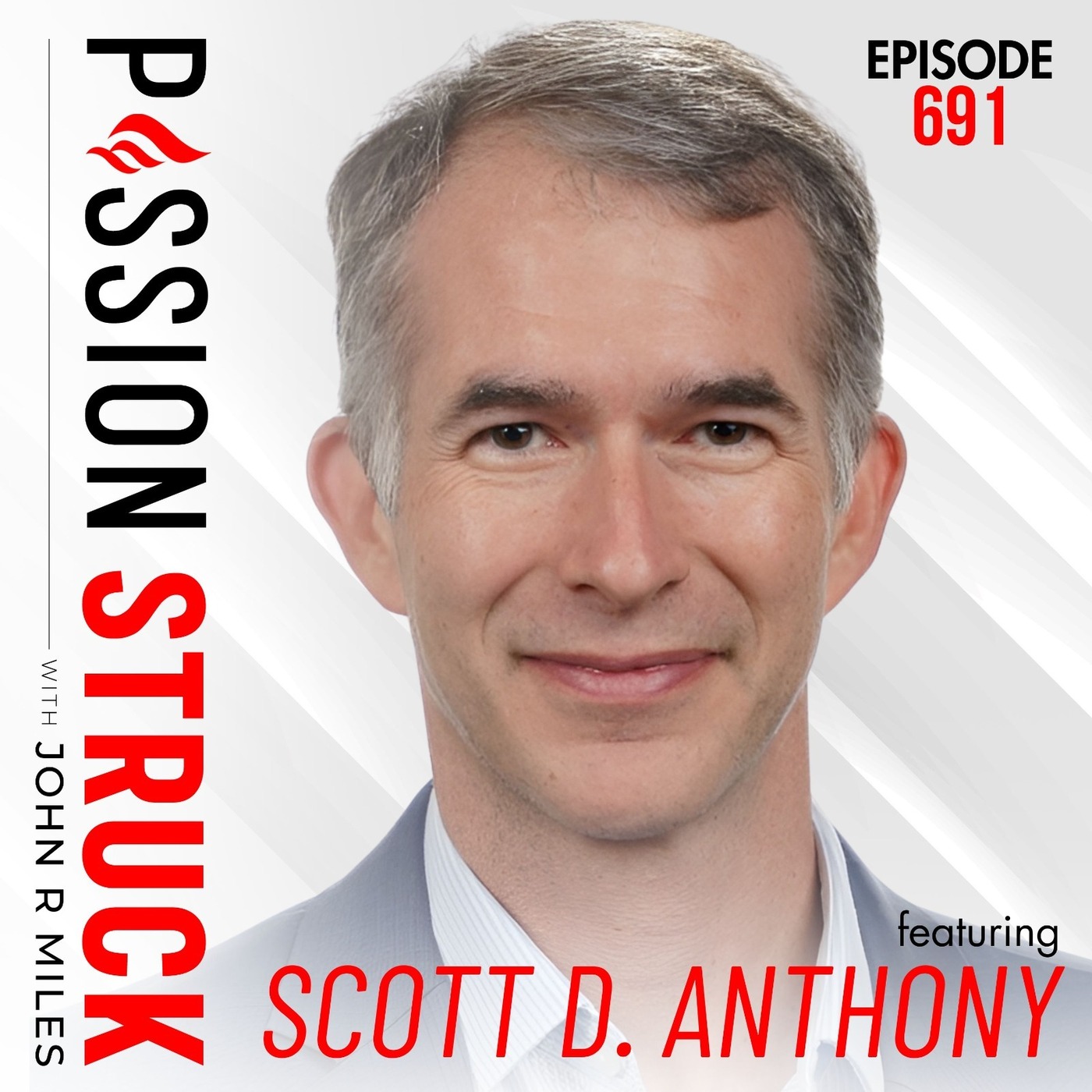
Scott D. Anthony on 11 Epic Disruptions That Changed History
What if the future isn’t something that happens to us… but something we shape?
In this future-defining episode of Passion Struck, host John R. Miles sits down with innovation thinker and bestselling author Scott D. Anthony to explore the 11 epic disruptions that reshaped civilization and the hidden patterns that will shape the next era of human possibility.
Drawing on Scott’s new book Epic Disruptions and his decades of work alongside Clayton Christensen, John unpacks why breakthroughs like gunpowder, the printing press, the iPhone, and AI follow a predictable rhythm, why leaders routinely miss the future even when it's right in front of them, and what it means to think in two time horizons at once.
This episode continues our acclaimed series, The Irreplaceables: a journey into the human capacities no machine can duplicate.
If you're navigating change, leading through uncertainty, or simply trying to understand the world that’s coming, this conversation is your roadmap.
Read the full show notes here: https://passionstruck.com/epic-disruptions-that-changed-history/
Listen + Watch + Go Deeper
All episode resources, including my books You Matter, Luma and Passion Struck, The Ignited Life Substack, and Start Mattering store are gathered here: https://linktr.ee/John_R_Miles
To go deeper, download the free companion workbook:
The Disruption Decoder: available now at TheIgnitedLife.net
Inside, you’ll find frameworks, reflection prompts, and practical tools to help you anticipate change, widen your imagination, and build the mental agility required to lead in an era of accelerated disruption.
About the Episode
In this episode, you'll learn:
- How 11 breakthroughs — from gunpowder to the iPhone — rewired the world
- Why disruption is predictably unpredictable
- Why even great organizations fail
- Why innovation is always a team sport
- Why AI mirrors the printing press more than we realize
- The human side of disruption
Support the Movement
Everyone deserves to feel seen, valued, and like they matter.
Show it. Wear it. Live it.
See Privacy Policy at https://art19.com/privacy and California Privacy Notice at https://art19.com/privacy#do-not-sell-my-info.
Press play and read along
Transcript
Speaker 1 My place in tech changes every day, but I don't fear the future because I'm with the leader, Plural Sight.
Speaker 1 Their online learning platform has the hands-on, expert-led courses I need to master new tech skills and create bigger impacts.
Speaker 2 So I can learn quickly and stay ahead.
Speaker 1
With Pluralsight, I don't fear what's next. I embrace it.
Tap in at pluralsight.com and see for yourself.
Speaker 1 Why choose a sleep number smart bed?
Speaker 3 Can I make my site softer?
Speaker 1 Can I make my site firmer? Can we sleep cooler? SleepNumber does that, cools up to eight times faster, and lets you choose your ideal comfort on either side. Your sleep number setting.
Speaker 1 Enjoy a personalized comfort for better sleep night after night. It's our Black Friday sale, recharged this season with a bundle of cozy, soothing comfort.
Speaker 1
Now only $17.99 for our C2 mattress and base plus free premium delivery. Price is higher in Alaska and Hawaii.
Check it out at a sleep number store or sleepnumber.com today.
Speaker 2 Coming up next on Passion Struck.
Speaker 1 You need this duality, almost a paradox in your mind, where you are simultaneously thinking about long-term future and present reality, recognizing if you don't care and deliver for today, you don't earn the right to do tomorrow.
Speaker 1 But if you don't have a vision, a direction to which you're trying to go to for tomorrow, the efforts that you have in today are going to be misguided or even counterproductive.
Speaker 1 And the thing that I generally counsel leaders to do is make sure that you just stop and you apply different timeframes and mental models as you're looking at different things that you are trying to decide around.
Speaker 4
Welcome to Passion Struck. I'm your host, John Miles.
This is the show where we explore the art of human flourishing and what it truly means to live like it matters.
Speaker 4 Each week, I sit down with change makers, creators, scientists, and everyday heroes to decode the the human experience and uncover the tools that help us lead with meaning, heal what hurts, and pursue the fullest expression of who we're capable of becoming.
Speaker 4 Whether you're designing your future, developing as a leader, or seeking deeper alignment in your life, this show is your invitation to grow with purpose and act with intention.
Speaker 4 Because the secret to a life of deep purpose, connection, and impact is choosing to live like you matter.
Speaker 4 Welcome back to Passion Struck, friends. I'm your host, John Miles, and this is episode 691 in our continuing November journey called The Irreplaceables.
Speaker 4 It's a month dedicated to remembering the things that technology can't duplicate and the world can't take from you. Each week, we're exploring a different piece of what makes you human.
Speaker 4 Your courage, your presence, your imagination, your voice.
Speaker 4 And if this show has ever sparked a new idea, shifted your perspective, or helped you take one small step forward, here are two simple ways to help it grow.
Speaker 4
First, share this episode with someone who needs it. Second, leave a five-star writing review on Apple Podcast or Spotify.
It's the single best way for new listeners to discover these conversations.
Speaker 4 Last week, we walked two very different paths to rediscovering our worth.
Speaker 4 On Tuesday, I was joined by Elias Wise Friedman, or as millions know him, the doggist, who reminded us that connection can still break break us open in the best way, sometimes in the middle of a sidewalk with a stranger and a dog.
Speaker 4 Then on Thursday, Amina Altai showed us that ambition doesn't have to drain us. It can be rooted in purpose, alignment, and joy.
Speaker 4
And today we turn to another deeply human skill, your ability to imagine the future, and then to step boldly into it. My guest today is Scott D.
Anthony.
Speaker 4 one of the world's leading thinkers on innovation and disruption.
Speaker 4 He's a clinical professor at Dartmouth's Tuck School of Business, a longtime partner at Innocyte, and a co-architect of some of the most influential frameworks in the innovation world, alongside the late Clayton Christensen.
Speaker 4 Scott's new book, Epic Disruptions, is a sweeping look at 11 breakthroughs that changed the course of history, from gunpowder to the printing press to the iPhone, and what they can teach us about navigating disruptions shaping our lives today.
Speaker 4
In our conversation, Scott and I explore why leaders miss the future even when it's right in front of them. How to think in two time horizons at once.
What I call the Bee and Turtle effect.
Speaker 4
Why the innovator's dilemma still haunts organizations and how to break free. We go into the human side of disruption.
Things like fear or loss. Identity and the courage to see differently.
Speaker 4
We discuss why AI mirrors the printing press more than we realize. and why real innovation has never been a genius sport.
It's always been a team sport. Before we dive in, two quick invitations.
Speaker 4 My new children's book, You Matter Luma, is now available for pre-order, a story about courage, connection, and the ripple effect of mattering.
Speaker 4 You can pre-order it at Barnes ⁇ Noble or at youmatterluma.com.
Speaker 4 And join me at theignitedlife.net, my sub stack, where I share deeper frameworks, bonus interviews, and tools to help you live more intentionally in a world moving faster every day.
Speaker 4 Now let's step into this groundbreaking, clarifying, and future-shaping conversation with Scott Anthony.
Speaker 4 Thank you for choosing Passion Struck and choosing me to be your host and guide on your journey to creating an intentional life. Now, let that journey begin.
Speaker 4 If you've followed me for any length of time, you know I'm constantly searching for the breakthroughs that actually make a difference in how we age, feel, and perform.
Speaker 4 Lately, I've been taking timeline Meto-Pure gummies, and I got to tell you, I'm feeling the shift. My energy is more sustained, my focus sharper, and my recovery quicker.
Speaker 4 It's like I upgraded my engine at the cellular level. What makes them stand out?
Speaker 4 They're powered by Mitopure, the only clinically proven form of urolithin A, a compound that activates your longevity pathways, supports muscle strength, and improves cellular energy.
Speaker 4 It's clean, vegan, and backed by over 15 years of cutting-edge science. Dr.
Speaker 4 Mark Hyman calls urolithin A a game changer for longevity, and with Mitopure, everyone can benefit, no matter your gut health.
Speaker 4 If you want to stay strong and energize now and as you age, then you have to try Motto Pure Gummies. My friends at Timeline are offering 20% off just for my listeners.
Speaker 4
Head to timeline.com slash passionstruck to get started. That's timeline.com/slash passionstruck.
Yourselves will thank you.
Speaker 1
This episode is brought to you by Progressive Commercial Insurance. As a business owner, you take a lot of roles.
Marketer, bookkeeper, CEO.
Speaker 1 But when it comes to small business insurance, Progressive has you covered.
Speaker 1 They offer discounts on commercial auto insurance, customizable coverages that that can grow with your business, and reliable protection for whatever comes your way.
Speaker 1 Count on Progressive to handle your insurance while you do, well, everything else. Quote today in as little as eight minutes at progressivecomercial.com.
Speaker 1 Progressive Casualty Insurance Company, coverage provided and serviced by affiliated and third-party insurers. Discounts and coverage, selections not available in all states or situations.
Speaker 1
Hey, Zach! Are you smiling at my gorgeous canyon view? No, Donald. I'm smiling because I've got something I want to tell the whole world.
Well, do it. Shout it out.
T-Mobile's got home internet.
Speaker 1 Whoa, I love that echo. T-Mobile's got home internet.
Speaker 1
How much is it? Look at that, Zach. You got the neighbors' attention.
Just $35 a month.
Speaker 1
And you love a great deal, Denise. Plus, they've got a five-year price guarantee.
That's five whole trips around the sun. I'm switching.
Speaker 1
Yes, T-Mobile home internet for the neighborhood. Donald, you still haven't returned my weed whacker.
Carl, don't you embarrass me like this, please. What's everyone yelling about?
Speaker 1 T-Mobile's got home internet.
Speaker 1 Yes, T-Mobile's got home internet. Just $35 a month with autopay and any voice line.
Speaker 2 And it's guaranteed for five years. Yodeling.
Speaker 1
Beautiful yodeling, Carl. Texas at these apply.
T-Mobile.com slash ISP for details and exclusions.
Speaker 4 I am so excited today to have Scott Anthony join me on Passion Struck.
Speaker 1 Hey, Scott, how are you today? And John, I'm doing great. Thank you very much for having me.
Speaker 2 And I'm so honored to have you here, primarily because I've been studying your work for a couple of decades.
Speaker 2 So it's great to actually talk to a person who I admire and I applied their teachings into my professional career.
Speaker 2 I can't mention you without mentioning another person who deeply impacted my career, which was Clayton Christensen.
Speaker 2 Can you take us back to that first spark and what drew you so deeply into the field and also into his work?
Speaker 1
Yeah, for sure. So it started in September 2000.
I was a second year student at the Harvard Business School, and I signed up for this class called Building and Sustaining a Successful Enterprise.
Speaker 1
It was a new class, so there were no reviews of the class. I just thought the description sounded interesting.
The first day of the class, Clay Christensen ambles into the room.
Speaker 1 He was six foot, eight inches tall, so so quite a figure, and did something that was really quite anachronistic, which was he took out acetates, like actual slides, and put them onto a projector and started lecturing.
Speaker 1
And if you know anything about the Harvard Business School, that's really unusual. It is entirely the case-based method.
That's just the way that classes start.
Speaker 1 But Clay was saying from the beginning, this is going to be a different class. Yes, we're going to do lots of cases.
Speaker 1 We're going to explore lots of territories, but I want to ground it in models, frameworks, frameworks, and ways of thinking so that you leave it with new lenses to look at the world.
Speaker 1
And from that minute, I was captivated just by the approach. Then as I learned about some of his thinking, well, we can explore that in more depth.
I was even more hooked.
Speaker 4 Must have been just amazing to work.
Speaker 2 alongside Clay. I wanted to ask, how has your understanding of disruption evolved since those early Harvard days, especially with the evolution of AI that we see all around us today?
Speaker 1 Yeah, the world certainly is different than it was in 2000 in lots of ways, for better in some and for worse in others.
Speaker 1 I always think about the sign that Clay had hanging in his office, the famous sign, anomalies wanted. Clay was a very good social scientist.
Speaker 1 When he saw something that didn't fit his research, he didn't seek to go and hide it or to refute it. He sought to understand it so he could make his models, tools, and frameworks better.
Speaker 1 And certainly over the past 25 years, the world has gotten more complicated.
Speaker 1 I look a lot now to the research of my tech colleague Ron Adner, who has done some great work on ecosystems to understand disruption sometimes occurs in a pocket of an ecosystem.
Speaker 1
And if you don't take what Ron calls the wide lens and look at the entire ecosystem, you can sometimes miss the implications of it. So that's one thing.
You've had ecosystems and platforms emerge.
Speaker 1 So it's gotten more complicated. The other big thing that I would point out is Clay's first book, a famous book, The Innovator's Dilemma.
Speaker 1 The subtitle kind of says it all, when new technologies cause, wait for it, great firms to fail.
Speaker 1 What he said is there is a dilemma when disruption strikes, when someone makes the complicated simple, the expensive affordable.
Speaker 1 My research says you bet on the attacker, the incumbents struggle with it.
Speaker 1 Over the past 25 years, people have read that book and read all the other work that's been produced and have learned that the innovator's dilemma presents the innovator's opportunity.
Speaker 1 In a previous generation, Microsoft would have missed cloud, it would have missed artificial intelligence, Meta would have missed messaging, would have missed Instagram.
Speaker 1 In this world, they see it, they respond to it, they can seize those opportunities. That is a huge shift.
Speaker 2 It's interesting. One of the times I was most
Speaker 2 kind of involved with the research was during my time as an executive at Lowe's. And I was taking MBA courses at Wake Forest.
Speaker 2 and I remember this course I was in was examining the Fortune 500 and the professor was asking us to look at the evolution of the companies in the Fortune 500 list over the past 20 to 30 years and how many of the names had dropped off because they were great companies but they hadn't evolved enough to keep pace with the disruptions that were happening around them.
Speaker 2 So I was taking this to heart and I was trying to influence our executive leadership team to understand that while Lowe's was in the retail industry,
Speaker 2 I thought we needed to stop looking at the industry itself and evolving to what other right-of-ways we might have that would make the company more powerful, such as our supply chain ecosystem.
Speaker 2 But also I was trying to get them to think of us. as instead of I was in the IT organization, an IT
Speaker 2 impacted organization to becoming a software company or a retailer powered by software.
Speaker 2 And the current, that past leadership team, I couldn't get them to see it, but the new leadership team that's at Lowe's now actually describes the company as a software company.
Speaker 2 So it's crazy how paradigms shift over time and why it's so important.
Speaker 1
For sure. And you've hit on a couple really important things.
One, when you're dealing with a world where disruption is ever present, that's another big shift.
Speaker 1
In 2000, disruption was a niche phenomenon. Now it's pervasive.
Alex Partners had a report earlier this year where two-thirds of leaders said that they had experienced disruption within the last year.
Speaker 1 So everybody is facing it to some degree. When you have that kind of world, recognizing that the essence of the organization might not be what you think it is.
Speaker 1 You're not a retail company, but you're a software company that provides retail services.
Speaker 1 Or an organization that I consulted with back when I lived in Singapore, DBS Bank, it's not a bank, it's a technology company that happens to provide banking services. That's a really important thing.
Speaker 1 And then second, this idea that you really do have to change in order to survive. I think people now understand this.
Speaker 1 And I suspect we're going to actually see a change in the long-term trends where over periods of time, big churn in the Fortune 500, the S ⁇ P 500, and so on.
Speaker 1 But I think more and more organizations are getting it.
Speaker 1 Of course, lots of exciting startups that are driving big change, but more and more big organizations recognize that standing still is moving backwards and they have to change, they have to evolve if they're going to thrive in a world of never-ending disruption.
Speaker 1 It's an exciting time. It's a scary time at the same time.
Speaker 2 One of the things I was trying to get them to see is I was the chief data officer in one of my roles and we competed against Home Depot and others using data to our advantage, but they didn't see the more macro.
Speaker 2 When I look at companies like Amazon, I really think of Amazon as a data company and Lowe's had that opportunity to do the same given our customer interactions and other things.
Speaker 2 But why do you think it's so hard for leaders at times to see
Speaker 2
themselves in a different light? Like that Lowe's could be a data company, that we could compete. against others using data.
It's so hard to get people to make that leap.
Speaker 2 Yet I think once you do, it's so apparent the chasm that can be crossed.
Speaker 1
I think absolutely. I think one of the cases that I researched for my book, Epic Disruptions, helped to make this really clear to me.
So I have a chapter about steel mini-mills.
Speaker 1 If you study disruptive change at all, Clay Christensen loved the steel mini-mill story. There were integrated mills that created big, expensive plants that created the best steel in the world.
Speaker 1 And then there was a classic disruptive technology, steel mini-mills that used electric arc furnace that did pretty good steel at really low prices, and they drove big change in the space.
Speaker 1 So the question is, why did the market leader, Bethlehem Steel was one of them? It's the one I look into deeply in the book, why did it struggle to go and adopt mini-mill technology?
Speaker 1
It could go and buy an electric arc furnace. It wasn't that expensive.
It could have created a like-for-like competitor to it. It could have embraced disruptive change.
Speaker 1 The argument that I make in the book is Clay had part of the answer. He talked about the the resource allocation process naturally prioritizing making today better versus tomorrow different.
Speaker 1
That's absolutely true. And I say there's another part, which is maybe a little bit irrational.
I argue in the chapter that every organization, to a degree, is haunted by ghosts.
Speaker 1 In homage to Charles Dickens, some of those are ghosts of the past, traumas the organization hasn't gotten over. Bethlehem Steel had to deal with a lot of labor unrest.
Speaker 1
One key to mini-mills was non-unionized labor. Talk about that and people are like, no, that's scary.
You have ghosts of the present.
Speaker 1 You have the inertial pull, the patterns you follow that you're not aware of. It's just the way you do things.
Speaker 1 There had been 80 years where Bethlehem Steel focused on making sure it was the scale producer, that it didn't pioneer, that it was just really good at executing at scale.
Speaker 1
That was just the way they did things. It's hard to fight that.
Ghosts of the future, a fear that if you do something new, you're going to invalidate who you are.
Speaker 1
Your identity is going to be threatened and nobody likes that. Bethlehem Steel.
They had this massive, outdated plant that had all these things jury-rigged together in Bethlehem, Pennsylvania.
Speaker 1
Rationally, they should have shut it down. But who were they? They were Bethlehem Steel.
So I think you have to recognize there's a resource allocation problem. That's hard.
Speaker 1 And there's an irrational set of ghosts that you have to overcome if you're you're going to drive change. That is equally, if not harder, to overcome.
Speaker 1 That's why I think you see so many organizations struggle with the exact problem you described.
Speaker 2
In another conversation, I heard you talking to that podcast host about Nokia and Apple. But I want to take it to a different comparison.
I want to compare Apple to Microsoft.
Speaker 2 Because when I was at senior executive at Dell, I got to work with both of them very closely. And And it's interesting because Apple made a pivot and exploded their market value.
Speaker 2 But at the time, Microsoft, at that time under Steve Bommer, was facing obscurity.
Speaker 2 What ended up happening, in your opinion, after Bommer left and Satya came on that really changed the whole trajectory of where Microsoft is and changed its whole destiny?
Speaker 1 I think the thing that most scholars would point to who have studied Microsoft, it would be pretty simple and complex at the same time. A fundamental mindset shift.
Speaker 1 The mindset that Nadella tried to bring to the organization, trying, successfully brought to the organization, was the growth mindset that said, we're going to go from a culture where we are know-it-alls, which it really was.
Speaker 1 I experienced it. I'm sure you experienced it too.
Speaker 1 Everything from we're going to force rank people and get rid of the people who are the lowest performance to we're going to encourage a lot of rivalry inside the organization and we're going to believe we're microsoft we have the right god to go and produce monopoly profits forever they wouldn't say the m-word in that but the rest of it they would say to a culture where we're really going to be learn it alls where we're going to be humble we're going to recognize the limits of our knowledge we're going to seek to go and explore seek to go and try things and along the way we're going to fail and have setbacks and that's fine we're going to learn from them celebrate blah blah blah blah blah it's such a simple idea but so powerful when you implement it because it just opens up possibilities I think one example of this is there's the famous video of Steve Bomber seeing somebody using an iPhone and taking the iPhone and throwing it down you got to use Microsoft products you can't use the competitors products Satcha on the other hand when you saw Elon Musk tweet something about how Grok wasn't being favored by Microsoft no matter what Satcha Nadella personally thought about it he recognizes as an ecosystem provider you got to work with everybody So let's talk about it.
Speaker 1
Let's talk about how we work together. Let's learn.
Let's go and develop. Let's push.
Let's experiment. It's really amazing to see the changes that have taken place in Microsoft in a generation.
Speaker 1
20 years ago, it looked like Innovator's Dilemma version 2.0. It's like it could be the focal case study the next time you update that book.
Now it looks like Innovator's Solution 2.0.
Speaker 1 And that's happened in a pretty short period of time.
Speaker 4 It really is.
Speaker 2 I had a first-hand experience because somewhere around 2012, I interviewed for their CEO role.
Speaker 2 And just as you're explaining, I came in there having examined the company and being at Dell, they were a close partner of ours.
Speaker 2 So I knew them pretty well and saw Bomber basically mandate that when we were launching our first mobile device, he mandated to Michael that it needed to be on the Microsoft operating system instead of Android.
Speaker 2 And so we were dead on arrival.
Speaker 2 But I went in there with all these fresh ideas and everyone I met along the interview pattern basically said, what what we're doing is better until I met Satya and in one of my last interviews.
Speaker 2 And he was the only one I met who was really open to other ideas. Well, getting back to the reason for our discussion today, you've brought it up already.
Speaker 2 You've written a new book, Epic Disruptions, and you have eight books before this one.
Speaker 2 Why turn to history and why release it now?
Speaker 1 Well, do you want the answer that I'm supposed to give or you want the truth? I'll give you the truth. The truth is, it actually was not my idea.
Speaker 1
So I had a very different book that I proposed to my publisher, Harvard Business Review Press. I teach a class at Tuck called Leading Disruptive Change.
Teaching is a second career for me.
Speaker 1
I was a consultant for about 20 years before that. So I started teaching three years ago.
I designed this class. The class was going well.
I said, I want to write a book about the ideas in this class.
Speaker 1 And the publisher said, it sounds great. We're really interested in it, but we have a different idea for you.
Speaker 1 They had just named disruptive innovation one of of four ideas that had shaped the modern business world, along with shareholder value maximization, emotional intelligence, scientific management.
Speaker 1
And they said, you're so intertwined with the idea. What about writing a history book about disruption? And at first, I was like, that's not the book I want to write.
I had another idea in mind.
Speaker 1
And then it just sat in my head. I said, there still are a lot of questions about disruption.
It's been 20 plus years since the idea has been out there. People misuse it.
People don't understand it.
Speaker 1 I I said, maybe taking a fresh look and looking through the lens of deep history will teach me things I didn't know and allow me to communicate in ways I couldn't communicate before.
Speaker 1 And that's absolutely what I found.
Speaker 1 In the end, I was so thrilled that I didn't have this idea, but I did like this idea because it just taught me so many things about disruption that I just would not have learned in any other way.
Speaker 4 I hope you're enjoying my conversation with Scott Anthony. Want to watch this episode? You'll find the full interview, shorts, and exclusive content on our YouTube channels.
Speaker 4 Do you want to wear your purpose? Visit startmattering.com to explore intention-driven apparel designed to remind you, you matter, live like it. Now, a quick break from our sponsors.
Speaker 4 Thank you for supporting those who support the show.
Speaker 3 Audival's romance collection has something to satisfy every side of you. When it comes to what kind of romance you're into, you don't have to choose just one.
Speaker 3 Fancy a dallions with a duke or maybe a steamy billionaire. You could find a book boyfriend in the city and another one tearing it up on the hockey field.
Speaker 3 And if nothing on this earth satisfies, you can always find love in another realm. Discover modern rom-coms from authors like Lily Chu and Allie Hazelwood, the latest romanticy series from Sarah J.
Speaker 3 Maas and Rebecca Yaros, plus regency favorites like Bridgerton and Outlander. And of course, all the really steamy stuff.
Speaker 3 Your first great love story is free when you sign up for a free 30-day trial at audible.com slash wondery. That's
Speaker 3 slash wondery.
Speaker 1 Hello? Hi, Greg.
Speaker 3 We're trying to process a refund to your account, but first, you need to confirm your social security number.
Speaker 1 Wait, what? Who are you?
Speaker 3 Scammers are getting harder to identify because they use your personal information to mimic businesses you trust. But how do they even get your info? Your data is out there, but you can take control.
Speaker 3 CalPrivacy is working hard to make privacy easy. Learn how to protect your data at privacy.ca.gov.
Speaker 4 You're listening to Passion Struck on the Passion Struck Network. Now, back to my conversation with Scott Anthony.
Speaker 2 Yeah, Scott, the word epic feels intentional, and this whole podcast is about intentionality. So I find it to be both historical and mythic.
Speaker 2 How do you define epic disruption, and what distinguishes the 11 stories you already went through, one, from typical innovation case studies?
Speaker 1
So first, just to make sure we've got terms of reference, let me talk about what disruption is. And I will illustrate this with an example.
My father was born in 1947.
Speaker 1
In 1947, there was exactly one computer in the world. It was huge.
It weighed about 20 tons. I was born in 1975.
Now there are tens of thousands of computers in the world.
Speaker 1 They're still pretty big, and they're not things that I, as an individual, would likely ever access because they're in very large organizations in central locations. My daughter Holly is born in 2007.
Speaker 1
Now there are hundreds of millions of computers. We talked already about Microsoft Dell and we know all the names.
There are laptops and desktop computers.
Speaker 1
And of course, in 2007, we now have a computer that's in our palm and in our pocket with the introduction of the Apple iPhone. Today, there are billions of computers.
That's disruption.
Speaker 1 Take the complicated and expensive, make it simple and affordable, change market dynamics, drive explosive growth. The word epic in the title is absolutely an intentional word.
Speaker 1 In 1620, Sir Francis Bacon said, there have been three things that have changed the state and appearance of the entire world. Gunpowder, printing press, and the compass.
Speaker 1
Those are epic disruptions, things that change the state and appearance of the entire world. Two of those three made it into epic disruptions.
The compass did not for whatever reason.
Speaker 1
The rest of the stories are like that. You can see a material difference in the world before and the world after.
That is an epic disruption. The world is different because it exists.
Speaker 2
I love that. And one of the earliest stories you tell us is about gunpowder.
What does this unlikely innovation reveal about how disruption actually unfolds?
Speaker 1
Many things. I will highlight two things.
First, it helps us to understand that innovator's dilemma. So the story starts in 1453.
There's an army approaching Constantinople.
Speaker 1
Now, inside the city, people probably felt okay because they had these walls, these Theodotian walls. There's a moat that goes around the walls.
The walls have two sets to them.
Speaker 1
They're each 15 feet thick. There's 96 towers that buttress them.
They had stood for more than a thousand years until gunpowder.
Speaker 1
There was this cannon that a mysterious gunner named Orban cast that could fling a half-ton cannonball over a distance of a mile. Imagine that.
The world had never seen anything like this before.
Speaker 1
And suddenly, cannonballs are flying out of the sky. The walls were smashed.
The city fell in 47 days. This reminds us that disruption changes everything.
Speaker 1
The defenses that were built for yesterday are not fit for the disruptions of today. That's lesson number one.
Lesson number two, the path to get there is not a straight line.
Speaker 1
142, that is the first reference that I could find to gunpowder. And of course, then it wasn't gunpowder.
It's just people messing around with stuff.
Speaker 1 It was alchemists that were working on it, magicians who were working on it, philosophers who were working on it for about the first thousand years until people say, hey, you mix saltpeter and sulfur and charcoal together in the right way.
Speaker 1
You put a container around it, you put a projectile in it. We can do some interesting things with militaries as well.
Somehow it crosses over to Europe.
Speaker 1
People keep experimenting, et cetera, et cetera. This is a very persistent part of the stories of disruption.
Disruption rewards patience.
Speaker 1 It's not something where, pardon the pun, there's a big bang and all of a sudden overnight the world changes. It takes time, it takes iteration, it takes experimentation before you get there.
Speaker 1 There are other lessons, of course, in the chapter, but those are the two big ones that really struck me as I was going through it.
Speaker 2 In my first book, I have this concept I lay out called the B and Turtle Effect. And I examined Elon Musk using it.
Speaker 2 And I was trying to show that Elon, like the sea turtle, has a very long range view of where his head is at. He's thinking of exploration in the cosmos.
Speaker 2 And so he's trying to think of if we're going to get to Mars, what types of disruptive technologies are we going to need to survive there? So it's led him to look at
Speaker 2
different ways that you're going to have to propel things up there using different forms of energy generation. He knows you're not going to be able to survive on the planet.
on its surface.
Speaker 2 So he's done a lot of expeditions using deep mining technology, et cetera.
Speaker 2 But he also works like the honeybee, which is very concerned about serving the mother bee and carrying out what it needs to on a daily basis.
Speaker 1 So
Speaker 2 you talked about gunpowder. I brought up the iPhone earlier.
Speaker 2 It's two examples of one taking that long-term view, one that many people would think is a shorter-term view, although in jobs head it probably unfolded a lot slower than that.
Speaker 2 But how to, using all these examples, how do leaders plan for deep roots and fast fields at the same time?
Speaker 1 It is a truly fantastic question.
Speaker 1 And we now get to bridge a little bit into some of the material in the book that is yet to be written, which is about how do you really lead through disruptive change.
Speaker 1 And I love the metaphors that you've given because that's exactly what you need.
Speaker 1 You need this duality, almost a paradox in your mind, where you are simultaneously thinking about long-term future and present reality, recognizing if you don't care and deliver for today, you don't earn the right to do tomorrow.
Speaker 1 But if you don't have a vision, a direction to which you're trying to go to for tomorrow, the efforts that you have in today are going to be misguided or even counterproductive.
Speaker 1 And the thing that I generally counsel leaders to do is make sure that you just stop.
Speaker 1 and you apply different timeframes and mental models as you're looking at different things that you are trying to decide around. And it's a wonky word, but I think an important one.
Speaker 1 And I think if you were to peer into Elon Musk's brain or Steve Jobs' brain or whatever, you would see this.
Speaker 1 You need to have metacognition, which means you are thinking consciously about how you are thinking and saying, okay, what hat am I putting on? What glasses am I putting on?
Speaker 1 What lenses am I putting on? What timeframe am I thinking about? How do I go and connect these things?
Speaker 1 Danella Meadows, who taught at Dartmouth for a long period of time, was a famous thinker in the the systems thinker space.
Speaker 1 We're really bad as humans at being systems thinkers, about thinking about second order effects. And what do we have to do to be able to do this? And then what happens?
Speaker 1 And that's the sort of thing that someone who has high metacognition is able to do. Good news, this is a trainable skill.
Speaker 1 You can practice and get better at it by making sure that you get diverse stimuli. You think about different things, you have different experiences and so on.
Speaker 1 But it's not something that we spend a lot of time talking about. And the ones that really drive disruptive change are really good at doing it.
Speaker 2 For many decades in my career, Mark Benioff, the CEO and founder of Salesforce, was a close mentor of mine. And
Speaker 2 something that you argue about
Speaker 2 is predictably unpredictable disruption. And when I think about Mark, that kind of sums up a lot of
Speaker 2 what I think his ethos was. For someone who doesn't understand what that means, can you explain what it is and specifically what tilts the odds?
Speaker 1 So let me illustrate it with a brief story, Julia Child, who was one of the more fun chapters in the book and one I really didn't see coming when the research and writing started.
Speaker 1 Julia Child, if you're asking your head, well, what exactly did she disrupt? Well, you go back to the 1950s, you live in America, you want to enjoy a great French meal. What do you do?
Speaker 1 You probably don't have a restaurant in your local area. So that means your best choice is to get on a plane and fly to Paris, which meant not many people were enjoying French food.
Speaker 1 Mastering the Art of French cooking made it simple and accessible for a broader population to enjoy French cooking. Julia Child amplified that by having her TV show that brought it to more people.
Speaker 1 Classic disruptive innovation. So the story, the brief story, Julia Child joined with two co-authors, Sim Kabeck and Louisette Berthold, in 1951.
Speaker 1
to work on the project that became Mastering the Art of French Cooking. It was not an overnight success.
It took 10 years. There were three different publishers.
There were two near-death experiences.
Speaker 1 She needed help from an outside friend, Avis Devato, who introduced her at the last minute to Judy Jones and Alfred Knopf that published the book.
Speaker 1
This is one of the very clear patterns for disruptive innovation. There's always twists and turns.
There's always false steps and fumbles.
Speaker 1 There's always in the classic mono myth, divine help from an outsider that can help to make connections.
Speaker 1 I know for sure whenever I start researching or writing or helping somebody with a disruptive idea, that pattern will exist. That's predictable.
Speaker 1
Exactly where and when and how misfortune or fortune will strike, you cannot know for sure. It is not Newtonian physics.
It is not deterministic. It is not a checklist.
That part is unpredictable.
Speaker 1 What that means is you have to recognize that you're going to learn experientially as you're progressing with disruption.
Speaker 1 You're going to have have to be ready to handle setbacks and you're going to need a lot of friends to help you along the way.
Speaker 1 And then you got to strap yourself in and be ready for the ride because exactly what will happen, exactly when it will happen is very hard to tell. That's the idea of being predictably unpredictable.
Speaker 2 Yeah, and I want to focus on Julia here for a second because as I was reading this, I think she's a great example beyond what you just talked about, because people often look at people like her or other people we've talked about in today's discussion and they see the end trajectory of what they've created, but they don't see the journey along the way.
Speaker 2 And when I think about Julia, what gets lost is that she really struggled when she was going through schooling to become a chef.
Speaker 2 So not only did she have this near-miss with her book, but her career could have been derailed before it even started had she not doubled down and on how she was focusing on her cooking.
Speaker 2 And I think that's another thing that people don't really see is the perseverance that disruptors have to take.
Speaker 1
And that is true for anybody, anybody who is wildly successful. Julia Child, she's born in 1912.
She does not come out of the womb as a great chef. Nobody does.
Speaker 1
The first time she cooked a meal for her husband, Paul Child, she made brains and red wine. I have no idea why she picked that recipe, but it sounds not very appetizing.
And it was a disaster.
Speaker 1 When she visited Paul's family, the joke was she couldn't successfully boil water.
Speaker 1 When she went to France and got struck by this idea of cooking French food, she enrolled at Les Corde d'Anble and then failed the final exams.
Speaker 1 There's a lot of setbacks along the way before you actually see success. You go and study people who are great athletes, almost all of them.
Speaker 1 Yes, of course, they're touched by God with amazing talent, but almost all of them will tell you stories of shooting a thousand shots in the driveway and working and working and working to get better at something and the help of a coach because it's not just practice it's deliberate practice where someone can give you feedback and help you get better we see the end of the story we don't see the work that goes into it that's something that i think really struck me in the research then there's something john that just struck me literally last week so last week i got a call from my publicist she said you were considering pitching a story to arp and they asked any protagonists in the book who are over 50 and i said i think so and i thought immediately of Julia Child and Julia Child, the first time she went on television, she was 50 years old.
Speaker 1 But then I started going through every chapter and every chapter where there's names. The printing press, Gutenberg was at least 55 when the first Bible came off the printing press.
Speaker 1
Sir Francis Bacon, who I mentioned before, the disruptive idea of the scientific revolution, he was more than 60. when he wrote his breakthrough book.
And this is in the 17th century.
Speaker 1 Steve Jobs is 52 when the iPhone comes out. So, of course, we celebrate the Wonderkins that come up with ideas in their late teens and early 20s.
Speaker 1 But there's a lot to be said for people who have crystallized intelligence, who can take all the wisdom they have and say, I see something here.
Speaker 1 I see pieces I can put together that you might not see because you don't have the experience. That was just an interesting thing that was in plain sight, but I had not seen it before.
Speaker 1 Disruption begins at 50, I guess. I just turned 50 this year, so I like that.
Speaker 2 Well, I think another great example of that is if you want to look at actors, is Morgan Freeman. He didn't start his career really didn't take off until he was in midlife either.
Speaker 2 And I think you bring up a very good point. The other thing I wanted to highlight here is I was having a discussion with Jim McCaldy, who co-founded Square.
Speaker 2 And Jim was telling me that the reason he sees most entrepreneurs or innovators fail is they run into
Speaker 2 these friction points like you described with Julia. And a lot of them, instead of staying true to their direction and adapting, tend to become so distracted, they start venturing from it.
Speaker 2 And that lack of focus is what causes the disruption to come to a grinding halt, which is something else I think is important.
Speaker 2 One other thing I did want to explore is what do Julia Child and crypto have to do with each other?
Speaker 1 At first, I will admit it's a little bit of a stretch.
Speaker 1 The conclusion of the book, it says, for each of the chapters that focuses on a product, let's find an echo of that product in modern days that has some disruptive elements to it.
Speaker 1
Some of them were very easy. So, gunpowder, boom.
Let's look at clean tech, the printing press, artificial intelligence, the bottle tea, Henry Ford's breakthrough vehicle, autonomous vehicles.
Speaker 1 I wanted to get cryptocurrency, distributed ledger technologies in there. I'm like, which one does this fit best with?
Speaker 1 And I said, okay, let's do a little bit of squinting in the book and say, Julia Child. The squinting in the book is this.
Speaker 1 When Julia Child was working on her book, she was very concerned that the recipes she was working on, which were carefully crafted, honed through lots of experimentation, were going to leak.
Speaker 1 So when she sent them to people, top secret stamps on them and make sure that they were wrapped and all that. And she used to work at the predecessor to the CIA, so she understood all this stuff.
Speaker 1 In modern days, she could use distributed ledger technologies to make sure that there is clear mark of ownership of everything that she distributes.
Speaker 1
And if there is leaking, she can figure out exactly where in the chain it happened and how. That was the argument that I made.
Since writing the book, I've realized I could have said even more.
Speaker 1
Julia Child, one of the things she was great at, pushing frontiers. She pioneered chefs going on television.
She pioneered modern formats for all the TV shows that we see now. I am willing to wager.
Speaker 1 that if she were alive today, she would certainly accept payment in crypto and she probably would have a meme coin because she's very memeable.
Speaker 1 So I could have done even more in the book with that one, I think.
Speaker 2 I love it.
Speaker 2 You call disruption collectively individualistic. And that spoke to me because when I started this podcast, it was really a solopreneur type of initiative.
Speaker 2 And now, like so many people out there, you reach a point where it can't be a solo initiative anymore.
Speaker 2 So I thought that this one was one to highlight for our audience, especially how should we design teams around that truth?
Speaker 1 Well, I'll answer that question first and then go back to a story from the book that helped to really firm this up in my mind. How should we design teams? Number one, make sure you have them.
Speaker 1 Make sure you recognize that this is not, no matter what you're doing, it's not an individual activity. There are people who support you and augment you and amplify you, et cetera.
Speaker 1 Whether it's a village or a platoon that it takes to actually do this, make sure you format.
Speaker 1 Then the second thing, one of the very persistent findings in the innovation literature is that magic happens at intersections, where you get different mindsets and backgrounds colliding.
Speaker 1 The more that team is replete with intersections, people who will look at the world in different ways, think in different ways, have different skills, et cetera, the stronger that team is going to be.
Speaker 1
And the story to reinforce this is the printing press story. This one taught me a lot.
The printing press, I had historically told as a story about the lone genius. You have Johannes Gutenberg.
Speaker 1
He's the one guy who does this. Of course, you go and study history.
You realize that's not true at all. 1437, he forms a partnership.
The partnership isn't to go and create the printing press.
Speaker 1 It's to create trinkets with silver foil or mirror behind them that would capture the essence of the Holy Spirit during a planned pilgrimage in 1439. The bubonic plague broke out.
Speaker 1
The pilgrimage was called off. So that little team had to go and, in modern terms, pivot.
They added some new members.
Speaker 1 They found this guy, Conrad Saspach, that had this really interesting press that was originally for wine, but could be used for other purposes. They got funding from Johann Fusst.
Speaker 1
They found Nicholas of Cusa, who was looking for ways to standardize religious ceremonies. A bunch of people are coming together.
It always requires a bunch of people coming together.
Speaker 1
Of course, there's a hero in the story. There always is, but there usually are multiple ones.
There are heroes, and there always are lots of people involved in it. So I love solopreneurs.
Speaker 1 My 14-year-old son, Harry, who is at that 14-year-old awkwardness and says, can I just build a huge business without ever talking to anyone?
Speaker 1 I encourage him to go as far as he can, but I say, Harry, you really are going to have to learn how to look people in the eye and talk with them.
Speaker 1 Harry, I apologize for sharing this story during this podcast, but over time, I hope you appreciate it.
Speaker 2 I want to go back to my comments earlier about my Wake Forced learnings about the Fortune 50 and so many of them disappearing, because it ties back to something that you wrote that companies often play a critical role in their very own disruptions that end up unseating them.
Speaker 2 What are some great historical examples that illustrate this paradox?
Speaker 1 Well, I was just speaking at an event recently and they said, well, we want to hear your own story. So I said, okay, let me tell you a version of my story at least.
Speaker 1 So my first face-to-face experience encounter with disruptive innovation was in 1995 when I was the managing editor of a newspaper now if you've tracked what i said about how old i am and when i was born you'll very quickly recognize that i was not the editor of the new york times or wall street journal this was my college newspaper i was 20 years old at the time 1995 was an important year because the year before mark andreessen and his team had introduced the netscape browser So there we were, a leadership team staring at disruptive change in the face.
Speaker 1
And we made all the mistakes. We hesitated to allocate resources towards it.
Rather than embracing the new power of the internet, we tried to force fit it through our old model.
Speaker 1
We did everything wrong. 2000, I told you before, I met Clay Christensen.
I start to understand disruptive change. I say, oh my gosh, it's obvious what we did wrong now.
I study it. I learn about it.
Speaker 1
Clay and I worked together for a couple of years. I'm his research assistant.
I then join the team at Innocyte, the consulting company that he had set up, and I get my shot at redemption.
Speaker 1
2005, I lead a project with the American Press Institute to save the U.S. newspaper industry.
You know how this one turned out? It's a line on my failure resume now.
Speaker 1 The newspaper industry was not saved because I recognized after this how deliciously deep the dilemmas of disruption actually are.
Speaker 1 It was crystal clear in 2005 that readers were going to other places, new business models were emerging, the industry needed to fundamentally change.
Speaker 1 The challenge the industry had at that time is while it intellectually made sense to them, their businesses were still healthy. Their businesses were still producing lots of positive cash flow.
Speaker 1
The data lagged the degree of disruption. And because of that, they felt no urgency to act until the data were crystal clear.
And by the time the data are crystal clear, it's too late.
Speaker 1 You don't have the degrees of freedom to act around it. Me and a couple of former Innocyc colleagues in a Harvard Business Review article a few years ago called this the information action paradox.
Speaker 1 And that is, to me, one of the deepest challenges of dealing with disruptive change. By the time the data are clear, it's too late to act based on the data.
Speaker 1 So a good leader will act at the moment when the data tells them not to, which is a wonderful paradoxical thought that you have to act against what the data tells you, but that's what's required in disruptive change.
Speaker 4 I'm glad you brought up that example.
Speaker 2 I'm going back to a conversation I had with Jim McKelvey.
Speaker 2 He started a new company called, I think it's Invisibly, and he's trying to disrupt that whole model that you were just talking about, historical, the way we consume content.
Speaker 2 And he's trying, as I understand it, to put more onus on the consumers of the information and how do you incentivize them financially to consume the best data that's out there.
Speaker 2 Because I don't know if you're like me, but I hate it when I'm doing research and I keep hitting paywall after paywall to get the information that I need.
Speaker 2 And instead of hitting the paywalls, it would actually be incentivizing the person to look at that content and then recommend it to others as being the foremost content that's applicable to the question that they're asking, which is an interesting model if he can get it to grow momentum.
Speaker 2 But that's often the most difficult part is having this great idea, having this disruptive path that you can take and then making it a reality.
Speaker 2 Because what I have typically found is the original ideas that you come across rarely are the ones that eventually take hold. So
Speaker 2 long way of asking you, like, how do you cross that chasm?
Speaker 1
I think first to highlight what you said, the first and final ideas are never, ever the same. And even the ones that we deem brilliant get it wrong all the time.
This is something I had forgotten.
Speaker 1 But in the research for the book, I went back and watched the video where Steve Jobs launched the iPhone at Macworld 2007. And somebody asked him, what is the killer app of this thing?
Speaker 1
And he said, well, it's a phone. So it's the ability to make and receive phone calls.
Of course, that's the killer app, which turned out to be completely wrong. So we forget this.
Speaker 1 But in the early days, the iPhone sales were pretty low. The phone was a pretty disappointing thing because you couldn't do that much with it.
Speaker 1 There was a good browser on the phone, but there were no apps because Apple had a very tightly controlled ecosystem.
Speaker 1 It took someone convincing Steve Jobs, telling him that, you know what, we got to open this thing up for the App Store to come into being and for the world to really change.
Speaker 1
Point number one, first and final are not the same. Point number two, even the geniuses get it wrong.
Point number three, how do you cross that?
Speaker 1 You cross it by experimenting, by testing, by learning, by probing, by listening to dissenting voices, by trying things and letting the world work out for you what actually the right answer is.
Speaker 1 Your firm in vision, so Steve Steve Jobs had a very clear vision.
Speaker 1 We're going to create an amazingly easy to use computer that fits in your hand, in your pocket, that also incidentally allows you to make phone calls. That vision never changed.
Speaker 1 The components of it absolutely changed based on reactions from real people in real context using it. So the idea you detail, I think, has a lot of merit to it.
Speaker 1
It's a problem I certainly have encountered, many people have encountered. You are asking people to change their behavior.
That's hard to do. How do you figure out how to actually do it?
Speaker 1 You go and do it.
Speaker 1 That is the only way.
Speaker 2 Well, I'm going to ask you a follow-on to that because across these different 11 disruptions, what struck you most about the human dimension of innovation?
Speaker 2 This podcast talks a lot about human flourishing, but to me, there's an individual aspect of that and there's a business aspect of that in how I think connection forms a critical element of why companies are successful or not, making people feel like they belong, that they matter.
Speaker 2 So
Speaker 2 look, using that as a lens,
Speaker 2 what struck most out to you?
Speaker 1
One of the things that was a very surprising finding to me from the book is, look, I love disruption. I've studied it for 25 years.
I've researched it. I've written about it.
I've practiced it.
Speaker 1
I teach it. I truly believe the world is a better place because of it.
However, as I went into each of the stories, for as good as disruption is, it also casts a shadow.
Speaker 1 That shadow can be a company that was a great company that fails, and a lot is lost when companies fail. It can be a market that goes through a lot of tumultuous changes that has pain as that happens.
Speaker 1 And the one I want to focus on is it casts a shadow on individuals.
Speaker 1 I think perhaps my favorite find for the book was the 1548 proclamation from King Edward VI or his team, because he was 10 at the time.
Speaker 1 Proclamation against those that do innovate you see the title you're like well that that's silly why would the king care about people innovating but then you pause for a second what do innovators do at their core they question the status quo they say why are we doing it this way how might we do it differently if you are questioning the status quo in 1548 who are you questioning you are questioning the king or you are questioning god that's not a good thing We do not issue proclamations like this, but we still act like they exist inside many of our organizations.
Speaker 1
We punish people for taking well thought out risks, for trying things, for experimenting. And then individuals, they get scar tissue.
They internalize it.
Speaker 1 They say the safest thing for me to do is to not do anything at all. That compounds something that we all as humans suffer from, known as the status quo bias.
Speaker 1
All things being equal, we'd like things to remain exactly the same. I said it before.
I'll say it again. I love disruption.
The first time I got into a robo-taxi, my palms got sweaty.
Speaker 1
I got nervous because I'm a human. The new and unfamiliar still strikes me to my course.
So what we need in our organization is we need to make sure that it's clear that it's okay to try.
Speaker 1
It's okay to be nervous. It's okay if things don't work out.
As long as, of course, we do it in the right way. We do stupid things.
Yeah, you should be punished for that.
Speaker 1 But taking well-thought-out, intelligent risks, we need to remove the king's proclamation.
Speaker 1 We need to make sure we don't act like it's still in effect because in far too many organizations, that's what life looks like.
Speaker 2 Scott, if you were to write Epic Disruptions 2.0 in 20 years,
Speaker 2 what emerging areas might you bet on as seeds of tomorrow's epics?
Speaker 1 John, one of the things that I think is most interesting to me, so 2022, I had lived in Singapore for 12 years, moved back to the United States, decided it's time for a career transition, start career 2.0, go from consulting to teaching.
Speaker 1
One of the things that's in my mind is consulting is very fatiguing. You're always fighting.
You're fighting against the client, the problem, the world, sometimes your own team, like academia.
Speaker 1
It'll be nice and safe. It doesn't change at all.
And then three months after I joined the faculty, ChatGPT comes out. I say, all right, here we go.
Speaker 1 And then you have political changes and the world of higher education is going through the beginning of what will be an epic disruption.
Speaker 1 So I think in 20 years, there will be a chapter on the universities that responded to the moment well and drove the next generation of growth and those that didn't.
Speaker 1
And I think they will maybe not disappear. Lots of reasons make that harder than in other industries, but I think lose their position of prominence in the world.
So universities, one big space.
Speaker 1 My old industry, professional services, consulting. I will tell you from talking to the leaders of professional services organizations,
Speaker 1 the world stands at a crossroads.
Speaker 1 There are a group of people who are extremely excited about artificial intelligence, what it can do to improve client service, what it can do to drive efficiency and effectiveness.
Speaker 1 There's a group of people who say,
Speaker 1 I'm not sure what we have unleashed here. We are helping our clients be better than us, and we are withering and atrophying our ability to develop young talent.
Speaker 1 The essence of our model is going to disappear. So I think McKinsey, one way or another, will feature in Epic Disruptions 2.0.
Speaker 1 And then the third and final one that I would say, the clean tech world is a fascinating world.
Speaker 1 I almost wrote and decided the story is still very much being written, a chapter on clean tech in the book. But 20 years from now, I think we're going to have some clarity.
Speaker 1 And I think a lot of the things that are happening right now will come together in ways that people don't expect because that's always what happens.
Speaker 1 And I think we're going to see some really interesting and the optimist in me thinks powerfully and good things happen over the course of the next 20 years. I very much hope I'm right about this.
Speaker 2 I'm going to ask you just to follow on since you brought up AI and I'm going to go back to the printing press.
Speaker 2 You end up drawing fascinating parallels between the printing press and generative AI. And I know one thing that I get more questions about on the show than anything else is
Speaker 2 how do I shape my career now that AI is disrupting it, especially for those coming out of college, like you just mentioned with the McKenzie business model.
Speaker 2 What can today's youth and leaders learn from those who live through first information revolution?
Speaker 1
Fantastic question. So, the printing press really changed everything.
Before the printing press, you could basically take all the books in the world and put them in a wagon.
Speaker 1 By 1500, there are millions of books that are being produced. So, really democratized knowledge and enabled knowledge to spread and had lots and lots of knock-on effects.
Speaker 1 So, I think a few things that I would say, if you look at parallels from that to today's information revolution, number one, expect expect more people are going to know more things.
Speaker 1
This net is a very good thing for the world. The more people who have more knowledge, the further that we can push things.
Number two, go and adopt and embrace the new technology.
Speaker 1
I teach a class at TUC, generative AI and consultative decision making. It's a laboratory.
Half of our graduates go into consulting. So let's say.
Speaker 1
in this safe space of an academic environment, no holds barred. Let's see what we can do if we really play.
Do that. Go and adopt the new technology and push it.
Speaker 1 Ethan Malik from the Warden School at the University of Pennsylvania says the price of admission for AI is three sleepless nights.
Speaker 1
At first, if you're somebody who's got experience, you'll want to use it like Google. You'll learn that's not what you should do.
And there's lots of other great things you should do.
Speaker 1 So that's the second. And the third is stay curious, keep learning, keep thinking of new things, keep remembering that timeless proverb that magic happens at intersections.
Speaker 1 I think the more that we keep looking to learn and keep keep looking to see new things, the more we've got a foundation where we can use whatever tool it is, whether it's the tool that Aristotle did not like, the pencil to write things down, or it's the printing press or it's artificial intelligence, the more we can use that tool to achieve great things.
Speaker 1 I, as I said, am an optimist. I think that AI is something that really can have powerful transformational potential, but we have to make sure that we keep learning, we keep knowing how to use it.
Speaker 1
Look, you can go to a gym and bring a forklift and lift any amount of weight that you want. That's not why you go and lift weights at the gym.
You lift weights at the gym to get stronger.
Speaker 1 Do the same thing with your mind.
Speaker 2 Yeah, I remember, I think Tom Billiou said this, that the greatest asset that differentiates us from any other species is our ability to continuously learn. Yet it's the one thing so many of us.
Speaker 2 put on the back burner.
Speaker 2 But I agree with you in this next era, being a continuous learner and trying to start thinking about being five to ten years in the future in your thinking is i think what's going to differentiate those who are able to really maximize their impact over the next two decades compared to those who get stuck where they are
Speaker 2 Well, Scott, it was such a fabulous time having you on the show. For people who want to learn more about you and what you're doing and your courses, et cetera, where's the best place for them to go?
Speaker 1 So LinkedIn is the social media platform on which I live. So Scott Anthony Tuck, because there are more than one Scott Anthony's out there, that will point you to me.
Speaker 1 And there is a companion website for the book, Epic Disruptions, with an S at the end. There's more than one, epicdisruptions.com.
Speaker 2
Awesome. Well, thank you so much for joining us and congratulations on the launch of this book.
It was so nice to have you.
Speaker 1 John, thanks for having me and thanks for the great questions.
Speaker 4 That's a wrap on today's conversation with Scott Anthony.
Speaker 4 What I love about this episode is how it takes disruption, a word we often associate with chaos, and reframes it as something predictable and deeply human.
Speaker 4
Here are a few reflections to carry with you. First, disruption follows patterns.
Those who understand them can shape the future, not just react to it.
Speaker 4
Second, leaders often play a role in their own disruption. Awareness and adaptability are key.
Third, history's greatest innovators from Gutenberg to jobs weren't lucky.
Speaker 4 They recognized inflection points and acted boldly.
Speaker 4 If this conversation challenged how you think about innovation and leadership, then pay the fee, share this episode with someone leading through change, and leave a five-star rating or review on Apple or Spotify to help others discover Passion Struck.
Speaker 4 On Thursday, we continue the Irreplaceables with a conversation that hits at another essential human skill, one AI will never master. Your ability to communicate with clarity, presence, and authority.
Speaker 4 I'm joined by Lynn Smith, a former national news anchor, communication strategist, and founder of Ryland Media for a powerful discussion on how to speak so people don't just hear you, they feel you.
Speaker 4 We go into why clarity is kindness and how to lead with presence in high pressure moments.
Speaker 4 If you've ever struggled with being misunderstood, overlooked, or unheard, this episode will change the way you show up.
Speaker 3
I called it the brain bully because it was so pervasive. It's also known as the saboteur, the inner critic.
It's that voice in your head that's saying to you, you're not good enough.
Speaker 3
Nobody's going to like this. Everybody hates you.
This is not landing. It is the root cause of poor communication.
Speaker 3
So the whole foundation of what I do is expose the disease of your ums, sos, repeating yourself, rambling. It's the brain bully.
It's not what you're saying. It's not a power pose.
Speaker 3 It's not any quick hack. It is the voice in your head that's running the show and has the microphone and it's coming out of your mouth in a not clear or concise way.
Speaker 4
Until then, remember: to matter is to be seen. To be seen is to be known.
And the revolution starts with one simple moment of paying deeper attention. I'm John Miles.
You've been passion struck.
Speaker 1 On the job, every minute counts.
Speaker 1 That's why Lowe's now has ProBlock Quick Dry Primer, expertly manufactured by Sherwin-Williams, engineered for pros to drive fast and go on smooth for virtually flawless results that keep your job moving.
Speaker 1
It's available in oil and water-based, and getting it is easy. Order online by 2 p.m.
and get free same-day delivery right to your job site. Lowe's, we help.
You save. Orders placed after 2 p.m.
Speaker 1
will be delivered next day. Valid in select zip codes, subject to driver availability.
More terms apply.