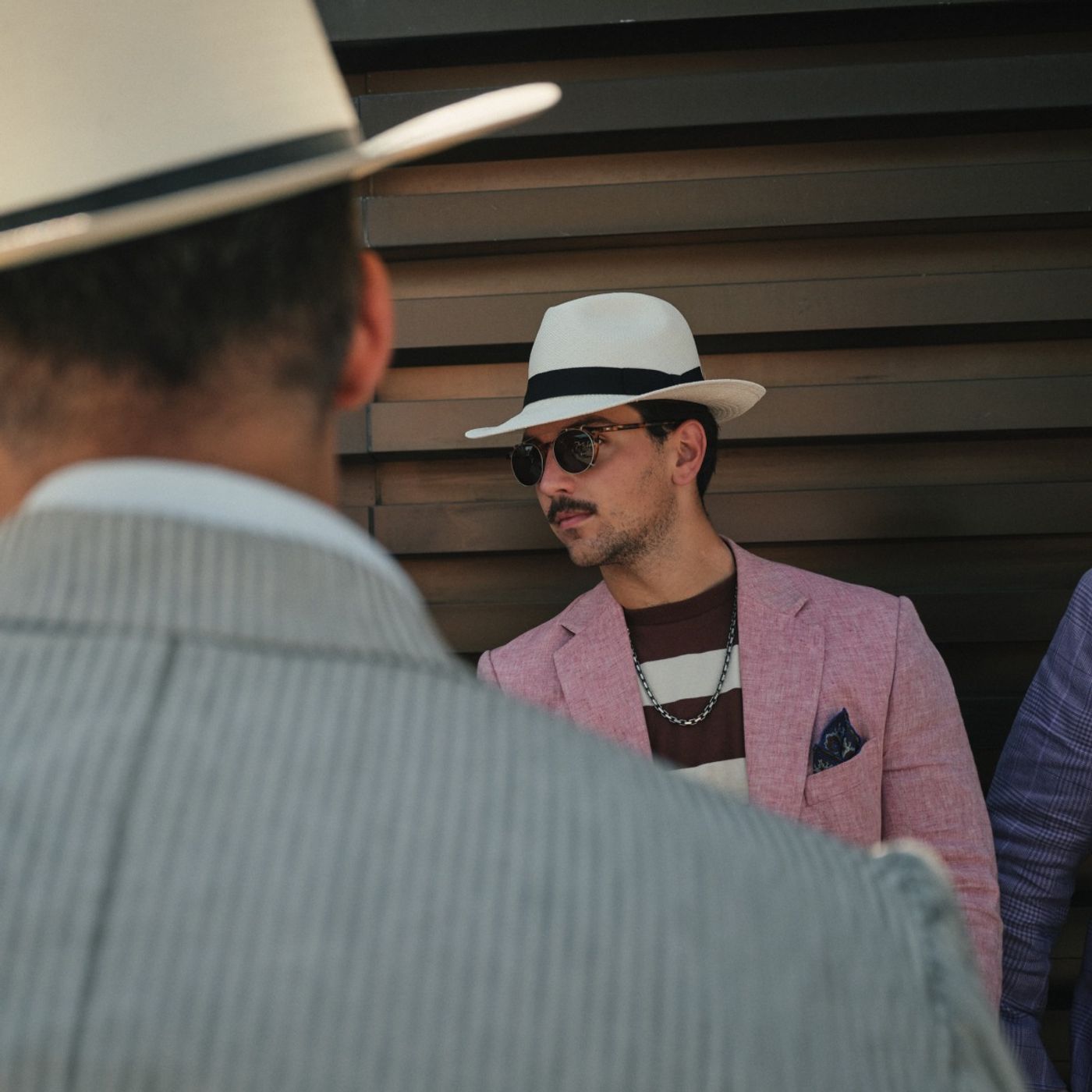
Sunday Special: The Fashion Episode
56m
This month kicked off the big four fashion weeks: New York, London, Milan and Paris. Each year, designers, brands, influencers and celebrities flock to these events to see and be seen.

On today’s episode, Gilbert sits down with Stella Bugbee and Jacob Gallagher, two of The Times’s foremost style experts and veterans of the fashion week circuit, to discuss clothes. They talk about what fashion week means in the frenetic fashion ecosystem of 2025, and they answer some listener questions about how to cultivate a personal style.

Press play and read along

Runtime: 56m

Transcript

This podcast is supported by the Capital One Quicksilver Card. Earn unlimited 1.5% cash back on every purchase, every day.
Plus, there's no limit to the amount of cash back you can earn.

Whether it's toys for your pet, a tablet to read that book everyone's been talking about, or some new gadgets for the kitchen. Every purchase earns rewards.

Because who couldn't use a little cash back? The Capital One Quicksilver Card. What's in your wallet? Terms apply.
See CapitalOne.com for details.

Welcome to the Daily Sunday Special. I'm Gilbert Cruz, the editor of the New York Times Book Review.
And every week, I'm here with my colleagues.

We're talking about music and movies and books and TV, just all sorts of fun stuff. Today, we're talking about fashion.
This month kicked off the big four fashion weeks.

New York, London, Milan, and Paris. And if you've ever seen even a single photo from one of these runways,

I think you know that those clothes bear little resemblance to what we wear on a daily basis. But those clothes and those events are still important and influential in many ways.

I want to know how, and today we're going to talk about that. And we're also going to answer some of your questions about personal style.

With me today are two of my colleagues who cover Fashion for the Times. Stella Bugby, the editor of our styles desk.
Hello, Stella. Hello, Gilbert.

Also here is Jacob Gallagher, who is one of our fashion reporters who goes to a lot of fashion week events. Hello, Jacob.
Hi, Gilbert. Hi.

Okay, so I feel like I have to fess up straight away. Maybe you already know this based on what I wear around the office, but I don't feel like a particularly fashionable person.

I don't follow the world of fashion. I don't think about it a ton.
Not because I don't think it's important, but because it seems kind of impenetrable to me. It's a little like sports sometimes.

There's so many names to remember, so many designers. I'm hoping that we can have a conversation that sort of unlocks that.
But I want to go way back first.

I want to ask each of you, when you think you first understood that fashion was not only important, but it's actually something that you wanted to spend your time thinking about.

We're all pointing at each other. This is a Spider-Man meme here.

I think what makes fashion interesting to me is that it is

about how we like to be perceived out in the world and the messages that we like to send. And it's one way that we can decode the world around us neatly and easily.
Or at least that's the hope, right?

You pick the clothes you pick to communicate sort of how you think you stand in the world, if you can. I think I was very aware of that growing up in Washington, D.C.,

where

what you wear is very coded to where you fit into the world. And as a very little child, I just remember thinking, like, oh, it's very easy to tell which group everybody is a part of.

There were the suits, the punks, the soccer moms, just these tribes of style choices that people would make. And it had nothing to do with high fashion.

As a young child, I wasn't, you know, aware of trends or anything like that, but I was very aware of the way people use fashion to

display their values in the world

gilbert i'll maybe i'll maybe ask you to not use fashion as much as clothes like i'm sure a lot of listeners make that same distinction but to me like what we do is cover clothes like i i think and fashion is a part of that like high fashion as you're perceiving it on the runway is certainly part of that but like what we talk about is is just the broad universe landscape of clothes.

And so like I also grew up, I grew up right outside DC and I grew up in kind of the skateboarding hardcore punk world. And that is a very, you know, aesthetically driven space.
It's very tribal.

How you dress dictates, you know, what you're into or who you're into. And I think that was where the awareness came in for me.

Like I have a cousin who is from the Bay Area, which was its own punk scene.

And I will always remember, and the way you always look up to your older cousins, he had a hoodie that he never washed and it was disgusting.

But I thought it was the coolest thing on earth because it it was like from this band that he loved and he was really into that I didn't know of because they were from the Bay Area.

And that I just remember the fact that it felt like that sweatshirt had something that made it greater.

And

the fact that a piece of clothing and cotton stitched together could take on something like that, that registered with me pretty early.

And I would say, to maybe try to answer your question in like the high fashion world, the first piece of high fashion I bought were a pair of Junya Watanabe jeans that I bought when I was like,

I want to say 20. And I had just moved to New, I transferred colleges.
I was in New York. I was working retail and I saved up for these jeans.

And I really, they looked like what you'd put on a scarecrow. Like out in the

out on your farm. Like ready to stop.
They were

really patched. Yeah, it was like they should have come with a packet of straw, but they, to me, they felt, and I hate saying this word now because it's so cringe, but they felt very punk.

They felt like the high fashion version of what I grew up looking at and believing in and wanting to emulate. And I still have them.

I refuse to get rid of them. They are now like way, way too small, but

they're so prized to me still.

I think what you're getting at is one of my favorite terms, which is the narcissism of small differences, right?

It's like this idea that you're going to notice that somehow my shirt is different than somebody else's shirt because you're going to be clued in to the secret messages that junior Watanabe jeans might send out to the people who know what those things are.

That's kind of what makes fashion sort of fun. Absolutely.
What happened to your cousin's sweatshirt? Oh, man, I'd have to ask you.

He definitely did wash it at some point, or it's just disintegrated. It's now in a landfill out near Benicia, California.
He never washed it. He never washed it.

Well, you know, I mean, also, like, there was a time where this is a total tangent, but in like clothing, you know, the whole thing was to never wash your jeans.

And they could, you know, eventually walk out the door on their own. But they, I tried to never do that, but I wonder if he was just ahead of the curve maybe on the raw denim movement a little bit.

I feel like we all had that cousin. Oh, totally.
That you looked up to totally. It's always a cousin.
It's never a sibling, you know.

As we speak, New York Fashion Week has ended, Stella. You are shortly going to head over to Paris Fashion Week.
Is that that correct? I am, yes.

So, speaking for myself, I have little idea what goes on at these events. I see videos, I see photos, I imagine various celebrities sitting in various places and watching models walk down the runway.

But I actually don't know what any of that means. I don't understand what's happening in the room.

I would love for you to decode it for me a little bit, if you can, as someone who's been to maybe more than a few of these. Yes.

I don't think that I understood before I started going to fashion shows exactly what the purpose of fashion shows were.

They are both to display new ideas for that season or for the coming opposite season. So if it's fall, we're looking at spring of the following year.
If it's spring, you're looking at fall.

And the show is supposed to preview for editors and members of the press, as well as buyers for major... department stores and smaller stores, you know, what's going to be available.

And so the buyers will go to the show and then they will do an appointment after the show and pick which things they're going to bring into their stores.

The editors will go to the show and they will ostensibly decide which looks they're going to photograph in the pages of their magazines. That was how it used to work.

And that's pretty much still the format that we all follow. Am I missing anything, Jacob?

Well, I would say I think it's important to parse out that the buyer interaction has in many cases like that's withered, I would say, like because a lot of as you kind of alluded to actually Gilbert, like

for some brands, what they show is purely conceptual. It will never be shown to buyers.
It will never be purchased. It will never land in stores.

I think people focus maybe a little too much on that aspect, but there is no denying that the

purpose of it, I think, is now more as marketing exercise than as a way to drum up interest for the commercial side of your business or to get, you know, to try to offer catnip to those buyers.

I think now it's like the event itself is the marketing end. Right.
And you see that in like reports about how much like marketing dollars these shows equate to and what have you.

And that's why they invite celebrity and all that. But I think it still functions the same as like a member of the press in a way.

You're still looking at it, trying to dissect like what this might mean for the broader market. Yeah, like what are the trends going to be?

I think that's such a big question coming out of each season. That, at least traditionally, has been

I wouldn't say that it's so predictive. Yeah, I think that's right.
I think like

the glamour that you're seeing, if I can kind of try to bring you in the room, like

the glamour that you're seeing is

really not what we're experiencing. It's like, if you've ever waited for the bus or if you've ever been at a concert and you've been like, why will this band just not go on already?

That's what being at a fashion show feels like a lot of the time. You get there and you sit there and you're like, okay, I understand.
It's this like performative ritual of if the show's at one,

it will actually begin at 1.45

or when the last celebrity that they have been waiting on finally arrives. And, and that can be.
And it will last 10 minutes and then you will be herded back out the door. Yes.

What are you doing in those 45 minutes? Are you looking around? Are you?

I play Spelling Bee by the New York Times.

No, like any good reporter, I'm getting up and I'm going to talk to whatever celebrity is there.

And sometimes they're interesting. And a lot of times they are the same celebrity that you've already seen three to five to seven times that week.

Because, you know, like the season that Chapel Rhone got. popular, like it was like she arrived in Paris and her people were like, we'll have her go to every show possible.

And she was at all these shows back to back to back. And part of that is like image building for them.

And part of that, I don't know what brand deals Chapel Roan has or what she's fostering, but part of that is that eventually that relationship with the brand might result in a endorsement deal that could be very lucrative for them.

So especially on the men's side, like, you know, the NBA is offseason, you'll see a lot of basketball players just suddenly show up at these shows and they're going to like, Zenya.

Then they'll be at, you know, the Canali presentation. Then they might show up at Prada.

And you're like what how did you end up just like but in a way that becomes that becomes its own trend oh yeah it's like almost more interesting to see who's at the show on the celebrity side on the vip side because it's a way to see like yeah what culturally who's mattering to these big brands what are you seeing in the room stella

what are you looking for i mean when what i'm looking for in a show

is

something

surprising, something directional, something that changes my mind about the brand even.

You know, if I often go into a show with an expectation from a certain brand, and when they surprise me, I'm always delighted. It's like, oh, I've never seen Tori Birch do something similar.

Yeah, can you tell me something that falls into this category? I mean, you don't have season last one. Yeah, you don't have those moments very often.

And when they happen, it's like, oh, all this waiting, all this stress was worth it because that was magic. You know, that felt really exciting.

And I can imagine that changing the way that women are going to wear wear their coats or something. You know, I mean, we have those

moments, few and far between. But I remember, for example,

you know, there'll be a designer like Eddie Slimaine, who's a very, you know, controversial type of guy. Polarizing? Polarizing, perfect word.
Like personally polarizing.

Yeah, like, and he's been at the helm of several brands.

But, you know, sometimes you'll be sitting there and you'll have an experience like I did in, I don't know, this is more than 10 years ago when he took over Saint Laurent.

And everybody in the audience hated it so much. And I remember sitting there thinking, I don't know, this is kind of fun, it's kind of good.
And maybe it's a little provocative. And rather than,

for example, being swept up in the energy of disliking it, I was sort of like sitting there allowing myself to think whether I was about to have an independent reaction to this thing and going back to my hotel room afterward and writing that I liked it.

And then feeling like, uh-oh, I'm going to be at odds with the prevailing attitude about this particular show. And that kind of shows that.
What did he show? What was the look?

That runway was just a bunch of

leather mini dresses,

which, you know, everybody was like, oh, those could be from Hot Topic. And, and I sort of had a different feeling about it.

And, and just that willingness to challenge my own expectations and then also perhaps be at odds with my peers. And it's kind of fun to have those moments.

You know, I often get them at Prada. Like you'll sit there and she'll send something out that's so wild and different and crazy, something like you've never seen.

And you have to decide, is the reaction I'm having negative? Is it positive?

Is it positive that it's negative?

It sounds silly, but

that's what makes it fun. That's what makes it glamorous.
That's what makes the sport of it engaging year after year after year.

Jacob, do you remember a moment at a show where you said to yourself, I'm seeing something that feels unique, different? I'm having a genuine aesthetic or emotional reaction to it.

When the whole experience is calibrated just right, it's like the it's still to me, I feel corny saying this, it's still like the greatest thing to get to witness.

I think like there's a couple Prada shows from back when I remember there was one season where the space was like a ship and we were sat

like sunken looking up at the runway,

and the whole the collection was this kind of nautical shipwrecky feeling to it and i remember sitting there and i was like this is so incredible and i just want like this pea coat and i remember thinking like i still try to find this peacoat from this collection it had like a denim strip on the sleeve um but it was incredibly um

like it felt like being in theater kind of like you were in an immersive theater experience that you could then shop from, which is so cool as a way to break down what a show is.

Yeah, I think I'm not shopping so much as wanting to be

have my perspective changed around my own desires and my own idea of the way that someone can look.

So, for example, Valenciaga, I have never bought an item from Demna, who designed Valenciaga for all these years.

But I remember sitting in his shows, like his early shows in Paris, and thinking,

this is a totally different way of presenting a body

of,

you know,

interpreting modernity. And those kinds of thoughts, like

whether or not I was actually going to buy them was less important to me. It was more that I had never seen anything like this before.
And that's kind of thrilling in and of itself. So

like as a critic, like the times where I'm sat there being like, oh, I want to buy something very, very few and far between. Right.
I mean,

but that peacoat still does rattle in my brain.

But, you know, I think there, there have been a number of shows, you know, he's now at Dior, but Jonathan Anderson on the men's side in particular, to me, has been very, very good at that.

He was at Loeve for a number of years. But he would do these shows and you would kind of see the way he was thinking about

the male body proportionally in particular. Like,

I really remember this one show where he showed these pants that were like

sat at the rib cage and they were sparkly, but they were shown with otherwise conservative items, you know, dark blazers and buttoned up shirts.

And I just sat there smiling and was like, this is actually new. This has no applicability to how anyone.
will or probably should dress, but what a cool way to rethink where a pant should sit.

And maybe that will have impact to make people think differently about how their pants sit.

Not to that dramatic scale, but like certainly you could see him saying, okay, I'm going to plant the flag here. Now it's up to you guys to see how far you want to go to catch up to me.

That's a great transition because I feel like what you are both talking about is an aesthetic experience in some way that you're having there, right?

You're thinking about fabrics, you're thinking about looks, you're thinking about moments of extremity, maybe, but how is that influencing the way I wear my my jacket on the street?

You know, how are the high pants influencing?

Maybe not these pants, which are the most boring J. Crew pants you could possibly find, but I love the way they feel on me.
How are those affecting the way people wear pants?

Well, you know, we brought up, uh, Stella brought up Eddie Slimaine earlier, and it's like that's probably the last like real.

I mean, correct me if I'm wrong, but to me, that's like what he did at Saint-Laurent was the last time that the runway had like a movement-wide impact on how people dressed in the the mainstream.

You had like Eddie Slimain and then Tom Brown both pushing very shrunken suiting. But then that really did like, that's the reason why like Jay Crew ended up doing their like slimmer suit.

Like that did have a direct trickle-down effect.

Today, listen, it's, it's harder to see for sure. I think you have to really be looking at the corners and

squinting to see the impact at times, but it's there. Like,

I think it's- Well, I would say something much like more, slightly more controversial, which is that it's always trickled up more than we give it credit for.

So,

yes, designers, they're synthesizing the moment, they're looking around the world, they're putting it through their filter, and they're interpreting through a sort of high-fashion lens.

But these trends like probably bubble up as much from Jacob's cousin's dirty sweatshirt as they do

music communities or

subcultures of all kinds.

And there's, I don't think that historically we've given that enough credit for the way that people like yourself dress or people just like just regular people dress.

You know, what's fun about looking at fashion historically is that you can identify time periods very

sort of succinctly, like based on what people were wearing. I don't know that that's so easy to do now.
We live in a kind of like post-consensus, post-trend world.

I just, like you, you, you're wearing something that you could have been wearing five years ago. You're wearing something probably that you'll be wearing in five years from now.
Absolutely.

People always ask both of us, what are the trends for the season? What's what's in? What are the trends? And it's really hard to answer that now because I don't think that

you could

reasonably say there is one or there are even five. Yes, there may be a lot of lace on the runway or something like that, but it doesn't necessarily mean that there's going to be a lace trend.

It doesn't work that way anymore. But I also think that like

the way that high fashion works, the way that luxury fashion works now, it has to be broadly palatable.

And what I mean by that is these corporations that own these smaller fashion labels, your Louis Vuittons, your Dior's,

your St. Laurents, your Balenciagas, they have to be globally successful.
And when you are operating at that big of a scale and you have

to continue to generate revenue at a incredible clip, you don't offer as revolutionary of ideas within the store.

And that's true both for, I think, the huge companies as well as like, you know, your big mainstream fashion labels, your, you know, Levi's, your Gaps, your Uniqlos to an extent.

And so you kind of have to keep giving the the consumer what they're buying into already.

And so it does become harder and harder to, I think, revolutionize that consumer and create excitement and have people really believe they need to get behind that.

I feel like there are so many analogs here between clothing and other sorts of culture, other kinds of pop culture, which is, you know, the

corporations, companies say, we know there's a mass audience out there for these type of movies or these type of TV shows. Therefore, that is the thing we need to cater to.

We need to make the most palatable form of it because we are here to make money and

high forms of art or experimentation maybe is not the thing that we are going to invest in.

Well, I would also say for me, when I was growing up, like the way I dressed was a reflection of the subculture that I was into.

I think now the way kids dress in a lot of ways is a reflection of the clothes they're into, if that makes any sense.

Like that, that like the clothes themselves are what people are interested in and what they're pulling from. And they're very removed from their original subcultural context.

So that ends up resulting in like, you're seeing this weird feedback loop right now where like kids on the street, kids, we're using kids very loosely, but like let's say like 20 something people on the street, teenagers are dressing very like 90s, like the...

baggy pant crop top thing. And then that, I think, is then feeding back into fashion.
And you're seeing designers then try to give that directly to that audience.

So they're trying basically to make money by pulling from how these kids are dressing.

I think we're, I like to call my kids who are Gen Z the like Gen Z chaos fashion. It's just,

it has. Have you officially branded this? Is this? With them, yes.
I love how chaotic they are. They're truly chaotic.
Like there's no, I look at the choices they make and I'm like, I don't understand

what's informing this. And I don't think they do.
And I think that that's what I mean when I say post-consensus. but um

I keep thinking about NormCore

which was a little over 10 years ago a pretty big movement that was I think a rejection of individuality and and that didn't come from fashion but it was expressed often through fashion which is just this everything is generic

and

you're one of seven billion and that has been hard to shake although I when I talk about Gen Z chaos style, I think that that is the first time we're seeing kind of a rejection of NormCore, which I think has been NormCore being the most prevailing aesthetic that we've seen in the last 10 years.

And whether that's in minimalist clothing or minimalist interiors or Millennial Pink or any of these big pervading aesthetics that have like really changed interior design or have changed car design or shoe design or, you know, all of those things were related to that.

Now I think we're seeing a more eclectic rejection of that desire to be anonymous. People are, I think, finding their individuality again a little bit.

Okay, on that point, let's take a break. And when we come back, you all are going to answer some listener questions.

This podcast is supported by the American Petroleum Institute. Energy demand is rising, and the infrastructure we build today will power generations to come.

We can deliver affordable, reliable, and innovative energy solutions for all Americans, but we need to overhaul our broken permitting process to make that happen.

It's time to modernize and build, because when America builds, America wins. Read our plan to secure America's future at permittingreformnow.org.
This podcast is supported by Doctors Without Borders.

Around the world, the need for humanitarian aid is rising. Doctors Without Borders is working around the clock to meet this moment, but they can't do it without your support.

In over 75 countries, medical teams are responding to natural disasters, caring for patients in war zones, helping stop disease outbreaks, and more.

This Giving Tuesday, you can make a life-saving impact. Donate today at doctorswithoutborders.org/slash the daily.
This podcast is supported by Bank of America Private Bank.

Your ambition leaves an impression. What you do next can leave a legacy.
At Bank of America Private Bank, our wealth and business strategies can help take your ambition to the next level.

Whatever your passion, unlock more powerful possibilities at privatebank.bankofamerica.com. What would you like the power to do? Bank of America, official bank of the FIFA World Cup 2026.

Bank of America Private Bank is a division of Bank of America NA member FDIC and a wholly owned subsidiary of Bank of America Corporation.

A few weeks ago, we did a call out and we asked listeners to send us their personal style questions and we got so many responses. Thank you to everyone who submitted a question.

Obviously, we can't ask or answer them all, so I'm just going to put a few to Stella and Jacob and see what we get. Are you guys ready? Sure.
Yep.

So as I, so many questions, as I said. And as I read through

many of the questions, I saw that something that a lot of people had on their minds is how to dress for their age.

People in their 60s, 70s, people in their 80s, but also listeners that were much younger than that. And this first one is from Paul.
He lives in Rostock, Germany.

Paul asks, I've been trying to find a more modern adult style for a while now, since I'm still wearing a similar style to the one I've been wearing since high school.

I believe Paul is in his late 20s. Why is that? And how can I change that?

I can answer the why easier than the how. I think the why is that is because basically there's very little societal pressure today to dress in an adult manner, depending on your career.

But, you know, I think there is

not the same pipeline of like you graduate school, you get a mature wardrobe as you move into the workforce. You don't need that anymore based on, I would say,

the withering of dress codes in the corporate world.

It's very hard as a result. I feel for Paul, like, I do understand that.
Like, it's hard to try to then dress in a way that feels better without feeling like risky.

I get that tension. I feel like we need to go back to the, to the fundamental question.
You said we got tons of questions about how to dress your age yeah and

you know pulling back on that it's it's so hard to age period it's we have like a ton of things to navigate psychologically around those questions you know it's not just clothing it's it's your body changes it's your feeling about others change it's your your feeling about your authority in the world changes how do you reflect that with your clothing that's that gets at the very most difficult question about fashion period.

So it's not surprising to me that so many readers would ask, like, how do I dress my age? Because how do I talk my age? How do I feel my age?

You know, I might feel a lot younger than I seem or that I look. So

I would say it's probably okay for him to dress like he did when he was 20, as long as it's okay for him socially. But if it doesn't

line up with how he feels as a person, he's going to have to actually spend some time thinking about about how he feels as a person, and then he'll figure out how to dress.

I think we think that clothes will answer those questions for us, but in fact, we have to answer those questions and then go out and find the clothes that match our feelings about ourselves.

And, you know, that actually evolves fairly frequently as we age.

And that's why you're getting questions from people in their 80s, 70s, 60s, and lower is that, like, we're always trying to navigate this problem.

Well, I think a lot of people don't want to, again, dress like they're trying to be 25 when they're in their 40s, or they don't want to try too hard to look cool, even though they want to feel good in their clothing.

One thing that I keep saying and thinking is that it is almost impossible to escape the moment in which you were forged.

You cannot quite shake that, whether you're a boomer, whether you're a Gen X, whether you're a Gen Z, like it just will be there. And there's something in there that you can't quite fight.

And that's okay. Stella, I went to a Catholic all-boys high school and I still dress that way.
I think I locked it in when I was 16 years old. That was a really beautiful answer.

I thought that was really eloquent. Don't tell me I'm wrong.
No, no, no.

I think that you are absolutely right, but I'm trying to think of how materially to help here. And what I would say is already asking the question clearly indicates that there's something

that when Paul and people like Paul look in the mirror, they think, I'm dissatisfied with this. This seems off of who I am or who I'm trying to be.
And what I would say is

try

to then stand there and figure out maybe what part of what you're wearing makes you feel that the most and begin there.

Like if it is that you're still wearing the same exact chinos you wore in high school or the same exact sort of Catholic school button up, if you will, and that that is pulling you too far backwards or too far to that time that you want to pull out of, then begin there and start slowly and try to figure out how you might update or even just modify that a little bit within your box.

Don't go out and buy seven gajillion pattern shirts because you've worn solid shirts your whole life. That's just a waste of money and you will not actually end up wearing those.

I'd say zero in on that thing and then build outward from there.

That would, and don't get daunted by that, that, that process. That would be my guidance.
That is very exonable advice. That's good.
Thank you.

Like start with the shoes, for example, or, you know, start with something.

Shoes are so hard.

Yeah, but you can, most people, let's say your weight changes as you age or you're, you know, you go through surgeries or you, you know, you have all kinds of physical changes, but shoes can be one way that a person can update their look quickly.

That

they come in a different range of prices. You're probably not going to outgrow them.
They are, you know, if you wanted to make a big investment, you could

justify that because you'll wear them all the time and you'll get them repaired. Like, that's a good place to start.

I feel like this is related to our next question, which is from Laura in Menlo Park, California. Laura writes that after giving birth to her son, none of her clothes felt appropriate to wear anymore.

And again, touching on this theme we've been talking about, the clothes that she accumulated in her 20s no longer matched her sense of self. She's a different person now, inherently, as a new parent.

So she asks,

How do you suggest navigating this early motherhood era with regard to personal style? And

how do you do so without going broke? Yeah, I would say

the transition to new motherhood is one of the most profound shifts a woman is going to experience in her life, in her body, you know, in relation to others, in relation to the child she now has to take care of.

So you're also navigating a realignment to who you feel you are in the world. That's maybe the most difficult of all that I've experienced and that I've witnessed other people experience.

And similar to our other answer, I think it's got to happen gradually if you can't afford to just throw it all out and start over, which is this sort of fantasy.

I don't think anybody can really, you you know, unless you're a very rich celebrity, chances are you're going to have a lot of the same old stuff you always had.

And you have to figure out how to make it work. I guess not to be corny, but to be slightly gentle with yourself as you go through that, maybe pick up one or two things that you feel really good in.

It's kind of the opposite of what Jacob is saying: is like, identify the thing that makes you feel the worst.

But this would be like, go out and treat yourself to at least one thing that you do really feel good in that make that does express that about you.

Start with that and then um wear it to death kind of just wear it all the time yeah

i mean obviously i uh i'm a i'm a man so my my my answer will be very uh gendered in this way but i'm i'm a new father uh my son is less than five months old as we speak and i truly just got off leave like a week ago and i went through that entire period of leave dressing and almost the exact same thing every single day.

I wore shorts and a old shirt, like an old tee every day. And I did that for months and I was fine, you know, obviously you're so sleep deprived and you're so whatever, like you're not seeing people.

You're like, who cares? Just

get me dressed so I can have, you know, feed him. And I think it took until like two weeks before I came back to work, I went and I did buy something.
And I bought something that was like

very

personal to like, it was very like of my style, quote unquote. It was a sweater.
It like had

no, it's not this sweater. It had like a funky pattern to it.
And it felt like I was like, oh, this is a reminder of like what I like and who I am. Cause it is really difficult.

Like you're like, I think I look at a lot of stuff in my drawer right now and it feels very juvenile, which makes like no sense because I only, I wore that like a year ago.

But then there's other things where I'm like, does this make me look too much like a dad? Like, what is that? And then what does that mean?

And you're just kind of tortured by it a little bit, but I think that's a great piece of advice, Stella. All right.

This one, I'm actually, I'm interested in this one as a dude who sees dudes dressing terribly. Okay, so this is from Kale in New Haven, Connecticut.
Don't know where he went to college.

He is a law student who describes himself as, quote, never particularly concerned about fashion or style, but he gets anxious about making sure his outfit fits the particular setting he's in.

So he asks, What are good rules of thumb I can or should be following to make sure I'm not finding myself chronically overdressed or underdressed?

And this touches on a theme that a lot of, I think, men asked about, which is how do they dress better than they do now without looking overly formal?

I would say that what I've observed is that many men, their primary goal, I'm going to be grossly

grossly generalistic, is not to stand out too much. Correct.

And that's, you know, there are all kinds of social reasons for that that are above my pay grade, but, you know, are quite deep and psychological.

So, you know, I don't know, you know about red sock theory. Do you know about that? Do you want to go? Please tell me about this.
No, go ahead. No, you go ahead.
No, you go ahead.

Well, I might mangle it, but what I understand it to be is that you can pick one item to have a little bit of flair and that people will respond well to that tiny bit of flare.

But if you, let's say, put a red blazer on, they might not respond as well. You're standing out too much, so you want to stand out just a little, but not too much.

And that's what red sock theory comes from. But I do feel like maybe this person asking this question wants a little bit of flair, but not too much.
Like they want to walk a line, but not.

Why are you giving me that? Because I have several pairs of red socks. That's why.

Well,

you're special. Oh, God.
I was going to say, the unfortunate thing about the sock theory is that a lot of people know it. So a lot of people do the same tricks.
So it doesn't become as memorable.

I actually, I'm like wondering, as I sit here, I think this guy should go the other way. I mean, I feel this is like

he should just wear a suit all the time. Like, well, that is an option.
That's a good option. It's better to be overdressed.

I think it's like, if I'm this guy and I'm thinking, I'm concerned about being overdressed.

People will very, unless you're wearing a tuxedo, they will very rarely judge you for being overdressed.

I think you might feel a bit abnormal in that immediate moment, but you're not going to be judged. And to the Red Sock theory, you will probably be remembered.

And especially in this universe where I think people, men in particular, sit in this kind of weird, wishy-washy zone of

business casual, sometimes too business, sometimes too casual, whatever. It's like, just, I think you could lean in, wear the suit, wear a tie even.

I'd say not vary it up that much if you're going to do that. I'd say keep it pretty, you know, standard suit, maybe solid colored knit tie,

solid colored shirt, but like get a good template going. And maybe that's just what you wear all the time.
And you can lean into that if you're comfortable with it. I'd say otherwise,

you know,

it's tough because i think yeah i think too many men are in that kind of muddy middle right now where it's like oh here's my button-up shirt with my like v-nex sweater over and or my performance polo or and you know then you just look kind of pedestrian yeah a lot of have sips yeah a lot of i think the half measure quarters the half measure is where you're you're in trouble i think i i like what you're saying which is basically

like

Be bold. Go for it.
Go for it. Why not? Can we touch on the obvious, which is did the pandemic break the way some people think about clothing oh a thousand percent yeah

it's like i wonder if she's going to disagree but i think like it didn't change me in any way well i think okay we got it sella

i think it i think it

irreparably changed what the market for clothes is you know i think we were maybe

heading in a different direction before the pandemic. Like, you know, this is such a

very specific high fashion example, but I remember being at a Louis Vuitton show just before the pandemic happened, and there were a lot of suits.

And I thought, okay, this is something that people are going to try to message around. This is what the brand's going to try to package.
This is what magazines might try to make editorials out of.

This is going to be a talking point. And then, boom, the pandemic happened.
Those clothes hit the stores, but they, you know, did in a very muted way because of when they landed.

People were at home in sweatpants. I think that the

casualization of everything, it's like you can't put that back in the box. You know, you can't put the toothpaste back in the tube.
I think people still do in a lot of ways shop with

how can I feel comfortable as the number one criteria and often I think the only criteria.

I think pulling back a little bit is like what it did to our whole society where we became

disaggregated and a little siloed, that will have a profound effect on the ability for trends to kind of take hold because you can live in your little echo chamber where

boat shoes are cool and never have to confront a group of people that think they're not cool.

And so to the extent that the pandemic just further atomized us, yes, I think it has been profound. So this is good.
This is good because Maggie from Summit, New Jersey,

she has a question that relates to what you're talking about here, I think. She says she's really concerned with coming off as, quote, a trend hopper.

She says that she finds that whenever she goes back to something in her closet, it inevitably feels like she's drafting off what other people are wearing, even though it's just her wardrobe.

So she writes, I feel like it's harder than ever to curate a unique personal style without parts or the whole becoming social media's latest microtrend.

I guess she's worried about appearing trendy to the world, if I'm understanding this correctly. So what would either of you say to Maggie? Yeah, I think Maggie just needs to

be okay with her wearing the thing. Like, don't worry about how people are going to perceive you in it.

I think also,

as we've discussed, like everything feels like a trend all the time. You know, shirts are long, shirts are short.
Like pants are wide, pants are narrow. Like everything is possible.

And so within that it's like tune out that noise just if there's something in your closet you want to wear just wear it if you want to buy the thing you're never going to be able to identify how you were incepted to buy the thing you know like you're in a store you see something that's yellow you might like it without realizing that butter yellow was the trend of last year or what have you yeah if you are personally compelled towards something don't waste your time psychoanalyzing why you're compelled toward it.

If it likes, if you like it, it makes you happy. You'll think, you'll, you think you'll look good in it, just just wear it.

Yeah, you just pulled a Miranda Priestley right there. You're like that butter yellow that you're wearing.

You may not know how it got. I mean, that store.

I think color is still where that does re where the trickle down is still probably the

most potent.

But yeah.

I have a question that is going to draft off a little bit of what you were talking about here. This is Dana, Tempe, Arizona.

Dana asks, quote, how can you keep up with trends while trying to limit overconsumption and make environmentally conscious style choices?

You cannot.

You actually cannot. There's no ethical consumption under capital ensemble.

Well,

you can buy vintage clothing.

That is a choice that you can make.

My personal mission would be to tell people to stop following trends in that way and to think more about what they like and to wear what they like. But I'm anti-trend.

Why are you posing it to me like I'm pro.

I feel like you're about to argue with me.

Before you respond, what is anti-trend? What does that mean for the styles that you? I don't think that people should change how they look and dress and act every six months.

I fundamentally think that that has been a problem with the fashion industry. I think you should not even encourage people to do that.

There's something grossly consumerist and unsustainable about that behavior.

You know, one thing that we haven't touched on here is the way in which trends often have to do with silhouette and proportionality of clothing.

And so, you know, the ways that something might look five years ago or 10 years ago have to do with like how high your hemline is, how short your shirt is.

You know, Jacob has a piece coming out this week about men's shirts getting shorter and shorter and shorter.

Not crop tops, but just sort of regular button-up shirts and how they now have a kind of a flat front.

And I have Gen Z children who shop in thrift stores and, you know, they sew their clothes to look like that because they can't afford brand new clothes and it's more sustainable and they're into that.

So paying attention to the ways that designers are suggesting that you wear your clothes enables you to keep up with the trends in a variety of ways.

Like you could buy an an old shirt and chop it up and make it look like the silhouette of the quote-unquote moment. And that's a sustainable way to quote unquote keep up with trends.

It's also just kind of a fun,

like in the sporting mode of what are people wearing. It's just one way that you can start to think about clothes.

And I think the idea of silhouette, that's actually a big part of what we're talking about when we talk about trends. Yeah, I do agree with Stella.
I think, you know,

people want to say vintage is sustainable. I don't really really buy that 100% because I think the way vintage is treated now, it's still treated as like a very consumption-based habit.

It's still more sustainable. It's still more sustainable.
It's certainly still more sustainable.

I don't, I don't want to like cut into that, but like, you know, our habit remains like consumption-based.

Like, we still want to buy the hot new thing and feel like we're kind of taking part within fashion.

to be truly sustainable within that is is very, very, very difficult. And

I also think it's worth noting that like, you know, vintage clothes are not, you know, always better made, you know, especially now as we get closer and closer to things from the 2000s being considered vintage.

Like they're probably just as

fast, fashion, disposable as a lot of stuff that's in stores. And we're kind of heading toward a weird time in the vintage market for that reason.
But yeah, sure.

But it goes back to kind of what I'm saying. It's just like, and also what you're saying, buy one thing.
Buy one thing. Buy one thing.
That's what I was going to come back to. Buy one thing.

That's a way that you can be more. And wear that thing all the time.
Wear it a lot. Wear it until you're sick of it and you can buy your next one thing.
And that instead of,

I, you know, a lot of us grew up with this idea that, like, it's back to school. So you're going to get a new bunch of clothes and you're going to change who you are every year.

And, you know, I don't know if that's the Sears catalog of my childhood. you know, Pavlovian experience that it's September.
So I feel like I have to reinvent myself.

Just went through this, you know, new pair of sneakers, new pair of, you know. But actually breaking free from that idea.
And, and,

you know, I do think that the pandemic, the one way in which it really did actually change the way I dress is that I was wearing the same thing over and over and over again, and it felt great.

And when I'd go out, I'd wear the same coat to every event, and it was fine. I didn't need a new dress.
I didn't need, you know, to habituate myself to novelty. And that

is actually at the answer of almost every one of these questions. It's like, if you feel like you're not yourself, pick one way in which you want to alter it.

If you, you know, if you want to be sustainable, buy less, pick one thing and wear it all the time.

If you want to be fashionable like everybody else, like pick the one thing that you think is holding you back and alter that. These are really good advice.

Our final reader question is specifically for Jacob.

A reader named Schmilbert Schmooz from New Jersey. He wants to know, Jacob, should he be wearing double-pleated trousers? All he has are flat front pants.

Okay, I do think you should try double-pleated trousers. Yeah, why?

So I only buy pants that have two pleats, pretty much. I think maybe these are.
No, these are one pleat today, but these are also very, very wide through the leg that I'm wearing.

I think they are more comfortable.

I will advocate for that.

I think they are more comfortable and I think that it is a very, the comfort aside, I think it's a very good way to add intrigue because it modifies one part of your outfit and everything else can remain balanced up top.

Everything can remain the same. I think it makes you think a little deeper about what shoes you wear because

I do have pants that seem to swallow a lower profile shoe. But

I like the cleanliness of a broader pant and how straight that line feels along the side. And I think that that looks nice.
I just think it looks very sharp.

And you look, particularly like for the workday, It's in this moment where suits are really have long faded and ties are really endangered.

I think it's a way to look like clean and crisp and a little traditional

without having to really modify your entire outfit.

I do know that the minute you switch, fashion will change because that's what happens, right? This is a pendulum. It is sick.
What if I leave this booth right now and go buy a pair of double trousers?

That means, like, in three months from now, flat trousers will be back. Okay.
That's how is that the laws of the universe here? Yeah, the laws of the fashion universe.

We'll be right back, and when we return, we are going to end our episode as we do every week with a little game.

20th Century Studios presents the upcoming comedy, Ella McKay, from Academy Award-winning writer-director James L. Brooks.

Emma Mackey plays Ella McKay, an idealistic young woman who juggles her family and work life in a story about the people you love and how to survive them, featuring an all-star cast including Emma Mackey, Jamie Lee Curtis, Jack Loudon, Kamal Nanjani, Iowa Debore, Julie Kavner, with Albert Brooks and Woody Harrelson.

Ellen McKay, in theaters December 12th. Get tickets now.
If you're overextended and understaffed, Upwork Business Plus helps you bring in top quality freelancers fast.

Get instant access to the top 1% of talent on Upwork in marketing, design, AI, and more. Ready to jump in and take work off your plate.

Right now, when you spend $1,000 on Upwork Business Plus, you'll get $500 in credit. Go to upwork.com slash save now and claim the offer before December 31st, 2025.

Again, that's upwork.com slash S-A-V-E. Scale smarter with top talent and $500 in credit.
Terms and conditions apply. Support for this podcast comes from GoodRX.

The holidays are here, but so is cold and flu season. Find relief for less with GoodRX.

You could save an average of $53 on flu treatments, plus save on cold medications, decongestants, and more. Easily compare prescription prices and find discounts up to 80%.

GoodRX is not insurance, but works with or without it and could beat your copay price. Save on cold and flu prescriptions this holiday season at goodrx.com slash the daily.

Okay,

every week we play a game, and the time to play that game is now. And I promise the two of you, it's not going to be silly.

Maybe it'll be a little silly, but that's fine. Let's roll with it.

We've talked about all kinds of fashion today, but this quiz is about a piece of clothing that I think pretty much everyone has worn at some point in their lives. This quiz is about jeans.

Skinny jeans, baggy jeans. You love them, you hate them.
We've talked about them. They've been part of the American wardrobe for a very long time.

And so how the game is going to work is we have three rounds here, and they're all focused on jeans in some way. It's a little bit of genealogy.
You ready?

Yeah. Oh, boy.

These two cool fashion riding trainers right here. All right, we have three rounds.
Just are you ready? Tell me you're ready.

All right, hands-on buzzers or on laptop space bars.

First round is called Behind the Jeans.

I'm going to ask you a question about a notable denim moment in pop culture from the past 40 or 50 years. Once I finish reading, you can buzz in.
Please do not buzz in until I finish reading.

Daisy Dukes, the incredibly short denim shorts, draw their name from Catherine Bach's character on what? 1970s television series? Bugby.

Which is the name I see in front of me. Stella.
Was that the Dukes of Hazard? The Dukes of Hazard. Correct.
Okay.

Next question.

What former pop star couple showed up to the red carpet of the 2001 AMAs in matching Canadian Tuxedos? Jacob. Justin Timberlake and Britney Spears.
That is correct. Next question.

Just earlier this month, which actress showed up to the Emmy's red carpet wearing a pair of Levi's? Jacob.

Oh,

from Hacks.

Yeah.

Yeah. Megan.

Megan.

I don't know.

Okay. Meg Stalter.

Megan. Meg Stalter.
Megan Stalter. Okay, next question.

Lena, Tibby, Bridget, and Carmen are four different size friends who nonetheless share the same magical pair of jeans in what 2001 novel adapted to the screen in 2005? Jacob.

The sisterhood of the traveling pants. That is correct.
That is correct, sir. Thank you.
Next question.

What seminal 1957 novel about nomadic hipsters did William Burroughs once say, quote, sold a trillion Levi's? Stella. Is that on the road? On the road.
Very good. You guys are both doing great.

Last question in this round. Last month, Gap released an ad that has been viewed more than 30 million times.
It stars What Girl Group dancing in Gap Denim? Jacob. Cat's Eye.
Cat's Eye. Excellent.

Good job.

The next round is a musical round. This is a round we are calling Name the Jardist and the Jong.

It turns out that people do not just love wearing jeans, they love singing about them. I'm going to play you a clip of a song that mentions jeans.
You get one point if you can name the artist.

You get another point if you can name the song title. These clips are quick.
Be ready to buzz in.

First one.

Jacob. It's Beyonce, and the song is...
Isn't it Levi's jeans? Levi's jeans. You're right.
You got both points. All right, next.

Stella, Stella. It is the yardbird's house of the rising sun.
It is the house of the rising sun. And I believe believe this is the animals.
The animals. I always get those.
She confuses. Yes.

You got it. Next clip.

Jacob. It's Katy Perry, and the song is Teenage Dream.
Gee, you guys are. We should make this harder.
All right, final clip.

Jacob hit it so fast. Jacob.
It's Nelly, and the song is Apple Bottom Jeans.

Both of those are wrong.

The song is Low by Flow Rock. Oh, no,

I totally knew that.

I heard.

Yeah, okay, there we go.

All right. Final round.
This is Rapid Fire. This is a round we are calling Artistic Geniuses.
I will tell you what they did. You tell me who they are.

First, he starred in Singing in the Rain,

Jacob.

It's Gene-based. Yeah, Gene Kelly.
Gene Kelly. Yes, great job.
Okay. You just hit Buzz.
You didn't even know.

Now you know his strategy.

He's the Jeopardy guy.

You buzz first. I don't know.
All right. She just won another Emmy for her role in Hacks.
Jacob. Is Gene Smart? Gene Smart.

Next, he played the title character in Willy Wonka and the Chocolate Factory. Stella.
Oh, no.

I got two boss on that one.

You really don't know? You do know it. You know this.

It's Gene Wilder. It is Gene Wilder.

I don't know how we're going to score that one.

I don't know how we're going to score that one.

All right, this is the final question in the round and the game at large. He won an Oscar for his role in the French Connection, and he also passed away this year.
Jacob. Who's Gene Hackman?

Gene Hackman. Stella, did you just give up over there? You're just staring at me.
I just keep thinking about Gene Simmons.

Why you didn't pick him?

Okay, the winner of this week's quiz is Jacob. Jacob, I think we all knew Jacob had this

right as soon as he said Nelly.

Apple bottom cheese.

For some reason, that was when I hurry in my ears.

I was like, oh, it's got to be apple IMGs. That's coming.
Jacob, I have a prize here for you. This is the fifth one of these that we are awarding.
This is what we call a Gilby.

It is a small golden trophy with my face on it. I'm so sorry, but congratulations.
Thank you very much.

I'll cherish this forever.

I'm so sad not to have won a Gilby.

I think I only half believe you, but I think you just have to come back on and maybe we can get you one.

Thank you, Jacob. Thank you, Stella, for being on this week's episode of the Daily Sunday Special.
Thank you, Gilbert. Thanks for having us.

This episode was produced by Kate Lepresti with help from Luke Vanderplug, Alex Barron, and Tina Antellini. It was edited by Wendy Dorr.
We had production assistance from Dahlia Haddad.

The Sunday special is engineered by Sophia Landman. Original music by Dan Powell, Marion Lozano, and Diane Wong.
Special thanks to Paula Schuman. We'll be back next week.
Thanks for listening.

This podcast is supported by Bank of America Private Bank.

Your ambition leaves an impression. What you do next can leave a legacy.
At Bank of America Private Bank, our wealth and business strategies can help take your ambition to the next level.

Whatever your passion, unlock more powerful possibilities at privatebank.bankofamerica.com. What would you like the power to do? Bank of America, official bank of the FIFA World Cup 2026.

Bank of America Private Bank is a division of Bank of America and a member FDIC and a wholly owned subsidiary of Bank of America Corporation.