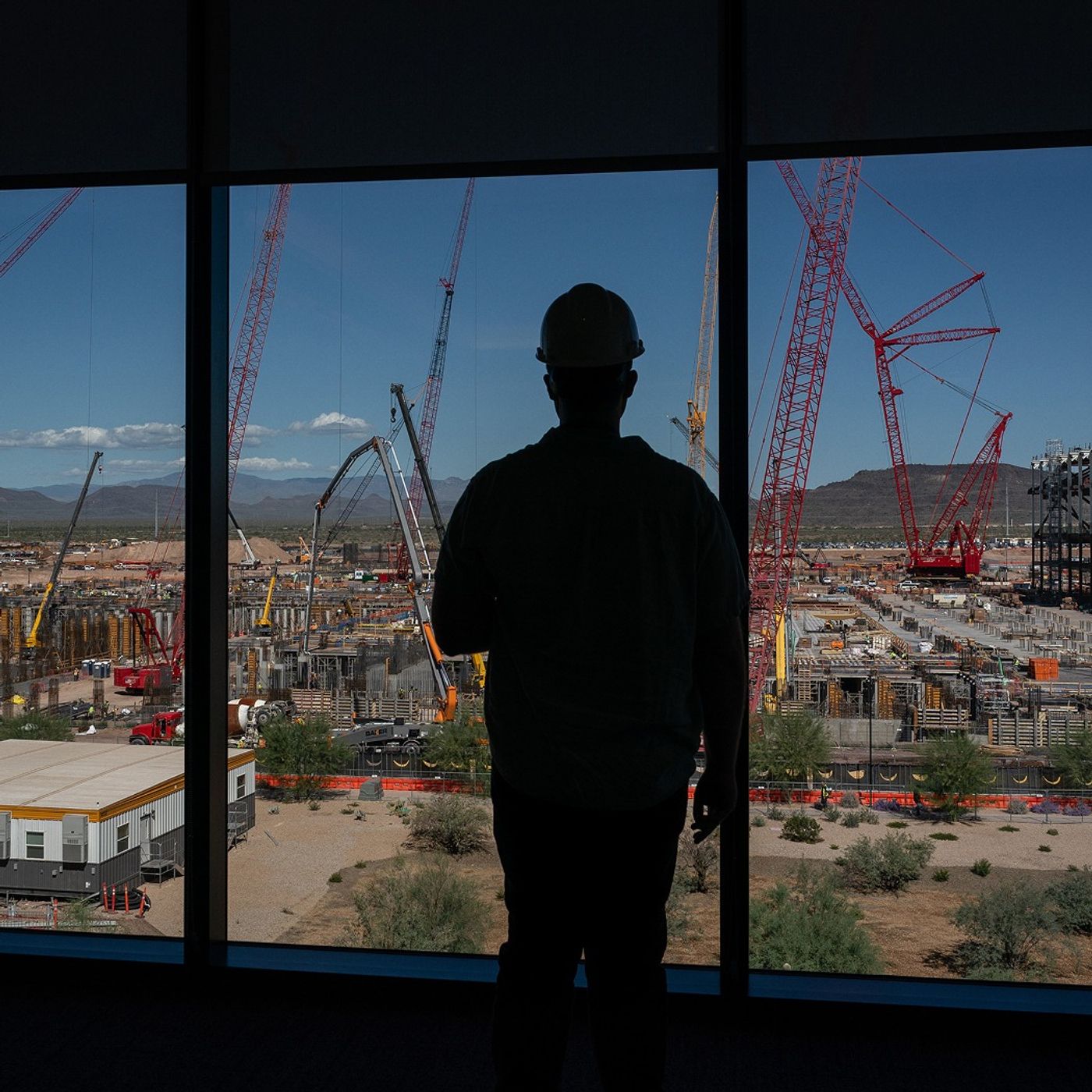
The Messy Reality of ‘Made in America’
But undertaking big projects is not as simple as it seems. Peter S. Goodman, who writes about the intersection of economics and geopolitics for The New York Times, explains why.
Press play and read along
Transcript
Speaker 1 This podcast is supported by the Capital One Venture X Card. Venture X offers the premium benefits you expect, like a $300 annual Capital One travel credit, for less than you expect.
Speaker 1 Elevate your earn with unlimited double miles on every purchase, bringing you one step closer to your next dream destination. Plus, enjoy access to over 1,000 airport lounges worldwide.
Speaker 1
The Capital One Venture X Card, what's in your wallet? Terms apply. Lounge access is subject to change.
See capital1.com for details.
Speaker 2 From the New York Times, I'm Michael Mavarro.
Speaker 3 This is the daily.
Speaker 3 The construction of a massive factory in Arizona was supposed to embody the Trump administration's ability to bring manufacturing back to the U.S.
Speaker 3 Instead, as my colleague Peter Goodman found out, It's provided companies around the world with literally
Speaker 3 000 reasons to think twice about building in america
Speaker 3 it's monday december 22nd
Speaker 3 peter good of you to come into the studio delighted i wonder just to start this conversation if you can describe this factory that you recently visited to us.
Speaker 2 Yeah, sure.
Speaker 4 So it's about 9.20 in the morning on Friday, and I'm just arriving.
Speaker 2
I mean, there's this giant, mostly empty desert valley in the extreme north of Phoenix. As far as the eye could see, really.
Emptiness.
Speaker 4 I'm standing on a gravel road looking at cactuses and various desert scrub just flowing out to the horizons. That this is all going to get filled up with housing and offices to feed.
Speaker 2 So this factory, I've seen a lot of factories in my day. You sure have, is on a scale that I've never even imagined.
Speaker 2 We're talking about more than a thousand acres.
Speaker 4 The complex itself, I'm looking at a long, low, gray building with a bunch of smokestacks visible on top. You can see at least a dozen cranes.
Speaker 2 You can hear the roar of something.
Speaker 4 There's black smoke now coming out of the top of one of these buildings. And beyond, you can see these cranes that are working.
Speaker 2
And there are construction cranes in every direction. Now, I lived in Shanghai, China, in the height of the construction boom there.
So I was in Dubai when Dubai was under enormous construction.
Speaker 4
And then to the west of there, there's a ton of cranes, just counting row. One, two, three, four, five, six, six, seven, eight, nine, ten, left.
I mean, I'm running out.
Speaker 4 I've counted 15 of them, and there's still more. And then there's more visible like way beyond to the west.
Speaker 2 These are the only places where I've seen these numbers of cranes and numbers of construction people wandering about and that feeling of like you're present there for a moment when things are really changing in a deep way in that place.
Speaker 4 Just beyond, I see heavy equipment on the move.
Speaker 4 I see diggers that are moving soil around.
Speaker 4 There's a whole wall of porta potties, as you would expect at a giant construction project. I mean, this is people say the biggest construction project in North America.
Speaker 4 And I got to say, it doesn't disappoint.
Speaker 2
And looking at this factory under construction evokes that sense as well. Of scale.
Not just scale, but that this is important beyond the thing itself.
Speaker 3 What does it represent, this gargantuan, crane-filled factoryville?
Speaker 2 It represents a moment when a consensus broke out in the American political system, in the business world, that globalization, this system that we've been living under for most of our adult lives, has been very fruitful and beneficial in all sorts of ways.
Speaker 2
But there are some things where it matters where we make them. And one of those things is computer chips.
We need to have our own stock of computer chips.
Speaker 2
We need to make them at home in the event of war or disaster. And that's what they're making in these factories that I saw.
Computer chips are the brains of just about everything.
Speaker 2
The iPhone in your hand, the data centers that are getting built all over the place to make artificial intelligence work. They're going into our cars.
They're going into our appliances.
Speaker 2 I mean, it's pretty hard to think about any manufactured product now that doesn't have some kind of computer chip. So it would seem like a very, very big
Speaker 3 and
Speaker 3 overdue thing to have such a factory building those chips right here in America.
Speaker 2 It's a big deal. I mean, it is the most palpable manifestation of this really, I think you can say national aspiration to build things in America again.
Speaker 2 But there are some complications.
Speaker 2
This company that's building these factories is not American. It's Taiwan Semiconductor Manufacturing Corps, TSMC, as it's known.
It is a Taiwanese company. It is a very successful Taiwanese company.
Speaker 2 But it's also been an excruciating pain for TSMC to get this thing built with American subsidies, with a whole political process designed to bring this about.
Speaker 2 It's still been slow, expensive, and difficult. And so it really raises the question: is this a triumph? Is this the template for how we can do this going forward? Or is this the cautionary tale?
Speaker 3 So Peter, tell us the story of this factory and all the ways in which it suggests a potential future or perhaps the impracticality of that future.
Speaker 2 Look, you have to go back to the pandemic, which was the great reveal that it's not such a great idea to concentrate nearly all of the production of vital things in single countries.
Speaker 2 So, you know, waking up and discovering that you really can't make a ventilator in the middle of a pandemic unless you import stuff from China.
Speaker 3 Where the pandemic was at its worst.
Speaker 2 Where the pandemic began, a country that not incidentally we decided to have a trade war with, not a great way to reliably get the stuff you need.
Speaker 2 And computer chips, the most advanced ones, are made overwhelmingly in Taiwan.
Speaker 2 Taiwan is, of course, a self-governing island that is claimed as part of Chinese territory by the People's Republic of China and its government in Beijing, which means that
Speaker 2
there is the not zero risk that on any given day, the Chinese military could show up and take over. And that could be an enormous disruption to the computer chips.
Right.
Speaker 3 And in a sense, the pandemic was a potential theoretical foretaste of what it would be like if all of a sudden China were to invade Taiwan, because it showed us what it looks like when your global supply chains get cut off.
Speaker 3 Suddenly, we have to grapple with the idea that maybe all those computer chips can't ever get out of Taiwan.
Speaker 2 And we have to think about resilience.
Speaker 2
The way to think of it is we need some insurance. It's not that globalization is bad.
It's that globalization without insurance against the risks that are an inevitable part of life.
Speaker 2 That's not so good.
Speaker 3 Aaron Powell, Jr.: And what does that insurance actually look like?
Speaker 2 It looks like the government saying we're going to have to play a direct role in making sure that certain things are built in the United States, and that's going to require subsidies.
Speaker 2 So along comes the Biden administration, and the Biden administration breaks from
Speaker 2 generations of free trade dogma, this idea that we just let the market sort out what gets built and where. And they say, efficiency only takes us so far.
Speaker 2 The government's going to have to play a role in making sure that certain things, like computer chips, are built in the United States.
Speaker 2 And this becomes the Chips and Science Act, this landmark piece of legislation that's got tens of billions of dollars in subsidies given to companies that build computer chip factories in the United States.
Speaker 2 One of those companies, Taiwan Semiconductor, actually participates in the writing of this bill.
Speaker 2 And that company, TSMC, ends up with a $6 billion plus grant to then build this complex of factories in Phoenix.
Speaker 2 At the end of the day, when it's all built, they'll be making roughly a third of all the advanced chips they make worldwide right there in Phoenix, Arizona.
Speaker 3 That's a really, really big deal given just how much of that work was concentrated in Taiwan.
Speaker 2
It's a very big deal. It's a very big deal for TSMC.
It's a very big deal for the United States.
Speaker 2 And it's certainly a very big deal for the local economy in Phoenix, which has traditionally been very tied to the boom and bust cycle of real estate.
Speaker 2 And now we're talking about thousands of jobs in construction to build this, thousands more to eventually make the chips themselves.
Speaker 2 And then there's all sorts of associated services, lawyers, insurance companies, caterers, truck drivers, warehouses.
Speaker 3 Right, a state would, in theory, kill for this kind of economic activity.
Speaker 2 Any state would kill for this kind of economic activity. That's right.
Speaker 2 So on the day of the groundbreaking, this is December 2022, you've got the Republican governor of the state of Arizona. You've got members of the Senate.
Speaker 2 You have union representatives, university presidents.
Speaker 5 Well, I tell you what, you're starting off in the right place. This is going to be an incredible asset to the state of Arizona.
Speaker 2 A special thanks to the president. And finally, Joe Biden, the Democratic president, shows up leading the parade in celebration of this enormous triumph in economic development.
Speaker 5 technical change that's going to take place.
Speaker 2 And that's well understood. The president is associating his administration with reclaiming the future.
Speaker 5 And I know our host won't mind my pointing out that America invented the chip.
Speaker 2 He's delighted to be talking about what a huge deal this is for the rejuvenation of American manufacturing and in something that's forward-looking.
Speaker 2 This is building an American future in a technology that the U.S. actually pioneered.
Speaker 5
And you're here because you're seeing what we're all seeing. American manufacturing is back, folks.
American manufacturing is back.
Speaker 3 And I know, because you said so at the beginning of our conversation, Peter, that this story is about to take a complicated twist.
Speaker 3 But so far, it really does feel worth saying that this is a fable of what's possible in an American system that's not known for getting big domestic manufacturing projects of any kind done.
Speaker 2 Yeah, this is a real life manifestation of what this enormous economy full of talented, skilled people. And political system.
Speaker 2 Political system that doesn't always help bring about the most fruitful outcomes, but we got a lot of money, we got a lot of know-how, and if we can get it all working right, this is what we can produce.
Speaker 2 And yet, by the time I got out to Phoenix, about three years after the groundbreaking,
Speaker 2 it was still a marker of incredible triumph.
Speaker 2 But alongside the triumph was a sense that, wow, what a pain it's been to get this constructed and that the whole complex had become symbolic, not just of what we can achieve, but also the many ways in which American governance can get in the way of our visions.
Speaker 2 We'll be right back.
Speaker 1 This podcast is supported by the International Rescue Committee. Co-founded with help from Albert Einstein, the IRC has been providing humanitarian aid for more than 90 years.
Speaker 1 The IRC helps refugees whose lives are disrupted by conflict and disaster, supporting recovery efforts in places like Gaza and Ukraine, and responding within 72 hours of crisis.
Speaker 1
Donate today by visiting rescue.org slash rebuild. This podcast is supported by Doctors Without Borders.
Now more than ever, the world is in crisis.
Speaker 1 Hospitals bombed, children facing starvation, families displaced. Now more than ever, your support is needed.
Speaker 1 Doctors Without Borders is on the ground, providing medical care, delivering aid, and saving lives wherever the needs are greatest.
Speaker 1 Now more than ever, Doctors Without Borders patients need them, and they need you. Donate today at doctorswithoutborders.org slash the daily.
Speaker 1 If you're overextended and understaffed, Upwork Business Plus helps you bring in top quality freelancers fast. Get instant access to the top 1% of talent on Upwork in marketing, design, AI, and more.
Speaker 1 Ready to jump in and take work off your plate. Right now, when you spend $1,000 on Upwork Business Plus, you'll get $500 in credit.
Speaker 1
Go to upwork.com/slash save now and claim the offer before December 31st, 2025. Again, that's upwork.com/slash S-A-V-E.
Scale smarter with top talent and $500 in credit. Terms and conditions apply.
Speaker 3 So, Peter, after after all of this promise and achievement in the story, what starts to go wrong with the construction of this set of factories after the groundbreaking?
Speaker 2 Well, from the beginning, it's clear that Taiwan Semiconductor, this very successful company that's managed to make
Speaker 2 and run huge factories in Taiwan, is dealing with a system that's very different than the one that it's accustomed to.
Speaker 2 And, you know, at home in Taiwan, they're building factories in these dedicated science parks where there's one central authority, there's one permit, one inspection, and they're done. How nice.
Speaker 2 How nice. And they're separated from, you know, homeowners who may have different ideas about what they want to see, what they want to live next to.
Speaker 2 Well, in Phoenix, they're dealing with the county, they're dealing with the municipal government, there are state and federal environmental regulations.
Speaker 2
And so there are literally thousands of permits that they have to get. Thousands.
Thousands where it would have been one in Taiwan. And this is all new to TSMC.
Speaker 2 And even if an American company were trying to do this, it would be new to them because we, it turns out, don't have regulations governing this particular industry at the county and the municipal level.
Speaker 3 There's no code on page 25 of the local zoning manual that says when building a chip factory here in the desert, this is the lighting system.
Speaker 2 Correct. So TSMC actually has to write 18,000 rules
Speaker 2 that they then have to comply with while they're trying to figure out, like, well, let's see, you've got this federally administered clean air program, but it's the county we actually have to deal with to get the permit.
Speaker 2
And they have to write the language. 18,000 rules cost them $35 million.
Just to write the rules, huh? Just to write the rules, it turns out.
Speaker 3 And just to be clear, when we say that this company is writing
Speaker 2 these rules,
Speaker 3 they're helping write rules that will then be drafted, adopted by local government.
Speaker 2 Correct. But this is like the frontier, right?
Speaker 2 So they actually have to get down in the nitty-gritty of educating the people who are supposed to be regulating them on what it is that they're doing and what could go wrong and how it needs to be done.
Speaker 2 What's the most intriguing rule you came across? Huh. Well, at one point, there was a supplier, a company called Lindy
Speaker 2
that makes air separation equipment. The inside of these computer chip factories has to have really pure air.
And so they pipe in this clean air from a neighboring plant.
Speaker 2 And just to move a mound of dirt and then leave part of the mound in place required 15 different permits and more than 15 different inspections.
Speaker 3 Okay, so that is the first of what I imagine are many headaches.
Speaker 2
Right. Then they quickly figure out that there aren't enough people with the right sorts of skills to build one of these plants.
These plants have to be built to extraordinary specificity.
Speaker 2 I mean, it's, you know, it's kind of an industrial magic trick to make a computer chip, and it involves, you know, beaming light onto tiny pieces of silicon. It's sort of like a photographic negative.
Speaker 2 We're talking about fractions of a thousandth of a percent of the width of a human hair.
Speaker 2 Things have to be just so.
Speaker 2 And in Taiwan, there are thousands of people who've come through an apprentice system, who've actually participated in building fabs.
Speaker 2 The last time we completed a large-scale fab in the computer chip industry in the United States was 13 years ago.
Speaker 2
So we just simply don't have the muscle memory to build one of these plants. We can't do this without relying on places that have this expertise.
And those are places in East Asia.
Speaker 3 So how does the company deal with that?
Speaker 2 They start bringing in specialized workers from Taiwan, which immediately causes
Speaker 2
major animosity with local unions. And the local unions say, well, hold on a second.
If the federal government's writing a check for $6 plus billion dollars,
Speaker 2 we should be getting the job.
Speaker 2 And TSMC says, you will be getting thousands of jobs, but to get this thing off and running right now, we got to go find some people who know how to install this specialized, highly advanced equipment that goes into these plants.
Speaker 2 So they bring in people to do that.
Speaker 2 So eventually the unions win some promises that TSMC will hire a certain number of workers and peace reigns with the unions.
Speaker 2 But meanwhile, there's a lawsuit filed by a bunch of American workers who accuse TSMC of discriminating against American workers, treating them like they're lazy and incompetent.
Speaker 2 They accuse the Taiwanese managers of speaking in Chinese as a way of excluding the American workers from participating.
Speaker 3 Which is probably not quite the case. They're probably speaking Chinese because they speak Chinese.
Speaker 2 I mean,
Speaker 2 that's the language that they could speak most efficiently.
Speaker 2 So, I mean, this was certainly something that I heard from Taiwanese Americans who are living in Phoenix that, you know, it's hardly an act of discrimination that, you know, someone who's under the gun to deliver on a complicated project that costs billions of dollars with the mothership breathing down their neck to deliver, they're going to want to speak to people in their native language.
Speaker 3 So on top of all the tensions about rules, there are these cultural tensions being revealed between an international company trying to do this hard thing and a group of local American workers who are chafing.
Speaker 2
at all that represents. TSMC is a highly successful company in its own system, but now it's navigating a different system.
And there's a different set of expectations for workers.
Speaker 2
I mean, in Taiwan, TSMC operates in a kind of paternalistic fashion where we'll take care of you. You'll be very well paid.
We'll get involved in your housing if need be.
Speaker 2
But when we need you in the middle of the night, when something goes wrong at that factory, we really don't care what you're up to. You got to be over there pronto.
And that's understood.
Speaker 2 People work very long hours. Construction crews work what we would call overtime without logging as such.
Speaker 2 The American worker is operating in a system where we don't have the same sort of faith in our employers. We don't have the same sense of social obligation.
Speaker 2
And so the American worker comes at this from a much more contractual, hey, you know, I'm supposed to be off at five kind of standpoint. Don't call me.
And you call me on the weekend.
Speaker 2
I'm home with my kids. Maybe I can't make it.
And so this creates all sorts of misunderstandings, bad bad feeling from the American standpoint.
Speaker 2 They're dealing with this domineering, you know, control-oriented company.
Speaker 2 From the Taiwanese perspective, they're dealing with workers who aren't fully in it for the team and aren't working as hard as the people they're bringing in from Taiwan.
Speaker 3 And of course, we haven't even gotten to the idea that there are neighbors to this vast complex who, no doubt, because this is the United States, have some questions and concerns.
Speaker 2 Right.
Speaker 2 So I spent time looking at uh a plant that's being built by one of tsmc's suppliers it's a company called amcor they do what's an ancillary building nearby it's a so-called packaging plant they take the chips that are made and they configure them to fit into your iphone or your car or whatever well they end up in this um
Speaker 2 right in the middle of a planned mixed-use community that's supposed to mean you know retail maybe some offices walkable homes. There are golf courses around.
Speaker 2
And neighbors learn that there's this factory planned. It's going to interfere with their views, their peace and quiet.
They're worried about water.
Speaker 2 They're worried about tractor trailers coming through the area. And the local city, they offer these assurances that the factory is only going to be so high, it's not going to be that big.
Speaker 2 And then, meanwhile, because of the stunning demand for AI chips, suddenly it's going to be twice as high, It's going to be four times the footprint.
Speaker 2 And eventually these homeowners mass together and they successfully kill this. plant, or at least they force Amcor to go move to a different site.
Speaker 2 And I think this is a moment worth unpacking that on the one hand, if we're really serious about having computer chips made in the United States, we need a plant like Amcor's.
Speaker 2 On the other hand, these homeowners didn't sign up for some sort of national crusade
Speaker 2
to advance American manufacturing. Most Most of these people are retirees.
They just want a peaceful place to live and enjoy watching the sunset and play golf, right?
Speaker 2 So it's worth coming back to this point that in Taiwan, these two groups would be separated by vast distances. It's uniquely in the American system, and some people would call these guys NIMBYs.
Speaker 2 Others would say, It's absurd that government didn't plan this better so that there is no collision of interests.
Speaker 2 A A bunch of retirees who want to look at cactuses should be able to do that at the same time that we're figuring out where else in this giant state of Arizona could there be a piece of land big enough to have this factory.
Speaker 3 In the course of reporting on all of these disputes and tensions, I'm curious where you found your sympathies lying.
Speaker 3 Is it with a company that says, look, we're just trying to fulfill America's pledge to have insurance against the worst case scenarios. We're just trying to build a factory in the U.S.
Speaker 3 that makes sure you have access to chips, we have access to our clients.
Speaker 3 Did you find yourself instead more drawn to these American folks who said, wait a minute, these should be American jobs, or we did not sign up for this building in our community?
Speaker 2 Well, I think part of the complexity of this is that pretty much everybody at the table has a reasonable argument to make. We live in a democracy.
Speaker 2 People who buy homes in a planned community expecting that maybe a Starbucks will pop up and not a factory should have a say over what gets built in their midst. And in a place where
Speaker 2 it's a desert, it's literally a desert.
Speaker 2 And you're worried about shortages of water and there's already great battles over who gets access to the Colorado River and the depletion of the watershed in areas.
Speaker 2 There should be a process to figure out, you know, what are the impacts. And a lot of these permits are permits under programs that represent triumphs of American democracy.
Speaker 2 We have advanced workplace safety. We have advanced environmental protection.
Speaker 2 It's just that this bureaucracy has now grown up around some of these laws without us sorting out these knotty land use questions.
Speaker 2 And I think one can be sympathetic to the argument that we have to think seriously about our national security, our industrial future, and that's going to require a government role.
Speaker 2 But that's got to be done in a thoughtful, deliberative way. And we got a lot of catch-up to do in that area.
Speaker 3 Aaron Powell.
Speaker 3 So I think, Peter, this brings us to the most important and most existential question of all to emerge from this reporting you did, which is, did all of the rigmarole involved in getting this project complete, did it make this a template for the reestablishment of manufacturing in the United States at a massive scale?
Speaker 3 Or does it loom as the cautionary tale for why it's just too hard to do this in the U.S. that would send similar companies and perhaps those not getting a multi-billion dollar check from the U.S.
Speaker 3 government running in the other direction?
Speaker 2 Yeah, it's a great question. I would say, kids, don't try this at home.
Speaker 2
I mean, like in all seriousness, we are tempted to look at this this and say, of course, at the beginning, it's going to be messy. It's going to be tricky.
We'll get better at this.
Speaker 3 This is the messy beginning.
Speaker 2
Yeah, it's the messy beginning. And, you know, we'll look back in 25 years and say, yeah, you know, that was tough.
But boy, we really got through that and we really got something. And this will
Speaker 2 be a template.
Speaker 2 But, you know, let's remember Taiwan Semiconductor is now promising to invest $165 billion. There aren't a lot of companies that can throw around that sort of money.
Speaker 2 This is a highly successful company. It is by any measure the global industry leader, and they had a tough time of it.
Speaker 2 They've said that they've learned a lot and they're in a position to go faster now. And there's reason to think that that's so.
Speaker 2 But this is certainly not something where just any other company in any other place could come along and summon out of nowhere.
Speaker 3 Right. And if it's this hard for the most successful maker of computer chips in the world,
Speaker 3 how hard will it be dot, dot, dot, for anybody else?
Speaker 2
Correct. And that message is out there that the U.S.
is a tough place to do business. It's a tough place to get permits.
Speaker 2
It's a tough place to find people you need to do the stuff that needs to be done. And you're going to have to pay them a lot to do it.
This is not for the faint of heart.
Speaker 2
So if we're trying to figure out whether this project is going to send the signal to investors and other companies around the globe that, hey, the U.S. is open for business.
Come build a factory.
Speaker 2
It's going to be awesome. This is not that story.
This is a story that says it's possible.
Speaker 2 And if the government writes you a check and gives you concierge service, which is what TSMC has gotten, then maybe everything comes together and makes it possible.
Speaker 2 But this is not the thing that will convince anyone that it's going to be really easy to build a factory in the United States.
Speaker 2 If you're in an industry where you're not being forced essentially to build a plant in the United States, there's a good chance you'd look at this experience and say, maybe we'll find somewhere else to put our next factory.
Speaker 2
Peter, thank you very much. We appreciate it.
Thank you, Michael.
Speaker 2 We'll be right back.
Speaker 1 This podcast is supported by Planned Parenthood Federation of America. As a listener of the daily, we know you want the facts.
Speaker 1 Fact one, some lawmakers are making it harder for Americans to access health care.
Speaker 1 Two, a new policy threatens to prevent patients from using Medicaid insurance for life-saving care at Planned Parenthood health centers.
Speaker 1 This could mean cancers going undetected, STIs left untreated, and patients not receiving care they need.
Speaker 3 3.
Speaker 1
Planned Parenthood will not back down, but they need your help. Donate at plannedparenthood.org/slash defend.
We all have moments when we could have done better. Like cutting your own hair.
Yikes.
Speaker 1
Or forgetting sunscreen so now you look like a tomato. Ouch.
Could have done better. Same goes for where you invest.
Level up and invest smarter with Schwab.
Speaker 1
Get market insights, education, and human help when you need it. Learn more at schwab.com.
Sometimes the best way to scale is to simplify.
Speaker 1 That's why many leading companies trust Deloitte to serve them behind the scenes.
Speaker 1 From AI to cybersecurity to intelligent automation, Deloitte's highly specialized teams can step in to help you streamline, standardize, and scale operations.
Speaker 1 So your organization can focus on what matters most, building on the promising possibilities that can drive innovation and shape your your business's future. Deloitte together makes progress.
Speaker 3 Here's what else you need to know today.
Speaker 3 On Sunday, the Trump administration defended its decision to remove more than a dozen photos related to Jeffrey Epstein from a government website just hours after thousands of files had been released to the public on Friday evening.
Speaker 3 The official, Deputy Attorney General Todd Blanch, said that the photos, including one featuring President Trump, had been removed to address complaints from Epstein's victims, not to protect President Trump.
Speaker 6 We are not redacting information around President Trump, around any other individual involved with Mr. Epstein, and that narrative, which is not based on fact at all, is completely false.
Speaker 3 And over the weekend, the United States Coast Guard stopped and boarded a tanker carrying Venezuelan oil, its second such interception in the past month.
Speaker 3 The Coast Guard is currently pursuing yet another tanker linked to Venezuela, whose crew had refused to let American guardsmen board the vessel.
Speaker 3 It's all part of a growing pressure campaign against the Venezuelan leader, Nicolas Maduro, that has increasingly been focused on oil.
Speaker 3 Today's episode was produced by Shannon Lynn and Mary Wilson with help from Asta Chautharbati.
Speaker 3 It was edited by Mark George with help from Devin Taylor, contains music by Alyssa Moxley, Alicia Baitu, Pat McCusker, and Dan Powell, and was engineered by Alyssa Moxley.
Speaker 3
That's it for the daily. I'm Michael Belbaro.
See you tomorrow.
Speaker 1 This podcast is supported by Planned Parenthood Federation of America. As a listener of the daily, we know you want the facts.
Speaker 1 Fact one, some lawmakers are making it harder for Americans to access health care.
Speaker 1 Two, a new policy threatens to prevent patients from using Medicaid insurance for life-saving care at Planned Parenthood health centers.
Speaker 1
This could mean cancers going undetected, STIs left untreated, and patients not receiving care they need. 3.
Planned Parenthood will not back down, but they need your help.
Speaker 1 Donate at plannedparenthood.org/slash defend.