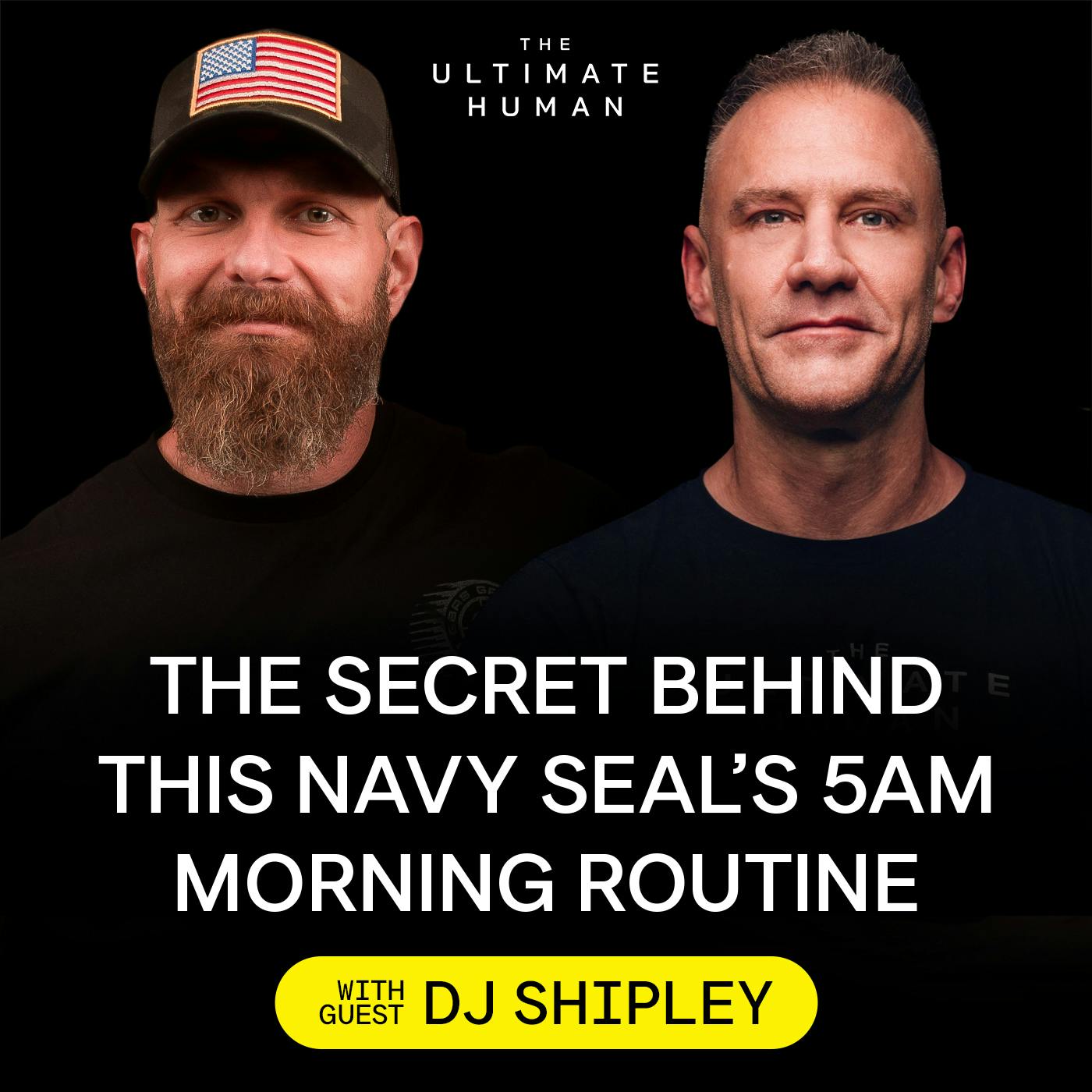
217. DJ Shipley: On Psychedelics, Discipline, PTSD & Rebuilding the Mind After War
Join the Ultimate Human VIP community for Gary Brecka's proven wellness protocols!: https://bit.ly/4ai0Xwg
Connect with DJ Shipley
Website: https://bit.ly/4qQ7Ahn
YouTube: https://bit.ly/4nLSqac
Instagram: https://bit.ly/3WJdGCt
TikTok: https://bit.ly/47xIADV
Facebook: https://bit.ly/4973B9N
X.com: https://bit.ly/49K4VQ6
LinkedIn: https://bit.ly/47yKUe2
Thank you to our partners
H2TABS: “ULTIMATE10” FOR 10% OFF: https://bit.ly/4hMNdgg
BODYHEALTH: “ULTIMATE20” FOR 20% OFF: http://bit.ly/4e5IjsV
BAJA GOLD: "ULTIMATE10" FOR 10% OFF: https://bit.ly/3WSBqUa
COLD LIFE: THE ULTIMATE HUMAN PLUNGE: https://bit.ly/4eULUKp
WHOOP: JOIN AND GET 1 FREE MONTH!: https://bit.ly/3VQ0nzW
AION: “ULTIMATE10” FOR 10% OFF: https://bit.ly/4h6KHAD
A-GAME: “ULTIMATE15” FOR 15% OFF: http://bit.ly/4kek1ij
PEPTUAL: “TUH10” FOR 10% OFF: https://bit.ly/4mKxgcn
CARAWAY: “ULTIMATE” FOR 10% OFF: https://bit.ly/3Q1VmkC
HEALF: 10% OFF YOUR ORDER: https://bit.ly/41HJg6S
BIOPTIMIZERS: “ULTIMATE” FOR 15% OFF: https://bit.ly/4inFfd7
RHO NUTRITION: “ULTIMATE15” FOR 15% OFF: https://bit.ly/44fFza0
GOPUFF: GET YOUR FAVORITE SNACK!: https://bit.ly/4obIFDC
GENETIC METHYLATION TEST (UK ONLY): https://bit.ly/48QJJrk
GENETIC TEST (USA ONLY): https://bit.ly/3Yg1Uk9
Watch the “Ultimate Human Podcast” every Tuesday & Thursday at 9AM EST:
YouTube: https://bit.ly/3RPQYX8
Podcasts: https://bit.ly/3RQftU0
Connect with Gary Brecka
Instagram: https://bit.ly/3RPpnFs
TikTok: https://bit.ly/4coJ8fo
X: https://bit.ly/3Opc8tf
Facebook: https://bit.ly/464VA1H
LinkedIn: https://bit.ly/4hH7Ri2
Website: https://bit.ly/4eLDbdU
Merch: https://bit.ly/4aBpOM1
Newsletter: https://bit.ly/47ejrws
Ask Gary: https://bit.ly/3PEAJuG
Timestamps
00:00 Intro of Show
02:32 Growing Up in Military
07:44 Mindset, Training, and Culture-Building
19:22 Heroic Experiences in the SEAL
24:33 Witnessing (and Being Part of) Real Combats
30:00 What is a Typical SEAL Mission?
33:10 Gnarliest Missions Experienced
44:16 Managing Family Life while at SEAL Service
56:44 Transition from Navy SEAL to Civilian Life
1:02:39 Importance of Having Daily Routines
11:13:16 Showing Up as the Best Version of Yourself
1:20:09 Ibogaine Experience
1:40:04 What does it mean to you to be an Ultimate Human?
The Ultimate Human with Gary Brecka Podcast is for general informational purposes only and does not constitute the practice of medicine, nursing or other professional health care services, including the giving of medical advice, and no doctor/patient relationship is formed. The use of information on this podcast or materials linked from this podcast is at the user’s own risk. The Content of this podcast is not intended to be a substitute for professional medical advice, diagnosis, or treatment. Users should not disregard or delay in obtaining medical advice for any medical condition they may have and should seek the assistance of their health care professionals for any such conditions.
Learn more about your ad choices. Visit megaphone.fm/adchoices
Press play and read along
Transcript
Speaker 1 I had my best friend get killed on a hostage rescue December 8th, 2012. That was a tough thing to go through, man.
Speaker 2 There's no greater bond than just you 100% knowing that the guy beside you is willing to give his life and you are willing to give your life for the mission.
Speaker 1
I mean, you've been in some that are just you pinned down, feel helpless. Your buddy's dying in your arms.
This guy's shooting at us. I've got to save him while I'm not getting shot at.
Speaker 1 And you can't take out the human aspect of it. You've spent so much time together.
Speaker 2 You'll never reach that level of culture in the civilian world because people are not willing to do what you guys had to do to develop that culture.
Speaker 1 What is the culture? 1% better every day, be a pro, leave it better than you found it, don't be an asshole. At the end of the day, how do you want to be a good Navy SEAL? Be a good dude.
Speaker 2 And one of the things I really identify with is that you are not afraid to be selfish with the first part of your day so that you can be selfless and give the rest of your day away.
Speaker 1 I'm trying to live to be 105. I'm trying to be an asset to my family as long as humanly possible, and there's a big physical component of that.
Speaker 1 I'm exhausting everything everything I can to be there and be present on the moments where they really need me to be.
Speaker 2 What about the mindset of having been a SEAL? What did you draw out of that culture and that career that's now just a part of who you are, not what you do?
Speaker 1 I think ultimately, I think somebody do really good is
Speaker 2 Hey guys, welcome back to the Ultimate Human Podcast.
Speaker 2 I'm your host, Gary Brecca, human biologist, where we go down the road of everything, anti-aging, biohacking, longevity, and everything in between. Today is a really, really unique podcast.
Speaker 2 Not only is our guest a former member of SEAL Team 10, but he's a father, he's an entrepreneur, he's a husband, and his advice, I've actually, I've told him today, I actually take some of your advice.
Speaker 2 I started following your morning routine. And if you know anything about me, like my morning routine is sacred, but
Speaker 2 welcome to the podcast, DJ Shipley. You invaded my morning routine and now I'm actually taking some advice from you.
Speaker 2 You know, it's astounding, you know, you've been here for a few hours and I always end up running a podcast before the podcast with my guest.
Speaker 2 But it's been great getting to know you, brother.
Speaker 2 We had an awesome morning. We're both freezing right now because we just got out of a cold punch, but we did hyperbarracks and then we got in the sauna and then did a little cold punch.
Speaker 2 So we're both, the lights are on.
Speaker 1
Oh, yeah. Firing on all eight cylinders, man.
Thank you very much for having me.
Speaker 2 So, you know, there's so many avenues that we could go down with this podcast, but you know, what I found really unique about your story, I feel like you were kind of like the uncommon Navy SEAL.
Speaker 2 I mean, you come from a long line of military and your family, you know, your fathers, your uncles,
Speaker 2 even your mother
Speaker 2 and grandparents, World War II.
Speaker 2 Your father was a SEAL.
Speaker 2 Father-in-law Father-in-law was your father-in-law was a SEAL. Your mother was,
Speaker 2 she was in the military.
Speaker 1 She's in the Navy.
Speaker 2
She was in the Navy. So my father was in the Navy too.
So you kind of have no choice, right?
Speaker 1 Yeah.
Speaker 2 I find that there's a kind of a common theme that runs through my podcast. And I feel like the people that are the most impactful in this world,
Speaker 2 the people that are the most
Speaker 2
passionate, like purpose-driven, are people that solve the problem, something in their life. And that became the foundation for greatness.
And
Speaker 2 for you, was that how you were shaped as a Navy SEAL? I mean, because you were, you were actually 17 when you went in, right?
Speaker 2 So, um, and I found it really fascinating that you said, you know, today's day and age, I probably wouldn't have made it just because the The qualification, not that the qualifications have changed, but the caliber of the people coming in.
Speaker 1
They're so much more educated and well-prepared, more than I was. You know, it's 2025.
The internet's infinite.
Speaker 1
They can download a David Goggins and Jocko and all these other people. They can read about the pipeline.
They can see it on the Discovery Channel. We didn't have any of that.
Speaker 1 And the human potential has grown so much. I mean, the barrier for entry, if you look at the screen test and what it takes to get in, it's not a very hard thing to do.
Speaker 1 But the numbers these kids are producing now, they wouldn't have even looked at me. Really?
Speaker 1 Yeah, good enough to get through, good enough to make it through.
Speaker 1 But now the scores are all based off of physical push-up push-up uh sit-ups pull-ups running swimming all of those things the numbers are so much greater than what i was able to produce in 2002 it just shows the you know the human potential it's really climbing fast
Speaker 2 did you go in because your father sort of gave you no choice i mean one of the interesting things and i want you to tell this story but um is when i hear you talk about your story i mean you really grew up in this you know environment he actually he didn't take you on missions, but I mean, he took, you were around those guys a lot growing up, not just because they were over at the house, but, you know, you went out to the base.
Speaker 2
I grew up there. Grew up there.
And so, so it was like, kind of like this environment that you were in. And, and I recall you talking about how you never really around a lot of normal people.
Speaker 1 Never.
Speaker 2 So what was that like, you know, being a young kid? you know, father's a Navy SEAL, high achiever, coming from a long line of military families, and that sort of growing up around this base.
Speaker 2 Because I don't think a lot of people really are in tune with what that kind of youth is like.
Speaker 1 When people think, growing up in the military, they think
Speaker 1
Major Dad, right? Flat top haircut. He comes in plouch uniform.
You know,
Speaker 1
SEAL teams are very, special operations is very unconventional. So they never felt like they were in the military.
You'd see the uniforms and you'd see all the stuff, but
Speaker 1 it felt like more like a professional sports team than anything else. But it was the culture, the the way they were, the
Speaker 1 living out of 15 passenger,
Speaker 1 15 passenger vans, in and out of hotels, always going on the road, dropping off dirty laundry. But just, you know, the humor, the dark humor, just the physicality.
Speaker 1 When these guys would come over, I mean, I can remember being a tiny, tiny child and watching the guys pour into our house and just, they all looked like superheroes.
Speaker 2 They're specimens.
Speaker 1
I mean, they were freaks. And I just, I always wanted to be one.
I really wanted to to be a veterinarian. Like in the back of my mind, I loved animals.
I loved being around that.
Speaker 1
So I'd always say that, I want to be a vet. I want to be a vet.
And they would just, you don't want to be a vet. Yeah.
Speaker 2 Well, I mean, you had like chickens, goats,
Speaker 2
like every animal in the world when you're growing up. So you're, you know, you're in that farm lifestyle.
Um, I grew up on a 300-acre tobacco farm.
Speaker 2 So I know what it's like to be in that urban environment, you know.
Speaker 2 skateboarding was your outlet, you know,
Speaker 2 and then you used to bust yourself up a lot skateboarding.
Speaker 1 Oh, yeah.
Speaker 1 I've been hurt.
Speaker 2 Um,
Speaker 2 and um, so, you know, was your dad
Speaker 1 around a lot?
Speaker 2 I mean, at that time, he was always on deployment, right?
Speaker 1 Always, just gone.
Speaker 1 I kind of rough average it out: 250, 300 days out of the year, gone. Wow, and that's continuous the entire time.
Speaker 2 But when he was back, he put you in that lifestyle, you know, you're on the base, you're around his guys.
Speaker 1 Did you
Speaker 2 did anything strike you? Like, did you notice that culture?
Speaker 2
Were you young enough to grasp it? Like, these guys, I mean, they're messing with each other. They have a funny language.
They joke a different way. They all look like physical specimens.
Speaker 2 But could you feel that culture like as a child? Taste it.
Speaker 1 It was palpable. And, you know, now that I've, I've been on the other side, I could see where his frustrations coming back and trying to assimilate normal life.
Speaker 1 There's always a friction point because he'd never heard the words no. And now I think back to all the small things like, hey guys, everybody's got to come up to my house.
Speaker 1 You know, we had a hurricane. We've got 14 trees falling down and 60 dudes show up at the house with cases full of beer and chainsaws and they
Speaker 1
chop up every single tree. No one complains about it.
They do it. They burn it.
They haul it out. That's just what you do.
You've never heard the word no or I can't do that or it's too heavy.
Speaker 1
It's too long. We can't make it.
They always just did it. So you get used to.
that being the performance anxiety. Like they've never said no.
They've never said we can't do it.
Speaker 1 They're always going to find a way because the collective is always trying to solve that problem together.
Speaker 1 And I think that's what makes it so infectious because everybody deals with stress and problems all day long.
Speaker 1 Nobody has a group where everybody goes, I'm going to stop everything I'm doing right now and we're going to solve it together right now.
Speaker 1 And that's what the essence of that culture is.
Speaker 2 I think it's so unique because, you know, how do you take a,
Speaker 2 you know, young farm kid? Because you go into the
Speaker 2 SEALs at 17 years old.
Speaker 2
So you don't know what combat's like. You probably don't even know what buzz is like.
You have no idea idea what to expect. I mean, you have a little
Speaker 2 maybe idea of the culture from being around your father and all of his buddies.
Speaker 2
But I always find it fascinating. I think it's just such a metaphor for life.
It's a metaphor for culture, for families, for businesses.
Speaker 2
How they take these disapartheid guys that don't know each other. They're young.
probably can't find your ass with both hands at 17 years old, right?
Speaker 2
It's not like you have this vision of being on this team and, you know, you know how to build culture. Those are not things that are just inherent to you.
And you go into this program,
Speaker 2 which is really designed to weed you out. I mean, it's really designed to fail you, to break you.
Speaker 2 And the shocking fact that you're not broken leaves you with a unit that's tight.
Speaker 2 But then talk to me about like the culture building because lots of people do hard things and lots of people do hard things in groups. Right.
Speaker 2 Um, it's one of the reasons why I think CrossFit was so successful, for example, because it was the first time,
Speaker 2 you know, for most of the people in that class that they pushed themselves to absolute exhaustion.
Speaker 2 I remember after CrossFit Wads, everybody's laying on the floor sweating, and but there was that unity, you know, the conversation afterwards, where you're just dripping off sweat.
Speaker 2 It didn't matter if somebody was a school teacher, another dude was a firefighter, another guy was a, you know, he was there from a SWAT team from the county.
Speaker 2 You were all on the same level for 50 minutes.
Speaker 2 You know?
Speaker 2 So how does that culture evolve? I'm really interested in, because there's an intentionality to it. You're bringing in these guys from all over the country.
Speaker 2 You're putting them through a battery of tests. But all that battery of tests is doing is saying, who's the hardest? Who's the most determined? Who has the greatest willpower? Who has
Speaker 2 an unbreakable ability to deal with suffering? But at the end of that, you don't just magically get culture.
Speaker 1 No.
Speaker 1
Can you share a little bit about shared suffering? And then a lot of it is the unknown. It's the fear of the unknown.
Nobody knows what's coming next. You've never done it before.
Speaker 1 And some of the evolutions you do, I mean, I'll say it to everybody. There's a point where your mind will take over and it'll tell yourself, you're going to die right now.
Speaker 1 They don't realize how cold you are.
Speaker 1 They don't realize what stage of hypothermia you're in and you're going to die if you don't say something and you'll look to your left and right and nobody's throwing their hand in the air and you go
Speaker 1 i'm not going to say anything i don't want to get pulled out of here i don't want to get the pro because if my core temperature does drop and they kick me out of here that's not what i want i'd rather i'd rather die right here in the surf zone close out the whole chapter knowing i did everything i could yeah and i think people hit that when the collective hits that same point it's no different than crossfit yeah at a certain point during that wad during that workout you think your heart's going to explode.
Speaker 1
You do. And no one else is stopping.
And you just keep going. Like there's a little internal governor inside of your body that you just override and you go, one more.
One more.
Speaker 1
Like we've all done these crazy runs where you're like, my heart's going to stop right now. Like I have to stop.
And yet you don't. Yeah.
Speaker 1 Once you do that so many times and you see everybody else do the exact same thing, it builds this internal strength that nobody else can feel but you.
Speaker 1
But you get stronger as it gets harder. People start to leave.
They're all quitting.
Speaker 1 And you see guys show up to special operations like they look like dolph lungren in rocky four you're like really i can't believe that kid grew up and looks like that and wants to do the same thing i do like why aren't you on the cover of men's health yeah and they quit in five minutes yeah how
Speaker 1 that cold water changes everybody like they don't want to be here and i think that's where a lot of my success was is
Speaker 1 that was a barrier for entry i have to do all of these things in order to do that
Speaker 1 and i've been around it so i see what the instate is everybody who i've ever met has gone through this exact same thing They picked up that same boat, the same logs, been in the same water.
Speaker 1
You have to do it. Yeah, if you want a college degree, you got to go through college.
This is my college.
Speaker 2
Yeah, I have to make it through. You know, we talk a lot about mindset.
And I remember you telling a story about how you're, you know,
Speaker 2 you're in California, you're in, you're in the, um, you're in the surf, you're in the water, water's cold as shit, and you guys are all linked up, and you're doing whatever calisthenics, and you're going through the program in the water.
Speaker 2 And
Speaker 2 you're suffering, and you feel like you're going to die. And then you look over and you see like a kid with a inflatable
Speaker 2 like pink flamingo like floating in the surface. You're like, how is this 14 year old boy or 10 year old boy floating next to me? I feel like I'm going to die.
Speaker 2 So that's, it's got to be where the mindset comes in.
Speaker 2 And so during, during Buzz, which has got to be the hardest thing you've ever done in your life, I don't know if that is or not.
Speaker 1 Maybe it's on the mission.
Speaker 1 Okay, if the time.
Speaker 1 for sure.
Speaker 2 Because we're going to get into that too.
Speaker 2 And at that point, you're not a unit yet.
Speaker 2
You're just suffering as a group. Right.
So
Speaker 2 that camaraderie, that culture has not started.
Speaker 2 This is the weeding out process.
Speaker 1 You can feel the culture in the cadre.
Speaker 1 And I think that's one of the things that nobody ever gets to see unless you're... If you'd be exposed to it early, you can watch the subculture inside of it.
Speaker 1 So you can see the class just getting pounded. And you can watch the instructors.
Speaker 1 They'll go off to a little corner, they're drinking coffee, they're dipping Copenhagen, they're talking smack, but you can see how much they love each other because they've all been through this before.
Speaker 1
It's like, man, I really wish I had that cup of coffee. I was over there.
Well, if I ever want to have it, I got to get through this.
Speaker 1
Do you get to see the culture from a distance? And the closer you get to graduating, the more you feel like you're connected to it. Really? You got to go through all these steps.
But
Speaker 1
they bring out the best and brightest to be butt instructors. They're all physically fit.
They represent what the essence of being a SEAL is so well.
Speaker 1 So when they come out there and they're leading PT, they're a freak. Really?
Speaker 1 Oh,
Speaker 2 and they're in it with you a lot of times, too, right?
Speaker 1
They're leading the PT. So you get a guy that'll drop down, and I mean, you'll do a 500 push-up workout.
That's 500.
Speaker 1 And I mean, wide grip, close grip, diamonds, all kinds of crazy stuff. And you'll go mount the bar and they'll have a guy that'll hang on that bar for five straight minutes doing pull-ups.
Speaker 1 And guys are cycling through, and he's not dropping. And you're looking at it, and you're like, how is he able to do that?
Speaker 1 He's been prepping, but he sets the bar so high, you think you'll never be able to get there. Yeah, like he's been right here with me, falling out after his first set of 10.
Speaker 1
Like, he can't hang on the bar anymore. He's so exhausted, but they always give you this pinnacle.
Like, if you just keep going, you'll get to that spot. So don't take your foot off the gas.
Speaker 1 I think you do a really good job of showcasing that.
Speaker 2 Yeah. And I mean, a lot of the culture is based on,
Speaker 2 we talked about this in the sauna today.
Speaker 2 Like, I mean, your training has got to be as difficult as the combat situations that you're going to go into so that you're not shocked by the exhaustion, the temperature change, you know, the environmental shifts.
Speaker 2 You're prepared because your training was so difficult that the missions become, as you said earlier, routine, right?
Speaker 2 I know exactly what I'm going to do at this second, at the next second, at the next second.
Speaker 2 And,
Speaker 2 you know, when you, when you, when you graduated or you, you know, you, you completed this,
Speaker 2 is that where the culture really began? Is that where you really, because at some point, a SEAL has got to be willing to exchange his life for
Speaker 2 his comrade, right? And I think there's no
Speaker 2 greater risk, there's no greater bond than just
Speaker 2 you 100% knowing that the guy beside you is willing to give his life and you are willing to give your life for the mission, that level of trust must be something that's really difficult to emulate in the civilian world.
Speaker 2 Right? I mean,
Speaker 2 the mediocrity and averagism of life after you've done something like that and then taken those skills, deployed them in combat, which I want to get into too.
Speaker 2 Coming back from that,
Speaker 2 doesn't life seem like
Speaker 2 very mediocre?
Speaker 1
Okay. Yeah, most people have never had an opportunity to sacrifice themselves for something they couldn't take with them.
Like you'll sacrifice for $100 million,
Speaker 1 but you won't sacrifice it for $70,000 a year, right? Knowing you can't take the pinnacle of that profession, you can't take it with you once you're gone.
Speaker 1 At a certain point in your career, you realize that and you just don't care. You just want to play another game.
Speaker 1
Talk about Tom Brady a lot. Yeah.
He could have wound that thing up and retired early and still been the greatest ever.
Speaker 2 Yeah.
Speaker 1
He wasn't done. He wanted to play one more game.
That's very much
Speaker 2
for him and not for anyone else. Yeah.
Yeah.
Speaker 1
It's like for the group. It's like, yeah, and for the team.
Yeah. You got to be willing to sacrifice it for the group.
Yeah.
Speaker 1
And once you see people how far they're willing to push, I mean, you'll do evolutions. You're like, there's no way I can do that.
There's no, there's no way I can do it.
Speaker 1 And then as soon as you get through it, it's like a little confidence boost. And you're like,
Speaker 1 well, if I got through that,
Speaker 1
well, I can get through this. I can get through this.
Somebody said it the other day, like, if you change the entire the entire selection, in order to do that, you had to run the Moab 250.
Speaker 1
If you want to be on this team, you have to run the Moab 250. Every single person would run the Moab 250.
Really? Everyone.
Speaker 1
If that was the new selection process, everything else is out. Get through this evolution.
You can do this job. Everybody would do it.
Wow. The attrition rate would still be the same.
Speaker 1 The training protocols would be the same or be different, but you'd still get through it. If everybody had to climb Everest, you'd have a lot less people, but they would still climb Everest.
Speaker 2 When did it first click for you? Like, when, when did you
Speaker 2
decide, I am in the right place. This is the right time.
This is what I'm meant to do. Like,
Speaker 2 when did that culture snap into reality for you? Was it after Buds? Was it after you actually performed a mission? Was it like?
Speaker 1 It's probably...
Speaker 1
Probably halfway through my first deployment. I was in Iraq 2005.
We had Operation Red Wings in Afghanistan happen with Marcus Luttrell. That was the other half of my SEAL team.
Speaker 1 When that thing happened, that shock was our own little private 9-11.
Speaker 2
That's when the publicity, I think, of the SEALs just started. I mean, you were in it.
It was very much a, I feel, just a very secretive organization beforehand.
Speaker 2 I mean, a lot of people didn't even know that we had them.
Speaker 2 The movies didn't really start coming out until what, like 2002.
Speaker 1
ish. I mean, we had Charlie Sheen, Navy SEALs back in the day, the greatest Navy SEAL movie ever made.
Yeah.
Speaker 1 You you had tears of the sun with bruce willis you had a couple things but yeah i mean it wasn't i mean kids made fun of me in high school what'd your dad do he's a seal
Speaker 1 right no he's a commando and they're like what's up like oh god nobody knows yeah you say it now everybody knows right it's a household name now but it wasn't back then like you were doing it for something that nobody else could would ever see yeah i've said that before like I've seen 12 people do the most amazing things you'll never get to see.
Speaker 1 I can't explain it to you. You'll never understand.
Speaker 1 Yeah.
Speaker 1 But the juice is totally worth the squeeze. It is.
Speaker 1 And I think that's really when you get invested in the culture, when you watch that group of people do the most heroic things you've ever seen, and no one else will ever witness it outside of us 12.
Speaker 1
Right. We never even talk about it.
Right. Some of the things that have humbled me the most is I have seen things that almost haunt me with how heroic they were, and they don't even talk about them.
Speaker 1
They don't even debrief it. Wow.
It's like, what? I mean,
Speaker 1 one of my very first times I brought it up and debriefed. Like, are we not going to address this incident that happened?
Speaker 1 And he looked right at me and he goes, when you get in the end zone, act like you've been there before, and walked out.
Speaker 2 Really?
Speaker 1
Wow. Wow.
Like,
Speaker 1
I've seen quite a few things up until that point, and that was definitely the most heroic thing I had ever seen. It's like, you don't even want to talk about it.
Yeah. Okay.
Wow. Okay.
That's the bar.
Speaker 1 Cattle recognition. The deed, not the glory.
Speaker 2 What was the first time that you ever saw real combat? Because, you know, before we, just to preface this, when we were in the sauna, we were talking about how I've had this fascination with
Speaker 2 not just professional athleticism, but like a professional athlete that can dominate their sport over a really prolonged period of time. You know, like a Lance Armstrong, seven Tour de Frances,
Speaker 2 you know,
Speaker 2 a LeBron James or Michael Jordan or Tom Brady, who's not just excellent or excellent once, but is excellent over a prolonged period of time, which means they were able to block out all the other other noise, right?
Speaker 2 All the pleasures of the flesh, all, all the fame, all the fortune, you know, all of a sudden going from
Speaker 2
virtual obscurity to to to fame, which has its own set of challenges, and block all that out and stay excellent for a long period of time. That's always fascinated me.
And I described to you how
Speaker 2 a former wide receiver from the running back that had won multiple Super Bowls was telling me that he he described this moment where he would break off the line and he would be barreling down the field, giving exactly 100%
Speaker 2
of every ounce that he had in his body. He knew that he did not have one more ounce of energy or effort to give.
And he would tell me, like, at that moment,
Speaker 2 there'd be 70,000 people in his stadium, and I could like hear a single voice, right? I could hear one person saying, go, Billy. And he would like cue into that one voice.
Speaker 2
And he knew, you know, 25 yards later that the trumpet player was standing too close to the sideline. And that's where he was going to go out.
And he's going to wipe out that trumpet player.
Speaker 2 And what he told me was he's like, I could feel the ball snap. Like I actually knew the ball was in the air, even though I hadn't looked back to see that it was in the air.
Speaker 2 I could feel the defender coming across the field to hit me. And at that moment, just given 100% effort, and I would put my hands up, I would grab the the ball, I would get hit, would end.
Speaker 2 But he said there was that period, he would just chase that moment like a rat to cheese.
Speaker 2 And
Speaker 2 I have to imagine, because I know nothing about combat, but by the grace of God, I've never been shot at. So, and I'm never shot at somebody.
Speaker 2 But I have to imagine that when you're in a combat situation and the risk is not whether you win or lose a game. The risk is whether or not you go back or
Speaker 2 you go home
Speaker 2 in a coffin or you you come back to maybe see your family like the the level of risk the stakes in a game like that the level of trust and confidence that you've got to have on the people around you can you can have zero doubt not just in yourself but in whether or not the people that are on your flank are going to do exactly what they're supposed to do
Speaker 2 like
Speaker 2 Where does that come from? And can you talk about like, what was the first time that you saw real combat and you you came back and you're like, this was worth it. This is for me.
Speaker 1 Fortunately for me, in that first deployment, you got to see a face full of combat the entire time, but it skewed over the years. It got more violent, more violent, more violent.
Speaker 1
In 2007, it really uncorked in Fallujah. You really got to see some really serious combat in your face, close proximity.
It can't be ignored.
Speaker 1 And then all the things that would freak out normal people. They no longer freak you out.
Speaker 1 And it's because the training has been ingrained so much and they've taken it so above and beyond what's necessary to normal people
Speaker 1 that nothing fazes you anymore.
Speaker 1 Like you're walking up to a door, you're under night vision, there's not an ounce of starlight, there's no moon, it's jet black, and as you're walking up, all you're seeing are infrared lasers.
Speaker 1 I mean, a foot off your head, covering everything around you. And if that door opens as you're touching it, they're going to take a shot right past your head and you don't move.
Speaker 1
You don't need to. He's going to make that shot every time and you just trust it because you've been exhausting all the resources.
The boys are trying trying to do that.
Speaker 2 Those are your boys behind you with the...
Speaker 1 They're training 52 weeks out of the year.
Speaker 1 I mean, they're exhausting everything they can mentally, physically, spiritually, emotionally, tactically, to make sure that we don't ever have to say no or I can't do that. Can always make the shot.
Speaker 1
We can climb up and over the mountain. We can jump out of the plane.
We can do all the things. And you build that trust through time.
Speaker 1
Like I've seen you show up every day. You're in here at 5 a.m.
You're in the gym. You're at fight club.
You're on the range. You're in the kill house.
Speaker 1 You're jumping, the wind tunnel, everything you have to be great at. You're really committed to greatness in all those areas.
Speaker 1 Unfortunately for us, there's not a whole lot of room for anything else.
Speaker 2 Right.
Speaker 1 So all the external stuff, you kind of got to block out and really be good at departmentalization.
Speaker 2
Here's something most people don't realize. Salt isn't just about flavor.
It's about biology. Your cells need minerals to make energy, hydrate properly, and function at their best.
Speaker 2 That's why we created the new Baja gold shakers, naturally harvested straight from the Sea of Cortez, unrefined, lightly air-dried, and loaded with essential trace minerals. This isn't table salt.
Speaker 2
It's nature salt. The taste is richer.
The mineral profile is unmatched. And you can use it every day in your kitchen, on your table, and every single recipe.
And now you can pick it up at Walmart.
Speaker 2
Make the switch to Baja Gold. Your taste buds and your biology will thank you.
Now, let's get back to the Ultimate Human podcast.
Speaker 2 When you're in that moment, like a real combat situation, how much of your confidence comes from planning and that you're confident that you know what to do, even if this situation shifts.
Speaker 1 No plan ever survives first contact.
Speaker 1
It doesn't. It's like Mike Tyson.
Everybody's got a plan to get punched in the face. It's like for us, because you're so diligent in the debrief and all the planning, you're so meticulous.
Speaker 1
All the operations kind of stack on top of each other. You can draw information from this one and apply it to this one.
But when it rapidly changes, everybody just adopts a different tactic right now.
Speaker 1 Can't do that. We got to do this.
Speaker 1
And you don't even call an audible. You just do the audible.
It just naturally transitions into it.
Speaker 1 But that's because you've only been thinking about that one thing the entire time.
Speaker 1
Like Tom Brady's not thinking about pickleball. No.
He's not thinking about his golf swing.
Speaker 1
He's watching game film and just studying this one thing. So he can, when he gets on a line of scrimmage, he can read it in real time.
Right.
Speaker 1 I mean, all the little micro moves that are happening, he's just processing information. Everybody on our team is the exact same way.
Speaker 1 They're just processing speed is so fast compared to the opposition that unless you just get us in a mudsuck and get really lucky, we're going to solve that problem really, really fast, regardless of whatever you're going to have to do.
Speaker 2 Yeah. I mean, I remember you talking about the amount of preparation that you went through,
Speaker 2 you know, phones, emails, patterns,
Speaker 1 you know,
Speaker 2 you know, a hit on a. on a target that was going to be watching a, their favorite football game that day, football football by soccer.
Speaker 2 That day,
Speaker 2 you knew if you took out the satellite, he would get up from the football game, go to check on the satellite, and that's where contact would be made.
Speaker 2 The amount of preparation and investigation and
Speaker 2 intelligence that you would do beforehand, was that a lot? of the confidence that you had going in.
Speaker 2 So when you got out of that, when you jumped out of that plane and you were on your way to the ground, you'd technically never never been there before.
Speaker 2 I mean, maybe you had a model city that you had used or a model compound that you had used,
Speaker 2
but you'd never been there before. You don't know how prepared they are.
You don't know if something's changed in the plan that you had hoped would be executed.
Speaker 2 I find that fascinating because it's such a metaphor for life, for business, for our families. You know, that people are not adaptive.
Speaker 2 They crumble and they get stressed from
Speaker 2
change. I think it's our expectation that we set, and then we're constantly disappointed that things don't meet our expectation.
Our spouse doesn't meet our expectation.
Speaker 2
Our business partner doesn't meet our expectation. Our competition, our partners.
So
Speaker 2 when you're a SEAL,
Speaker 2 how much of that planning
Speaker 2 is giving you the comfort when you're in that zone and your life is on the line? Like, what does a typical mission look like building up to that moment when it's go time?
Speaker 1 A lot of of it depends on
Speaker 1 your currency, right? In the height of the global war on terror, I mean, sometimes, depending on where you are, sometimes it's two times a day. You hit a daytime, you hit a nighttime.
Speaker 1
Sometimes it's three or four a night back to back to back. Sometimes it's a dry spell.
It might be a bigger target. You know, you've been after this guy for a while.
Speaker 1
You think you have a group of intelligence folks. All they do.
is build a target package on this guy. They have watched every move he has ever done for the last six months.
No blinking coverage.
Speaker 1
They know everything about him and they're just spoon feeding to you. So you go in there, you're eating lunch, and you're just watching the ISR feed, you're watching the satellites.
Where does he go?
Speaker 1
Where doesn't he go? Right-handed, left-handed. He's always, he's kicking a soccer ball at 2 p.m.
with his kids. At 6 p.m., he's walking next door and he's coming back with an RPG.
You're like,
Speaker 1 okay.
Speaker 1
He's got a motorcycle stage, two houses down. His wife doesn't know about.
Blah, blah, blah. This is how he's doing all this.
So you really get to see a real picture.
Speaker 1
When you drop down on the floor of it, it always looks different. But if you've done your homework, I know how many doors, how many windows, inward opening, outward opening.
Is there a storm door?
Speaker 1 Is there 10 on the windows? I mean, you can tell everything, how high the walls are, how many sections of aircraft ladder we have to bring.
Speaker 1
I mean, all the different things when you get there, I have gone through every possibility, every contingency we've been through. So this happens.
Option two, here we go. Yeah.
Speaker 1
Option two is not going to work. Go to three.
Three is not going to work. Going to four.
Boom, boom, boom. Four is not an option.
Make one up. Here we go.
Speaker 1 And I mean, it happens so fast because everybody's an individual thinker.
Speaker 1 You might be looking at this skate going, I don't know how I'm going to get through this. And he comes over and he's like, we're going up and over the top.
Speaker 1
And we are up and over the top. Yeah.
Yeah. I mean, like, you don't even have time because everybody's on the same page as you.
Speaker 1
Some people are just farther in the OOA loop process than you are. Yeah.
So that's where the strength of the team comes.
Speaker 1 And I know a lot of a lot of different organizations, they put so much pressure on developing the individual. And there's nothing wrong with that.
Speaker 1
For us, it's the strength in the group. Yeah, we don't do solo missions, that's not our jam.
We do everything as a group, and that's really where the source of strength comes from.
Speaker 1 Because I know you are just as committed as I am. If you weren't, you wouldn't be here.
Speaker 2 Yeah, what's an average team size that you would do a deployment with, a mission with?
Speaker 1 It all depends on the target size, but no more than
Speaker 1
typically 20 guys, and that's that's all the supporting assets. I mean, that's everybody.
You do it in very small teams. Yeah.
Like a typical assault team is
Speaker 1
five to seven people. Really? I mean, hopefully you have two assault teams.
So, I mean, you run out of bodies really, really quick.
Speaker 1 I mean, we have done some really complex stuff with nine guys, ten guys.
Speaker 1 Really? You get done at home. You're doing debrief, and you're like,
Speaker 1
I'm glad we didn't have 50 people. Yeah, we had 50, it would have been a nightmare.
Yeah. What about 25? Like, 25 would have been a zoo too.
Yeah. Sometimes less is more.
Because
Speaker 2
you've got to get in and get out. Yeah.
Right. If you don't don't mind me asking, what was the gnarliest mission that you ever went on?
Speaker 1 Anytime you introduce water, it's always gnarly.
Speaker 1
That ocean is big, black, and scary. And it's unforgiving.
He doesn't care who you are. He doesn't care how much you've prepared.
One slip up and now you're soaking wet.
Speaker 1
You're freezing cold and the surf zone is just consuming you. Yeah.
So we did one in one off the coast of Africa that was very dicey. Shark-infested waters and the whole thing.
Speaker 1 And the reason that thing became so complicated is because they didn't want us to kill him.
Speaker 2 They wanted you to capture him.
Speaker 1 Yep.
Speaker 2 So you have to put hands on.
Speaker 1 That becomes the issue because if you don't want to be captured and you have an AK and grenades and suicide vests, it's very hard to capture you.
Speaker 1
So if anything goes wrong, any early warning network, dogs are barking. He happens to walk outside to smoke a cigarette.
He usually doesn't do that after midnight. Now it's one o'clock in the morning.
Speaker 1
He's standing on the front porch smoking a cigarette. Very dicey, very different.
so all those different things but anytime where you are
Speaker 1 anytime where you're kind of hamstrung like you have to bring him home alive yeah what if he doesn't want to come alive like now i've i've basically assumed all this risk to put myself in position to put hands on him and now it goes lethal like i still have this thing in the back of my mind i don't want to have to say no You told me not to kill him.
Speaker 1 I'm going to exhaust everything in my arsenal to not kill this guy.
Speaker 1 But at a certain point, we're going to have to do something because now we can't get out of here.
Speaker 1 Now we're pinned down. Somali is very unforgiving.
Speaker 2 And crowds are mad. Somalia is so...
Speaker 2 I think,
Speaker 2 you know, I don't have a good reference point, but I think, you know, people think of Somali and they're like, okay,
Speaker 2 they're chucking spears and rocks. I mean, but
Speaker 2 apparently not.
Speaker 1
You've seen Black Lock Down? Yeah. It's exactly how it is.
Really? That is one of the movies on these war movies.
Speaker 2 And these guys are, yeah.
Speaker 1 It's one of the best war movies ever made.
Speaker 2 How accurate of a depiction do you think that was? Pretty accurate.
Speaker 1 I mean, you have to ask Tom Satterly and the boys that were on the ground, but from my experience, I went there exactly 20 years later to the day.
Speaker 1
Our operation was 20 years after Mogadishu, and the Beltway was so concerned. They don't want anybody to go into Mogadishu.
Really? Very gun-shy over that. Helicopters getting shot down.
Speaker 1
That's not what we want. Americans getting drugs to the streets.
We're trying to avoid that at all costs. They had to assume a lot of risk for us to be able to go and do that.
Speaker 1 But I mean, I tell people, my very first time I ever drove into Mogadishu in broad daylight, you know, we're in this big convoy, and there's a dog. You're very visible, yeah.
Speaker 1
I mean, yeah, I'm a white dude. I stand on Mogadishu, but I'm not the whitest dude you'll meet.
Yeah, you know what I mean? Tat it up.
Speaker 1 Yeah, we're driving through here, and we've got a bunch of Ethiopians. We're in MRAPs, we're doing the whole thing.
Speaker 1 And right in the center of a car market, there's, I call it a loose traffic circle, and there's a dog sitting there with a human arm hanging out of its mouth. No.
Speaker 1 Oh, wow.
Speaker 1
There's no police. There's no red lights.
It's whatever you want. Everybody's walking around with AKs and machetes, and you just don't know what they're doing.
Speaker 1
You don't know what they're, you don't speak the language. Yeah.
It's violent.
Speaker 2
And it's not organized enough that you really have, I would imagine, like a specific hierarchy. If we wipe out this hierarchy, then they're all disjointed.
There's sort of this loose band.
Speaker 1 It's all tribal.
Speaker 2 Yeah, very, very tribal. What was the mission there?
Speaker 1 We were going after
Speaker 1 going after a bad guy who had done a bunch of bad stuff he did a he did a mall attack killed a bunch of people and
Speaker 1 yeah we were we were supposed to swim in grab him extract him and get him out to a vessel and then prosecute him later for crimes against all the things he'd been doing and
Speaker 1 everything was going great
Speaker 1
the swim in was great everything was in approach and we got contacted on the roof. So three-story building.
And all the intel that we're getting is this is his beachside bungalow.
Speaker 1
Like, this is a place he goes with the family to chill out, to kind of rest and regroup. And that's what we were talking about the football game.
I'm like, okay, we're going to go over there.
Speaker 1
Twist off the satellite. He'll walk outside, wrap him up, peel him over the third story, swim him out, the whole thing will be over.
Easy.
Speaker 1 How do you just swim somebody out that
Speaker 2 doesn't want to go?
Speaker 1 That's one of the things we talk about, physical readiness. Like sometimes you have to.
Speaker 1
You have to subdue people and you have to force them to do something against their will physically. And that's a superhuman feat.
So, you have to be able to overpower them.
Speaker 1 We had a bunch of things we were trying to do, and we got guys set on the roof. The whole thing was getting ready to commence, and a guy came out of the third story, cracked, looked out.
Speaker 1 Our guys don't shoot him because he can't see a gun yet. Next thing you know, AK comes around the corner,
Speaker 1 he's shooting at you, skipped off one of the boys' helmets, shot a strobe off his helmet, and the whole thing cracked off. When it did, all three fours lit up
Speaker 1 sustained gunfire, belfed machine guns, AKs, everything going off all in one shot.
Speaker 2 He was that ready.
Speaker 1 Yeah.
Speaker 1 So what they didn't tell us is we had a gap in coverage. So we weren't seeing everything and they were hauling dirt out all day long.
Speaker 1 They were digging out bunkers the entire time, sandbag positions in there, getting ready for a fight.
Speaker 1 I don't know how they knew, if they knew, it was just bad coincidence, but when it went, it went all floors. Shooting out all the windows.
Speaker 1 Throwing grenades out the front door right in front of you.
Speaker 1 But you can't kill him.
Speaker 1 So at a certain point, you have a right to inherent self-defense i have to be able to shoot back but in the back of your mind the last thing he said was don't kill this guy right like
Speaker 1 but i you can kill everybody else though you don't know who they are you can't see them they're just they're shouting in they're shouting swahili and mix of english and it sounds like arabic you don't speak the language you don't know who he is and you can't see him it's not like i walk into room three you were sitting here i'm like I'm not going to shoot you.
Speaker 1 I'm going to shoot everybody else. It's not like that.
Speaker 1 So it puts you in this weird shift of, now I feel like a failure. Like, what are we going to do now? Well, now we have to get out of this place, right?
Speaker 1 Now, we've got technicals massing, the whole city's coming alive, just like Blackhawk down.
Speaker 2 They're going to surround us, and we're all going to die as soon as that starts happening and starts calling in other assets, right? They start coming to that site.
Speaker 1
Yep, his wife's on the phone, springing up everybody. I mean, they've got all these little tribal pockets that are all over the city, and here they come.
Oh, boy! So, now you're getting the updates.
Speaker 2 How deep were you at that time? How many guys?
Speaker 1 Uh,
Speaker 1 about 20, 20 guys in.
Speaker 1
And now we've got technicals that are massing, they've got diskkas. They've got belt feds.
They've got RPGs and they're all closing in on you. So we've got to get out of here.
Speaker 1
We've got to get out of here right now. Yeah.
Well, we're blocked off. They're shooting out of every corner of this place.
Speaker 1 And the only egress is right in front of the front door, right in front of the gate where he's shooting.
Speaker 1 Now you're lobbing grenades back and explosive charges, trying to get a little bit of gap in coverage. And
Speaker 1 it never stopped. It felt like that Hollywood, that Rambo belt-fed machine gun just
Speaker 1
and it never ends. It was like that.
Wow.
Speaker 2 And you only have so much ammunition because you brought what you brought.
Speaker 1 You don't take a whole lot. And that's the difference in special operations.
Speaker 1
You watch a lot of guys, you know, if you've ever seen a documentary with Strepo, those guys are running out with nine, 10, 12 magazines. Right.
We're running out with four. Right.
Speaker 1
Because, you know, you shoot what you kill. Like, I don't need to have.
12-round magazines. That's not the gunfights we're trying to get in.
That's not typically what happens.
Speaker 1 And yeah, I mean, it got dicey really, really fast. Now guys are blown up, massive concussion, bleeding out of your ears, bleeding out of your nose.
Speaker 2 It's a nightmare. And then you got to get those guys out.
Speaker 2 Were there any guys that were injured? I mean, severely.
Speaker 1
Injured. I mean, I was injured.
A bunch of the guys were, but it was a lot of TBI, a lot of concussive stuff. And then, you know, torn shoulders, torn hips just from the surf zone.
Very unforgiving.
Speaker 1 Boats flipping over and just.
Speaker 1 Yeah. A lot of bad stuff happens.
Speaker 2 And then, so you retreated from that and went back out and and took back off. Did everybody make it?
Speaker 1 Everybody made it.
Speaker 2 That's where camaraderie comes from.
Speaker 1
Yeah. And I mean, I mean, but I mean, you've been in some that are just, you're pinned down, feel helpless.
Everybody's shot up. You know, your buddy's dying in your arms, essentially.
Speaker 1 And you're like, oh my God.
Speaker 1
This guy's shooting at us. I've got to save him while not getting shot at.
What are we going to do here? And you can't take out the human aspect of it. You've spent so much time together.
Like
Speaker 1 my best friend now, you know, Cole Fackler started all these businesses with him. We've done all these deployments together, went through Buds together.
Speaker 1
Like I spent more nights consecutive sleeping next to that dude than his wife ever will. Yeah.
180 days at a shot, like no break. Really? Every breakfast, every lunch, every lift, every op
Speaker 1 for years.
Speaker 2 Now, why is that? Is that so that
Speaker 2 you know everything about them? You do.
Speaker 1 Yeah.
Speaker 2 So, I mean, and the trust level. By the time you're in business, I mean,
Speaker 2 trust is not an issue.
Speaker 1 Yeah. Right.
Speaker 2 I mean, because, you know, you get back into that civilian life. And that's, that's what I'm so fascinated about.
Speaker 2 Like, how does this culture evolve to the point where everybody knows that everybody else will take the same level of risk with their life that you will?
Speaker 2 And there's never, you never second guess that, right?
Speaker 1 It's because you never hear no.
Speaker 1 You never hear it.
Speaker 2 In what training?
Speaker 1 Anywhere.
Speaker 1
Hey, come over here, help me do this. Yep.
Come over to my house on Saturday, six o'clock in in the morning, help me move. Yep.
Everybody, they just do it always. You never hear no.
Speaker 1
So you naturally just build trust through that. Wow.
I need for you to do this physically.
Speaker 1
They're in the gym every day. They can pull it off physically.
Hey, I need to make this shot. They make the shot.
Hey, we got to do this jump. They make the jump.
Speaker 1
You've never failed so far, and that's because you're exhausting all the resources and the training. You're not missing a day.
You're living this like it's your only thing. Yeah.
Speaker 1
You look at the work ethics, like he's putting in the work. Yeah.
He's showing up. He's a true believer.
He's bought in. I can see
Speaker 2 listen there's what i share on this podcast and then there's what i share with my inner circle if you've been following me for a while you know how i hold nothing back here but my vip community that's where the real magic happens picture this you're struggling with energy crashes brain fog or just feeling like you're not operating at your peak and you don't know where to get real answers but here's what really sets this apart you're not just getting my insights when i have incredible guests on the podcast vip members get to submit questions for a private podcast segment.
Speaker 2 So that world-renowned expert we just interviewed, you get exclusive access to their knowledge tailored to your specific situation.
Speaker 2 This section is under the private podcast section in the Ultimate Human Community.
Speaker 2 And speaking of exclusive, you're getting my personal protocols, the exact tools I use for water fasting, gut optimization, and morning routines that have taken me decades to perfect.
Speaker 2
This isn't theory. This is what works in the real world.
The community launches challenges throughout the year where you get direct access to me and my network of experts.
Speaker 2 It's like having a personal health advisory board for less than $100 a month. Your health is your wealth, and this investment pays dividends for life.
Speaker 2 Join the VIP community at theultimatehuman.com forward slash VIP and step into your ultimate potential. Now, let's get back to the ultimate human podcast.
Speaker 2 How do you manage a family, or, you know, even if you're not married and have kids, God, God forbid, at that time you do,
Speaker 2 you know,
Speaker 2 how do you manage a family?
Speaker 2 How do you assure your family when they're hearing all these stories that it's not going to be you?
Speaker 2 Because there's not a whole lot of communicado going on. I'm sure there are dark periods, you know, dark meaning no communication periods.
Speaker 2 I can't imagine what it's like for a spouse to go through something like that. Were you married during this time?
Speaker 1 I was. I got married in
Speaker 1
2009. So I had already been a SEAL.
I already done three or four rotations. My wife's first husband was a seal, got killed with Marks Luttrell on the ground.
Oh, wow. Correction Red Wings.
Speaker 1
So her dad's a seal. So she was already in green cold.
Okay. She was a veteran herself.
She's a little conditioned.
Speaker 2 Okay.
Speaker 1 So she was. Yeah.
Speaker 1
You know, that's the hardest lie you'll ever tell. Yeah.
It's not going to happen to me. Right.
So she could see the transition.
Speaker 1 Why? I mean, you know, it's like, yeah,
Speaker 1 she could see the transition from starting at team 10 and then transition over to the National Mission Force, tier one element. You have to change.
Speaker 1 And that group becomes smaller, more more intimate and now you don't leave it now you know you're up you're out of the house at 5 a.m you're not coming home till 11 12 o'clock at night training all night always with the boys everything you do is with a group even on weekends you're all doing it at somebody's house you're eating brunch you go to the normal place and three or four guys and team are in there sliding old tables together everything becomes one big community yeah and You can feel the resentment build up like you're spending so much time with them and that's your justification.
Speaker 1
They're the best in the world. Yeah.
If I want to elevate, they're all better than me. They're going to drag me up with them.
But I've got to be there. I've got to be in that van.
Speaker 1
I've got to be on that airplane. I've got to be in that hotel room.
I have to be at his house. Like, we have to all be together.
That's the only way because there's so much non-verbal communication.
Speaker 1
There's so much buy-in. And if you're running a nine-to-five schedule with us, you're not a true believer.
Yeah. So a lot of guys just sacrifice the household.
Wow. It's not the thing you want to do.
Speaker 1 It's a thing you have to do.
Speaker 1 But the divorce rate in special operations is over 100%.
Speaker 1
It is. Oh, yeah.
Oh, yeah.
Speaker 1
I'm a unicorn. Like, the fact that me and my wife are still married, and we shouldn't be.
She should have divorced me multiple times.
Speaker 1
She should have. You ever heard my story? Like, I burnt a candle at both ends.
Yeah.
Speaker 1 But I mean, most guys have been divorced two and three times.
Speaker 1
My first true chief or second one, I think he'd been married six times. Really? I mean, they're not used to it.
Some guys, you know, they graduate high school. You've got your girlfriend.
Speaker 1
She goes off to college. You join a Navy.
You come back together. She has no idea.
She's going to be sitting at home in a city she's not from for 300 days solo. She doesn't know what that's like.
Speaker 1
She doesn't want that life. So if she leaves you, what do you do? Collapse on a team.
Take it. Take it and run.
I've got my boys. I'm good.
Speaker 1 And you keep doing that same thing until you retire until you get forced out medically or whatever. And then you have nothing left.
Speaker 1
Yeah. So that's not what I tell guys now, but in the moment, I wouldn't change it.
Yeah. You have to be able to sacrifice everything else.
Speaker 1
And that was my big turning point when I really started to isolate and wall myself off from my family is I saw the risk. I had my best friend get killed.
And he was a true believer.
Speaker 1
Like Nick Check was one of the greatest Navy SEALs that has ever walked this planet. There is no denying it.
Everybody knows it. Really? And he got killed on a hostage rescue December 8th, 2012.
Speaker 1 When he got killed, it crippled my wife.
Speaker 2 And where was that?
Speaker 1 Afghanistan.
Speaker 2 He was shot?
Speaker 1 Yep.
Speaker 1 Crippled my wife. Crippled me.
Speaker 2 Because she knew him
Speaker 1 very well because he was one of your boys that was was in that sphere constantly i went to buds with him we did our first platoons together he went over to the tier one command right before i did pulled me in now we're in the same team i mean before his first deployment with that organization he retiled my entire kitchen floor him and my wife together like he left there covered in soot from cutting tiles and jumped straight on c-17 and flew to afghanistan no yeah i mean he is one of the greatest humans that's ever lived wow and when he died i was uh i actually had my both my uncles one was an army ranger one was a marine they were in town at virginia Beach, and we were eating at Yard House.
Speaker 1 And I got a phone call from one of my friends, and he goes, Where are you at? I was like, I'm eating dinner with my uncles. Walk outside,
Speaker 1 walk outside, and he's like, Hey, man,
Speaker 1 Nick got shot.
Speaker 1 Okay, how bad is it? There's a long pause, and I could feel my anxiety start to build up.
Speaker 1 I could feel the goosebumps coming, and you could tell by the whimper in his voice, he's like, He didn't make it, and I fucking crushed. Like, my
Speaker 1
I'm so surprised I didn't throw up. Yeah.
I mean, I walked back in there, I sit down at that booth, and I could feel my wife staring at me because she saw the numbers.
Speaker 1
She knew it was one of the guys from the team. And my hands were shaking, and I'm staring right in between my two uncles.
And I could fear burning a hole in the side of my head.
Speaker 1 And she goes, what's going on? I went, nothing.
Speaker 1
I have to go to work. And she grabbed me and spun me.
And I looked at her, made eye contact, and I just started.
Speaker 1 convulsing just ugly crying at that table and i was like he's gone she's ugly crying we drive into work and do the whole thing and that was the hardest thing because he was the reason, or one of the reasons.
Speaker 1 He was one of the things I used to justify how much time you spend at work. Showing up early, staying late, training on weekends, Christmas morning, New Year's, everything everybody was doing.
Speaker 1 That wasn't me. That was a cultural thing that everybody did
Speaker 1 because it buys down the risk. And she looked at me and she goes,
Speaker 1 if it buys down the risk, how is he dead?
Speaker 1 Yeah.
Speaker 1
It's a dangerous game, honey. It's a dangerous game.
But right now, I have to exhaust all the resources, buy down as much risk as humanly possible.
Speaker 1
At the end of the day, you run into an eight-foot room with people with belt-fed machine guns shooting at you. Yeah.
It's dangerous. Yeah.
And that's what happened.
Speaker 2 Now, why weren't you on that mission with him? Were you not?
Speaker 1 So we had Extortion 1.7 happen when all the guys got killed in the helicopter crash. I remember August 6th, 2011.
Speaker 2
All the bullshit that came out in the media about that. That had to be so frustrating.
I've heard you talk about it, but it frustrated me. It frustrated my father, who's a Navy captain.
Speaker 2 He was a Navy SEAL, but
Speaker 2 it frustrated the the hell out of my father. He was like, I don't believe in, you know, banning free speech with these people.
Speaker 1 Dude, I have goosebumps segment, but I've never been so mad, never been so disgusted with people for saying the things they were saying.
Speaker 2 People that have absolutely zero inkling into what's going on there, they have no line into it at all. Probably never even served in the military.
Speaker 2 Just on there, there's just the keyboard warriors, you know.
Speaker 1 And even some of the family members, those guys came on, they're like, it was an inside job.
Speaker 1
Yeah. Not an inside job.
Anyway, that happens, and every other team had to cough up some bodies to refill all those people. So Nick got put over
Speaker 1
there. If you look at him, I mean, the amount of combat experience was on that helicopter will never be recreated.
Never.
Speaker 1 I hope we never go to a conflict that long, but I mean, you had guys in there with 14, 15, 16 combat rotations. So think about that in the Vietnam.
Speaker 1
Guys come back and they're like, I've got three tours in Vietnam. That's substantial.
This dude's got 16 to Afghanistan.
Speaker 1 wow the amount of experience in between that dude's two ears you're never gonna understand yeah the amount of things he's forgotten about hunting humans you'll never even understand yeah you lost them all in one shot well we got to backfill him you backfill him and that's what happened to him that next deployment got killed in a hostage rescue and you know i looked at her and i was like
Speaker 1
it wasn't for a lack of preparation It wasn't for a lack of commitment. Yeah.
His number got called. Yeah.
And he went through it with no hesitation.
Speaker 1
And if that's what happens to me, that's what happens to me. Yeah.
You got to exhaust all the resources, but that was a tough thing to go through, man.
Speaker 1
I just, I walled that up and I just, I never wanted to think about it again. I keep a picture of him in my refrigerator.
I see him every day, but I haven't processed that at all.
Speaker 1 I keep that in a special little box buried way down deep, and every now and then it'll uncork and come out. And
Speaker 2
it sucks, man. And the reality of it, all the reality of it.
The reality of it sits. But you went on after that.
Speaker 1
I mean, I mean, that happened in 2012. Yeah.
I didn't retire until 2019. Wow.
Speaker 2 So you were deployed after that, too.
Speaker 1 Yeah, right after it. Yeah.
Speaker 2 And were there other guys deployed with you that were also very close to him?
Speaker 1 Yeah.
Speaker 1 Never talked about it.
Speaker 2 Never talk about it.
Speaker 2 Just one of those unwritten risks of the job.
Speaker 1
You don't want to think about it. Yeah.
Because
Speaker 1 it sucks because in the military, when people die, there's only one of two things.
Speaker 1 It was either a freak accident or that guy wasn't really as good as we're going to make him seem during his eulogy, right? You're always going to paint him up like, oh, he was the greatest.
Speaker 1 He was the greatest. No, he wasn't.
Speaker 1
He was C average at best. He was a nine-to-fiver.
Yeah, he did a very hard job, but was he exhausting all his research? Absolutely not. No, he wasn't.
He's 30 pounds overweight, blah, blah, blah.
Speaker 1 This dude was a phenom in everything he did, and everybody knew it. Really? If
Speaker 2 you take 100 people. You didn't want to be on the other side of him, in other words.
Speaker 1
No, you take 100 people that work at that organization. 96 of them are absolute true believers.
A couple guys squeak by, but even them, they're so good that it doesn't really matter.
Speaker 1 It all kind of averages out. But when you lose a guy like that,
Speaker 1
and that was like extortion, every single dude they lost was like that. Yeah.
All of them, you're like,
Speaker 1 oh,
Speaker 1 you just see the families, you see everybody else, and you see all of us.
Speaker 1 Well,
Speaker 1 I never thought that would happen to us. I never thought that would be a reality.
Speaker 1
Same thing for June 28th. My father was in the military.
There was no combat going on back then. A little bit of skirmishes, Grenada, Panama, Somalia, but not that he was involved in.
Speaker 1 So I wasn't going to funerals this entire time.
Speaker 1
Now, so that was not a part of the culture. No, Navy SEALs getting killed was a freak accident.
Guys falling off the back of a truck and hitting their head.
Speaker 1 Guys dying in a parachute accident, drowning, like randomness,
Speaker 1
not like that. And getting shot out of the sky with the best.
pilots in the world was just not something that I ever thought was going to happen.
Speaker 1
Even though you're getting under the risk because you're so successful, like, ah, that'll never happen. That's an anomaly.
Then it happens to you, and you're like, oh, my God.
Speaker 1 Have I just been lucky this whole time?
Speaker 2 Were you ever deployed when you lost somebody close to you on a deployment?
Speaker 1
Not lost. Nope.
No. Came really close.
Should have lost. Should have lost a bunch of them.
Oh, yeah.
Speaker 2 Yeah. Because I've heard you talk about IEDs and
Speaker 2 the danger of that and how you were in a convoy multiple times and it was either the one in front of you or the one behind you, or it was delayed when it went off.
Speaker 2 But for whatever reason, your number just didn't come up. I mean, and that, that's, I mean, how that doesn't play in the back of your mind when you're on one of these missions.
Speaker 2 We were talking a little bit in the sauna earlier about where mindset sort of integrates with training.
Speaker 2 And this is, this is where I want to bring this back down to the every person, because I think so many people can benefit from the, the, not just the mental toughness, but the mindset that you you developed and the mindset that you still have today.
Speaker 2 I feel like you apply a lot of your
Speaker 2 military training to your life
Speaker 2 still today. So
Speaker 2 back in, let's just call it civilian life,
Speaker 2 father, husband, father of two,
Speaker 2 your kids are seven and ten? 12 and seven. 12 and seven.
Speaker 2 And so, you know, 12 and seven year olds,
Speaker 2 wife, you're in the real world now.
Speaker 2 You know, so what about the mindset of having been a SEAL and having been such a part of a team like that? The ability to set that kind of culture outside of a SEAL team, it's impossible.
Speaker 2 I mean, you'll never reach,
Speaker 2
and correct me if I'm wrong, but you'll never reach that level of culture. in the civilian world because people are not willing to do what you guys had to do to develop that culture.
So
Speaker 2 what do you take away from that? You know, building a business, raising a family, being a husband?
Speaker 2 Like, what did you draw out of that culture and that career that's now just a part of who you are, not what you do?
Speaker 1 I think ultimately,
Speaker 1 and somebody do really good, is you'll have a guy who is the exact representative of what you're trying to mass produce. It could be your boss.
Speaker 1 It could be a dude who's three or four guys down in the team, but he's the guy.
Speaker 1 If you close your eyes and imagine what you think a navy seal looks like open your eyes and he's standing right there okay close your eyes what is he gonna say when he opens it opens his mouth and he says and you're like okay
Speaker 1 get him on the fly range he does the thing get him in the shoot house he does the thing jumping out of airplanes he does the thing he represents the best of what it's supposed to be right what my job is to emulate that My job is now there's 50 of us sitting in a room.
Speaker 1
I need one representative to stand up and be the example. I should be able to just, you, Brian, get up.
You're our guy. If everybody represents what we think the essence is, then we've said it.
Speaker 1 It's really hard to do that or ask for it if you're not representing it yourself.
Speaker 2 So that's the first thing.
Speaker 1 The guys I really model myself after, they lived and breathed it.
Speaker 1 They woke up, they did fitness, they did fight club, they were on the flat range, they did all the core things they had to be, and they represented the group really, really well.
Speaker 1
And they would always say, he's like, the culture is not going to morph to you. You have to morph into the culture.
And if you don't, you can't be part of it.
Speaker 1
We don't take half-time or part-time. Beat it.
You got to live it at full value. And it's like that in everything.
Yeah.
Speaker 1 It's really hard for me to talk about mental health if I'm drinking a 12-pack every night, posting hateful stuff on social media.
Speaker 1 It's really hard to talk about physical fitness if I'm 50 pounds overweight.
Speaker 2 Right. Right.
Speaker 1
But if you live it, and they say it is the example, I'm not a unicorn. I'm doing the same thing I've been doing my entire life.
Yeah. Do it too.
So we started GBRS. We did the same thing.
Speaker 1 First thing, I need a gym. We had a squat rack, a 70-pound dumbbell, and a barbell.
Speaker 1 I mean, that's what we had. It's nasty in there, dude.
Speaker 1 now now he's built the whole thing up now it's hyperbaric chambers and a whole thing but the thing is the same yeah like when i say i'm training five days a week i don't mean kind of yeah i mean five days a week i got up this morning 5 a.m got a lift in next door came over here did morning routine with you yeah i'm not missing it for anyone right not my 20 minute walk not my diet not just what i eat but what i consume if i just live it in your close in proximity you'll naturally have to pick it up yeah if you and me are on board you'll naturally have to pick up he's on board the three of us, she's on board.
Speaker 1
Everybody will just start to adopt it. Yeah, before you know it, you look around, everybody's living the same routine.
We're all living the culture.
Speaker 1
What is the culture? One percent better every day, be a pro, leave it better than you found it. Don't be an asshole, be a good dude.
At the end of the day, how do you want to be a good Navy SEAL?
Speaker 1 Be a good dude. Yeah, what's that require? Be good at all your jobs and represent the group before yourself.
Speaker 1
Just do that, dude. I love that.
Just do that, man.
Speaker 2 God, it's such a great metaphor for culture.
Speaker 1 It is.
Speaker 2
You know, I'm big on culture too. And I'm the the same, I believe, in lead by example.
You know, my wife and I just did
Speaker 2 14 cities, 18 days.
Speaker 2 The team was with me on a lot of that. What I've noticed too is we're doing so much more on our team with less people
Speaker 2 because
Speaker 2
we've got people managing work, not managing people. When I first started the company, We just hired somebody for everything.
You know, we need a marketing director. Let's hire a marketing director.
Speaker 2
We need to do a media buy. Let's hire a media buyer.
You know, we need a social media director. Let's buy somebody from social.
Oh, we need somebody to answer emails. Let's have people answer emails.
Speaker 2 And then as the team actually started to shrink, we started to produce more outcome. And
Speaker 2 in this space,
Speaker 2 which just in this social media space, I mean,
Speaker 2 everybody is bought into the mission. When we have meetings, I'm clear about the culture.
Speaker 2 I'm clear about where is this company going to be and where's the ultimate human platform going to be in three months? Where is it going to be in six months? Where's it it going to be nine months?
Speaker 2 What are the big things that we're going to do next year? We're going to do a lot more than, you know, like we're going to, we're going to try to put 20,000 people.
Speaker 2 We're going to put 20,000 people in a stadium.
Speaker 2 You know, we're going to host a live event for a million people online. We've never done it,
Speaker 2 but I know that we can do it.
Speaker 2 And I think what you've done fostering this culture so this lead from the front,
Speaker 2 it's more about, it's like when you're raising kids, they learn more from observation than they do from what you tell them to do.
Speaker 2 This whole do it because I told you, not do as I say, not as I do.
Speaker 2 They learn more from what you do.
Speaker 2 And one of the things I really identify with is that you are not afraid to be selfish with the first part of your day so that you can be selfless and give the rest of your day away.
Speaker 2 Can you talk a little bit about that?
Speaker 2 you know because i've actually borrowed some of your believe it or not um and my my
Speaker 2
my morning routine is sacrilege, man. That's like, it's my time.
My wife knows it. The team knows it.
Speaker 2
My assistant knows. You schedule meetings and travel around sleep and exercise.
Sleep, exercise, everything else. And
Speaker 2 that has
Speaker 2 been such an incredible mind shift for me, right? Because
Speaker 2 most entrepreneurs have that mentality. You wake up, start to grind.
Speaker 2 But
Speaker 2 if you do that, eventually you just start putting yourself in the back seat, yeah.
Speaker 1 Nothing into women, you're used to self-sacrifice because you're mothers, that's what you do.
Speaker 1 I don't like that approach.
Speaker 2 It's also why 82% of all autoimmune disease is in women because they have this, it's called caregiver syndrome.
Speaker 2 They just put the needs of everyone else before the needs of themselves, and they don't realize how detrimental that is. They think that that's being very selfless.
Speaker 2 Um, it's actually being selfish because you don't care for yourself. There's only so many withdrawals you can take from a bank account before you make a deposit, right? Um, and we're no different.
Speaker 2 So
Speaker 2 how do you structure your day?
Speaker 2 And what is a typical day for you, you know, look like?
Speaker 1 In a perfect world, in one where I control all the variables, there is nothing that's going to stimulate me on that phone or an email before 10 a.m.
Speaker 1
Not answering text messages, not on social media. What time are you up? 5 a.m.
5. Wow, five hours.
So in a perfect world, in a perfect world, it's five.
Speaker 1 Realistically, because I started doing the math, i'm not having enough time with my kids to make a positive impact so i was waking up at five i was out of the door before they woke up
Speaker 1 knowing that no matter what i am unracking at 7 a.m that's what time the workout is that's what time my trainer comes in we used to do it at 6 a.m
Speaker 1 now he's getting a he doesn't have time with his kids my business partner doesn't i don't now we come home you know you know the grind as an entrepreneur yeah you're coming home at six i may be coming home at nine now i'm not seeing him for weeks on end right i don't want to keep having that.
Speaker 1 I have to have a shutoff at some point,
Speaker 1
but I'm getting pulled in so many different directions. If I don't make time for myself, I'm not going to find it later.
Right. And I hear these guys like, I'll get a workout and drive home.
Speaker 1
No, you won't. No, you won't.
Not five days a week, you won't.
Speaker 1
So for me, I've always been accustomed to sacrificing sleep. I know that's not what the doctor wants.
I know that's not what I'm supposed to do, but that's what I'm used to doing.
Speaker 1
So if I come in on the red eye, like tonight I land at 12.30 in Norfolk, 12.30 a.m. I'm still getting up at 5 a.m.
and I'm still doing my entire routine. I don't care.
I'm not sleeping until 8.
Speaker 1
I'll skip a workout because of jet lag. I don't do that.
I wake up, I knock it out, but I'll wake up at 5. I've got my whole evening routine where I do.
I lay out my clothes the night before.
Speaker 1 I've got a brand new bottle of water sitting next to my bed. My phone's at 100% charge.
Speaker 1 After the human podcast, I started doing that.
Speaker 1 But if you look at it, the majority of people, my wife included, I'll throw her under the bus right now.
Speaker 1 She'll wake up, her phone will be at 16%.
Speaker 1 At what point is your phone going to sit on the charger for two and a half hours to fully fully charge that you're not going to be on it? It's not.
Speaker 1 So now you're running around with your primary system of communication already almost dead. Yeah, I don't want that.
Speaker 1
But if I have it right next to my bed, that's where people lean over, they hit the snooze and lay back. I've got mine stretched all the way over.
I have to get out of bed.
Speaker 1
I just carry the momentum with me. I swing feet out of bed, grab the bottle of water, unplug my phone.
I've already got the water. I've already got the cell phone.
I walked in the bottom.
Speaker 1
Phone's at 100%. Phone's at 100%.
I don't check to see text messages. I don't roll over and scroll on IG for an hour.
Speaker 1 I'm up, I'm out. Toothpaste on the toothbrush, get it wet, put it in my mouth, go to the bathroom.
Speaker 1 By the time I spit out the toothbrush, pills go down, drink with a bottle of water that I had the night before, get dressed, left sock, right?
Speaker 2 I like you kissing in, brushing your teeth at times, compressing time.
Speaker 1
Yeah, I got that. Because I'm trying to get out of there as fast as humanly possible.
Because if not, I'm going to make more noise. I'm going to wake the wife up.
Speaker 1
Wake the kids up. That's why I don't have, you know, I've got a big Yeti tumbler.
I don't want that with all the pots and pans and the cups. Now I'm rummaging around, making noise.
Speaker 1
She calls it the orchestra. Yeah, so does my wife.
If you stop putting my stuff away at night, I've laid it out for a reason.
Speaker 1
Machine goes on, coffee goes in. I'm staying next to my red light.
I've got my methylene blue. I've got all my stuff.
I just took that perfect timeline and I shifted it now.
Speaker 1
But I mean, I've got to do a cold plunge. I've got to do a hyperbaric session.
I've got to do all that before 7 a.m.
Speaker 1 So now I'm on this teeter-totter schedule where...
Speaker 1
If I wake up at 6, I'll be able to get my morning routine. I can leave the house at 6.45, walk in, I'll unrack, and and then I'll shift it.
So I'll do hyperbaric at the end of the day.
Speaker 1
I can make time for that. At the end of the day, it's just for me.
Everybody's powered it down. But I'm really trying to give my kids and my wife a positive introduction first thing in the morning.
Speaker 1
And then in the evening, if I come through at six o'clock, most people have their kids in bed, shower in bed by 9, 9.30. Yeah.
I've only got three hours. Yeah.
Right.
Speaker 1
So for me, it's about sacrificing my time just for me so it doesn't inhibit anybody else. I'm not asking my wife to wait.
I'm not asking my kids kids to hold on for me.
Speaker 1
Hey, we got to shift this. I'm knocking out everything that makes me better right now.
The things you're in control, I'm controlling because once 10 a.m. hits, you know the deal.
Speaker 1 You're a slave to the masses. But I have to be able to teleport and become the person I need to be, that little representative every door I walk through.
Speaker 1 So if I go into this meeting, what's the version of DJ that needs to walk through that door? Wow. Right.
Speaker 2 That's a great way to think about it.
Speaker 1 So if you ever watch the content I do, I always do the clap.
Speaker 1 The guys in media made me do it for the sound bites like get the clap i clap before i do everything because it tells me whatever version of me right now i have to switch it into this mode they don't need an operator right now they need a kid to come through and play barbies for an hour i've got three hours before bed my 70 wants to play barbies sister we're playing barbies here we go yeah yeah here we go you know what i mean like i'll do it i'll do the tea party i'll take them on a 20 minute walk we'll do a bike ride but it's so hard to do if i feel bad about myself because i didn't do fitness yeah i didn't do any time for me right now i feel slow i feel lazy lazy.
Speaker 1
I've got brain fog. And now I'm not present anyway.
I might physically be there, but mentally I'm not there. Right.
If I get my fitness in first thing in the morning, I'll do whatever you want to.
Speaker 1
Yeah. We can watch movies all day.
We can do Netflix and chill. I've already got my fitness.
Yeah. I can't compromise on that.
Speaker 1 And I watched a thing with Michael Phelps the other day, and he talked about his schedule. swimming twice a day, 52 weeks out of the year, never missing a session for five consecutive years.
Speaker 1
That's brutal. That is what it takes.
I just do a more realistic approach for me. I don't need to be Michael Phelps.
I don't need to be David Goggins.
Speaker 1
I don't have to run the, you know, the bad water 250 or whatever. The Moham 250 or whatever.
I don't need to do all that, but I need to do something that makes me better than I was the day before.
Speaker 1 And sometimes that's just the consistency of doing the same thing over and over. Does it hurt me? No.
Speaker 1
You know, I'll talk to guys that are like, oh, you do too much. Like, you'd grow more.
You'd be healthier if you only lifted three days a week.
Speaker 1 I'm doing that workout more for my mental health than I am my physical health because I know what happens. Those two for me are really tightly intertwined.
Speaker 1 Yeah, and if one goes, the other ones are right behind me.
Speaker 2 Hey, guys, let me tell you about one of my favorite new hydration drinks. Now, this is for distance athletes, hits cardio exercisers, people that sweat a lot or exercise intensely.
Speaker 2 An A-game is a hydration drink. It has eight essential vitamins, it has all of the electrolytes, the entire suite of B vitamins.
Speaker 2 Before you freak out and read that it has 21 grams of sugar, which it does, the sugar is coming from natural cane sugar and honey, my preferred mechanisms for getting glucose into the blood during intense exercise.
Speaker 2 It also has natural flavors, but these natural flavors don't come from bacterial fermentation. They actually come from real citrus fruits and the color is from vegetable juice, not artificial dyes.
Speaker 2 So next time you're looking for a great hydration drink and you're exercising intensely, a game is your choice. Now let's get back to the Ultimate Human podcast.
Speaker 1
I've had some really bad injuries, and when I can't get up and move, I'll lay there and my mental health just declines so fast. And that's not good for me.
It's not good for the group.
Speaker 1
It's not good for my family. So that's how I justify it.
I'm sacrificing what I want to do right now, which is probably sleep in and be lazy.
Speaker 1
I'm doing this because it makes me better for everybody else. I said it with Andrew.
Like, everybody says they'll take a bullet for their kids. Like, I jump out of a building for my kids.
Speaker 1 You won't get on a treadmill for them.
Speaker 2 No.
Speaker 1
Like, you've seen a bunch of 80-year-olds running out of 300 pounds? I haven't. Yeah.
I'm trying to live to be 105. Yeah.
Speaker 1
I'm trying to be an asset for my family as long as humanly possible. And there's a big physical component of that.
I'm training VO2 max for longevity.
Speaker 1
Like, I've got some kidney stuff going on right now. I'm exhausting everything I can to be there and be present on the moments where they really need me to be.
I just live a normal routine for me.
Speaker 1 I watched the thing with Schwarzenegger.
Speaker 1
Did you work out today? Yep. You didn't work out tomorrow? Uh-huh.
I brushed my teeth last night. I brushed them this morning.
I'm going to do the same thing tonight, same thing tomorrow morning.
Speaker 1 It's part of my routine, and I never plan on breaking it.
Speaker 2 Right. Why would I?
Speaker 1 I've been doing roughly this routine my entire life, especially since I was 17.
Speaker 2
Why break it? Dude, we're such circadian creatures. We're such creatures of habit and we're creatures of routine.
The body craves routine.
Speaker 2 You actually, there are a lot of studies that support this too, that the more
Speaker 2 regimented you are about your routine, you know, even when you travel, you know, if you take it with you like you did today,
Speaker 2 when your routine is portable, the more grounded your body is, the more you are capable, it's, you know, when you levy these hormetic stresses on your body the more you're capable of adversity and change and and you know dealing with like you know trauma and problems because they don't have a tendency to overwhelm you you're strong enough to to to meet those so your first 90 minutes two hours of the day you're you're up you're still at the house when the kids are up so you see them in the morning okay i'm trying to now now with this hyperbaric chamber Because I just did stem cells.
Speaker 1
They didn't want me to jump in the chamber right away. I wanted to give it a time.
So it was really a 6 a.m. to 6.45.
And then I'd cruise in. I know the exact time.
Speaker 2 We got one in today. Yeah.
Speaker 1 Like
Speaker 1
cars filled up the night before. There's nothing that's going to derail me.
So I don't have to be late because I hate being late. The anxiety builds up in me.
It's like, I'm not setting the example.
Speaker 1
I'm 25 minutes late. Right.
I've got to be a master at time management.
Speaker 1 It doesn't have to be, I don't have to be a Nazi, but I need to be able to justify everything. So when my wife says, oh, it'll only take us 10 minutes to get there.
Speaker 1 I already know it's going to take us 25.
Speaker 1
I already know it. It's like, but I'm really good.
Like, she'll ask me, she's like, how far are you out? I'm like, 12 and a half minutes. And you're 12 and a half minutes.
12 and a half minutes out.
Speaker 1
Like, barring a wreck or a red light that I just missed, like, I'm sub 13 minutes out from being home. Yeah.
I understand the timelines. I know exactly where I'm at, but it makes you accountable.
Speaker 1 And it's a small things. So I talk a lot about micro wins.
Speaker 1 If you look at my entire routine of micro wins, I mean, we could break it down by the minute. By the time I leave that house, I've done 25, 30 things under my control every single day.
Speaker 1 You get accustomed to being successful. So now when you get to that meeting and it doesn't go your way, when you look at it over the course of your day,
Speaker 1
it's a rounding error. Yeah.
It's one thing out of 85 things I did that were positive today under my control and I controlled them. It builds confidence in you.
Speaker 1 And when everybody else sees it, you're doing the same thing as me. Now we've got 25 people in this room, everybody's stacking at micro wins all day long.
Speaker 1
You're used to being successful. Just continue it.
So now when you hit a blip on the radar, it's a blip on the radar. Yeah.
Back on track, back on routine, keep going. I'm not OCD.
Speaker 1
If you look at my, you look at my general area, there's, it's chaotic. It makes sense to me.
I know exactly where everything is. You don't need to understand my system.
Yeah.
Speaker 1 Just take the broad, you know, the broad concepts. I'm controlling the controllables and I'm trying to be 1% better than I was yesterday.
Speaker 2
Yeah. It's funny, man.
I've had a lot of lawyers over the years. And when you walk into a lawyer's office, the more shit is just stacked up everywhere that looks like random haphazard nonsense,
Speaker 1 the better lawyer they are.
Speaker 2 That guy's got everything tucked away, his one piece of paper sitting on his desk, the pencils perfectly lined up next to it. Like, yeah, you don't have a lot on your mind, man.
Speaker 2 So I love the routine you have to be like where you, you cause these little breaks so that you say, who's going to show up right now? I'm about to show up for my family.
Speaker 2 And you talked about the technique that you use when you, when you're popping the garage door, checking my phone.
Speaker 2 You know, I'm intentionally setting
Speaker 2 my next phase of what I'm going into. Like I'm walking into this house with the intention of being present for my kids.
Speaker 2 I think that is just phenomenal because I think so many times, and I'm a huge victim of this myself, is that
Speaker 2
you know, your workday never kind of really ends. You're kind of always on your phone.
You're kind of always distracted. You can kind of get to emails anytime.
Speaker 2 And you're not thinking intentionally about who's showing up right now.
Speaker 2 You're still at work, even though you're at home. You're sort of half there.
Speaker 2 But you have this intentional way. I want you to talk about that a little bit about, you know, you have this routine that you go through.
Speaker 2 I think a lot of this has to do with very like your military training, but, you know, you have a routine that you go through so that you're like, okay, I'm going to show up.
Speaker 2 This is their time with me. I'm going to be a dad.
Speaker 1
You know the deal. You're so stressed throughout the day.
All the little connections you have to have, all the sidebar conversations, the social media, the business, the finances, everything else.
Speaker 1 Is that the person they need for a seven-year-old? No. Does she need a Navy SEAL to come to the door? Absolutely not.
Speaker 1
But my whole life, it's only been that. So I talk about dials, not switches.
I flicked that Navy SEAL switch at 17 and I never unflicked it until it almost cost me my marriage in my life, right?
Speaker 1 When I went down to Mexico and did the IBM experience, that's what it showed me was the dials, not switches. So when I came back, I'm like, I've got to strip out everything else.
Speaker 1 What are the only two things that really matter? Well, I've got the business and I've got my family. What can I do to support both of those things? And I can't do them simultaneously.
Speaker 1
To me, multitasking is a falsehood. You can't do them both.
I can't be on here two-hand texting and have a normal conversation with a 12-year-old about navigating seventh grade. I can't do it.
Speaker 1
Why would I lie to her and why would I lie to myself and say I could? I can't. So when I leave work, we'll call it five o'clock.
I'm rolling out of work at five o'clock. I sit in my car.
Speaker 1
I have it in park, start the whole thing. I put on Chris Stapleton pretty much every day.
That's awesome. I love Chris Stapleton.
Put you in a good mood. It does, man.
It settles me down.
Speaker 1 And that's what we talked about. You know,
Speaker 1 not just what you eat, but what you consume. If I'm blaring, and there's been times, Metallica, mega death,
Speaker 1 that kind of energy is not what I need to go home and be the best version of myself for them.
Speaker 1 So I put on something that calms me down, puts my heart rate at 42, nice and chill, and I pre-rehearse everything I'm going to go through. So before I put it in drive, all my texts are cleared.
Speaker 1
I respond to everybody I need to. If I need to mark them on red, I mark them on red.
Check social.
Speaker 1 do not disturb. I've got a 12-minute drive home and I start to pre-rehearse everything.
Speaker 1 So if my kids had a doctor's appointment, if they had parent-teacher conference my wife went to, what do I need to check in with? And what's the version of me they need to see right when I come home?
Speaker 1
Super stressful day. My wife had a medical appointment.
My father's sick in the hospital, all these different things. I don't need to come in here blaring on all eight cylinders, ramping everybody up.
Speaker 1
I've got to meet them where they're at and the shared energy across the board. So if I come come in super hostile, like you won't believe what happened, it spikes everybody up.
Yeah.
Speaker 1 But if I come in Switzerland, nice and easy, where's everybody at?
Speaker 1
Hugs and kisses to everybody, nice positive interaction. How was school today? Great.
I'm actually there. I'm not on my phone.
Yeah, how was school? Uh-huh. Uh-huh.
Yeah, yeah, yeah. Oh,
Speaker 1
hold on one second. This is my favorite.
Yeah, yeah, yeah, hold on. I can't do this anymore to the 12-year-old.
Speaker 2 Yeah.
Speaker 1
You're more important than this phone. You're more important to me than business.
And I actually mean it now.
Speaker 2 Yeah.
Speaker 1
I'd leave the whole thing right now if I had to for the family. And I was never like that before.
When I was in teams, that was the only thing that mattered.
Speaker 1 I'm not proud to say it, but if she would have taken the kids and left, I would have let her.
Speaker 1
I wouldn't have left teams for that. I would now because now I really realize the strength of that family.
That's really what I want, that's really what I'm trying to hold on to.
Speaker 1 But I've got to be able to give them the best version of myself. And if I'm outside of that routine, they're never going to get it.
Speaker 1
Now I'm thinking about, I didn't get my fitness in. I'm not leading by example.
The culture's failing. I'm failing.
Now I go home and I feel like a suboptimal version of myself. Yeah.
Speaker 1 I can control that. I can control that with just a routine.
Speaker 1
It's not OCD. Like I don't have to move pencils around.
This doesn't have to be there. Right.
The small, low-hanging fruit. Yeah.
Just a little bit of structure. Just bring it in.
Speaker 1 And now I'm accountable for every minute out of my day. We're at 2.15 right here.
Speaker 2 Yeah.
Speaker 1 I can.
Speaker 1
You can justify everything you're doing because it's not for me. Yeah.
It's for you. It might look like it's selfish right now.
Speaker 1
Like, hey, you came in on the red eye, spend spend the morning with the kids. You can't.
Yeah. Because one day it'll turn into two.
Two will turn into five.
Speaker 1
A week turns into a month really, really fast. I haven't been inside the gym in a month.
I've been so busy. Yeah.
I'm about to get back on the train. No, I'm not.
Speaker 1 I'm not taking phone calls, not a Zoom call, nothing before 10 a.m. I'm not doing it.
Speaker 2
That's so legit, man. I think this, I think that level of discipline and structure, just that level of organization, routine is so important.
It's so important to your circadian rhythm.
Speaker 2
It's so important to the success of your business. It's so important to your ability to be regarded as a leader.
It's even important to your ability to handle and be resilient to stress because you
Speaker 2 talk about
Speaker 2 mental illness and the mental struggle, struggle, PTSD quite a bit.
Speaker 2 You had
Speaker 2 an experience with it yourself.
Speaker 2 And I'm really interested. in your Ibogaine experience
Speaker 2 because,
Speaker 2 you know, I know lots of people people that have done Ibogaine, ayahuasca, ketamine.
Speaker 2 They're not really mixed stories.
Speaker 2 They're different stories, but they have, in most cases, very similar outcomes where this was like the life-changing for them.
Speaker 1 Like literally life-changing.
Speaker 2 And I'm talking to, you know, badass men like yourself that are not going to make shit up, that are not
Speaker 2 trying to sell some Ibogaine journey
Speaker 2 and they're not fruity frufy about things. You, what made you make the decision to go and try the? Did you know people that had done this? Okay, you knew people that had done this journey.
Speaker 1
I had a former teammate, Marcus Capone. Him and his wife, he was the quintessential Navy SEAL.
He's six foot five, built like a brick shed house. I mean, he is the dude.
Speaker 1
When you see him, like, you're surprised he's not carved out of granite on a Mount Olympus. I mean, that's the way he looks.
And I watched him. You know, he was at SEAL Team 10 when I went there.
Speaker 1
And when he checked in, he was larger than life. He represented everything you wanted to be.
Just, you know, how you want to be the best basketball player.
Speaker 1
Way out Kobe Bryant's routine and just live it. Right.
It's the same thing. Just follow in his footsteps.
He'll lead you to the promised land. And that's what he did.
Speaker 1
And when he went over to the tier one side, very busy, very hectic, a lot of combat, lost a lot of friends. And you watched it slowly but surely morph him.
Eyes got jet black, drinking too much.
Speaker 1
Family finally said it was enough. He was going to transition out of it.
And you watched him death spiral.
Speaker 1 You heard the rumor mill, like he's drinking a lot, his wife's going to leave him, like, I think he's suicidal, all these different things. And he kind of goes dormant for a while.
Speaker 1 And he kind of loses track of him. And his wife, Amber, in the background, she was done.
Speaker 1 They tried talk therapy, stelliate, ganglion blocks, all the neurobehavioral, everything you could have tried, they've already tried, and nothing was working.
Speaker 1 He's actually getting worse, especially with all the medications. Now you had an alcohol, no sleep, insomnia, and gave him a shell of who he was.
Speaker 1 And she found Ibogaine and sent him down to Mexico to do it. So a combination of five MEO and Ibogaine.
Speaker 1
They made this little infomercial on social media. It was basically his story.
He looked completely different.
Speaker 1
I couldn't believe it was him. And I was at the exact same point.
My wife was going to leave me. I was going to let her.
Speaker 1
And we watched that thing and she's bawling. She slides the phone over.
I watch it. I'm bawling because I see the change in him.
She looked at me and she said. For the better.
For the better. Wow.
Speaker 1
He looked like he was reborn, but he wasn't foo-foo. Like, he wasn't, you know, grounding beads in his hair, doing the whole thing.
Right. You know, you hear guys go out to the West Coast.
Speaker 1
Now they're doing, they're licking toads and they're doing all this weird stuff. I'm like, typical West Coast.
Oh, my God. Yeah.
You claimed another one. But he was better.
Speaker 1
He was the same guy, but you could see the dial in him. He was the same dude.
He can roll it to 10 really, really fast, be the most violent person you've ever seen. Really?
Speaker 1
But he can hover to two all day. Yeah.
That's what I couldn't do.
Speaker 1 That's what none of my friends could do we were always at an eight nine ten intensity always i just wanted a break i want to be able to power it down and i didn't know how she's like if you love me you'll go and i went down there with some really really heavy hitters and that from your
Speaker 1 guys that you were yep yeah and that medicine is the only thing i've ever found stronger than the ego wow like you've built yourself in this this vessel you think is the essence of your craft and you need something to break through it you're like well i pride myself, nothing can break me.
Speaker 1 Not physically, not mentally, not spiritually, emotionally, nothing. Like I'm very resilient up to this point, but I needed something to hammer through me and break me down to bare metal.
Speaker 1 And that's exactly what it did.
Speaker 2 How was it administered? What was the setting like? Like, what was therapeutic? It was a procedure like.
Speaker 1
Very therapeutic. I mean, they've got challenges.
What kind of setting?
Speaker 1
You're essentially a four-story villa. You've got nurses, ENTs, chefs are there.
I mean, people just taking care of all your needs, everything. They give you a drug test when you get there.
Speaker 1 They confiscate all your medications, make sure you're not on Adderall, any kind of stimulant. There's no nicotine, caffeine, nothing.
Speaker 1
So you are fully sober for the first time, for a lot of the guys, first time in decades. I mean, I was taking 60-plus pills a day.
So when I went down there, I was the worst I'd ever been. Wow.
Speaker 1
Mental health was the worst. Physically, I was the worst.
I just, I didn't want to play the game anymore. Right.
And if I'm being honest, I had no intention of coming back from Mexico.
Speaker 1 Really? I was so suicidal. I i just wanted to die i didn't care
Speaker 1 and
Speaker 1 i think in the back of my mind i kind of hope ivory game was going to kill me so i wouldn't have to go home and face the music and all that kind of stuff and
Speaker 1 everything i thought i was going to see is not what i saw i thought i'd see nick check i thought i'd be in the back of helicopters i thought i'd see tall grass and all the stuff we lived through and i didn't when i say zero not a singular memory of military it gapped it from the day i joined to the day i retired none of it no i've done Abigail four times.
Speaker 1
And never once. Never once.
Not a singular bit of it.
Speaker 1 Maybe because that's not where your regret lies. That's not my trauma.
Speaker 1
I loved every ounce of that. Even the stuff that's bad, even the stuff that I thought was giving me nightmares.
It's not.
Speaker 1 It's a bunch of childhood stuff.
Speaker 1 And then it's the realization that I'm doing the same thing to my kids. And I don't want to be like that.
Speaker 1
I don't. Like, I have regrets on the way I've treated my wife, conversations we've had, infidelity, the whole thing.
It's like, I did all that. And it's so hard to realize that's what you've done.
Speaker 1 So when you wake up the next day, they call it the gray day.
Speaker 1
It was like I had a 300-pound noose around me. My posture was broken.
I didn't want to go home. At the same token, that was the first time I'd ever been homesick.
Speaker 1 Like, if Elon Musk would have had a teleportation machine right there, I would have jumped home.
Speaker 2 Right.
Speaker 1 But I still had this reservation, like, I still don't want to go home. It's this weird, it's this weird shift you find yourself in.
Speaker 1
But everything you had been suppressing your whole life is now at the very top of your throat. Now it's coming out of your mouth.
You sit down this big school circle and,
Speaker 1
okay, let's talk about your experience last night. And everybody just looks at each other.
I'm Chatty Kathy, like I want to send it.
Speaker 2 Right.
Speaker 1 And I start talking and everybody else starts piping up. I start talking about wanting to kill myself and suicide IDH and...
Speaker 1 dependency and all this stuff and everybody else like me too me too me too really
Speaker 1 and then i get pissed I'm like,
Speaker 1
really? What do you mean, you too? Like, I've known you for 20 years. You're my best friend.
What do you mean, you too?
Speaker 1 He's like, Yeah, I'm the same boat.
Speaker 1
You were gonna let me sit in my guest room and shoot myself in the head, and you weren't gonna say anything. You knew I was suffering.
Nothing, you're just gonna watch it happen.
Speaker 1
And I made that decision right then. I was like, I am never going to sit here and mum to the word.
I'm not doing that. Yeah.
Speaker 1 Next day, we do 5-MeO DMT, and
Speaker 1 it must be what finding religion is truly like.
Speaker 1 wow when it happens you set up and you're like oh my god oh my god oh my god oh my god i mean you're freaking out you feel interconnected to everybody like it's so hard to describe until you've done it you can't believe you feel that good you can't believe you feel that grounded that balance that interconnect that much empathy in your life really but it's controllable it doesn't make you a pacifist and that was my biggest concern is like i don't want to run around here with flowers and beads in my hair feeling sorry for all the things i did it's not like that a bit.
Speaker 1 It gave me a full dial. I can roll it to 10 so fast, but I can sit here to two and be the coolest dude in the world.
Speaker 1
I'm the most normal dude you'll ever meet. I wasn't like that a couple of years ago.
Really? I was wound so tight. I mean, I wouldn't leave my house.
Speaker 1 I always thought I was going to be under attack. I'd have blades and guns and all kinds of tools on me because I thought I was always under attack.
Speaker 1
I'm not. Like I can control all these different things and it made me such a more well-rounded person than I was before.
Yeah. and it's all because of that medicine.
Speaker 1 And now, once you're off all those pills, my headaches are way too much. You cold turkey off of all that? Yeah, to wean off because I was on some balls of Adderall.
Speaker 1 I mean, it takes a while to get off them.
Speaker 1 But man, once you're stone cold, sober, no booze, no nothing in you, it's like,
Speaker 1
I can't believe I feel this good. I mean, I dipped Copenhagen for 20-something years, cold turkey, one shot, completely done.
And I didn't want to quit. Every ounce of addiction, your body is gone.
Speaker 1 So, addicted to women and chaos and everything else, it's gone.
Speaker 1 You've had this this whole time.
Speaker 1 So I told Mark Sandamber when I came back, you know, they meet you on the other side of San Diego and, you know, hugs and kisses and whole thing.
Speaker 1
And I grabbed them both and I was like, I'm going to get on the nearest building. I'm going to scream it from the rooftops.
I promise you. And I went on Sean Ryan, unblurred my face and told my story.
Speaker 1 And I became an advocate for the medicine. I remember that.
Speaker 1
If you think you've exhausted everything, you haven't gone down there and done that. There is still room left on the table.
You can still make progress.
Speaker 1 I hate a bunch of guys.
Speaker 1 Like, I've done the immersion, I've done this, I've done that, I've done talk therapy, stelliate, ganglion, blocks, all the medications, and they provide a little bit of relief, but it's not the entire thing.
Speaker 1 And I was suffering so bad,
Speaker 1 and I could see all my friends suffering too. I'm like,
Speaker 1
I'm so sick of putting friends in caskets for self-inflicted stuff. Right.
We can't do it anymore. Get the message out.
And
Speaker 1 that has been the greatest thing that's ever happened to me in my family.
Speaker 2 And when you, how many days was it?
Speaker 1
The original one was a three-day protocol. Now they do a five-day.
So they do Reiki massage, breath work. They do it all.
Sweat lodge. I mean, it's a full, it's a full protocol.
Wow.
Speaker 1 And it is perfect. We do it through Ambio Life Sciences.
Speaker 1 They run the most amazing clinic. Really? Oh, yeah.
Speaker 2 And so when you were getting ready to leave there, you had clarity maybe for the first time in a very long time.
Speaker 1 Stone cold, sober. And it was the clarity that I didn't even want.
Speaker 1 Like, I knew I had to go home and confess my wife about all the infidelity and all the things I'd been doing, but I had such a clear picture of how it happened. Yeah.
Speaker 1 And not a lot of people ever have that. They just
Speaker 2 think it was an impulse.
Speaker 1
Yeah. Yeah.
I was so hung up on the job that I had to set up these walls and these different barriers so I couldn't let my family get inside to cloud my judgment.
Speaker 1
Because you have to be able to self-sacrifice right now. It's so hard to do.
when I'm thinking about my wife. I'm thinking about those two kids.
Speaker 1
I'm going to make her the first two-time widow in NSW history. I'm going to orphan my two kids.
Like, I'm not doing this. Like, there's a hesitation that I can't have.
So what do I do?
Speaker 1
I block them off. I don't put pictures of them up.
I try to limit how much we FaceTime. We won't talk for days on end.
Speaker 1 Like, I'm trying to keep you on the back burner so I can focus on the task at hand, limit your options, narrow your focus.
Speaker 1 Nobody cares if my 63% husband.
Speaker 1 Nobody cares.
Speaker 1
That's not what they care about. They need me to be able to perform right now.
And if it calls for sacrifice, I have to be able to sacrifice.
Speaker 1 So we'd go on these trips and I'd live these alternate lives.
Speaker 1 We'd go on jump trips and dive trips and you know, I'm not just running around, but because I'm not thinking about them, there's that internal governor that's no longer there.
Speaker 1
Where it's like normal people would lean on religion, strength of their family, all that. I didn't have any of those things.
I was just living this singleton life.
Speaker 1
We're on the road 300 days out of the year. And it's so much easier to compartment them.
compartmentalize completely and not think about them when I'm fully single. So in my mind, I'm fully single.
Speaker 1
Wherever I'm at outside of this house, I can be a completely different person. Now I come home, I snap back into it.
Am I really present? No. Physically, I'm there.
Mentally, I'm not there.
Speaker 1 Emotionally, I'm not there.
Speaker 1 That's all the time that I regret. So out of everything I've done for my life up to the 40 years on this planet, there's a stretch of four years I absolutely hate myself for.
Speaker 1
I can never get that back. And we came back through.
I mean, I can't believe we made it through it.
Speaker 1 All the stuff I put her through, but I told her, I was like, I'm going to re-earn my seat at this table every single day I'm left on this planet.
Speaker 1 You will see a positive change in me every minute I'm alive because I owe it to you. And if you ask her today, I wake up every day with that in the forefront of my mind.
Speaker 1 I'm going to reearn my seat at this table by whatever means necessary. And the other thing is we cut out toxicity out of my life.
Speaker 1 I sat down at the edge of my bed with her in a lot of its personal relationships. went through my phone, started at A, and rolled all the way to Z.
Speaker 1 This person, this person, click, click, click, click, click, click, click. About 150 people block and delete.
Speaker 2 All of them.
Speaker 1
Really? Never going back. I've known you for 25 years.
Every interaction's been toxic. I mean, family members included.
I can't do it anymore.
Speaker 1 I owe these three people everything right now, and I'm going to give you both barrels right now because you deserve it. Because I've been absent for our first 15 years of marriage.
Speaker 1 Like the GWAT took you, or took me from you. Now I've got to give it back.
Speaker 1 For me, it's totally worth it, but it is so hard to go down there and let yourself go and is this is this over several days that you come to this or is it how is it administered pill form so they grind it all down it comes from a root in west africa they grind it down to the capsule form take three or four pills you take one 20 minutes later take another one and you'll slowly start to feel the effects come on nothing crazy you need a little bit of tracer and then you take the fourth or fifth final pill banging on the rock as you're staring at yourself in the mirror and then all of a sudden
Speaker 1 am i feeling it you'll shake back and forth and everything will drift and you're like oh boy here we go here we go you'll hear like bees buzzing in your ear and you put on the eyeshades and whatever happens happens and
Speaker 1 some guys don't see anything some people you just feel emotions you can
Speaker 2 you can feel memories you're not even but you're conscious you're awake you're in charge you're in charge of your choices it's not like you're not on like a weird acid trip where it's okay but i mean like you get up
Speaker 1
you get up and go to the bathroom it's very hard to walk you don't have your c legs They're assisting you. But, I mean, you know, you're in Mexico.
I know I'm laying on the bed.
Speaker 1 I know that that guy's mad. I know that that's cold.
Speaker 1 Yeah. Put on the eye shades and then whatever you're feeling is what you feel.
Speaker 2 How long are you in that zone from that?
Speaker 1
About 24 hours. 24 hours.
Yeah, 12 to 24. So you don't actually sleep through it.
Oh, no. No, you're awake the entire time.
So that gray day, you can't sleep either. So, I mean, you're just up.
Speaker 1
Process guys journal. They'll take audio notes, all this.
But that medicine's in your body for probably six months.
Speaker 1 So you'll be sitting in a red light and all of a sudden sudden a picture or an emotion that you felt from six months in the past during treatment, it'll click.
Speaker 1 All the dots will connect and you go, that's why I did that.
Speaker 1
You'll go home to your old lady and you're like, do you remember in 2012 this? And she's like, uh-huh. I was like, this is why.
And she'll look at you and go, that makes sense. That makes sense.
Speaker 1 I'm like, it'll take you so long to process it, but
Speaker 1
that's what a lot of the guys do wrong is they'll go down there. They'll have this amazing change.
They'll come back and be reinvented and they'll go straight back to that same toxic lifestyle. Yeah.
Speaker 1 Like,
Speaker 1
you know, you got to quit booze because it's consuming you. You go to Mexico, you come back, but your wife's drinking six, seven glasses of wine a night.
It's not going to help you.
Speaker 1 Eventually, you're going to have one. And then it's going to turn to two and you'll go straight back into it.
Speaker 1
If, you know, your buddies at work are hitting strip clubs, you know, every weekend, now you go back with them. You're back on the same path.
It's like you have to.
Speaker 1
You have to scrub out all the toxicity out of your life and reinvent yourself. But once you do, my God, it's like a superpower.
Really?
Speaker 1 Everything is more vibrant, colors, the edges are crisp and clean.
Speaker 1 You feel interconnected to everything.
Speaker 1 It is truly amazing.
Speaker 2 That is wild, dude. I mean,
Speaker 2 you know what's amazing is I've had multiple people that I, some that I hold in very, very high regard
Speaker 2 tell me almost identical stories.
Speaker 2 I still don't quite understand the mechanism of how it allows you to break through your ego because I feel like when you're in that state and you're not in control, you know, you're not conscious enough to process it and make a reasonable choice out that'll lead to a life-changing outcome.
Speaker 2 But that's not what they report.
Speaker 1
So when you come into Ibogaine, that's not the ego death. That conjures up everything else you've been suppressing.
The 5MEO is what kills it. They call it the ego death for a reason.
Speaker 2 So good, man. The ego is so dangerous.
Speaker 1
It is. It's so dangerous.
You think it's a source of your strength. Yeah.
But for us, when you get in there, I did six rounds of five MEO my first time through. Wow.
How long were you there?
Speaker 1
Each one of those is, it's different from everybody else. Mine, we're probably four to six minute rides.
You kind of have a loose trap.
Speaker 1
You can kind of track a little bit of time, but it's so hard to describe. It feels, in Trevor, I'll tell you, if it feels like you're going to explode, explode.
Feels like you're drowning, just drown.
Speaker 1
Feels like you're dying, just die. Whatever it's going to do, don't try to fight it.
Just open your arms and just breathe and let it happen.
Speaker 1
And I was probably five rounds through and I wasn't having that breakthrough moment. My ego wasn't dying.
I was holding on to it. I would scream and cry and I'd ball it up.
Speaker 1 And then I'd come out of it and I'd look at the practitioner. He'd go,
Speaker 1 hit him again.
Speaker 1
This last one, I don't know, because we used to go down there with nothing but seals. So they would hold space for you.
You'd look around the room. You're like, okay, I'm going to take this medicine.
Speaker 1
I'm going to put these eyeshades on in this foreign country and they're going to protect the house, make sure nothing's going to happen. So it gives you that peace of calm.
Yeah.
Speaker 1 And that very last time, I don't know if it was a practitioner or a team guy that was there, they knew how bad I was struggling. And they were like, you want to kill yourself, right?
Speaker 1
Yeah. And he goes, then do it.
I changed my intention. And the sixth time I smoked that medicine, I did it with the intention to kill myself.
And that is what broke me open.
Speaker 1
It felt like my whole soul went into my sternum. It cracked open and shot out of me.
I mean, just laying there, just, I mean, you got the eyeshades on.
Speaker 1 It feels like every ounce of your soul is leaving your body in one shot. I'm really screaming.
Speaker 2 It's that profound.
Speaker 1
When we get done, I'll show you a video of my, of me screaming. It sounds like a Viking devil.
Damn a video. Oh, wow.
Screaming. And you don't know what's happening.
Speaker 1
That's just what your body is doing. And when you wake up from that, it's the most sobering thing you've ever had.
Like, everything in the world is right. Every wrong I've ever done, I can fix.
Speaker 1
You're like, I'm good. Like, I don't have to close this out.
Like, I got to go home and I got to confess right now and I got to rebuild this bridge brick by brick right now.
Speaker 1 It gives you the motivation.
Speaker 2 You got to get your seat at the table, yeah.
Speaker 2 yeah like i can totally come back from this i can totally do it without that medicine there was no coming back for me wow that is so profound mim because i know so many people are struggling from what they feel is insurmountable mental illness everybody's got it and even just to some extent yeah
Speaker 1 so we're doing a documentary it's launched on netflix november third and wave is it really yep oh dude i'm gonna light that thing up for you man that's awesome yeah november 3rd about your journey my journey mark scapone and then if you heard me talk about um on the Sean Ryan podcast, Matt Roberts gets shot through the arm doing that whole thing.
Speaker 1 It's essentially Marcus saving me, me going down to get treatment, us coming together and going, we got to save Maddie. Yeah.
Speaker 1
Now it's me convincing Matt to go down his whole treatment protocol and then all of us going down to Mexico together. It films the entire procedure.
Simultaneously, Stanford.
Speaker 2 Sean's doing it too.
Speaker 1 Sean did it too. Yeah.
Speaker 1 But Stanford did a study on ibogaine and what it's doing for the brain. It's unbelievable.
Speaker 2 I got to dig into it.
Speaker 1 It's killing addiction, it's repairing all the um
Speaker 1 all the neural pathways in the brain. I mean, guys that are really, really jammed up, it's curing it in one shot.
Speaker 2 Don't start fucking with big pharma's pockets.
Speaker 1 Big pharma is gonna hit this, especially
Speaker 1 Navy SEAL shirt
Speaker 1 because it's working, man.
Speaker 2
That's worse than any enemy you ever fought. Yeah, but yeah, it's amazing that you know, uh, empowering the body to just heal itself.
I'm such a huge, huge believer.
Speaker 2 Dude, this is this has been amazing, man. Um,
Speaker 1 I uh
Speaker 2 First of all,
Speaker 2 I'm really thankful that you came down and came onto the podcast. And before we wind things up, I have a VIP group.
Speaker 2 These are my most loyal followers. They're a community that I've built that are really on the same journey with me.
Speaker 2 They knew that you were coming on the podcast. They've got some questions for you.
Speaker 2 I want to take you into that room and answer their questions. But before we go, I wind down all my podcasts by asking my guests the same question.
Speaker 2 And that is, what does it mean to you to be an ultimate human?
Speaker 1 I mean, for me, being an ultimate human,
Speaker 1 it's a realization you're on a consistent progression throughout life. The person you are at 18, you're progressively getting better through your 20s, through your 30s, through your 40s.
Speaker 1 And I'm going to continue that exact progression, understanding there's no finish line. There's no gold medal to win where I just hang it up and I go, and I'm not going to do anything else.
Speaker 1 I am going to live this exact same path, knowing there's still room to go, still room to grow the entire way through.
Speaker 1 Different modalities, you got a different pill that makes me better, give it to me.
Speaker 1 Different drink, different sleep, hygiene, whatever it is, I'm adopting everything positive in my life to make me better than I was the day before.
Speaker 1
And I'm trying to push that out to everybody and I'm just trying to live it. To me, that's the ultimate human.
Am I better than I was the day before? Yeah. I am.
Speaker 2
I will tell you, man, I'm around a lot of people, a lot of great thinkers, a lot of very successful, unique individuals. You have an energy about you, brother.
I mean, you really do.
Speaker 2 I feel like I've known you all my life. And I'm
Speaker 2
not saying like, I feel like you're my best friend. No, I just feel like I've known you all my life.
I can tell that you're a very genuine, very intentional,
Speaker 2
very humble person. And I really enjoyed the last couple of hours with you, man.
I truly have. I mean, this has been
Speaker 2 an awesome engagement. And like I say, I meet a lot of people, a lot of high achievers, but you have that special chord, like that authentic energy that I don't feel very often.
Speaker 2 So maybe it was the Abogaine and it worked.
Speaker 1 I appreciate it. I appreciate the opportunity.
Speaker 2 Yeah, I'm excited to go in and meet some of the VIPs and get their questions answered. But wow, what an amazing podcast.
Speaker 2 I'm going to have you back because I want to see how your journey continues to go. And, guys, until next time, that's just signed.