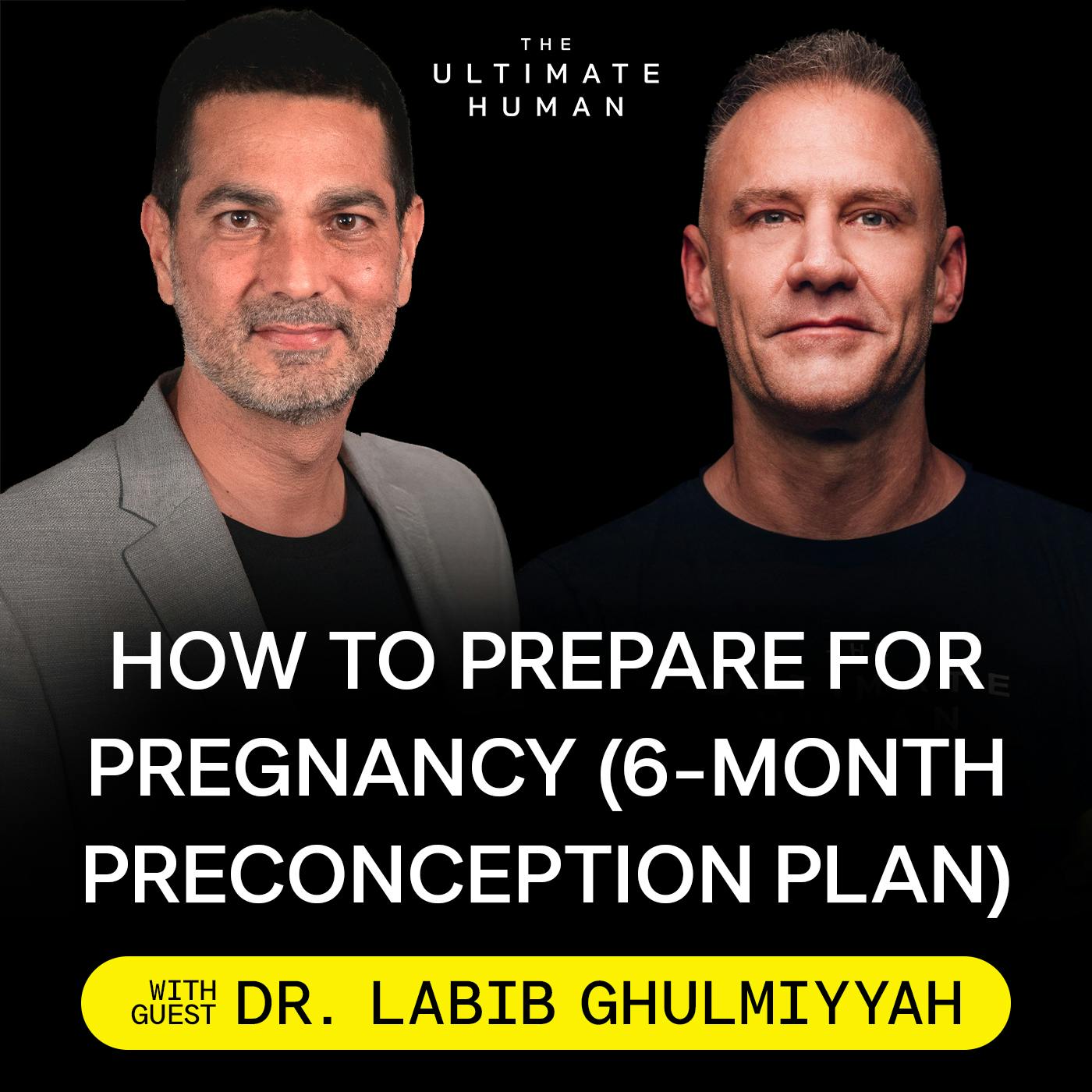
216. Dr. Labib Ghulmiyyah: On How To Prepare Your Body for Pregnancy, Fertility Decline, and Preconception Health
Join the Ultimate Human VIP community for Gary Brecka's proven wellness protocols!: https://bit.ly/4ai0Xwg
Get Dr. Labib Ghulmiyyah’s book, “Gen Tox Live Clean“ here: https://bit.ly/4opv8rC
Connect with Dr. Labib Ghulmiyyah
Website: https://bit.ly/3XiOFOt
YouTube: https://bit.ly/4hJ9oEP
Instagram: https://bit.ly/48ZtLLD
TikTok: https://bit.ly/43fivXJ
LinkedIn: https://bit.ly/4or3R8o
Thank you to our partners
H2TABS: “ULTIMATE10” FOR 10% OFF: https://bit.ly/4hMNdgg
BODYHEALTH: “ULTIMATE20” FOR 20% OFF: http://bit.ly/4e5IjsV
BAJA GOLD: "ULTIMATE10" FOR 10% OFF: https://bit.ly/3WSBqUa
COLD LIFE: THE ULTIMATE HUMAN PLUNGE: https://bit.ly/4eULUKp
WHOOP: JOIN AND GET 1 FREE MONTH!: https://bit.ly/3VQ0nzW
AION: “ULTIMATE10” FOR 10% OFF: https://bit.ly/4h6KHAD
A-GAME: “ULTIMATE15” FOR 15% OFF: http://bit.ly/4kek1ij
PEPTUAL: “TUH10” FOR 10% OFF: https://bit.ly/4mKxgcn
CARAWAY: “ULTIMATE” FOR 10% OFF: https://bit.ly/3Q1VmkC
HEALF: 10% OFF YOUR ORDER: https://bit.ly/41HJg6S
BIOPTIMIZERS: “ULTIMATE” FOR 15% OFF: https://bit.ly/4inFfd7
RHO NUTRITION: “ULTIMATE15” FOR 15% OFF: https://bit.ly/44fFza0
GOPUFF: GET YOUR FAVORITE SNACK!: https://bit.ly/4obIFDC
GENETIC METHYLATION TEST (UK ONLY): https://bit.ly/48QJJrk
GENETIC TEST (USA ONLY): https://bit.ly/3Yg1Uk9
Watch the “Ultimate Human Podcast” every Tuesday & Thursday at 9AM EST:
YouTube: https://bit.ly/3RPQYX8
Podcasts: https://bit.ly/3RQftU0
Connect with Gary Brecka
Instagram: https://bit.ly/3RPpnFs
TikTok: https://bit.ly/4coJ8fo
X: https://bit.ly/3Opc8tf
Facebook: https://bit.ly/464VA1H
LinkedIn: https://bit.ly/4hH7Ri2
Website: https://bit.ly/4eLDbdU
Merch: https://bit.ly/4aBpOM1
Newsletter: https://bit.ly/47ejrws
Ask Gary: https://bit.ly/3PEAJuG
Timestamps
00:00 Intro of Show
01:19 Healthy Pregnancy Lifestyle (for both Women and Men)
05:34 Medical Guidelines during Pregnancy
09:24 US Ranking Highest in Maternal and Infant Mortality
11:54 Decline in Fertility and Sperm Rates
14:03 What is an Ideal Healthy Pregnancy?
17:36 Maternal Instinct and Postpartum Recovery
21:41 C-Section vs. Vaginal Birth
25:52 Exercising during Pregnancy
28:44 Connect with Dr. Ghulmiyyah
The Ultimate Human with Gary Brecka Podcast is for general informational purposes only and does not constitute the practice of medicine, nursing or other professional health care services, including the giving of medical advice, and no doctor/patient relationship is formed. The use of information on this podcast or materials linked from this podcast is at the user’s own risk. The Content of this podcast is not intended to be a substitute for professional medical advice, diagnosis, or treatment. Users should not disregard or delay in obtaining medical advice for any medical condition they may have and should seek the assistance of their health care professionals for any such conditions.
Learn more about your ad choices. Visit megaphone.fm/adchoices
Press play and read along
Transcript
Speaker 1 One thing I tell patients before they get pregnant to prepare for the pregnancy as much as they prepare for their wedding.
Speaker 1 And I think also one area that we forget to talk about is the preparation of the men for the pregnancy.
Speaker 2 I love what you say about preparing the husband along with the wife because I think that spousal support is so critical.
Speaker 1
It's a two-player game, it can be one person. And I think we throw pregnancy on women, and men should play a role.
And being supportive, and when you have this support, you will make a difference.
Speaker 2 Pregnancy is also a time when women are supposed to be elated and joyful. The pregnancy glow, it's really supposed to be a time that they enjoy.
Speaker 1 So that's how I imagine a perfect pregnancy.
Speaker 1 Preparing the men, preparing the women on all those important pillars from their nutrition, their movement, their sleep, their stress, their family support, which is extremely important.
Speaker 2 There's so much advice for women that are pregnant, but there's so little medical advice for them.
Speaker 1 That's why I got into more the functional medicine and started asking why and why.
Speaker 1 So pregnancy is a miracle it says another human comes out of a human and then instinctively they can raise them once a woman is pregnant what does an ideal healthy pregnancy look like to answer you as far as the pregnancy is concerned I think
Speaker 2 hey guys welcome back to the ultimate human podcast I'm your host human biologist biologist Gary Brecca, where we go down the road of everything anti-aging, biohacking, longevity, and everything in between.
Speaker 2 And today's guest is going to have special appeal to my staff because I've got a lot of pregnant women on my staff. And
Speaker 2 he is a
Speaker 2 board certified in obstetrics and gynecology. He's also additional certifications in functional medicine and nutritional medicine.
Speaker 2 I cannot wait to unpack this podcast because it's so germane to the conversation we've been having here in Saudi Arabia so far.
Speaker 2 Just a lot around diet, lifestyle, spiritual well-being, and the aspects of health that are non-pharmaceutical, non-chemical, and non-synthetic.
Speaker 2
And so, this is going to be an amazing, amazing discussion. I'm really excited about this.
Welcome to the podcast.
Speaker 1 Thank you, Gary. Thank you for having me.
Speaker 2 Labib Gumaya.
Speaker 1
Correct. Excellent.
I got it right.
Speaker 1
From the first trial. All right.
For the first trial.
Speaker 2 Dr. Labib, I'm so excited to
Speaker 2 into this topic because just jumping right into pregnancy
Speaker 2 with women,
Speaker 2 there's so much advice
Speaker 2 for women that are pregnant, but there's so little medical advice for them.
Speaker 2 I mean, we don't do randomized clinical trials on pregnant women because nobody wants to mess with a woman while she has a fetus in the womb.
Speaker 2 I constantly am asked the question, can I take this during pregnancy? Can I take that during pregnancy? And there's very little evidence for us to fall back on.
Speaker 2 We have clinical trials on just about everything, but we rarely do them on women while they're in the process of bearing children.
Speaker 2 So what does a healthy pregnancy lifestyle look like?
Speaker 2 You know, most women are so stressed about getting pregnant. And then when they conceive, Now the stress shifts to, am I doing everything right to care for this fetus while it's in the womb?
Speaker 1 Well, you know, one thing I tell pregnant patients or ideally before they get pregnant, to prepare for the pregnancy as much as they prepare for their wedding. Wow.
Speaker 1
You know, sometimes weddings take six months to prepare. You have to do the same thing for pregnancy, but a lot of times, unfortunately, they come in already pregnant.
Well, what does that look like?
Speaker 2 Let's back that up a little bit. What does it look like ideally moving into a healthy child?
Speaker 1 Yeah, ideally, of course, we touch on all the pillars of health,
Speaker 1 from their nutrition, their movement, their sleep, their stress,
Speaker 1 their family support, which is extremely important, their connection. So we try to get into all of those pillars.
Speaker 1 And to be honest, you know, even me being an OBGYN, and I did the fellowship in maternal fetal medicine, which involves only high-risk pregnant patients, we were never trained in, you know, addressing all these pillars.
Speaker 1 Of course, you know, with time, you know, I learned that these are so important, so basic and
Speaker 1 there's no doubt that they make a difference in the outcome of the pregnancy.
Speaker 2 Prevention, preparation.
Speaker 1 Because, you know, I, you know,
Speaker 1 maybe I'm biased, but because most of my pregnant patients are high risk. So we see a lot of preeclampsia, preterm labor, gestation diabetes.
Speaker 1 And I can tell you from the patients who prepare for the pregnancy, they have less of those.
Speaker 1 Of course, this is not a randomized trial because, you know, it's difficult to do randomized trials in pregnancy, but no doubt preparing, like you're preparing for a marathon, like you're preparing for an exam, you have to be ready.
Speaker 1
And I think also one area that we forget to talk about is the preparation of the men for the pregnancy. Wow.
Because
Speaker 1
we talk about us. Yeah.
I mean, we got to go through this too. We assume that, you know, she's carrying the pregnancy.
Yes, of course. But again, he's giving half of the genetic material.
Speaker 1
And this genetic material can epigenetically change in the womb. I know you talk a lot about epigenetics.
And during my fellowship, I did a lot of...
Speaker 1 animal studies on epigenetics on mouse models that were hypertensive and not hypertensive and you would see the offsprings and their outcomes and we see this going from one generation to another of mice of course we assume it same thing happens in pregnancy but in humans but men are important because they're giving the genetic material they're supporting their uh partners throughout the pregnancy and then after delivery you know it's stressful too i mean they have to uh you know be there you know help during you know breastfeeding supporting the their partner so it's a two-game you know it's a two-player game it can be one person and i think we throw pregnancy on women, and I think men should play a role.
Speaker 1 And them being supportive, and when you have the support, you will make a difference.
Speaker 1 And I'm sure physiologically, their physiology will improve when they see support, when they see someone caring for them.
Speaker 1
So that's how I imagine a perfect pregnancy, preparing the men. preparing the women on all those important pillars.
And then, you know, throughout the pregnancy, you will do your prenatal care. And,
Speaker 1 of course, try to fix or optimize any of your nutritional deficiencies and get to those.
Speaker 1 One area, and I know you like this, and I love, and that's why I follow you, is the biology of our genes and who needs to be tested for genetic mutations and all of that, neutrogenomics, and all of that.
Speaker 1
These are important, but unfortunately, it's not easy to do on everyone. And a lot of times they come in already pregnant.
And
Speaker 1 because of traditional medicine, you know, we're taught not to do those tests, right? And
Speaker 1
why? I don't know. And I feel like sometimes we just follow what we were told.
Right. And you have no time to do it.
Standard of care, we call it standard of care, exactly. Evidence-based medicine or
Speaker 1
legal medicine. We're worried that this is going to go into a medical-legal thing.
So we follow what ACOG or what SMFM tells us, and that's it.
Speaker 2 And I think sometimes, I mean, it's good to have guardrails. Yeah, of course.
Speaker 2 But also the practice of medicine, especially under the, you know, the FDA,
Speaker 2 is really meant to be in the hands of the practitioner.
Speaker 2 You know, you don't have to follow FDA guidelines.
Speaker 2 You have to
Speaker 2
follow the regulations, but you don't have to follow the guidelines. They're there as guidelines.
I mean, that's why we have off-label medications and off-label use.
Speaker 2 People wouldn't use propecia for male pattern baldness if you weren't allowed to practice outside the guidelines.
Speaker 2 But I think there's a prevailing wisdom that there's, in medicine anyway, there's only one way to do everything, right?
Speaker 2 I mean, in California, your license can be at risk even if you go against the sort of state-outlined dogma.
Speaker 2 And at what point the state was able to decide the practice of medicine when the practitioner is interfacing with the patient to me seems pretty mad.
Speaker 1
This is assuming everybody's the same and we are not the same. Everybody is genetically different.
Everybody,
Speaker 1 you know, detox their, you know, the endocrine disruptors in a different way.
Speaker 1 You know, I have a friend actually now, they just moved to a house in Miami and his wife, within a few weeks, is having allergic reactions.
Speaker 1 You know, she's worried about, you know, mold toxicity. And they found mold.
Speaker 1
Yeah. They found mold.
But he's not feeling anything and she's having headaches and sinus.
Speaker 1
So people, even living in the same household, household, will feel differently. So there's no question.
That's why, like you said, a lot of things we do off-label.
Speaker 1 And by the way, do you know that when we induce women, we use a product called mesoprostol, which is a prostaglandin to induce, you know, to dilate the cervix.
Speaker 1
And this is not FDA approved for induction of labor. It's off-label use.
And I will say maybe, you know, most of the inductions in the U.S. are done through mesoprostol or another prostaglandin.
Speaker 1 And if you look at the label, it's used off-label. And many, many drugs are used off-label.
Speaker 1 But yeah, sometimes we have to follow some of the guidelines.
Speaker 1 And then again, if you drift a little bit from the guidelines, you have to be really,
Speaker 1 you know, make sure you are doing something not to harm the patient.
Speaker 1 But a lot of times we don't have the answer to a question because it's difficult to do trials in pregnancy.
Speaker 1 But as long as you are being reasonable, you are taking, you're looking at the whole patient as a whole, not just
Speaker 1 one value from her lab work, then I think
Speaker 1
it's a good way of practicing things. And that's how we're going to learn and change our practice and maybe improve pregnancy outcomes.
Because preterm labor, for example, has not,
Speaker 1
the prevalence or the incidence of preterm has not changed over the last 20 years. Actually, it has increased a little bit.
Yeah.
Speaker 1 And, you know, so many places are trying to do, you know, research and trials to detect who's at risk for preterm labor, but we have no solution to it.
Speaker 2 And we're seeing more and more babies being born preterm yeah um you know it's it's fascinating to me that we're so advanced medically in the united states um we definitely don't have a spending problem we spend five trillion dollars a year on health care in general um but in the civilized world we rank among the highest in maternal mortality and infant mortality absolutely both um what do you attribute that to?
Speaker 1 Yeah, I think a major, major risk factor that we see is, you know, the demographics and the metabolic diseases that we have and the pandemic of obesity, which is probably a final sign of inflammatory disease and insulin resistance, plays a major role.
Speaker 1 And that will increase your risk of preterm labor, preterm delivery of because of preeclampsia and other complication, C-section rates are higher because of obesity.
Speaker 1 So I think, you know, there are multiple factors, but I think it all leads leads to the unhealthy lifestyle that
Speaker 1
the U.S. has been getting.
And the diet plays a huge role in this.
Speaker 2 Huge role. I mean, and you, as a practitioner,
Speaker 2 you have to play with the hand that you're dealt. I mean, when the patient shows up,
Speaker 2 you don't have a choice over what lifestyle choices they've made to that point.
Speaker 2 So you're inheriting whatever risk pattern they've developed for themselves. And I love the idea of preparing six months out for pregnancy.
Speaker 2 You know, like you would prepare for, I'm preparing for 10K and I've been on a program.
Speaker 1 Yeah, of course.
Speaker 1 Otherwise, you'll stop in the middle and
Speaker 1 you can't finish it. So I think, yeah, that preparation is so important.
Speaker 1
And that's all knowledge. I mean, you don't have to get pregnant in six months.
You can maybe prepare even a year or two years before, but at least have the knowledge of what's important to be done.
Speaker 1 you know, lectures and workshops should be given to high school students, to college students, and like sexual health.
Speaker 1 You're not going to cause people to be more sexually active if you teach them about it.
Speaker 1 I think that's what a lot of people fear, especially actually in this part of the world, because I lived in Lebanon also, practiced for 12 years
Speaker 1 in Lebanon, which is part of the Arab world. And a lot of people fear that if you talk about sex or sexual health, people are going to become more sexually active.
Speaker 1 And actually, it's the other way around.
Speaker 1 So same thing. Talk about pregnancy, preparation for pregnancy, and definitely the outcomes will be better.
Speaker 2 Yeah,
Speaker 2 I couldn't agree with you more. You know, I think, too, that
Speaker 2 we have a very serious challenge going on in the U.S. I mean, statistically, population-wise, you see fertility rates beginning to decline,
Speaker 2 and you also see sperm rates beginning to decline about 1% per year.
Speaker 2 1% per year doesn't sound like a big decline. That's 10%
Speaker 2 every decade. And you combine that with infertility rates in women conceiving,
Speaker 2 and you have a repopulation disaster potentially on your hands, or at least we're heading for one.
Speaker 2 What do you account for the declining rates of sperm count in men and declining rates of fertility in women?
Speaker 1 Yeah, I think they go kind of hand in hand.
Speaker 1 When the sperm count is dropping, also the fertility rates will drop. But I think because the sperm and the eggs come from endocrine organs, and those endocrine organs are so vital for our
Speaker 1
health span and even longevity. We know now the ovaries are so important for that.
Same thing for testes, but we are bombarded with toxins.
Speaker 1 And when I say toxins, I don't mean just chemical toxins. That's
Speaker 1
financial toxins, social toxins, social media toxins. always bad news.
I mean, wars all over the world, hurricanes. I mean, we're always bombarded.
Speaker 1 I'm sure our ancestors had also issues, but so many things happening at the same time.
Speaker 1 I think all this is stressing our body, cortisol levels are high continuously, and then you have those endocrine disruptors that are constantly invading our bodies, and we can't get rid of them easily.
Speaker 2
I'm so happy to hear you say that. I mean, not happy to hear you talk about these problems, but I mean, I'm happy to hear you say that.
That
Speaker 2 allopathic medicine, traditional medicine, is recognizing that
Speaker 2 the body has frequency and
Speaker 2 emotion, mood. These have a major impact, stress on our ability to conceive, our sperm counts, you know, terms of healthy pregnancies.
Speaker 1 So, now,
Speaker 2 once a woman is pregnancy, what does an ideal healthy pregnancy look like? um, for you?
Speaker 2 What are some of the recommendations, the guidelines that you tell your patients to give them the best possible outcome? Because I feel like that is the time when a woman is the most selfless.
Speaker 2 You know, I've seen it in my
Speaker 2 the mother of my children. I've seen it in my wife now, who's a phenomenal mother.
Speaker 2 Um, you know, during that time, their sole concern, almost like it's a genetic programming, is everything is about that fetus.
Speaker 2 Um, you know, they give up some of the things they love the most, wine, coffee, you know, but you know, sorry to interrupt you, they give up those
Speaker 1
not because they're obliged to do it. They know it's harmful, but their physiology changes, Their gut microbiome changes.
So they stop having those cravings.
Speaker 1 So I think it's a lot of the hormones that the placenta secretes make them, you know, not liking certain smells just to protect their baby.
Speaker 1 So there is something, there's something, you know, like too holistic that happens without us interfering. But of course, sometimes,
Speaker 1 you know, we have patients that still smoke or use drugs during pregnancy.
Speaker 1 And that has a lot of, you know, reasons why but in general i think the human body knows so well what to fear and what to avoid in preparation for uh you know that that pregnancy but to answer you as far as the pregnancy is concerned i think you know continuing with those pillars you know sleeping well uh you know eating um you know the correct uh foods and amounts uh to keep your microbiome healthy avoid toxins um and of course you know lowering your stress all of these are things that we advise advise women to do.
Speaker 1 And I usually, it's so difficult to work on all of them. I try to see where is the weakness, where this patient is having issues with, and we try to work on that part.
Speaker 1 The first part of the pregnancy, the first 12 weeks, is when the fetus is developing. So it's a very critical time.
Speaker 1 But even afterwards, the baby's growing, your brain keeps growing until later in the pregnancy, even after birth, the brain keeps growing, the lungs. So
Speaker 1 I think you just have to give advice on
Speaker 1 where they they are lacking as far as issues with their sleep or with other issues.
Speaker 1 And then, of course, the regular prenatal care, coming to their visits, having the ultrasounds, make sure the pregnancy is normal.
Speaker 1 We have multiple testing that we can do to predict if this woman is going to develop eclampsia. We screen for diabetes.
Speaker 1 So there are standard guidelines that so far work well and they do decrease the risk of morbidity and mortality.
Speaker 1 But I think as physicians, we need to
Speaker 1 let the patient tell you what's bothering her.
Speaker 1 Make every parental visit count.
Speaker 1
So instead of having 10 visits, you can do four visits in a low-risk patience. I'm talking that are really meaningful.
So I think those will make a huge difference.
Speaker 1 Then also having the women have access to knowledge, whether through an app, whether through
Speaker 1 social media, just for them to be educated
Speaker 1 and not just listen to their friends. And because everybody's different.
Speaker 1 I keep telling them that because, oh, my friend took this vitamin. Is this vitamin better?
Speaker 1
Yeah. You know, you should not compare yourself in anything.
Not that in the pregnancy, neither on social media. Everybody's different.
Speaker 2 You know what I found fascinating?
Speaker 2 We first had children with my former spouse, the mother of my children. And we were able to successfully separate the husband and wife from the mother and the child.
Speaker 2 And we still maintain a very great friendship and an amazing modern family.
Speaker 2 But one of the things I was fascinated about was I was paralyzed by fear. I was in my 20s.
Speaker 2 She got pregnant, which we were not trying to conceive, but we were not trying to not conceive.
Speaker 2 And I was very excited about the prospect of having a child.
Speaker 2 But I also was absolutely paralyzed because I was like, I have no, like, no idea what to deserve. Like a book, chapter one, take it out of the crib, wrap it up like this.
Speaker 1 What if the baby falls down?
Speaker 1 You know, there's no guideline.
Speaker 2 But what happened and,
Speaker 2 you know, obviously my,
Speaker 2
I knew my wife at the time very, very well. We had dated a long time, been engaged for a period of time, then got married.
And so I knew her very well.
Speaker 2
But I noticed right after our first child was born, this entire new human being came out of her. I don't know where she adopted this knowledge.
from on what to do, how to know what to do.
Speaker 2 And I've heard a lot of men talk about this with their wives too.
Speaker 2
She knew like the different cries the baby would have. Like, oh, no, she's constipated.
Nope, she needs to be fed. No, she's, she's lonely.
Speaker 1 I'm like, how the hell do you know?
Speaker 1 I think this is called maternal instinct. It all sounded the same to me.
Speaker 1 Yeah, I think, you know, during breastfeeding, you know, like the baby being on skin to skin with the mom or with the dad, the connection happens immediately. And yes, you're absolutely right.
Speaker 1 Like, you know, I was an Obi Joan for almost 12 years. And then that's when I met my wife and we had the baby.
Speaker 1
I had no idea, also, about, you know, I would deliver the baby, give it to the parents, and my job was done. Right, right.
Now, this time it's mine. So, same thing.
I had no idea what to do.
Speaker 1
And I felt the same thing. She knew how to do the right thing.
So, you are the professional, all this training, like all this. She would ask some baby questions.
Speaker 1
I don't know. I don't know.
Yeah. So, and then the other part which was shocking is like the postpartum recovery of my wife also was something I discovered.
Speaker 1 It's like, wow, women go through so much, you know, stress from the recovery because pregnancy is so tough on the heart and on all your organs. So, it takes time for them to recover.
Speaker 1 And my wife is a very healthy person, and it took her almost a year to go back.
Speaker 1 So, I started imagining what would happen to somebody who had preeclampsia at 26 weeks, and she had an emergency C-section, and how her recovery will be. I never thought about it before, yeah.
Speaker 1 So, that's why you know, I got into more of the functional medicine and started asking why and why. So, pregnancy is, I think, a miracle, it's It's an amazing, like you said, it's so amazing.
Speaker 1 Another human comes out of a human and then instinctively they can, you know,
Speaker 2 it's, you know, not to frame it the wrong way, but it's a parasitic relationship, you know, between the fetus and the mother. True.
Speaker 2
And so the fetus is there to take everything that it needs for itself. And so that withdraws a lot from the mother.
I mean, it will take minerals from the bone, amino acids from the muscle.
Speaker 2 I mean, it will.
Speaker 1 Today you spoke about the immune system. And like you said, because the baby's, you know, DNA, half of it is foreign to the mom.
Speaker 1
So there is this kind of a barrier where you don't want the mom to reject the baby. So her immune system is active in a way.
So this is also maybe adding to more stress on her organs.
Speaker 1
And we know there are a few studies that show that. moms would age faster after a pregnancy, but then they can catch up later on.
But that immune response also, I think, plays a huge role.
Speaker 1 If you do a regular blood count, you'll see the white count is higher when you're pregnant. So interpretation of labs should be also different in pregnancy.
Speaker 1 But this immune system that you spoke about is huge in pregnancy.
Speaker 1
You're constantly fired, you know, immune immune-wise throughout nine months. So, imagine what that can cost to your body.
And the body of women is so resilient, it's unbelievable.
Speaker 2 I've seen a lot of data on the difference between C-section rates of
Speaker 2 different neurodevelopmental conditions and vaginal MERS.
Speaker 2 And, you know, supposedly linked to the inoculation through the vaginal canal, certain bacteria that help inoculate the gut. We know now how important the gut microbiome is.
Speaker 2
This was, you know, there was a book written by Dr. Perlmutter years ago called The Gut-Brain Connection.
And then he wrote another book called Grain Brain. It was the first time
Speaker 2 as a human biologist that I'd read something that really drew my attention to the importance of the gut and the microbiome and the microbiome in general. And it really
Speaker 2 starting at birth,
Speaker 2 this first inoculation at birth. So, for women that have had C-sections
Speaker 2 and they want to avoid this, are there infantile probiotics?
Speaker 2 Are there some natural ways that she can mitigate having had to have a C-section versus a vaginal birth?
Speaker 1 There's a few trials that were done, I think, small studies where they do smearing of the baby.
Speaker 1 Like after the baby's delivered through a C-section, they would take vaginal swabs and smear the baby with the
Speaker 1 flora of the mom and to see if this makes a difference. But they were very short-term studies, so there's no proof that they would change the outcome.
Speaker 1 But definitely the gut and the brain are connected. The baby, when they're in the womb,
Speaker 1 their GI tract is basically sterile. So once they pass through
Speaker 1
the birth canal, they're going to collect all these good micro. And the microbiome changes during that time to be really beneficial to the baby.
Right, it's unbelievable, even the milk.
Speaker 1
You know, let's say a mom delivers at 26 weeks, her milk composition will be different than if she delivers that term. So, that way, that milk will be very beneficial to the baby.
It's,
Speaker 1
I mean, it's unbelievable. What a machine.
But
Speaker 1 there are some tribes that are smearing the babies to kind of
Speaker 1 re-inoculate them with that, you know, microbiome.
Speaker 1 But it's not a routine thing that's that's done.
Speaker 2 But the initial colostrum that's created from a mother's milk, which is unbelievable. If you look at the composition of it, it's largely ketogenic, but lots of fat going into the baby.
Speaker 2 There are microbes in there as well, which is also fascinating to me that only exist during that time in her entire lifetime. They don't come out in breast milk.
Speaker 2
They only exist during the first 48 hours of pregnancy. I mean, such a miracle thing.
And the more you study it, the more you understand and know about it, the
Speaker 1 more you don't understand. For me, yeah, the more it makes me believe in God because I don't think that any of this happened by accident.
Speaker 2 Absolutely.
Speaker 2 But,
Speaker 2 you know, that said aside, so you know, healthy pregnancy is
Speaker 2 not much different from just being a healthy young woman, right? I mean, clean food, rest, stress mitigation.
Speaker 2 I love what you say about preparing the husband
Speaker 2 along with the wife, because I think that spousal support is so critical.
Speaker 2
But, you know, pregnancy is also a time when women are supposed to be elated and joyful. The pregnancy glow, it's really supposed to be a time that they enjoy.
Maybe not the delivery itself, but the
Speaker 1 delivery has to be a nice experience, you know. And I think we medicalized it so much that a lot of times it becomes...
Speaker 1 not unenjoyable because you know they're hooked up to monitors and to the IV and with an epidural so a lot of times they feel the experience is not nice but I know so many patients they love being pregnant because of the glow, the hair.
Speaker 1 So, yeah, we try to make that time as nice as possible.
Speaker 1 But again, there are physiological changes that happen. You know, the center of gravity changes.
Speaker 1
It sure does. The pelvic pain.
You know, yeah, working out is not a very kind way of saying you're going to put on weight. Yeah.
Yeah. I mean, working out is not easy.
Speaker 1 So, but I think that's why the preparation will make that experience nicer.
Speaker 1 And yeah.
Speaker 2 So let's talk about a couple of those things real quick.
Speaker 2 Are there,
Speaker 2 where do you fall in the advice of exercise during pregnancy?
Speaker 1 I tell patients they need to exercise and keep moving. I mean, you don't want to.
Speaker 2 It's not just rest, just relax, just lay down.
Speaker 1 Not even, you know, not even women that are high risk for preterm labor, we tell them to stop exercising.
Speaker 1 Of course, we might limit the type of exercising if they've had preterm contractions or a very early delivery, the previous pregnancy. We might limit a little bit the movement, but not bed.
Speaker 1
Actually, when patients come in, it's like, oh, my previous doctor told me to be on bed rest. I'll tell them this is bad rest because it's going to make things worse.
They're going to get blood clots.
Speaker 1
They're going to be depressed. They're going to gain weight.
So no, everybody should be moving. Yes.
Of course, it depends on your risk factors.
Speaker 1 We might modify some of those, but they can continue, you know, weightlifting. They can,
Speaker 1
you know, do some cardio. So they do whatever they were doing before.
And maybe sometimes they were not exercising. And now it's a good opportunity to get them into exercise.
Yes.
Speaker 1
So, yeah, absolutely, they need to work out. And this is what the guidelines say: you have to work out at least five days a week, you know, for yes, treatments.
Yes, so fantastic.
Speaker 1 So, they should all, and of course, depending on the trimester, the type of exercises changes because of the center of gravity changes.
Speaker 1 You don't want to injure those women and their joints are a bit more flexible. So, you want to avoid things that could injure their joints.
Speaker 1 So, you have to be very knowledgeable in the types of exercise.
Speaker 2 And there are many professionals that can have the time to sign up for a marathon, but yeah.
Speaker 1
No, exactly. Or go skiing or horseback riding.
No, but
Speaker 1 you know?
Speaker 1 So I think this is a great time to initiate movement if they were not
Speaker 1 because movement is the huge part of it.
Speaker 2 Movement is such a key to longevity.
Speaker 2 Dr. Gomaya, you know, there's so much to unpack here.
Speaker 2 I hope that you will come back on the Ultimate Human podcast because
Speaker 2
I really, there's so much in your background here that's so germane to my audience. We're in Saudi Arabia now and I have a hard stop for commitment.
And the conference is running
Speaker 1 so late.
Speaker 2 So unfortunately, we're not going to get to unpack it now. But you're in
Speaker 1
Miami. You're in Miami.
I'm close to you.
Speaker 2 Okay. So if you'll promise me you'll come down to the studio.
Speaker 1
I promise you. Okay, great.
Yeah, come to the Miami. It's an honor to come, of course.
Speaker 2 Thank you so much. Because
Speaker 1 there are,
Speaker 2 you know, so many women in my life
Speaker 2 now that are the key parts of my team that are you know uh going through pregnancy or just delivered it's such a it's such a uh
Speaker 2 uh a near and dear thing to you know to to my heart my audience is craving you know quality information so make sure if i come to miami they'll be at the studio so i will
Speaker 2 bring you in a session yeah but dr gumaya um i really appreciate you sitting down with us for a few minutes on the ultimate human podcast i'm really excited to continue to run this when we get back to Miami because my audience is desperate for this type of information.
Speaker 2 But until then, where can they find out more about you?
Speaker 1 Well, they can find me on social media
Speaker 1 with my name, Dr. Labib Pulmia.
Speaker 1
I have a website, drlabibib.com. So I try to use my first name so it'll be easier.
Dr. Labib.com.
And yeah, I, you know, I do practice
Speaker 1 OBJN, MFM, and Miami.
Speaker 1
And I do some telehealth consultations. Okay, really? Okay, great.
As needed.
Speaker 1
But yeah, I mean, my social media, LinkedIn. Great.
It's easy today to find people.
Speaker 2 Yeah, I'm going to put all of this. Well, if you can put this last name together, but I'm going to put all of this in the show notes for you guys.
Speaker 2 I wish we had more time to unpack this. We will run this one again because there's just so much in his background of this, so germane and so aligned with our mission.
Speaker 2
And there's so many of you that have submitted questions. I want to make sure that we get to all of those.
But until next time, that's just science.