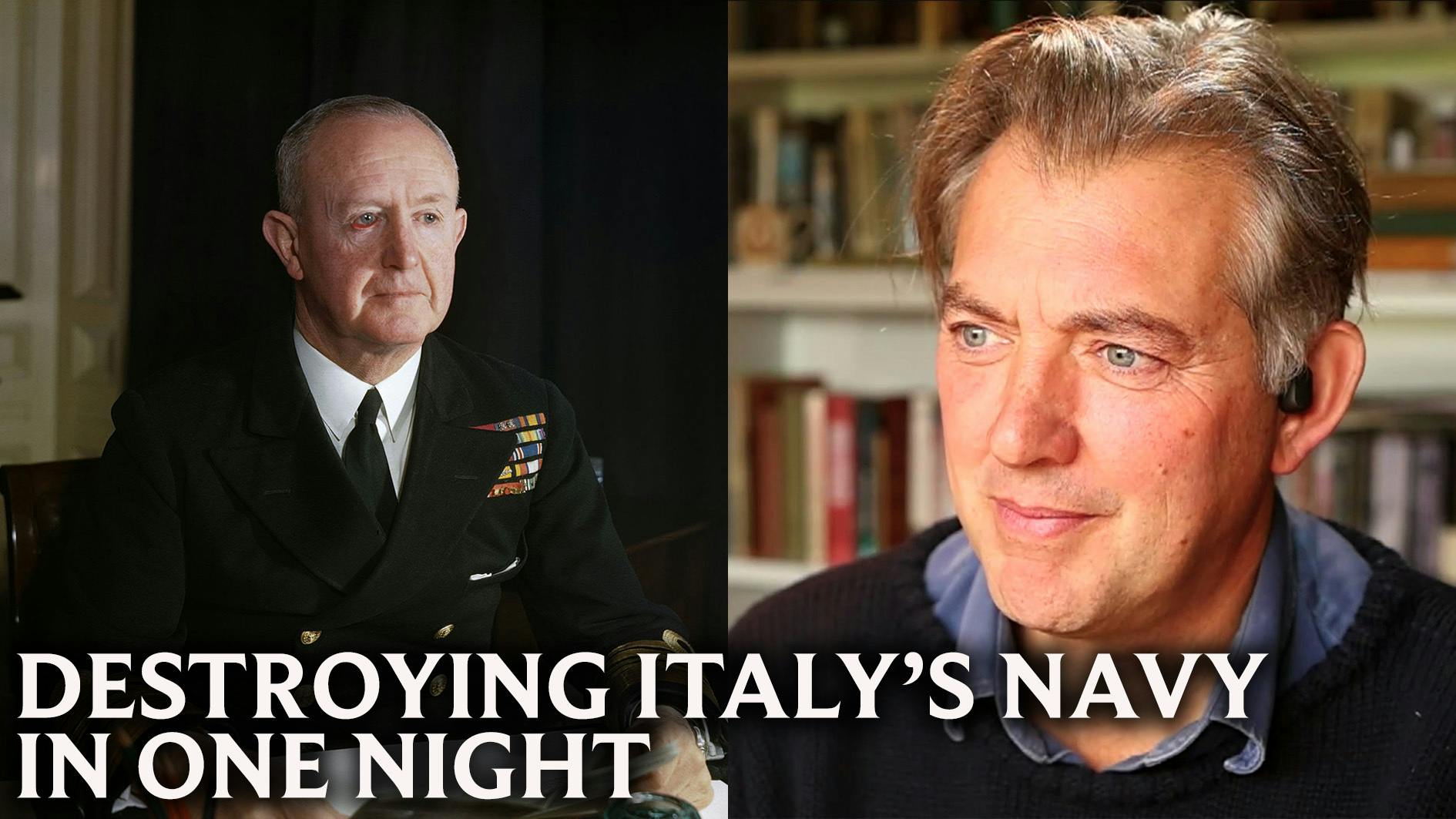
The Siege Of Malta: Britain's Submarine Ace (Part 2)
Join James Holland and Al Murray for part 2 of this thrilling series on the siege of Malta, and how the very course of WW2 depended on the defence of this small island in the Mediterranean.
Start your free trial at patreon.com/wehaveways and unlock exclusive content and more. Enjoy livestreams, early access to podcast episodes, ad-free listening, bonus episodes, and a weekly newsletter packed with book deals and behind-the-scenes insights. Members also get priority access and discounts to live events.
A Goalhanger Production
Produced by James Regan
Exec Producer: Tony Pastor
Social: @WeHaveWaysPod
Email: wehaveways@goalhanger.com
Membership Club: patreon.com/wehaveways
Learn more about your ad choices. Visit podcastchoices.com/adchoices
Press play and read along
Transcript
Speaker 1 Thank you for listening to We Have Ways of Making You Talk. Sign up to our Patreon to receive bonus content, live streams, and our weekly newsletter with money off books and museum visits as well.
Speaker 1 Plus, early access to all live show tickets. That's patreon.com/slash wehaveways.
Speaker 3
This episode is brought to you by eBay. Buying a car should feel secure start to finish.
That's why you should buy your next ride on eBay. Whatever you're into, eBay's got it.
Speaker 3
From classics to SUVs and trucks to imports, all in one place. And with secure purchase, the process is streamlined and protected.
Secure purchase means no DMV visit.
Speaker 3 Sellers and titles are verified, all the paperwork is handled, and financing, delivery, and insurance options are built right in.
Speaker 3 Plus, eligible vehicle purchases are backed by up to $100,000 in protection. Looking to sell your ride? Secure purchase makes that easy too.
Speaker 3
Your buyer and their funds are verified, and the title transfer and loan payoff are totally seamless. So skip the hassle.
Shop with confidence. Buy your next car on eBay.
eBay. Things people love.
Speaker 3 Secure Purchase is powered by Caramel Dealer Services LLC, an eBay subsidiary.
Speaker 5 When cool, creamy ranch meets tangy, bold buffalo, the whole is greater than the sum of its sauce. Say howdy, partner, to new Buffalo Ranch Sauce, only at McDonald's for a limited time.
Speaker 6 At Participating in McDonald's. If we knew more about our sleep, what would we do differently? Would we go to bed at a consistent time or take steps to reduce interruptions to our sleep?
Speaker 6 With the all-new sleep score, Apple Watch measures your bedtime consistency, interruptions, and sleep duration.
Speaker 6 Then, every morning it combines these factors into an easy-to-understand score from 1 to 100. So you'll know how to take the quality of your sleep from good
Speaker 6 to excellent.
Speaker 4 Introducing the new sleep score on Apple Watch, iPhone 11 or later later required.
Speaker 2 Lieutenant Commander Wanklin is a man of resolute character, quiet speech, and has penetrating brown eyes. He is over six feet in height and like most submariners in wartime, sports a beard.
Speaker 2 He married his wife, Elspeth Kinlock, in Malta and has a two-year-old son Ian now staying at Ellen Gowan in Meigel. He is a Scot by birth, but best known in Cheltenham.
Speaker 2 Asked what quality was most needed in submarine warfare for success, Britain's submarine ace replied, Hmm, that's a nasty one. So I'll use a long word: imperturbability.
Speaker 2 That was an interview with Lieutenant Commander David Wanklin in the Times of Malta on the 24th of December 1941.
Speaker 2 And we'll get to why he's being interviewed a little bit later on, but it's a favourite bit of journalism for me, I have to say that.
Speaker 1 So, welcome to We Have Ways of Making You Talk with me, Al Murray and James Holland, for the second episode in our Siege of Malta series titled The Thorn in the Axis Side.
Speaker 1 Because the thing to remember is that any place like Malta, you need to hold it, but you holding it is a problem for the enemy as much as the enemy attacking you is a problem for you.
Speaker 1 That there's a plus one, minus one here. The Germans don't just want it for themselves, they need it denied to the British because of what the British can do in the Mediterranean if they hold Malta.
Speaker 1 And in our last episode, we laid out the rather parlor state of defences, the inertia from the pre-war provision made in Malta, and then the extremely aggressive spirit of the Royal Navy, the Mediterranean Fleet under ABC, under Admiral Cunningham, which I think is a key note throughout the history of the Second World War in the Mediterranean, until it sort of stops when it stops.
Speaker 1 And I think what's really striking is that when we've talked about the Navy before, if we've touched on it, we've talked about the Battle of the Atlantic, really, which doesn't have this major encounter stuff going on in it.
Speaker 1
It's a war of increments. It's a game of cat and mouse.
This is not a game of cat and mouse.
Speaker 1 This is the Royal Navy going, come and ever go if you think you're hard enough, to the Regimarina, and pretty much giving the Italians a lot to think about.
Speaker 1 But as we also pointed out in the last episode, Churchill's main worry is what happens when the Germans turn their attention and their professionalism in comparison with the Italians to this theatre.
Speaker 1 And this is where we got to at the end of the last episode, but the attacks on Illustrious, the attempt by Luflotta 10 to be much more serious in prosecuting the war against the British in Malta.
Speaker 1 So the Luftwaffe are in Sicily, but they're starting to have other fish to fry. It's the German problem at this stage of the war, of course.
Speaker 2
Can't be everywhere. That is the problem.
You know, raids are continuing, mainly directed at the harbours and the airfields. You know, there are a daily occurrence.
Speaker 2
More and more people are living in shelters now. Suzanne Palby, she's a young British cipher clerk.
She's had the opportunity to leave the island and thought, was actually, no, I'm not going to.
Speaker 2 I'm going to stay here.
Speaker 2 So she's working for military intelligence, first in the Auberge de Castile, which is in the main square in the centre of Valletta, and then moving into the tunnels, the Lascaris tunnels, which have been dug underneath Valletta.
Speaker 2
And she's living in the St. James's Hotel.
And I mean, I remember her talking to her about this. And she said, you know, it was terrifying.
Speaker 2 You had to use your willpower to quell the fear, which would be trying to burst out from within. Showing your fear, of course, was unthinkable, but sometimes it was hard not to.
Speaker 2 Wow.
Speaker 1 Jim, as a simple psychological portrait of what it's like being under pressure. That's everything in it, isn't it? You had to use your willpower to quell the fear.
Speaker 1 I think people still think that, don't they? That showing fear is un you don't want to show fear, but sometimes it's hard not to.
Speaker 1 She's told you everything about herself and how it feels in three sentences there. I think it's amazing.
Speaker 2 Well, and one time the raid, you know, the tyrants went out and the bombers came over and a bomb hit the St. James's Hotel and they had all gone down into the cellars.
Speaker 2
which they were hoping was safe, but the rubble came down and blocked their entrance. So they couldn't get out.
And they think, oh my God, you know, we're all going to suffocate.
Speaker 2 It's full of dust and smoke and stuff. You can imagine how choking it was, they haven't got enough water, they can't get out.
Speaker 2 They just think, you know, I mean, she said, you know, we all thought we were going to die.
Speaker 2 But the rescue people came and managed to clear it away, and they did all get out, and they were all absolutely okay. But there's also, I mean, what's amazing about this is there is a single staffle.
Speaker 2 And for those of you who listen to our Battle of Britain series, will remember that a staffle is supposed to be 12 planes, but very rarely is. But it's it has an establishment of 12 planes.
Speaker 2 One staffle of 109s, E7s, of seven staffle of JG26, Jaggeschwada 26, Fighter Group 26, are based at Gela on southern Sicily.
Speaker 2 And they're led by Oberloitnen Joachim Muncherberg, who is a Battle Britain ace, good-looking chap, absolutely brilliant at it. And they are absolutely slaughtering the Hurricanes.
Speaker 2 I mean, the Hurricanes are still struggling to get sort of half their height when Muncherberg and his mob are kind of diving out of the sun, sun behind them.
Speaker 2 hurtling down, just blasting them out of the sky. Picking their moment, it is the woeful climbing rate that is the real problem of of the hurricanes more than anything else.
Speaker 2
They just cannot get there in time. They always have the height and the sun advantage, you know.
That's the truth of it.
Speaker 1 What would really help on Malta right this minute? Are we going to say it?
Speaker 2 What would really help?
Speaker 2 We're not going to do too much Spitfires on this. We're going to go into Spitfires of a Vengeance in episode three.
Speaker 1 Okay, but if they had some Spitfires, things might be the balance might be slightly different. But there we are.
Speaker 2 And the numbers of Hurricanes on the islands of, you know, as a result, are soon getting whittled down.
Speaker 2 You know, we've got five replacements from North Africa beginning of March and six on the 18th of March.
Speaker 2 but moments before they arrive five hurricanes are shot down in a single action it's not great is it no the truth is in those first months of you know sort of february march april into may of of 1941 malta might as well have had no fighter planes whatsoever because they're not then they're not doing any good whatsoever can't get into the sky quick enough the airframes the engines are all tired and overused and there aren't enough spares and they're kind of having to be sort of you know it's all make do amend and and you know munchberg's men are just holding total mastery you know and the truth is there's many luftwaffe of planes left on sicily but they don't need it problems are still coming over several times a day.
Speaker 2 So there's 107 raids in February and 105 in March.
Speaker 1 The Luftwaffe know that they haven't really got to try that hard.
Speaker 2 No point having more than Staffel, you don't need him.
Speaker 1 Is there a final score for that Staffel them versus Malta?
Speaker 2 Well, yeah, but I don't want to spell that out just yet.
Speaker 1
It's shocking. We'll come to the final scores later.
So those of you... So we haven't got to say, look away now if you don't want to see the result, but it's bad.
Speaker 1 Now, in the last episode, we introduced Adrian Warburton, who's the Ace Recce pilot. He's still got a thing about takeoff, though, hasn't he?
Speaker 1 I think that starts to be the thing that you get every time you get in the plane. Oh, God, I can do everything else.
Speaker 2 Yeah, isn't it like still playing cricket and getting the yips as a bowler? You just suddenly can't do it.
Speaker 1
Exactly. Yeah, you know, that recipe you can't crack.
I always used to have a problem with Risotto. Just can't get it right.
Speaker 2 Anyway, taking off is his big beef.
Speaker 2 There was a hilarious account of him taking off for a night operation and, you know, they had flares on the path, and he's zigzagging so you can see properly because it's a tail-dragger.
Speaker 2 And he just crashes into all these hurricane lamps which are trailing fuel kind of across the airfield really funny you know he has this reputation for always getting his pictures uh and and by this time he's become titch whiteley who you remember is the uh the the the reconnaissance flights commanding officer the aussie um and he's become his most most trusted pilot and more and more pilots and planes have been joining the flight so 431 flight is now given squadron status becomes more to the second squadron 69 squadron in january they're busy photographing sicilian airfields and warby is promoted he's promoted to flying officer and gets his DFCs.
Speaker 2 I think we mentioned the last one. And George Burgess, who you may remember as one of the original multi-fighter flight pilots, he now also joins 69 Squadron.
Speaker 2
And they also photograph an aqueduct in Puglia. Of course, this is Operation Colossus.
Wonderful. We've talked about before.
This is the first commando raid. Well, first SAS, isn't it?
Speaker 1
Yes, that's right. Yes.
Warburton discovers that there are, in fact, two aqueducts.
Speaker 1 um not one as previously assessed and he assesses the damage of course sees that they've blown the the main pipe, but not the struts.
Speaker 1 But, you know, that's a very, actually a very important event in the Allied war effort.
Speaker 2 But also the the Malta submarine base is also sent to go and pick up the commandos. But they're obviously recalled because it doesn't happen.
Speaker 2 But anyway, but, you know, throughout, you know, all the way up into May, Adrian Warburton and the 69th Squadron crews are are reporting the departure of the Luftwaffe. Yeah.
Speaker 2
So the last to leave are Muncherberg Staffel. I can't stress it enough.
It's one staffel.
Speaker 2 The same day that the 249th Squadron who have arrived and become Operation at Takali, seven seven JG26 flies over Malta for the last time and in two months they've shot down 42 hurricanes for not a single loss.
Speaker 1 That is very bad.
Speaker 2
Muncherberg has shot, you know, he's an ex-person obviously. He's shot down 20 himself.
Done half of them.
Speaker 2 Can you think of a single example that better underlines the need for an improved aircraft to the hurricane than that statistic? This is May 1941, by the way.
Speaker 2
This is a very, very early indication that hurricanes are not suitable for Malta because of their low climbing speed. That is the problem.
It's not that they're not as fast as modern planes.
Speaker 2 As we all know, they're wonderful gun platform,
Speaker 2 but they can't climb fast enough. And that is a major, major problem when you are defending Malta, which is 60 miles away from Sicily, which is a 15-minute flight.
Speaker 2 So if you can't reach 25,000 feet in 15 minutes,
Speaker 2 you are useless.
Speaker 2 You can't do what you need to do.
Speaker 1
Because the problem is the same problem that you had the previous summer during the Battle of Britain. It's the same problem.
It's the same issue. So the solution you would imagine is the same.
Speaker 1 Yet, Spitfires are being required for the REF's fighter offensive over the northern coast of France, where they're being used in an offensive rather than a defensive role.
Speaker 1 And they're having a terrible time too, is the truth.
Speaker 2
Why not send over hurricanes? Here's an idea. Don't do rhubarbs.
But my point is this.
Speaker 2 That there is ample evidence at this point, in this comparatively early stage in the siege, that the hurricane is not cutting it.
Speaker 2 This is not some kind of post-war revelation by historians studying this in intimate detail. This is something which is appreciated and understood by every single hurricane pilot on Malta.
Speaker 1 The ones are still alive, right?
Speaker 2 And the RAF have a plane which can climb considerably faster than a hurricane. Why are you sending any hurricanes at all? What's the point? Because they're just going to get shot down.
Speaker 2 They're not achieving anything. So why bother? Why go to all this effort, this logistical effort of sending hurricanes to Malta when they can't do anything?
Speaker 2
Why not think, hmm, actually, what we really need here is something that can climb a bit faster. Oh, I know.
Maybe some Spitfires would be a good idea. Anyway,
Speaker 2
Maynard is replaced. And there's a new air officer commanding, Air Commodore Hugh Pugh Lloyd, who then is almost immediately promoted to Air Vice-Marshal.
He is ex-bomber command.
Speaker 2 He's not a fighter pilot. And he is briefed to continue the the offensive.
Speaker 2 Those of you who are listening to the Battle of Britain again, 249 Squadron based first at Boscombe Down, then at North Weald. We had the memories of Tom Neild that we included.
Speaker 2
Well, Tom Neild is still part of 249 Squadron. They joined 46 Squadron.
There's also 261 Squadron, of course. So there's now three fighter squadrons on
Speaker 2
the island. The numbers are growing.
And now the Luftwaffe has gone. I suppose the Hurricanes have got some chance.
Speaker 1 Well, yeah, they got some chance because there's no threat.
Speaker 2 But they're still got, you know, they're still not able to climb quick enough to get to intercept even Italian bombers. So, you know, they're still the wrong aircraft for the scenario.
Speaker 2 Anyway, starting to get really riled by this already.
Speaker 2 It's so annoying.
Speaker 2
It's so bad. Anyway, we should touch on what it, you know, what, what, what life is like on Malta at this time.
I mean, you know, they've had their first dose of Luftwaffe medicine.
Speaker 2 ABC is frantically demanding reinforcements, but this is largely falling on deaf ears.
Speaker 2 It's the time of the Blitz, of course, and, you know, battle in North Africa and German invasions of the Balkans in March. And, you know, Malta is one part of the Mediterranean theatre.
Speaker 2 I would argue it's a very important one. And I'm totally with ABC that this should be the priority for reinforcement and building up.
Speaker 2
But be that as it may, a three-ship convoy does reach Malta in March with 24,000 tons. So that's all good.
Rationing has begun on the island.
Speaker 2 There are food reserves on the island, but no one has, you know, of course, you know, when you've got reserves, that's great, but you don't know how long you've got to reserve them for.
Speaker 2 So, you know, you've got to be careful.
Speaker 2 The biggest problem, of course, is kerosene, because there isn't much electricity on malta there is electricity but but it's not universal across the board so people are using oil lamps which is kerosene they're also using kerosene for cooking and food obviously is really important you know this is a key thing so kerosene has to be rationed and originally they they rationed it to half a gallon per person per purchase but by may that is down to half a gallon per week per family which is not very much actually no general conscription also introduced on the 3rd of march in malta which hadn't been there until then which i think is is quite interesting that is very interesting isn't it seems quite late in the day doesn't it but jim that must be the politics of it being it's an imperial outpost so actually whether you can conscript is quite difficult but obviously once the place is being bombed regularly it's a different decision isn't it um a a different situation but things keep going though don't they the times of malta which is owned by mabel strickland is reduced to four pages a day but they get an edition out every single day yes and when i was doing that i i they've got original copies they've got original copies in the central library in what is now Republic Square.
Speaker 2 It's a fantastic building. You've got this huge sort of marble staircase and it's got this one big long sort of rectangular room with a sort of mezzanine going around the edge of it.
Speaker 2 It's absolutely fantastic. It's sort of old-fashioned, you know, wooden desk with reading lamps and stuff.
Speaker 2
Anyway, I went through every single edition of the Times of Malta because it was only four pages long. And it was absolutely tremendous.
You know, that's where we got the interview with David Wanklin.
Speaker 2 But they have news, you know, and they also have news from the re-diffusion system, which is an island sort of intranet, I suppose you could call it. A primitive intranet is an island radio network.
Speaker 2 Some people have their own sets, but mainly they're, you know, on public places, you know, in squares and, you know, cinemas and all the rest of it.
Speaker 2 They have two switches, A and B, which is offering English and Maltese. And these are used for sort of delivering news, but also for air raid warnings, of course.
Speaker 2 And there's also a flag, which goes, there's flags that go up. They have a series of flags on high positions over all the major towns, you know, in Schlima and Valletta and Three Cities and wherever.
Speaker 2 But clearly, oil is the biggest shortage, and that's the biggest problem. So, civilian cars are ordered off the road, bus service is curtailed, then taxis and motorbikes are also banned.
Speaker 2 And this is a problem because, you know, people have got to get from A to B, and it's also about delivering food and things like this.
Speaker 2
You know, there's only so many mills and so many bakeries and all the rest of it. So, air raid shelters are already built.
Private sellers are requisitioned.
Speaker 2 So, at the foot of down at the harbour wall, you know, down at the harbour quay side, underneath Valletta, for example, there's loads and loads of tunnels which are originally used as sort of naval stores and shipping stores and warehouses and all the rest of it.
Speaker 2 They're now expanded into tunnels as air raid shelters. The great thing is, is the
Speaker 2
rock is that the limestone is really soft underneath the surface. It only goes really, really hard once it's sort of baked by air and the sun.
And so actually it's quite easy to chisel away.
Speaker 2 But of course, nearly all of this is done by hand. And you'll be pleased to know there was also an Ensa-style concert party.
Speaker 1 And they are a concert party in the sort of Ensa mold, led by a music hall comedian, comedy act, and also an English dancer called Christina Ratcliffe. Warby, despite his wife at home.
Speaker 2 Oh, no, she's long gone.
Speaker 1
Oh, great. Well, that's all right then.
Didn't want anyone's heart getting broken. And they're doing gags and songs and sketches.
Speaker 2
Yeah, there's a great, there's a great line they have. You know, one of them comes on and goes, there's a lady without.
And he goes, without what? She goes, well,
Speaker 2 without food and clothing. Well, give her some food and bring her in.
Speaker 2 I love it. Yeah.
Speaker 2 I love it.
Speaker 1 Yeah. And a very traditional clairvoyant.
Speaker 2 Say Madame Moya. Yeah.
Speaker 1 She'd go into a trance and then she'd slap the volunteer and say, oh, so that's what you were thinking.
Speaker 2
But he does this at one point to an Italian prisoner who's been allowed to go and watch. He doesn't know what the hell are they talking about.
So he just slaps him and he bursts into tears on stage.
Speaker 2 Oh,
Speaker 2 funny but sad.
Speaker 1 At the end of the last episode, we promised submarine action in this episode as part of Malta's... Because a lot of what we've been talking about here is Malta on the receiving end.
Speaker 1 But actually, you know, although the Air Force are having a really, really bad time, the Royal Navy are getting themselves properly organized.
Speaker 1 And it's submarines that take up the mantle of attack, Nelsonian attack in the med, isn't it?
Speaker 2
Yes, it is. But, you know, these are all new boys.
That's the point. You know, they're new boys.
They're actually comparatively inexperienced. All these guys are having.
And they're operating in...
Speaker 2 Yes, okay, they've had a long journey from England in their U-class submarine, but these U-class submarines have not been tested in combat yet.
Speaker 2
It's all new ground or new water, I suppose would be a better way of putting it. And, you know, the challenge is a stiff one.
I think it's fair to say.
Speaker 1
Yeah. The thing to remember as well is these submarines, and we've talked about this with U-boats in episodes before.
Are they submarines or are they really submersible?
Speaker 1
Because they can't spend a long time underwater. It's batteries which will last 60 hours at a kind of walking pace.
The maximum speed underwater is eight to ten knots.
Speaker 1 But actually, you know, if they're going to, if they're going to go full pace, the batteries don't last anything like that.
Speaker 1 They're spending their time always considering how far they can go, what they can do, how, you know, when they can dive. Compare this to other ships.
Speaker 1 You know, most merchant vessels are doing between 8 and 15 knots, but naval vessels are quicker. You know, Illustrious, the aircraft carrier we talked about in the last episode, could do 24 knots.
Speaker 1
Destroyers are meant to be quick. They could do 30 knots.
Upholder on the surface, so as a, for instance, as a sub, you know, as a U-class sub, can do 11 knots on the surface.
Speaker 1 They're not compromised, but it's a different, it's a different ball game to being a surface vessel.
Speaker 2
It is. It's really challenging.
It's really, really challenging.
Speaker 2 I mean, obviously, the best way to do it is to catch an enemy, you know, the best way to catch an enemy ship is to lie in wait and see them coming because you're not going to catch them.
Speaker 2 That's the bottom line, you know.
Speaker 2 So the problem is at the beginning of 1941, you know, Bletchley, the government code and cipher school, hasn't decoded the Italian naval codes at this particular point.
Speaker 2 So they don't know they're coming. So they've just got to go out on patrol and hope they bump into some Axis shipping, you know, but that's easier said than done.
Speaker 2 You know, the Mediterranean is a big old place. I mean, you know, I was in Malta last week, week, as you know, and, you know, you look out from dingly cliffs and all you can just see is blue forever.
Speaker 2 So one of the boats that's come over is HMS Upholder, which is literally just arrived a day ahead of the Illustrious and actually is in Frenchman's Creek, having its post-trip to Malta, kind of refitting and getting ready for combat operations.
Speaker 2
And is on the other side of Frenchman's Creek when Illustrious pulls in. So also Maraxy doesn't get hit.
I mean, it's just incredible. You know, it's quite the wake-up call.
Speaker 2
They're sent out on patrol for their first combat patrol. And it is the first combat patrol of this group.
You know, David Wanklin is a new submarine commander.
Speaker 2 He's been second in command, actually, previously to Shrimp Simpson, the commander of the Malta submarine base, when Simpson had been commander of HMS Porpoise.
Speaker 2
So they knew each other very, very well. You know, Simpson wants him to come over, but he's new to command.
That's the important thing to understand.
Speaker 2 And, you know, there's a huge number of considerations which come into play with any any attack in a submarine, particularly in a U-class submarine, which is smaller and slower than a larger one.
Speaker 2 You know, so calculations need to be made, you know, take into account speed, range, and course of the enemy ship you're trying to attack, as well as the speed, course, and course of the submarine you're actually operating and the torpedo you're firing.
Speaker 2 So, you know, you've got a lot of things, a lot of moving pieces in this. And the captain has to make a number of visual calculations through the periscope.
Speaker 2 You know, the range is calculated by reading the angle between the waterline waterline of the target and the bridge of the masthead.
Speaker 2 But one of the problems that you have in a UCOS is it's got a really delicate trim. And what that means is if you're near the surface and the water is a bit rough,
Speaker 2
because it's so small, it's lighter, so it gets buffeted around a lot more. So you need to keep it steady because you can't be wobbling all over the place.
You're trying to make...
Speaker 2
calculations about the size and scale of an enemy ship you're about to attack. And that's a problem.
They do have some various bits of kit.
Speaker 2 So they've got the Aztec, of course, which we have mentioned many times. But
Speaker 2 I'm not sure that we've ever mentioned what ASDIC stands for, have we?
Speaker 1
Well, it's a First World War innovation. And I mean, this is the most fantastic acronym.
It has literally nothing to do with the device.
Speaker 1 Because radar is radio detection and ranging, right? There it is. ASDIC, however, is the Allied Submarine Detection Investigation Committee.
Speaker 2 How can there be a committee when it's a piece of equipment on a U-Class submarine?
Speaker 1 Every single time we say, ASDIC, we're crediting a committee with important war work. I think it's the Allied way, right?
Speaker 2 Say you're in your U-class boat, you're wobbling around, you're desperately trying to keep your trim.
Speaker 2 So you're number one, who is your first lieutenant, he would be in charge of controlling the submarine, while the captain is glued to the periscope and having to make a series of calculations.
Speaker 2
So captain would call out estimates of distance and size of the enemy ship you're about to hit. Oh, I think that's an 8,000 tonner or whatever.
And I think it's probably, you know, 5,000 yards away.
Speaker 2 But, you know, easier said than done. I mean, when you're looking through a periscope, and again, you know, you're moving around all over the place.
Speaker 2 So these estimates would then be passed to the navigating officer. So he could then start to plot a course for a suitable interception between the boat and the torpedo and the enemy vessel.
Speaker 2 And the crucial factor is working out the director angle, the DA, which is effectively, you know, in layman's terms, the aim-off.
Speaker 2 Firing it so that when the torpedo, the torpedo and the ship can converge.
Speaker 2 But of course a torpedo is effectively a mini submarine in itself, and it's most effective when hitting a target at 90 degrees, you know, actually dead straight into the side of it.
Speaker 2 Captain's continually refining his estimates, and different information is being programmed into a kind of primitive kind of computer known as a fruit machine.
Speaker 2 And this would help produce the DA, the director angle, the AMOF. And when the captain is happy, then he'd give the order to fire.
Speaker 2 But I hope people are appreciating that, having described all this, it is extremely difficult for accurate shooting. You know, it's really, really hard.
Speaker 2
And this is one of the reasons that 20% of submarines account for 80% of the scores. It's a bit like being a fighter race.
You know, there's very, very few. Most people just never quite master it.
Speaker 1
Yeah, some people crack it and others don't. You do need to be daring and decisive, but you can be daring, decisive, and miss as well.
It's the truth.
Speaker 2 It's really hard.
Speaker 1 I mean, I think what's interesting about this is the U-class only has four firing tubes and only eight torpedoes.
Speaker 2
Yeah, they're super cramped. They're so cramped.
They're small. They're small, these things.
Speaker 1
You can shoot your bolt quite quickly is the thing. Yeah.
You know, on a sortie, you can have a go, miss, and that's that, basically.
Speaker 1 And Shrimp has told the captains to fire at 2,000 yards or closer to get in nice and close to sort of, you know, reduce these probabilities in your favour.
Speaker 2
Yes, and hold that thought. 2,000 yards is the prescribed distance from which to attack.
2,000 yards or closer.
Speaker 1 Yeah, exactly. On the 26th of January, upholder sees three merchant vessels, but they're two and a half thousand yards away with no hope of gaining distance.
Speaker 1 They fire twice at two 2500 yards and miss and then two more at three thousand yards and also miss and as we said they've only got eight torpedoes that's half gone but two nights later at 900 yards they hit a ship you know that's this nervous of steel stuff they hit another one at two nights later again from 4 000 yards to double the prescribed distance yeah which is good that's good shooting though so they're off the mark you know they've got their score started but this show just shows how constrained you are you know eight torpedoes is that makes a Hurricane or Spitfire sound luxuriantly armed with 303 rounds, doesn't it?
Speaker 2
But the trouble is, is none of them are doing very well because they're all new to this. They're new to the Mediterranean.
They're new to operating.
Speaker 2
You know, they haven't trained on these submarines as fighting vessels. They're struggling with the trim.
They're struggling with the shortage of torpedoes. It's incredibly difficult.
Speaker 2 And by the middle of February, Upholder is the only submarine at Malta submarine base to score a single hit.
Speaker 2 It's just really, really difficult. And on top of that, Malta is now completely surrounded by enemy minefields, and there's insufficient minesweepers to clear them.
Speaker 2 So every time they're leaving and coming back into harbour, they've got this problem as well.
Speaker 2 I mean, I cannot stress enough how difficult and challenging it is for these new crews operating out of Malta. I mean, really.
Speaker 2 To make matters worse, the Royal Navy in the Mediterranean, at this time, is still operating under pre-war rules of engagement.
Speaker 2 This means there's restrictions against attacking merchant vessels without warning them first. I mean, really?
Speaker 2 Unrestricted attacks are only allowed within 30 miles of Italy or Italian-held Italian-held territory, such as Libya. So you can, you know, the ones he hits are within 30 miles of the Italian coast.
Speaker 1 Which is obviously more dangerous because there's air cover and all that for the Italians.
Speaker 2 There's bonkers. Yeah.
Speaker 1 And this means it's too late to stop the Africa Corps getting to Libya, who have come by sea.
Speaker 1 There's clear passage for the Africa Corps at this point, which they can't do anything about for this reason. And this, I mean, this is, there's going to be a lot of this kind of gnashing of teeth.
Speaker 1 You did a bit of it earlier, Jim, about hurricanes.
Speaker 1 You know, there are golden opportunities in the Siege of Malta for Britain's war leaders and the people on Malta running the show and they miss them there's never enough of anything on Malta we need to take a quick break when we shall return with hopefully some good news from Malta Jim up holder finds its mojo we'll see you in a second
Speaker 7 this episode is brought to you by Indeed stop waiting around for the perfect candidate instead use Indeed sponsored jobs to find the right people with the right skills fast.
Speaker 7 It's a simple way to make sure your listing is the first candidate see. According to Indeed data, sponsored jobs have four times more applicants than non-sponsored jobs.
Speaker 7
So go build your dream team today with Indeed. Get a $75 sponsored job credit at Indeed.com/slash podcast.
Terms and conditions apply.
Speaker 7 Hi, I'm here to pick up my son Milo.
Speaker 8 There's no Milo here.
Speaker 2 Who picked up my son from school? Streaming only on Peacock.
Speaker 1 I'm gonna need the name of everyone that could have a connection.
Speaker 9
You don't understand. It was just the five of us.
So this was all all planned.
Speaker 2 What are you going to do?
Speaker 8 I will do whatever it takes to get my son back.
Speaker 9 I honestly didn't see this coming. These nice people
Speaker 9 killing each other.
Speaker 4 All her fault.
Speaker 2 A new series streaming now, only on Peacock.
Speaker 8 You know how to make a great meal.
Speaker 8 And when it comes to the mess, Palmolov knows how to handle it.
Speaker 8 Palmolive Ultra removes up to 2.5 times the grease versus Don Non-concentrated. Palmolive's most powerful formula instantly cuts grease, leaving you with sparkling clean dishes.
Speaker 2 Palmala Vultra.
Speaker 8 Click or tap the banner to shop now or visit palmolive.com.
Speaker 1
Welcome back to We Have Ways to Make You Talk with me, Almari and James Holland. We're dealing with the siege of Malta right now.
And gotta be honest, Jim, that last section was all a bit of a downer.
Speaker 2
Yeah, no, it's gonna get better. Don't worry.
Don't worry. It's gonna get better.
Speaker 2 I think we should do a little bit of context.
Speaker 2 So, you know, Malta is completely married to the rest of the Mediterranean strategy, the rest of the Mediterranean campaign, what's going on in North Africa, what's going on in Greece and elsewhere.
Speaker 2 It's just absolutely part and parcel of the whole thing. So it's important to understand what's going on.
Speaker 2 So, 23rd of February, that's the greatest British advance they have with the Western Desert Force under Dick O'Connor. They get to Elagala, which is round the kind of bulge of Cyrenaica,
Speaker 2 heading westwards towards sort of Tripoli. But then in March, you know, the Western Desert Forces stripped down of troops to go and help Greece.
Speaker 2 Britain's got old promises to Greece, you know, to support them.
Speaker 2 On 24th of March, that enables Rommel to then, who's now over with his Deutsche Afrika Corps, having got over completely untouched in February because of lack of strength on Malta, ridiculous pre-war...
Speaker 2 um naval stuff and you know engagement rules and all the rest of it and the and the and the newness of the submarines uh and so that he gets their cross intact he starts his offensive and you know between the 31st of march and 8th of april the British are pushed all the way back across Irenaek to Tobruk.
Speaker 2 And Generals Dick O'Connor and Niem, they're both captured. Then there's a bit of good news for ABC again.
Speaker 2
There's the battle of the night battle of Cape Matapan, which is a great victory for ABC in the Mediterranean Fleet. They absolutely trounce the Italians.
So three Italian heavy cruisers are sunk.
Speaker 2
Two destroyers are sunk. 2,300 Italian sailors are killed for not a single loss to the Royal Navy.
Then on the 6th of April, Germany with its new ally Bulgaria invade Greece.
Speaker 2
10th of April is the start of the siege of Tobruk in North Africa. 30th of April is the final evacuation of Greece.
And then, of course, is on the 20th of May is the German invasion of Crete.
Speaker 2 So, while this is going on, it does mean, of course, that Malta is getting a bit of a respite because Hitler's decided to go for Crete rather than Malta. But, you know, the British are
Speaker 2 in a bad way, really. Yeah, when you put it all like that, this is a very, very, very bad start to the year.
Speaker 2 Yeah, and, you know, and it's difficult for ABC trying to evacuate two's evacuations, you know, and and ABC reckons he's fighting on two fronts, you know, one at sea and one with the war chiefs back in London, who are, you know, endlessly sending him missive demanding more from the Mediterranean fleet without much terms of material help.
Speaker 2 And while all this is going on, Axis supply lines are just cruising across the Mediterranean to North Africa. So there's sort of huge opportunities being missed all round, I would say.
Speaker 2 I mean, I think the Germans have missed a trick not coming in harder on Malta and and Malta are missing a trick by not coming harder against Axis shipping, is the truth of it.
Speaker 1
Central to this is Cunningham's belief that Malta is the best place to launch offensive operations against Axis shipping. He doesn't just want submarines.
He wants cruisers, destroyers.
Speaker 1 But the central issue is the lack of air cover. He could do this, but he'd have to do it at night for maximum speed.
Speaker 1 I mean, everything's working against him, really. The fuel's running out.
Speaker 1 And he sends four destroyers to Malta under Captain Philip Mack of the Jarvis, which immediately sink five Axis merchant vessels in one action on the 16th of April.
Speaker 1 One of of those destroyers has lost an action. But so there is good news, particularly when Cunningham gets to do what he wants to do, it works and shows the potential of Malta
Speaker 1 as a base. However, the submarines still aren't quite delivering on their possible promise, are they? Upholders not doing very well.
Speaker 1 They've hit nothing since sinking those two merchant vessels on their first patrol. They fire eight torpedoes on a patrol for the 13th to 14th of April and hit nothing, not a thing.
Speaker 2
They've lost it. Captain Roar, who is...
so, so, so the Malta submarine base is under the command of the first submarine flotilla, which is based in Alexandria. And that is commanded by Captain Roar.
Speaker 2 And Captain Roar signals to Shrimp Simpson in Malta, and he says eight torpedoes were fired without scoring a single hit, a result which can only be described as extremely disappointing.
Speaker 2 I mean, that's old school phraseology for Neil Pois, isn't it? I mean, you know, that's a really bad rap over the knuckles.
Speaker 2 And Tubby Crawford, who was the number one chap I knew very well, and he was just an amazing guy. So he's his second in command, effectively.
Speaker 2 And he says, you know, there's absolutely no doubt about it that Simpson was getting really worried about this.
Speaker 2 And he said, you know, he had absolutely no doubt that Shrimp had had a quiet word with Wanklin. And basically, the next patrol he gets sent down, it's kind of last chance saloon time.
Speaker 2 He's got to come back with some scores or else he's being relieved of command. I mean, can you imagine it? Anyway, they're out at sea on the 24th of April when they spot a ship.
Speaker 2 It's a heavily laden merchant vessel between the little island of Lampedusa and Tunisia and it's immediately assessed as enemy and Wanklin gives a signal to start the attack.
Speaker 1
So all crews are now at their stations. Wanklin's at the center of the control room.
Tubby Crawford is number one. He's commanding control of the submarine.
Speaker 1 He needs very very steady trim but it's quite rough so this requires absolute total concentration.
Speaker 1 Next to the upright torpedo calculator is the torpedo officer, the navigation officers by the fruit machine. You know, you look at pictures of the the interiors of submarines.
Speaker 1 There are a billion dials all doing their own thing, and you have to know exactly which one's which, and you need command of all of this information all at once. They have got to sink this ship.
Speaker 1
They have to do this. Wankman's staying calm.
He gives the order to fire at 700 yards, so well within the prescribed distance. Two torpedoes.
Speaker 1
They can all feel the pressure on their ears as the torpedoes shoot from the boat's bow. Boat lurches.
Everyone's holding their breath. Seconds pass, 20 seconds, 25 seconds.
Speaker 1
Finally, there's an explosion. Upholder's shaken by the blast.
The lights on the boat flicker. A couple of bulbs are smashed.
I mean, this is all straight from the movies, isn't it?
Speaker 2 There's a faint flicker of a smile on Wanklin's face.
Speaker 1 They've done it. Bingo.
Speaker 1 Almost immediately, they have new orders. They're to head to the Kirkina Bank of Tunisia and finish off a destroyer and a supply ship that have run aground.
Speaker 1 Now, this sounds simple because obviously they've run aground. they've not got to chase them down, but the problem is it's very, very shallow.
Speaker 1 An upholder will be vulnerable because difficult waters to navigate and difficult waters to hide in. Crawford says it was a kind of situation no submariner relishes.
Speaker 1
Again, the language of understatement here. You're reminded, you know, Suzanne Polby saying, showing your fears unthinkable.
That's what's going on here. They get there the next day.
Speaker 1
They're submerged. It gets dark.
They approach in the darkness. Both ships have been abandoned.
And it's actually too shallow for torpedoes. So they move alongside the supply ship.
Speaker 1
Wanklin sends in a boarding party. They pick up papers.
They lay demolitions. The destroyers at even shallow waters and can't reach it.
So it's into May, a few days later.
Speaker 1
Remember, this is 1941. The weather's rough as they run into a convoy of five Axis ships.
Crawford's doing everything he can to keep up holders steady.
Speaker 1 The periscope observations are really, really difficult. So now, and Wanklin, here he goes, right? He decides, despite the bad weather, obviously makes laying onto a target much more difficult.
Speaker 1
He fires four torpedoes at the enemy. And just under a minute later, there's three explosions.
Two torpedoes have struck a German ship of 7,000 tons, which sinks immediately.
Speaker 1 A third one hits a smaller merchant vessel. The destroyers counterattack, but Uppholder gets away.
Speaker 1 And in the First World War, there had been the tradition of submarines based in Malta to fly the Jolly Roger in the event of a successful attack with a white bar for every fresh sinking.
Speaker 1 And Shrimp Simpson sees upholder sneak back into the harbor flying the jolly roger with four bars stitched on and the crew on the bridge wearing their looted german helmets i mean come on hooray it's just brilliant why watch das boot when you can when you can watch up holder exactly oh it's just it's just terrific stuff isn't it I mean, that's a guy.
Speaker 1 Richie filmed them coming back in in their German helmets, isn't it? Well, he's missing a trick there.
Speaker 2 Come on. Absolutely amazing.
Speaker 2 so is there more good news jin yeah there is it's not just uh the submarines which are finding their mojo you know the the fleet air arm is now operating from malta has been since january 830 fleet air arm squadron operating from how far flying fairy swordfish They're carrying out a series of night operations.
Speaker 2
So this is mine laying and torpedo strikes on the Libyan coast. So they've got to fly across the Mediterranean at night.
And Nat Gold is a guy I got to know.
Speaker 2 And he was at the time, he was a 19-year-old tag a telegraphist air gunner who we mentioned in the last episode and he arrived on Malta by ship the long way around he got to Egypt then transferred to a destroyer HMS Diamond so part of the illustrious fleet you know the Mediterranean Fleet when the Illustrious action reaches Malta the same day as Illustrious 10th of January he's starting to really mount up his his operations and you don't have as a as a tag you didn't have a fixed pilot you would sort of move around on the 5th of May he's sent to Tripoli with a mine strapped underneath and these mines were known as cucumbers because they're sort of long and narrow.
Speaker 2 Just taking off from the airfield is fraught enough because there's some sort of debris about.
Speaker 2 And actually earlier in February, eight men had been killed when one of the cucumbers accidentally exploded as they were taking off.
Speaker 2 So every time you're taking off for one of these, you're just sort of thinking,
Speaker 2
but try and not show your fear, of course. And they set off at 6.45 p.m.
There's clear weather over Malta, but it's cloudy over the Libyan coast.
Speaker 2 So they only managed to spot Tripoli when they could see the thin beam of searchlights waving around through the cloud.
Speaker 2 And the problem they have have is that they're worry that as they're approaching, the sparks from the exhaust have been seen.
Speaker 2 But on the swordfish, the exhaust is on the right-hand side, on the starboard side. So they would always descend with the coast on the port or the left side so that people couldn't see it.
Speaker 2 So check this out. You descend to 4,000 feet and then you cut the engine and then you glide down into the harbor with no engine going.
Speaker 2 And you do this in silence so that you hope searchlight would take longer to spot them and less fret from flak.
Speaker 2 So you're descending into an enemy port with lots of flak searchlights without an engine in an open cockpit at night, having flown across the sea.
Speaker 2 And then you drop the magnetic mine, check this out, at a hundred foot off the deck. Yep.
Speaker 2 And then you hope that the engine will start again. There's always a cough and a splutter.
Speaker 2 And Nat Gold said to me, he said, the old Pegasus engine never let us down, although we always maintained that even if it did, the wings would start to flap.
Speaker 2
Anyway, it did start again. And, you know, as soon as the engine started, the flax, you know, the searchlights dig them out.
The flax starts going off.
Speaker 2
Darts of tracer from the port and from a destroyer in the harbor. And they make it back.
But, you know, goodness me. It's just incredible.
Speaker 2
Anyway, a few nights later, they attack an Italian cruiser trailed by a Malta-based Wellington. And they're attacking with torpedoes.
And Nat and his pilot are the last in line to attack.
Speaker 2 And he's a new pilot, and he's also only 19 years old and by the time they get in to attack this ship all the searchlights are on all the flaks going every which way they manage to drop their torpedo fine don't hang around see whether it hit don't think it hits and then they're given a kind of recognition flare on on the water which is their their marker to where to turn north to to malta but as they approach it it goes out So he then sees another one.
Speaker 2
He aims for that. And as they reach it, that one also goes out.
So he's just thinking, you know, it's this new pilot. First mission.
It's night time. They're in the middle of the Mediterranean.
Speaker 2
I have no idea where to go. They can't get back to Malta.
They're just thinking, what the heck, what are we going to do? So Nat remembers seeing a lighthouse on the coast that he's spotted before.
Speaker 2
He says, let's use that as a marker. So they eventually find it, but then they see another one, and another one, and another one.
They're thinking, oh my God, you know, I have no idea where they are.
Speaker 2
You know, having complete panic on. So Nat then sends a coded message on his radio, but gets no answer.
Then sends an SOS, gets no answer.
Speaker 2
So then sends another SOS and gets a reply from Bombay telling him to keep off the net. I mean, all the way from Bombay and India.
Absolutely incredible.
Speaker 2 And then just in the nick of time when they're really starting to panic, they get a faint signal from Malta.
Speaker 2
And on that, they get their, you know, they're able to kind of navigate their way back home. And they land back down.
And the new pilot gets out and hugs Nat and says he's so happy.
Speaker 2 He's going to ask the CEO if he can always have him as his tag. Nat's thinking, yeah, thanks a lot.
Speaker 2
Amazing. I mean, just amazing, isn't it? I mean, those guys, I mean, talk about nerves of steel.
Jeepers. Yeah.
Speaker 1
Everything all adds up in that, doesn't it? You know, he's a new pilot. It's at night.
They don't know where they are.
Speaker 2 They're 19. It's an open cockpit.
Speaker 1
Well, it's the ocean to ditch into either. It's not like you're going to put down and hopefully some sympathetic peasants will put you on an escape line.
I mean,
Speaker 1
that's it, isn't it? You go down, you're done, aren't you? There's no rescue. boat coming for you.
Towards the end of April on the 27th, we get more fighters, Jim. Good news.
Speaker 1
There's some new fighters. 27 new fighter planes have arrived on Malta.
But there's a butt, isn't there, James? They're all hurricanes. We don't want to set him off again, listeners, do we?
Speaker 2 This is 249 Squadron and 46 Squadron. And yeah, I mean, you know, one of those flying is aforementioned Tom Neal.
Speaker 2 He gets into a bit of a stew because just as soon as he gets, he takes off from the Art Royal, he's still got his cockpit open, you know, the canopy open and all his maps just go.
Speaker 2 Where am I going?
Speaker 2 But anyway, they they managed to get it says it's like a little finally spots it like a leaf floating on the on the sea which a lot of people say that and anyway he makes it amazingly that spring you know the planning section L section of the OKW with the Oberkommando de Wehrmacht the combined general staff is given the job of of making plans either to invade Crete or Malta and everyone within the OKW is unanimously agreed it should be Malta but Hitler overrules this and recommends an ops Crete reason because he wants to protect the oilfields of Romania So that's that.
Speaker 2
That decision made. So they attacked Crete on the 20th of May.
Duke Force is beaten back again, as we know. ABC has to orchestrate his second evacuation as many months.
Speaker 2 In the process of these two evacuations, he loses three cruisers, six destroyers, seven damaged, including Warspite, and loses 1800 men. You know, this is not good.
Speaker 2 And ABC says, once again, it has been borne in upon us that the Navy and Army could not make up for the lack of air forces.
Speaker 2
In my opinion, three squadrons of long-range fighters and a few heavy bombing squadrons would have saved Crete. Well, yeah, probably right.
Yep. But Upholder is on a roll.
Speaker 2
And while Crete is going on, Upholder is sent back out to sea. Trouble's brewing on Upholder because there's one torpedo has developed a leak, so that's out of action.
So they've only got seven.
Speaker 2
They've got to maneuver it around. Then their ASDIC goes on the blink on day three.
So they've got no ASDIC whatsoever. But they continue to patrol anyway.
Speaker 2 And on the evening of the 20th of May, they spot an Axis convoy. And it's quite a long way off, but Wanklin orders three torpedoes fired at 7,000 yards.
Speaker 2
So that's more than three times the prescribed distance. It's a hell of a long way.
And one of them hits and sinks a tanker. Three days later, they sink another MV.
Speaker 2
So he's now only got three left because one of them is diss. So on the 24th of May, they're preparing to head back to base.
This is amazing action. So Tubby Crawford is in the control room.
Speaker 1 Jim, he's using the force or something here. I mean, how is he doing?
Speaker 2
He's suddenly got the knack. Yeah.
So Tubby Crawford's in the control room.
Speaker 2 He's on the periscope, fading dusk light suddenly spots something on the horizon realizes that after some time he's looking up at an enormous troop ship heading to north africa in fact it's four troop ships and they're zigzagging to the west of upholder they're silhouetted against the glow of the setting sun it's quite a swell the trim is extremely tricky They've only got two torpedoes left, not three, and the ASDIC is still diss.
Speaker 2
So there's little chance of success. Tubby Crawford thinks he's going to abandon it, but Wanks is a changed man.
And he goes, nope, we're going to go for it. So it's getting dark.
Speaker 2
He reckons it'll be harder for the destroyer screen to spot them. And he says the key is going to be getting as really close as possible.
And they're coming towards him.
Speaker 2 So he's got a chance to get really, really close. But it's extremely risky because even if they manage to hit something, they've then got to escape with this screen of destroyers.
Speaker 2 So they manage to maneuver into position as the convoy is coming towards them.
Speaker 2 They get so close they're in danger of being rammed, and actually, they nearly are because tubby is tubby crawfords frantically trying to keep the sub going and steady in this in the swell.
Speaker 2 And Wanklin's on the periscope, and suddenly, right in front of them, one of the destroyers looms in front of them. They have to rapidly dive, and they're missed by a hair's breadth.
Speaker 2 And now they're inside the destroyer screen, so they're literally point-blank range.
Speaker 2 So, they prepare to attack again, quickly fire, torpedo streams and is and is spotted, but not before it hits the troop ship. There's a massive explosion, and it starts to sink immediately.
Speaker 2
But now they need to escape. And, you know, the wrath of the destroyers is up.
So getting out of there is almost entirely Wanklin's responsibility.
Speaker 2 And he's constantly changing course and depth, occasionally stroking his beard, exuding calm. They hear the swish of the destroyers' propellers going above them.
Speaker 2 You know, and I said, I remember saying to Tummy, God, you must have been actually terrified at this moment. He goes, well, we always sort of felt that they've got to get us on three different levels.
Speaker 2 You know, we're moving forward, moving sideways, and up and down. So, you know, it's quite hard to actually hit us.
Speaker 2 Yeah, maybe, but you know, they're depth charged again and again and again.
Speaker 2 And the submarine's rocking, the corking is falling off, light bulbs are breaking, you know, needles on the gauges are jumping wildly.
Speaker 2
You know, an attack follows an attack, and eventually 37 depth charges explode around them between 8.05 p.m. and 9.05 p.m.
One man goes mad. He gets demented.
Speaker 2
He loses his nerve, tries to escape up the conning tower. Has to be forcibly restrained.
You know, everyone's nerves are completely taut. And then they hear this awful creaking and grinding sound.
Speaker 2
And of course, it's the sound of the troop ship breaking up and sinking. And eventually, they surface at 11 p.m.
and all is quiet and all is calm.
Speaker 2
But all they can smell on the air is a sort of oily smell. They don't know it yet, but they've just sunk the Conte Rosso, an 18,000-ton troop ship and 1,300 access troops.
Goodness.
Speaker 1 And you'd think if they'd been able to do this this when the Afrika Corps was setting itself up, you know, earlier in the year. Wow.
Speaker 2
But what an action. I mean, that is, that's incredible.
That's proper. And, you know, to get out of that, you need skill and luck.
Speaker 1
Yes, you need luck and skill. But the Luftwaffe have gone for now.
So there is a respite on Malta itself. You've got Italian bombers still coming over, but it's mainly at night.
Speaker 1
And they're not really hitting anything much. You know, there is a qualitative difference between the Italian and the Luftwaffe effort when it comes to Malta.
Life is difficult, though.
Speaker 1
It's very, very hot. Supplies are running short.
There's There's disease, jaundice, sand fly, fever. Medical supplies are running short.
Life is hard, but people are managing, aren't they?
Speaker 1 And the summer and autumn of 1941 are really a chance because of reduced LeFuffer effort to make the Axis really like feel it. So you've got more planes reaching Malta.
Speaker 1 You've got Blenheims, you've got Wellingtons, you've got the Malta Night Fighter Unit, the end of July, which is eight hurricanes painted black. They look great in a black colour scheme.
Speaker 1
Hurricane's by the way. It's not just the Defiant that looks great now.
Very strong. Very strong.
And they're harrying Italian airfields on a nightly basis.
Speaker 1 And then shrimp simpson receives a message from abc kesselring has established hq at miramar hotel tarmina eliminate him kill him
Speaker 1 no messing about yeah yeah but yes this is a mark of abc's uh style his aggression funny enough i mean wanklin had honeymooned at tarmina before the war yeah so he's gonna go he's gonna go he's earmarked for this Yeah, the plan is he's gonna take some commandos there.
Speaker 1 Then they hear that Kesselring has moved, so the assassination plan is ditched.
Speaker 2 It's a great story though, isn't it?
Speaker 1 It's a great story. Eliminate him.
Speaker 1 At the end of June, a combination of 830 Fleet Air Arm Squadron, some Blenheims, some Marylands from 69 Squadron, and the Malta submarines are all coordinating an attack on a fast Axis troop convoy.
Speaker 1 Submarines can't get there, because as we said, they're slow, but they hit two troop ships.
Speaker 2 But it shows the coordination, I think. I think it's quite impressive, isn't it?
Speaker 1 Well, it's ambition, isn't it? It's an ambition to turn things around and combine operations. I think that is really interesting.
Speaker 1 ABC also decides that he can use his larger submarines to deliver supplies from Alex. So on the 12th of June, HMS Rawqual, which is a Grampus-class mine-laying submarine, which is 89 meters in length.
Speaker 1 So a big, much bigger boat, delivers two tons of medical supplies, 62 tons of 100-octane fuel, 45 tons of kerosene, 24 passengers, and 147 bags of mail. So that's quite the tally, isn't it?
Speaker 1 Three days of flying time in terms of aviation fuel, so you can carry on with offensive operations.
Speaker 2 Can I just tell you a story about that, about HMS Rawkall? So HMS Rawcall was commanded by by Lieutenant Commander Lennox Napier.
Speaker 2 And Lennox Napier, when I was younger, used to play cricket for Fovent. Fovent's a village on the other side of the hill from where I live.
Speaker 2 And because he was so old, he always used to field at Slip and bat at number 11. And we all sort of go, oh, well batted Lennox, you know, and pat him on the back in a slightly patronising way.
Speaker 2
I had no idea until I read his obituary of what he'd done. Amazing.
And he was the commander of HMS Rawkel on Malta. Can you believe it? Incredible.
Speaker 1
So in June, 143 hurricanes arrive, Jim. But the Luffoff are absent anyway, and they're hurricanes.
So they do achieve air superiority for the first time since June 1940.
Speaker 1 You've got 249 squadron, 261, 185, and 126 all present.
Speaker 2 So four squadrons.
Speaker 1 A new convoy of six merchant vessels arrives Malta on the 24th of July. The island now has 94 heavy anti-aircraft guns and 96 light anti-aircraft guns.
Speaker 1
So gradually, the defenses are being sort of plumped up. Right, here we go.
26th of July. The Italians try to actually bring the attack to Malta.
E-boats come to the Grand Harbour.
Speaker 2
Yeah, they're not Chanel boot. I just want to say these are not Chanel booters.
These are Italian E-boats. So they're little, small, very fast torpedo boats.
And they make an absolute hash of it.
Speaker 2 I mean, it's just a disaster.
Speaker 1
They're noisy. They're unsubtle.
Harbour defenses are too strong. And they blow up a bridge connecting the breakwater.
It's all done in six minutes. And every single one of them is destroyed.
Speaker 2
Boom, just like that. And everyone hears it.
It's amazing. Literally everyone I spoke to heard that attack.
You know, it was sort of your searchlights going crazy.
Speaker 2 You know, and basically there was either side of, you know, there's guns now either side of the harbor entrance in the Grand Harbour, and they just get absolutely pummeled.
Speaker 2 But I think the thing is, is it
Speaker 2 we're entering the kind of sort of golden moment of the of the siege.
Speaker 2 This is the point where Malta is really becoming a thorn in the side of Hitler's plans in the Mediterranean because for the first time they've got air superiority over the island.
Speaker 2
No Germans on Sicily. Italians are kind of half-hearted, not really doing very well.
Strength of Malta has grown quite substantially.
Speaker 2 And there's a clear pattern emerging that when Malta is being hammered, you know, forces of the Allied forces in North Africa is not doing very well, rather.
Speaker 2 And when Malta is on the offensive, 8th Army in Libya is also successful.
Speaker 2 And, you know, the success of Operation Crusader in November, December 1941 is a direct correlation with the huge offensive successes that happened in Malta that autumn.
Speaker 2 So the submarines are to the forefront of that. And on the 1st of September, the Malta submarine base gets flotilla status and becomes the 10th submarine flotilla.
Speaker 2
And Shrimp Simpson is promoted to captain. And Wanklin's given a DSO.
And Tubby is given a DSC, a Distinguished Service Cross. And in mid-September, this is just amazing, this episode.
Speaker 2 So mid-September, intelligence arrives of an Axis troop ship convoy heading from Italy to Tripoli.
Speaker 2 Upholder, Upright, Ursula, and Unbeaten, four of them are all sent off to intercept, operating as a wolf pack. Upholder is struggling with some kit again.
Speaker 2 Its subsonic transmission is on the blink this time, which is the means of rapid communications with the other boats.
Speaker 2 The seas are rough again as well, but Tubby Crawford spots the convoy first, and in the ensuing attack, Upholder sinks two troop ships, the Neptunia and the Oceana, each of 19,500 tons.
Speaker 2
And this time, Wanklin keeps... Upholder on the surface to watch.
And they actually hit three ships. One is successfully towed away.
One sinks quickly.
Speaker 2
And the third was dead in the water and is finished off by Upholder early the following morning with the sun behind her and it goes down in eight minutes. Wow.
I mean that is something else, eh? Yeah.
Speaker 2 And this is why it becomes the most successful submarine the Allies ever have because they're hitting these, you know, that's the Conte Rosso of 18,500 tons and then two of these at ninety and a half thousand tons.
Speaker 2 Those are big boys. You know, I remember Tubby saying to me, I was saying, so, you know,
Speaker 2 ever worry you a bit that you're kind of sending all these troops to their to their graves? And he said, well, you know, our job was to stop reinforcements reaching North Africa.
Speaker 2
And by sinking these ships, this was achieved. But of course, you know, later one does always think of the appalling loss of life.
But, you know, war is awful. Can't really argue that, can you? No.
Speaker 2 As you can imagine, there's you know, everyone's ecstatic back on Malta. And Captain Roar, do you remember he was sort of, you know, one can only be considered extremely disappointing?
Speaker 2 He's now signaling Simpson and going, Lieutenant Commander Wangton's devastating accuracy at 5,000 yards range in poor light and his ship yawing badly was almost unbelievable and shows the highest skill, not altogether unexpected from this most able officer.
Speaker 2 Something else, isn't it?
Speaker 1 It's not almost unbelievable. It's totally unbelievable.
Speaker 2 It's totally unbelievable. But he did it.
Speaker 1
Yeah, it's incredible. He's further reinforced, though, ABC in October.
He's given a sort of coastal command sort of equivalent.
Speaker 1 201 Naval Corporation Group, Recke Planes and 2 Engine Mediums, Bombers, as well as Force K.
Speaker 2 At last.
Speaker 1 Which is a four ships, fast naval force of light cruisers, Penelope, Aurora, and the destroyers Lance and Lively. Their job is to create mayhem based in Malta.
Speaker 1 On the 8th of November, and one of the interesting things here is Ultra starts to kick in, that there is some success attacking Axis codes.
Speaker 1 So, and a Recky aircraft, although, you know, in which order these things happen, the Ultra or the Wreckie aircraft, spots an Axis convoy off the toe of Italy.
Speaker 1
In the early hours of the 9th of November, it's a 10-ship convoy with six escorts. ABC, the result was a holocaust for the Italians.
Nine out of ten of the merchant vessels are sunk.
Speaker 1
The 10th is left ablaze. Three destroyers also sunk.
This is amazing. Force K then becomes known as the Saturday Night Club.
Speaker 2 I mean, that is a total wipeout, isn't it? Can you imagine that?
Speaker 1
Yeah, yeah, yeah. And so much of this is to do with how difficult it is to run a convoy, to keep it all.
And once you're attacked, what do you do?
Speaker 2
It's also really superior seamanship. I mean, a gunnery.
I mean, these guys are just...
Speaker 1
They don't have the radar gunnery that the Royal Navy do. They can't answer it in the same way.
Later that month, Force K sinks another convoy of a German ammunition ship and a tanker.
Speaker 1 And Count Ciano, who's the Italian foreign minister
Speaker 1 and is Mussolini's son-in-law, isn't he? He admits that these attacks would have profound repercussions in Italy, Germany, and above all, in Libya.
Speaker 1 So it's making the enemy sweat, all of this stuff coming out of Malta. Tubby Crawford is then posted home in December to be sent on the Perish, of course.
Speaker 1 And then news arrives that Wanklin has been awarded the Victoria Cross.
Speaker 2 Yeah, and this is for his action on the Conti Rosso back in May, on the 24th of May.
Speaker 2 So while he's coming back into port from a combat patrol, and Shremp has had the ribbon sewn onto Wanklin's jacket, you know, it's all supposed to be the big reveal, but he doesn't notice, doesn't notice till lunch.
Speaker 2
And then everyone's all going, you know, surprise. You know, you've won the VC.
Amazing. Huge celebrations, all the rest of it, which is just fantastic.
Speaker 2 And, you know, the truth is, by the end of the year, by the end of December 1941, then Malta is really, really hurting the Axis effort in Libya. And in November alone, 70% of all Axis supplies sunk.
Speaker 2
And just, I just want to put this back in some context. At no point do the Wolfpacks in the Atlantic sink anything like that amount of shipping.
I mean, you know, this is really on a big, big scale.
Speaker 2
And obviously, the Germans aren't going to put up with it. You know, retribution is coming.
Things are slowed down on the Eastern Front.
Speaker 2 You know, Hitler can afford to sort of shuffle his troops and his forces around a little bit more and send the Luftwaffe, which can't do much operating on the Eastern Front in the middle of winter, and Luftflotter 2 arrived with a single aim, which is to crush Malta.
Speaker 2 So, having had this sort of comparatively decent time of things for the past six months, it is just about to get a whole load worse.
Speaker 1 Yeah, you know, there are now four squadrons of fighters on Malta. They've used the respite to reinforce, but probably with the wrong aircraft, as we'll see in the next episode.
Speaker 1
Thanks very much for listening, everyone. If you want to listen to all of these Siege of Malta episodes, I hope it's a roller coaster this gym.
We go up, we go back down again.
Speaker 1 And the sort of iron law of war is that the enemy has a vote. And while they've looked for being absent, when they return, things are going to get a lot more serious again.
Speaker 1 But if you want to listen to all these in one go, then join our Patreon, why not? And become a member. In the next episode, well, what have we got for everyone, Jim?
Speaker 1 We have got finally some Spitfires, right?
Speaker 2
Yeah, it is. It's Spitfire time, but it's another epic story.
So looking forward to that. An epic story.
Speaker 1 Thanks, everyone, for listening. We'll see you again very soon.
Speaker 2 Cheerio. Cheerio.
Speaker 10
K Jeweler's early Black Friday sale is happening now. Get up to 50% off Black Friday deals and up to 40% off everything else.
Don't miss this sale. Start your season with savings.
Only a K.
Speaker 10 Exclusions Apply. ck.com/slash exclusions for details.