The Siege Of Malta: Fortress Malta (Part 1)
Join James Holland and Al Murray for part 1 of this thrilling series on the siege of Malta, and how the very course of WW2 depended on the defence of this small island in the Mediterranean.
Start your free trial at patreon.com/wehaveways and unlock exclusive content and more. Enjoy livestreams, early access to podcast episodes, ad-free listening, bonus episodes, and a weekly newsletter packed with book deals and behind-the-scenes insights. Members also get priority access and discounts to live events.
A Goalhanger Production
Produced by James Regan
Exec Producer: Tony Pastor
Social: @WeHaveWaysPod
Email: wehaveways@goalhanger.com
Membership Club: patreon.com/wehaveways
Learn more about your ad choices. Visit podcastchoices.com/adchoices
Press play and read along
Transcript
Speaker 1 Thank you for listening to We Have Ways of Making You Talk. Sign up to our Patreon to receive bonus content, live streams, and our weekly newsletter with money off books and museum visits as well.
Speaker 1 Plus, early access to all live show tickets. That's patreon.com/slash wehaveways.
Speaker 2
This episode is brought to you by eBay. Buying a car should feel secure start to finish.
That's why you should buy your next ride on eBay. Whatever you're into, eBay's got it.
Speaker 2
From classics to SUVs and trucks to imports, all in one place. And with secure purchase, the process is streamlined and protected.
Secure purchase means no DMV visit.
Speaker 2 Sellers and titles are verified, all the paperwork is handled, and financing, delivery, and insurance options are built right in.
Speaker 2 Plus, eligible vehicle purchases are backed by up to $100,000 in protection. Looking to sell your ride? Secure purchase makes that easy too.
Speaker 2
Your buyer and their funds are verified, and the title transfer and loan payoff are totally seamless. So skip the hassle.
Shop with confidence. Buy your next car on eBay.
eBay. Things people love.
Speaker 2 Secure Purchase is powered by Caramel Dealer Services LLC, an eBay subsidiary.
Speaker 3
Tires matter. They're the only part of your vehicle that touches the road.
Tread confidently with new tires from Tire Rack.
Speaker 3 Whether you're looking for expert recommendations or know exactly what you want, Tire Rack makes it easy.
Speaker 3 Fast, free shipping, free road hazard protection, convenient installation options, and the best selection of Firestone tires.
Speaker 3
Go to tire rack.com to see their Firestone test results, tire ratings, and reviews. And be sure to check out all the special offers.
TireRack.com, the way tire buying should be.
Speaker 4
I use Shift same-Day Delivery to stay connected with my sister during the holidays. She lives across the country.
Shift has tons of stores to order from.
Speaker 4 Groceries from Albertson's, crafts from Michaels, even pet supplies from PetSmart. The list goes on.
Speaker 4 So when we have long-distance movie nights, I turn to Shift to get face masks, snacks, and everything else we need delivered to her and to me same day. Download the app or visit shift.com.
Speaker 4 That's shipped.com.
Speaker 1 Almost immediately, large formations of aircraft were sighted to the northward and were very soon overhead. They were recognised as German, three squadrons of Stukas.
Speaker 1 The Illustrious flew off more fighters, but neither they nor the patrol already in the air could gain sufficient height to do anything.
Speaker 1 We opened up with every AA gun we had, as one by one the Stukas peeled off into their dives, concentrating almost the whole venom of their attack upon the Illustrious.
Speaker 1 At times, she became almost completely hidden in a forest of great bomb splashes.
Speaker 1 One was too interested in this new form of dive-bombing attack really to be frightened, and there was no doubt we were watching complete experts.
Speaker 1 Roughly formed in a large circle over the fleet, they peeled off one by one when reaching the attacking position. We could not but admire the skill and precision of it all.
Speaker 1 The attacks had pressed home to point-blank range, and as they pulled out of their dive, some of them were seen to fly along the flight deck of the illustrious, below the level of the funnel.
Speaker 1 I saw her hit early on, just before the bridge, and in all, in something like ten minutes, she was hit by six £1,000 bombs to leave the line badly on fire, her steering gear crippled, her lifts out of action, and with heavy casualties.
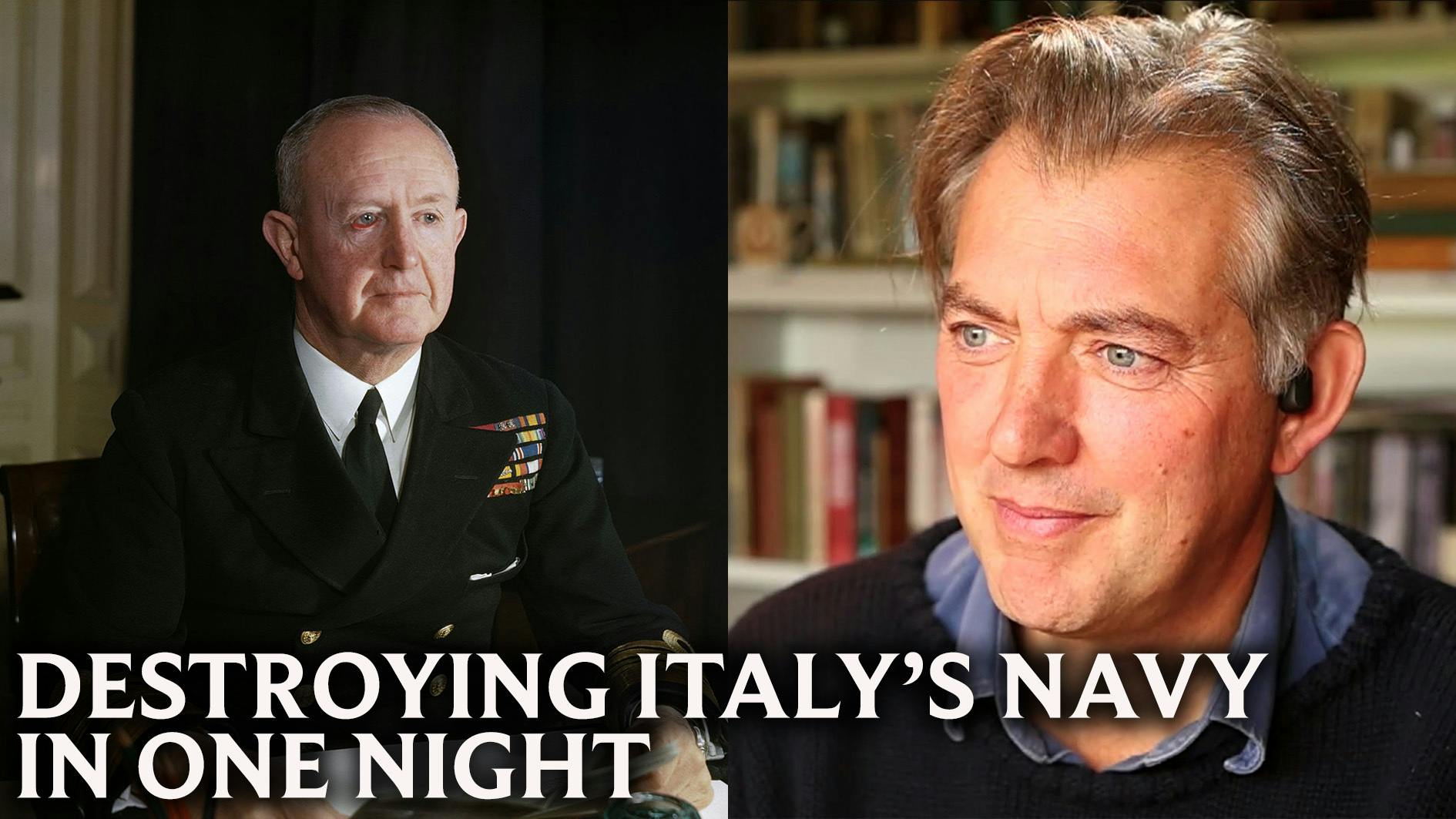
Speaker 1 That was, of course, Admiral Sir Andrew Brown Cunningham, ABC, Commander-in-Chief of the Mediterranean Fleet, aboard HMS Warspite off Malta on the 10th of January, 1941.
Speaker 1 Welcome to We Have Ways of Make You Talk with me, Al Murray and James Holland, your World War II podcast for all your World War II podcast needs. And this is our first episode of Fortress Malta.
Speaker 1 Jim, here we are. This is where you came in, isn't it? It is where I came in.
Speaker 5 It's my origin story for the Second World War. And I've got to say, what a joy it's been to revisit A Sailor's Odyssey by Admiral of the Fleet, Lord Cunningham of Heinhope.
Speaker 5
Very much cut from the Nelsonian cloth, an aggressive sea dog. He's a wonderful fellow.
Pictures of him are, you can see that he's got a twinkle in his eye.
Speaker 5 There's crow's feet extending from the side of his eyes. You know, he's a man of a sense of humour, but also he's sort of cussed and determined.
Speaker 5 And it's the face etched from long years standing on bridges being sort of sprayed by briny water and kissed by the Mediterranean sun.
Speaker 5 You know, he's on warspite with the great battleship, which he uses as his flag. And yes, I mean, the illustrious gets an absolute ham ring.
Speaker 5 But I think, you know, to start off with, we need to do a little bit of, we need to go back in time because this is this is the very beginning of January 1941.
Speaker 5 And of course, the siege of Malta starts the day after Mussolini declares war on Britain and France on the 10th of June 1940. So 11th of June is when Malta's war really begins.
Speaker 5
And the air raid siren rings out over the island just before 7 a.m. on that second day, 11th of June, 1940.
Italian bombers appearing at some 14,000 feet.
Speaker 5 I mean, that's just ludicrously high for to attack an island that's smaller than the Isle of Wight.
Speaker 5 First explosions are in the south towards Halfar airfield, but with absolutely no accuracy whatsoever, as you can imagine. And Flight Lieutenant George Burgess is on readiness.
Speaker 5 He's been on readiness since 6.30 that morning. Or rather, readiness in theory as he's sitting on the lavantry when
Speaker 5 the siren rings, which is a common occupation for people on Malta, it has to be said.
Speaker 5 He hurriedly pulls up his trousers, dashes to his Gloucester Gladiator, Sea Gladiator, hurtles down the runway, and then he's airborne.
Speaker 5 And Burgess is really a flying boat pilot, but has been made personal assistant to the air officer commanding, who is Air Commodore FHM Maynard, back in January 1940.
Speaker 5 But at the beginning of May, had volunteered for the new Malta fighter flight using these Royal Navy Gloucester Gladiators.
Speaker 5 And there's only four of them, and the idea is that it it would never have more than two in the air at any one time. But on the 11th of June, he's one of the two taking off.
Speaker 5 You can see explosions around how far airfield, but can't remotely catch the Italian bombers because his gladiator's not quick enough.
Speaker 5 Buildings around the dockyard are hit, and one bomb lands on the upper part of Fort St.
Speaker 5 Elmo, which is right at the very end of the little finger of Valletta, the capital, which extends out into Grand Harbour on the south side and Marsomshet Harbour on the north side.
Speaker 5 It hits a Royal Malta artillery position, killing six people outright, including Philip Bussertil, who's a 16-year-old duty telephonist. Gosh.
Speaker 5 Lasts about 20 minutes and then it's all clear and that's the beginning of it.
Speaker 1 The British, for all their like imperial perspective of things, and you know,
Speaker 1 let's be honest now, in the 1930s, they agonise about where they should spend their money and how they protect their imperial possessions across the world.
Speaker 1 There are no firm plans for Malta should the island come under attack.
Speaker 5 Oh, there.
Speaker 1 It's not that they've been taken by surprise.
Speaker 5 It's just completely taken their eye off the ball.
Speaker 1 After the start of Blitzkrieg, the governor, Lieutenant General Sir William Dobby, has advised those in the cities with relatives in the countryside to move there.
Speaker 1 As you said, it's a tiny island, so I suppose that might help. But people do now begin to flee.
Speaker 1
They've ignored that, but they do now begin to flee. Now it's sort of started.
But as ever, you get this thing where people are shocked to be under attack.
Speaker 1 So soon into the war, and they've gone to work because they don't think it's possibly going to happen. We're going to end up talking a lot about the fighty defense of the islands.
Speaker 1 There are echoes of the Battle of Britain, aren't there? Italy's not very far away. It's not that difficult for the enemy to muster planes and put them over Malta in pretty quick order.
Speaker 1 It's only 60 miles away, but the Italians up to this point have been their neighbours and now they're bombing them.
Speaker 1 And it's always this thing as well with the Second World War is the first bombing raid never really amounts to much, does it?
Speaker 5
Well, it's just such a shock. I think that's the thing.
You know,
Speaker 5 Malta hasn't been bombed from the air before. So this is an entirely new experience.
Speaker 5 You know, obviously they've been sort of following events of what's been going on, but, you know, no one knows how to react and what to do. And the island itself is underprepared.
Speaker 5
There's another raid in the afternoon of the 11th of June. And, you know, the Channelists try and bomb the airfields of Lucca and Tikali.
There's three airfields on Malta. Lucca, Tikali, and Halfar.
Speaker 5
None of them were very successful. There was another raid in the evening.
This was meant for the dockyards, but most fell on Cospicua, which is one of the three cities.
Speaker 5 So south of Valletta, which is this finger that sticks out into Grand Harbour, there's... Three further little fingers sticking out
Speaker 5
into Grand Harbour, and they are known as the three cities. So Saint Clair, Cospicu, and Vittoriosa.
And 22 people are killed, you know, and this is it. You know, the siege of Malta has begun.
Speaker 5 That's it. And it will continue until kind of back end of 1942, which is what we're going to be covering in this six-part series.
Speaker 1 But we touched on it earlier, that Malta is part of the British Empire, the imperial picture. Why? Why have we got this tiny little plug of land? I mean, and it couldn't be better placed.
Speaker 1 If what you need is to get from one end of the Mediterranean to the other, and you maybe need air cover on your way from the Straits of Gibraltar all the way to Alex,
Speaker 5 it couldn't be more perfectly placed for the strategic situation that's going to unfold in the second world war could it it is literally bang in the middle it is not quite equidistance between alexandria and gibraltar but but it kind of it almost is and you know it's 60 miles off the coast southern coast of sicily so it's it's bang in the way of any any italian shipping wanting to go to north africa to go to libya for example um it's not a million miles from from tunisia you know it's within striking distance of northern tunisia so yeah it is it's incredibly well well placed And it's got these two fantastic harbours.
Speaker 5 It's got Grand Harbour and Marsomschett Harbour, which are 80 feet deep and 70 feet deep, respectively, which basically means that anything can get into it.
Speaker 5 And the nature of the three cities, these little fingers sticking out, means you've got these really quite well protected dockyards as well.
Speaker 5 So it's been the centre of the Mediterranean fleet, you know, since since 1800. And this is because Napoleon's France, the French have invaded Malta in 1798.
Speaker 5
And after the Battle of the Nile, Nelson sails into Grand Harbour. The Maltese rebelled against the the French occupiers.
The Royal Navy is bombarding the French. The French give up.
Speaker 5 And so they take it over. And Nelson says, I hope we shall never give it up.
Speaker 5 And this is a view that's sort of echoed very much 140 years later by ABC, Admiral Andrew Brown Cunningham, who we heard it earlier at the beginning. Yeah, ABC is a terrific figure.
Speaker 5 And, you know, he's an absolute Mediterranean man, a bit like Nelson was, and spent much of his career in the Mediterranean, knows literally every nook and cranny and stretch of the coast intimately.
Speaker 5 And Malta had been the home of the Mediterranean Fleet until it moved to Alexandria on the 30th of April that same year, 1940.
Speaker 5 And ABC, as Commander-in-Chief of the Mediterranean Fleet, he might now be based in Alexandria, but he absolutely believes that British domination of the Mediterranean is totally vital for their war efforts.
Speaker 5 Of course he does, but for good reasons, frankly. So you've got Gibraltar at the western end, which is a gateway to the Atlantic.
Speaker 5 You've got Alexandria at the eastern end with access to the Suez Canal. And as we say, Malta, 17 miles by 9,
Speaker 5 bang in the middle. As a strategic stronghold, you couldn't ask for more.
Speaker 1 Yeah, particularly if you're going to end up having to fight, you know, another war further east as well.
Speaker 1 That if you need to be able to keep things joined up, let's say it kicks off with Japan, it's going to be incredible.
Speaker 1 I mean, it's actual importance globally, strategically, Malta's importance, I think can't be understated.
Speaker 1 It's probably the most important single piece of real estate in the Mediterranean, without a doubt, but globally as well.
Speaker 1 If you're going to join up the naval daisy chain that gets you to Singapore and beyond, you need Malta.
Speaker 5
Yeah. Yeah, yeah, yeah, absolutely.
When Nelson, you know, kicks out the French in 1800 with the help of the Maltese revolting. It is the Maltese that ask Britain to stay.
Speaker 5 They say, will you stay and be, you know, can we be part of Britain?
Speaker 5
And, you know, it's a mutual back scratching thing because the Maltese then have a protector because they're very vulnerable where they are. And the British has a big base.
So, you know, of course.
Speaker 5
And Malta is formally annexed to the British crown in 1813. So it's like Gibraltar, it's like the Falkland Islands.
You know, it's like these other possessions that Britain has. It is British.
Speaker 5
It's got, you know, in 1939, it's got red letter boxes and all the rest of it. You know, it is British.
And in one level, it's a very unusual match because, of course,
Speaker 5 the British are northern Europeans and Protestants, and the Maltese are all, for the most part, completely devout Catholics. But somehow it kind of works well.
Speaker 5 And of course, you know, the British being there brings a huge amount of jobs, you know, into naval dockyards and stuff.
Speaker 5 You know, it's been a productive relationship for the quarter of a million Maltese. And Malta is really interesting.
Speaker 5 You know, the language itself has this sort of weird blend of sort of Arab and European influences. Valletta and the three cities are absolutely magnificent.
Speaker 5 So is Medina, right in the center of the island. Now, these are huge sort of classical Renaissance cities with huge star-shaped bastions.
Speaker 5 And it was these bastions that resisted Suleiman the Magnificent and the Ottomans in the first great siege of 1565. And they're still there to this day.
Speaker 5 I mean, you go there and there they are and it looks completely formidable. So it's not just that it's got these harbours, it's also got natural defenses as well.
Speaker 5 But obviously, that was then and this is now and it's 1940 and you need a bit more than just bastion walls and cannons. You need anti-aircraft guns and you need loads and loads of aircraft.
Speaker 5 And that's what they don't have. And the bottom line is Malta is badly underdefended.
Speaker 1 Which is remarkable, isn't it? Really? Given what we've said about how important it is. But also
Speaker 1 a sign of problems with defence spending in between the wars and the lack of money and the unwillingness of successive governments to cough up.
Speaker 1 You only have to look at the way they dither about what to do about Singapore in the British government in between the wars.
Speaker 1 Somewhere less in people's minds as an imperial possession down the pecking order isn't going to do well at all. There's so much controversy around defending Singapore.
Speaker 1 So Malta's going to end up right at the bottom of the ladder, isn't it, for that?
Speaker 5 If you have a Mediterranean policy which they do in the 1930s and you're determined to protect the suiz canal and malta is right in the middle of the mediterranean you should defend it and and the bottom line is is because it's so small actually to defend it heavily doesn't require a huge amount you know it's not like you're defending france or you know the whole southern coastline of england or or anything like that i mean you're talking about a pretty tiny island there is scale here and you've got three airfields you know use them yes you know you've got these bastions great places to put anti-aircraft guns.
Speaker 1 But there's this failure of imagination around
Speaker 1 the entire thing. The Navy are getting its big battleships as and when treaty allows, but everything sat everything further down the pecking order in terms of defence spending.
Speaker 1 It's just, it's incomplete.
Speaker 1 It's only after the Pact of Steel, you know, the declaration of sort of allegiance between the Italians and the Germans in May 39 that the Committee for Imperial Defence say, all right, yes, let's reinforce it.
Speaker 1 But even then, it's nothing like what's going to be needed.
Speaker 5 Yeah, but also, you know,
Speaker 5 you've had the Spanish Civil War, you've had the Abyssinian crisis in the mid-1930s.
Speaker 5 So there are already, just in those two conflicts, there are plenty of indicators that Malta's position at the heart of the Mediterranean is quite vulnerable if you don't reinforce it.
Speaker 5 1938, ABC is deputy chief of the naval staff and he's continually pressing for reinforcement of Malta and it's not being heard.
Speaker 5 Even after the Pact of Steel in May 1939, you know, they agreed to send over 112 heavy anti-aircraft guns and 60 light anti-aircraft guns, 24 searchlights and four fighter squadrons.
Speaker 5
And almost none of it has been delivered by the 11th of June 1940. They're short of 78 heavy guns, heavy anti-aircraft guns, 38 light anti-aircraft guns.
You know, they have no fighters at all.
Speaker 5 I mean, they certainly don't have three fighter squadrons. I mean, they've got nothing.
Speaker 5
They've got four battalions of infantry, King's Own Malta Regiment, from which one company is made up from Boy Scouts. It's not ideal, is it? No.
A few fairy swordfish.
Speaker 5
One radio-controlled Queen Bee, which is of absolutely no use whatsoever. It's hopeless.
Yes.
Speaker 1 Well, it's because the defence of England has been prioritised, doesn't it? It's as simple as that. And at this point, the air defence of England is also untested, isn't it?
Speaker 1 That this is the thing, that the things we take for granted as the way you fight this stage of the Second World War are not in place yet. Or if they are, they're untested.
Speaker 1 And Malta being that far downstream, priority-wise, it's just that the lack of vision
Speaker 5 is quite extraordinary.
Speaker 1 It's absolutely boggling, given that the people are, you know, you've got Cunningham on the ground. He's He's deputy chief of the naval staff.
Speaker 1 It's going to be his theater, and yet he can't get his way. And I find all that very interesting that people are not able to get this taken seriously.
Speaker 5 Air Commodore Maynard, you know, once it all kicks off in France in the beginning of the 10th of May, 1940, suddenly thinks, Crikey, we haven't got our four fighter squadrons.
Speaker 5
Yeah, we've got no fighter planes at all. I've got just a handful of...
fairy swordfish and that's it. What am I going to do?
Speaker 5 And he then discovers there are 18 sea gladiators in crates, you know, all boxed up at California Sea Plane Base, which is right on the south, just below Halfar airfield.
Speaker 5 And the Navy intends to reassemble them and then send eight to HMS Glorious and 10 to HMS Eagle, which are two aircraft carriers.
Speaker 5 And so Maynard signals to ABC and says, can we have the, you know, the 10 gladiators which are going for the Eagle? And ABC says, yeah, sure.
Speaker 5 So in April 1940, four of the gladiators have been assembled and formed into the Malta Fighter Flight at Halfar. But Maynard has no trained fighter pilots at all.
Speaker 5 So Arsenal volunteers, which is why George Burgess, who we mentioned earlier on, is one of the ones that kind of volunteers along with seven others.
Speaker 5 The Royal Navy then veto the decision, you know, go over the head of ABC. So they're dismantled again, only for the decision to then be reversed once again.
Speaker 5 And so the Malta fighter flight is reformed, but with just three planes. And the fighter flight is split into two flights, flights of three pilots with no more than two airborne at any one time.
Speaker 5 I mean, you know, three Gosta Gladiators. It's not a lot, is it?
Speaker 1 No, it's not a lot. I suppose, actually, in May 1940, it's not the best time to get onto the phone to the RAF and go, we need some planes over here, please, is it?
Speaker 5 They're going to go, nah, you're not.
Speaker 1 Decisions being vetoed from far away is very much the story of the siege of Malta. But the Mediterranean fleet itself.
Speaker 5 It's also under strength, isn't it? And that's because the priority has gone to the home fleet for obvious reasons.
Speaker 1 Yeah.
Speaker 1 And
Speaker 1
they're lacking submarines. There's only 12 submarines in the Med in May 1940.
The Italians have 115.
Speaker 5
It's unbelievable. Yeah, but you know, but Italy's make all its effort in the Mediterranean, can't it? Yeah, exactly.
Of course. Yeah, Britain's got a global effort, e even in at this stage.
Speaker 1 If yes, if it's not really taking it very doesn't seem to be taken particularly seriously.
Speaker 1 There are plans to build big sub-pens under Valletta bastions, but it doesn't happen.
Speaker 5
Yeah, and you can see the start of them, actually. You can see where they were starting to build them.
Then they just they got abandoned.
Speaker 5 So they're right underneath Valletta on the on the Marsam Scheppt harbour site on the northern side of Valletta.
Speaker 5 You can still if you go along there, you can still still see the starts of the tunnels, and they just never finished them. There is a commander of the Mortar submarine force.
Speaker 5 This is Lieutenant Commander R.G. Pop Giddings, as he's known, he's known as Pop Giddings, who's only part-time and spends most of the time as a wine rep.
Speaker 1 That doesn't surprise me. I mean, when you read David Niven's memoir, The Moon's Balloon, when he talks about being on Malta in between the wars as a subaltern, and it's cricket and gin.
Speaker 1 You know, they're not particularly leaning into the soldiering, so it doesn't much surprise me.
Speaker 5 And there's a new governor, because General Sir Charles Bonham Carter, who's been around for a little while and is generally a good egg.
Speaker 5 He falls falls ill in the spring of 1940, so he's replaced by Dobby, who is very devout and a member of the Plymouth Brethren. He's come from, I think he's come from Singapore or Malay or somewhere.
Speaker 5 So, so, you know, he is a sort of complete out and out extreme Protestant, governor of an extreme Catholic island. I mean, who thinks of these things?
Speaker 5 I mean, you know, and Dobby is, you know, he's all right, but he's a bit sea-less, really.
Speaker 5 You know, and his appointment sort of adds to the kind of general belief that Malta's sort of a long way down the pecking order when it needs to be a lot higher.
Speaker 1 What is the relationship, though, between Cunningham and the top? All of the things we're talking about are legacies of the government, of the Chamberlain government, aren't they?
Speaker 1 Of its state of preparedness. As of May the 10th.
Speaker 5 I don't think we need to worry about Malta.
Speaker 1
Exactly. We're looking at a change of management at the top.
And what difference does Churchill coming in make?
Speaker 5
Well, it makes a massive difference because he's not going to give up anything. That's the whole point.
You know, we'll never surrender and we'll never surrender any of our territories.
Speaker 5 Saying never surrender means apart from the Channel Islands, obviously. But Churchill, you know, he's thinking globally, isn't he? Always, he's thinking, okay, what's our next moves?
Speaker 5 You know, okay, we might be a bit snooked here, but you know, we're going to need the Suez Canal. You know, what about India? How are we going to get there? You know, we need to, we need our
Speaker 5
protectorate of Egypt. We need X, Y, and Z.
And, you know, Malta is a. Churchill can completely see its strategic importance.
He's not going to give it up. No way, Jose.
Speaker 1 So, so, in that sense, the change for the likes of ABC, that change in management is a good thing, isn't it?
Speaker 1 Because, as you said, Cunningham's thing is Nelsonian aggression and finding the enemy, engaging him, destroying him, putting him off, styming him any way he possibly can.
Speaker 1 So the change in situation suits ABC enormously, doesn't he? And although the Italians do outnumber the Mediterranean fleet, they're not technologically nowhere near as advanced.
Speaker 1 They don't have radar, for instance, and they don't have any aircraft carriers. And ABC is expecting...
Speaker 5 They're not as well trained either.
Speaker 1 Yeah, it's expecting them to attack but they don't the Italians lay mines outside the harbour at Alexandria while the fleet's um out
Speaker 1 but you know they get round those he returns refuels vitals heads out to sea again and the bombards the Libyan coast sinks six Italian subs immediately cunning
Speaker 5 109 to sort out
Speaker 1 yeah well exactly yes quite right yeah but but Dudley Pound Admiral Dudley Pound is the first sea lord. He's really worried about holding on to Malta if France is knocked out of the war.
Speaker 1
What can actually be done? And this is fascinating. On the 17th of June, he writes to ABC saying, we may have to evacuate Malta.
We may need to pull the plug.
Speaker 1
And Cunningham replies, this is a bad idea. The consequences are unthinkable.
It would lead to the loss of the Mediterranean, Egypt. Middle East, etc.
Speaker 1 And as you said, luckily, Churchill has no intention. So Pound is seen off.
Speaker 1 Cunningham's been able to get support from Churchill for that kind of attitude far more than he was from the previous government.
Speaker 1 Although this now means you do lose the southern French coast, everything's just getting much more difficult, isn't it?
Speaker 1 And at this stage, of course, they don't know which way the French Navy's going to jump either, do they? Which is really adding to the pressure.
Speaker 5 But, you know, but Churchill and ABC's view is you don't even think about evacuating until you absolutely have to. And at the moment, you know, look, we've still got the Mediterranean Fleet.
Speaker 5 The Mediterranean Fleet is still sizable. You know, crack on.
Speaker 1 at this stage of the war when churchill's brand new it's the people between him and the decision getting actually enacted that means all sorts of stuff he says needs to happen doesn't happen or happens quite in quite a different way to the way he expects or the with the air ministry intervening or the air ministry prioritizing its own decisions despite what he said i think every episode we're going to say just send spitfires to malta at some point in every episode so i just want to broach that here just send spitfires to malta so what are the what are the malta fighter flight up to at this at this early stage of the siege well they're they're doing their best i mean they're taking up every you know they're taking off every day the two of them uh and the problem is is that you know they're slow to climb and you know they try and reduce the time it takes them to take off by just sort of being strapped into their cockpits ready you know they're seen so it's it's giving the islanders a bit of a bit of a boost Harry, they get their name, they're called Faith Open Charity, because eventually they get another one.
Speaker 5 And so they get another one out. So they do sometimes have three in the air.
Speaker 5 And Harry Kirk, who's an RAF corporal at RAF headquarters in Scott Street in Valletta, sees the three gladiators in the sky.
Speaker 5 He thinks they remind him of the three silver hearts on a brooch of his mother's. And each heart on the brooch had a name, Faith, Hope, and Charity.
Speaker 5
So he points up and goes, look, there goes Faith, Open Charity. And the name snuck.
And George Burgess, you know, he notices it.
Speaker 5
People got the impression that our aircraft were shooting down enemy planes death, right, and center. They didn't, but morale was kept high.
So, you know, they have a value definitely.
Speaker 5 By 21st of June, they have two more gladiators, but then that morning, one crashes on takeoff and a second crashes on landing the same day.
Speaker 5 And so although the pilots walk away, two-fifths of the planes are now out of action.
Speaker 5 But what they do do is that, you know, they've got, I mean, this is sort of a product of being on an island like Malta.
Speaker 5 There's lots of people with ingenuity and make do and mend and sort of, you know. So they managed to shorten the wings and soup up the engines so that the performance is massively increased.
Speaker 5
So they can now climb faster than a hurricane. And the first two hurricanes arrive on the 21st of June.
They think they're just staging on their way to Egypt.
Speaker 5
And they're told, no, no, no, you're staying here. And they're really not happy about it at all.
But anyway, it was tough.
Speaker 5 So Dobby sends messages to the war office on 12th of June, pleading for more fighters. And six hurricanes arrive on the 13th of June.
Speaker 5 He's told they can keep them because they're on their way to Egypt, but the message doesn't get through, so they do go. Then the two arrive on the 21st of June and they're told to stay.
Speaker 5
And six more arrive on the 22nd of June, which fly down actually through France. So on the day that France signs its armistice.
And those are the last ones to arrive that way.
Speaker 5 You know, from now on, they're coming into on aircraft carriers at the mouth of the Mediterranean and flying 700 miles, 800 miles down the Mediterranean to Malta. It's not an easy job.
Speaker 5 George Burgess shoots down the first enemy plane, an SM, a Savoya Macheti 52 bomber over Valletta, and it's seen diving into the sea by Faza's famous photograph of it.
Speaker 5 You know, that's the first aerial victory they have after, you know, 11 days.
Speaker 1 It's like firing guns, firing the anti-aircraft guns doing the Battle of Britain, isn't it? As long as it's something seen to be done, morale may stay intact, you know,
Speaker 1 and certainly you shoot a play down, everyone sees it go down in flames.
Speaker 5 Jackpot.
Speaker 1 However, as you said, the 22nd of June is the French armistice.
Speaker 1 As we said, if France falls... the French coast falling into enemy hands, if it does, and what the French Navy is going to do is hugely important and could really alter the fate of Malta.
Speaker 1
And we'll take a break and after it, we will return with the Battle of Calabria and the first proper dust up in the med, ABC getting his guns onto some Italian targets. Jolly good.
Carry on.
Speaker 1 Enemy on the starboard bow. See you in a tick.
Speaker 6 Jamie Lee Curtis and Lindsay Lohan are back in Disney's Freakier Friday, now streaming on Disney Plus.
Speaker 5 We switched bodies.
Speaker 1 I am freaking out right now. I think I just peed a little.
Speaker 6 It's an absolute riot.
Speaker 6 And the only movie that can be described as so much weird than the last time.
Speaker 4 What last time?
Speaker 6 It's the frequel. You ready? We've been waiting for.
Speaker 4 That absolutely slays.
Speaker 6 Disney's Freakier Friday, now streaming on Disney Plus, Rated PG.
Speaker 8 The holidays mean more travel, more shopping, more time online, and more personal info in more places that could expose you more to identity theft.
Speaker 8 But LifeLock monitors millions of data points per second. If your identity is stolen, our US-based restoration specialists will fix it guaranteed or your money back.
Speaker 8 Don't face drained accounts, fraudulent loans, or financial losses alone. Get more holiday fun and less holiday worry with Life Lock.
Speaker 9 Save up to 40% your first year. Visit lifelock.com/slash podcast.
Speaker 8 Terms apply.
Speaker 7
Rainex wipers are the number one wiper blades in America. That means all kinds of drivers choose Raynex.
Big drivers and small cars choose Raynex. Small drivers and big cars choose Raynex.
Speaker 7
Drivers with long hair and short commutes choose Rainex. Drivers with short hair and long commutes choose Raynex.
Drivers with pets on board, babies on board, and bored babies on board choose Raynex.
Speaker 7 Basically, drivers who love a clear view of the road all choose Rainex wipers, the number one wiper blades in America.
Speaker 1
Welcome back to We have Ways of Making You Talk with me, Armory, and James Holland, episode one of our Siege of Malta. So, Jim, we promised people the Battle of Calabria.
Let's give it to them.
Speaker 5 Well, yeah, so the first convoy headed from Alexandria to Malta leaves on the 7th of July.
Speaker 5 So the fleet goes out to support it. And as they're heading out into the sea, you know, on the 8th of July, ABC gets the news.
Speaker 5 He's on the bridge of HMS Warspite, the great battleship, that the Italian fleet has been spotted by a Royal Navy submarine 200 miles east of Malta.
Speaker 5 So ABC orders the Malta seaplanes to shadow the Marina Militare.
Speaker 5 The Italians have also spotted the mediterranean fleet so you know wrecking planes are flying over them and then bombers but yet again they're too high and bombs are unlikely to hit a ship from 12 000 feet i think um it's fair to say and lo and behold they don't then reports come that the italian fleet you know they've dropped some bombs they can go back to base now um so they're heading back towards italy and abc changes course in an effort to come between them and their base the following morning the mediterranean fleet is now only 90 miles west of the italians but outnumbered and outgunned but you know that's not going to put him off and by three o'clock that day he's in range range enemy battle fleet in sight is relayed from hs neptune the first time the by the british mediterranean fleet since nelson that's abc notes in his magnificent memoir it was a great moment for neptune i mean he's just splendid isn't he
Speaker 5 anyway italian cruisers open fire as does war spite at a range of 13 miles the italians then retreat behind a smokescreen ABC and the fleet, you know, they press on at four o'clock on the dot, the enemy flagship is hit.
Speaker 5 And the amazing thing is that admiral riccardi who's on the the italian admiral who's on the uh on the flagship he's an old friend of abc's yeah you know they've known each other because they've been doing maneuvers and stuff in the early 1930s don't forget italy was an ally being originally yeah the biggest exporter to italy is britain in the 1930s 90 of italy's coal comes from britain so you know they're all they're all sort of not exactly besties but you know they're on good good order um and then suddenly it's sort of you know it's all changing anyway but it's too much a bloody nose for riccardi and and having been hit he then sort of retreats and that's that.
Speaker 1
Yeah. But the point is, is the British press on.
Don't give the Italians a minute off. You know, destroyers are pursuing the Italians.
And they get within, I mean, it's amazing.
Speaker 1 They get within 25 miles of the Italian coast. I mean, talk about making yourself vulnerable to air attack.
Speaker 5
Well, and they are vulnerable and they get attacked. And Warspite's straddled by 24 different bombs at one point.
But lo and behold, the Italians don't hit anything again.
Speaker 1 The thing to remember with all of this and those air raids on Walter Early, it's everyone's first go, right? They're only going to get better at it.
Speaker 1 What's quite clear from Calabria is you need air cover.
Speaker 1 You need carriers, especially if you're going to do offensive operations and here we go here's the classic churchill early war churchill intervention where he goes look
Speaker 1 there's an obvious solution here writes a memo so on the 12th of july he writes to his mate the contacts we've had with the italians encouraged the development of a more aggressive campaign against the italian homeland by bombardment both from the air and sea it also seemed desirable that the fleet should be able to use malta more freely.
Speaker 1 A plan should be prepared to reinforce the air defenses of Malta in the strongest manner with AA guns of various types and with airplanes.
Speaker 1 Let a plan for the speediest anti-aircraft reinforcements of Malta be prepared forthwith. Well, I'm not going to say it, but dream on.
Speaker 5 It's very Churchill, isn't it?
Speaker 1 That yeah, it's very Churchill. It's like, you know, he's got, there's all sorts of people between him, his conception of the action and the action being carried out.
Speaker 1 Certainly at this stage of the war when he's brand new and no one, they're thinking, oh, God, here we go.
Speaker 1 Churchill also says to Dudley Pound, who we mentioned earlier, I do not understand what he's meant by reviewing the whole Mediterranean situation.
Speaker 1 It is now three weeks since I vetoed the proposal to evacuate the Eastern Mediterranean and bring Admiral Cullingham's fleet to Gibraltar. I will hope there will be no return to that project.
Speaker 1 So in other words, Navy's doing whatever it wants, and he might have said, sort this out, but they're not listening. This is what happens at this stage of the war, though, isn't it?
Speaker 1 When he's newly in office.
Speaker 5
Yes. To be fair, Malta does get reinforced.
You know, don't forget, this is, we're talking about July 1940 here. What, you know, there is something else going on at that point.
Speaker 5
Britain's quite distracted, so HMS Illustrious is sent to join the Mediterranean fleet. Get out there.
And more supplies are sent. You know, so a series of convoys are arriving.
Speaker 5 You know, 2nd of September, three ships, including a tanker, 40,000 tons reach Grand Harbour's, another one in November. You know, the truth is, the Italians aren't really pressing home their attack.
Speaker 5 That's the usual lack of enthusiasm from the actual people doing the fighting. First fighter pilot is only killed on the 16th of July.
Speaker 5
And only one of the gladiators is actually lost in the air, and that's Charity, which is shot down on the 31st of July. Burning like a magnesium flare.
Bits of it have been recovered.
Speaker 5
It's now being rebuilt, I'm glad to say, at Takali. Italians have lost 12 aircraft by the end of July.
It's a pretty small beer, isn't it, really?
Speaker 1 The Italians have come into this stage of the war thinking it's the end of the war, right?
Speaker 5
Yeah, yeah, completely. And there's no plan, clearly, for invading Malta.
They just think it's all going to be handed on plate. They're expecting Britain to see for peace.
Speaker 5 So they're just, you know, this is just a sort of, this is a bit of pressurisation.
Speaker 1 Well, show willing to Germany when Germany applies the thumb screws in, whatever settlement's coming, isn't it? We had a go, so we deserve Malta.
Speaker 5
Yeah. But 12 more hurricanes arrive on the 2nd of August.
Again, none of the pilots have been told beforehand.
Speaker 5 They all arrived in Malta thinking it's a staging post, and then they're told that, you know, it's not. So Maynard, as a AOC, the air officer commanding, has now got 15 planes and 18 pilots.
Speaker 5
So the Malta fighter flight becomes 261 Squadron on the 16th of August. It's first Malta squadron.
The Illustrious is now on its way to the Mediterranean. Also, the battleship HMS Valiant.
Speaker 5 And both of these crucially have on-board radar. And Churchill writes to ABC on the 8th of September.
Speaker 1 It is of high importance to strike at the Italians this autumn, because as time passes, the Germans will be more likely to lay strong hands upon the Italian war machine, and then the picture will be very different.
Speaker 1
And he's not wrong. Yeah.
The prescience in that is quite something.
Speaker 5
No, he's absolutely spot on. And as it happens, ABC has already been planning an attack.
And this is on the Italian fleet's harbour at Taranto, which is in the kind of soul of the... boot of Italy.
Speaker 5 And he plans it to be launched on the 21st of October, which is Trafalgar Day, of course as all naval types know and this requires very careful reconnaissance of course and so three Glen Martin Marylands which are twin engine bombers or reconnaissance craft whatever you want to want them to be the American built they touch down at Lucca on the 6th of September again having flown over France on the way you know it's a risky route but pays off in this occasion and one of those on board is one of the legends of Malta he's a pilot called Adrian Warburton but he's not flying he's an he's a navigate he's doing the navigating he's got an absolutely hopeless record.
Speaker 5 He is the qualified pilot in the REF who flies the least in the Battle of Britain. He eventually gets his, you know, he's got his wings the previous year with a below average mark.
Speaker 5 He's completely weird and eccentric. Marries a barmaid called Betty, who's much older than him and already has a daughter in Portsmouth.
Speaker 5 Does it in secret without telling any of his family and racks up gambling debts and is in a sort of you know in a terrible state, awful at landing and awful at taking off as well.
Speaker 5 Anyway, he's sent to Moulton to get him away and as a navigator rather than a pilot. And the 431st reconnaissance flight is commanded by Flight Lieutenant Titch Whiteley, who's an Aussie.
Speaker 5 And he's just got to make the best of his limited resources, which is basically three aircraft, a few spares and a ragtag air crew.
Speaker 5 But the amazing thing about Warby, as he's known, Adrian Warburton, is that he quickly proves excellent as a navigator and really amazing at spotting ships.
Speaker 5 He just has this incredible 2020 vision, superb eyesight.
Speaker 5 And when Moulta Dog, which is a sort of particularly virulent form of dysentery, gets one of whiteley's pilots he's forced to give warburton a another go so
Speaker 5 on his first flight you know his his um sortie is abandoned owing to hydraulic failure and the aircraft crashed on landing and what really happens is he zigzags so badly taking off that the wheels come off jeepers so he's nearly taken off flying again but they're so short of pilots that whiteley doesn't really have any choice and so on his second flight Warby does manage to take off and land again without mishap and so from thereafter he's starting to to be used a bit more frequently.
Speaker 5 I think the big problem is he just hasn't had enough flying hours, is the truth of it.
Speaker 1 Yeah, well, and also, I mean, these Marylands, it's it's different types, isn't it?
Speaker 1 Everything takes them getting used to, but he becomes like a seam through the story of the siege of Alta, as we'll see.
Speaker 1 Well, so Cunningham's, you know, needs no encouragement by Churchill for being aggressive, as you've pointed out.
Speaker 1 He's planning this attack on Taranto, but he's also asking for more submarines because, in the med, the possibilities for submarine warfare are fantastic, aren't they?
Speaker 5 It's the truth, Yeah, absolutely.
Speaker 5
And so Commander George Shrimp Simpson, he's always known as Shrimp. He's 39 years old.
He's a hugely experienced submariner. He's served in submarines since 1921.
Speaker 5 At the time of his appointment, he's the second in command of the third
Speaker 5
submarine flotilla at Harriage on the East Anglian coast. But then in September, he's given his orders to go to...
to go to fly to Egypt and then take over on Malta. And the Malta submarine base is
Speaker 5 going to be set up on Manuel Island, which is this little island in the middle of Marsam Shet Harbour, which is the one to the north of Valletta.
Speaker 5 There's a building there called the Lazaretto, and this is the old quarantine.
Speaker 5 So, because people were coming into Malta, they were quarantined there until they're sort of cleared of smallpox or whatever. And it's the most amazing place.
Speaker 5 I mean, it's been under construction and development and scaffolding ever since I've been going to the island, and it still is to this day.
Speaker 5 But I did get on there about a dozen years ago, and you can see all this incredible graffiti on the walls, including one from Byron. Caravaggio was there and various others.
Speaker 5
I mean, it is the most amazing place. But this is going to be the submarine base.
And they're also going to be given a new type of submarine, which is the Unity class.
Speaker 5
And these are really training boats. They're much, much smaller with a crew of only kind of sort of 31, 32.
You know, the bigger British submarines are about sort of 80 to 90 meters long.
Speaker 5
The U-class are nothing like that. But the key thing, they're USP for the Mediterranean.
So they're very quick to dive. And you need this because the waters in the Mediterranean are very clear.
Speaker 5
So it's very easy to spot them from the air. Very different to operating in the Atlantic.
Yeah. So they're on their way.
Again, they're not there yet, but you know, things are in motion.
Speaker 5 In the meantime, ABC is now planning to use HMS Illustrious as one aircraft carrier for the attack on the Italian fleet. So these are swordfish, fairy swordfish.
Speaker 5 I think we're big fans of the swordfish, aren't we?
Speaker 1 Yes, I think so. I think we're happy with being fans of the swordfish.
Speaker 5 Known as string bags.
Speaker 1 And this isn't us being ironic, like about
Speaker 5 the Defiant,
Speaker 1 which looks great in black, but that's the extent of it, right? The thing about the swordfish is don't let the appearance fool you.
Speaker 1 What you need on an aircraft carrier, if you're in a torpedo attack vessel, is something that can take off and land really, really easily from an aircraft carrier, right?
Speaker 1 And you need something that can fly low and stably and under the radar, just above the waves, and deliver a torpedo quietly and efficiently. And that's the swordfish.
Speaker 1 And, you know, they're not that different in their performance, say, from the kind of anti-submarine strike helicopters that follow after the war.
Speaker 1
No one ever says, oh, helicopters can only do 120 knots because that's all they can do. The swordfish is a a great piece of kit.
End of discussion.
Speaker 5
Yeah. Designed for design for three men, usually just two.
So you would have a pilot and then you'd have a tag, which is a telegraphist air gunner.
Speaker 5 So he'd have his machine guns Defiance style at the back, a brace of Lewis guns, but he'd also have a radio set as well. Open cockpit.
Speaker 5 To carry out this attack, you also need reconnaissance photographs to know what you're attacking. And so this is where the four hundred thirty one reconnaissance flight operating from Malta come in.
Speaker 5 And this is where Warby really makes his name as one of the Maltese legends. Because when they first fly over on the 9th of October, Warburton is flying as navigator to the CEO Titch Whiteley.
Speaker 5
And the CEO is just, you know, Whiteley's completely stunned that Warburton not only picks out all the ships, but names them. And they're later 100% confirmed.
So he's just absolutely nailed it.
Speaker 5
10th of October, Warby flies himself and takes excellent photographs. And suddenly, everyone's still going, well, maybe we underestimated this guy.
Maybe actually
Speaker 5
he's pretty impressive. The Zenfar in one of Illustrious's hangars.
So this sets back the date.
Speaker 5 So it's postponed from Trafalgar Day on the 21st of October to the next suitable moon, which is the 11th of November, the armistice day.
Speaker 5 And that gives him time for obviously for more reconnaissance flights.
Speaker 5 So on the 30th of October, the weather's really poor, but Wolby still flies to Taranto and still gets his pictures by coming in incredibly low under the cloud, loads of flak, gets his pictures, gets out again.
Speaker 5 On his way back, runs into Italian seaplane, shoots it down. You know, so he's obviously pretty good in the air as well.
Speaker 5 A few days later, the weather is still bad but the plan attack is getting closer so warby flies in again at zero feet the barrage balloons are low because the cloud is so low so warby weaves between them and catches the enemy completely unaware again he gets out just as the flak is getting going but has counted six battleships not five and he thinks oh there were only five yesterday and he says are you absolutely sure to the to the guys with him and the guy goes yeah yeah definitely six so he goes well warby goes no i'm gonna have to go in again goes in so low they're almost skimming the water they count five this time.
Speaker 5
The sixth one had been a cruiser. On the way out, they're pursued by four Italian planes.
And Warby's rear gunner shoots down a CR-42, which is a biplane, and another seaplane. So he's now got three.
Speaker 5
They get back to Malta. And when they land, they discover that one of the ship's aerials tangled around the tailwheel.
Christ. It's quite impressive, isn't it? How cool is that?
Speaker 5
That's absolutely amazing. So then he flies two more times over Taranto.
So the final time is on the very afternoon of the 11th of November.
Speaker 5 And this time, they really do count six battleships, along with 14 cruisers and 27 destroyers.
Speaker 5 And Taranto is quite interesting because there's a Gran Mare, which is the main harbour, which is sort of out to sea kind of thing.
Speaker 5 And then there's a sort of the there's a Piccolo Mare, which is the kind of inner.
Speaker 5 You go up, there's a little sort of bridge which you can go under a little channel, which leads into this sort of inland harbour, which is where the destroyers are.
Speaker 5 The plan is... for two types of attacks, and it's the same for both.
Speaker 5 So aircraft would go in, drop flares to light up the battleships, which are the prime targets, and these are all in the Mario Grande.
Speaker 5 They then dive-bomb the cruisers and destroyers while the strike force attacks the battleships, and then that's repeated for the second attack.
Speaker 5 So, first squadron takes off of Stringbags takes off at 8.35pm. Moon is high, sky's clear, no clouds around, just a few thin clouds sort of flitting across the moon, all the rest of it.
Speaker 5 Just before 11 o'clock at night, the harbour defenses hear them, begin firing, and most of the aircraft get through and carry out the attacks as planned.
Speaker 5 And the second squadron arrives just before midnight. And in the entire attack, only two planes are lost.
Speaker 1 Yeah, I mean, it's extraordinary, isn't it? The fact that the Italians, it's not they've been given clues by relentless wreck-y of their ships in the harbour. I think they'd be on better readiness for
Speaker 1
the possibility, especially on a moonlit night. I mean, in itself.
But 431 Ricky Flight, go back the next day to look at how this has gone.
Speaker 1
Obviously, everyone wants to know if the attack has been a success. ABC's pacing the bridge on Warspite.
And it has. They've
Speaker 1
sunk or damaged three battleships. A cruiser and two destroyers have been damaged.
It's a real proper blow for the Italians.
Speaker 1
That's really underlined by the fact they move to Naples, which is further from Malta. They bug out, basically.
And it means that convoys will be able to run more safely.
Speaker 1 It's a real result for the ABC's posture in the Mediterranean, isn't it?
Speaker 5 Yeah, really. And it's showing that the Royal Navy has bested the Italian fleet, you know, and the Italian fleet has had a sort of massive confidence dent.
Speaker 5
The Mediterranean fleet has had a massive confidence boost. Yeah.
And it's just made life easier for Malta.
Speaker 5 And this is proved by the fact that, you know, at the end of November, another convoy reaches the island with no losses. Another 20,000 tons is delivered.
Speaker 5 Later in November, the fourth west, you know, the Fourth West Kents arrive, plus yet more guns, spare barrels, ammo, gun crews, RF ground crew, three and a half thousand men, you know, arrive to kind of bolster the island.
Speaker 5 There's one really bad incident, though, which is when eight hurricanes have flown to the island, 12 are sent, and eight of them get lost.
Speaker 5
They run out, you know, because the leader just doesn't know how to find it, can't do it. And they ditch into the sea and they're all drowned.
They're all just lost. God.
Speaker 5 I mean, mean, how desperate is that? But you know, the truth is, by the end of 1940, Malta's in pretty good heart.
Speaker 5 The island's still, it's not strong, and you know, it could be a lot better, but the defenses are getting stronger. They've got more anti-aircraft guns, heavier and light.
Speaker 5 Harbours are now defended, the airfields are defended, you know, the submarines are on their way to join the Malta submarine base.
Speaker 5 And there's Beauforts and Blenheims and Wellingtons arriving on the island. But it has to be said, trouble is brewing, you know, because the Germans are entering the Mediterranean sphere.
Speaker 1
Yeah, as Churchill says, as time passes, the Germans will turn their attention. We're more likely to lay strong hands upon the Italian war machine.
And this is exactly what happens.
Speaker 1 It's Rader at the Kriegsmarine, who's very, Admiral Rader is very worried about what Malta and the British holding Malta and their naval presence amounts to in terms of a threat. And Goering as well.
Speaker 1 I mean, you know, quite interesting that the Germans can figure this out. And Rader says to Hitler, the naval staff regards the British fleet as a decisive factor for the outcomes of war.
Speaker 1 It It is no longer possible to drive it from the Mediterranean as we have so often proposed.
Speaker 1 So he gets it and the Luftwaffe, you know, again at this stage of the war have been at full stretch, although Hitler has posted Fleek Corps 10, which is 200 aircraft from Norway to Sicily.
Speaker 1 So by the beginning of January, by the turn of the year, they're now set up, they're ready to go and add their weight to what's going on in the Mediterranean.
Speaker 1 Cunningham's at Malta over Christmas and then goes back to Alex before heading out again. And this is the thing.
Speaker 1 When we say Cunningham's at what we mean is him and his fleet, him and his effort, they're out at sea because he's because he's a fighting admiral. He's not doing it from a bunker, is he?
Speaker 5 But you can't attack anything if you're
Speaker 5 your own harbour, can you?
Speaker 1
No, exactly. Exactly.
He's going back to Alex, but he heads out again on the 7th of January to meet the latest convoy that's coming from Gibraltar. The second convoy of two ships follows out of Alex.
Speaker 1 But it's dawn of the 10th of January. and northwest of Malta, steering to intercept the enemy convoy.
Speaker 1 And you've got your fairy Fulmars, another fleet air arm type that probably we're best skipping over.
Speaker 5 They're flying above, keeping watch.
Speaker 1 HMS Gallant, a destroyer, hits a mine. And then at 12.30pm, two Italian torpedo bombers swoop in low and undetected.
Speaker 1 But the Full Mars try to deal with them, but minutes later, a much, much larger formation appears.
Speaker 1
Unfortunately, it's Flieger Corps 10, ladies and gentlemen. 40 Stukas.
So a proper effort. They put a huge anti-aircraft flat barrage up, but these 40 Stukas all come for Illustrious.
Speaker 1 So the Germans know exactly what they're doing. And as we said, you know, ABC is too fascinated to be frightened, mesmerized by the spectacle.
Speaker 5 I can clearly understand that. I think if I was watching 40 Stukas peeling off and attacking an aircraft carrier, I think I'd just be mesmerized with excitement.
Speaker 1 I could manage being frightened as well.
Speaker 5 No, I could manage both.
Speaker 5
They're not necessarily... So do you not think you should sort of take cover? Oh, no, no.
I'm far too mesmerized and interested interested by this fascinating sight to be taking cover.
Speaker 5 My word, look at that, isn't it? I mean, one has to just admire them.
Speaker 1 Goodness, goodness, they're awfully well trained, aren't they?
Speaker 5
Yes, sir. One can tell that these are real experts.
So
Speaker 5 the sky becomes a mass of twisting planes, exploding shells, as puffs of anti-aircraft fire bursting around all over the place, as fierce fires on the deck of the illustrious and you know, soon covered with extinguisher foam, but also bits of debris and the wing of a stooker and oh my god, fixed smoke mushrooming into the sky.
Speaker 5 Anyway, but the illustrious is still afloat. The engines are still going, and it just needs to reach Malta by nightfall.
Speaker 5 And then it might have a chance because perhaps it could sort of be repaired there and it can make good its escape. It's attacked later on that afternoon, but by this time it's within sight of Malta.
Speaker 5 And it's really interesting because people on the island can hear this naval battle raging. I remember talking to a young guy called Michael Montebello, only a 10-year-old boy at the time.
Speaker 5 And he said he can remember hearing it and thinking, oh my god, what's this coming our way?
Speaker 5 But it does, it makes it gets into grand harbour straddled by three tugs and at 9 p.m on the 10th of january it's berthed at the parlatorio wharf which is on the west side of frenchman's creek which is the innermost of these inlets of the three cities and above it is the is a corradino heights so it's kind of sort of the western side of it you can tuck yourself in quite neatly i mean you know you are quite well protected and the amazing thing and also of course of course the defences are better by this point yeah and what they've done is they've set the anti-aircraft guns into a box barrage.
Speaker 5
So they're all geared to detonate at different heights. So anyone attacking is just going into effectively a wall of splintering shrapnel and explosions.
That's the idea behind it.
Speaker 5 So once it's in there, it's absolutely by no means safe. You know, I wouldn't want to give that impression, but it does have a chance.
Speaker 5 But Malta is very much braced.
Speaker 5 knows that attacks are coming and defending the island by this point are only 16 serviceable hurricanes two gladiators, and the surviving aircraft from Illustrious, which are now kind of flown off and are based at how far?
Speaker 5
Yeah. They've got Wellington, so they're sent to strike airfields in Sicily.
But it's absolutely clear that the brunt of the defence of the Illustrious is going to be the anti-aircraft gunners.
Speaker 5
So there's this waiting, this incredible waiting that happens. You know, nothing happens on the 12th of January.
Few stookers appear on the 13th. It's all really strangely quiet.
Speaker 5 And actually, it's not until Thursday, the 16th of January, almost a week after it's first arrived, on a bright and sunny day, that the attacks come. I mean, that's bizarre, isn't it?
Speaker 5 I mean, what are they thinking?
Speaker 1
No, they're thinking, it's not going anywhere. Let's get ourselves sorted.
Let's be absolutely sure of what we're attacking.
Speaker 1 I think it's really, really striking that you've gone from the Italians sort of having a go and showing willing and dropping the odd bomb here and all this sort of stuff and
Speaker 1 basically bugging out the minute things go wrong at Taranto to the Germans being, right, okay, the thing we have to strike is the aircraft carrier.
Speaker 1 Our best way of doing it is xyz let's make sure we know exactly where it is because after all the taranto attack is delayed and held off and you know and i think this shows that you're up against professionals now rather than sort of have a go italian attitude yeah i never thought of that but i think you're absolutely right again the ducks in a row they know that there will be preparations in malta but they're confident that they know exactly where their target is and what they've got to do to strike it because because the other thing is they do that they don't do this in half measures and so the the planning for that might take a couple of extra days too and they want perfect weather.
Speaker 1
What you're looking at is 100, more than 100 aircraft sent to attack the illustrious. And it's two o'clock when the siren goes.
Three cities, the three cities are engulfed by waves of bombs.
Speaker 1
Senglia, closest to Frenchman's Creek, is absolutely hammered. There's aircraft everywhere.
The flak, exploding shells, puffs of smoke, tons of noise.
Speaker 5 Grand Harbour disappears.
Speaker 1 Yeah, everything. Yeah, Stukas are being hit, but that is the kind of the deal with Stukas, is that you're going to lose a few, aren't you?
Speaker 1 Trailing smoke, exploding in mid-air, crashing into the harbour just in front of Senglier Point and bombs landing on Valletta.
Speaker 1 There's John Adjus, who's a Maltese civilian at the Royal Air Force Headquarters in Scott Street, says, with all the stuff coming down and all the stuff going up, it was the most terrific din, absolutely terrific.
Speaker 1 And Trimp Simpson is on Malta, says, looking up, the bombers are in flights of five, like arrowheads in a straight line, at precise intervals of about 800 yards, as far as the eye could see.
Speaker 1 Silver flashes around and above them indicated their fighter escorts glinting in the sun. So the Germans are doing this properly.
Speaker 5 They're giving it the treatment but they don't hit illustrious it's amazing don't hit it once no but they're effectively attacking blind and they're they're attacking down into this box barrage and that's a problem but the amazing thing is after this attack on the 16th of january the next day sengleia you know the first of the uh the three cities a complete ghost town everyone's everyone's bugged out including my old friend michael montebello who'd been separated from his mother at the time when the bombing happened so as you can imagine you know when they found each other later on that afternoon there was sort of a a tearful reunion but anyway they're looked for off a return again in strength on saturday the 18th of january so two days later and they're also attacking the airfields of luka and halfar but actually most of the fighters have been now transferred to tikali which wasn't hit and again the second attack illustrious survives and again on the 19th of january it's attacked on at 8 30 second rain is 11 a.m and this time with junkers 88s as well huge clouds of smoke and dust again you know this protects the the carrier because they just can't see it and by the end of the day, the town of the three cities have lost, you know, 100 people and 330 buildings.
Speaker 5 But these attacks have really badly hurt the Luftwaffe. And on the night of the 23rd of January, Illustria has been sufficiently patched up to make good its escape.
Speaker 5
Leaves Malta, steering gear's been fixed, so it can head out on its own, Steve. It's still looking an absolute mess, but it can function properly at 24 knots.
And it slips out.
Speaker 5 and it safely makes it to Alexandria on the afternoon of the 25th of January. I mean, really, it's something of a miracle.
Speaker 5 But the thing is, the illustrious Blitz, as it becomes known, is really that's the start of the siege of Malta proper. You know, it's one thing a few Savoya Marchettis coming over at 12,000 feet.
Speaker 5 Luftwaffe, that's a whole different ball game. Yeah, it's clearly a pretty major test for the Maltese, the Maltese defenders, but also the, you know, the Maltese islanders.
Speaker 5 But they've come through, but it's absolutely clear that the defenses are not remotely strong enough.
Speaker 5
For all the reinforcements they've had since June, you know, they are not ripe or ready for repelling a concerted and prolonged attack. Yeah.
Right.
Speaker 1 Well, the siege of Malta was underway proper.
Speaker 1 We're going to look at how in the next episode Malta strikes back and makes itself very difficult for the Axis in lots of ways with things we've talked about.
Speaker 1
Submarines, the swordfish, of course, Wellington's Wimpies and Force K. from Malta.
So join us for our next episode.
Speaker 1 And if you want to listen to all these in one go, and forgive me if you've heard the spiel before, if you're a regular listener, subscribe to our Patreon where all sorts of other goodies trickle through to you.
Speaker 1 And we will see you for our next episode as Malta gives some back to the enemy. Thanks for listening, cheerio.