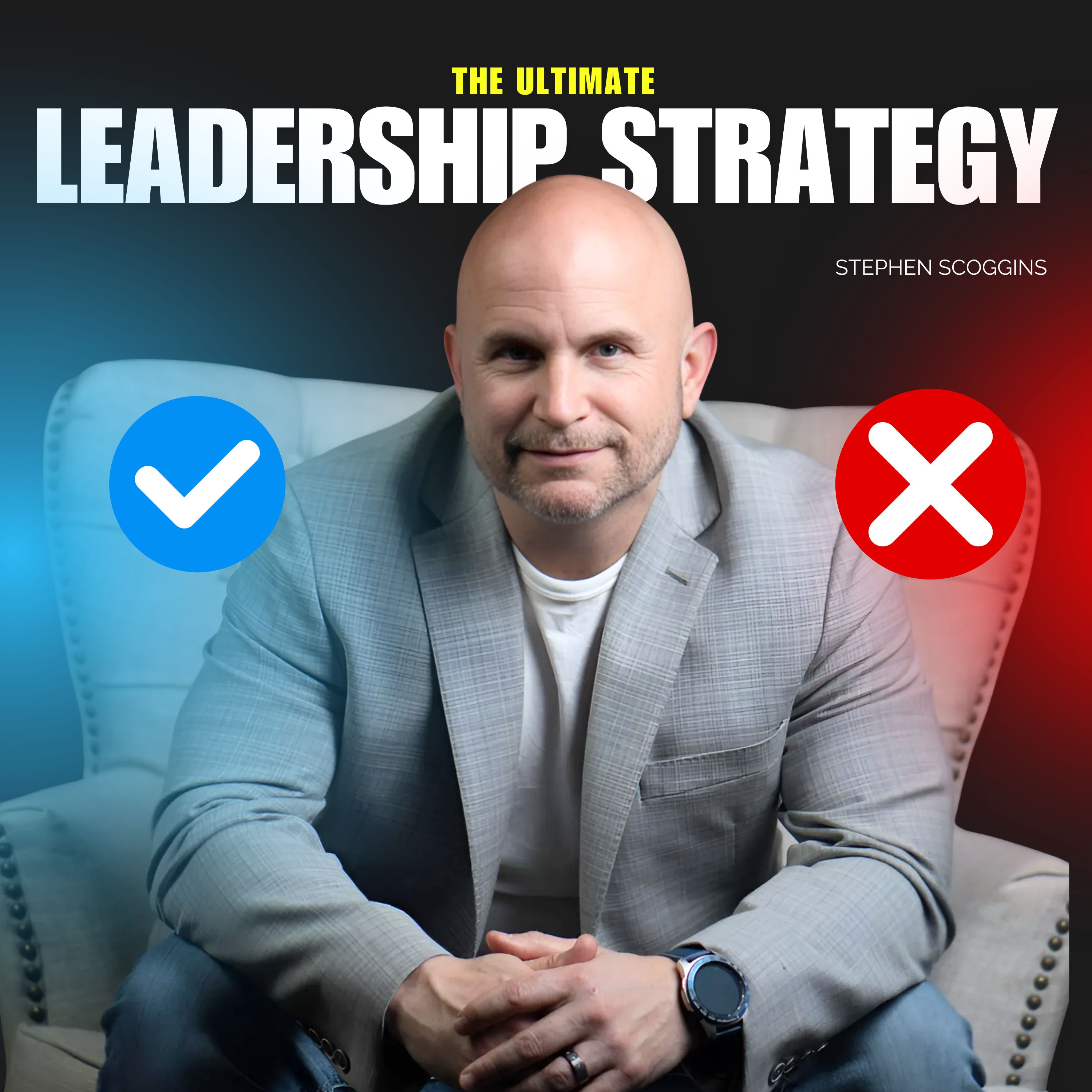
The Ultimate Leadership Strategy Explained | Stephen Scoggins
Press play and read along
Transcript
Speaker 1 This episode is brought to you by Progressive Insurance. Fiscally responsible, financial geniuses, monetary magicians.
Speaker 1 These are things people say about drivers who switch their car insurance to Progressive and save hundreds. Because Progressive offers discounts for paying in full, owning a home, and more.
Speaker 1
Plus, you can count on their great customer service to help you when you need it. So your dollar goes a long way.
Visit progressive.com to see if you could save on car insurance.
Speaker 1
Progressive Casualty Insurance Company and affiliates. Potential savings will vary.
Not available in all states or situations.
Speaker 3
Peter's on a boat. Storms raging everywhere.
Jesus is asleep. He's taking a nap and waking from his nap and they're all freaking out.
We're going to die. We're going to die.
We're going to die.
Speaker 3
And he's like, ah, peace be still. You guys have little faith, right? The ability to be present and grounded in a storm will save you millions of dollars.
You are going to face storms.
Speaker 3 Your ability to be resilient and believe in a vision, even when everything around you seems like it's not coming to fruition the way you want it to come, will save you time, energy, and resource.
Speaker 4 I was researching everything you have going on and there's so much for us to dig into.
Speaker 5 I'm so excited to have you here.
Speaker 4
You actually have this quiz on your site, which I highly recommend everyone listening, go and check out. I'll have a link in the show notes.
But
Speaker 4 in how you describe the quiz, there was this sentence that I just, this is where I wanted to start. It says, when hustle and strategy don't work, there is a deeper reason.
Speaker 4 And that clicked with me so much because a lot of the founders and entrepreneurs that have been hitting me up lately in like social DMs, it's this, they're like, man, I feel like I got the right strategy.
Speaker 4
We're working hard. I got a great team.
And for some reason, like we're stuck at this moment. So I'd love for you to kind of dig into this, this spot.
Speaker 4 Like, I feel like this is a huge pain point for a lot of entrepreneurs and founders.
Speaker 3 Gosh, well, I'm going to go down a bit of a rabbit hole because I think it's important for you to understand from a sheer place of perspective.
Speaker 3 So one of the things that I see a lot of entrepreneurs and especially early stage founders and startups do, which obviously I'm a founder myself, I've founded multiple companies, exited, I had a four as a roll up,
Speaker 3 which is a rare event in general, right? So just to break through the seven-figure scene, all right.
Speaker 3 So you, everybody knows that eight out of 10 businesses fail in the first, you know, call it five years.
Speaker 3 That means of those 20% that succeed, only 86% of them ever break a top line revenue of a million dollars in annual revenue, right?
Speaker 3 And of those, only I think a subset of maybe 1% of those will actually break eight figures. And it just continues to get more and more diluted.
Speaker 3 uh as you go through the the process all the way to where you have a you know you have a nine-figure company or something like that.
Speaker 3 And essentially what happens is, is now you've got this rarest of the rare. And one of the things that I've seen
Speaker 3 that's been so instrumental of a lot of the entrepreneurs that I'm working with that I have broken through the seven, the eight-figure and the nine-figure ceilings, because a lot of my, you know, a lot of my current clients and past clients are typically eight, nine-figure entrepreneurs that are trying to not actually fix their businesses as much as they are trying to get what I like to refer to as alignment.
Speaker 3 And the reality is, when it comes down to why businesses often fail, the economics or the statistics would tell you that it's like typically top five reasons: lack of sales, lack of product fit, poor management team, poor leadership style.
Speaker 3
Like it's the same things over and over again. And then I had this epiphany.
When I go back and look at my entrepreneurial journey that I've had over the last, gosh, 30,
Speaker 3 call it 30 years, just around, round down, around up. I think, I think, I think it's 33 years in now.
Speaker 3 But when I go back and look at that journey and I'm honest with myself, and I look at the things that really either impeded my growth
Speaker 3 or
Speaker 3 basically prevented my growth.
Speaker 3 So there's, you know, impeding the growth, making it slower, making it stall, where we naturally think that we need to hustle more and do more and have more, like what I call anxious activity, which is not, I don't believe, is healthy.
Speaker 3
I did all these things. I'm not speaking from a place of, hey, you should go do this way.
And I know it all because I'm not a guru and vice versa means.
Speaker 3 I'm just simply someone who built businesses with my own two hands, basically. And but when you go and look at those statistics, you very quickly realize that there's something off there.
Speaker 3 So when I go and look at, okay, what impeded my growth, what prevented my growth, in almost every case, in some way, shape, or form, it came down to me, right?
Speaker 3 It wasn't how much, it wasn't even how much knowledge I have.
Speaker 3 It wasn't as much, it wasn't even how much skill I have. Because knowledge and skill, you can develop over time.
Speaker 3 In fact, I used to tell people all the time, one of my greatest mistakes in building companies was not building myself along the way.
Speaker 3 And I mean, legitimately, intentionally focused building myself not not you do a seminar once a year maybe you maybe you listen to a podcast once every two months maybe you're reading a book every two or three months like i mean like intentional hey it's monday today we're focused on my financial well-being hey it's tuesday now we're focused on my emotional well-being hey it's wednesday now i'm focused on my spirituality hey it's thursday now i'm going to focus on my relationships right there's there's no growth path that's actually planned ahead I say all that to say that I discovered that no matter what stage of entrepreneurship you're in, like if you're a founder wanting to start something,
Speaker 3 you know, desiring to make an impact, you know, and founders and entrepreneurs, I love them to death because by definition, they create something out of thin air. Okay.
Speaker 3 They have a vision and they literally bring that vision into reality, right? Sometimes it's an established niche. Sometimes it's in a not-so-established niche.
Speaker 3 Sometimes it's in a completely new thing, right? We all know AI came out, it seemingly came out of nowhere.
Speaker 3 It's been a development for a decade, you know, but we go and look at all of these things, right? And at the seven-figure entrepreneur trying to get eight figures and eight figures got to get nine.
Speaker 3 It doesn't matter what the thing is. I find that there's five core constraints, five core constraints to actual growth.
Speaker 3
And it actually has more to do with the entrepreneur themselves than it does to do anything else. All right.
And I'll give you some examples after I break these down. But the first one is arrogance.
Speaker 3 Okay.
Speaker 3 The entrepreneurial vision, a lot of times, and I see this a lot with founders specifically.
Speaker 3 There's an element of fear attached to it.
Speaker 3 But a lot of times founders, they don't understand that having the skill set of a CEO is very different different than having the hutspah, if you will, of the founder, right?
Speaker 3 The founder is absolutely needed and should be honored for their impact, right?
Speaker 3 But unless they want to go through the personal growth journey of becoming a CEO, they will impede or prevent their business growth by not bringing in a professional CEO that has been trained with the skill sets of a CEO, for example.
Speaker 3
So that's a form of arrogance. The next one is ignorance.
Right.
Speaker 3 Ignorance and having major blind spots that you're not willing to look at, that you're not willing to get what I would like, again, I'd like to refer to as alignment, right?
Speaker 3 When you have these kinds of issues, what happens is, is this ignorance is now preventing you from learning the things you need to do or preventing you from developing the relationships you need to develop or simply just allowing other additional levels of fear to creep in, right?
Speaker 3 So we got arrogance, ignorance, right? Now we got the one thing that I see every single entrepreneur on the planet share. This is one common thing that we all share.
Speaker 3 We all think we should be further along than we actually are.
Speaker 3 All of us. I don't care if you just busted through $100 million and you did it in three years, which would be unimaginable for most people,
Speaker 3 right?
Speaker 3 You still think, well, I should be at 150.
Speaker 3 I should have a team of 300 people, or I should have this over here, I should be doing this over here.
Speaker 3 True entrepreneurship, I'll come back to this in a second, operate from a place of alignment. The most successful entrepreneurs that I see that really have it all, right?
Speaker 3
They have a successful company. They have a successful relationship.
They have a successful family. They have a successful wellness program for them.
Speaker 3 They have a successful level of fulfillment, right? They all have achieved what I, again, I like to refer to as alignment. Now, if we go to the fourth one, the fourth one is called insecurity,
Speaker 3 right? So insecurity will prevent you from taking action when you need to take action.
Speaker 3 or you know activating a certain segment of your business or firing that team member because they've been with you for 10 years or there's a whole number of different things that if you if you have a low sense of self-worth which you'd be surprised of the percentages of founders and entrepreneurs that honestly, part of the reason that they build something from scratch is to prove to the world that they're worth something, right?
Speaker 3 So this is some of these things that I want to eradicate and kind of flip on their head because I discovered that
Speaker 3 I had significant intrinsic worth long before I ever built the first company, let alone all the things that happened along the way.
Speaker 3 So I'd actually, I actually tell entrepreneurs all the time, I prefer you not celebrate. the success.
Speaker 3 I prefer you celebrate the sacrifice, the things that you're willing willing to do that no one else is willing to do right now.
Speaker 3 Because most entrepreneurs that do become successful, as my old man, Myrt, my first mentor used to tell me all the time, he's like, hey,
Speaker 3 you have to be willing to do today what others won't so you can have tomorrow what others don't. And he wasn't talking about the haves as far as houses and cars and planes and stuff like that.
Speaker 3 He meant the entire wellness of life, right?
Speaker 3 So that leads us to the fifth and final constraint, which is fear.
Speaker 3
Fear of success and fear of failure. Fear of firing, fear of hiring, fear of partnering.
You know,
Speaker 3 one of the biggest transitions that I had to do, Ryan, was this.
Speaker 3 I had to come to a point when we were about a $60 million company with the company that I exited a couple of years ago, where I had to decide, do I actually want to develop the skill sets of a CEO or is it more important for me to bring in a CEO?
Speaker 3 And I say that loosely because I feared that somehow if I brought in a CEO, then ultimately what was going to happen in my life is I was not going to not just lose control, but the vision, the thing that I spent the last, you know, 15, 20 years putting together was going to be so radically altered that it wouldn't even resemble me in the process.
Speaker 3 Right.
Speaker 3 So fortunately for me and my specific self, I had a lot of great counselors and mentors and coaches along the way.
Speaker 3
And I to this day still have coaches in a lot of different domains of life and business included. Right.
I was able to understand, okay, I do have what it takes to develop these skills.
Speaker 3 But at the same time, part of the reason I added in my company is because I didn't want to take it to $200 million.
Speaker 3 Right.
Speaker 3 So what I did was I went out and found a management team, partnered them with my existing management team, and created a roadmap for wealth for all of them because I knew I didn't want to do it.
Speaker 3
I knew I didn't have the skill sets at that time to go from 100 million to 200 million. That's a whole nother leap.
It's just a leap, right?
Speaker 3 So those five constraints create a certain level of anxiousness, burnout, and overwhelm consistently. So if you add, if you have an entrepreneur and I said, what does burnout feel like? Okay.
Speaker 3 Burnout feels like I wake up tired every day, that I can't get to all the places I want to get to, hug all the people I want to hug,
Speaker 3
love all the people I want to love. And instead, I feel like that I'm just exhausted all the time.
Okay.
Speaker 3 Overwhelm, on the other hand, feels like you have the constant weight of the world on your shoulders. Like if you don't make this decision just right, the whole thing's going to fall apart.
Speaker 3 Or if you don't partner with this person just right, the whole thing's gonna fall apart.
Speaker 3 So I say all of that to say, and I know it's a long way to answer to your first question, but I wanna give a complete picture to the entrepreneurs to understand there's true empathy coming from me to them because I understand.
Speaker 3 I've walked this journey out. But if I could summarize it all in one statement, it's this.
Speaker 3
You cannot scale dysfunction. You can't scale a dysfunctional sales team.
You can't scale a dysfunctional leadership team. You can't scale a dysfunctional financial pipeline.
Speaker 3
You can't scale dysfunction. You can only scale out of alignment.
And that is at the root cause of what I've seen that has to change in the foundry.
Speaker 8 Now's the time to start your next adventure behind the wheel of an exciting new Toyota hybrid.
Speaker 9 With the largest lineup of hybrid, plug-in, hybrid, and electrified vehicles to choose from, Toyota has the one for you.
Speaker 7 Every new Toyota hybrid comes with Toyota Care, two-year complementary scheduled maintenance, an exclusive hybrid battery warranty, and Toyota's legendary quality and reliability.
Speaker 10 Visit your your local Toyota dealer today.
Speaker 2 Toyota, let's go places. See your local Toyota dealer for hybrid battery warranty details.
Speaker 3 The CEO and the entrepreneur and the executive leaders of every single business is they have to get out of their own way and learn to collaborate and learn to align with the vision, align with their actual skill sets.
Speaker 3 And if the skill sets and the vision don't align directly over top of each other, you look for the wise person looks for the piece, brings that piece in, and lets that piece operate in fulfillment and fullness.
Speaker 3 And then you can scale a company.
Speaker 4 To me, founder is a mindset, CEO is a job. And I love the way that you broke that down.
Speaker 4 Do you have a filtering system or
Speaker 4 method that, and even maybe talk about your own personal journey?
Speaker 4 And because I know a lot of founders deal with this issue and they just, there's this assumption, you, you founded the business, you become the CEO. There's just this assumption.
Speaker 4 And if somehow you take a different path, right?
Speaker 4 Maybe your peers, your colleagues, or, and again, going back to insecurity and fear, you start creating all these things that don't exist where people are going to judge me because I founded the company.
Speaker 4
I should become the CEO. So you're feeling that pressure.
How do you think through this process?
Speaker 4 How do you remove some of the emotion attached to this or deal with the emotion might be a better way because it's going to be there, but think through logically, am I the right person?
Speaker 4
to go from founder to see because i might be the best cto in the company i might be the best revenue generator in the company because CEO is a job, not a mindset. Founder is a mindset.
CEO is a job.
Speaker 4 If you, one, if you believe with that kind of categorization.
Speaker 4 And two, I'd love to know your filtering system for that because, man, I know so many people are struggling, especially as, and I apologize for the long question, but you said something that I think is very important.
Speaker 4 I think today more than ever, founders and CEO, founders, considering this transition to CEO, are thinking about their life sacrifices, right?
Speaker 4 I think there's less founders who are willing to go, Steve Jobs, Elon Musk, I'm going to live on a cot 24-7,
Speaker 4 you know, not see my family for months to get this thing off the ground, right? I think there's a lot more founders that are saying, I don't want that life.
Speaker 4 Respect and appreciation that that's the decision they made, but that's not the life that I want. So maybe with that understanding, how do we think through this decision?
Speaker 3 Yeah, I think so when it comes down to filtering, first of all, you have to understand the complete stages of building a business, right?
Speaker 3 Well, I would call it the drivers, actually. So, in my world, I can take these five drivers, lay them over top of any business, doesn't matter what niche it's in.
Speaker 3 And because each niche allows for flexibility for each of the
Speaker 3 areas of a company, so ideation is the number one niche. And I'll come back to ideation super fast because that's where I want to spend the bulk of the time to answer your question.
Speaker 3 The second thing is sales, right? So, you got ideation, sales, fulfillment, finance, and you have a raving fan retention model. Okay,
Speaker 3 we'll come, we can discuss those later, later, but ideation, okay?
Speaker 3 Ideation in so many cases is essentially the overall complete vision of the company. When I say vision, it's not just the pie in the sky statement that we look out on a wall every now and again.
Speaker 3 It's legitimately, this is who we are, this is who we're not, this is what we stand for, this is what we stand against. Okay.
Speaker 3 So that's filter number one. Does anyone that I'm considering bringing into the business, or am I operating, and this is a good question for leaders, right?
Speaker 3 Am I i actually operating as if i am actually embodying this set vision because i find a lot of us especially early days we don't do that we don't do that we we we say these things but we're not embodying those things um but in the grand scheme of things the ideation process is obviously your mission your vision and core values it's roles responsibilities and strategies of implementation Okay, so it's laying the groundwork of the other drivers sales finance the financial raving family tension so on and so forth fulfillment and everything else.
Speaker 3 The reason that's important is because for me, there was one time in my business career where I should have
Speaker 3
gotten an outside person in and put them through a proper vetting process. Okay.
Now, the vetting process for me is a little bit based on Patrick Linceone and one of their elements.
Speaker 3 So he has this phrase called hungry, humble, smart.
Speaker 3
Okay, they have to be hungry. They got to be humble and they got to be smart.
Right. I think the third one is that they have to fit the culture.
Speaker 3
Okay. Now, I'll come back to culture in a second.
Now, when it comes down to actually filtering these people through, I'm going to sit down with them and say, okay, how hungry are they?
Speaker 3 How humble are they? How smart are they? How they fit the culture. Now, when founders are looking at CEOs,
Speaker 3 CEOs naturally, especially trained ones, people that have already been CEOs with other enterprises and stuff like that, have a natural level of experience that you don't have, like early stage as a founder.
Speaker 3 Okay. When I was a founder, perfect example was, is I promoted a senior level accountant into a controller role that cost me, that one mistake cost me millions of dollars.
Speaker 3 Okay.
Speaker 3 Because what they did through their, and then look, they were a great human being.
Speaker 3 They didn't possess the skill set needed to operate a high eight-figure company at the time. Okay.
Speaker 3 So what happened was that they literally created a hot mess that I had to spend about $200,000 of actual cash to come in and clean up on top of all the erosion that happened through margin of profitability.
Speaker 3 Right. So the founder has to be honest with themselves and say, do I have the skill set and the experience?
Speaker 3 And after they've done it one time, so let's say that, let's say this is the first time the founders created something from scratch, right? They've got a profitable enterprise.
Speaker 3
They've worked their ass off. They sacrificed nights, holidays, weekends.
They put the work in. They built the team.
You know, they put their own money in continuously. They haven't paid themselves.
Speaker 3 They don't sleep at nights.
Speaker 3 Like the odds, that's all the stuff that they're carrying when they're trying to make this decision about whether or not to bring an outside party in as a partner in many respects to this organization.
Speaker 3 So what happens is, is they're doing one of the things that I used to do very poorly all the time until I got better at this, again, where alignment comes into play, is I used to make emotional driven decisions.
Speaker 3 Okay. If you're going to be a seven-figure entrepreneur, an eight-figure entrepreneur, a nine-figure and beyond, you are going to learn to make decisions on data.
Speaker 3 Okay.
Speaker 3
And radical honesty. So the filtering process is this is who we are.
This is what we stand for. This is what we stand against.
Now let's get down to radical honesty. Here's the vision.
Speaker 3 Do I actually have the, do I actually possess the current experience level to take this thing to the next level? At least 90%.
Speaker 3 The other 10% you can learn. right most founders okay and it's no dig on founders because again i am one right
Speaker 3 Most founders struggle with this because what they remember is the past five years, the past year, the past 12 months, the past six years. Like they have all this history of what they've done.
Speaker 3
So, how a successful CEO would integrate that is a couple different things. So, if we know that culture is a specific piece, when they go to interview CEOs, they're going to take their time.
Okay.
Speaker 3 The more important the decision, the more time that needs to be taken. However, I might spend 90 days evaluating separate CEOs to see who's going to be the best fit.
Speaker 3 Now, a quality CEO is going to do two things very well. First of all, they're going to come into the business and know how to optimize it, right? If the business has
Speaker 3 a desire or need to raise capital, the CEO is going to have the ability to raise capital, monetize efficiencies, read CF, you know, data that comes to have the COO, the CTO, and the CFO, right?
Speaker 3 And then translate that back to the founder. Because typically a founder will slide over to a visionary officer or something like that to keep the business growing.
Speaker 3
And that's putting people everybody in their sweet spots. A great CEO is also going to do another thing, which I think is super important.
They're going to regularly honor the founder publicly.
Speaker 3 They're going to come up when they have their meetings with their team.
Speaker 3 It's like, hey, just like Jane used to say all the time when she was building this thing, or Joe used to was building this thing from the, you know, from his card table at his kitchen table or whatever, you know, that we would do this, this, and this.
Speaker 3 And this is what we stand for. And when you have that aspect, what happens is the founder now feels like,
Speaker 3 all right, I'm seen, I'm heard, I'm valued.
Speaker 3 And then they will actually go do what they do best, which is go create.
Speaker 3
Right. So the founder creates, the CEO optimizes, right? And both of those things are important.
And it's very, very rare that a founder truly becomes a CEO.
Speaker 3 You can take, let's look all the way back at Uber, all right? The young man that started Uber, founder, gritty, tenacious. Because he wasn't a trained executive as the CEO, it took a while.
Speaker 3
They had a lot of growth pains early on in getting Uber off the ground. And getting, he had, he got a bad rap a few times.
They made movies about it, right?
Speaker 3
Because he wasn't operating from alignment, right? Great CEOs. And the difference is, is operating from emotion versus operating from essentially data.
Okay.
Speaker 3 If you operate from emotion, you're going to blow stuff up by accident. You're not going to mean to,
Speaker 3 right? And if you hire a CEO from emotion, you're going to mess yourself up, right? What does the data say? What do we need? The data is
Speaker 3 the important piece.
Speaker 3 If entrepreneurs can move from the emotional side of their brain to the intellectual side of their brain and make data-driven decisions on a regular basis, they're going to be much stronger in the end.
Speaker 3 So I would use those types of methodologies to filter in. So one,
Speaker 3 who are we? What do we stand for? What do we stand against? Make sure that's clear because that CEO also has to believe heavily in that same thing.
Speaker 3 They got to, I mean, they got to really believe it, right?
Speaker 3 The second thing is, okay, what is the culture, right?
Speaker 3 So is this a culture of of honor and respect you know because i found that if if the founder has any level of emotional maturity as their honor they also honor the ceo back right and honor has to be established with the leadership team a dysfunctional leadership team will create a hot freaking mess amongst hundreds of team members ask me how i know like i've lived it you see what i'm saying all right and the third and final thing is like okay well how do we move from emotional behaviors and decision making to basically data intellectual decision making?
Speaker 3 I think those three are the core filters because, and this will be for the CEOs that are coming in for founders,
Speaker 3 not just the honor piece, but also understanding that that founder probably has a unique
Speaker 3 instinct to a degree, right? And be able to respect that instinct and be able to sit down and say, hey, John, Look, I respect your instincts. Your instincts are awesome.
Speaker 3 Here's what I see.
Speaker 3
Help me understand more about your vision. Because a lot of founders have a really hard time really communicating the next level of vision.
So being able to have that dialogue, right?
Speaker 3
Founder and the CEO is vitally important. Vitally important.
Those are probably my top brains.
Speaker 4 No, and you,
Speaker 4 the third one is the one that maybe I'd love to just ask, like, because a lot of founders, right, it was their gut, it was their intuition that
Speaker 4 gave them the idea to create the thing, right? So now, so to your point, because of that, they tend to over-index on gut, feeling, emotion.
Speaker 5 But,
Speaker 4 so, but, I completely agree with you, right? We have to live in reality, and this is a big part of what I talk about in this show.
Speaker 4 I talk about like my own leadership style, I call a reality-based operating system.
Speaker 4 Like, you can't, you can't build your business on a fantasy or some sort of utopian version of how businesses become real.
Speaker 5 So, we have to work off data.
Speaker 4 So, how do we marry the or find a better put, how do we find harmony between
Speaker 4 the gut instincts of a founder or even a CEO or even you know other founding team members with the data that's coming out that we see on a day-to-day basis and and because sometimes the data might not show exactly what we want but a gut call gets us over the hurdle and then the opposite can also be true so how do we start to find harmony between those two things Well, first of all, the management team of the business will only scale at the speed of trust.
Speaker 3 Okay. And trust is built through experience and over time.
Speaker 3 So if I'm sitting there with an executive team member and my gut says X, now I'm one of those weird people that my gut tends to be more right than wrong when it comes to business.
Speaker 3 Now, that might be kind of how I've managed to get to where I'm at or played a role in that. At the same time,
Speaker 3
I'll give you, I'll use a CFO example. So CEO to CFO.
Let's say the founder became the CEO. The CEO is now working with a CFO.
The CFO has been trained, trained to be a CFO.
Speaker 3 The founder has not necessarily been trained to be a CEO, right? So there's automatically like this guy's coming at this guy or lady's coming at from this angle. He's coming at it from this angle.
Speaker 3 What I've discovered is, is a very simple phrase.
Speaker 3 Can you help me understand?
Speaker 3
Help me understand your perspective. Just help me understand.
I want to see it clearly. Because my goal, Jane, as the CFO to the CEO is I want to make sure your vision becomes reality.
Speaker 3 That's why I'm here.
Speaker 3 I also have an obligation to you to make sure we get there in the healthiest possible way,
Speaker 3 period, which means once each party has had the chance to share openly without defense.
Speaker 3 Again, this is where freaking alignment comes into play because only emotional, mature people can actually be grounded in the moment, actually listen.
Speaker 3 There's a difference in hearing and listening, right? If you can't regurgitate, so I'm sorry for the bad word, but it's kind of a joked at word.
Speaker 3 But if you can't regurgitate the words back to the person, you didn't listen.
Speaker 3 If you can't physically say, Well, here's what I heard you say, okay, because a lot of times what you say, well, oh, here's what I heard you. Well, I didn't say that at all.
Speaker 3 I actually, I was trying to say this. Well, why didn't you say, you know, it's like, so that's how you avoid that complex nature.
Speaker 3 Once each party has had a chance to listen, how do we allow the visionary to create create the stretch? So, let's say the data says we can go from A to M
Speaker 3
by doing things this way, right? Sequential order. This is how we build up cash flow.
This is how we build up a sales pipeline. This is how we optimize our fulfillment.
Speaker 3 This is how we do it this way, right?
Speaker 3 Then you go, then you can go back to the founder and say, okay, this is the strategy that I see to make your dream a reality or our dream a reality on top of I want to learn to be in the stretch.
Speaker 3
Here's where the founder gets to be in the stretch. The founder gets to set the stretch goal.
You see what I'm saying? And it's within reason. Hey, we're going to agree that
Speaker 3 we'll strive for a 20% stretch. So if you were going to be involved in the fulfillment process, how would you see it differently? And what's that 20% stretch?
Speaker 3 What you're looking for is you're building a collaboration of communication.
Speaker 3 or I'm sorry, communication of collaboration.
Speaker 3 As you build a communication of collaboration, what happens is you build trust and pretty soon you're gonna you're gonna find that the the founders release more and more and more and more because trust has been built but trust is only built by actually working together and actually operating in the tension the reality here's the crazy part is trust is built in the tension
Speaker 3 right that's when jane and john are like hey
Speaker 3 i i you know what we tried your idea
Speaker 3
all right and it worked fantastic yeah let's high five hey jane had this great idea. She helped us with the stretch.
Right.
Speaker 3
Or if it didn't work, hey, this is cool. We learned, we learned a valuable lesson.
Now
Speaker 3 let's see what the data now supports. Right.
Speaker 3 It may seem like in the moment you're slowing the business down from growth, but what you're really doing is you're really setting up a firm foundation.
Speaker 3 Because when trust is established, now the CEO can execute with excellence because the founders now trust.
Speaker 3 Right. And
Speaker 3 the founder is getting honored regularly by repeatedly bringing back in the story of creation to the company. So, as you bring on another value,
Speaker 3 let's say the about the normally about the time a transition can happen from a founder to a CEO is typically around the $10 million mark, sometimes a little before, depending on the industry.
Speaker 3 It's absolutely in place by the time you're at 50, 100. Like, you can't get there unless, again, the founder's will to do the work to become a CEO.
Speaker 3 And
Speaker 3 that is a very, very,
Speaker 3 not difficult thing, but pretty, pretty stinking difficult in some respects, right?
Speaker 3 Let's say all that happens.
Speaker 3 When all of that happens, now you've got this new level of team members constantly coming in the business, okay?
Speaker 3 The CEO, part of what the CEO will do is they'll put a strategy in place with the HR department or whoever's actually operating in the HR area to say, hey, part of our onboarding process is to talk about how Jane built this business, how she helped us get going, how much we value her insight and her instincts, and how she sees things differently, right?
Speaker 3 So, basically, you put in the culture that supports the honor of the founder, and the founder is going to end up releasing more trust to the CEO because the CEO is already honoring the founder.
Speaker 3 Yeah, it's again, it's all communication, it's all trust, and it's all honor and respect.
Speaker 5 That's my opinion.
Speaker 4 I know, I completely agree with you. I think
Speaker 4 I also think
Speaker 4 there is a skill for the founder to strategically give
Speaker 4 their executive team opportunities to sink or swim, right?
Speaker 4 Like you don't want to give them an opportunity, maybe, especially early on, that's like a bet the farm decision, but hey, on some of these tactical decisions where, where
Speaker 4 you might feel you know the answer, right? But you want to see how does, how does he handle it? How does she handle this, this particular decision and let them go.
Speaker 4 And sometimes, and you have to be okay with, they might take a path that I know is not going to work and let them go down that path, be unsuccessful, learn the lesson themselves.
Speaker 4 And then you get to see how do they handle failure, right? I mean, this is one of the things that if you don't provide slack to your team, if you're one of these helicopter founders, right?
Speaker 4 Helicopter managers, if you don't provide your team some slack to make some mistakes occasionally, right? As long as they're pushing in the right direction with engines and all that kind of stuff,
Speaker 4 then you don't know when the shit really hits the fan, you have no idea how they're going to react.
Speaker 4 And now, when, when, in your worst day, you're getting your first experience with how someone handles a negative situation, which is the absolute opposite thing that you want, right? So, sure.
Speaker 4 Um, no, I love that. Um, I'd like to transition a little bit
Speaker 5 to
Speaker 4
I want to talk about faith and faith in your life. You, you, you wear a cross, I, I, I do too.
It's funny. We're actually opposites.
Speaker 4 I have a black white shirt, you got the black shirt, like silver cross.
Speaker 3 Um, yang today,
Speaker 4 but uh, like,
Speaker 4 what role does God and your faith play in how you operate your life?
Speaker 4 And then I'm particularly interested in how you've utilized that aspect of who you are in your business life and what role that plays and how it manifests.
Speaker 3 Yeah. So, man, I think the similar question is what role does it not play?
Speaker 3 I operate all, I'll tell you this.
Speaker 3 So my vision, my mission, core values, all the things that I've talked about in the navigation stage of building a business and i look at those stages every 12 to 18 months by the way that's how you that's how you scale that those that same system but i look at that as that's how i'm going to conduct myself so it starts with uh embodying the examples
Speaker 3 elements of faith are honesty integrity compassion empathy boldness right so i sell that to say that my grandfather told me in uh 2016 before he passed away just before i started speaking writing books and then doing the the things i do in the world now you know at the time i was like because my my first company was a a roll-up of a bunch of construction companies basically i was having a really hard time making the mental and emotional leap you know again i'm i'm facing those same constraints i'm telling you about in this transition and as i'm talking to my grandfather he's like he's like here's the thing you need about leadership and business life love everything You have to become one part lion and one part lamb.
Speaker 3 And when we started talking about the lion and the lamb, all right, right, so the lion is bold and courageous, protects its own, hunts on a regular basis.
Speaker 3 And you've got the lamb, you know, in theory that is empathetic and compassionate and caring. Because there will be times when you yourself or your team need a kick of the butt, which is the lion.
Speaker 3 There'll be other times they actually need a hug, which is the lamb.
Speaker 3
The tricky part is developing the wisdom to operate in the blank space. be able to be having enough situational awareness.
So the way I see situational awareness is I studied the life of Jesus.
Speaker 3 I studied how he operated with his disciples, right?
Speaker 3 Most of the time he ended up giving Peter a bit of a hug because Peter was in his own way a lot.
Speaker 3
A few times he challenged Peter. He gave him a lion.
Get behind me, literally, get behind me, Satan.
Speaker 3 Like, I mean, I don't know about you, but like, if my mentor told me that, I'd be like, oh, yeah, kind of shocked, right? You know, and
Speaker 3 To me, faith is what happens in the quiet moments.
Speaker 3 If I go back to the alignment piece I discovered when I woke up each morning and I just went straight into my phone straight to my computer straight in my activities make and I've been hitting the gym for a long time so the gym was my you know I'd be going to the gym but I'd be thinking about my day I'd be thinking about the client I'd be thinking about all these different things that created the embodiment of overwhelm Contrast that with, as I guarantee myself the first 30 to 40 minutes of every day with some sort of grounding or presence practice.
Speaker 3
Okay. I have a journaling practice that I use from time to time.
This is what I hear you say is. I grab my journal, I sit in quiet, what I hear you say is, and I write down whatever I hear.
Speaker 3 And lo and behold, sometimes it's three or four pages. Sometimes it's a few quotes, right?
Speaker 3 I'll get out, I'll go touch the grass, I'll go put my feet on the grass nowadays, right? I'll go sit out in the first sunlight of the day. I wake up every almost every morning.
Speaker 3 I'm healthy, I'm wealthy, I'm wise, I'm a steward of the most high, and I love you, Stephen.
Speaker 3 That last one, I've discovered that nine out of 10 entrepreneurs that I've worked with can't even say that to themselves in the mirror.
Speaker 3
Right? And by getting those things in place, I become more grounded. And because I become more grounded, all I'm doing is mimicking what my Lord did.
That's all I'm doing.
Speaker 3 How many times did Jesus go off away by himself and go, quote unquote, be with the Father, be in a state of presentness?
Speaker 3 Like he walked into a room and had presence.
Speaker 3 consistently because he spent so much time being present in every moment.
Speaker 3 When he was with Peter or when he was with
Speaker 3 John or anything, he was very focused on being present with them.
Speaker 3 If I model that in my business, that means when I'm meeting with one of my executives, I'm very present with them. I'm not thinking about the other things.
Speaker 3
I got my phone off, turned over, don't have any dinghams going on. We started this podcast.
First thing I did was hit do not disturb so we wouldn't be disturbed. Right.
Speaker 3 These are types of ways of becoming more present. So presentness is a piece of it.
Speaker 3 Being grounded is a piece of it.
Speaker 3 Being more emotionally calm in times of stress as peter's on a boat storms raging everywhere jesus is asleep he's taking a nap and they wake him from his nap and they're all freaking out we're gonna die we're gonna die we're gonna die and he's like ah peace be still this episode is brought to you by progressive insurance do you ever think about switching insurance companies to see if you could save some cash Progressive makes it easy.
Speaker 1 Just drop in some details about yourself and see if you're eligible to save money when you bundle your home and auto policies.
Speaker 1 The process only takes minutes and it could mean hundreds hundreds more in your pocket. Visit progressive.com after this episode to see if you could save.
Speaker 1 Progressive Casualty Insurance Company and affiliates. Potential savings will vary, not available in all states.
Speaker 8 Now's the time to start your next adventure behind the wheel of an exciting new Toyota hybrid.
Speaker 9 With the largest lineup of hybrid, plug-in hybrid, and electrified vehicles to choose from, Toyota has the one for you.
Speaker 7 Every new Toyota hybrid comes with Toyota Care, two-year complementary scheduled maintenance, an exclusive hybrid battery warranty, and Toyota's legendary quality and reliability.
Speaker 10 Visit your local Toyota dealer today.
Speaker 2 Toyota, let's go places. See your local Toyota dealer for hybrid battery warranty details.
Speaker 3 You guys have little faith,
Speaker 3 right?
Speaker 3
The ability to be present and grounded in a storm will cost, will save you millions of dollars. It'll advance you twice as fast.
But on top of that, then you also have the resilience piece, right?
Speaker 3
I don't care who you are in business in general. I don't care if you're a C-suite professional.
I don't care if you're the founder. I don't care if you're thinking about being a founder.
Speaker 3 You are going to face storms.
Speaker 3 Period.
Speaker 3 Your ability to be resilient and believe in a vision, even when everything around you seems like it's not coming to fruition the way you want it to come,
Speaker 3 will save you time, energy, and resource. Because again, you're going to come back to alignment, come back to being grounded, come back to being rooted and being present.
Speaker 3 When you're present is when you make the best decisions.
Speaker 3 Almost every dumb decision I made, and I've keep in mind, I'm saying this from a place of experience and empathy in that I have lost millions of dollars because of the dumb things that I did.
Speaker 3 Putting the wrong people in the wrong seats on the bus, not paying attention to the financials, like literally just trying to be sheer instinct, right?
Speaker 3 Every one of those dumb decisions came from a place of what's known in the marketplace now as what's called emotional dysregulation. It's being in the mind.
Speaker 3 This is why I'm not a fan of hustle culture. When I say hustle culture, I don't mean you don't have to wake up at 4 a.m.
Speaker 3 and go out for a run and pump a bunch of iron and then you see what I'm saying?
Speaker 3 It's actually better if you can start present.
Speaker 4 Between working hard and working to work.
Speaker 5 Yeah.
Speaker 5 Yeah.
Speaker 3 Yeah, exactly. So I say alignment.
Speaker 3
leads to intentional focus. Intentional focus leads to diligence.
Diligence leads to positive outcomes. Right?
Speaker 3 If you're emotionally dysregulated, you wake up in fear, and emotional dysregulation is nothing more than being in fight or flight.
Speaker 3 You either, you can build your businesses in fight or flight, you're going to scare a lot of people, you're going to scare yourself, you're going to make dumb decisions, or you can start now from someone who's lived it, who doesn't want you to have to go through all those extra suffering moments because there's already going to be tension.
Speaker 3 Right. There's a whole nother level if you're operating from emotional dysregulation, which again is just nothing more than operating from the fear of flight.
Speaker 3 So I say all of that to say that my faith is what grounds me. My faith is what's true.
Speaker 3 It doesn't mean that I have to have every team member that comes in the door, we have to share the same faith or the same values, right?
Speaker 3 But we do have to share the same core values of honesty, integrity, diligence, compassion, collaboration, autonomy. Like we have to share those things.
Speaker 3 And it just so happens over course of time, if you embody this behavior, you embody this presentness from faith,
Speaker 3 not only will you attract others that are kind of that way, that kind of operate that way. So there's less chaos itself because there's less chaos in the business.
Speaker 3 Like every position is based, has someone who's like emotionally grounded and regulated or can get there.
Speaker 3 So there's a peace and a safety into that. But on top of that, you will also become a little bit of an inspirational light to others who are trying to figure that part out.
Speaker 3 You know, because it never, I mean, I've had this situation happen before where I'd had a teammate movie for seven or eight years, rock star,
Speaker 3 and they got unexpectedly divorced.
Speaker 3 Their spouse did something that, you know,
Speaker 3
created a catastrophic event in their relationship. And obviously, there's always two sides of things and how relationships play out.
But that person really, it really rocked that person for a year.
Speaker 3 So what do you do? Do you fire them? Because all of a sudden their performance is completely tank?
Speaker 3 Or do you find a way to bring this faith element around them and compassion to other team members to say, hey, we got you right now.
Speaker 3
We know you're not going to be your best self right now. And we see you.
We love you. We got you.
Speaker 3 Right.
Speaker 3 I find that that culture structure creates a level of lift that most businesses can never find. That's why you can have a billion-dollar business and have turnover like it's going out of style.
Speaker 3 There's a really well-known
Speaker 3 digital marketplace business, really well-known, billions of dollars.
Speaker 3 and if you were to actually look at the statistics of how many how they churn their team they are literally part of part of their major line item on their billion dollar budget is headhunting constantly
Speaker 3 they can't keep they can't keep a position and they can't keep a position because there's no compassion there's no seeing the person
Speaker 3 everybody wants to feel seen valued heard and appreciated i learned all of that from Jesus. All of it.
Speaker 3 Everything in my business, the skill set set he gave me with my hands. You know, okay, so my dad taught me how to use my hands and my heart, right?
Speaker 3
You know, that's great, but my faith is what taught me resilience. It's what taught me compassion.
It's what taught me boldness in the face of storms.
Speaker 3 It's what taught me all these different elements that are intangibles. That if entrepreneurs can really tap into that, they can do some pretty unstoppable things.
Speaker 4 And I think you made the point in there that I completely agree with
Speaker 4 and have been talking about for a long time, which is the values, the belief structures, the opinions of the founder of leadership. Like
Speaker 4 these things have to be shared in public domains. And the reason is not to build an audience or a personal brand or whatever.
Speaker 4 It goes much deeper than that, in my opinion.
Speaker 4 It signals, as you said, to the individuals who align with or aspire to those values that this is a place that I can call home. And what it also does, and this is what I think
Speaker 4 a lot of the founders, business owners that I talk to that struggle with hiring,
Speaker 4 they struggle with hiring because one, they've never shared their value structure.
Speaker 4 And, or if they have, they've shared it in a very corporatized PR paid branding kind of way.
Speaker 5 So what they get is people.
Speaker 4 people coming to the business who don't actually align with their actual values.
Speaker 4 So it acts as a dual filtering system. You get people who align with or aspire to your values values and the people who disagree with your values, they never show up.
Speaker 4 And, you know, it's why, you know, I thankfully, and all the businesses that I've ever run at a top level have never had a problem hiring.
Speaker 4 And it's because I'm so vocal with what I believe, how I lead, you know,
Speaker 4 out front. So someone could go to my LinkedIn and be like, I want to work for this guy or I don't want to work for this guy.
Speaker 5
Exactly. Very obvious.
Yeah, exactly. Yeah.
Speaker 4 And, and so, so maybe
Speaker 4 how would you coach a founder, a CEO, et cetera, through
Speaker 4 the, maybe if they have some emotional turmoil around being truly public, right? Like, like, I have no problem telling people I have conservative values.
Speaker 4 I believe in the American Constitution and I believe in the Bible, right? So most of my value structure is the Bible with the original intent of the U.S. Constitution sitting on top of it, right?
Speaker 5 Like those, that's kind of my value structure.
Speaker 4 If you don't align with that, right? That's great, but that's mine. So,
Speaker 4 how do you walk them? But I get a lot of crap for that. People will be like, oh, you know, you know, well, you don't, you know,
Speaker 4 why would you tell people you're a conservative? You know, you're going to turn off everyone who'd buy from you who's a liberal. I'm like, that's fine.
Speaker 5 I don't think
Speaker 5 that doesn't bother me.
Speaker 4 Now, one, I don't think that's actually true because I, you know, but two, I think like, how do you become okay with that?
Speaker 5 Because a lot of people struggle with this.
Speaker 3 Well, I don't know. I'm, I'm, I'm known for being a little too,
Speaker 3 transparent, just in general. I just, I wear my heart on my sleeve.
Speaker 1 Yeah, me too.
Speaker 3 I am who I am, and I've discovered that I like who I am when I am who I am.
Speaker 3 I discovered I don't like who I am when I'm not being who I am, right? Some close to me know referred to it as ego man versus spirit man. Like, I like being spirit man.
Speaker 3 Spirit man's solid, grounded, rooted. Ego man is concerned about, you know, scarcity and fear and all these types of things.
Speaker 3 The first thing I would tell a founder is there's a big difference in filling a seat and filling a role.
Speaker 3 Okay.
Speaker 3 If you have a really well-executed strategy, it's going to define a role. That role then defines responsibilities.
Speaker 3 Those responsibilities then define the key KPIs or key performance indicators, the metrics that are going to be held to.
Speaker 3 Now, the one thing that I think is really interesting is I personally am like you. I would rather hire well
Speaker 3 than not.
Speaker 3 And you hire well based on culture fit. So yes, you're going to attract people that share similar core values, things of that nature.
Speaker 3 But let's say, in this instance, let's say that there is a, at least in the political world, there's a disparity between one or the other. Okay.
Speaker 3
Okay, great. I'll use Jesus again.
Jesus never forced himself on anybody.
Speaker 3 He also never shirked back from declaring, this is what I believe. The kingdom is heaven is like, right?
Speaker 3 Calling the Pharisees out. Right?
Speaker 3 Like, like helping everyone he came in contact with that was actually in need first one to say i came for the sick not the healthy right so if we if we just model that behavior you can have an environment where there's mutual respect which is that's at the that's at the core of why there's no bridge built between multiple different disparities of various people groups is because no one's willing to just build a bridge right you build a bridge by modeling jesus jesus accepted them for exactly who they are and then asked them point blankly do your values align with mine at least i think they well, I think, I think he used this process, you know, because he went around and said, oh, Peter, I want you.
Speaker 3
Andrew, I want you. Hey, John, I want you.
Matthew, I know everybody else in the world hates you, but I want you.
Speaker 3 Right.
Speaker 3 And he went around and uses the, he used that element. And I think you can do that in the workplace, right?
Speaker 3 I had people working at my companies that didn't share my
Speaker 3 world values, but they shared my core values. Okay, my core values, honesty, respect honor collaboration autonomy right integrity
Speaker 3 if they could if we could agree on the core values then our worldviews may not have to match as much because the core values actually built the bridge between the two worldviews okay it actually allowed for you know collaborative conversation later on to actually after some relationships built some trust has been built hey i'm curious i'm help me understand like why do you like how did how did you how did you get to your position you know what happened in your life that made you, or that, you know, that inspired you?
Speaker 3 Or, you know, you start looking, you can start seeing how certain patterns of belief systems are formed when you're not so resistant to everybody else's. And that's how you build bridges.
Speaker 3 I actually feel like part of my calling in this next season of life is to figure out a way to build bridges between different areas.
Speaker 3 Like, I'm, I historically, I mean, if it's biblical, that's typically what I'm at, you know, kind of thing.
Speaker 3 So at the same time, I also realize that others have had different traumas and different circumstances and different influences. So much of what most of us believe was, was taught to us way early on.
Speaker 3 Very few of us go through the architecture or the deep dive or the rabbit holes. I chose to because I found my faith through a process of compression as well as discovery.
Speaker 3 Like I've, I can articulate how I got to where I got to, right?
Speaker 3 Most people can't do that, right? So how can you have a collaborative conversation to open that up? But you're not going to have that happen unless you can build a bridge between core values, right?
Speaker 3 So, honesty, respect, you start looking for those, and then you can bring, you can still bring a team member in, even though they may not share your worldview.
Speaker 4
Steven, this has been wonderful. I have enjoyed this conversation.
And man, I mean, I take, so I take notes just for my own well-being. And for those of you watching, like my entire page is filled.
Speaker 4
I got lines and all kinds of stuff. This has been, this has been a masterclass, man.
I appreciate the hell out of you.
Speaker 4 So I am positive that people are going to want to get deeper into your world who are listening or watching the show. How do they do that? What's the best place?
Speaker 3 You know,
Speaker 3 again, I'm so passionate about people becoming aligned. So they can see with alignment, they have a better behavior set, right?
Speaker 3
But the first piece of getting aligned is becoming truly self-aware. We created a tool and assessment.
We call the integrated alignment method. It's exactly how I got from point A to point.
Speaker 3 Well, I hope it's not Z yet, like at least point M now, right? Yeah.
Speaker 3 And how I now grow and scale companies and leaders based on integrated alignment, like actually being fully. So I would invite them to go to stevenscoggins.com backslash alignment.
Speaker 3 They can take
Speaker 3
the assessment for free. It takes about six or seven minutes.
It's not even super long. And the best part is that I don't sell you anything.
Speaker 3 If you want to book a call after that, you can, but I don't sell you anything. This is strictly for you to become self-aware to start your journey.
Speaker 3 I'm on all the platforms, of course, but
Speaker 3
if you want to engage with me through DMs, I'm Instagram. So I'm probably my best there.
This is Stephen underscore Skockin. So those are the two ways.
Speaker 3
And dude, thank you for letting me share with your audience, man. I really appreciate it.
It's, I know it's, it's a process of selection. Like, I'm highly selective of who I let on my show as well.
Speaker 3 And I'm just super grateful that you allowed me to share today. Thank you.
Speaker 4
Dude, it was wonderful. It was absolutely wonderful.
I mean that in the truest sense. And
Speaker 4 I just, I love the way you've actually, you know, so, you know, I've been doing, I've been doing 400 plus episodes of the show.
Speaker 4 I, you know, if you go back to when I started podcasting, I've done like more than 2,000 interviews, which is a story for another day. Congratulations.
Speaker 5 Talk about bad decisions made.
Speaker 4 I had a show, dude. So, so, and guys, you're listening to this, you've probably heard it before, but so I actually started a podcast in 2012 and grew it in two years to 2014.
Speaker 4 I was the number ninth overall show in all of Apple. I have a screenshot of Ed Milette, two ahead of me and Gary Vaynerchuk two behind me, all of Apple, right?
Speaker 4 So this is like, and at the time I was doing 47,000 downloads a month. You can tell how much podcasting had grown in that time, right?
Speaker 5 Back then, that was the number nine overall show.
Speaker 4 And then I got, I took a job as a chief marketing officer, making more money than I'd ever made in my life for this company. And when they initially hired me, they told me I could keep the podcast.
Speaker 5 And I was like, fucking great. This is awesome.
Speaker 4
And then two months in, all of a sudden that story changed. And it was like, podcast has got to go or you got to go.
And,
Speaker 4
you know, for a whole bunch of reasons. I mean, I wasn't making any money out of the podcast at that time, advertisers, whatever.
So I let it go. And I think back and I'm like,
Speaker 4 holy crap, like, where would the show have been, you know, if I had just kept it going? But that's a story for a different way.
Speaker 3 That's means you got to keep going now.
Speaker 4
That's all. Yeah, no.
And all that being said, I love the way you framed some of these topics. And
Speaker 4 I just, this, this idea of alignment,
Speaker 4 I've never had anyone on on the show who spent so much time and emphasis on this idea and really broken it down the way you did. So guys, I hope you picked that up.
Speaker 4
I will have the links to everything Stephen just described, whether you're watching on YouTube, listening, wherever you listen, just scroll down. You'll find the links.
Highly recommend you connect.
Speaker 4 As genuine a dude as I've connected with on the show.
Speaker 5 And I just appreciate the hell out of you, man.
Speaker 3
Dude, I appreciate it. And again, I can't thank you enough for letting me share with myself, with you and the audience.
It's an honor to be able to do this work now. And I don't take it lightly.
Speaker 3 And I try to offer value every single time I pop on somewhere. And hopefully, I left some stuff today so people changed.
Speaker 4 Definitely did, bud.
Speaker 5 Let's go.
Speaker 5 Yeah, make it look, make it look, make it look easy.
Speaker 12 Thank you for listening to the Ryan Hanley Show.
Speaker 12 Be sure to subscribe and leave us a comment or review wherever you listen to podcasts.
Speaker 13 It's Black Friday at Paragold, the destination for luxury home. Save up to 30% on the largest ever selection of design's best brands.
Speaker 13 Shop the sale in store and online at paragold.com, only from November 25th through December 2nd.
Speaker 14
Hey, it's Parker Posey. How did I get here? I love improvisation when it comes to acting, but when it comes to a real-life plan, I stick to a script.
Cue the music.
Speaker 7 Invest in your story with DIA, the only ETF that tracks the DAO from State Street.
Speaker 8 Getting there starts here.
Speaker 15
Before investing, consider the fund's investment objectives, risks, charges, and expenses. Visit state street.com slash IM for perspectives containing this and other information.
Read it carefully.
Speaker 15
DIA is subject to risks similar to those of stocks. All ETFs are subject to risk, including possible loss of principal.
Alps Distributors Inc. distributor.
Speaker 8 Now's the time to start your next adventure behind the wheel of an exciting new Toyota hybrid.
Speaker 9 With the largest lineup of hybrid, plug-in hybrid, and electrified vehicles to choose from, Toyota has the one for you.
Speaker 7 Every new Toyota hybrid comes with Toyota Care, two-year complementary scheduled maintenance, an exclusive hybrid battery warranty, and Toyota's legendary quality and reliability.
Speaker 10 Visit your local Toyota dealer today, Toyota.
Speaker 2 Let's go places. See your local Toyota dealer for hybrid battery warranty details.