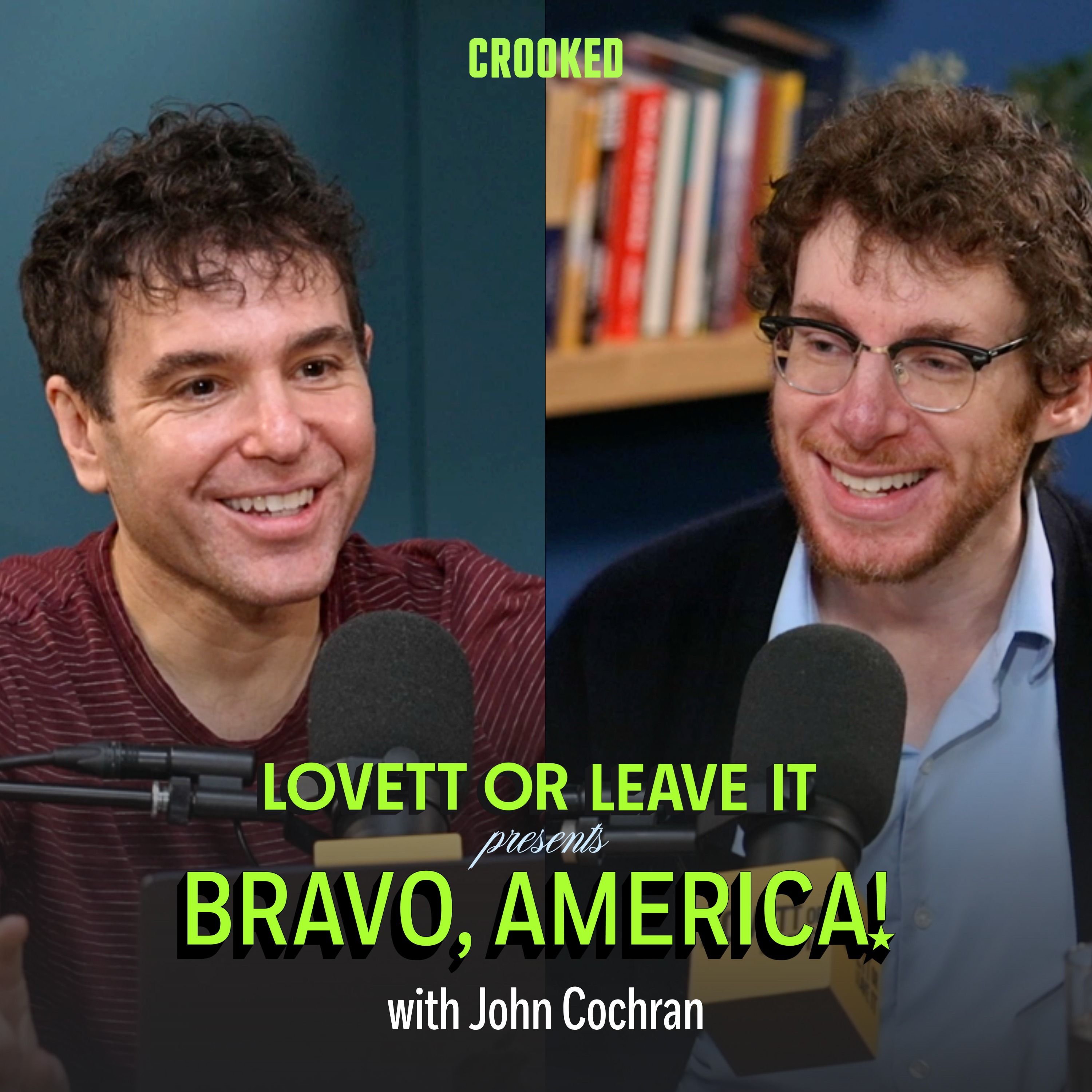
Lovett or Leave It Presents: Bravo, America! (with John Cochran)
For a closed-captioned version of this episode, click here.For a transcript of this episode, please email transcripts@crooked.com and include the name of the podcast.
Press play and read along
Transcript
Speaker 1 it or leave it is brought to you by AG1. The holiday season, it's upon us, and it can disrupt our routines because there are shorter days, you're traveling, you're going to holiday parties.
Speaker 1 This season, let AG1 help you stay one scoop ahead.
Speaker 1 Of all things that can throw you off your game, it's the easiest thing you can add to your daily routine to support whole health, especially during the busy months.
Speaker 1 There's crowded airports, long travel days put a strain on your system. AG1 provides antioxidants, probiotics, and functional mushrooms to support immune immune resilience.
Speaker 1 Holiday meals, sweets, and snacks are wrecking your diet, but AG1's full spectrum of micronutrients from whole foods helps fill nutrition gaps.
Speaker 1 This time of year can bring a lot of stress and disrupted habits. And it's great to have a healthy part of your routine.
Speaker 2 Hey, listen, you're not eating right, all right?
Speaker 1
You're not eating right, and you're not getting enough vegetables and healthy things. AG1 helps.
Make sure you're getting some of the good stuff every day.
Speaker 1 Head to drinkag1.com/slash love it to get a free welcome kit with an AG1 flavor sampler and a bottle of vitamin D3 plus K2. When you first subscribe, that's drinkag1.com/slash love it.
Speaker 1 Drink ag1.com slash love it.
Speaker 1 Hey, everybody, welcome back to Love It or Leave It Presents, Bravo America.
Speaker 1 I'm sitting down with some of my favorite personalities from reality TV because you cannot understand politics in this moment if you do not understand the dynamics of reality television.
Speaker 1 Take a listen listen to how Congresswoman Sarah McBride put it on Pod Save America earlier this year.
Speaker 3 Some of my colleagues are treating me the way they are treating me for a couple of reasons. One, it's because they want attention, right? They want to employ the strategies of a Bravo TV show
Speaker 3 to get attention in a body of 435 people. And the way to do that is to pick a fight with someone and throw wine in their face.
Speaker 1 Today, I'm joined by Survivor's John Cochran. He made his debut in season 23, and then he came back to win in season 26.
Speaker 1 Jeff Propes has called him one of, if not his favorite, survivor competitors because of his unlikely comeback story as a scrappy, self-deprecating nerd who overcame the odds on the island.
Speaker 1 We dig into Cochrane's experience being bullied, though he questions the term, in his first run, and how he's able to understand a control dynamic in his second season on the show and win.
Speaker 1 We also talked about the ways in which survivor has evolved alongside our culture.
Speaker 1 And as politics become more mean and toxic and bullying, Survivor has become more sincere and almost a bit more wholesome. It was a great conversation.
Speaker 1 I love getting to talk to John Cochran about Survivor, reality TV, what it says about our politics. So here's my conversation with John Cochran.
Speaker 1 John Cochran, thanks for being here.
Speaker 2 Thank you so much for having me. So
Speaker 1
you hold this historic place in Survivor Lore. because you were on two seasons.
And in your first season, you were kind of put upon. You were, I think, buffeted by events.
Speaker 1 You tried to make the best of it. You got a lot of shit from
Speaker 1
people on your tribe. And then you come back three seasons later, and you have one of the greatest runs in survivor history.
Do you agree with that?
Speaker 2 I mean, that's a very kind mythological way of putting it.
Speaker 2 I felt the first time that I was kind of, it was a self-fulfilling prophecy that people were, I was, I went in with so much insecurity that it was kind of the the fact that people didn't respond well to me.
Speaker 2 I can also kind of blame myself.
Speaker 1
See, I thought you might say something like that. So let's, I want to get into this.
So just.
Speaker 2 Okay, I sorry. No, no, no.
Speaker 1 See, you're already apologizing. Don't apologize.
Speaker 1 I want to talk about your evolution between the two seasons because I do think there's something about what happened to you that speaks to something larger about reality television.
Speaker 1 But for people that aren't familiar, you just,
Speaker 1 what is your story of what happened the first time you were on Survivor?
Speaker 2 So the first time, I mean, I went onto the show during an era of the show when it was derisively referred to as being populated by MACTORs, a lot of models and actors on the show that hadn't necessarily seen Survivor before, weren't super passionate about it.
Speaker 2 Whereas I had been this big, naughty super fan that wrote a paper about it in law school and used to hand out newsletters and
Speaker 2 memorabilia to school. So when I got to the island, I think I had all this theoretical knowledge of what I was supposed to do, but disregarded the fact that it's fundamentally a social experience.
Speaker 2 And if the people that I'm with don't respond well to me and I don't respond well to them, that all the knowledge about what day to play an idol, when a merge is going to happen, it means nothing if they don't want to sit and just have a conversation with you.
Speaker 2 So I think that first time...
Speaker 2
Sorry if I'm going on too long. You can cut me off on your hand.
You're not going on too long.
Speaker 2 We had the tribe, our tribe captain, it was returning players on each team. And our captain, my captain was Ozzy,
Speaker 2
who's this physical beast, maybe the best challenge competitor the game's ever seen. He can climb coconut trees effortlessly.
He can dive into the ocean with a spear and come up with fish.
Speaker 2 But I think by having him be the tribe captain, that kind of set the value system for the group. And so it's like, if you're on the Ozzy tribe, you better be good at challenges.
Speaker 2 You better be kind of like a cool social person. And I didn't fit into that pocket.
Speaker 2 I was kind of the nervous guy that's like, I don't want to take off my shirt the first, like the first moment on the first episode, Ozzy was like, hey, let's all get in our underwear and go into the ocean and bond.
Speaker 2 And I'd watch the show before. I felt like there was like at least an hour where you're standing around the beach talking to each other and collecting wood.
Speaker 2 This is like, no, immediately get in your underwear and go into the ocean. And so that was like, just initially, I didn't want to take off my shirt right away.
Speaker 2 So it was like, and I think that probably was not the best introduction to my tribe mates who are all having fun in the ocean, making a spectacle of myself over my discomfort.
Speaker 2
And then just, it progressed. I was not super well integrated in my tribe.
And then there came a point around halfway through the season when there's a merge.
Speaker 2 And I was getting votes at like every single tribal council, which is, even though when you're watching the show, you're like, oh, that was last week's episode.
Speaker 2 But when you're out there, it's like, oh, no, that was like last night. And I just had to go to bed with these people that like just voted me off.
Speaker 2 And those things accumulate so that by the time the merge arrived, there was a part of me that's like, I should just jump to the other side.
Speaker 2 Why am I sticking with this team that keeps trying to vote me off and convincing Ozzy to go home or stay instead of me? I don't know. So I jumped sides.
Speaker 2 And if you're an Ozzy fan at home, that was like a very disappointing moment for the season because it kind of put a, you know, blew up his plans.
Speaker 2
And I don't know, then I pretty quickly got voted off after flipping. It didn't work out for me strategically.
I didn't integrate into the new tribe as well as I was hoping I would.
Speaker 2 It was a very religious,
Speaker 2 it was an unusual group of players that I think historically there hasn't been that tight-knit of a group.
Speaker 2 I feel like usually you'd be able to find the people on the bottom of the pecking order and maybe find some fluidity there, but it was really this impenetrable group.
Speaker 2 And I just got kicked off a couple weeks after flipping.
Speaker 2 So
Speaker 1 I would like to show the picture of you once you did take your shirt off.
Speaker 1 I think this captures what happened to you in that season, kind of metaphorically. Can we show that picture?
Speaker 2 That's the second time, actually.
Speaker 1 Is that from the second season?
Speaker 2 The sunburn was the second season.
Speaker 1
Oh, my God. That's your second run of it? Well, I actually think it applies better to what happened to your first season.
God damn it. What the f? What?
Speaker 1 This is your second season and this happened to you?
Speaker 1 What happened? Why did you put sunscreen on? What was going on in your mind? You're a smart guy. What the fuck was this?
Speaker 2 This is so bad. I thought I was just about to have an encouraging speech.
Speaker 2 So,
Speaker 2
well, I get burnt very, very easily. I'm a red-headed guy.
I'm very vulnerable. And there is sunscreen available off campus.
So I can't blame the show and say we didn't have access to it.
Speaker 2 The problem is that the first, we got, this is like the first episode of my second season. Right when you arrive on camp, we went to a water wrestling challenge.
Speaker 2 So all the sunscreen I had on me washed off immediately because we were fighting around in the ocean.
Speaker 2 And then they did this very scenic, like pirate ship ride to camp that didn't even make the episode. We just sat in the ocean for like three hours waiting for helicopters to come film us.
Speaker 2 And it was during that time where, for continuity purposes, I was like, oh, I should probably just keep on my sweater vest.
Speaker 2 But I should have just put on all my shirts and covered my skin.
Speaker 2 But then I got back and I had an inverted sweater vest of, you know, very pale sweater vest shape on my chest and then red everywhere else um the weird thing is that it kind of at the time I was like oh I'm gonna be medically evacuated because they brought in doctors and everything and my bad yeah my feet got too swollen to wear shoes so I had to wear Brenda's flip-flops because they were the only open-footed footwear available I was kind of convincing myself like maybe this will be funny because I was already like into like thinking like I'm going home and this is at least an anecdote like the nerdy sunburned guy got medically evacuated for it.
Speaker 2 But it weirdly, I think strategically was maybe helpful.
Speaker 2 Not that I was already like a threat coming in, but it definitely neutralized any threatening qualities of me of like, oh, there's the guy that I was not even allowed to leave the shelter for a couple of days because they didn't want me in the sun.
Speaker 2 So, and those are critical days at the beginning of the season where everyone's kind of coupling off.
Speaker 2 But let's just say that maybe it's strategically worked out in the long run, even though physically it's very painful.
Speaker 1 Because you didn't seem like a threat at the beginning of that season.
Speaker 2 Yeah, it's like a wounded bird, kind of.
Speaker 1 So, back to the season with where you, your first season. So, I want to try to get at this,
Speaker 1 which is
Speaker 1 you talk about how, oh, you know, you didn't really gel with your tribe at first, and then you flipped sides because
Speaker 1
you never really felt like you belonged in that group, and you'd been getting votes. It was much worse than that.
They were incredibly hostile to you in a way that was not strategic.
Speaker 1 They seemed to just viscerally dislike you.
Speaker 2
Yeah, after a flipping, definitely. I mean, there was like a big reaction to me after flipping where they were yelling at me.
And
Speaker 2 yeah, there's like they even showed an ME is like most outrageous moments in reality of the year.
Speaker 2 And there's just night vision footage of of me being called disgusting, like during a little like clip reel.
Speaker 2 But before that, it was more, I think it was more that I was very,
Speaker 2 and during that era of the show, tribal strength and performance and challenges was a huge priority. And I would get so nervous in these competitions and I would come back and be apologizing.
Speaker 2 I'm sorry, I got nervous there. And I think that just added to my reputation as the guy that, like, if we lose, it's his fault.
Speaker 2 So there's probably just, and if Ozzy's your captain, he's like all about challenge performance. I think it trickled down.
Speaker 1 Yeah, you're still blaming yourself for it.
Speaker 2 So I, I,
Speaker 1 they didn't like you, and that's a flaw. Like you have great qualities, right?
Speaker 1 And so they're not liking you is not a reflection on you, although in some sense, of course it has to be, but it's also a reflection on them, right?
Speaker 1 Because you come back and win the next time you're on the show. So clearly that was in you.
Speaker 1 They didn't like you because
Speaker 1 you're, you know, a smart, anxious, Jewish guy. And like, right?
Speaker 2 I mean, part of this is on them Jewish right well part of it well the qualities that go along with that were not qualities that they sure that they appreciated and in generally when you're trying to live on an island and there's limited resources and there's lots of stress and physical reliance like probably the anxious guy that can't do anything physical that's mainly there to be like maybe there's going to be an endurance challenge next like isn't that helpful because that was my main contribution was like trying to decode tree mail which um I don't know, didn't endear me that much to them.
Speaker 1 You're still doing it.
Speaker 2 Because I'm also one of like, I don't know, I'm like, it's ancient history with them, and we're all kind of on good terms. And like, I don't care about that.
Speaker 1 Look, I am sure that you have your relate. This is long, how many years ago was your first appearance?
Speaker 2 14 years ago.
Speaker 1 14 years ago.
Speaker 1 This is not a judgment of where they came and how you think of them.
Speaker 1 Now, I think it's okay to, while acknowledging that these are full-fledged human, complicated human beings, that you've, you're relate, you've talked about it since you've evolved since I want to talk about what happened while you were there.
Speaker 1 Because in watching it,
Speaker 1 there is a
Speaker 1 way in which you were isolated from the very beginning that felt like, yes,
Speaker 1
it didn't feel like it was part of the game. It didn't feel like they were casting you out strategically.
It felt like you were,
Speaker 1 it felt like high school. And it did feel like bullying even before you flipped.
Speaker 1 And I wonder if you, you've, you've been reluctant to acknowledge that in the past, but like you were bullied before you flipped.
Speaker 2 There was definitely like a lot of condescension.
Speaker 2 There was one thing that was like very unpleasant where like I'm a big animal guy and they showed this in like the extra clip scene but like I didn't want to hold I didn't want to deal with the chicken having its head cut off but like Ozzy was very insistent I had to hold the chicken while the head was cut off because it would be like some growth experience for me and like I'm holding it and then they cut the head off and I don't I'm just keeping I'm still holding it because I don't like I don't know what to do in that case it's flapping around like as it does
Speaker 2 and they started like Ozzie and the guys were laughing at me they said it looked like I was having sex with the dead chicken because I didn't want to let go of it because I was afraid it was going to happen and it's like it was already a slightly upsetting experience then to have it.
Speaker 2 That was the one thing where I was like, oh, that's like, I don't feel too bad if I, if I write down somebody's name tonight. But
Speaker 2 bullying is, it's tough to say bully. I'm just relevant to that because I, I don't know, it's the why.
Speaker 2 It's such a contrived environment that it's like, usually in our everyday life, it's not, I'm going to, you don't get to just eliminate someone.
Speaker 2 So like bullying, not bullying, but like exclusions built into the game. It's a game of musical chairs and can you sit with us and can you not?
Speaker 2
So like the fact that I was one of the people that didn't have a seat for a while, I can't completely blame them. But I don't know.
We just didn't personally, I'm sure I was annoyed.
Speaker 2 Like I said that maybe we got oral herpes from one of the competition challenges that we did. Like that was probably a weird thing to say that turned some people off.
Speaker 1
Well, yeah, that's a great example. So you like made a joke.
That was a joke that you made that was a very kind of the
Speaker 1 I like, I remember that moment being, oh my God, that's like, that's the kind of joke that I would make because it's like a little bit like outrageous and you're saying something that's like about something gross but you're not actually
Speaker 1 attention diffusing kind of thing right right and it is received so poorly by this group of people that don't appreciate your humor they're like that's that's a that's their mistake right to not appreciate that right do you see it that way like you don't allow but this is what i'm saying like this is what's so interesting about how you talk about this which is like these people were assholes to you from the jump they were condescending they were dismissive of you they didn't like you personally they it was a very high school thing i do think that part of it,
Speaker 1 part of it is that you are like,
Speaker 1 there's a ways in which people brought like a kind of stereotype about Jews to this. I'm sorry, but that is present.
Speaker 1 And like, I want you to acknowledge that like that's something that they were doing, not something you were doing.
Speaker 2
No, for sure. I agree that there was like, I was not entirely to blame for every dynamic I had out there.
I can't read their minds about what
Speaker 2 their motives were.
Speaker 1 I'm not saying motives and I'm not implying. I have no idea what their mentality was.
Speaker 1 I'm saying that as someone who watched it, what I observed was you were the Jewish person applying to the Wasps Country Club, is what it seemed like. And they were like, he just doesn't fit in.
Speaker 2 I definitely felt like I didn't fit in. That was my first thing I said is the 90200 tribe, and I was one of the zeros on it.
Speaker 2 And it felt like that was maybe even a deliberate casting thing of like, if you looked at the lineup of people, it looked like
Speaker 2 Melrose place. And then I'm, you know, some Big Bang theory or something.
Speaker 2
It felt like, oh, let's see how this guy functions in this. But maybe that's me giving myself too much credit.
Maybe they were not focused on that. But
Speaker 2 sorry, what was the question?
Speaker 1 It's that, like, they were, they were bullying you
Speaker 1 over and over, and it was nothing that you did wrong.
Speaker 2 Look, they kept voting for me. It's hard to say.
Speaker 2 It was just, we didn't, I mean, people say the second time that I was slightly bullish, I made fun of people in some of the interviews, and I feel a certain level of guilt over that.
Speaker 2 I mean, oh my God, I know. I'm on the people.
Speaker 1 I know it's not. But so, but
Speaker 1 I'll let it go.
Speaker 2 No, no, but I'm happy to unpack it with you.
Speaker 1 Here's the thing that I, like, when I remember watching this, I remember thinking, God, what a sad,
Speaker 1
what a sad way in which to see Ozzy. Ozzy was one of the great players, a beloved figure.
He's an asshole to you.
Speaker 1
And to like, he, he, there's a cockiness and an arrogance and a mean-spiritedness to how you are treated. That is not part of the game.
They could have been very kind to you and voted you off.
Speaker 1
Like you were mistreated in a way that is a strategic. And like, this is a game and all is fair in the game.
And my view of it has always been that like
Speaker 1 lying, backstabbing, all of that, completely justified and completely moral.
Speaker 1 And this is, I think,
Speaker 1 in the years since you played, I think there's been an ethical evolution in Survivor, which is people used to bring their outside morals into it.
Speaker 1 But those outside morals are part of a plus, like a positive sum game where cooperation leads to a better world. But in this game, cooperate, conflict is only one prize, right?
Speaker 1 And so you don't have to bring those ethical questions, I think you can put aside and say it's all part of the game.
Speaker 1 But that is up until someone is inside of the game needlessly cruel or mean-spirited in a way that is not strategic or purposeful or part of the game.
Speaker 1 I think Russell would do that at times as one of the great villains.
Speaker 1 But I think in this season, like there is a hostility and a meanness towards you that just felt gratuitous and almost fun for the people that weren't you.
Speaker 2
Yeah. I think there's obviously there was a certain level of self-entitlement.
It It was his third time playing. So it's like,
Speaker 2 why isn't everyone listening to me? Like, of course, I'm going to be the person that everyone defers to.
Speaker 2 So the fact that I was kind of anyone that didn't fall into line, I think he was probably he was not going to be on the greatest terms with.
Speaker 2 Yeah, I don't know.
Speaker 2
But I think it's also, that's the dark. I was on season 23 and 26.
People now refer to that as the dark ages of the show. It was like a different mentality.
Speaker 2 I mean, there's been a big discourse online about villains and whether that's something we want on the show. I think then people more leaned into slightly more conflict
Speaker 2 and combustibility because it was what people liked on reality TV, whereas now that's not sustainable with reality or with social media
Speaker 2
quite as much. So I think I mean, I don't know, I've met people from the new era.
I don't know if they're necessarily all as equally compassionate to each other. I think it's just kind of like the
Speaker 2
show is emphasizing that it's still a game of like, we don't want you here anymore. And even though we've been living together, you're gone.
And that hurts regardless.
Speaker 1 We're going to hold there for a second. We'll be right back.
Speaker 2 Hey, don't go anywhere. There's more of Love It or Leave It coming up.
Speaker 1 Love It or Leave It is brought to you by Aura Frames. What's your favorite holiday tradition? Who started it? How long has it been going? And do you have photos of it?
Speaker 1
I have a holiday tradition for you. It involved three wise men heading towards Bethlehem.
And no, there are no photos. Who started it?
Speaker 2 The big guy.
Speaker 1 Yeah.
Speaker 1
That's right. I'm Jewish.
What if you could give a gift that brings your family holiday traditions and memories to life every day?
Speaker 1
With an Aura frame, you can upload unlimited photos and videos to your frame for free. Just download the Aura app and connect to Wi-Fi.
Setup is easy.
Speaker 1 It takes about two minutes to set up a frame using the Aura app. The app allows you to share photos and videos effortlessly at any time, straight from your phone.
Speaker 1
You can even personalize your gift by adding a message before it arrives to your loved one. And there's no gift wrapping necessary.
Every frame comes packaged in a premium gift box with no price tag.
Speaker 1 You can't wrap togetherness.
Speaker 2 But you can
Speaker 1
frame it. They're great gifts, Aura frames.
You get to people have pictures. You can load them up with great stuff.
Speaker 1 People love them. They got one at the Favreau household.
Speaker 1 Yeah, the favreau household meaning my parents right and they're just kind of all the all the memories are in there i take a picture it's on my phone and then i go to the aura app and i'm just like boom suddenly they got it on their frame they love it yeah there's obama on the stage you know
Speaker 1 for limited time visitorframes.com get 45 off aura's best-selling carver matt frames named number one by wire cutter
Speaker 1 using promo code love it at checkout that's auraframes.com promo code love it this exclusive black friday cyber monday deal is the best of the year so order now before it ends.
Speaker 1 Support this show and mention us at checkout. Terms and conditions apply.
Speaker 2 A massage chair might seem a bit extravagant, especially these days. Eight different settings, adjustable intensity, plus it's heated and it just feels so good.
Speaker 2 Yes, a massage chair might seem a bit extravagant, but when it can come with a car,
Speaker 2 suddenly it seems quite practical. The Volkswagen Tiguan, packed with premium features, like available massaging front seats, that only feels extravagant.
Speaker 1 What's interesting is you flip tribes. You just abandon this team, which was a great decision.
Speaker 1 It was hard to imagine it working out to you winning once you've done that. But like, of course, like,
Speaker 1 I think this gets at to me why I'm like interested in this a little bit because
Speaker 1
so they're treating you like dog shit. You flip on them.
They are. They're treating you like shit.
They're voting for you. You flip on them.
Speaker 1 They are so angry at you in a way that is not justified, right? And also not, they're not thoughtful at all about it, right? They are lashing out at you as if it isn't a game and
Speaker 1
as if the way they were treating you didn't happen. That to me is what I find so galling about it.
Some quotes about some quotes. about what is said about you after.
Speaker 1 That's how a wiener plays.
Speaker 1
You're a piece of shit coward. You're a poor excuse for a man.
Don't fucking talk to me ever again. That's Ozzy.
Speaker 2 Some of you are at Jim, I think.
Speaker 1 Oh, no, this one's Jim. You're a fucking piece of shit nerd.
Speaker 1
You realize, Keith and I saved you three times, and this is what you fucking do. You disgust me.
You're a rat.
Speaker 1 No, you weren't. No, you weren't.
Speaker 1 You weren't. That is not true, right?
Speaker 2
Right. No, I wasn't a rat.
I mean, I think they were just frustrated feeling like their game was over at that point. And
Speaker 2 yeah,
Speaker 2
that was the low point of the entire thing. I was legitimately like kind of freaked out.
And it was like pitch black outside.
Speaker 2 So it's just like these screaming voices at you in the aftermath of tribal council. And you have to go to bed.
Speaker 2 You have to like lie down on the ground with these people and ostensibly function in this little society again.
Speaker 2
No, I wasn't a rat. I get a lot of rat.
I feel like people, if you're a little scrawny guy, there's certain lingo that I feel like rat I would get a lot online. I still get it.
Speaker 2 I still get messages about like ugly rat coward poor excuse of a man thing. So those, that, those, those things have stuck around.
Speaker 2 But I think people are just are discovering that seasons over the pandemic and beyond. So it's always a new little batch of
Speaker 1 people like siding with these bullies.
Speaker 2 Yeah, or they love Ozzy. The sense I get is that it's just like, you're watching the show and you want Ozzy to do well enough.
Speaker 2 This little guy that's not good at the challenges screws him over, then you ruin the season for me. I'm not saying that's a rational response, but I feel like that's
Speaker 2
and I'm actually on okay terms with Ozzy. That's also part of my reluctance with it.
Like I don't have any ill will towards any of these people.
Speaker 1
And I just want to say that I'm pushing on that. You're not bringing, you're not revisiting this.
I'm revisiting this because I'm interested in it.
Speaker 1 You may be on good terms with these people, but this is what.
Speaker 2
Tell us later. That was a super upsetting.
That was like, yeah.
Speaker 1 And I like, and I'm not, again, I'm not putting this on anyone individually, and I'm not suggesting that I know anyone's motivations.
Speaker 1 I just, I, because I consumed a bunch of these mids, these seasons from the middle run of the show at once.
Speaker 1 And there is something that happens with a certain kind of smart, nerdy player, often a Jewish player, which is that they are scheming.
Speaker 1
This happens to Penner. Penn is the big one.
This happens to a number of Jewish, smart players that all of a sudden there's just this, oh, you know, you can't trust him. You know, they're schemers.
Speaker 2 Yeah. Kind of a rat.
Speaker 2
I mean, my whole demeanor might be contributing to that beyond just the fact that my mom's Jewish. I mean, like, uh, I'm like a nervous guy that's like hunched over.
And I don't know.
Speaker 2 I think I have my
Speaker 2 I don't know why I'm turning into this like this is self-integration thing, but
Speaker 2 you're you
Speaker 1 this is what like okay
Speaker 1 So this is how you I'm like bringing him up This is like interesting to me because I feel like this is part of your so so this is you you're you're even you're you're you you're closing in you're kind of now you're back so now we're in the mentality of season 23 you're apologizing for apologizing for apologizing okay
Speaker 1 then you come back right right
Speaker 1 you do get destroyed by the sun within minutes of arriving on the beach, which I think is a nadir in that season for you because you then go on one of the best runs in Survivor ever.
Speaker 1
You dominated that season. It's a perfect season, right? You didn't receive a single vote.
Is that right?
Speaker 2 Yeah, one of two people. That's right.
Speaker 2 So what
Speaker 2 changed?
Speaker 2 Well, it was only the next summer. So it wasn't as though, like, even though it was three seasons apart, it was literally a few months after the season stopped filming.
Speaker 2 So So it wasn't like I didn't undergo like a huge personal transformation or certainly physical transformation.
Speaker 2 The big thing is like the people you get put with, I mean, that determines really everything.
Speaker 2 And it's not the most glamorous answer, but like there's a lot of variability in how you perform based on what group you're put with. I also think going back, there's a huge different mentality shift.
Speaker 2 I was so nervous the first time, just like, it's very vulnerable. I was just a student that had very little exposure to any outdoorsy stuff or socializing.
Speaker 2 And then suddenly there's a camera crew and there's a Miss America runner and a retired cop and you're in a bamboo shelter together, and it's just like very overwhelming.
Speaker 2
Whereas the second time, a lot of that luster kind of is gone. You know, we're just like, I want to win.
I didn't just want to be a big character.
Speaker 2
I was like, I want to play the game that I'd loved a long time. And then just the people were more receptive to me.
I had several people from my first season on there.
Speaker 2
And then just like it's a survivor social circle. I met, you know, Andrea.
It was somebody that I was friendly with.
Speaker 2 But it was also nice just that mix of people I think was better. Like that first time just felt like a very homogenous tribe that I was put in.
Speaker 2
And I always kind of wanted a group of misfits that I can kind of blend in and out of. And I like that it's a big tribe.
It was 10 people. I know you had a six-person tribe.
Speaker 2 I don't, I need the big tribe to be able to kind of like have some hiding room.
Speaker 1
I feel like you and I had a similar early experience. Like you were able to survive early because it's bigger tribes.
Totally. And I, like, there was just nowhere for me to go.
Speaker 1 And I, like, I don't, it was, my group was not hostile at all, but they were,
Speaker 1 I was very different from my group, and there was just very little space, especially once
Speaker 1 there had been sort of the
Speaker 2 kind of what,
Speaker 1 especially once there had been the kind of like crazy moment and the breakdown and sort of the things sort of, I sort of lost control very quickly.
Speaker 1 But I did feel the same kind of feeling of like, I don't know, there's something about being
Speaker 1 an anxious, smart person that once the
Speaker 1 once this once the avalanche starts, you know, you're kind of, you're just sort of a passenger of like being unable to kind of contain it and kind of do breezy.
Speaker 1 You don't do you like it's hard to once you feel I feel like that's I think something that we have in common because I think once you felt like you were losing them you go into a kind of
Speaker 2 spiraling. Yeah.
Speaker 1 It's interesting.
Speaker 1 So you think the difference between the first season the season which you were kind of maligned and called a rat and disgusting and the season where you won, the main difference given that it was only a summer later has nothing to do with you, that it was the mix of people.
Speaker 2 And an attitude shift. I mean, I was definitely, I think it hardens you.
Speaker 2 Like being on these shows, you get a a lot of, I was very nervous the first time about how people are going to respond to me just being making fun of what I look like or what I sound like.
Speaker 2 And you get so, it's like a focus group testing on who you are as a person when you're on these shows. You get tons of feedback.
Speaker 2
You have to figure out which ones to incorporate and which ones to ignore. But it does kind of give you thicker skin.
So I think the second time I was slightly, I had a little bit of a shield of armor
Speaker 2 and a little bit more confidence. Just like not, the uncertainty is the scariest part.
Speaker 2 I feel like the first time when you're flying out there and you don't know who you're going to be with, you go through the casting process for the returning player seasons.
Speaker 2
You see who's going to be there. So it's already a slightly more comfortable thing.
But yeah, I don't know. I mean, I did better in challenges, for instance, the second time, which like
Speaker 2 I think that was just a comfort level thing as opposed to like, I didn't practice balancing or lifting things.
Speaker 2 I mean, I want a gross food eating challenge and stuff, but it was more about just being calm with the circumstances.
Speaker 2 I wish I had a better like transformation explanation, but I think it was more the people and
Speaker 2 being open to meeting them. I think the first time I was also kind of like trying to shoehorn my strategies into other people's polls, whereas it's like you have to find
Speaker 2 common ground and maybe, you know, give a little bit if you want to get something.
Speaker 1 Yeah, I feel like, now you were a super fan at a time when that really wasn't part of the show.
Speaker 1 Like it was, like, you were on with people that were just doing it and figuring out as they went, but you had come with a lot of plans, but you really never got to put them into fruition at all.
Speaker 1
It wasn't like you tried your various ideas of what survivor could be. You like kind of, you took your first punch and then that was out the window.
You were just trying to hang on.
Speaker 2 And then very quickly I was like the alter once you become the other option for who to vote off at every tribal council it's hard to kind of like cement yourself as a serious strategic source of information because it's just like oh we'll say we'll tell so-and-so that we're voting for you but it's actually going to be so-and-so but you never do that to the person that you actually like respect their place in the game because if that person plays an idol then the person that they're saying i don't know it just it was an insecure mind frame i was in the whole time so yeah it wasn't there was never anything i was like here's what we're doing next tribal council i give you the idol you vote for so-and-so and magic's gonna happen watch the fireworks It was like just me going, like, it's not going to be me this week.
Speaker 2 Why, right, please don't vote for me. Like, don't vote for me.
Speaker 2 Which when I got home, it was, I mean, it was a little bit of a,
Speaker 2 I took a semester off from law school because I was like very nervous about watching that show. I was kind of dreading how it was going to come across.
Speaker 1 And how do you feel watching it?
Speaker 2
I don't like watching it. Like, the fun part is being on it.
Like, even though, even the misery, it's the deprivation you're signing up for and the testing your limits.
Speaker 2 Afterwards, it's no longer your story. And it's, even though I love all the production, they do it very faithfully and accurately, but I just like hearing your voice on an answering machine.
Speaker 2 But it's like way worse because you know, 10 million people are hearing that voice on the answering machine, and they can say what they think about you.
Speaker 2 And it's also, there's you're having bathed in a month, and you're wearing a little outfit that they told you to wear with a red sweater vest and a pink button-down shirt, and it's like everything was just.
Speaker 2 I didn't really do viewing parties that season because I was like, this is just going to be a source of stress more than anything.
Speaker 2 I would, I would feel sick on Wednesday nights and then would stay up all night just reading every single comment. The next day, I would just be reading every single comment on every website.
Speaker 1 I felt I really wasn't thinking about what it would be like to air when I went, which I think is the right thing to do.
Speaker 1 I was just thinking about, and I had the same, like, having watched a lot of reality television of all kinds, my general feeling is that there is an ethic to how Survivor is made that actually doesn't apply to basically any other reality show.
Speaker 1
And so I was very comfortable kind of pushing my chips forward and letting the edit fall where it may. I'm just sort of trusting the ledger of it to be fair.
But then I remember the dread.
Speaker 1
Well, first of all, of course, because I knew I was going to be voted out. but the dread of watching it.
I was like, you know what?
Speaker 1 Given how nervous this feeling is, I would rather have gone home first than third, fourth, or fifth.
Speaker 1 Though, of course, I would have rather gone home much later too. Do you think I should do it again? Do you think that I you've watched?
Speaker 1 Look, you and I you made it further in your season, your first out, first season through it, but I think the thrust of the experience, you like,
Speaker 1 I think that your first season confirmed some of your fears about how you would be received.
Speaker 2 Oh, 100%.
Speaker 1 And I feel like
Speaker 1 that isn't exactly true for me other than just going home first, which is an interesting worst case scenario. But I feel like I never really got, like I never really got purchased.
Speaker 1 Like I told Jeff when I met Jeff, I'm either going to go home, I'm going to make it all the way or I'm going to go home first. And I just sort of caught the bad steer.
Speaker 1 But do you think I should do it again?
Speaker 2 Do you want to do it again?
Speaker 1 I don't know. What do you think? Do you think I should do it again?
Speaker 2 I think you have to want to do it. I feel like it's something you don't want to do.
Speaker 2 It's going going to end up being a negative experience because it's like such an intense thing but if you want to do it also you have all the upside it's going to go better this next time but i do your and i know well but there's you know there's francesca and i was unfortunately part of that i'm not proud of that um what was that like by the way oh god this is like dragging up all these painful memories um painful no that one's like not a fun one because i was like i was friendly with her that uh
Speaker 2 is a Well, I thought this woman, Jane, was going to be out there from Nicaragua. And it ended up being Don was, who ended up being my closest ally.
Speaker 2
I thought we were going to vote off Jane first because I was like, oh, I don't think, I don't know if people know her. I don't know.
That ended up being Dawn out there, who was my closest ally.
Speaker 2 Then the vote ended up coming down to Francesca versus Andrea, who looked at Tupa was actually friendliest with. It was kind of the worst case scenario for a first vote out for me.
Speaker 2
But I was closer with Andrea. And I don't know.
I think they had this built-in tension between Philip and Francesca, which they, you know, that was probably what they were hoping for, some sort of,
Speaker 2 not necessarily exactly what happened, just some kind of rekindling that feud. But that was not fun.
Speaker 2 It's not fun. It's like a painful game where
Speaker 2
it's a fun TV show. But when you're out there, you feel a lot of guilt because you realize, oh, I'm going to see this person afterwards, and we're going to be talking, and we have mutual friends.
And
Speaker 2 that's part of the reason I don't go back because it's like, oh, you hurt a lot of people's feelings. And
Speaker 2 you can't control how you come across. And I don't know.
Speaker 2 I feel guilty about it.
Speaker 2 Even though things turned out well and I won, that doesn't say it isn't accompanied by some little elements of, oh, I wish things had been different.
Speaker 1 But uh yeah we're gonna take a quick break we'll be right back
Speaker 2 hey don't go anywhere there's more of love it or leave it coming up
Speaker 1 love it or leave it is brought to you by prolon are you considering changing up your health routine do you find yourself saying i want to lose weight or i want to be healthier but nothing really sticks then you need prolon's five-day fasting mimicking diet program after just five days you'll feel lighter more energized and back on track and now they've upped their game with next gen
Speaker 1 backing the same science-backed benefits into a cleaner, more convenient, and tastier format, supporting fat, focused, weight loss and lean muscle protection. No injection required.
Speaker 1 Prolon is a plant-based nutrition program featuring soup snacks and beverages designed to nourish the body while keeping it in a fasting state, triggering cellular rejuvenation and renewal.
Speaker 1 Developed over decades at USC's Longevity Institute and backed by top U.S.
Speaker 1 medical centers, Prolon has been shown to support biological age reduction, metabolic health, skin appearance, fat loss, and energy.
Speaker 1 With Prolon's NextGen, you can get everything you need pre-packaged and ready to go.
Speaker 1 Each order of Prolon's five-day program comes with five boxes labeled labeled by day, so you know what to eat each day.
Speaker 1 Next gen, build on the original Prolon with 100% organic soups and teas, a richer taste, and ready-to-eat meals. For a limited time, Prolon is offering listeners 15% off site.
Speaker 1 Why plus a $40 bonus gift when you subscribe to their five-day program? Just visit ProlonLife.com/slash love it.
Speaker 1 That's P-R-O-L-O-N-L-I-F-E dot com slash love it to claim your 15% discount and your bonus gift, ProlonLife.com/slash love it.
Speaker 2 Hey, Ryan Reynolds here, wishing you a very happy half-off holiday because right now, Mint Mobile is offering you the gift of 50% off unlimited. To be clear, that's half price, not half the service.
Speaker 2 Mint is still premium unlimited wireless for a great price.
Speaker 4 So that means a half day.
Speaker 2 Yeah? Give it a try at mintmobile.com/slash switch.
Speaker 4
Upfront payment of $45 for a three-month plan, equivalent to $15 per month required. New customer offer for first three months only.
Speeds low under 35 gigabytes, the network's busy.
Speaker 4 Taxes and fees extra.
Speaker 2 See Mintmobile.com.
Speaker 1 What's interesting is you were
Speaker 1 a person who understood and really had paid attention to Survivor. You were, I think, one of, if not the first player to kind of really bring that kind of fan energy.
Speaker 2 Now,
Speaker 1 that's a big part of what Survivor has become. And actually,
Speaker 1 it's a lot of, it's the evolution a lot of reality shows have now gone. And this is true of competition shows,
Speaker 1 and it's also true of the real housewives. That the first couple seasons,
Speaker 1 these are people
Speaker 1 trying to
Speaker 1 be themselves or play the game, whatever that means. And then as you get further along, people come on the show having become fans of the show and that changes the show.
Speaker 1 And I'm curious what that's been like for you to watch as more and more people come to it with a similar
Speaker 1 knowledge that you had.
Speaker 2
I mean, I think it's fun to watch. Just even having met the most recent cast, I feel like I get along with them more.
It's like, oh, this is like, everyone's very nice and compassionate and smart.
Speaker 2 And I mean, I understand there's some frustration, like, we want more, you know, people that don't know the games. There's a mix of people that are inept versus strong players.
Speaker 2 But I think that if you got that in reality, it might be.
Speaker 2 I watch a lot of Big Brother too, and there are frequently people on Big Brother that have no idea what's going on. It's a greater source of frustration than entertainment to watch on the show.
Speaker 2 So I kind of like having a lot of people that know what's going on.
Speaker 2 The game's gotten so much more complex now that I feel like you almost kind of have to have people that are able to roll with the punches and do the different twists and everything. But I enjoy it.
Speaker 2 I mean, the shows had to evolve.
Speaker 2 I rewatched some of the early, I rewatched Marquesas over the pandemic, and it was a super fun season, but I don't think if it aired now that it would capture the viewers in the same way.
Speaker 1 Yeah, there are a lot of people that are critical of the new seasons of Survivor because of all the kind of
Speaker 1 the more complex rules around idols and challenges
Speaker 1 and immunity.
Speaker 1 But they are kind of willful, they're kind of forgetting that some of the early seasons of Survivor, they were quite boring because a lot of it was foregone.
Speaker 1 They were trying to generate drama, but there there was foregone conclusions.
Speaker 1 I mean, there were seasons like before Idols. I mean, it was just sort of like, and just you're just sort of, it's more about the survival and the social dynamic, but often that was predictable.
Speaker 1
And so this does add a level of kind of intrigue and complexity and change that I do think is good for the game. But then I do think it's harder for players.
Like, I think I
Speaker 1 like them constitutionally more kind of suited to a slower version of the game.
Speaker 2 Aaron Ross Powell,
Speaker 2 no, I feel the 20. I'm curious what you felt, but like the 39-day setup, the one big difference I would feel like is we'd have these off days where nothing happens.
Speaker 2 Like, usually the busy days you have a challenge, or you maybe have a tribal council and you have to be transported there, and you have to wait around a little bit, and there's lots of activity, and it feels like you're going on a field trip.
Speaker 2 But the days where you have nothing going on, and you don't even get told nothing's going on, you're kind of like waiting to find out.
Speaker 2 Maybe you're going to get tree mail, maybe this is an exciting day, and then gradually the realization sets in, like, oh no, I'm just stuck with these people sitting around and not eating for another 24 hours.
Speaker 2 Those days, actually, if there's anything I was good at survivor, I think I was actually probably good at those days because it's like I wasn't getting into fights and I was kind of an easy, low-key presence that if other people were having tension, they might decompress with me afterwards.
Speaker 2 I don't function. I don't operate well in the high
Speaker 2
activity days where it's like, hey, grab you in the woods. This is what we're going to do.
Like that, I kind of go into my shell.
Speaker 2
And that coupled with the smaller tribes, I feel like I would struggle. I would have a harder time with the new setup.
That's not to to say I don't like it, but
Speaker 2 it's definitely a different game.
Speaker 2 The small tribes in particular, imagine if you had three or four other people on your tribe. It would have been like a completely different experience.
Speaker 1 Well, it was also, I think,
Speaker 1 with six,
Speaker 1 there's only so many combinations. And once it was 2-2-2,
Speaker 1
you very quickly run out of... room to operate.
My only, yeah, I mean, just there was no,
Speaker 1 because, you know, as you know, like right before a tribal council, there's a ton of machinations and talking and groups forming, and they can't show all of that.
Speaker 1 But man, I was hustling to try to put something together.
Speaker 1 My only regret of the whole thing is, because I was doing the math in my head before the vote, which is I was like, I think I got like a, I thought my chances of making it out of the vote were roughly the same as the chances of rolling a die.
Speaker 1 Like, I thought it was like roughly the same, and I thought, all right, should I just say fuck it and do the shot in the dark?
Speaker 1 But then I really had like, well, if I, but if I spend this vote on the shot in the dark, and that's what sends me home, it was sort of tough. It was a tough call.
Speaker 2
I can understand the first tribal not wanting to use the shot in the dark. But I do like that twist.
That's obviously one of the new era twists that I do like as a little
Speaker 2 escape hatch and create some uncertainty. You can't tell people that you're going to, like, it forces blind sides.
Speaker 1 Yes, I think it's much rougher for the player mentality, but I think it's probably ultimately good for the game. So, one thing that's also happened is
Speaker 1 Survivor has moved away from the villains.
Speaker 1 It's just, it's, and it's interesting you say it, because I do think, like, having now spent time with a lot of the new era players myself, it does feel a lot of like front of the classroom kids.
Speaker 1 And Survivor used to be a lot more about the back of the classroom kids versus the front of the classroom kids.
Speaker 1 And you happen to be on a tribe with five back of the classroom kids, which really screwed you. But
Speaker 1 there's not the same amount of like bullying and harshness.
Speaker 1 But what's interesting about that is, as Survivor, I think, has become socially gentler and physically more kind of aggressive, like our culture has become
Speaker 1 overrun by bullies. It feels as though you're, you know, in your season, like it feels as though your tribe ultimately wins in the culture fight.
Speaker 1 And I'm like wondering if like just sort of in a politics dominated by bullying, if you've like thought about how like
Speaker 1 your experience with survivor,
Speaker 1 what you notice about in the commonalities with how bullying plays out in politics.
Speaker 2 Bully. That's interesting.
Speaker 2 I mean, a thing that's interesting with the
Speaker 2 villain aspect of everything is that there used to be like explicit villains. They'd be burning socks or throwing out your food or saying really cruel things.
Speaker 2 But even though the show has now shifted, I think Jeff Stevens said, look, we're kind of steering away from casting villains. It's not our priority anymore.
Speaker 2 Because of the cultural bullying and stuff, the public will identify a villain. They will create one.
Speaker 2 In the absence of an explicit one, they'll find a person that is, they don't like their voice enough. Or
Speaker 2 I watch Jeopardy a lot.
Speaker 2 People are cruel to like how contestants hold the buzzers like like they'll find anything that they don't like and that's enough of a justification for that to be the person that they hate even this current season i've seen people say oh these people are mean it's like if you watched reality tv from 20 years ago this would not even be a blip on the like radar of bad behavior but it's actually kind of full circle but like season two it's kind of going full circle with like jerry manthe She's the original villainess of all time, but you looked at her sins.
Speaker 2
Did she criticize how rice was made? And that got her booed off the stage in Madison Square Garden and made fun of in a scary movie franchise. It's insane.
It's insane.
Speaker 1 It's actually like, it's a, it's a good, like, um,
Speaker 1 if you go back and watch those seasons and the way that they were received, it actually speaks to how much the culture has shifted.
Speaker 1 You can't watch it through early 2000s eyes because 20 years ago, there was such a hostility towards a woman like Jerry that like inside of the show, the edit presumes the audience is seeing what
Speaker 1 that like, can you believe this bitch? And it's like, she didn't do anything. She didn't do anything.
Speaker 2
She's the sweetest. If you've remembered, she's like, so unbelievably kind and sweet.
And the fact that she was the person that was like picked out as the first villain of reality TV.
Speaker 2
And it's even kind of like with Parvy. I feel like her reputation is changed.
Like in the old days, she was really torn apart. And you can see there's been a shift in the conversation about it.
Speaker 2 Now that's actually a celebrated personality instead of like we hate the strong woman that's strategizing.
Speaker 1 Yeah, well,
Speaker 1
I talked to Parvity about that. And she kind of ultimately embraces this kind of villain archetype that she's meant to be playing.
And she just continues doing it. Now it becomes beloved.
Speaker 1 But so there's the ways in which people that weren't villains were treated as such because they were just being tough and not,
Speaker 1 I don't know, handsome guys, basically.
Speaker 1 But then at the same time, you have
Speaker 1 the ways in which reality T V villains
Speaker 1 politicians have learned from reality T V villains and now bring that energy to politics. And I'm just wondering if when you watch some of the ways in which
Speaker 1 Trump bullies people, the ways in which in Congress you have these sort of brawls and committee hearings, if it doesn't feel a little bit like they're playing kind of, I don't know, old school survivor.
Speaker 2 The thing that Yule Kwan, the survivor winner from Cook Islands, I was his legal intern a million years ago at the FCC. And before I went on survivor, I talked to him about the...
Speaker 2 you know, what I should be expecting. And one thing he talked about as a piece of advice was like, there are going to be times when you might be in an alliance.
Speaker 2 That ended up not even happening the first time. But he's like, you might be in an alliance and you're going to be like a group of people sitting over here.
Speaker 2 And there's going to be another alliance sitting like 15 feet away. He's like, don't, he's like, allow yourself to be the guy that's capable of going back and forth between the groups.
Speaker 2 Like, communicate with the other, because there is a tendency, and I experienced it and I participated in it.
Speaker 2 You'd literally be sitting 15 feet away, but like, you'd be assuming the worst about that other group.
Speaker 2 Even though I'm sure their conversation actually probably wasn't that different from yours, you're probably talking about what food you missed from home.
Speaker 2 Just because you were assigned different color buffs on day one, it's like, oh, I hate that person.
Speaker 2 I don't want to I want them out if you are I don't want to see their face but you'll like you know given the unpredictabilities of the game I'm kind of paraphrasing what I said but like given the unpredictability of the game there might be a time when it swaps around and the person you're sitting 15 feet away from might be able to be your ally you might have to play an idol with them or you might have to coordinate a vote with them so let's just say that the bullying of like the other eyes I think is something that I've noticed it's like the lack of communication makes it very easy to project the most monstrous version of your opponent onto them and then that's what you're responding to and then any sort of discourse is impossible.
Speaker 2
So that then you can just flip try. Then it's just like that's when you have a very non-fluid season of survivor.
I feel like that's the old era.
Speaker 2
It's like blue states and red, blue buffs, and red buffs. There's no intermingling.
Whereas now it's voting blocks, and if there's a shuffle, and I think that's a healthy thing.
Speaker 2 But I guess I kind of didn't completely answer your question about villains. But just, I think one of the things, just not
Speaker 2 the idea of the team sportification of politics is like created villains because you want to root against somebody, even though that's not what we're, you know, why is that what we're doing?
Speaker 2 Yeah, there's also,
Speaker 1 I think there's a,
Speaker 1 I think your instinct when
Speaker 2 people were kind of
Speaker 1 isolating you
Speaker 1 is to be self-deprecating, right? Almost to like, if someone throws a punch at you, you kind of like grab the fist and kind of pull it in. And that didn't seem to work.
Speaker 1 And I'm wondering, like in between your two seasons, like I, did you find yourself trying to avoid doing the self-deprecating thing because it just doesn't work or what?
Speaker 2 What's a compulsion? Like, it's not me being like, this will be an endearing thing right now.
Speaker 2 If I say something embarrassing and make a spectacle of how bad I am at something, that's just like a lifelong, if you get bullied and you'll make fun of yourself before anybody else has a chance to say the thing.
Speaker 2 And I'm way better at it than you are, so just listen to me.
Speaker 2
But I definitely, the second time there was a, it's also just like an attention. It's like, nobody wants to be talking about that.
Everyone's like the star of the season out there.
Speaker 2 Everyone wants to be, this is their story.
Speaker 2
I'm going to be getting all the great confessionals. So when you have one guy that's like, oh, look at me, I can't open a coconut.
Can somebody help me with a suntan lotion?
Speaker 2
It's like, all right, we're all out here. Why are you prioritizing? We're all uncomfortable.
We're all feeling discomfort.
Speaker 2 And yeah, just prioritizing other people. I mean, because that's like, you're still, I was still uncomfortable and I was still freaked out, but just not.
Speaker 2 I would save it for the confessionals, honestly. Like that's kind of the therapy session that you get where you don't have to,
Speaker 2 we can be super vulnerable and there's isn't that subtext of deception or trying to woo people like there is whenever you're around camp.
Speaker 2 So that's when I would, you know, really, if I were being self-deprecating, but it wasn't a deliberate thing.
Speaker 2 It's honestly, even during this interview, like when I do it, I'm not like, oh, this is going to be a little funny thing or something or it's going to make people endeared.
Speaker 2 It's like, no, I'll listen back to this and I'll be mortified, I'm sure.
Speaker 1 It's so exciting to me. It is just honestly, it is so rare to me to be in a conversation where someone is more this way than I am.
Speaker 1 Like, it's actually like, I'm just sitting here like, I mean, this is extraordinary.
Speaker 1 Like, this is the thing it's just like to see someone take what I do to its logical conclusion is so exciting It is charming.
Speaker 1 That's why I mean you did win your season because there you have charisma you have charm right you know that you can you compliment yourself ever
Speaker 2 because of self-deprecating stuff.
Speaker 1 No, I know I'm saying it was because of the good qualities you don't
Speaker 1 There's you don't do I don't know what the opposite of self-depth bragging I suppose you don't brag about it, but like you're a very smart charming funny person. Thank you.
Speaker 2 I don't seek out social stuff, but I get along with people pretty well. That was kind kind of why I applied for the show.
Speaker 2 I'm kind of a shut-in. Like I almost never hang out with people.
Speaker 2 But even in school, I'd always be able to get along with people from different social groups, like the jocks or the valley girl. And it wasn't Valley Girls, but you know, or the nerds.
Speaker 2 So even though I wasn't their favorite person, you don't have to be anyone's favorite person, just like somebody that they like getting along with.
Speaker 2 Usually vote off the favorite person because they're a threat to win. So it's kind of being like an even-keeled person.
Speaker 2
that isn't a source of drama. I thought I did a good job at Final Tribal Council.
That's the one thing where like I do pat myself on the back. You crush, yeah.
Because I had a lot of pressure.
Speaker 2 I put pressure on myself because of law school and stuff. But
Speaker 2 yeah, I don't know. What was the question?
Speaker 2 How did I transfer?
Speaker 2
I don't even remember what the question was. I was saying that I was better the second time.
Thank you.
Speaker 2 And then
Speaker 1 I'm just
Speaker 1 do you notice survivor
Speaker 1 when you watch the ways in which politics has become a lot more
Speaker 1 personality driven
Speaker 1 and there is a lot more kind of survivor-like qualities to the way people treat politics now. I'm wondering if you ever are watching
Speaker 1 a debate, a campaign, and think, man, this reminds me of what it was like when I was on Survivor.
Speaker 2 I mean, you can't help watch the big primaries with all the people trying to vie for votes and the gradual elimination. It's very reality, TV-coded.
Speaker 2 And the best presidential debates are like the best final tribal councils. And
Speaker 2
I listen to the podcast with Parvati, and she commented on like authenticity, I think, being one of the core. I think that's consistent across reality TV and politics.
The people that,
Speaker 2
at least they're able to put on the illusion of authenticity, will be a lot more effective than people that don't. And self-awareness, knowing your strengths and weaknesses.
And
Speaker 2 the question was, when I see politics,
Speaker 2 gosh, I mean,
Speaker 2 the fact that our presence, reality TV for another Mark Burnett acolyte, it's like it's inescapable. His whole dialogue of
Speaker 2 good guys and bad guys and shut up. And I don't want to talk.
Speaker 2
It's inescapable. I don't know.
I don't know that it's a good thing, honestly.
Speaker 2
I think it's a terrible thing. Yeah.
It's a very reductive thing.
Speaker 2 In everyday life, there aren't villains and heroes.
Speaker 2 Those are labels that reality TV puts on them, but those labels have kind of crossed out into politics and flattened people into these identities, just like a reality TV edit.
Speaker 2 It can kind of make you be like, oh, I'm just the nerd that's the self-deprecating stuff.
Speaker 2
Yeah, I don't know. It's a bleak thing.
I definitely do watch
Speaker 2 with Yule Kwan. I asked him whether he would consider politics because watching him, I was like, oh, he's a smart guy.
Speaker 2 He'd worked for Senator Lieberman and he worked for Google and McKinsey and has this incredible background in Yale and Stanford.
Speaker 2 But he said that he wouldn't, he said he wouldn't be able to, his personality type isn't good for governing or no, he'd be good at governing, but not campaigning.
Speaker 2 But just like it's a completely different skill set.
Speaker 2 So maybe the reality TV skill set is better for campaigning.
Speaker 1 Yeah, maybe so.
Speaker 2 Just the TV show aspect of,
Speaker 2 but I don't know.
Speaker 1 It's interesting because
Speaker 1 Yule is
Speaker 1 one of the greatest players and similar,
Speaker 1 I think, similar to you in a sense of being
Speaker 1 strategic, very intelligent.
Speaker 1 But
Speaker 1 I wonder if you feel this too, that there is a kind of self-discipline around his own emotions that I think is sort of not something either of us could replicate.
Speaker 2 Oh, no. I mean,
Speaker 2 I saw myself in certain aspects of him, that he was like a bookish guy that clearly took this game very seriously.
Speaker 2 But no, he is like cool as a cucumber and can be very clinical with how he deals with game stuff, whereas I'm an emotional, anxious mess. And if he is, he doesn't betray it, at least outwardly.
Speaker 2 And I think it's interesting.
Speaker 2 I think it actually cut against him the second time. The first time, I think it helped.
Speaker 2 And the second time, I think there was more like emotional bonding over, you know, families at the edge of extinction, and he less got into that.
Speaker 2 So, yeah, I just say I agree agree with you, I think. Yeah.
Speaker 2 You should talk to him.
Speaker 2 We should talk to you all.
Speaker 1
I would like to talk to you. He's very smart.
We're going to take a quick break. We'll be right back.
Speaker 2 Hey, don't go anywhere. There's more of Love It or Leave It coming up.
Speaker 1 Love It or Leave It brought to you by Blinds.com.
Speaker 1 You spent all that effort making your home feel like a winter wonderland from stringing lights to decorating every corner and setting the perfect vibe.
Speaker 1 But if those old blinds are throwing it all off, it may be time to do something about them.
Speaker 1 With blinds.com, you can upgrade your window treatments and pull the whole look together before the the holidays hit full swing. Blinds.com called out the window treatment industry.
Speaker 2 Yeah, that's right. They clapped back for what it
Speaker 1 for what it was.
Speaker 1 Outdated, overpriced, and built to serve salespeople, not customers. So they flipped it.
Speaker 1 While others overpromise or overcharge, blinds.com delivers custom window treatments for your space your way at your convenience. And unlike some competitors, the price you see is the price you pay.
Speaker 1 No hidden fees. There's zero pressure.
Speaker 1 From blackout and motorized options to classic shutters, blinds.com has window treatments for every room, style, and budget, every shade, even shades for your outdoor space.
Speaker 1 And it's all backed by Blinds.com's 100% satisfaction guarantee. So you know you're covered literally and figuratively, because at blinds.com, the only thing they treat better than windows is you.
Speaker 1 The Black Friday deals at Blinds.com are going strong all month long, so don't miss your chance to save big. And as always, our listeners still get $50 off when you spend $500 or more.
Speaker 1
Just use code LOVEIT at checkout. Limited time offer.
Rules and restrictions apply. See Blinds.com for details.
Speaker 2 Hey,
Speaker 2 Mint is still premium, unlimited wireless for a great price.
Speaker 4 So that means a half day.
Speaker 2 Yeah? Give it a try at mintmobile.com/slash switch.
Speaker 4
Upfront payment of $45 for a three-month plan, equivalent to $15 per month required. New customer offer for first three months only.
Speed slow under 55 gigabytes of networks busy.
Speaker 4 Taxes and fees extra.
Speaker 2 See Mintmobile.com.
Speaker 1 Now,
Speaker 1 you still are getting, because the seasons have been rediscovered, you're still getting feedback on your two seasons, like on social media all the time.
Speaker 2 I mean, like, multiple times a week.
Speaker 2 I don't want to sound like I'm constantly being flooded with stuff, but it's like every time I'll check that little hidden Instagram section, like the hidden DM things, it's like never a good thing.
Speaker 1 Yeah, don't go in there.
Speaker 2
And I got one recently. Actually, I don't want to give voice to the DMs because they'll be like, oh, oh, he read the specific one.
It was a woman that don't feed the trolls. But they got you.
Speaker 1 They got you.
Speaker 2
There's some very specific ones. I mean, some of it's the generic ones that are like, you're an ugly coward.
I do that to Ozzie or it's a rigged season. Hate you.
Whichever.
Speaker 2
I've heard that so many times. It's certainly, this sounded like somebody that knows me.
Not the one for me.
Speaker 1 Let's get at that for a second.
Speaker 1 Because it is like the criticism that you agree with that hit, or like you can, you, that, that's, that feels like something you'd say to yourself that like hits the hardest.
Speaker 1 And I'm curious, like, when you get, like, when you think about your experience experience on Survivor, like what is the self-criticism that still gets to you?
Speaker 2 Oh, so many things. I mean, like tons of things.
Speaker 2 I don't like that.
Speaker 2 I feel like I, especially the second time, like the way you were describing the bullies the first time, in a small way, I feel like, oh, did I turn into a bully the second time with when I was kind of mocking people in interviews?
Speaker 2
Part of that was like, it's a conversation with producers. You're trying to make them laugh.
And it's like a... And that's where you've ended.
Speaker 2
Yeah. And that's also like, I figure that's what I'm getting put on the show for.
Like, I'm not doing anything during challenges. That's particularly impressive.
I'm not causing any blow-ups at camp.
Speaker 2 It's like, no, that's just where I clock in and I say my wacky things and I go back to camp and do nothing.
Speaker 2 But so I felt guilt about that just because I know, that's also my reluctance about commenting about like other players online because I know how unpleasant it is to be on the show.
Speaker 2 And so to contribute.
Speaker 2 to use whatever little platform I have to like add on to that and be like, oh, I hate this person or I'm not enjoying, or even just saying, I'm glad this person survived implies that you were happy the other person got voted off.
Speaker 2 I get so in my head about that.
Speaker 2 So when I replay stuff I said on the show about being happy for voting somebody off or making fun of them, I feel because I just know that they're watching that episode with their family.
Speaker 2 It's easy when you're saying it on the aisle and it's like, okay, whatever, caught in this moment. Then you wait a year and it's like, oh, you get, they're maybe doing a viewing party.
Speaker 2 And I was kind of a guy that was like a trustworthy narrator. So if I'm making fun of you, it's kind of the endorsement of the show saying
Speaker 1 the voice of the show. Yeah.
Speaker 2 So I feel guilty about that.
Speaker 2 I mean, I don't like what I look like. I mean, this is just general embarrassment of like appearance and demeanor.
Speaker 2
But it's just mainly stuff saying about other people. I'm fine making some fun of myself.
I do that all the time. And I make fun of other people too, but
Speaker 2
I don't want it to be a public record that then identifies their experience. And then they feel bad for a long time.
Not saying that they feel bad, but this is the sort of thing that I worry about.
Speaker 2 But then yeah, the other criticism that was a rigged season and stuff, I don't really care. A lot of the criticisms about my gameplay, I don't really care about.
Speaker 2
Saying like I'm not a good winner. I'm a bottom-tier winner in a bad season that nobody should watch.
I don't know. I'm at peace with that.
Speaker 1
you've said you don't want to do it again. You're kind of out.
But in having the two different experiences you've had on Survivor and the two different ways it was received,
Speaker 1 what did it teach you about what the audience appreciates or doesn't appreciate about competition? Like what did it show you about the way America views?
Speaker 1 what happens when someone like you either does poorly or does well?
Speaker 2 Well,
Speaker 2 it spoke to like the different value systems that people bring to the show when they're watching. I mean, even when you meet people, some people watch just for the challenges.
Speaker 2 And they fast forward through everything else, which is unfathomable to me.
Speaker 2 But so like, so if you prioritize that and you see me the first season and I'm the reason we're losing challenges and I'm on a tribe with Ozzie.
Speaker 2
A lot of those people hated me and they'd come to me like, oh, he loved you the second time. He started winning all these challenges.
But like, that's not even a thing I care about.
Speaker 2 That's not a, I mean, it's a fun thing. It was a fun thing to win challenges, but that's not my value system.
Speaker 2 I think a big thing, I mean, part of you touched on it, but I just think authenticity and vulnerability is like what people are looking for.
Speaker 2
You don't, you want, when things are going bad on the show, be vulnerable. Don't be saying, oh, I'm going to figure this out.
This is going to be great. I got it all covered.
Speaker 2 They want honesty. And if you're messing up, then being able to course correct is kind of like a thing that's, I don't know, people don't like the seasons where you just get locked into one thing.
Speaker 2 I don't know, but the motives and incentives for the viewership are different from the players.
Speaker 2 Like the viewers want an exciting season of lots of blind sides and idols being played and people whispering during tribal council, which is not necessarily what makes for the most stable game.
Speaker 2 I don't know. I feel like I'm not giving a good answer to this, so I'm freaking out.
Speaker 2
I'm going to spiral over this, text my mom afterwards. I need to that.
Okay.
Speaker 2 She wants to have the link to this when I'm done, though.
Speaker 1 Okay.
Speaker 1 We will get this episode to your mom then. Okay.
Speaker 2
What did I learn about what the viewers like out of this? I don't know. Well, viewers like different things.
Some people hate me. Some people like me.
Some people, they prioritize the people. Like,
Speaker 2
a lot of people love Boston Robb, who insists on a buddy system. It doesn't let you talk to people and tells you how to vote.
That's not how I operate. But
Speaker 2 it's just nice seeing how it's interesting how people latch onto different aspects of it. I don't know.
Speaker 2 There was a big split in how people reacted to me the second time, which is kind of almost like makes you a little cynical, because I don't feel like I changed that that much, but like,
Speaker 2 I want a gross food eating challenge, and now I'm deserving of respect. I don't know.
Speaker 1 It's like a it's it's people want
Speaker 1 it's complicated, right? Because with with Boston Rob, it's a little bit like he's a bully you root for.
Speaker 2 Yeah, he's a charming guy and charismatic.
Speaker 1 And people like a bully that they can root for, which is not, which does apply in politics, right? That somebody who is dominating, but also can get people behind them is a very powerful thing.
Speaker 1 For you, in your season, you're an underdog people can root for, but yet you're dominating the whole way through. So were you ever actually an underdog or is that just your energy?
Speaker 2 Do you have underdog energy?
Speaker 2 I've had a perpetual underdog energy. I mean, like, just very structurally, I was on the favorites tribe the second time with a big numbers advantage going into the merge.
Speaker 2 I think just because I'm a scrawny guy that's wearing a funny little too big for me button-down shirt and khakis and stuff, it like oozes like, oh, he's, it's, this is hard for, and I'm not good at the challenges, like just anything physical.
Speaker 1 But you won a challenge your season. You did.
Speaker 2 I won three individual activities.
Speaker 2
Physically, you want a physical one. Yeah, but I also have like advantages.
There's a little asterisk, believe I get reminded of the money. Oh, my God.
I'm going to take the fucking compliment.
Speaker 1
So in your season, it was two returning players, Ozzy and Coach, who were kind of the captains of their team. Ozzy, we talked about Coach created this oddly kind of spiritual religious tribes.
Really,
Speaker 1 what a weird fucking season that was.
Speaker 2 But they're both coming back for 50.
Speaker 1 And
Speaker 1 I wonder if you have thoughts about that. Like,
Speaker 1 what do you expect from an Ozzy and a coach this many years on?
Speaker 2 That's maybe the dynamic I'm, because, because I played with them, that's maybe the dynamic I'm most excited about. Because I don't think they like each other, or at least historically, they didn't.
Speaker 2 I feel like, this is also old, ancient history, maybe they've completely moved on, but I feel like at the time it was
Speaker 2 coach slightly felt like Ozzy was responsible for Coach not winning Final Tribal Council, because Ozzy kind of came into Ponderosa and was like, don't vote for Coach, he's a bad guy, and everything.
Speaker 2
So there's this lingering ill-will towards him. They were two returning players.
I think that also kind of added to the competitive thing, like, you did better than I did. And
Speaker 2 so I'll be curious to see whether there's any lingering resentment or whether, you know, the fact that they know each other, that theoretically could be a reason to get together.
Speaker 2 They're part of the same, I don't know if they're the same age range exactly, but they're same era of the show. And
Speaker 2 I don't know. I mean, honestly, the thing is, I'll be curious whether there's a new incarnation of him.
Speaker 2 I feel like that first version of him was so wonderful. And then,
Speaker 2 I don't know, I don't like talking bad about it.
Speaker 2 I'm already like self-editing and freaking out about what I'm saying.
Speaker 1 Can I take a shot at it?
Speaker 1
He was the golden boy of Survivor, this incredibly beloved figure. And he tarnished that by being a fucking asshole.
And
Speaker 1 maybe this is his chance to kind of, because he never wins, right? He never wins.
Speaker 2 No, that first time was the closest.
Speaker 2 Even the time I was on, he got very close to his final four, but that first time against Yule was like such a good, it was the ultimate strength performer versus the ultimate strategist.
Speaker 2 And it was like a 4-3 vote, or it was a very, very close vote, I think, which almost never happens now.
Speaker 2 But he would have won South Pacific had he won the final immunity immunity challenge that's the thing the whole thing was set up for him to like yeah
Speaker 1 that whole thing was so structured for him and it didn't happen for him so I feel like this is his chance but I do think like I wonder I wonder you know you can you can um downplay it all you want and blame yourself but I feel like
Speaker 1 there's got to be a residue from the kind of haughtiness that he brought to the season with you that he'd want to come I thought you're saying haughty and like HTTP no I wasn't saying that I wasn't saying I could I could so as a as somebody who was a super fan of Survivor, kind of a student of the game, kind of last question.
Speaker 1 How do you think about the way Survivor has changed as sort of our pop culture has changed since you and I both watched the first season live in 2000? Not together.
Speaker 2 We're strangers, but still. Yeah.
Speaker 2 Spiritually watched it together.
Speaker 2 I feel like,
Speaker 2 I mean, at the very beginning, it was like the wild west of television.
Speaker 2 I remember there being ambiguity about whether the people were going to die on the show, the people who were promoting. I was like, I'm going to take 16 Americans one by one.
Speaker 2
They're not going to get any food, and there's going to be one person left. And then they win.
It seemed like Lord of the Flies. And they were really leaning into the
Speaker 2
torture aspect of it. I mean, it was kind of also around the same time as Fear Factor.
It's like more eating bugs and seeing bug bites and people really struggling and burning themselves.
Speaker 2 And then there's been, I don't know,
Speaker 2 it's funny. I feel like when society is more, this is speaking of big brushstrokes.
Speaker 2 But like when there's society is more compassionate, the reality of TV is a little bit more sinister and then vice versa.
Speaker 2 I feel like right now, like with the political climate and the culture and conversation so toxic that it's almost kind of like survivor.
Speaker 2 It's not true of all reality shows, certainly, but like Survivor's kind of doing a public service of like, let's give you a little bit of a sanctuary from this dialogue.
Speaker 2 Even though it is still a game of deception and betrayal and paranoia and voting and everything, but I feel like now there's been an emphasis on more compassion and even just humanizing the contestants.
Speaker 2 Like, some people don't like the little flashbacks where they go to a thing and say, oh, I grew up and this is what my parents were doing and everything. But it is nice to know.
Speaker 2 It reminds you that, like, especially in the age of social media where people are so inclined to just dehumanize you and send you the most hateful stuff, it is a nice reminder, like, oh, this is a person that's going home to their life and family when this is over.
Speaker 2 But I feel like maybe when,
Speaker 2 because we get so much, if you turn on CNN, you're getting the most, you're getting the 2000 version of reality TV of all the people with the wounds and the bug bites.
Speaker 2
And so it's kind of like, We don't need that anymore. Maybe if it swings back, we'll be craving more Hunger Game style reality TV.
But I feel like, oh, there's House of Villains, though.
Speaker 2 There are shows that lean into villain stuff. Do you feel like there's been an overall
Speaker 2 change in the tone of reality TV? I'm so focused on survivor that I'm slightly less aware of what Real Housewives is doing.
Speaker 1 I think on Survivor, I think a lot of reality shows reflect the culture. I think that Survivor, you're right, now feels like something of
Speaker 1
an antidote or a kind of contrary version of culture. And I think you're right.
It has become socially gentler, but there's also something about the way in which Jeff,
Speaker 1 as someone who just believes in earnest striving and unironic hard work, right?
Speaker 1 And I do think, like, yes, there's a way in which toxic politics leads people to want a more wholesome experience, but also ironic culture and the ways in which everything is mediated and even hard work itself is sort of diminished,
Speaker 1 that there's still this kind of place where that's how you do it on survivor.
Speaker 1 At the end of the day, whatever is happening,
Speaker 1 striving and fighting, unironically,
Speaker 1 even to the point of sapping your own dignity is still a value. And I think that, like, I think people are,
Speaker 1 it's both a respite from the toxic political culture, but also a place where people can kind of sink into some unironic, earnest,
Speaker 1 like kind of competition for its own sake.
Speaker 2
No, that's a great call. I never even considered that, but you're right.
Yeah, it's people make fun of propes
Speaker 2 sincerity in those moments, but I actually think that is a nice,
Speaker 2
I don't like when there's every so often there's one contestant that seems a little too cool for school or ironic about it. I never like it.
That's not what survivor's for.
Speaker 2 It is about stripping you down to your essentials and the vulnerability and the authenticity. And I think, yeah, I think that's, you don't get that in anything else.
Speaker 2 That's why I was trying to to reality TV in the first place. That's actually kind of why I'm less into like
Speaker 2 traders and stuff because I feel like it becomes a career reality TV person that's curated this persona and it's no longer,
Speaker 2 it's kind of like an actor at that point.
Speaker 2 Not saying they're acting, but like I used to love game shows just because I liked seeing the fleeting real interactions of like the couple's on newlywed game or on family feud, the tension between the families.
Speaker 2 And imagine what the Car Ride Home is like.
Speaker 2 Or in Jeopardy, just like the interviews with Alex Trebek was always funny to me. And I feel like Survivor took that and expanded it out to this extreme, you know, hour-long adventure.
Speaker 2
And that's what I'm craving. Yeah, that's not ironic.
Yeah, the lack of iron. I never thought of it.
That's really cool. No, I think that's right.
It is.
Speaker 1 It is sort of like a hunger for sincerity.
Speaker 2 Yeah.
Speaker 1 So maybe the goal here is to get to a point where Survivor is a brutal and mean-spirited slog again in which sweet,
Speaker 1
smart Jewish nerds are kind of destroyed before us because that would mean our politics had gotten wholesome. And that's a beautiful place to leave it.
I love that. John Cochran, thank you so much.
Speaker 1 It's so great for talking to you.
Speaker 2 My pleasure. Thank you.
Speaker 1 If you're already scrolling endlessly, which we know you are, don't forget to follow us at Crooked Media on Instagram, TikTok, and all the other ones for original content, community events, and more.
Speaker 1 You can also find Love It or Leave It on YouTube for videos of your favorite segments and other YouTube-exclusive content.
Speaker 1 And if you want to sing our praises or rip us a new one, please drop us a review.
Speaker 1 Finally, if you want to listen to Love It or Leave It ad-free and get access to exclusive shows, go to crooked.com slash friends to subscribe on Supercast, Substack, YouTube, or Apple Podcasts, wherever you are, you can find us.
Speaker 1
Love It or Leave It is a crooked media production. It is written and produced by me, John Lovett, and Lee Eisenberg.
Kendra James is our executive producer.
Speaker 1
Bill McGrath and Caroline Rustin are our producers. And Kennedy Hill is our associate producer.
Howie Kiefer is our head writer. Sarah Lazarus.
Speaker 1
Jocelyn Coffin, Peter Miller, Alan Pierre, and Subha Arguel. are our writers.
Jordan Cantor is our editor. Kyle Seglin and Charlotte Landis provide audio support.
Speaker 1 Stephen Cologne is our audio engineer. Our theme song is written and performed by SureSure.
Speaker 1 Thanks to our designer, Sammy Koderna-Reeves, for creating and running all of our visuals, which you can't see because this is a podcast, and to our digital producers, David Toles, Claudia Shang, Mia Kalman, Delan Villanueva, and Rachel Gajeski for filming and editing video each week so you can.
Speaker 1 Our head of production is Matt DeGroote, and our production staff is proudly unionized with the Writers Guild of America East.
Speaker 5 10 years from today, Lisa Schneider will trade in her office job to become the leader of a pack of dogs. As the owner of her own dog rescue, that is.
Speaker 5 A second act made possible by the reskilling courses Lisa's taking now with AARP to help make sure her income lives as long as she does and she can finally run with the big dogs and the small dogs who just think they're big dogs.
Speaker 5 That's why the younger you are, the more you need AARP. Learn more at aarp.org slash skills.
Speaker 6 Hello, hot people who vote. Looking for the perfect gift this holiday season for the people in your life who give a damn? Look no further than the crooked media store.
Speaker 6 We've got merch from all their favorite shows like Pod Save America, Hysteria, and Love It or Leave It, plus holiday exclusives like our Santa is a Woman collection for everyone who knows she's making a list and checking it twice.
Speaker 6 There is also high-quality sweatshirts, tees, and stocking stuffers for everyone on your list, even you. Head to crooked.com/slash store now to shop.