Trump's tariff turnaround
The latest in President Donald Trump’s trade war waffling? Tariff exemptions aimed at lowering Americans’ grocery bills. Affected products could include supermarket staples, like coffee and bananas from Ecuador, Argentina, El Salvador and Guatemala. In this episode, how long it could take for shoppers and businesses to see lower prices. Plus: Work permit rollbacks fuel a janitorial workforce crunch in Texas, moviegoers shell out for IMAX screenings, and we check in with a Pennsylvania customs broker.
Every story has an economic angle. Want some in your inbox? Subscribe to our daily or weekly newsletter.
Marketplace is more than a radio show. Check out our original reporting and financial literacy content at marketplace.org — and consider making an investment in our future.
Press play and read along
Transcript
Speaker 1 This podcast is supported by Odoo. Some say Odoo business management software is like fertilizer for businesses because the simple, efficient software promotes growth.
Speaker 1 Others say Odoo is like a magic beanstalk because it scales with you and is magically affordable.
Speaker 1 And some describe Odoo's programs for manufacturing, accounting, and more as building blocks for creating a custom software suite. So Odoo is fertilizer, magic beanstock building blocks for business.
Speaker 1
Odoo, exactly what businesses need. Sign up at odoo.com.
That's odoo.com.
Speaker 3 Introducing your new Dell PC with the Intel Core Ultra Processor. It helps you handle a lot, even when your holiday to-do list gets to be a lot.
Speaker 3 Like organizing your holiday shopping and searching for great holiday deals and customer questions and customers requesting custom things, plus planning the perfect holiday dinner for vegans, vegetarians, pescatarians, and Uncle Mike's carnivore diet.
Speaker 3 Luckily, you can get a PC with all-day battery life to help you get it all done. That's the power of a Dell PC with Intel inside, backed by Dell's Price Match Guarantee.
Speaker 3
Get yours today at dell.com/slash holiday. Terms and conditions apply.
See Dell.com for details.
Speaker 2
We will, of course, review the week that was. We'll talk tariffs.
We can't not, really.
Speaker 2 But then, we'll go to the movies. From American Public Media, this is Marketplace.
Speaker 2
In Los Angeles, I'm Kyle Risnall. It is Friday today.
This one is the 14th of November. Good as always to have you along, everybody.
Hey, the shutdown's over.
Speaker 2 Everything economic is back to normal, right?
Speaker 2
Okay, no, I know that. But that is where we're going to start.
Kate Davidson is at Bloomberg. Courtney Brown is at Axios.
Hey, you two.
Speaker 5 Hey, Kyle.
Speaker 2
So, Kate, I'm going to start with you. The BLS, the Bureau of Labor Statistics, came out today and said next Thursday, the 20th, will be September Jobs Day.
So six, seven-ish weeks late.
Speaker 2 While that is, of course, good news, what's your sense of where we are with knowing where this economy is going?
Speaker 6 Yeah, well, I think that we've obviously been paying very close attention to all the private sector data that we've still been getting.
Speaker 6 It's not a replacement for the sort of gold standard government data.
Speaker 6 But what we've seen and we've heard Fed officials talk about is that a lot of that data suggests the labor market has continued to cool. Now, how worried should we be about that? How bad is it?
Speaker 6 It's kind of depends on how you look at it. I mean, we have continued to get layoff data, that is filings for jobless claims from the states each week.
Speaker 6 And that gives us a sense that those claims, the continuing claims, so people that are staying on uninsurance,
Speaker 6 they're trending higher, but they haven't spiked. New claims haven't spiked, even though we've seen all of these big layoff announcements from companies that are reporting earnings.
Speaker 6 So I think that the labor market is, you know, not great, but hasn't drastically deteriorated since the last time that we saw a snapshot of of it.
Speaker 2 Courtney, if you could reach into the guts of the federal statistical system, what piece of data would you most like to see right about now?
Speaker 5 Oh, don't make me pick, Kai.
Speaker 2 Don't make me pick.
Speaker 5 It's like picking and asking a parent which of their children is their favorite. Okay, if I had to pick, I think I would go with
Speaker 5 I'm going to go with the jobs data. Just because
Speaker 5 there is this schism on the Fed committee right now about, yes, the labor market is flowing, but is it due to factors that the Fed can't really solve for? Like,
Speaker 5 you know,
Speaker 5 the immigration crackdown that's that's causing perhaps the shortage of workers,
Speaker 5 AI-related developments. It's not that the jobs report would totally answer that question, but I think I just want to know what's been going on with the labor market in September and October.
Speaker 5
And as Kate says, we've had this private sector data, but I don't know. It doesn't hit the same.
It just doesn't hit the same.
Speaker 2 I hear you. Kate, same question,
Speaker 2 but put yourself in Jay Powell's shoes. What piece of data do you think he most wants to see?
Speaker 6 Well, I mean, I probably, I thought about this question, Kai, and I probably would also say jobs for Jay Powell. But since Courtney said jobs, let me talk about inflation for a minute, CPI.
Speaker 6 I mean, I think clearly the other side of the coin here for the Fed is what's happening with inflation.
Speaker 6 And you are hearing increasingly a bigger contingent of Fed officials who are worried about price pressures. Hey, it's not just the Fed, right?
Speaker 6 I mean, we saw this in all the conversation about the results of some big elections last week and this affordability conversation about how are voters feeling?
Speaker 6
They're still feeling like the prices are still high. They have been for a few years and price pressures are prevalent.
So
Speaker 6 the thing here is, though, the CPI data that we
Speaker 6 would have been collecting in October, the government was shut down. So, the folks who would be the government workers who typically are out collecting that, they haven't been doing it.
Speaker 6 And Trump administration officials have indicated we might not even have a CPI report to look at. So, I think that for
Speaker 6 policymakers who are worried about defending against inflation, even absent any new data, they're just going to say, Look, let's not cut rates until we know more.
Speaker 6 So, I think Jay Powell wants to have a good and updated look at that, but they might not get that for quite some time.
Speaker 2 Courtney, how worried are you about this thing that Caroline Levitt, the White House press secretary, said yesterday, which is that we may just not do October CPI, deal with it?
Speaker 5 Right. There's a question about whether there's going to be this just huge hole in our understanding of
Speaker 5 what happened with the economy in October.
Speaker 5 Kevin Hassett, one of Trump's top economists, seemed to suggest that maybe we get half the jobs report. Maybe we get the payroll number, but
Speaker 5 we don't get the data that actually the private sector data is not great at accounting for, which is the unemployment rate.
Speaker 5
That's based on the household survey, as Kate said and suggested with respect to CPI. It's kind of similar with the jobs report.
This is hard to kind of backtrack and fill in the gap.
Speaker 5 And it's almost impossible for the BLS to do that. So maybe with the jobs report, we only get half.
Speaker 5 And that's not very satisfying if you want a complete picture of how the labor market has been performing in recent months.
Speaker 2 Yeah.
Speaker 2 Okay. I want to do I want to do a little
Speaker 2
cremlinology on the on the Fed for a second. And here's the premise.
You two are both longtime Fed watchers. You've been studying and reporting on the central bank for a long time.
Speaker 2 There is, as the three of us know, a growing amount of dissent within the central bank.
Speaker 2 And this is a central bank that really prides itself and has for years on having a unified, easy-to-understand message for the markets and to the consumers. Kate, you get to go first.
Speaker 2 How much does this
Speaker 2 new-ish revelation of disagreement among Fed governors and central bank presidents, the regional presidents, how much does that really matter?
Speaker 2 You got like 30 seconds.
Speaker 6
I mean, I think it matters because it just, it's the big challenge for Jay Powell as the chair. I mean, his job is to forge consensus.
Now, does it matter if you have disagreement?
Speaker 6 No, I mean, there are certainly people who would argue it's healthy, but but you made an important point, Kai, that it's kind of about helping markets and the broader public understand where the Fed is headed, what is likely to happen.
Speaker 6 So much of what they depend on is this forward guidance of signaling what they're going to do.
Speaker 6 And I think for the first time, you're really seeing not just people disagreeing, but disagreeing in different directions. Some people think that they shouldn't cut at all.
Speaker 6 Some people think they need to cut even more than they have been. So it's unusually divergent right now.
Speaker 2 Courtney, over to you with an emphasis emphasis on that diverging in different directions thing that Kate said. That's important.
Speaker 5 One of my sources said that this might be a preview of what the post-Powell era looks like.
Speaker 5 With Trump getting to put a leader in place, you might see more divisions at the Fed than we've been used to seeing under Powell. And
Speaker 5
that's just a different era. And it comes at a very complicated time for the economy where there's concern about both the labor market and inflation.
So maybe this
Speaker 5 becomes the new normal.
Speaker 2
Huh. Courtney Brown at Axios and Kate Davidson at Bloomberg.
Great stuff on this Friday. Thanks, you two.
Speaker 5 Thanks, Katie.
Speaker 2 Wall Street, it was a relatively calm end to a not-so-calm week. We will have the details when we do the numbers.
Speaker 2 Here's some old news for regular listeners to this program.
Speaker 2 Despite what President Trump has been saying for forever, tariffs are indeed taxes, the costs of which are being passed down to American consumers and businesses.
Speaker 2 I point that out because there is some new news from the White House on tariffs today.
Speaker 2 Because grocery bills are, in fact, going up, President Trump is going to carve out some exemptions from his tariffs.
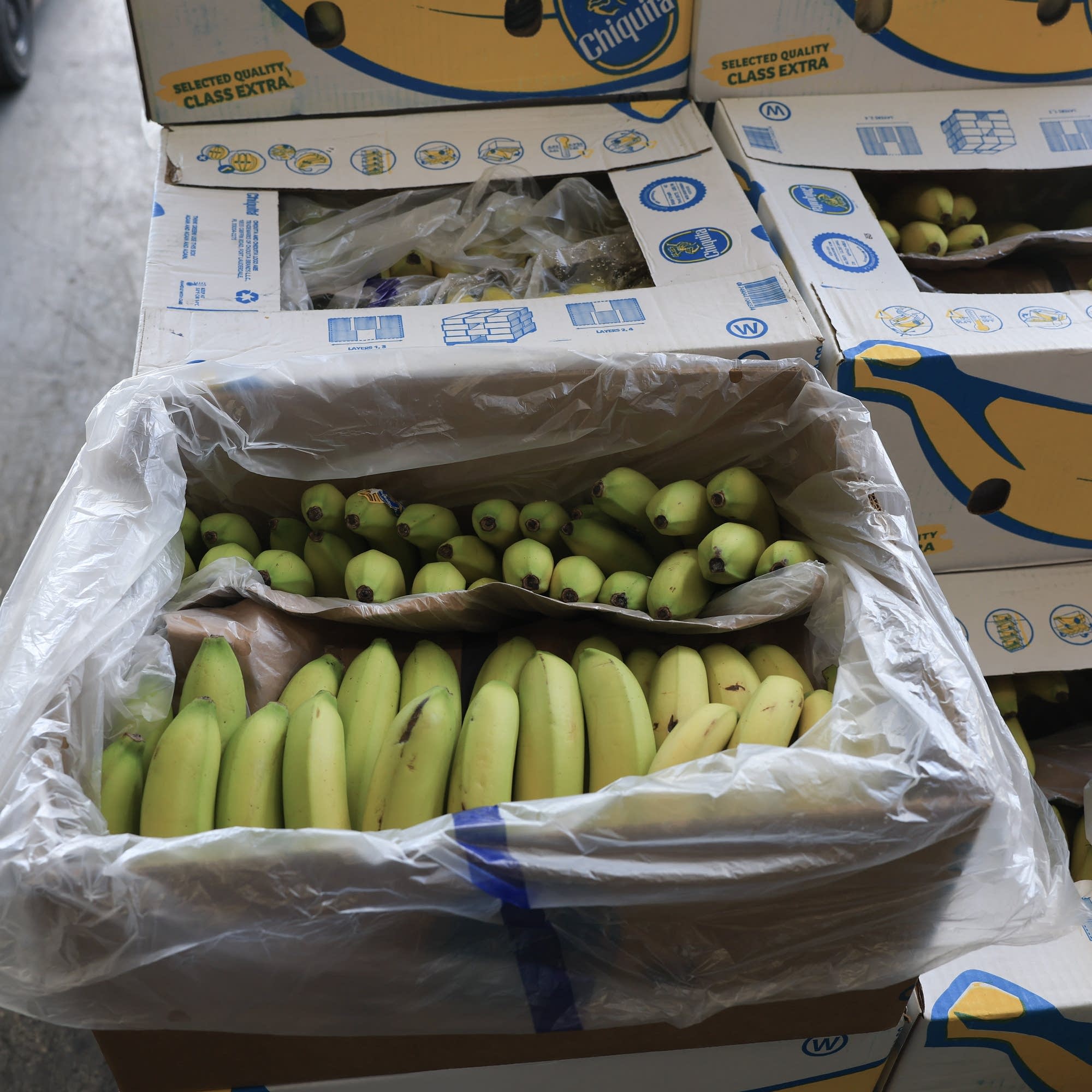
Speaker 2 Details are scarce, but there's been talk from some in the administration that relief might come to coffee and bananas, other foodstuffs as well, from Ecuador, Argentina, El Salvador, and Guatemala.
Speaker 2 Marketplaces of Kristen Schwab made some calls to see what that might mean.
Speaker 7 Another day, another potential tariff change. And Noah Namowitz, COO of Cafe Imports in Minneapolis, has a lot of tariffs to keep tabs on.
Speaker 8 Each country has its own unique rate.
Speaker 7 From Indonesia to Ethiopia to Peru, the company imports coffee from something like 30 different countries, including some on the exemption list.
Speaker 8 Open our computers every day and just figure out how we bring nice coffees to market.
Speaker 7
He says any tariff relief helps, but it's likely not going to have a huge impact on prices. The U.S.
imports about a third of its beans from Brazil, a country not on the exemption list.
Speaker 7 The tax rate for imports from Brazil is 50%.
Speaker 7 Meanwhile, coffee costs have been rising because of extreme weather.
Speaker 8 So,
Speaker 8 yeah, there needs to be a couple other things that probably happen for the coffee market to actually come down.
Speaker 7 Ricky Volpe, a professor of agribusiness at Cal Poly San Luis Obispo, says a tariff exemption is welcome news because it could help slow inflation.
Speaker 9 but it's not likely to bring food prices down.
Speaker 7 There are so many other factors that influence the price of food, like cost of labor, transportation, and warehousing. Plus, there are other tariffs.
Speaker 9 Pretty much every piece of capital that is necessary to get food from the fields to the supermarket is incredibly steel-intensive.
Speaker 7 Farm equipment, processing machines, storage shelves, the list goes on.
Speaker 7 Louise Ribera, an agriculture economist at Texas AM University, says there's also the issue of policy perception, whether businesses think the exemptions will stick.
Speaker 10 Policy can change from one hour to the next.
Speaker 7 Uncertainty comes with costs for importers here, also for exporters abroad. Namowitz, the coffee importer, says his growers are worried.
Speaker 8 Will my product be bought? Do I have a home for my coffee?
Speaker 7 If growers of coffee or bananas or other imports shrink their crop or shut down, it could squeeze supply. I'm Kristen Schwab for Marketplace.
Speaker 2 Consumers, of course, aren't the only ones looking for details on what those tariff exemptions might be. There are also all the people in the trade trenches, so to speak, customs brokers among them.
Speaker 2
We gave Gretchen Blau a call this morning. She's our customs brokerage manager at Logistics Plus.
They're in Erie, Pennsylvania.
Speaker 11 It's busy and it's confusing. It continues to be confusing with all these changes.
Speaker 11 So when I heard the news today, I went immediately to all the articles that, you know, to Google to get all the articles on it. I went to see if there's anything official posted.
Speaker 11 So I went to the White House website and found the fact sheet.
Speaker 11 It states that there will be benefits to them importing into the United States, that they, you know, that they will receive better rates, but there's nothing specific on that.
Speaker 11 So I'm sure we'll be getting a lot of questions on that, and we can't give any details as of yet. So, but that's kind of how things have been going.
Speaker 11 We kind of are used to that, and the importers are getting used to that as well. Moving forward, we'll be watching for the details of
Speaker 11 how this shakes out with the Latin American countries. We're also going to be watching the Supreme Court case regarding whether or not there will be refunds issued for
Speaker 11 the AIPA tariffs. If that's the way the court case is settled, it's going to mean a lot of work on our part.
Speaker 10 It's going to be a big deal at AIPA case.
Speaker 2 Gretchen Blau, Customs Brokerage Manager at Logistics Plus, Erie PA, is where they are.
Speaker 2 Coming up.
Speaker 10 He is one of the most in-demand people in Hollywood these days.
Speaker 2 Honestly, whoever you're guessing it is, it almost certainly isn't. But first, let's do the numbers.
Speaker 2
Dow Industrial is off 3.9 points today. That is six-tenths of 1%, closed at 47,147.
The NASDAQ rose 30 points. 10th, 1%, 22,900.
The SP 500 off three points. We'll call that flat.
6734 there.
Speaker 2 For the five days gone by, the week that was, the Dow gained three-tenths of 1%. The NASDAQ lost about 1%.
Speaker 2
The SP 500 notched up one-tenth of 1% on the day. Walmart ticked down about a tenth of 1%.
That on news that Doug McMillan is going to announce, has announced, rather, his retirement.
Speaker 2 New guy from inside the company taking his place. Bonds down yield on the 10-year T-note, 4.15%.
Speaker 12 If you're listening to Marketplace, this podcast is brought to you by Wise, the app for international people using money around the globe.
Speaker 12 With Wise, you can send, spend, and receive up to 40 currencies with only a few simple taps and save up to 55% compared to major banks.
Speaker 12 Whether you're buying souvenirs with pesos in Puerto Vallarta or sending Euros to a loved one in Paris, you know you're getting a fair exchange rate with no extra markups.
Speaker 12 That's what makes Wise the fast, affordable way to use your money around the globe.
Speaker 12 Wise offers 24-7 live support and runs over 7 million daily checks to catch catch and prevent fraud, so you know your money is where it's supposed to be. Be smart.
Speaker 12
Join the 15 million customers who choose WISE. Download the WISE app today or visit wise.com.
Learn more by visiting wise.com/slash US slash compare. T's and C's apply.
Speaker 1 This podcast is supported by Odoo. Some say Odoo business management software is like fertilizer for businesses because the simple, efficient software promotes growth.
Speaker 1 Others say Odo is like a magic beanstalk because it scales with you and is magically magically affordable.
Speaker 1 And some describe Odo's programs for manufacturing, accounting, and more as building blocks for creating a custom software suite. So Odoo is fertilizer, magic beanstock building blocks for business.
Speaker 1
Odoo, exactly what businesses need. Sign up at odoo.com.
That's odoo.com.
Speaker 4 This marketplace podcast is supported by wealth enhancement, who understand that dreams don't happen by chance, it takes a plan.
Speaker 4 They're ready to build your wealth blueprint for retirement, investing, taxes, and everything else your financial life brings.
Speaker 4 It reveals gaps and highlights opportunities you may have missed at no cost to you. Find out more at wealthenhancement.com/slash blueprint.
Speaker 13 Fifth Third Bank's commercial payments are fast and efficient, but they're not just fast and efficient. They're also powered by the latest in payments technology built to evolve with your business.
Speaker 13 Fifth Third Bank has the big bank muscle to handle payments for businesses of any size, but they also have the FinTech hustle that got them named one of America's most innovative companies by Fortune magazine.
Speaker 13 Big bank muscle? FinTech Hustle. That's how Fifth Third brings you the best of all worlds, going above and beyond the expected, handling over $17 trillion in payments each year with zero friction.
Speaker 13 They've been doing it that way for 167 years.
Speaker 13 But they also never stop looking to the future to take their commercial payments two steps ahead of tomorrow, constantly evolving to suit the ever-changing needs of your business.
Speaker 13
That's what being a fifth third better is all about. It's about not being just one thing, but many things for our customers.
Big bank muscle, then tech hustle.
Speaker 13 That's your commercial payments, a fifth third better.
Speaker 2 This is Marketplace. I'm Kai Rizdahl.
Speaker 2 At the risk of repeating myself, and without ignoring all of the other ways in which it is a very high-profile issue right now, immigration is a labor market story.
Speaker 2 And obviously, the more immigrants a given region of the country has, the more of a labor force issue it is.
Speaker 2 A survey by the Federal Reserve Bank of Dallas shows that 20% of the companies in its district, that's all of Texas, southern New Mexico, and northern Louisiana, 20% of the companies there say the Trump administration's immigration crackdown has hampered or they expect it to hamper their ability to hire and retain foreign-born workers this year.
Speaker 2 In this first story from an occasional series we're going to call Help Not Wanted, Marketplace's Elizabeth Troval looks at one slice of that workforce that relies heavily on those immigrants.
Speaker 14 It's evening rush hour in Houston.
Speaker 14
Most workers here on the west side of town are headed home. But not Maria.
Her cleaning shift at a nearby office high-rise starts soon, where she goes cubicle by cubicle cleaning up trash.
Speaker 14
Maria is in her 70s. We're not using her real name because she's afraid she could be targeted by immigration.
She earns about $13 an hour at her cleaning job, which she enjoys.
Speaker 14 You know, she gets her steps in.
Speaker 14 But she does come home tired and she's been working extra lately. That's because roughly a third of her coworkers have had to quit since the Trump administration started rolling back work permits.
Speaker 14 It's a shame they've left, she says. She's still able to work because the administration hasn't yet removed temporary protected status, or TPS, from Salvadorans.
Speaker 14 She and her colleagues keep showing up to work, but they're afraid.
Speaker 14 She's been a professional cleaner for about 30 years in Houston, but if she loses her TPS,
Speaker 14 even though her kids and grandkids are here, she'll have to go back to El Salvador.
Speaker 14 Even though immigration raids are getting a lot of attention, economist Pia Arrhenius with the Dallas Fed says there's something bigger going on.
Speaker 16 Hundreds of thousands, in some cases, maybe even millions of work permits are being canceled. And so that's really what's affecting employers most directly.
Speaker 14 Not just people with TPS are losing their work permits, but other humanitarian migrants too, many who came in post-pandemic.
Speaker 14 And now border crossings, which usually offer a steady inflow of labor, have also been reduced to a trickle.
Speaker 16 So for employers who rely on foreign-born workers, they're kind of getting squeezed on all sides.
Speaker 14 At Houston City Hall, dozens of people are becoming U.S. citizens at a naturalization ceremony as they're serenaded by a barbershop quartet.
Speaker 14 These are people who don't have to worry about work permits or green cards anymore. I asked Alexandra, who came here from El Salvador as a teen, how she feels becoming a citizen.
Speaker 14 She's excited about voting, taking college classes, getting a better job.
Speaker 14 She's a supervisor of a team of around 50 professional cleaners.
Speaker 14 Her team recently lost about 20 workers, many from Cuba. They hadn't found replacements, so she's picked up some of the slack, she says.
Speaker 14 She actually studied for the citizenship exam while picking up trash.
Speaker 14
The next day, I catch up with Alexandra's mom, Yanette, at a park near her house. She also cleans office buildings.
She's seen good workers and good friends leave because they lost their work permits.
Speaker 14 She estimates about 20% of her team have left, and her company, which pays her $12.50 an hour, hasn't found replacements either.
Speaker 14 The new hires last for maybe one, two weeks, she says, because it's a lot of work and the pay is bad.
Speaker 14 In Houston, I'm Elizabeth Troval for Marketplace.
Speaker 2 This time of year, Thanksgiving-ish onward, is typically when we got a lot of new movies, films that the studios are banking on to be their big holiday hits.
Speaker 2 And whether you're itching to see the new wicked movie or whichever number avatar sequel this next one is going to be, you're going to have a decision to make. To IMAX or not to IMAX.
Speaker 2 They are just a fraction of the screens in this country, but movies shown in IMAX are a growing share of box office sales, and thus those screens are something of a hot commodity in Hollywood.
Speaker 2 Ben Fritz wrote about the big appeal of the very big screen in the Wall Street Journal the other day. Ben, thanks for being here.
Speaker 10 Thanks for having me.
Speaker 2 Tell me, would you, first of all, what it is that makes IMAX so special, such a big deal?
Speaker 10 Yeah, well, the IMAX screens are bigger. They're specifically vertically bigger than most movie screens, and typically they also have higher quality digital sound.
Speaker 10 And overall, it's just sort of a better, more premium experience in the theater than you get in your typical movie theater.
Speaker 2 Trevor Burrus, Jr.: And yet they are a vanishingly small fraction of the movie theater screens in this country, right?
Speaker 10 Yeah, they're less than 1%.
Speaker 2 Which makes it treasured treasured real estate that directors like Christopher Nolan, who we'll get to in a second, really want.
Speaker 2 The company, though, is really interesting because it didn't used to be this way for IMAX.
Speaker 10
Yeah, IMAX used to be basically just in museums. You'd see a documentary in a museum.
That's what IMAX was until the late 2000s, really.
Speaker 10 Because you used to have to shoot everything on a special IMAX film camera and you had to have a theater specially built to show it.
Speaker 10 And then over time, as things went digital, they were able able to convert movies shot digitally into their IMAX format. And they were able to convert auditoriums to show IMAX movies.
Speaker 10
All they had to do was build a digital screen. They didn't have to rebuild everything from scratch.
That's what made it much easier to produce IMAX movies and to show IMAX movies.
Speaker 10 And that's kind of how they started to go Hollywood.
Speaker 2
Interesting. So speaking of going to Hollywood, Christopher Nolan, Dark Knight, right, was a biggie for him.
They shot some of that in IMAX.
Speaker 2 And then most recently, people will, of course, remember Oppenheimer shot an IMAX, and there were fights over screen time for that.
Speaker 2 It's, as I said, a rare piece of real estate that directors really want.
Speaker 10 Yeah, they really want it because, you know, the box office has been struggling ever since the pandemic. And when people do go to the theaters, though, they tend to want this premium experience.
Speaker 10
It's really different than what you can get at home. It really feels like this is worth leaving my house for.
And I don't mind spending a few extra bucks for it.
Speaker 10 So movies that are on IMAX are really consistently overperforming and making more money. That's why studios and filmmakers really want to get those screens.
Speaker 2 So how do they do it? I mean, not everybody is Christopher Nolan. So, how do you do you call IMAX and say, hey, can we have a screen? How does that work?
Speaker 10 Sort of, yeah. I mean, the CEO of IMAX is a guy named Rich Gelfond, and he is one of the most in-demand people in Hollywood these days because he controls what goes on these screens.
Speaker 10
And usually it's just one movie at a time. And so, and he's planning out two, three years in advance now.
So, people are going to Rich. They're showing him the early ideas for their movie.
Speaker 10
It could be concept art. It could be pre-biz.
It could be the the first footage they've shot. And they're saying, this movie's going to be awesome.
It's going to be so great in IMAX.
Speaker 10 People are going to flock to your screens for it. Will you please reserve me a time in May of 2027 or whatever on your screens?
Speaker 2 Aaron Powell, Jr.: You know, it's interesting in this piece, you quote him as saying, basically, once we make a deal, we're not going to break it.
Speaker 2 So, you know, studios and directors can do all the finigling they want, but once he's put it in the calendar,
Speaker 2 that's what's going to happen.
Speaker 10 That's exactly right.
Speaker 10 That's also why they want to get these screens far in advance, because if you wait till the last minute, they're usually booked. And IMAX does not break their word.
Speaker 10 For just to take one example, that the Taylor Swift music movie that came out just a couple of months ago
Speaker 10 that was only in AMC theaters, and they asked IMAX if they could get those screens.
Speaker 10 And AMC said, sorry, we're already booked for a re-release of Avatar, and we're not going to screw over, we're not going to screw over Jim Cameron. So sorry, Taylor Swift.
Speaker 2 That's a Clash of Titans right there, pal. I'll tell you what.
Speaker 2 So it's going to cost me, what, an extra like three, four, five bucks on top of an $18 movie ticket, right?
Speaker 10 Yeah, exactly. It's expensive.
Speaker 10 So you'd think on the one hand in an economy where people are kind of anxious that they wouldn't do this, but really it's kind of the opposite.
Speaker 10 People are not going to the movies as much as they used to. And because it's a special experience, they're willing to pay a bit extra to make it truly special.
Speaker 2 You're the professional in this conversation. Would you spend the extra money?
Speaker 10
Absolutely. I mean, I love movies.
That's why I do this job. And I want to see movie in the best format possible.
And I want to feel like this is not something I could possibly get at home. So
Speaker 10 I think movies are worth worth seeing in the absolute best format possible. And if it's a few extra bucks for it, I think it's usually worth it.
Speaker 2
You and Christopher Nolan, Ben Fritz of the Journal, covering entertainment. Ben, thanks a lot.
I appreciate your time.
Speaker 10 Yeah, it was great to talk to you, Kai.
Speaker 2 This final note on the way out today, which honestly I saw yesterday and I thought it was a joke, but it turns out not. Apple's got this new product, cost $230.
Speaker 2
It is, and I am not making this up, a pouch for your iPhone. This is a quote from the company, inspired by a piece of cloth.
Sort of a cross-body sling-like thing. $230.
Speaker 2
Our theme music was composed by BJ Lederman. Marketplace's executive producer is Nancy Fargalli.
Joanne Griffith is the chief content officer.
Speaker 2
Neil Scarborough is the vice president and general manager. And one last thing on this Friday.
Two names you don't ever hear in these production credits. Stephen Sculler and Marcus Gallamay.
Speaker 2 We moved this week, Marketplace did, from the offices we had been in for almost 25 years. Moving is never fun, much less so when you're trying to downsize a bunch of cranky journalists.
Speaker 10 Marcus and Stephen made that happen, and they did it on deadline.
Speaker 2
And I just wanted to say a public thank you. I'm Kyle Risdahl.
Have yourselves a great weekend, everybody. We'll see you back here on Monday, all right?
Speaker 2 This is APM.
Speaker 17 Ready to elevate your career in the sports industry?
Speaker 17 The Masters in Sports Business from the Levy School of Business prepares you for leadership roles, connecting you with partners including the San Francisco Giants and the 49ers.
Speaker 17 Discover mentorship and real-world experience that raises your game in the heart of Silicon Valley. Search Levy Sports Business Masters to find out more about the program today.