The job market keeps flashing warning signs
With no government jobs data available during the shutdown, analysts have turned to private reports for clues about the labor market. In the latest round, ADP said private companies added jobs in October, despite job openings hitting their lowest level since early 2021. Experts say the labor market is stalled but stable, though risks of a downturn are growing. Also in this episode: the K-shaped economy comes for the housing market, global food systems face challenges with limited land, and Southwest cuts accommodations for larger-bodied flyers.
Every story has an economic angle. Want some in your inbox? Subscribe to our daily or weekly newsletter.
Marketplace is more than a radio show. Check out our original reporting and financial literacy content at marketplace.org — and consider making an investment in our future.
Press play and read along
Transcript
Speaker 1 This podcast is supported by Odoo. Some say Odoo business management software is like fertilizer for businesses because the simple, efficient software promotes growth.
Speaker 1 Others say Odoo is like a magic beanstalk because it scales with you and is magically affordable.
Speaker 1 And some describe Odoo's programs for manufacturing, accounting, and more as building blocks for creating a custom software suite. So Odoo is fertilizer, magic beanstock building blocks for business.
Speaker 1
Odoo, exactly what businesses need. Sign up at odoo.com.
That's odoo.com.
Speaker 2 Introducing your new Dell PC with the Intel Core Ultra Processor. It helps you handle a lot, even when your holiday to-do list gets to be a lot.
Speaker 2 Like organizing your holiday shopping and searching for great holiday deals, and customer questions, and customers requesting custom things, plus planning the perfect holiday dinner for vegans, vegetarians, pescatarians, and Uncle Mike's carnivore diet.
Speaker 2 Luckily, you can get a PC with all-day battery life to help you get it all done. That's the power of a Dell PC with Intel inside, backed by Dell's Price Match Guarantee.
Speaker 2
Get yours today at dell.com/slash holiday. Terms and conditions apply.
See Dell.com for details. details.
Speaker 4 What the job market is telling us without the usual data sources from American Public Media. This is Marketplace.
Speaker 4
In Denver, I'm Amy Scott in Perkai Rizdahl. It's Wednesday, November 5th.
Good to have you with us.
Speaker 4 This should be a big week for jobs data with reports on job openings and turnover, the unemployment rate and wage growth.
Speaker 4 But of course, we aren't getting any of that because of the government shutdown, which is now officially the longest on record.
Speaker 4 So instead, we're continuing to follow what's happening in the labor market with the help of private data. Today, payroll processing firm ADP put out its monthly employment report.
Speaker 4 It shows private companies added jobs in October for the first time since July, about 42,000 of them, while the job search and hiring platform indeed says job postings were down at the end of October to their lowest level in nearly five years.
Speaker 4 Marketplace's Samantha Fields has more on what we can read into all of this.
Speaker 6 You never want to read too much into one month of data or one data source on the labor market or anything, really.
Speaker 6 But Elizabeth Pancotti at the Groundwork Collaborative says you can get a decent sense of what's happening by looking at a bunch of different data points from different companies.
Speaker 7 Taking all of that together, I see a very stalled labor market, but we are not seeing massive red flashing signs on the labor market yet.
Speaker 6 Hiring continues to be slow, as it has been for months, but despite all the high-profile layoff announcements in the last couple of weeks.
Speaker 7 I am not, I would say at this point, seeing a huge trend upward in those layoffs.
Speaker 7 I know the headlines feel like they are mounting, but in the data, this is still what we consider to be within the typical bounds.
Speaker 6 There are warning signs in the latest reports from ADP, though, Pancotti says, for small businesses in particular.
Speaker 7 We see large contractions among those small companies where we've lost 88,000 jobs since July, where large companies have added 151,000. That to me is the most concerning thing coming out of ADP.
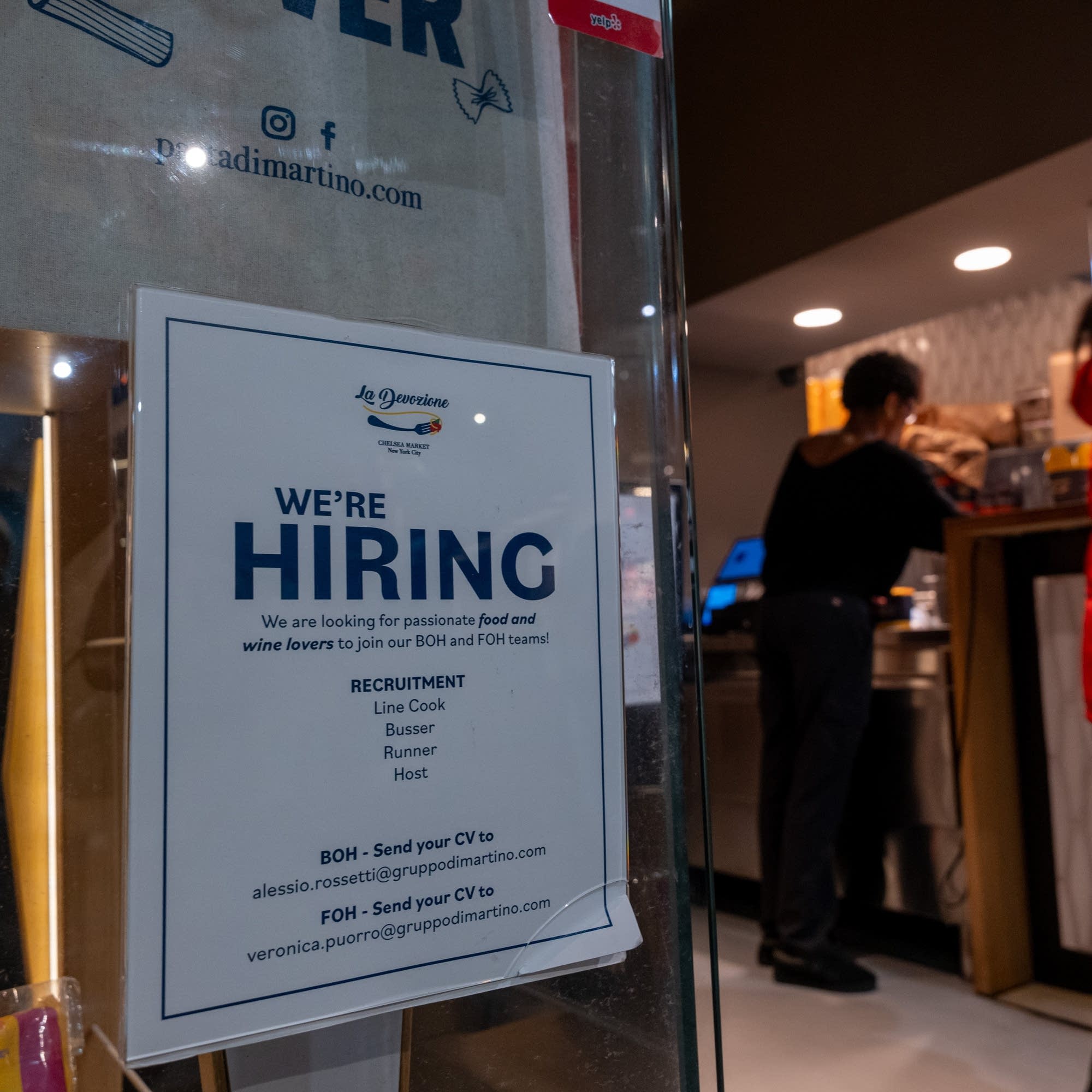
Speaker 6 Another concerning thing about this labor market is how hard it is to get a job if you don't already have one, says Allison Trivastov at the Indeed Hiring Lab.
Speaker 7 And that's impacting people who have lost their job and it's impacting people who are trying to enter the labor market for the first time.
Speaker 4 It's definitely a precarious situation we're in.
Speaker 6 And Daniel Zhao at Glassdoor says surveys show people are anxious these days, even those who have jobs.
Speaker 9 Employees feel very sour about the current job market.
Speaker 6 With good reason. In a strong economy, the labor market might add a couple hundred thousand jobs a month.
Speaker 9 And lately, we're talking about only tens of thousands of jobs being added.
Speaker 9 And really, I I think that the sluggish hiring we're seeing is the most important statistics for understanding the current malaise that the job market is.
Speaker 6 Despite all that malaise, Guy Berger at the Burning Glass Institute says the market's not terrible, but pressures are growing.
Speaker 10 The government shutdown is piling on top of all tariffs and everything else. And the question is, at some point, do these things break?
Speaker 10 At some point, does the very slow, gradual slide turn out to be a precipitous fall?
Speaker 6 And does the mediocre job growth we're seeing now turn into job losses? I'm Samantha Fields for Marketplace.
Speaker 4 On Wall Street, little sign of malaise today. We'll have the details when we do the numbers.
Speaker 4 If you listened to yesterday's show, you know the Supreme Court heard a case today on whether or not the president has the power to impose tariffs under the International Emergency Economic Powers Act.
Speaker 4 At stake are billions of dollars in tariffs that the president has imposed on pretty much all of our trading partners since April.
Speaker 4 And after nearly three hours of arguments, the court appeared to be skeptical of the president's authority here. But stay tuned for the final ruling in the weeks or months ahead.
Speaker 4 Legal questions about the president's tariff power aside for the moment, did you ever wonder how the tariff rates themselves are set? We did, so we gave Ernie Tedesky a call.
Speaker 4 He previously served in the Treasury Department and on the White House Council of Economic Advisors in the Biden administration. He's now a fellow at the Budget Lab at Yale.
Speaker 11 So before 2025, tariffs were usually very very narrowly set with a specific purpose in mind.
Speaker 11 We can actually go back to the first Trump administration back in 2018. So the Trump administration had a policy goal of incentivizing more production of washing machines domestically.
Speaker 11 And so they set a tariff rate on imported washing machines. There was some consideration given to the trade balance of the United States with regard to washing machines specifically.
Speaker 11 I'm sure there was also consideration given to diplomatically or economically how other countries would react.
Speaker 11 Those considerations may have led to a different rate than, say, a first-pass economic analysis.
Speaker 11 The tariff goal now is really much more weighted toward broad tariffs on all imports from specific countries because they have a goal of eliminating trade deficits.
Speaker 11
A lot of the country analysis is similar to what I described. There are also all of these other non-economic layers.
You can look at Brazil, for example.
Speaker 11 We have the administration has imposed a very high tariff rate on Brazil, largely not out of economic considerations, it's out of political consideration.
Speaker 11 I'm a public finance economist. A lot of what I monitor are changes in taxes and changes in spending policy, which tend to be very slow moving.
Speaker 11 With tariffs, it's completely different. There's a lot of uncertainty about where tariffs are going.
Speaker 11 You can wake up one morning and suddenly there's a whole line of tweets with brand new tariff rates and not a lot of specificity, right? Like a lot of times we're reacting to vibes around tariffs.
Speaker 11 And it happens frequently.
Speaker 11 When we at the budget lab decided to follow tariff policy, I mean, we knew that would be a challenge, but I think that like just the sheer quantity of updates that we've had to do as new policies come down has exceeded our expectations.
Speaker 4 That was Ernie Tedeski at the Budget Lab at Yale. You can hear more on tomorrow's Marketplace Morning Report.
Speaker 4 And by the way, Kai answered a bunch of listener questions about tariffs, like what happens if the Supreme Court rules against the president. Check out the video on our Instagram at MarketplaceAPM.
Speaker 4 Beef has been in the news a lot lately, with prices up 14% in the past year, based on the latest consumer price index, and with President Trump ticking off U.S.
Speaker 4 cattle ranchers with a plan to import more beef from Argentina. But there's another cost of our country's meat-heavy diet we don't talk about as much for the planet.
Speaker 4 I met up recently with journalist Michael Grunwald here in Denver at an upscale grocery store.
Speaker 4 So yeah, what do you see when you look at this case?
Speaker 12 So I mean I see filet mignon, I see New York strip, I see boneless ribeye, T-bone steak, and like my mouth is watering because beef is freaking delicious.
Speaker 12 But the other thing I see is what's eating the earth, right?
Speaker 4 We're standing in front of the meat counter looking at a selection of cuts from a network of sustainable ranches.
Speaker 4 A lot of us have been told that if we're going to eat meat at all, this is a better choice for the animals and the environment. Grass-fed, humanely raised.
Speaker 4 But Michael says for the climate, not so much.
Speaker 12 First of all, it takes them longer to get to slaughter weight,
Speaker 12 so the animals are alive longer to burp and fart methane. But the main reason is
Speaker 12 Because it's less efficient, it requires more acres to make the same amount of meat.
Speaker 4 That's one of the points Michael makes in his new book, We Are Eating the Earth. He spent five years researching the climate impacts of our food and agriculture systems.
Speaker 4 What got you interested in meat and food as
Speaker 4 a contributor to climate change?
Speaker 12 It's funny, I've been writing about climate and the environment for really 20 years.
Speaker 12
And the short answer is the food system is about a third of the climate problem. It's an even larger part of our other environmental problems.
You know, agriculture uses 70% of our fresh water.
Speaker 12 It's the leading driver of deforestation, wetland destruction, water pollution. And I realized I didn't know squat about it.
Speaker 4 What Michael means by eating the earth is that by gobbling up more land to produce food, we're unleashing more carbon dioxide into the atmosphere while also destroying the ecosystems that can absorb it.
Speaker 4 And beef is the biggest offender. Michael says in the U.S., we get about 3% of our calories from beef, but it uses about half of our agricultural land.
Speaker 12 It's just this very simple notion that basically the animals that we eat are using an awful lot of the earth.
Speaker 12 And it's one of those things that once you see it, you can't unsee it, right?
Speaker 12 If you ever take a cross-country flight and you see all those squares and circles out the window, I mean, you can tell that there's a lot of agriculture out there, but there is a lot of agriculture out there, right?
Speaker 12 It's now two of every five acres on Earth. There's just not going to be room for the forests and wetlands that store so much of the carbon that's stabilizing the planet.
Speaker 12 Even if we stopped using fossil fuels tomorrow,
Speaker 12 just through deforestation from the expansion of agriculture, we're on track to blow through all of our climate targets by 2050.
Speaker 12 So
Speaker 12 in many ways, the energy problem, it's a really big problem, but we kind of know what to do about it, right? We just need to electrify the global economy and run it on clean electricity, right?
Speaker 1 Simple, right?
Speaker 4 We have the tools.
Speaker 3 Right, exactly.
Speaker 12 I mean, we do know what to do, and we're actually starting to do it.
Speaker 12 We're in the middle of this incredible clean energy revolution that when I started writing about energy and climate 20 years ago, there really were no alternatives to fossil fuels.
Speaker 12 But that's where we are now with food and climate. And certainly,
Speaker 12 you know, I write about dozens of promising solutions in my book, but none of them really have a lot of traction yet. And so the problem is still getting worse every day.
Speaker 4 Yeah, and I think, you know, what's uncomfortable about the book for people like me is that, you know, we've been taught that small family farms, organic farming, regenerative agriculture, pasture raise, grass-fed, all those are good things.
Speaker 4 And here you are telling me that they're not, or at least they're not as good as we thought they were.
Speaker 12 The fact is that the real environmental disaster of agriculture was the initial transformation of nature into those nice rustic farms. That's when we lost the carbon.
Speaker 12 That's when we lost the biodiversity.
Speaker 12 And today, you know, this movement that is very powerful that's pushing for essentially, you know, low-yield agriculture across the world to replace industrial agriculture,
Speaker 12 if you're using, you know, if you're making less food per acre, you're going to need more acres to make food.
Speaker 12 And you're going to have more deforestation, more drainage of wetlands, and more carbon emissions.
Speaker 12 And I do think that's sort of an inconvenient truth for everybody who's sort of valorized and romanticized these kind of nice
Speaker 12 twee, organic,
Speaker 12 sort of closer-to-nature farms. And look, there is an environmental cost to the intensification of those sort of low-yield systems into these chemical-drenched monoculture crops and the factory farms.
Speaker 12 And look, they treat people badly, they treat animals badly, they use too many antibiotics, they're lobbying against environmental regulation and climate action.
Speaker 12 But one thing about them is that they do make a lot of food.
Speaker 12 And we are going to need more food with less land.
Speaker 4 To make more food with less land, one solution Michael turns to in his book is the industrial feedlot, the place where they fatten up the cattle before sending them off for slaughter.
Speaker 4 We visited one in the latest season of our climate podcast, How We Survive. Check it out wherever you listen to podcasts.
Speaker 3 Coming up.
Speaker 13 I mean, if you're an airline and you want to be able to make more money, an easy way to do that is to fly more passengers.
Speaker 4 More passengers means less space. But first, let's do the numbers.
Speaker 4 The Dow Jones Industrial Average rose 225 points, half a percent to close at 47,311. The NASDAQ picked up 151 points, two-thirds percent to close at 23,499.
Speaker 4 And the SP 500 found 24 points, just shy of 4 tenths percent to end at 6,796.
Speaker 4 Speaking of beef, McDonald's reported that same store sales in the U.S. grew more than analysts had been expecting in the last quarter.
Speaker 4 This, despite the fact that traffic to fast food restaurants is down this year, sales grew even faster at overseas locations.
Speaker 4 On the earnings call, Mickey D's CEO attributed that to new chicken products on the menus in Australia and the UK and promised to, quote, go after the broader chicken opportunity, whatever that means.
Speaker 4 The golden arches heated up just under two and 2 tenths percent.
Speaker 1 If you're listening to Marketplace, this podcast is supported by Odo.
Speaker 1 Some say Odo business management software is like fertilizer for businesses because the simple, efficient software promotes growth.
Speaker 1 Others say Odoo is like a magic beanstalk because it scales with you and is magically affordable.
Speaker 1 And some describe Odo's programs for manufacturing, accounting, and more as building blocks for creating a custom software suite. So Odo is fertilizer, magic beanstock building blocks for business.
Speaker 1
Odo, exactly what businesses need. Sign up at odoo.com.
That's odoo.com.
Speaker 3 This marketplace podcast is supported by Wealth Enhancement, who understand that dreams don't happen by chance, it takes a plan.
Speaker 3 They're ready to build your wealth blueprint for retirement, investing, taxes, and everything else your financial life brings.
Speaker 3 It reveals gaps and highlights opportunities you may have missed at no cost to you. Find out more at wealthenhancement.com/slash blueprint.
Speaker 3 This marketplace podcast is supported by Justin Wine. Get the celebration ready with Justin Wine.
Speaker 3 Since 1981, Justin has been producing world-class Bordeaux-style wines from Paso Robles on California's Central Coast.
Speaker 3 Justin offers curated gift sets, library wines, magnums, and even custom-etched bottles. Visit Justinwine.com and enter Market 20 for 20% off your order.
Speaker 3 Justin offers the perfect holiday gifts for clients, colleagues, friends, or family. Be sure to check them out at justinwine.com to receive 20% off your order for a limited time.
Speaker 14 It's time for Black Friday, Dell Technologies' biggest sale of the year. That's right, you'll find huge savings on select Dell PCs like the Dell 16 Plus with Intel Core ultra-processors.
Speaker 14 And with built-in advanced AI features, it's the PC that helps you do more faster.
Speaker 14 From smarter multitasking to extended battery life, these PCs get the busy work done so you can focus on what matters most to you.
Speaker 14 Plus, earn Dell rewards and enjoy many other benefits like free shipping, expert support, price match guarantee, and flexible financing options.
Speaker 14 They also have the biggest deals on accessories that pair perfectly with your Dell PC, improving the way you work, play, and connect.
Speaker 14 Whether you just started holiday shopping or you're finishing up, these PCs and accessories make perfect gifts for everyone on your list. Shop now at dell.com/slash deals and don't miss out.
Speaker 14 That's dell.com/slash deals.
Speaker 4
This is Marketplace. I'm Amy Scott.
We got some more data this week that lends support to the idea that the economy is going in opposite directions at the same time, depending on where you sit in it.
Speaker 4 Today's K-shape indicator is brought to you by the housing sector, where first-time homebuyers are having a rougher go than those who've owned before.
Speaker 4 A new report from the National Association of Realtors finds that only one in five homebuyers last year were first-timers, a record low.
Speaker 4 While the average age of those first-time buyers is now 40, a record high, Daniel Ackerman has more.
Speaker 15 These days, more and more of Susan Chaffee's home buyers are familiar faces.
Speaker 16 I'm actually seeing repeat customers either upgrading or getting something smaller.
Speaker 15 Chaffee is a realtor near Tampa, Florida, and she says those repeat customers have a big advantage.
Speaker 16 They have a lot of equity in their house.
Speaker 15 Which they can cash out and put towards their next house. Chaffee Chaffee says would-be first-time buyers don't have that luxury.
Speaker 16 A lot of them are either renting or moving back with their parents.
Speaker 15 And moving back home is a nationwide trend, says Jessica Lautz of the National Association of Realtors.
Speaker 17 The share of first-time homebuyers has essentially been cut in half from the historical norm.
Speaker 15 She says that's partly because of factors within the housing market, like a lack of affordable inventory and elevated mortgage rates.
Speaker 14 But there's also everything else.
Speaker 17 Like high rent, student loan debt, child care costs, they all add up and it makes it hard to save.
Speaker 15 She says a 10-year delay on home ownership has real financial impact.
Speaker 17 It translates into about $150,000 of lost housing wealth gains.
Speaker 15 Laut says she has seen some people getting creative in how they buy their first home.
Speaker 17 We have seen in the last couple of years the idea of purchasing with a roommate become more popular, even purchasing as a multi-generational family, so you can have cost savings pooling those funds together.
Speaker 15 Other would-be buyers are simply waiting for mortgage rates to drop, says Tiffany Russell, a realtor in Austin, Texas.
Speaker 19 But this will catch them, you know, in the end, because when they get back into that buyer pool when the rates go down, then they're going to have a lot more competition with the other first-time buyers.
Speaker 15 She says it's basically a choice between higher rates today or potentially higher housing prices down the line.
Speaker 15 Susan Wachter, a professor of real estate and finance at the University of Pennsylvania, says there are two ways out of this mess.
Speaker 16 If mortgage rates came down significantly into the 5% range, that would be a big help. In addition, we simply have to increase the supply of housing.
Speaker 15 Particularly, she says, of entry-level housing for people who aren't already sitting on a pile of equity. I'm Daniel Ackerman for Marketplace.
Speaker 4 As you've no doubt heard, Southwest Airlines is doing away with its popular open seating policy. Frequent Southwest flyers have a lot of feelings about that.
Speaker 4 Maybe less well known is that when the change goes into effect on January 27th, another perk is going away, one that made it easier and more affordable for people with larger bodies to fly.
Speaker 4 Marketplace's Savannah Peters has that story.
Speaker 8 Most of us don't book an economy class plane ticket expecting a comfortable journey, but that's especially true for people in bigger bodies, like Sidney Henry Ueno.
Speaker 20 I'm not just fat.
Speaker 18 I'm fat and tall.
Speaker 18 I'm six feet tall.
Speaker 20 Trying to cram this body into a little bitty seat is more than an ocean.
Speaker 8 And Henry Ueno really loves to travel. She flies about five times a year.
Speaker 20 She says rather than squeeze into a seat that doesn't accommodate her, I have to purchase business class or higher, which means a much more expensive seat.
Speaker 8 Or she can book two neighboring economy seats. Another pricey option that Henry Ueno says doesn't stop other passengers from bothering her.
Speaker 20 People will give you a look, a side eye, or make comments that they think are under their breath, but loud enough for me to to hear.
Speaker 20 Things like, you know, if you dieted, you wouldn't have to get an extra seat.
Speaker 20 Just making a lot of assumptions, y'all, about what a person's body is all about.
Speaker 8 Henry Ueno is willing to shell out for her comfort and safety. She doesn't want that rudeness to escalate into hostility.
Speaker 8 But there's one airline that gives her a break on the cost of extra space.
Speaker 20 Yeah, in fact, whenever we fly domestically, it's primarily Southwest because of that customer of size policy.
Speaker 8 Right now, Southwest has a customer of size policy. Anyone who doesn't fit into one seat can book a second and get refunded after their trip.
Speaker 21 That made Southwest for many years the best plus size passenger policy in the world.
Speaker 8 And Tigris Osborne with the National Association for the Advancement of Fat Acceptance says it made Southwest the airline of choice for people in larger bodies.
Speaker 8 For some of those customers, Osborne says its policy put air travel within financial reach for the first time.
Speaker 20 And that is really life-changing.
Speaker 22 So having that go away is really scary for a lot of people.
Speaker 8 Starting in January, Southwest customers will only get a refund for their second seat if their flight isn't fully booked. And about 80% of Southwest flights are typically full.
Speaker 22 If Southwest is no longer loyal to customers of size, then that opens us up to flying with whoever is most affordable and most convenient at the time.
Speaker 8 Osborne hopes another airline will see an opportunity here to snap up this loyal customer base with its own inclusive policy.
Speaker 8 But Ganesh Sitaraman, a law professor at Vanderbilt, doesn't see that happening.
Speaker 13 Well, it comes down to revenue. I mean, if you're an airline and you want to be able to make more money, an easy way to do that is to fly more passengers.
Speaker 8 And shrink the amount of space each passenger is allotted, which Situraman says airlines have done over the last few decades, even as the average American has gotten larger.
Speaker 8 And he says courts and regulators have declined to make rules about passenger space.
Speaker 13 It really, to me, speaks to a bigger question of
Speaker 13 what kind of airline experience should we have? And why is this something we can't do better with?
Speaker 8 Southwest declined an interview request from Marketplace, but noted its move to assign seating means it has to adjust its customer of size policy, and that both changes put it in line with industry standards.
Speaker 8 For former Southwest loyalist Sidney Henry Ueno, that's exactly the problem.
Speaker 20
I hate using this word, but it's unfair. Just because my body is different from someone else's, and that's really what it comes down to.
You're forcing us to spend more money.
Speaker 8 Moving forward, Henry Ueno says she'll just chop around for the cheapest airfare and probably go on fewer trips. I'm Savannah Peters for Marketplace.
Speaker 4 This final note on the way out today, a snapshot of household balance sheets. Courtesy of the Federal Reserve Bank of New York, U.S.
Speaker 4 household debt rose to nearly $18.6 trillion in the third quarter of the year, driven by increases in mortgage, student loan, and credit card balances.
Speaker 4 The total amounts to roughly $54,000 for every member of the U.S. population.
Speaker 4 Delinquencies increased just slightly, with 4.5% of outstanding debt in some stage of overdue, a rate the New York Fed called elevated but stabilizing.
Speaker 4 And if you were wondering, we're still getting Fed data amidst the government shutdown because the Federal Reserve System is only quasi-governmental and not subject to congressional appropriations.
Speaker 4
Our media production team includes Brian Allison, Drew Jostad, Gary O'Keefe, and Charlton Thorpe. Jeff Peters is the manager of media production.
And I'm Amy Scott. We'll be back tomorrow.
Speaker 4 This is APM.
Speaker 4 Imagine a future where chocolate and coffee are rare and expensive, where cheap nutritional staples like corn and wheat are threatened. Sounds unpleasant, doesn't it?
Speaker 4 Well, we could be heading there if we don't recognize that the climate crisis is also a food crisis.
Speaker 2 I've seen yields drop because of drought.
Speaker 2 And believe me, boy, have I seen them drop.
Speaker 6 We have had dry spells that have lasted years.
Speaker 4 I'm Amy Scott.
Speaker 4 This season on How We Survive, we investigate how the climate crisis is threatening our most vital food systems and how scientists are racing to develop alternatives that will shape the future of food.
Speaker 4 Listen to this season of How We Survive on your favorite podcast app.